|
|
|
| Effect of Rare Earth Ce Addition on Friction and Wear Property of Carburized Gear Steel 18CrNiMo7-6 |
HE Yimei1,2, FU Zhihao1, YANG Chaoyun1,2( ), LIU Hang1, LIU Peng1, LI Xing1, SHI Shuai3, ZHAO Yanqing3, LUAN Yikun1,2(), LI Dianzhong1,2 |
1.School of Materials Science and Engineering, University of Science and Technology of China, Shenyang 110016, China
2.Shenyang National Laboratory for Materials Science, Institute of Metal Research, Chinese Academy of Sciences, Shenyang 110016, China
3.HBIS Group Co., Ltd., Shijiazhuang 050400, China |
|
Cite this article:
HE Yimei, FU Zhihao, YANG Chaoyun, LIU Hang, LIU Peng, LI Xing, SHI Shuai, ZHAO Yanqing, LUAN Yikun, LI Dianzhong. Effect of Rare Earth Ce Addition on Friction and Wear Property of Carburized Gear Steel 18CrNiMo7-6. Chinese Journal of Materials Research, 2026, 40(9): 641-652.
|
|
|
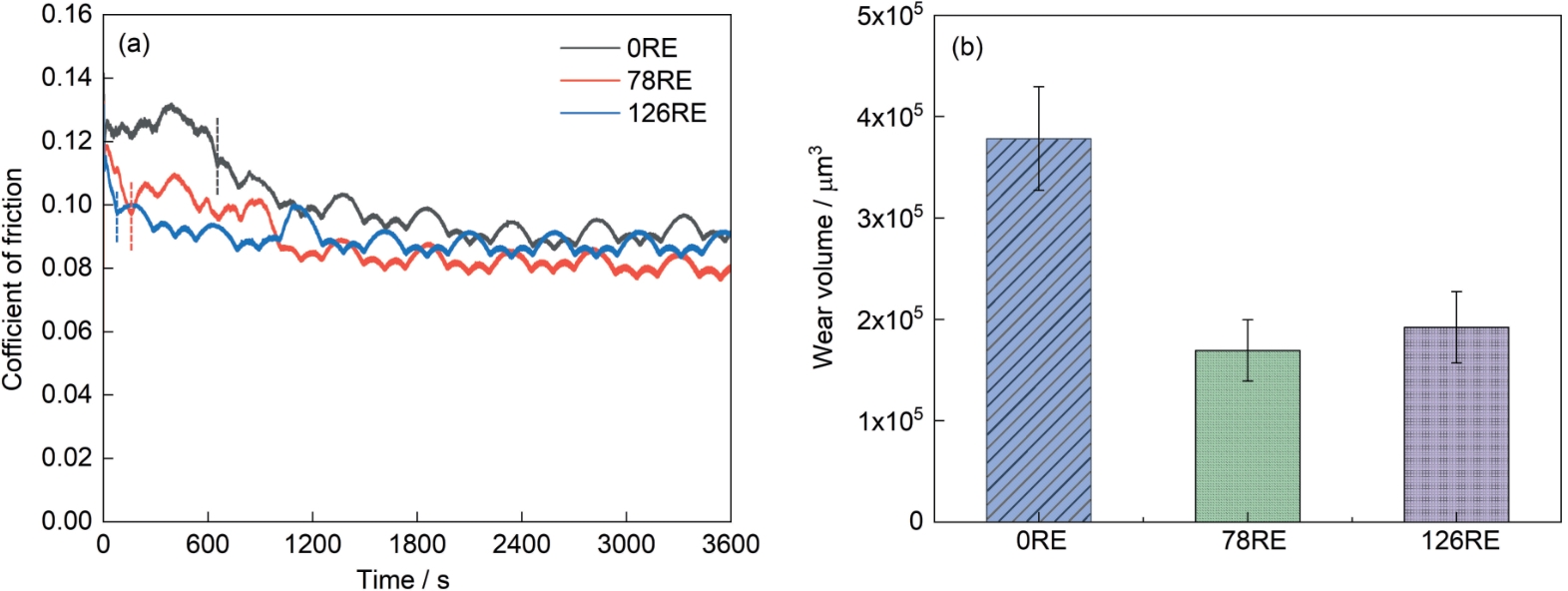
Abstract Heavy-duty gears used in rail transit and wind power sectors often require carburizing treatment to enhance their wear resistance during service. However, conventional carburizing processes face certain limitations in improving efficiency. Studies have shown when the rare earth (RE) elements are involved in some way, the carburizing atmosphere may be modified, thus increase the carburizing efficiency, and further enhance the wear resistance of the steels. Nevertheless, most existing research has focused on introducing exogenous RE elements into the steel surface during the carburizing process, while the effect of RE addition during steelmaking on the wear resistance of carburized gear steel remains insufficiently explored. In this study, 18CrNiMo7-6 gear steels with different Ce addition were prepared and subjected successively to heat treating at 1150 oC for 6 h, forging at 900 oC to 1150 oC, normalizing treatment at 880 oC for 2 h and followed by carburizing, quenching and tempering etc. Then the effect of RE addition on their friction and wear behavior was characterized via oil-lubricated sliding wear tester, contact profilometry, white light interferometry, scanning electron microscopy, transmission electron microscopy, transmission Kikuchi diffraction, and X-ray photoelectron spectroscopy, in terms of the surface morphology, subsurface microstructure evolution, and oxide scale composition on wear tracks. The results indicate that Ce addition can effectively mitigate the abrasive wear and improve the friction and wear behavior of the carburized gear steels during the steady-state wear stage, transforming the wear mechanism from a coexistence of abrasive wear and oxidative wear to oxidative wear-dominated mechanism, thereby significantly enhancing the wear resistance of carburized gear steel. Compared with carburized gear steel without RE, the wear volume of the carburized gear steels with 0.0078%Ce and 0.0126%Ce (mass fraction) is reduced by 55.3% and 49.2%, respectively. The improved wear resistance after Ce addition may be attributed to the increased hardness of the carburized layer and the modification of inclusion in the steels. The low surface hardness of the steel without RE may facilitate severe abrasive wear and pronounced subsurface plastic deformation, which readily leads to oxide scale fragmentation. Ce addition may be conductive to increasing the surface hardness of carburized gear steels, alleviating the subsurface plastic deformation, facilitating the formation of compact oxide scale, and consequently enhancing the oxidative wear resistance. Nevertheless, with the increasing Ce content, the continuously increased surface hardness results in further suppression of subsurface deformation, and there exists an increase in inclusion population and size. These two factors lead to the formation of thin, discontinuously distributed oxide scales, thereby compromising the wear resistance.
|
|
Received: 06 March 2026
|
|
|
| Fund: National Major Science and Technology Project of China(2025ZD0617900);National Natural Science Foundation of China(52404354);National Natural Science Foundation of China(52501193) |
Corresponding Authors:
YANG Chaoyun, Tel: (024) 23971973, E-mail: cyyang14s@imr.ac.cn;
LUAN Yikun, Tel: (024) 23971973, E-mail: ykluan@imr.ac.cn
|
| [1] |
Zhang Y X, Liu M, Han J Y, et al. Hard-turning-induced surface integrity and fatigue performance of 18CrNiMo7-6 steel for V-notched specimens[J]. Precis. Eng., 2026, 97: 268
doi: 10.1016/j.precisioneng.2025.09.016
|
| [2] |
Sakundarini N, Taha Z, Abdul-Rashid S H, et al. Optimal multi-material selection for lightweight design of automotive body assembly incorporating recyclability[J]. Mater. Des., 2013, 50: 846
doi: 10.1016/j.matdes.2013.03.085
|
| [3] |
Fu P, Jiang C H, Ji V. Microstructural evolution and mechanical response of the surface of 18CrNiMo7-6 steel after multistep shot peening during annealing[J]. Mater. Trans., 2013, 54: 2180
doi: 10.2320/matertrans.M2013287
|
| [4] |
Chen T M, Zhu C C, Chen J X, et al. A review on gear scuffing studies: Theories, experiments and design[J]. Tribol. Int., 2024, 196: 109741
doi: 10.1016/j.triboint.2024.109741
|
| [5] |
Qiu Z K. A study on preparation and tribological behavior of W-Mo coating on gear steel[D]. Nanjing: Nanjing University of Aeronautics and Astronautics, 2016
|
|
邱中凯. 齿轮钢表面W-Mo涂层的制备及摩擦磨损性能研究[D]. 南京: 南京航空航天大学, 2016
|
| [6] |
Wu Z H, Li Z X, Zhang Q Y, et al. Effect of microstructure on wear resistance during high temperature carburization heat treatment of heavy-duty gear steel[J]. Mater. Today Commun., 2024, 40: 109486
|
| [7] |
Gao M L, Zeng R, Hu J H, et al. Further enhancement of surface mechanical properties of carburized 9310 steel by electropulsing-assisted ultrasonic surface rolling process[J]. Surf. Coat. Technol., 2024, 480: 130593
doi: 10.1016/j.surfcoat.2024.130593
|
| [8] |
Qin S W, Chen W B, Wang L X, et al. Comprehensive enhancement of mechanical properties for 18CrNiMo7-6 carburizing steel: integration of carburizing and quenching-partitioning-tempering processes[J]. Int. J. Fatigue, 2025, 201: 109212
doi: 10.1016/j.ijfatigue.2025.109212
|
| [9] |
Jiang B, Mei Z, Zhou L Y, et al. High toughness and multiphase microstructure transition product of carburizing steel by a novel heat treatment cooling process[J]. Mater. Sci. Eng., 2016, 675A: 361
|
| [10] |
Tang L N, Yan M F. Microstructure and mechanical properties of surface layers of 30CrMnSiA steel plasma nitrocarburized with rare earth addition[J]. J. Rare Earths, 2012, 30(12): 1281
doi: 10.1016/S1002-0721(12)60221-X
|
| [11] |
Fang Y L, Men B X, Liu R L, et al. The effect of rare earth on microstructure and wear resistance of plasma electrolytic carburizing layer on 17-4PH stainless steel[J]. Mater. Today Commun., 2024, 39: 109118
|
| [12] |
Shi L, Cui X F, Li J, et al. Enhanced impact and wear properties of gear steel by supersonic fine particle bombardment modification technology[J]. Mater. Charact., 2022, 194: 112368
doi: 10.1016/j.matchar.2022.112368
|
| [13] |
Yu H X, Wang X H, Zhang J, et al. Cleanliness of alloying structural steel[J]. J. Iron Steel Res. Int., 2011, 18(12): 6
|
| [14] |
Yang C Y. Study on the influence mechanism of rare earth addition on inclusion-microstructure-properties of high carbon chromium bearing steel[D]. Hefei: University of Science and Technology of China, 2020
|
|
杨超云. 稀土对高碳铬轴承钢夹杂物-组织-性能的影响机理研究[D]. 合肥: 中国科学技术大学, 2020
|
| [15] |
Li D Z, Wang P, Chen X Q, et al. Low-oxygen rare earth steels[J]. Nat. Mater., 2022, 21(10): 1137
doi: 10.1038/s41563-022-01352-9
pmid: 36075967
|
| [16] |
Han J G, Wang K, Wang Z Q, et al. Tailoring the strength and low-temperature toughness of HSLA structural steel by adding trace Ce[J]. Mater. Today Commun., 2024, 40: 109789
|
| [17] |
Zhao Q C, Luo H, Pan Z M, et al. Study on mechanical properties of rare earth elements modified high carbon chromium bearing steel[J]. Mater. Today Commun., 2023, 34: 105329
|
| [18] |
He Y M, Fu Z H, Yang C Y, et al. Improving the impact toughness of heavy-duty gear steel by rare earth addition[J]. J. Mater. Res. Technol., 2026, 42: 9166
doi: 10.1016/j.jmrt.2026.05.034
|
| [19] |
Deng S J, Sun L M, Zhang Y Z. Development and current status of wear mechanisms[J]. Mech. Res. Appl., 2004, 17(6): 10
|
|
邓守军, 孙乐民, 张永振. 磨损机理的变迁与现状[J]. 机械研究与应用, 2004, 17(6): 10
|
| [20] |
Bonaventure J, Cayer-Barrioz J, Mazuyer D. Surface effects on boundary friction with additive-free lubricating films: Coupled influence of roughness and material properties[J]. Tribol. Lett., 2018, 66: 84
doi: 10.1007/s11249-018-1030-1
|
| [21] |
Wu F H, Jiang Z P, Liu Z J, et al. Analysis of influencing factors on the tribological behavior of 42CrMo4/17NiCrMo6-4 under grease lubrication[J]. Materials, 2023, 16(20): 6699
doi: 10.3390/ma16206699
|
| [22] |
Qi B Y, Wang M S, Sun K. Temperature-driven evolution of oxide films on MAX300 steel and corresponding wear behavior under high-speed friction[J]. Tribol. Int., 2025, 211: 110898
doi: 10.1016/j.triboint.2025.110898
|
| [23] |
De Oliveira M M, Costa H L, Silva W M, et al. Effect of iron oxide debris on the reciprocating sliding wear of tool steels[J]. Wear, 2019, 426-427: 1065
doi: 10.1016/j.wear.2018.12.047
|
| [24] |
Biesinger M C, Payne B P, Grosvenor A P, et al. Resolving surface chemical states in XPS analysis of first row transition metals, oxides and hydroxides: Cr, Mn, Fe, Co and Ni[J]. Appl. Surf. Sci., 2011, 257(7): 2717
doi: 10.1016/j.apsusc.2010.10.051
|
| [25] |
Xiao Z Y, Sheng L L, Wei X J, et al. In situ XPS analysis of fretting-induced tribo-chemical behavior in a pure iron[J]. China Surf. Eng., 2024, 37(2): 161
|
|
肖子玥, 盛亮亮, 魏雪娇 等. XPS原位分析纯铁微动磨损摩擦氧化行为[J]. 中国表面工程, 2024, 37(2): 161
doi: 10.11933/j.issn.1007-9289.20230329002
|
| [26] |
Yu X L, Jiang Z Y, Zhao J W, et al. The role of oxide-scale microtexture on tribological behaviour in the nanoparticle lubrication of hot rolling[J]. Tribol. Int., 2016, 93: 190
doi: 10.1016/j.triboint.2015.08.049
|
| [27] |
Chen K M, Wang S Q, Yang Z R, et al. High temperature wear and oxide film of steels[J]. Tribology, 2008, 28(5): 475
|
|
陈康敏, 王树奇, 杨子润 等. 钢的高温氧化磨损及氧化物膜的研究[J]. 摩擦学学报, 2008, 28(5): 475
|
| [28] |
Cui X H, Wang S Q, Wang F, et al. Research on oxidation wear mechanism of the cast steels[J]. Wear, 2008, 265(3-4): 468
doi: 10.1016/j.wear.2007.11.015
|
| [29] |
Wang Y, Zhang M, Jin J S, et al. Oxidation behavior of CoCrFeMnNi high entropy alloy after plastic deformation[J]. Corros. Sci., 2020, 163: 108285
doi: 10.1016/j.corsci.2019.108285
|
| No Suggested Reading articles found! |
|
|
Viewed |
|
|
|
Full text
|
|
|
|
|
Abstract
|
|
|
|
|
Cited |
|
|
|
|
| |
Shared |
|
|
|
|
| |
Discussed |
|
|
|
|