|
|
|
| Influence of Al+Ti on Microstructure and Mechanical Properties of a Ni-Cr-based Alloy |
ZHANG Fengzhi1,2, WU Yunsheng2, GUAN Xianjun2, HOU Jieshan2( ), ZHOU Lanzhang2 |
1.School of Materials Science and Engineering, University of Science and Technology of China, Shenyang 110016, China
2.Institute of Metal Research, Chinese Academy of Sciences, Shenyang 110016, China |
|
Cite this article:
ZHANG Fengzhi, WU Yunsheng, GUAN Xianjun, HOU Jieshan, ZHOU Lanzhang. Influence of Al+Ti on Microstructure and Mechanical Properties of a Ni-Cr-based Alloy. Chinese Journal of Materials Research, 2026, 40(9): 665-676.
|
|
|
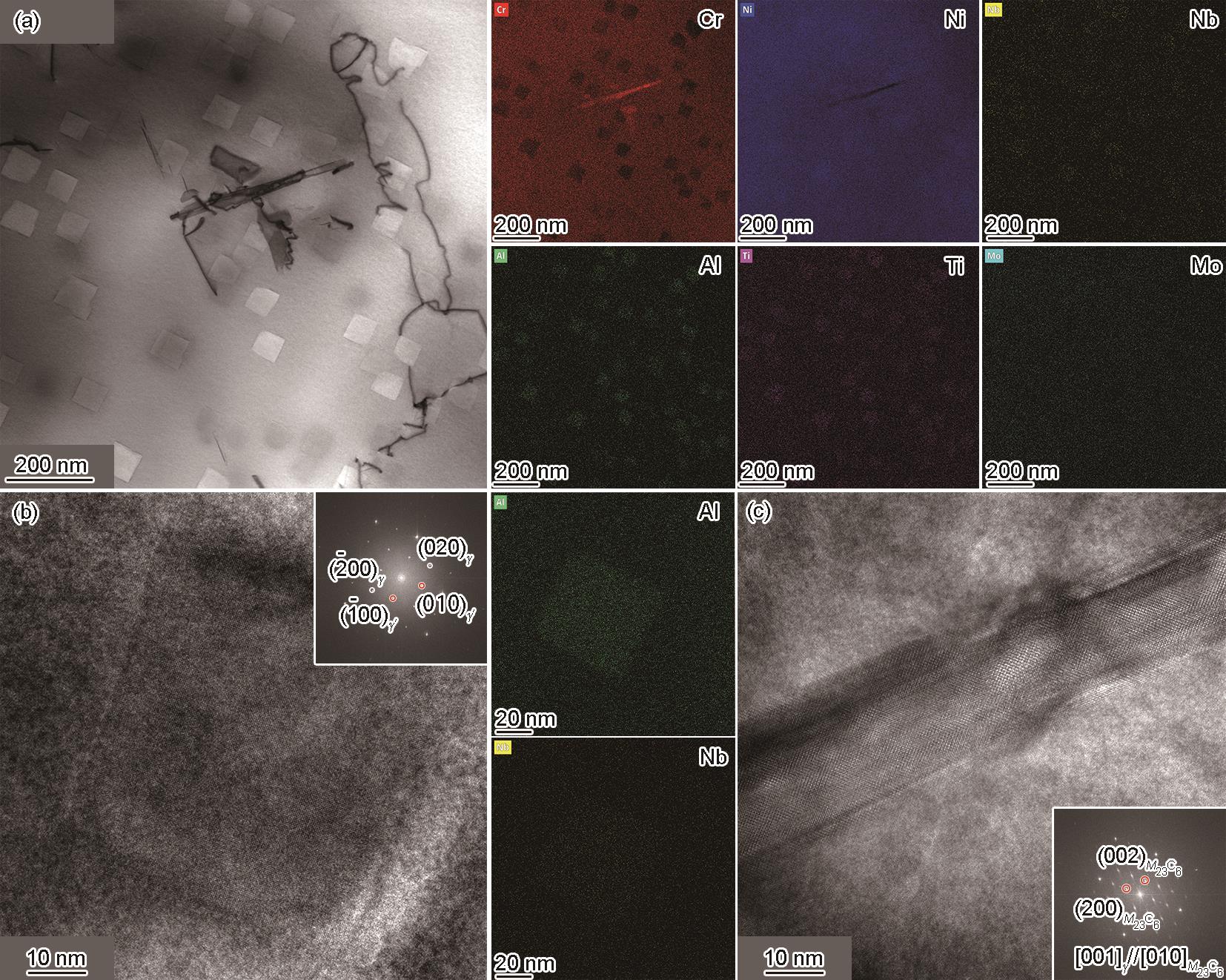
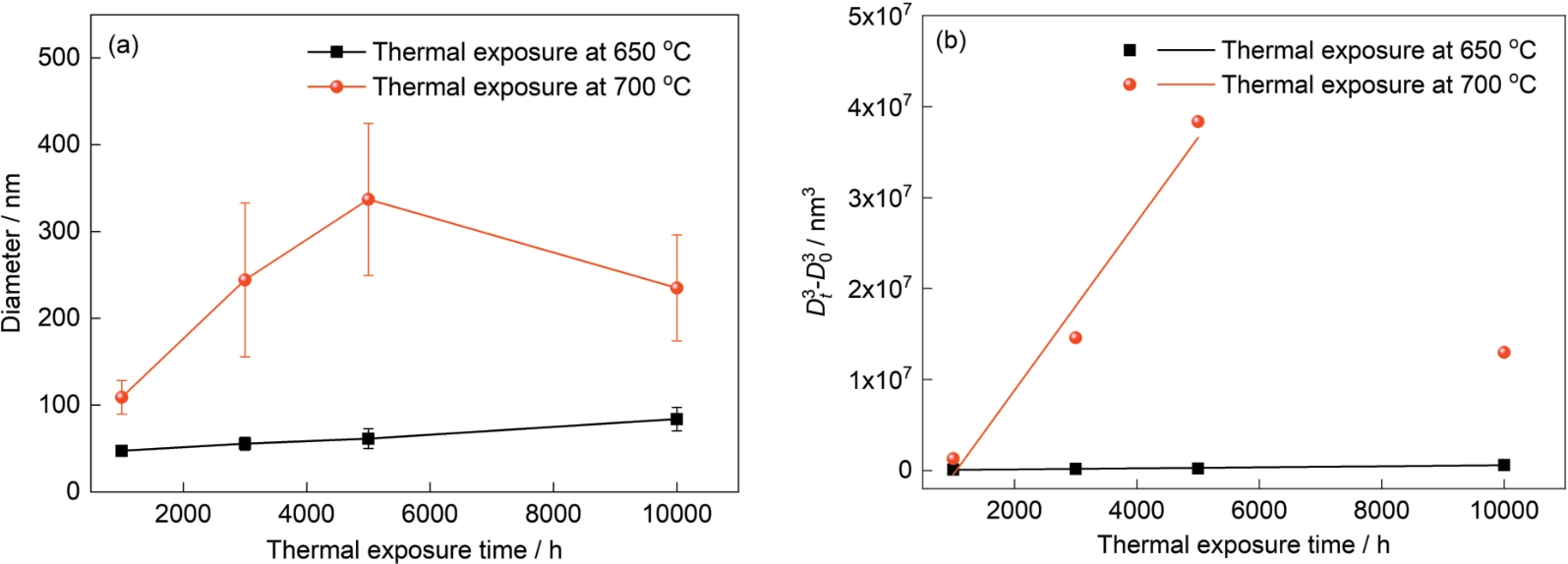
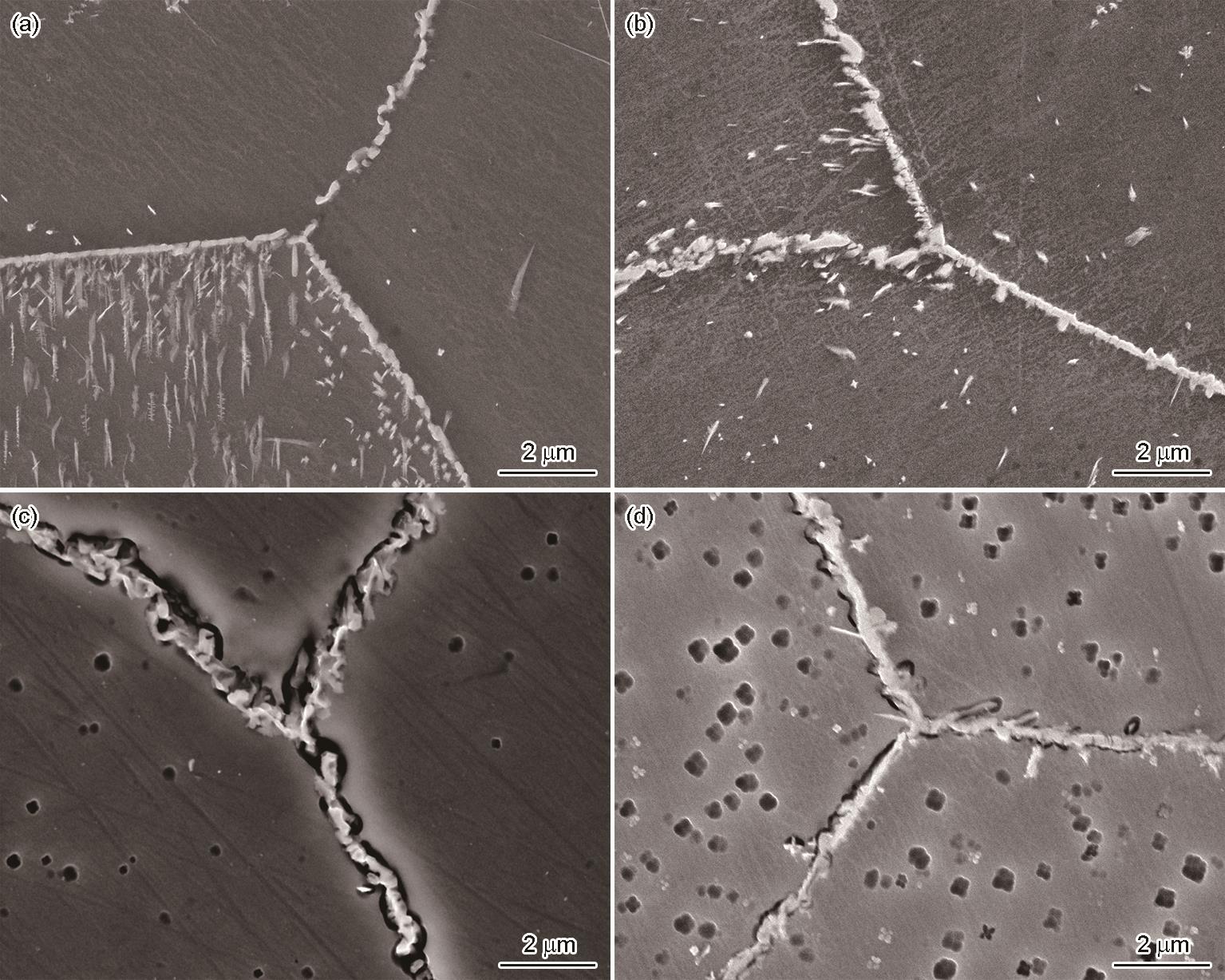
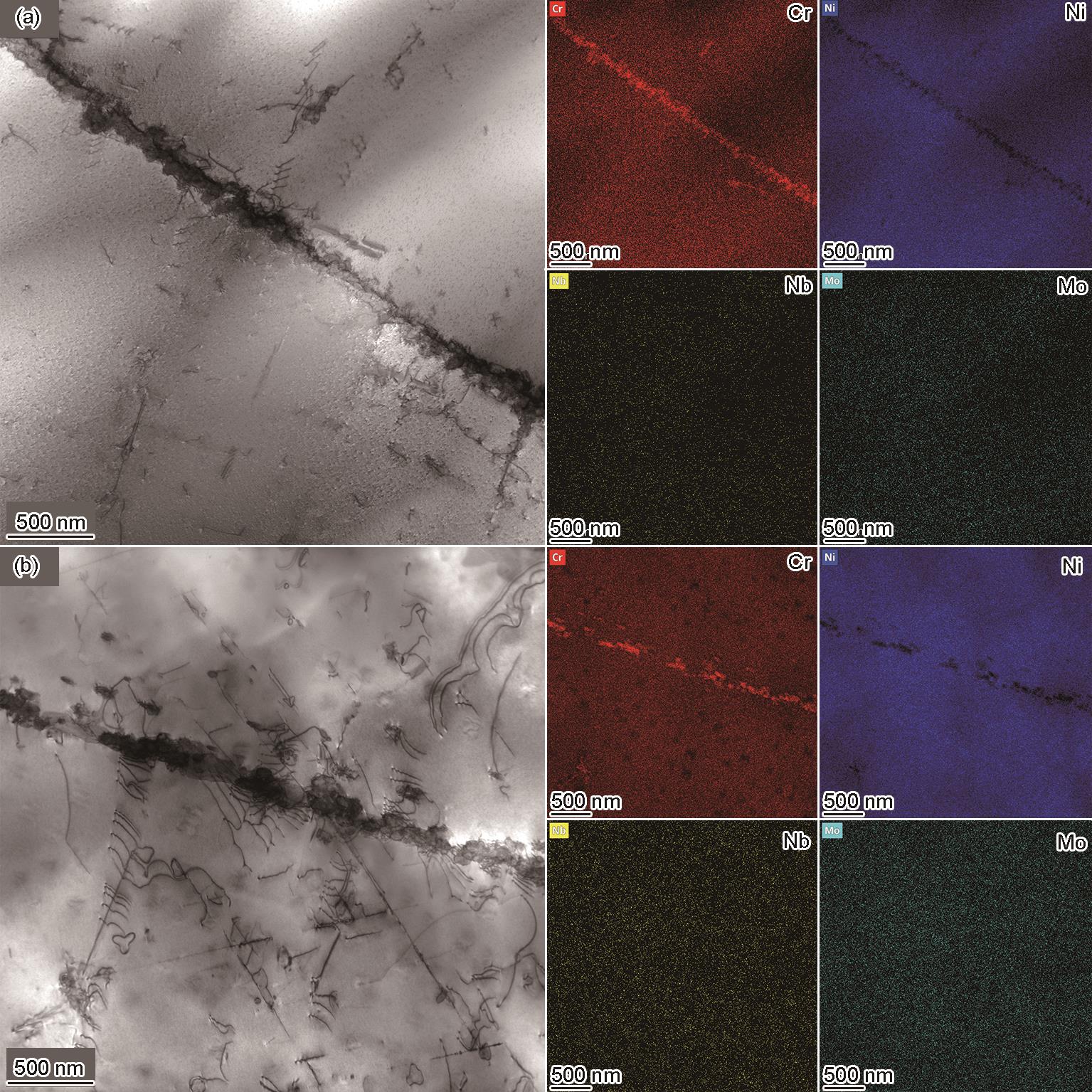
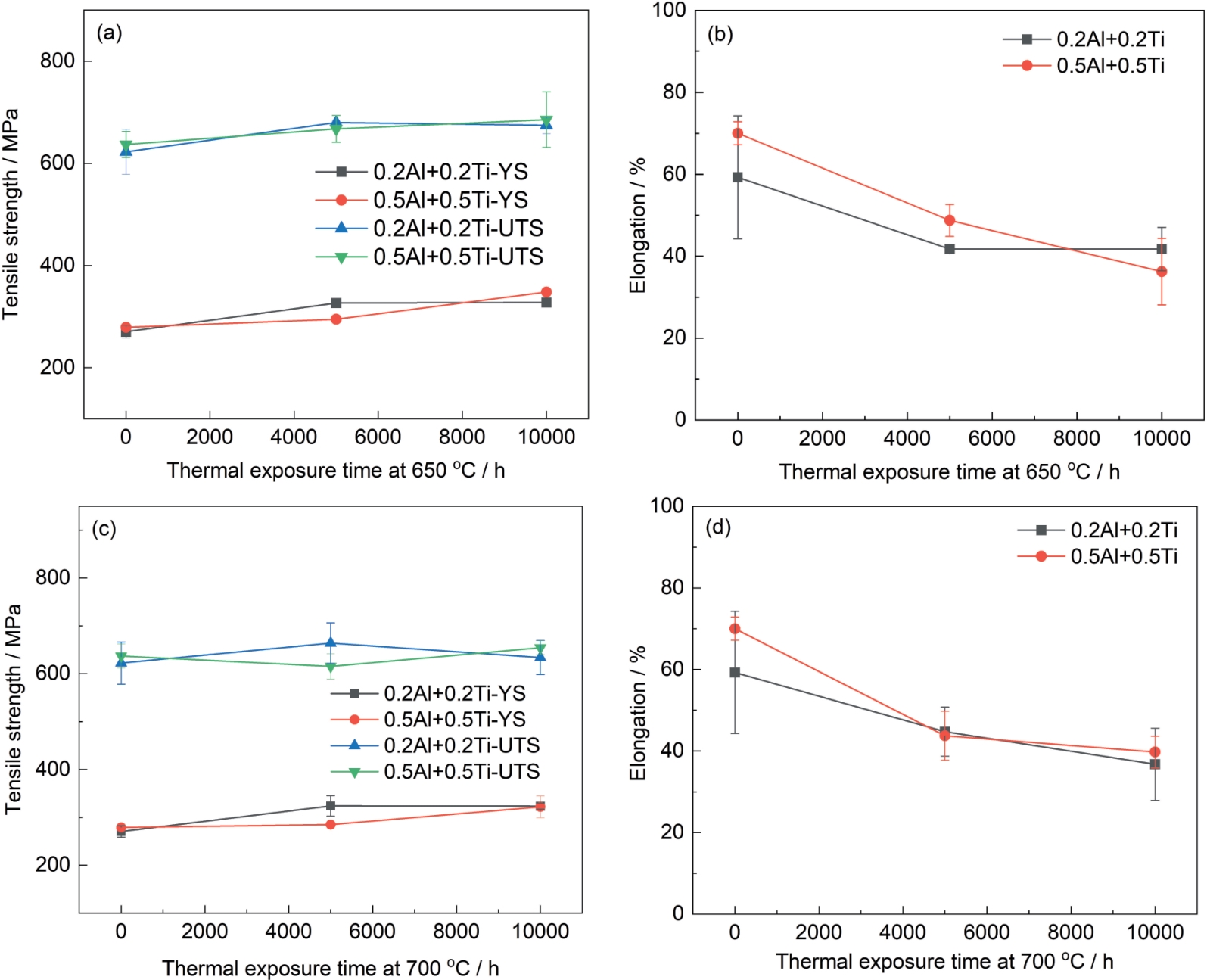
Abstract Two test alloys, based on a low Nb-containing solid solution-strengthened Ni-Cr-based alloy with addition of 0.2Al+0.2Ti or 0.5Al+0.5Ti, were made by vacuum melt-casting, and then subjected to solution treatment at 1200 oC for 1 h and water cooling, followed by long-term aging for 10,000 h at 650 oC and 700 oC respectively. Then the effect of the Al+Ti contents on the microstructure and mechanical properties of the test alloys was investigated through thermodynamic calculations, microstructural characterization, and mechanical testing. Results show that an increase in Al+Ti content reduces the solid-liquid phase transition temperature, narrows the solidification range, and promotes the segregation of Nb and Al elements. After long-term aging treatment, the main second phase is M23C6 carbides for the 0.2Al+0.2Ti alloy, whereas for the 0.5Al+0.5Ti alloy is mainly γ′-precipitates. With the increasing exposure time, the γ′-phase undergoes significant coarsening, and its morphology transforms from cubic to rounded square. The effect of Al+Ti content on solid solution strengthening is limited, and the strength difference between the two alloys remains insignificant even after aging treatment for 10000 h, although their strengthening mechanisms differ. In the 0.2Al+0.2Ti alloy, the fine and discretely distributed M23C6 carbides effectively enhance the alloy strength during thermal exposure. In contrast, in the 0.5Al+0.5Ti alloy, the larger γ′-phase turns to split after aging for 10000 h, leading to smaller in particle size while higher in quantity and density, thereby contributing to an increase in strength.
|
|
Received: 10 November 2025
|
|
|
| Fund: National Key Research and Development Program of China(2021YFB3704103) |
Corresponding Authors:
HOU Jieshan, Tel: (024)83978469, E-mail: jshou@imr.ac.cn
|
| [1] |
Ennis P J. Nickel-base alloys for advanced power plant components[A]. Shibli A. Coal Power Plant Materials and Life Assessment [M]. Cambridge: Woodhead Publishing, 2014: 147
|
| [2] |
Reed R C. The Superalloys: Fundamentals and Applications[M]. Cambridge: Cambridge University Press, 2008
|
| [3] |
Guo J T. Materials Science and Engineering for Superalloys[M]. Beijing: Science Press, 2008
|
|
郭建亭. 高温合金材料学[M]. 北京: 科学出版社. 2008
|
| [4] |
Jiang X L, Men Z X, Mou C H, et al. Research status and feasibility analysis of large nickel-based superalloy casting of 700 oC ultra-supercritical steam turbine operating[J]. Machinery, 2014, (3): 4
|
|
蒋新亮, 门正兴, 牟成海 等. 700 ℃超超临界机组大型高温合金铸件制造技术现状及可行性分析[J]. 机械, 2014, (3): 4
|
| [5] |
Zhao X B, Liu L, Yang C B, et al. Advance in research of casting defects of directionally solidified nickel-based single superalloys[J]. J. Mater. Eng., 2012, (1): 93
|
|
赵新宝, 刘 林, 杨初斌 等. 镍基单晶高温合金凝固缺陷研究进展[J]. 材料工程, 2012, (1): 93
|
| [6] |
Zhang J, Dai Y B, Ma J B, et al. Filling and solidification process control of large castings[A]. SunB D, Wang J, Shu D. Precision Forming Technology of Large Superalloy Castings for Aircraft Engines[M]. Singapore: Springer, 2021: 169
|
| [7] |
Zhang L, Wang L, Liu Y, et al. Hot cracking behavior of large size GH4742 superalloy vacuum induction melting ingot[J]. J. Iron Steel Res. Int., 2022, 29(9): 1505
doi: 10.1007/s42243-022-00767-7
|
| [8] |
Han F F, Li H, Lou L H. Effect of Ti/Al ratio on the microstructure and creep property in a directionally solidified Ni-base superalloy[J]. Chin. J. Mater. Res., 2012, 26(4): 361
|
|
韩汾汾, 李 辉, 楼琅洪. Ti/Al比对镍基定向高温合金组织和性能的影响[J]. 材料研究学报, 2012, 26(4): 361
|
| [9] |
Cheng S H, Wang J Q, Wu Y S, et al. The influences of Al/Ti ratio and Al+Ti content on microstructural and mechanical property stability of a Ni-Fe-Cr-based superalloy[J]. J. Mater. Res. Technol., 2025, 36: 4761
doi: 10.1016/j.jmrt.2025.04.153
|
| [10] |
Zhao Z, Dong J X, Zhang M C, et al. Microstructure and susceptibility to hot tearing of K424 nickel-based superalloys for turbocharger turbine wheels[J]. Chin. J. Eng., 2016, 38(10): 1429
|
|
赵 展, 董建新, 张麦仓 等. 增压涡轮用K424高温合金组织特征及热裂倾向性[J]. 工程科学学报, 2016, 38(10): 1429
|
| [11] |
Wang L Z, Zhang Y, Chen C Y, et al. Effect of Al and Ti addition on the characteristics of oxide inclusions in Ni-based superalloy[J]. Metall. Res. Technol., 2023, 120(2): 219
doi: 10.1051/metal/2023022
|
| [12] |
Wang J, Wang L Z, Li J Q, et al. Effects of aluminum and titanium additions on the formation of nonmetallic inclusions in nickel-based superalloys[J]. J. Alloy. Compd., 2022, 906: 164281
doi: 10.1016/j.jallcom.2022.164281
|
| [13] |
Bała P, Górecki K, Dziurka R, et al. The effect of Al and Ti additions on solid solution strengthening and precipitation hardening in CoNiFe medium-entropy alloys[J]. Materials, 2023, 16(18): 6297
doi: 10.3390/ma16186297
|
| [14] |
Ma Y C, Li Y, Ou M Q, et al. A review on microstructural stability regulation in nickel-based superalloys: synergistic effects of alloying elements and phase stability optimization[J]. J. Mater. Sci., 2025, 60: 9024
doi: 10.1007/s10853-025-10965-9
|
| [15] |
Wang C S, Wu Y S, Zhang F Z, et al. Influence of melt superheating treatment on solidification microstructure and mechanical properties of Ni-based superalloy GH742[J]. Rare Metal Mater. Eng., 2022, 51(11): 4270
|
|
王常帅, 吴云胜, 张丰之 等. 熔体超温处理对GH742返回料凝固组织和力学性能的影响[J]. 稀有金属材料与工程, 2022, 51(11): 4270
|
| [16] |
Cieslak M J, Headley T J, Romig A D, et al. A melting and solidification study of alloy 625[J]. Metall. Trans., 1988, 19A(9): 2319
|
| [17] |
Kurz W, Fisher D J, Rappaz M. Fundamentals of Solidification[M]. 5th ed. Switzerland: Trans Tech Publications Ltd, 2023
|
| [18] |
Xie X S, Dong J X, Wang G L, et al. The effect of Nb, Ti, Al on precipitation and strengthening behavior of 718 type superalloys[A]. Loria E A. Superalloys 718, 625, 706 and Derivatives 2005 [M]. Warrendale, Pa: TMS, 2005
|
| [19] |
Yoo Y S. Morphological instability of spherical γ′ precipitates in a nickel base superalloy[J]. Scr. Mater., 2005, 53(1): 81
doi: 10.1016/j.scriptamat.2005.03.022
|
| [20] |
Baldan A. Review progress in Ostwald ripening theories and their applications to the γ′-precipitates in nickel-base superalloys Part II Nickel-base superalloys[J]. J. Mater. Sci, 2002, 37(12): 2379
doi: 10.1023/A:1015408116016
|
| [21] |
Doi M, Miyazaki T, Wakatsuki T. The effects of elastic interaction energy on the γ′ precipitate morphology of continuously cooled nickel-base alloys[J]. Mater. Sci. Eng., 1985, 74(2): 139
doi: 10.1016/0025-5416(85)90427-6
|
| No Suggested Reading articles found! |
|
|
Viewed |
|
|
|
Full text
|
|
|
|
|
Abstract
|
|
|
|
|
Cited |
|
|
|
|
| |
Shared |
|
|
|
|
| |
Discussed |
|
|
|
|