|
|
|
| Effect of Laser Shock Peening on Microstructure and Wear Resistance of AlxCoCrFeNi High Entropy Alloy Laser Cladding Layer |
LIU Zhihui1, ZHANG Shiyi1( ), ZOU Aihua1, ZHANG Kaiyao2, ZENG Zhuo1, ZHANG Shiyi1, TU Jiajian1, YAN Xu1 |
1.School of Materials Science and Engineering, Nanchang Hangkong University, Nanchang 330063, China
2.China Aerospace Transmission Machinery Co., Ltd., Changsha 410200, China |
|
Cite this article:
LIU Zhihui, ZHANG Shiyi, ZOU Aihua, ZHANG Kaiyao, ZENG Zhuo, ZHANG Shiyi, TU Jiajian, YAN Xu. Effect of Laser Shock Peening on Microstructure and Wear Resistance of AlxCoCrFeNi High Entropy Alloy Laser Cladding Layer. Chinese Journal of Materials Research, 2026, 40(9): 710-720.
|
|
|
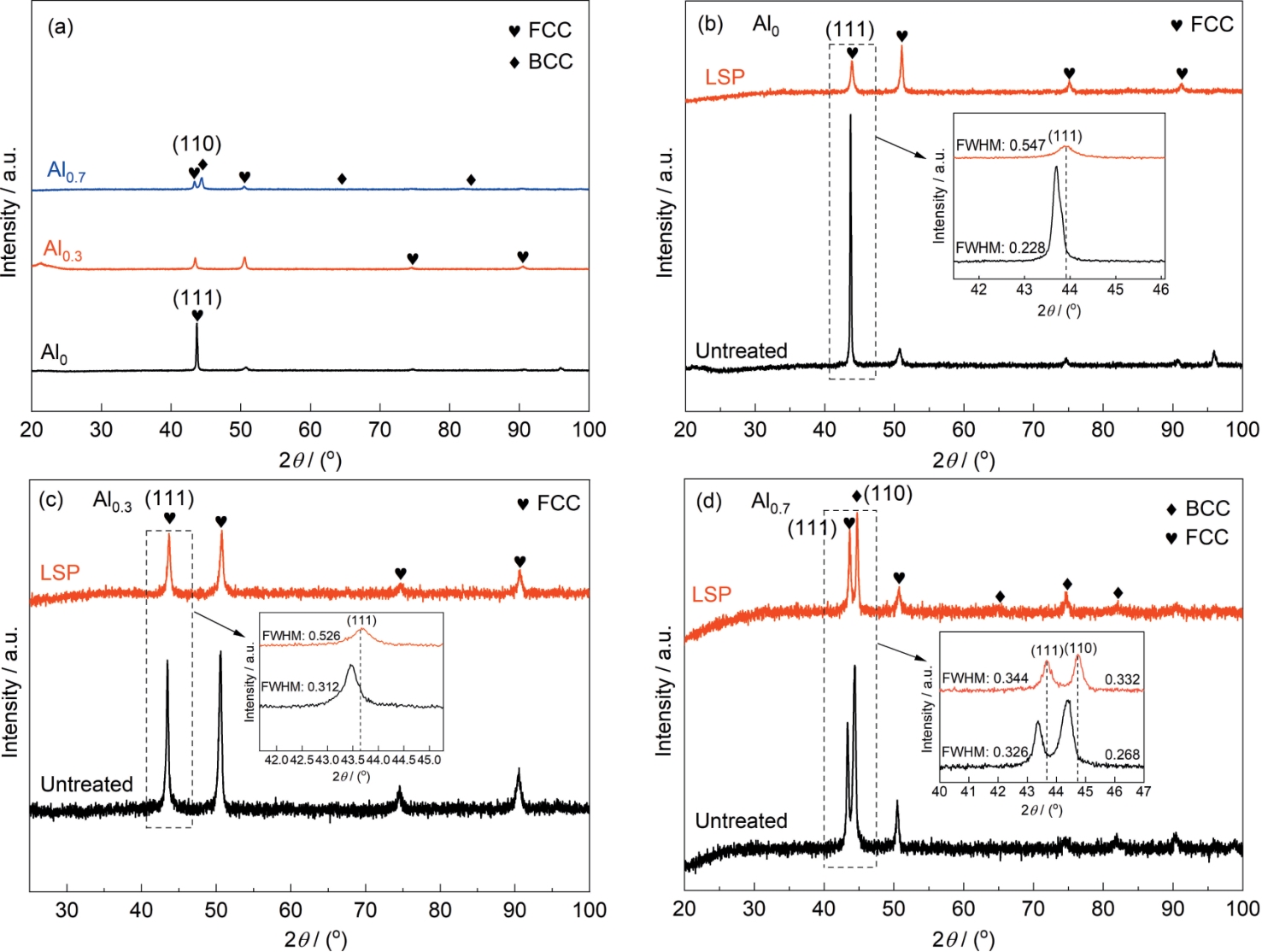
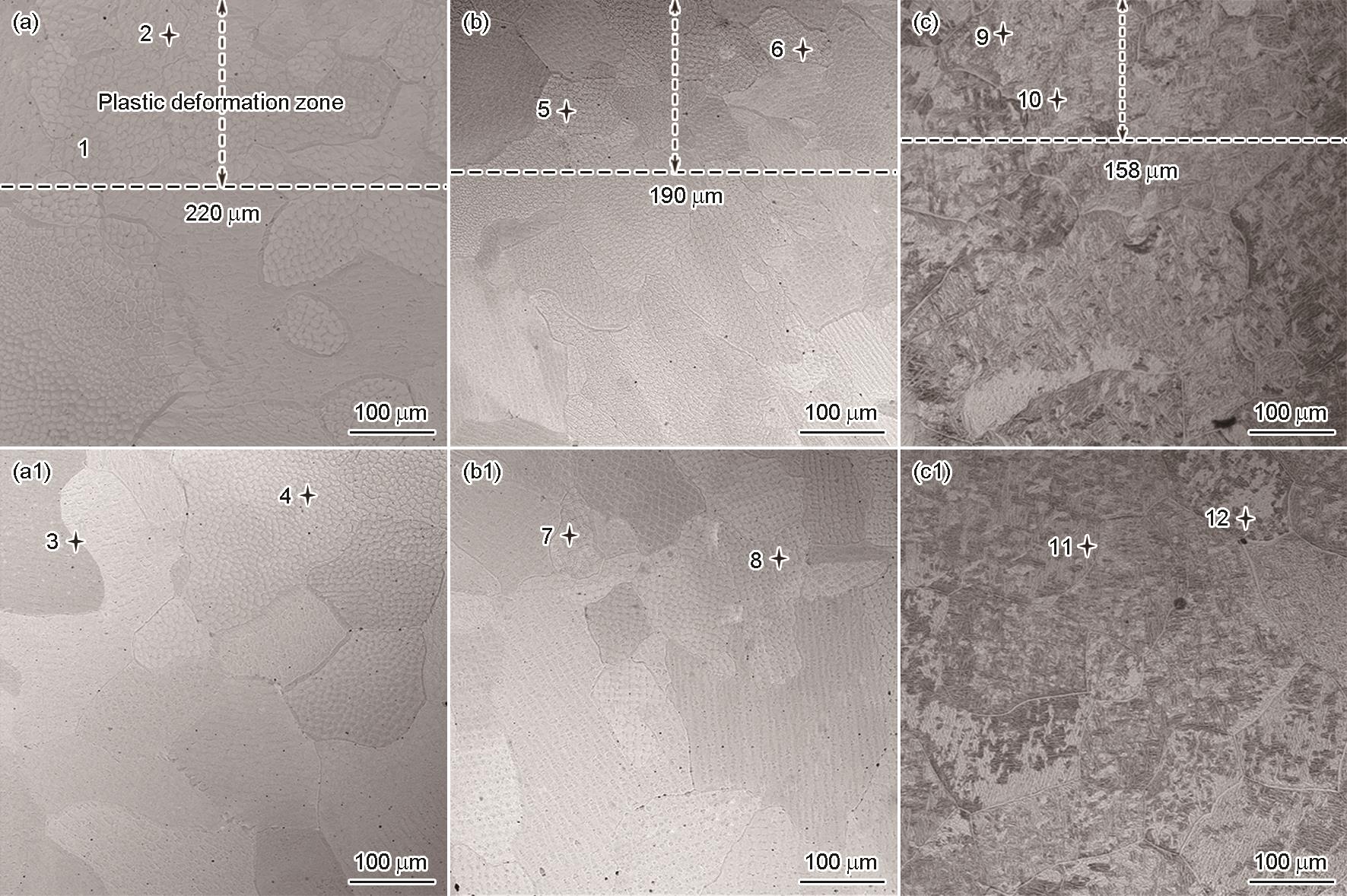
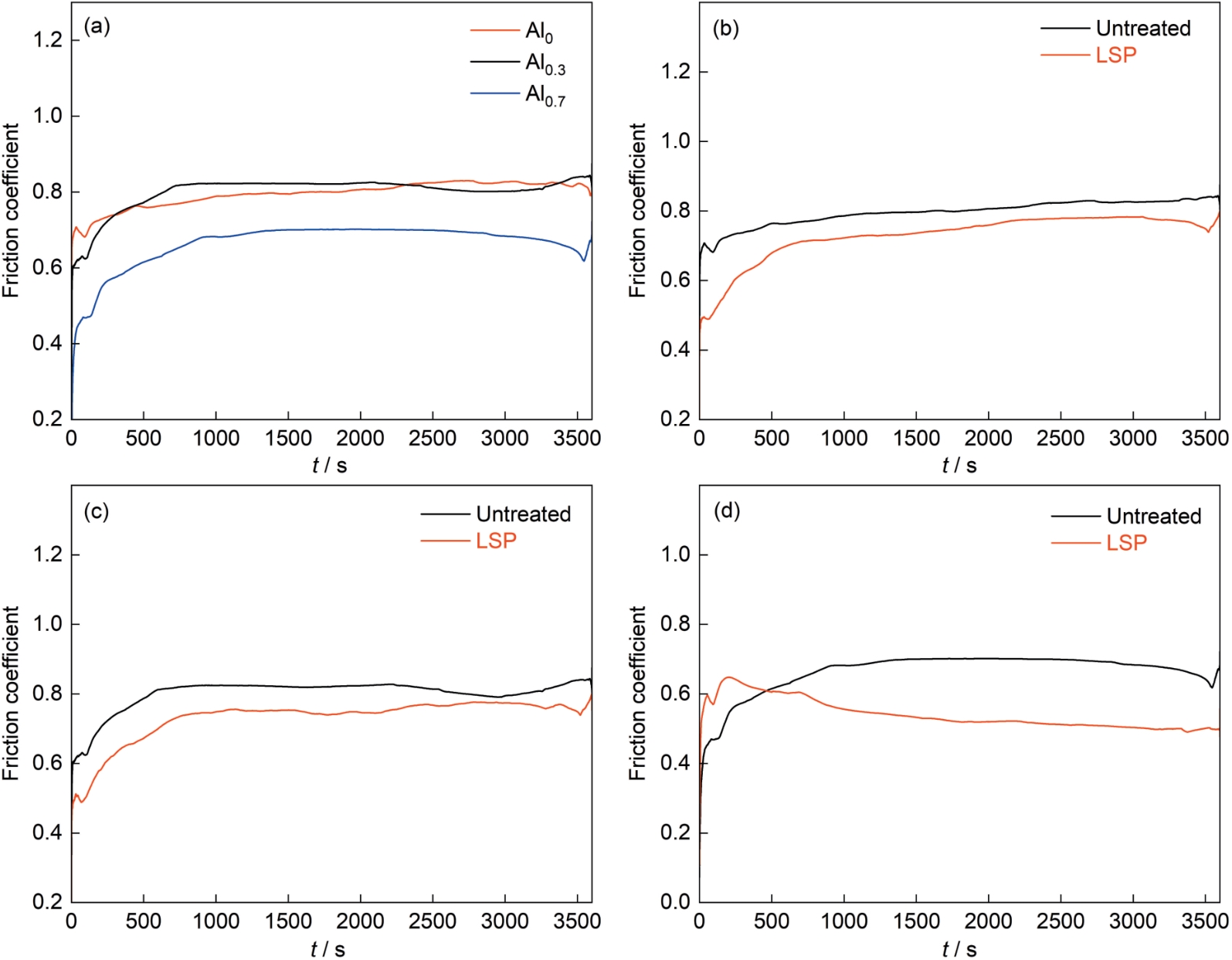
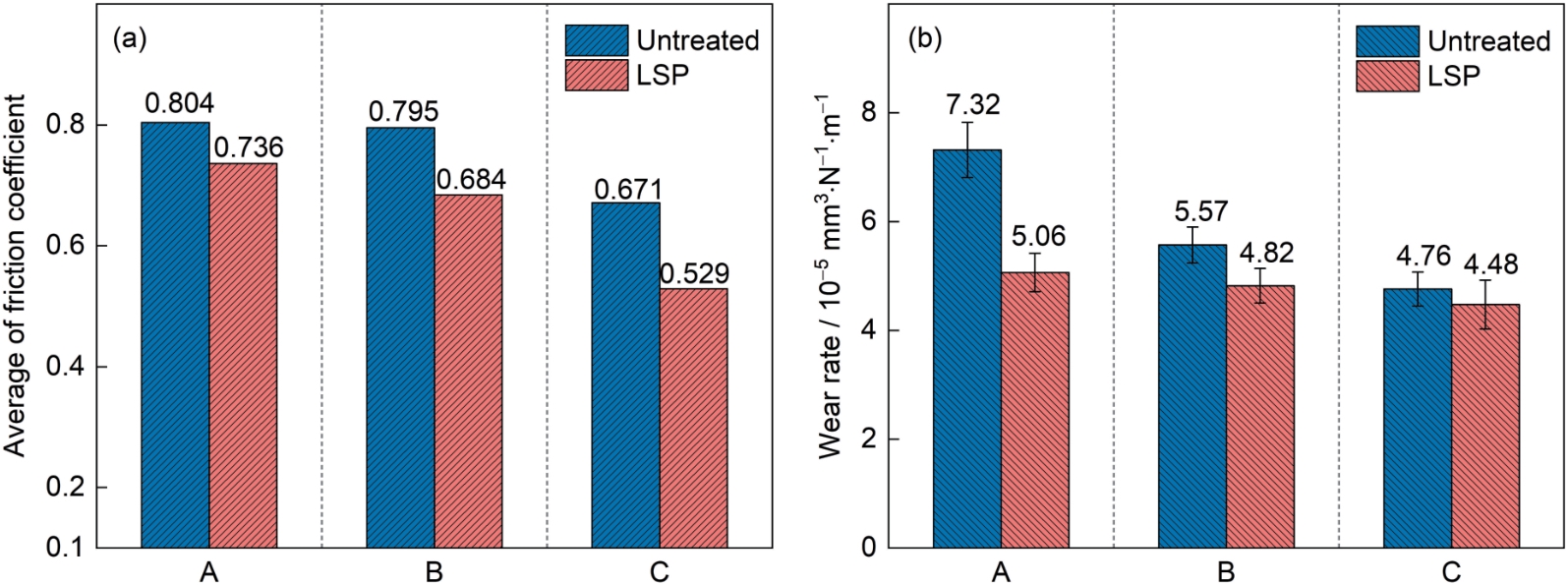
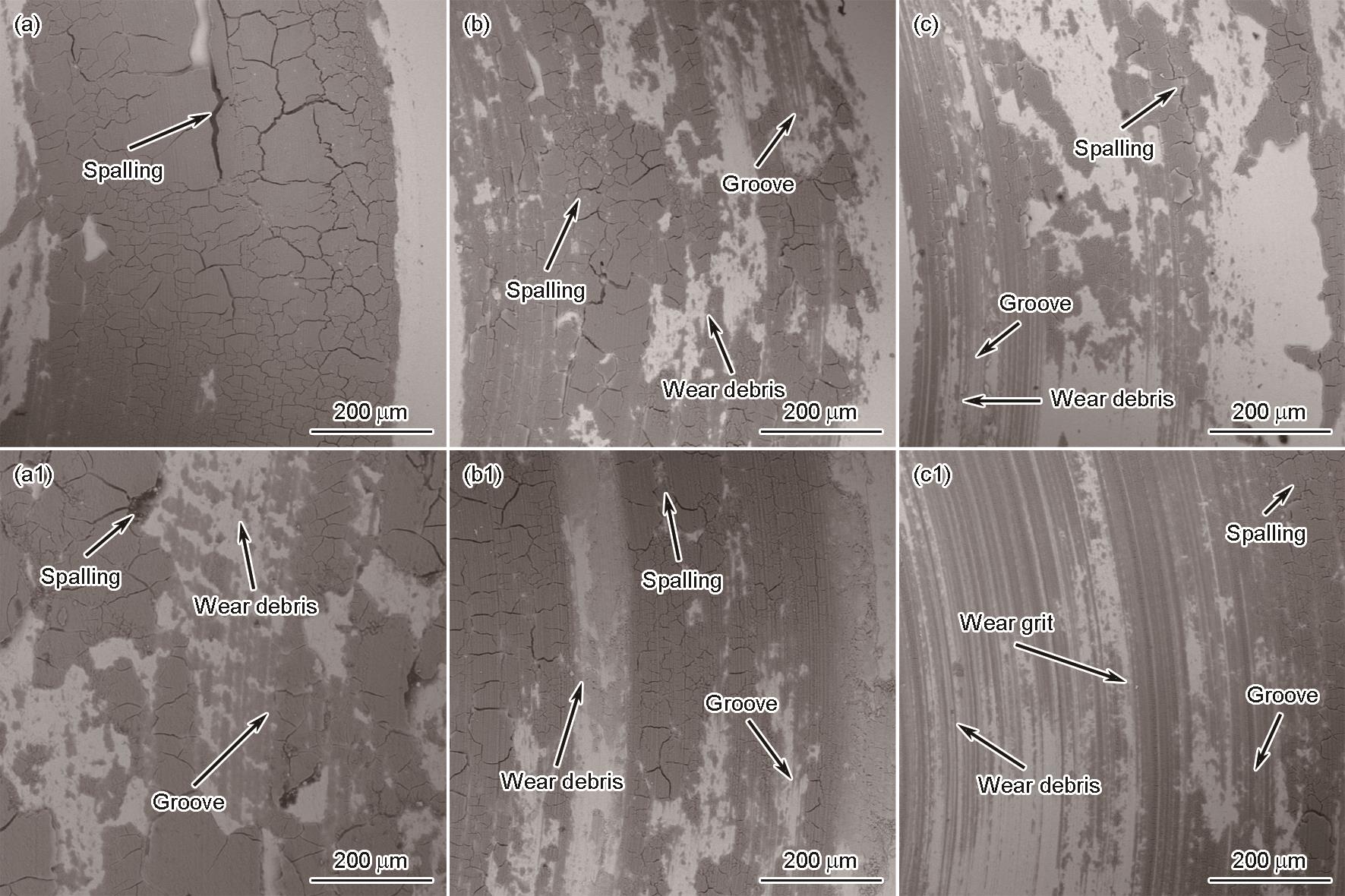
Abstract To investigate the strengthening effect of laser shock processing on AlxCoCrFeNi (x = 0, 0.3, and 0.7) cladding layers with different Al contents, AlxCoCrFeNi (x = 0, 0.3, and 0.7) high-entropy alloy layers were prepared on the surface of a 304 stainless steel substrate by laser cladding and subsequently subjected to laser shock processing for strengthening. The phase composition, microstructure, element distribution, microhardness, and wear resistance of the cladding layer were characterized before and after laser shock processing. The results showed that the phase composition of the AlxCoCrFeNi cladding layer remained unchanged after laser shock processing. A plastic deformation zone (impact-affected zone) was observed in the upper part of the cladding layer. With increasing Al content, the phase of the cladding layer transitioned from single-phase FCC (Al0 and Al0.3) to FCC+BCC (Al0.7), and the cladding layer was composed of columnar crystals at the bottom and equiaxed crystals in the middle and upper parts. The hardness of the cladding layers (x = 0, 0.3, and 0.7) increased by 53.9%, 42.1%, and 25.8%, respectively. Both the wear rate and friction coefficient decreased accordingly. At x = 0.7, the optimal wear resistance was achieved, with the wear rate reaching a minimum of 4.29 × 10⁻⁵ mm3/(N·m) and the friction coefficient reaching 0.542. The main wear mechanisms of the cladding layers at x = 0 and x = 0.3 were adhesive and abrasive wear. At x = 0.7, the wear mechanism remained dominated by abrasive wear, while the cracks and spalling on the worn surface decreased.
|
|
Received: 05 February 2026
|
|
|
| Fund: Jiangxi Provincial Natural Science Foundation(20262BAC240202);Chongqing Industrial Online Inspection Equipment Engineering Technology Research Center Open Fund(AWJ-23R03) |
Corresponding Authors:
ZHANG Shiyi, Tel: 15564864041, E-mail: zsy4141@126.com
|
| [1] |
Yeh J W, Chen S K, Lin S J, et al. Nanostructured high-entropy alloys with multiple principal elements: novel alloy design concepts and outcomes[J]. Adv. Eng. Mater., 2004, 6(5): 299
doi: 10.1002/adem.v6:5
|
| [2] |
Otto F, Yang Y, Bei H, et al. Relative effects of enthalpy and entropy on the phase stability of equiatomic high-entropy alloys[J]. Acta Mater., 2013, 61(7): 2628
doi: 10.1016/j.actamat.2013.01.042
|
| [3] |
Tsai M H, Yeh J W. High-entropy alloys: a critical review[J]. Mater. Res. Lett., 2014, 2(3): 107
doi: 10.1080/21663831.2014.912690
|
| [4] |
Cantor B, Chang I T H, Knight P, et al. Microstructural development in equiatomic multicomponent alloys[J]. Mater. Sci. Eng., 2004, 375-377A: 213
|
| [5] |
Zhang Y, Peng W J. Microstructural control and properties optimization of high-entrop alloys[J]. Procedia Eng., 2012, 27: 1169
doi: 10.1016/j.proeng.2011.12.568
|
| [6] |
Balaji V, Xavior M A. Development of high entropy alloys (HEAs): current trends[J]. Heliyon, 2024, 10(7): e26464
doi: 10.1016/j.heliyon.2024.e26464
|
| [7] |
Brif Y, Thomas M, Todd I. The use of high-entropy alloys in additive manufacturing[J]. Scr. Mater., 2015, 99: 93
doi: 10.1016/j.scriptamat.2014.11.037
|
| [8] |
Pickering E J, Carruthers A W, Barron P J, et al. High-entropy alloys for advanced nuclear applications[J]. Entropy, 2021, 23(1): 98
doi: 10.3390/e23010098
|
| [9] |
Liu Y X, Liu H X, Chen Y, et al. Microstructure and high-temperature wear behavior of TiZrNbAlx light-weight refractory high-entropy alloy coatings prepared by laser cladding on Ti6Al4V titanium alloy[J]. Surf. Coat. Technol., 2025, 512: 132297
doi: 10.1016/j.surfcoat.2025.132297
|
| [10] |
Liu S J, Wang Y, Deng M, et al. Mechanical properties and high temperature structure evolution of FeCrAlMoNb high entropy alloy coatings with different Mo contents for accident tolerant fuel cladding[J]. Intermetallics, 2025, 179: 108670
doi: 10.1016/j.intermet.2025.108670
|
| [11] |
Liu H, Xu Q S, Wang L W, et al. Microstructure and wide temperature range tribological properties of CoCrFeNiTi high-entropy alloy coating by laser cladding[J]. J. Mater. Eng. Perform., 2025, 34(2): 1515
doi: 10.1007/s11665-024-09142-x
|
| [12] |
Gelchinski B R, Balyakin I A, Yuryev A A, et al. High-entropy alloys: properties and prospects of application as protective coatings[J]. Russian Chem. Rev., 2022, 91(6): RCR5023
|
| [13] |
Liu Y, Ding Y, Yang L, et al. Research and progress of laser cladding on engineering alloys: a review[J]. J. Manuf. Process., 2021, 66: 341
doi: 10.1016/j.jmapro.2021.03.061
|
| [14] |
Li X, Zhang H, Zhao W, et al. Microstructure and properties of CoCrFeNiAlx Mo2- x high-entropy alloy coating by laser cladding[J]. Intermetallics, 2024, 166: 108169
doi: 10.1016/j.intermet.2023.108169
|
| [15] |
Prakash O, Chandrakar R, Martin L, et al. Laser cladding technology for high entropy alloys: effect and applications[J]. Mater. Res. Express, 2024, 11(9): 096510
|
| [16] |
Wu Y Z, Li Z D, Kong C, et al. Twinning- and transformation-induced high cryogenic strength and ductility of the CoCrFeNi high-entropy alloy: experiment and MD simulation[J]. Int. J. Plast., 2026, 196: 104553
doi: 10.1016/j.ijplas.2025.104553
|
| [17] |
Zhang F L, Chen X M, Liu H, et al. Recent developments in CoCrFeNi-based high entropy alloy coatings: design, synthesis, and properties[J]. J. Alloy. Compd., 2025, 1018: 179193
doi: 10.1016/j.jallcom.2025.179193
|
| [18] |
Tian Z G, Li X M, Qin Z, et al. Microstructure and wear resistance of CoCrFeNiTi x high entropy alloy coating[J]. Chin. J. Mater. Res., 2023, 37(3): 219
|
|
田志刚, 李新梅, 秦 忠 等. CoCrFeNiTi x 高熵合金涂层的显微组织和耐磨性能[J]. 材料研究学报, 2023, 37(3): 219
doi: 10.11901/1005.3093.2021.428
|
| [19] |
Zhu J, Lu K F, Hui X D, et al. Roles of Al on microstructures, mechanical properties and oxidation resistances of FCC AlxCoCrNiFe high entropy alloy coatings prepared by laser directed energy deposition[J]. Mater. Sci. Eng., 2025, 922A: 147626
|
| [20] |
Deng W W, Wang C Y, Lu H F, et al. Progressive developments, challenges and future trends in laser shock peening of metallic materials and alloys: a comprehensive review[J]. Int. J. Mach. Tools Manuf., 2023, 191: 104061
doi: 10.1016/j.ijmachtools.2023.104061
|
| [21] |
Munusamy S, Jerald J. Impact of laser shock peening on mechanical properties of wire arc additive manufactured grade 91 Steel and monel-400 bimetallic components[J]. Met. Mater. Int., 2025, 31(1): 36
doi: 10.1007/s12540-024-01722-9
|
| [22] |
Zhang H P, Cai Z Y, Chi J X, et al. Microstructural evolution, mechanical behaviors and strengthening mechanism of 300 M steel subjected to multi-pass laser shock peening[J]. Opt. Laser Technol., 2022, 148: 107726
doi: 10.1016/j.optlastec.2021.107726
|
| [23] |
Fu W J, Huang Y J, Sun J F, et al. Strengthening CrFeCoNiMn0.75Cu0.25 high entropy alloy via laser shock peening[J]. Int. J. Plast., 2022, 154: 103296
doi: 10.1016/j.ijplas.2022.103296
|
| [24] |
Tong Z P, Liu H L, Jiao J F, et al. Microstructure, microhardness and residual stress of laser additive manufactured CoCrFeMnNi high-entropy alloy subjected to laser shock peening[J]. J. Mater. Process. Technol., 2020, 285: 116806
doi: 10.1016/j.jmatprotec.2020.116806
|
| [25] |
Deng R, Wei R Z, Zhang Y C, et al. Investigation of variable-temperature wear characteristics of austenitic stainless steel coatings fabricated via laser energy deposition[J]. Wear, 2025, 572: 205993
|
| [26] |
Zhang Q, Wang Q, Han B, et al. Comparative studies on microstructure and properties of CoCrFeMnNi high entropy alloy coatings fabricated by high-speed laser cladding and normal laser cladding[J]. J. Alloy. Compd., 2023, 947: 169517
doi: 10.1016/j.jallcom.2023.169517
|
| [27] |
Dai F Z, Pei Z P, Ren X D, et al. Effects of different contact film thicknesses on the surface roughness evolution of LY2 aluminum alloy milled surface subjected to laser shock wave planishing[J]. Surf. Coat. Technol., 2020, 403: 126391
doi: 10.1016/j.surfcoat.2020.126391
|
| [28] |
Wu J J, Zhao J B, Qiao H C, et al. The new technologies developed from laser shock processing[J]. Materials, 2020, 13(6): 1453
doi: 10.3390/ma13061453
|
| [29] |
Lin C M, Juan C C, Chang C H, et al. Effect of Al addition on mechanical properties and microstructure of refractory Alx HfNbTaTiZr alloys[J]. J. Alloy. Compd., 2015, 624: 100
doi: 10.1016/j.jallcom.2014.11.064
|
| [30] |
Feng M Y, Lin T X, Lian G F, et al. Effects of Nb content on the microstructure and properties of CoCrFeMnNiNb x high-entropy alloy coatings by laser cladding[J]. J. Mater. Res. Technol., 2024, 28: 3835
doi: 10.1016/j.jmrt.2024.01.002
|
| [31] |
Cao X D, Wu J J, Xu Y Z, et al. Microstructural evolution and wear resistance improvement of laser additive-manufactured 316L stainless steel subject to laser shock processing[J]. Surf. Technol., 2026, 55(2): 112
|
| No Suggested Reading articles found! |
|
|
Viewed |
|
|
|
Full text
|
|
|
|
|
Abstract
|
|
|
|
|
Cited |
|
|
|
|
| |
Shared |
|
|
|
|
| |
Discussed |
|
|
|
|