|
|
|
| In Situ Construction of MAX-phase Reinforced Composite Coatings by Plasma Spraying and Their High-temperature Friction and Wear Properties |
HONG Huanhuan, YANG Panpan, GUI Xiang, LIU Xia, YANG Yang( ), YANG Kang, ZHANG Shihong() |
| Key Laboratory of Green Fabrication and Surface Technology of Advanced Metal Materials, Ministry of Education, Anhui University of Technology, Ma'anshan 243002, China |
|
Cite this article:
HONG Huanhuan, YANG Panpan, GUI Xiang, LIU Xia, YANG Yang, YANG Kang, ZHANG Shihong. In Situ Construction of MAX-phase Reinforced Composite Coatings by Plasma Spraying and Their High-temperature Friction and Wear Properties. Chinese Journal of Materials Research, 2026, 40(10): 781-791.
|
|
|
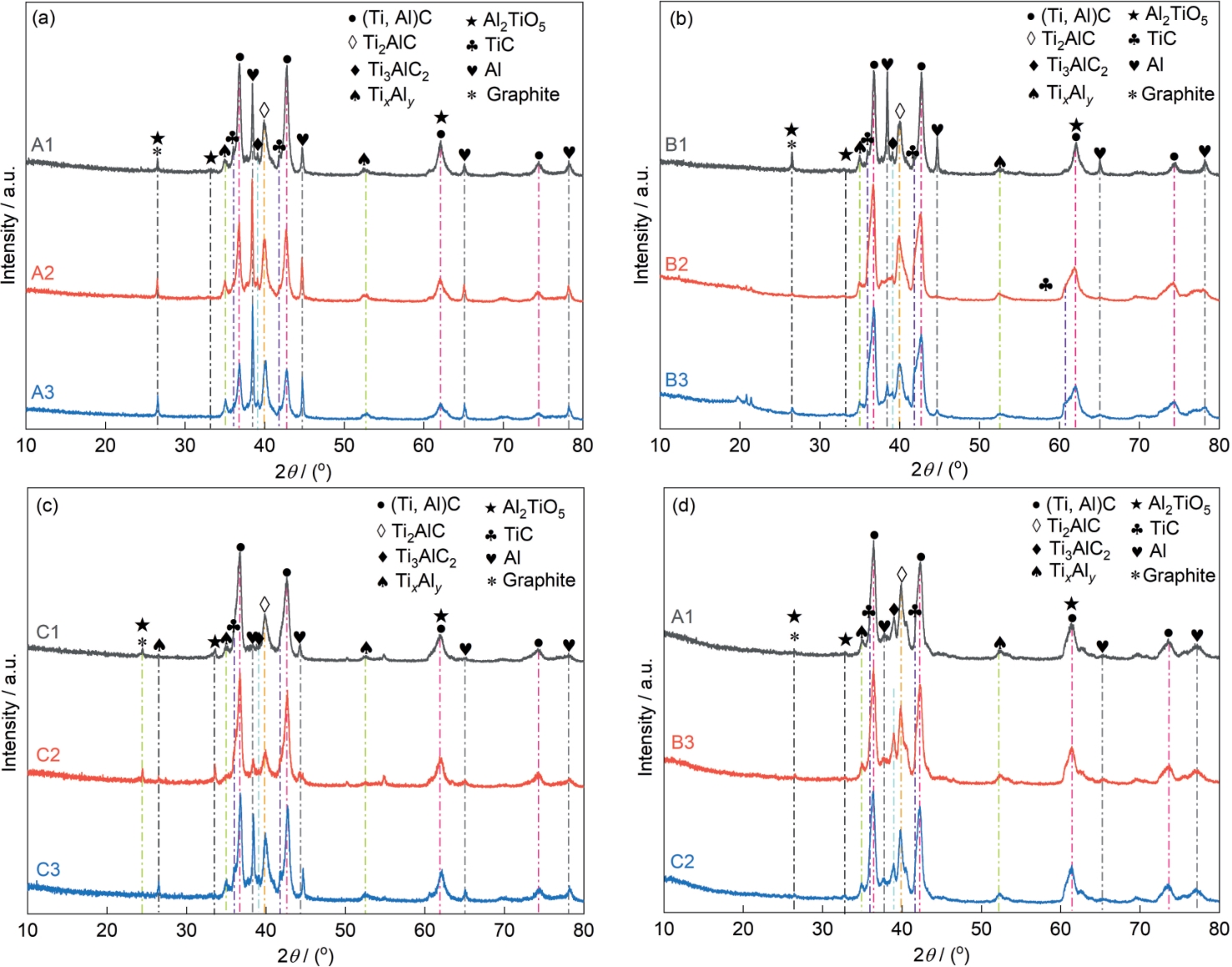
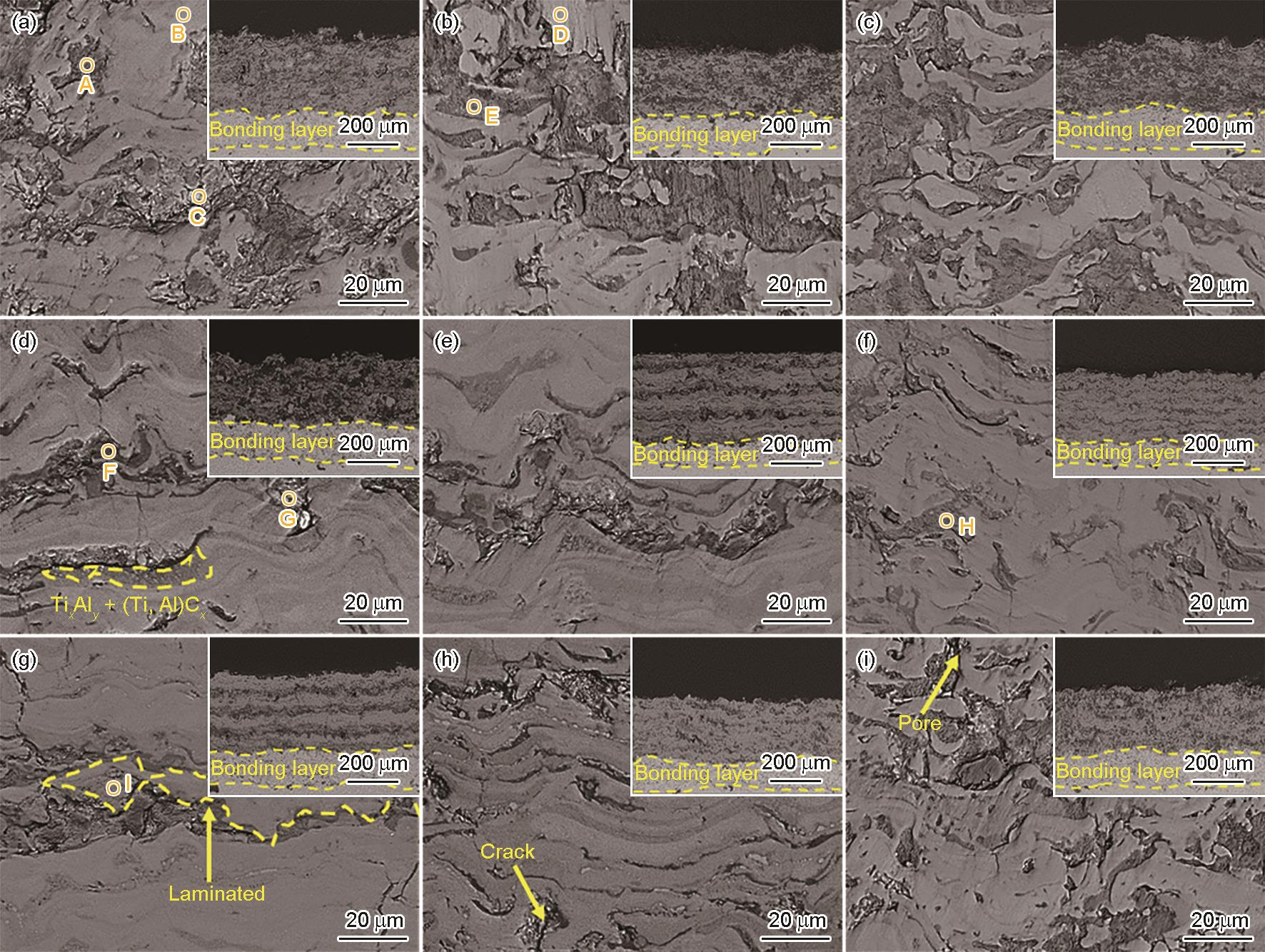
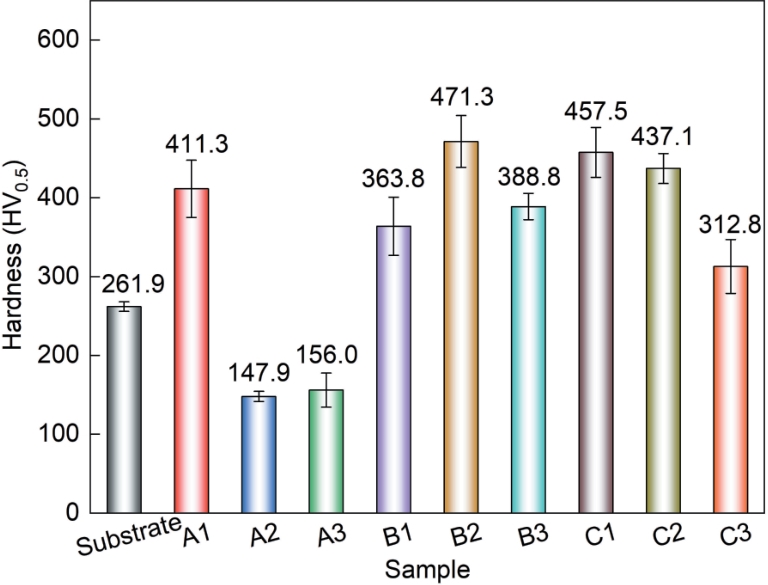
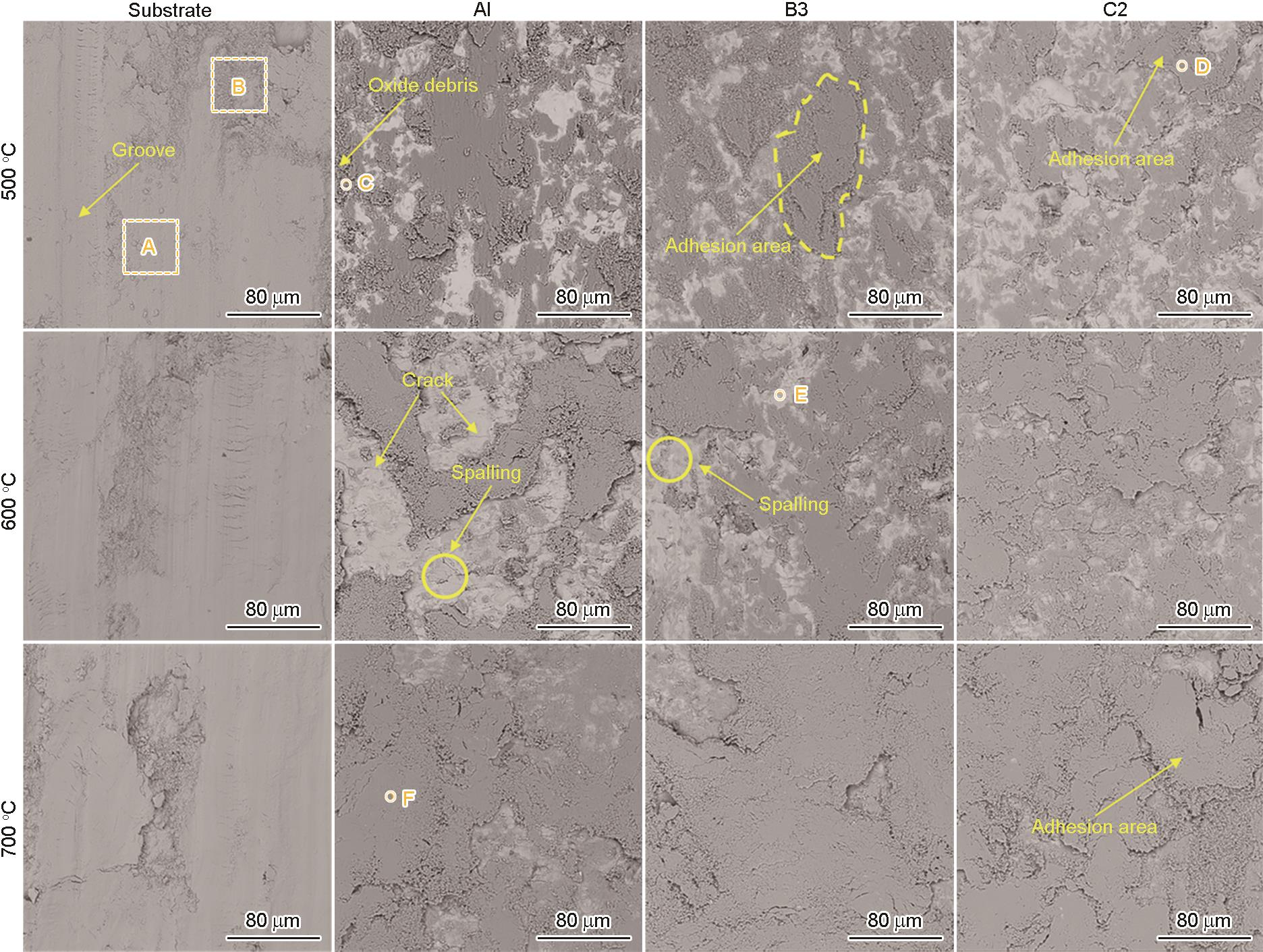
Abstract This study focuses on MAX phases and addresses the challenge of their decomposition during the construction of sprayed coatings. Ti, Al, and graphite powders were selected as raw materials to design and construct Ti-Al-C reinforced composite coatings, in which a portion of the MAX phase was formed in situ through centrifugal atomization drying, sintering granulation, and plasma spraying. A nine-group orthogonal experimental design was employed to systematically investigate the effects of spray parameters on the microstructure, mechanical properties, and high-temperature tribological performance of the coatings. The results revealed that, due to the presence of MAX phases and ceramic phases, such as TiC, the optimized coatings exhibit higher hardness than that of the substrate and excellent bonding strength. High-temperature friction and wear tests revealed that the coatings exhibit significantly lower wear rates than those of the substrate, and the wear resistance improves with increasing temperature. This enhancement is likely attributed to temperature-induced phase transformations or the further formation of MAX phases. At 700 oC, the wear rate of the C2 coating in the Ti-Al-C system is 98.9% lower than that of the substrate. After repeated wear, phases such as Ti x Al y and Ti2AlC in the coating undergo friction-induced sintering and oxidation, thereby forming a glazed layer on the worn surface. During sliding, material transfer occurs between the coating and the counterface. The dominant wear mechanisms of the composite coating are identified as oxidative, adhesive, and fatigue wear.
|
|
Received: 16 September 2025
|
|
|
| Fund: National Natural Science Foundation of China(U22A20110);Anhui Provincial Natural Science Foundation(2308085Y33) |
Corresponding Authors:
YANG Yang, Tel: 18855570497, E-mail: yangyang@ahut.edu.cn;
ZHANG Shihong, Tel: (0555)2311730, E-mail: shzhang@ahut.edu.cn
|
| [1] |
Dahlqvist M, Barsoum M W, Rosen J. MAX phases-past, present, and future [J]. Mater. Today, 2024, 72: 1
doi: 10.1016/j.mattod.2023.11.010
|
| [2] |
Chen H X, Sheng L, Zhang Z L, et al. Discovery of new MAX-phase-like layered ternary carbide V8P6C: crystal structure, thermal expansion, and elastic properties [J]. J. Mater. Sci. Technol., 2024, 174: 55
doi: 10.1016/j.jmst.2023.07.031
|
| [3] |
Bo L, Liu X L, Wang D Z. The corrosion behavior of multicomponent porous MAX phase (Ti0.25Zr0.25Nb0.25Ta0.25)2AlC in hydrochloric acid [J]. Corros. Sci., 2023, 222: 111430
doi: 10.1016/j.corsci.2023.111430
|
| [4] |
Ali R, Song P, Khan M, et al. Tribological and oxidation resistance performance of Ti2AlC MAX-phase generated by reactive spark plasma sintering [J]. J. Mater. Res. Technol., 2023, 26: 8309
doi: 10.1016/j.jmrt.2023.09.110
|
| [5] |
Azina C, Poll M, Holzapfel D M, et al. Microstructural and compositional design of Cr2AlC MAX phases and their impact on oxidation resistance [J]. J. Eur. Ceram. Soc., 2024, 44(8): 4895
doi: 10.1016/j.jeurceramsoc.2024.02.037
|
| [6] |
Arusei G K, Chepkoech M, Amolo G O, et al. Elastic and thermal properties of selected 211 MAX phases: a DFT study [J]. Comput. Condens. Matter, 2024, 39: e00891
doi: 10.1016/j.cocom.2024.e00891
|
| [7] |
Sung Lee K, Ahn H, Won Lee G, et al. Self-healing of indentation damage in Ti2AlC MAX phase ceramics [J]. Mater. Lett., 2023, 334: 133683
doi: 10.1016/j.matlet.2022.133683
|
| [8] |
Zhu X Y, Ding Z Y, Ma G Z, et al. Research progress on high temperature tribological properties of ternary MAX phase layered ceramic materials [J]. Mater. Rep., 2022, 36: 75
|
|
朱咸勇, 丁振宇, 马国政 等. 三元MAX相层状陶瓷材料高温摩擦学性能研究进展 [J]. 材料导报, 2022, 36: 75
|
| [9] |
Zhang S H, Hu K, Liu X, et al. Corrosion-erosion mechanism and research prospect of bare materials and protective coatings for power generation boiler [J]. Acta Metall. Sin., 2022, 58: 272
doi: 10.11900/0412.1961.2021.00464
|
|
张世宏, 胡 凯, 刘 侠 等. 发电锅炉材料与防护涂层的磨蚀机制与研究展望 [J]. 金属学报, 2022, 58: 272
doi: 10.11900/0412.1961.2021.00464
|
| [10] |
Zhang Z, Lim S H, Chai J W, et al. Kerosene-fuelled high velocity oxy-fuel (HVOF) spray of Ti2AlC MAX phase powders [J]. J. Alloy. Compd., 2018, 735: 377
doi: 10.1016/j.jallcom.2017.11.157
|
| [11] |
Li X, Zhang C H, Zhang S, et al. Manufacturing of Ti3SiC2 lubricated Co-based alloy coatings using laser cladding technology [J]. Opt. Laser Technol., 2019, 114: 209
doi: 10.1016/j.optlastec.2019.02.001
|
| [12] |
Laska N, Swadźba R, Nellessen P, et al. Oxidation behavior of Ti2AlC MAX phase-based coating on a γ-TiAl alloy TiAl48-2-2 produced by DC magnetron sputtering [J]. Surf. Coat. Technol., 2024, 480: 130601
doi: 10.1016/j.surfcoat.2024.130601
|
| [13] |
Xu A, Wang R Q, Yang Z C, et al. A novel formation mechanism: one-step synthesis of high-purity MAX phase bulk via enlarged reaction depth [J]. J. Eur. Ceram. Soc., 2024, 44(10): 5491
doi: 10.1016/j.jeurceramsoc.2024.02.055
|
| [14] |
Rud A, Kirian I, Zagorodniy Y, et al. Formation of Ti3AlC2 MAX phase in the Ti-Al-C system with B2O3 additive [J]. Open Ceram., 2024, 18: 100590
|
| [15] |
Mandegari M, Nasouri K, Ghasemi-Mobarakeh L. Synthesis of low-cost Ti3AlC2-Ti2AlC dual MAX phase with high-electrical conductivity using economical raw materials and novel compositions [J]. Mater. Today Commun., 2023, 36: 106868
|
| [16] |
Li W T, Wang Z Y, Zhang D, et al. Preparation of Ti2AlC coating by the combination of a hybrid cathode arc/magnetron sputtering with post-annealing [J]. Acta Metall. Sin., 2019, 55: 647
|
|
李文涛, 王振玉, 张 栋 等. 电弧复合磁控溅射结合热退火制备Ti2AlC涂层 [J]. 金属学报, 2019, 55: 647
doi: 10.11900/0412.1961.2018.00285
|
| [17] |
Zhang F Y, Chen J W, Yan S, et al. Microstructure and reaction mechanism of Ti-Al-C based MAX phase coatings synthesized by plasma spraying and post annealing [J]. Surf. Coat. Technol., 2022, 441: 128584
doi: 10.1016/j.surfcoat.2022.128584
|
| [18] |
Tian Y X, Xiao H Q, Ren L R, et al. A new strategy to fabricate Ti2AlC MAX coatings by the two-step laser method [J]. Surf. Coat. Technol., 2022, 448: 128944
doi: 10.1016/j.surfcoat.2022.128944
|
| [19] |
Ma F X, Guo X Y, He H W, et al. Preparation and mechanical properties of air plasma sprayed high strength and toughness nano-TiO2 coatings [J]. Therm. Spray Technol., 2024, 16(2): 99
|
|
马凤孝, 郭星晔, 何翰伟 等. 等离子喷涂高强韧纳米TiO2涂层的制备及其力学性能 [J]. 热喷涂技术, 2024, 16(2): 99
|
| [20] |
Hong S, Wu Y P, Wang B, et al. High-velocity oxygen-fuel spray parameter optimization of nanostructured WC-10Co-4Cr coatings and sliding wear behavior of the optimized coating [J]. Mater. Des., 2014, 55: 286
doi: 10.1016/j.matdes.2013.10.002
|
| [21] |
Ye J H, Chen L Y, Chen X Y, et al. Research on plasma spraying NiAl and NiCrAl coatings process based on orthogonal experiment [J]. Therm. Spray Technol., 2022, 14(1): 78
|
|
叶俊华, 陈凌云, 陈新悦 等. 基于正交试验的等离子喷涂NiAl和NiCrAl涂层工艺研究 [J]. 热喷涂技术, 2022, 14(1): 78
|
| [22] |
Shtansky D V, Kiryukhantsev-Korneev P V, Sheveyko A N, et al. Comparative investigation of TiAlC(N), TiCrAlC(N), and CrAlC(N) coatings deposited by sputtering of МАХ-phase Ti2 - х Cr х AlC targets [J]. Surf. Coat. Technol., 2009, 203(23): 3595
doi: 10.1016/j.surfcoat.2009.05.036
|
| [23] |
Lei Y L, Yang K, Xin Y, et al. Microstructure evolution of mechanically-alloying and its subsequently-annealed AlCrCu0.5Mo0.5Ni high-entropy alloy [J]. Acta Metall. Sin., 2025, 61: 731
|
|
雷云龙, 杨 康, 辛 越 等. 机械合金化AlCrCu0.5Mo0.5Ni高熵合金及其后续退火态的结构演化 [J]. 金属学报, 2025, 61: 731
doi: 10.11900/0412.1961.2023.00481
|
| [24] |
Yuan J H, Wang Z Y, Ma G S, et al. Effect of phase-structure evolution on mechanical properties of Cr2AlC coating [J]. Acta Metall. Sin., 2023, 59: 961
|
|
袁江淮, 王振玉, 马冠水 等. Cr2AlC涂层相结构演变对力学性能的影响 [J]. 金属学报, 2023, 59: 961
doi: 10.11900/0412.1961.2022.00438
|
| [25] |
Wilhelmsson O, Palmquist J P, Lewin E, et al. Deposition and characterization of ternary thin films within the Ti-Al-C system by DC magnetron sputtering [J]. J. Cryst. Growth, 2006, 291(1): 290
doi: 10.1016/j.jcrysgro.2006.03.008
|
| [26] |
Li Y M, Zhao G R, Qian Y H, et al. Deposition and characterization of phase-pure Ti2AlC and Ti3AlC2 coatings by DC magnetron sputtering with cost-effective targets [J]. Vacuum, 2018, 153: 62
doi: 10.1016/j.vacuum.2018.04.001
|
| [27] |
Mahmoudi Z, Tabaian S H, Rezaie H R, et al. Synthesis of Ti2AlC & Ti3AlC2 MAX phases by Arc-PVD using Ti-Al target in C2H2/Ar gas mixture and subsequent annealing [J]. Ceram. Int., 2020, 46(4): 4968
doi: 10.1016/j.ceramint.2019.10.235
|
| [28] |
Gutzmann H, Gärtner F, Höche D, et al. Cold spraying of Ti2AlC MAX-phase coatings [J]. J. Therm. Spray. Technol., 2013, 22(2-3): 406
doi: 10.1007/s11666-012-9843-1
|
| [29] |
Greczynski G, Jensen J, Greene J E, et al. X-ray photoelectron spectroscopy analyses of the electronic structure of polycrystalline Ti1- x Al x N thin films with 0 ≤ x ≤ 0.96 [J]. Surf. Sci. Spectra, 2014, 21: 35
doi: 10.1116/11.20140506
|
| [30] |
Halim J, Lukatskaya M R, Cook K M, et al. Transparent conductive two-dimensional titanium carbide epitaxial thin films [J]. Chem. Mater., 2014, 26(7): 2374
pmid: 24741204
|
| [31] |
Qiu S, Lyu W Y, Wang Q, et al. Effect of pore characteristics on corrosion behavior of Al-based amorphous alloy coatings [J]. J. Mater. Eng, 2024, 52: 173
|
|
邱 实, 吕威闫, 王 琦 等. 孔隙特性对铝基非晶合金涂层腐蚀行为的影响 [J]. 材料工程, 2024, 52: 173
|
| [32] |
Magnuson M. Electronic structure investigation of MAX-phases by soft X-ray emission spectroscopy [J]. MRS Online Proc. Lib., 2007, 1023: 901
|
| [33] |
Zhang Z, Lim S H, Lai D M Y, et al. Probing the oxidation behavior of Ti2AlC MAX phase powders between 200 and 1000 oC [J]. J. Eur. Ceram. Soc., 2017, 37(1): 43
doi: 10.1016/j.jeurceramsoc.2016.08.004
|
| [34] |
Yang K, Xin Y, Jiang Z T, et al. Mechanical alloying fabrication of nano-ZrB2-reinforced CoNiCrAlY composite powders and microstructure-property characterization of the resultant coatings [J]. Acta Metall. Sin., 2025, 61: 619
|
|
杨 康, 辛 越, 姜自滔 等. 纳米ZrB2增强CoNiCrAlY复合粉末的机械合金化制备及其涂层的组织与性能 [J]. 金属学报, 2025, 61: 619
|
| [35] |
Gao M Y, Liu L L, Huang Z X, et al. Electrodeposition and properties of Ni-W-Ti2AlC composite coatings [J]. Ceram. Int., 2024, 50(11): 18832
doi: 10.1016/j.ceramint.2024.02.372
|
| [36] |
Hong H H, Xie G R, Sun L, et al. The diffusion behavior and surface properties of catalytic nitriding with LaFeO3 film prepared by the sol-gel method [J]. Surf. Coat. Technol., 2023, 467: 129720
doi: 10.1016/j.surfcoat.2023.129720
|
| [37] |
Magnus C. Sliding wear of MAX phase composites Ti3SiC2-TiC and Ti3AlC2-Ti2AlC at 400 oC and the influence of counterface material (steel, Al2O3, and Si3N4) on wear behaviour [J]. Wear, 2023, 516-517: 204588
doi: 10.1016/j.wear.2022.204588
|
| No Suggested Reading articles found! |
|
|
Viewed |
|
|
|
Full text
|
|
|
|
|
Abstract
|
|
|
|
|
Cited |
|
|
|
|
| |
Shared |
|
|
|
|
| |
Discussed |
|
|
|
|