|
|
|
| Synergistic Control of Tool-chip Tribology in Turning Inconel 718 via WS2-enhanced Nano-MQL and Rake-face Micro-textures |
LIU Hanlu1, ZHANG Gaofeng2, JIANG Shengqiang1( ), DENG Yang2 |
1.School of Mechanical Engineering and Mechanics, Xiangtan University, Xiangtan 411105, China
2.School of Mechanical and Electrical Engineering, Changsha University, Changsha 410022, China |
|
Cite this article:
LIU Hanlu, ZHANG Gaofeng, JIANG Shengqiang, DENG Yang. Synergistic Control of Tool-chip Tribology in Turning Inconel 718 via WS2-enhanced Nano-MQL and Rake-face Micro-textures. Chinese Journal of Materials Research, 2026, 40(10): 769-780.
|
|
|
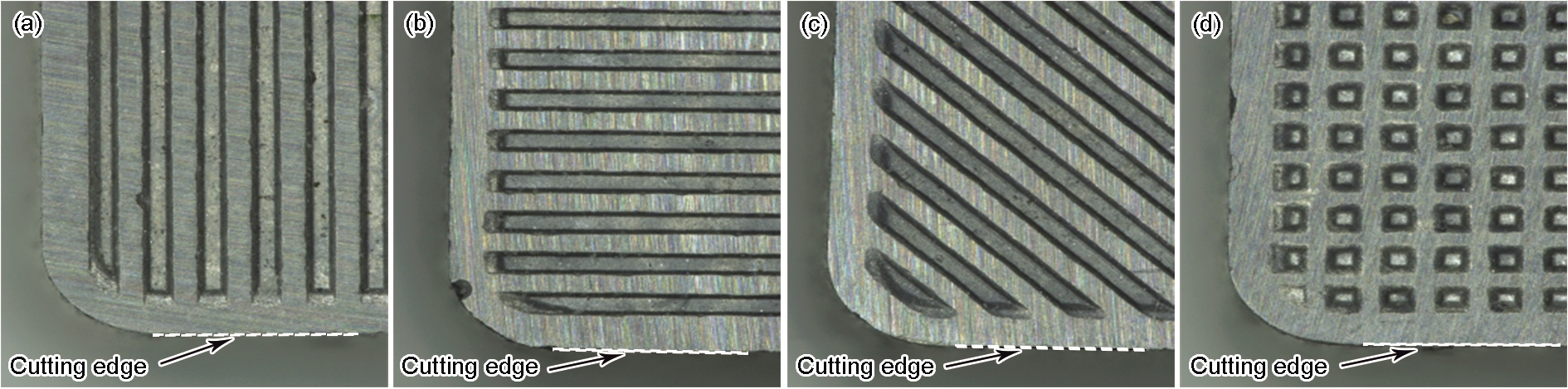
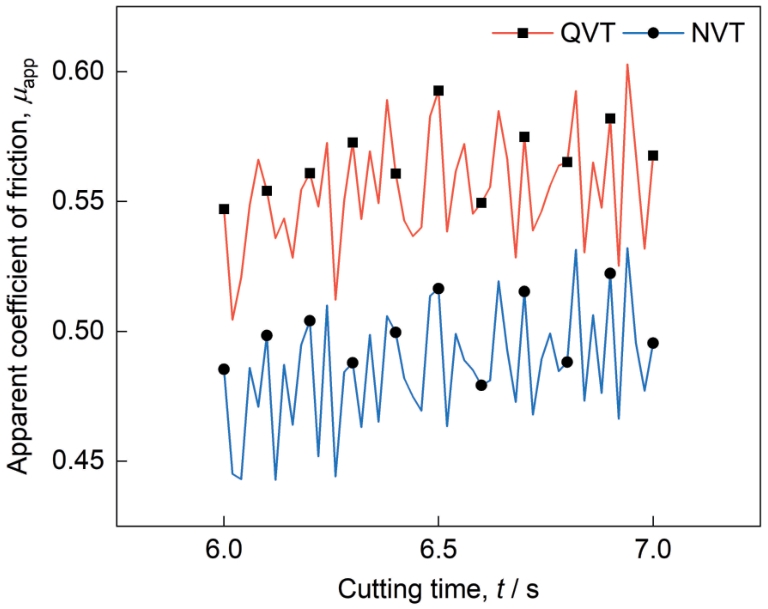
Abstract To address the severe interfacial adhesion, high cutting temperatures, and rapid tool wear encountered during the machining of the nickel-based superalloy Inconel 718, four rake-face micro-textured tools were designed in this study: grooves perpendicular to the cutting edge (VT), grooves parallel to the cutting edge (PT), grooves oriented at 45° (45T), and a square-dimple array (DT). An untextured tool (NT) was employed as the reference. Turning experiments were conducted under minimum quantity lubrication (MQL) and nano-minimum quantity lubrication (NMQL) conditions at three cutting speeds. The results indicate that the main cutting force initially decreased and then increased with increasing cutting speed, and the overall cutting load reached a minimum at Vc = 80 m/min. At this cutting speed, the main cutting forces of VT, PT, DT, and 45T were 9.12%, 7.63%, 5.21%, and 3.51% lower than those of NT, respectively, thereby confirming the effectiveness of rake-face textures in reducing cutting loads. Furthermore, the cutting temperature increased with cutting speed; however, both surface textures and lubricants significantly reduced the cutting temperature. Under MQL and NMQL conditions, the temperature reduction of textured tools relative to NT ranged from 8.8% to 14.5% and from 11.4% to 18.0%, respectively, with VT showing the most pronounced cooling effect. Based on the wear characterization of the rake and flank faces, rake-face adhesion and spalling were effectively mitigated under NMQL, and the maximum flank wear width (VBmax) of NVT was the smallest, with a value of only 60.99% of that of NNT. Overall, open-groove textures combined with WS2-enhanced NMQL demonstrated a pronounced synergistic anti-friction and anti-wear effect. This synergy reduced the apparent level of interfacial friction and improved the cutting deformation conditions, thereby alleviating heat accumulation and suppressing tool wear propagation. Ultimately, this enhanced the interfacial tribological environment and the tool service conditions during turning of Inconel 718.
|
|
Received: 15 April 2026
|
|
|
| Fund: National Natural Science Foundation of China(52275406);Hunan Provincial Innovation Foundation for Postgraduates(LXBZZ2024118) |
Corresponding Authors:
JIANG Shengqiang, Tel: 15074817558, E-mail: jsqcx@xtu.edu.cn
|
| [1] |
Ezugwu E O. Key improvements in the machining of difficult-to-cut aerospace superalloys [J]. Int. J. Mach. Tools Manuf., 2005, 45(12-13): 1353
doi: 10.1016/j.ijmachtools.2005.02.003
|
| [2] |
Paturi U M R, Darshini B V, Reddy N S. Progress of machinability on the machining of Inconel 718: a comprehensive review on the perception of cleaner machining [J]. Clean. Eng. Technol., 2021, 5: 100323
|
| [3] |
Liu Z Q, Zhao Y Y, Wang B, et al. Prediction and conditioning of surface integrity for cutting difficult-to-machine metallic materials [J]. China Mech. Eng., 2026, 37(3): 509
|
|
刘战强, 赵永耀, 王 兵 等. 难加工金属材料切削表面完整性预测与调控 [J]. 中国机械工程, 2026, 37(3): 509
|
| [4] |
Hao Z P, Gao D, Fan Y H, et al. New observations on tool wear mechanism in dry machining Inconel718 [J]. Int. J. Mach. Tools Manuf., 2011, 51(12): 973
doi: 10.1016/j.ijmachtools.2011.08.018
|
| [5] |
Devillez A, Le Coz G, Dominiak S, et al. Dry machining of Inconel 718, workpiece surface integrity [J]. J. Mater. Process. Technol., 2011, 211(10): 1590
doi: 10.1016/j.jmatprotec.2011.04.011
|
| [6] |
Weinert K, Inasaki I, Sutherland J W, et al. Dry machining and minimum quantity lubrication [J]. CIRP Ann., 2004, 53(2): 511
doi: 10.1016/S0007-8506(07)60027-4
|
| [7] |
Sheng R, Liu J X, Yan X, et al. Research progress on the application of minimum quantity lubrication in machining [J]. Manuf. Technol. Mach. Tool, 2025, (1): 86
|
|
盛 锐, 刘纪新, 颜 旭 等. 微量润滑在机械加工中的应用研究进展 [J]. 制造技术与机床, 2025, (1): 86
|
| [8] |
Sharma A K, Tiwari A K, Dixit A R. Effects of minimum quantity lubrication (MQL) in machining processes using conventional and nanofluid based cutting fluids: a comprehensive review [J]. J. Clean. Prod., 2016, 127: 1
doi: 10.1016/j.jclepro.2016.03.146
|
| [9] |
Wang X M, Li C H, Yang M, et al. Research progress on the physical mechanism of minimum quantity lubrication machining with nano-biolubricants [J]. J. Mech. Eng., 2024, 60(9): 286
doi: 10.3901/JME.2024.09.286
|
|
王晓铭, 李长河, 杨 敏 等. 纳米生物润滑剂微量润滑加工物理机制研究进展 [J]. 机械工程学报, 2024, 60(9): 286
|
| [10] |
Xu W H, Li C H, Zhang Y B, et al. Research progress and application of electrostatic atomization minimum quantity lubrication [J]. J. Mech. Eng., 2023, 59(7): 110
|
|
许文昊, 李长河, 张彦彬 等. 静电雾化微量润滑研究进展与应用 [J]. 机械工程学报, 2023, 59(7): 110
|
| [11] |
Chinchanikar S, Kore S S, Hujare P. A review on nanofluids in minimum quantity lubrication machining [J]. J. Manuf. Process., 2021, 68: 56
doi: 10.1016/j.jmapro.2021.05.028
|
| [12] |
Hegab H, Kishawy H A. Towards sustainable machining of Inconel 718 using nano-fluid minimum quantity lubrication [J]. J. Manuf. Mater. Process., 2018, 2(3): 50
doi: 10.3390/jmmp2030050
|
| [13] |
Bai X F, Li C H, Dong L, et al. Lubrication performance evaluation of Al2O3/SiO2 mixed nanofluid for minimum quantity lubrication in milling [J]. Manuf. Technol. Mach. Tool, 2024, (10): 29
|
|
柏秀芳, 李长河, 董 兰 等. Al2O3/SiO2混合纳米流体微量润滑铣削润滑性能评价 [J]. 制造技术与机床, 2024, (10): 29
|
| [14] |
Zhang Y B, Li C H, Jia D Z, et al. Experimental evaluation of the workpiece surface quality of MoS2/CNT nanofluid for minimal quantity lubrication in grinding [J]. J. Mech. Eng., 2018, 54(1): 161
|
|
张彦彬, 李长河, 贾东洲 等. MoS2/CNTs混合纳米流体微量润滑磨削加工表面质量试验评价 [J]. 机械工程学报, 2018, 54(1): 161
doi: 10.3901/JME.2018.01.161
|
| [15] |
Wang D X, Zhang Y, Jiang J L, et al. Tribological mechanism on the grinding interface of nickel-base superalloy under minimum quantity lubrication with ionic liquid and palm oil based nanofluids [J]. J. Mech. Eng., 2024, 60(19): 159
|
|
王德祥, 张 宇, 江京亮 等. 离子液基和棕榈油基纳米流体在镍基高温合金微量润滑磨削界面的摩擦学机理研究 [J]. 机械工程学报, 2024, 60(19): 159
|
| [16] |
Zhang Y, Wang D X, Guo F, et al. Molecular dynamics study on tribological mechanism of spherical nanoparticles on nickel-based alloy grinding interfaces under Nanofluid MQL [J]. China Mech. Eng., 2024, 35(3): 445
|
|
张 宇, 王德祥, 郭 峰 等. 球形纳米颗粒在镍基合金纳米流体微量润滑磨削界面摩擦学机制的分子动力学研究 [J]. 中国机械工程, 2024, 35(3): 445
|
| [17] |
Gong L, Bertolini R, Ghiotti A, et al. Sustainable turning of Inconel 718 nickel alloy using MQL strategy based on graphene nanofluids [J]. Int. J. Adv. Manuf. Technol., 2020, 108: 3159
doi: 10.1007/s00170-020-05626-x
|
| [18] |
Paturi U M R, Venkatesh S, Narala S K R, et al. Measurement and Analysis of Surface Roughness in WS2 Solid Lubricant Assisted Minimum Quantity Lubrication (MQL) Turning of Inconel 718 [J]. Procedia CIRP, 2016, 40: 116
|
| [19] |
Liang X, Liu Z, Wang B, et al. Friction behaviors in the metal cutting process: state of the art and future perspectives [J]. Int. J. Extreme Manuf., 2023, 5(1): 012002
|
| [20] |
Guo J, Wang X Y, Zhao Y, et al. Recent progress on fabrication technologies and machining performance of textured cutting tools [J]. J. Mech. Eng., 2021, 57(13): 172
doi: 10.3901/JME.2021.13.172
|
|
郭 江, 王兴宇, 赵 勇 等. 微织构刀具制备技术及加工性能研究新进展 [J]. 机械工程学报, 2021, 57(13): 172
|
| [21] |
Yang S C, Han P, Tong X, et al. Research on tool mesoscopic geometric feature forming technology and its function [J]. J. Mech. Eng., 2024, 60(5): 317
|
|
杨树财, 韩 佩, 佟 欣 等. 刀具介观几何特征成形技术及其作用研究 [J]. 机械工程学报, 2024, 60(5): 317
|
| [22] |
Ma J, Zhang M J, Liu Q, et al. A review of the research progress of bionic cutting tools [J]. J. Mech. Eng., 2022, 58(13): 261
doi: 10.3901/JME.2022.13.261
|
|
马 晶, 张明鉴, 刘 强 等. 仿生刀具研究进展综述 [J]. 机械工程学报, 2022, 58(13): 261
|
| [23] |
Obikawa T, Kamio A, Takaoka H, et al. Micro-texture at the coated tool face for high performance cutting [J]. Int. J. Mach. Tools Manuf., 2011, 51(12): 966
doi: 10.1016/j.ijmachtools.2011.08.013
|
| [24] |
Gupta M K, Song Q H, Liu Z Q, et al. Tribological behavior of textured tools in sustainable turning of nickel based super alloy [J]. Tribol. Int., 2021, 155: 106775
doi: 10.1016/j.triboint.2020.106775
|
| [25] |
Sivaiah P, Kumar G V A, Singh M M, et al. Effect of novel hybrid texture tool on turning process performance in MQL machining of Inconel 718 superalloy [J]. Mater. Manuf. Process., 2020, 35(1): 79
|
| [26] |
Fernández L P, Urbikain G, Plaza S, et al. Enhancement of ceramic tool behaviour with textured grooves during machining of Inconel 718 [J]. Int. J. Adv. Manuf. Technol., 2024, 134: 2955
doi: 10.1007/s00170-024-14222-2
|
| [27] |
Pei H J, Zhang C Y, Huo Y H, et al. Effect of micro-texture/hybrid nanofluid synergistic MQL on the turning Inconel 718 [J]. Manuf. Technol. Mach. Tool, 2025, (6): 60
|
|
裴宏杰, 张晨阳, 霍宇航 等. 微织构/混合纳米流体协同微量润滑对车削Inconel 718的影响 [J]. 制造技术与机床, 2025, (6): 60
|
| [28] |
Zhu D W, Liu S, Zhang Y K. Simulation study of cutting Inconel 718 alloy with micro textured tools [J]. J. Shanghai Univ. Eng. Sci., 2025, 39(2): 209
|
|
朱大伟, 刘 胜, 张烨锴. 微织构刀具切削Inconel 718合金的仿真研究 [J]. 上海工程技术大学学报, 2025, 39(2): 209
|
| [29] |
Rajurkar A, Chinchanikar S. Investigations on homothetic and hybrid micro-textured tools during turning Inconel-718 [J]. Mater. Manuf. Process., 2024, 39(4): 529
doi: 10.1080/10426914.2023.2236188
|
| [30] |
Wang Y, Huang S R, Zhang J, et al. Evaluation of machining performance of tungsten steel using graphene nanofluid minimum quantity lubrication grinding [J]. Manuf. Technol. Mach. Tool, 2024, (12): 120
|
|
王 勇, 黄世瑞, 张 晶 等. 石墨烯纳米流体微量润滑磨削钨钢的加工性能评价 [J]. 制造技术与机床, 2024, (12): 120
|
| [31] |
Li C H, Zhang Y B, Yang M. Thermodynamic Mechanism of Nanofluid Minimum Quantity Lubrication Grinding [M]. Beijing: Science Press, 2019
|
|
李长河, 张彦彬, 杨 敏. 纳米流体微量润滑磨削热力学作用机理 [M]. 北京: 科学出版社, 2019
|
| [32] |
Xi J S, Luo C, Jiao Z H, et al. Research on machining performance of low-temperature minimum quantity lubrication in turning of K403 cast superalloy [J]. Manuf. Technol. Mach. Tool, 2025, (9): 88
|
|
奚军生, 罗 成, 焦振华 等. K403铸造高温合金低温微量润滑车削加工性能研究 [J]. 制造技术与机床, 2025, (9): 88
|
| [33] |
Jia D Z, Li C H, Zhang Y B, et al. Grinding performance and surface morphology evaluation of titanium alloy using electric traction bio micro lubricant [J]. J. Mech. Eng., 2022, 58(5): 198
|
|
贾东洲, 李长河, 张彦彬 等. 钛合金生物润滑剂电牵引磨削性能及表面形貌评价 [J]. 机械工程学报, 2022, 58(5): 198
doi: 10.3901/JME.2022.05.198
|
| [34] |
Wang X M, Zhang J C, Wang X P, et al. Temperature field model and verification of titanium alloy grinding under different cooling conditions [J]. China Mech. Eng., 2021, 32(5): 572
|
|
王晓铭, 张建超, 王绪平 等. 不同冷却工况下的磨削钛合金温度场模型及验证 [J]. 中国机械工程, 2021, 32(5): 572
|
| [35] |
Kesriklioglu S, Pfefferkorn F E. Real time temperature measurement with embedded thin-film thermocouples in milling [J]. Procedia CIRP, 2018, 77: 618
doi: 10.1016/j.procir.2018.08.193
|
| [36] |
Li J D, Tao B, Huang S W, et al. Cutting tools embedded with thin film thermocouples vertically to the rake face for temperature measurement [J]. Sens. Actuators, 2019, 296A: 392
|
| [37] |
Rahman M, Seah W K H, Teo T T. The machinability of Inconel 718 [J]. J. Mater. Process. Technol., 1997, 63(1-3): 199
doi: 10.1016/S0924-0136(96)02624-6
|
| [38] |
Merchant M E. Mechanics of the metal cutting process. I. Orthogonal cutting and a type 2 chip [J]. J. Appl. Phys., 1945, 16(5): 267
|
| [39] |
Qiu T, Yan L, Wang F Z, et al. Research advances of Rehbinder effect in material removal process [J]. China Surf. Eng., 2024, 37(1): 59
|
|
邱 天, 言 兰, 王福增 等. 材料去除过程中Rehbinder效应的研究进展 [J]. 中国表面工程, 2024, 37(1): 59
|
| [40] |
Zheng J Q, Liu C F, Zhu X D, et al. Research progress of grinding technology with minimum quantity lubrication [J]. J. Liaoning Petrochem. Univ., 2023, 43(4): 84
|
|
郑嘉琦, 刘长福, 朱晓丹 等. 微量润滑磨削加工技术研究进展 [J]. 辽宁石油化工大学学报, 2023, 43(4): 84
|
| No Suggested Reading articles found! |
|
|
Viewed |
|
|
|
Full text
|
|
|
|
|
Abstract
|
|
|
|
|
Cited |
|
|
|
|
| |
Shared |
|
|
|
|
| |
Discussed |
|
|
|
|