|
|
|
| Effect of Heat Treatment on the Microstructure, Mechanical Properties, and Corrosion Performance of Biodegradable Zn-0.45Li Alloy Ultra-fine Wire |
SUN Zhixue1,2, ZHU Xinglong2, LI Moucheng1( ), YANG Lijing2(), JIANG Jianjun2, ZHANG Qingke2, SONG Zhenlun2 |
1.State Key Laboratory of Materials for Advanced Nuclear Energy, School of Materials Science and Engineering, Shanghai University, Shanghai 200072, China
2.State Key Laboratory of Advanced Marine Materials, Zhejiang Key Laboratory of Extreme-environmental Material Surfaces and Interfaces, Ningbo Institute of Materials Technology and Engineering, Chinese Academy of Sciences, Ningbo 315201, China |
|
Cite this article:
SUN Zhixue, ZHU Xinglong, LI Moucheng, YANG Lijing, JIANG Jianjun, ZHANG Qingke, SONG Zhenlun. Effect of Heat Treatment on the Microstructure, Mechanical Properties, and Corrosion Performance of Biodegradable Zn-0.45Li Alloy Ultra-fine Wire. Chinese Journal of Materials Research, 2026, 40(10): 757-768.
|
|
|
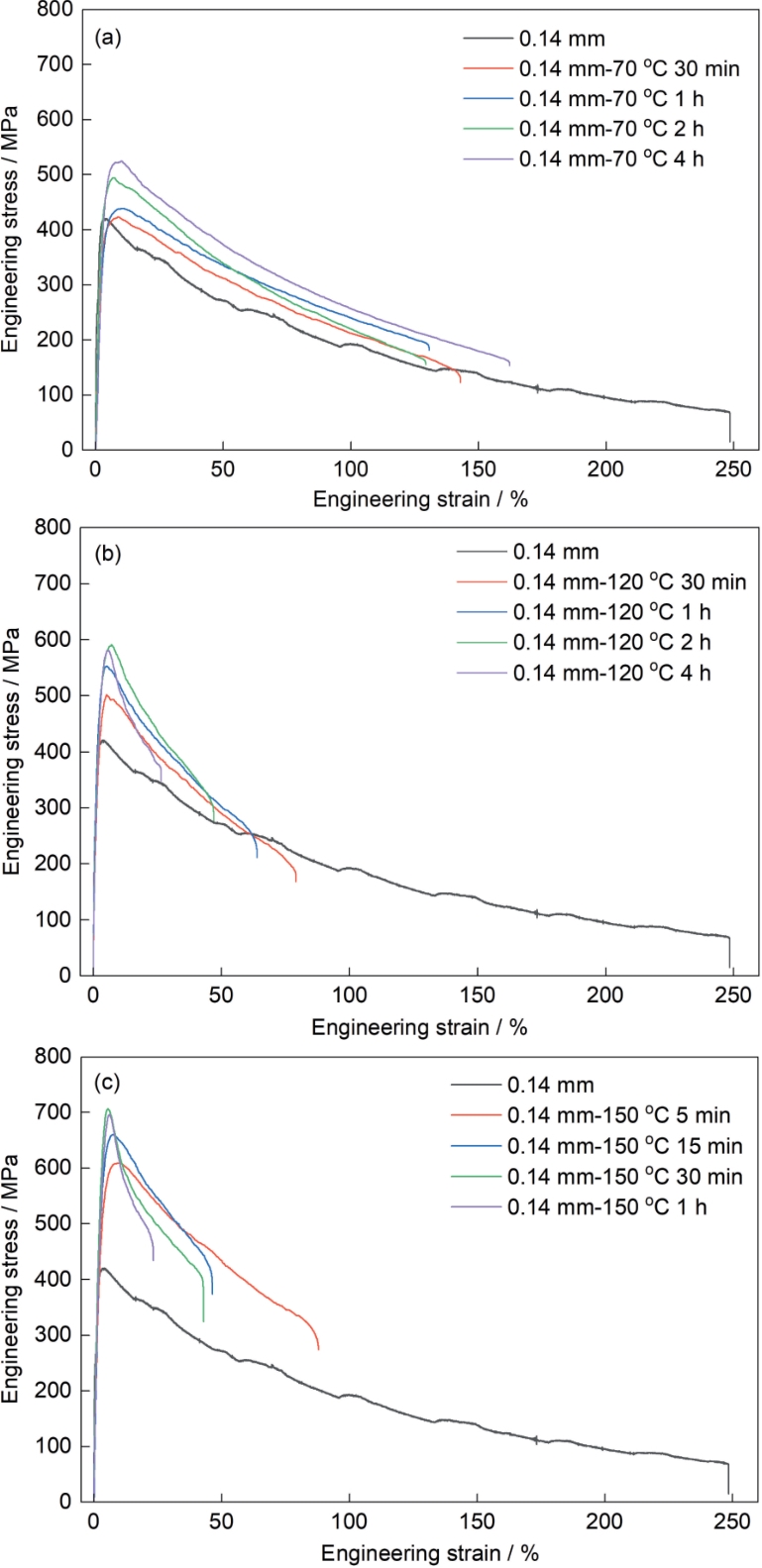
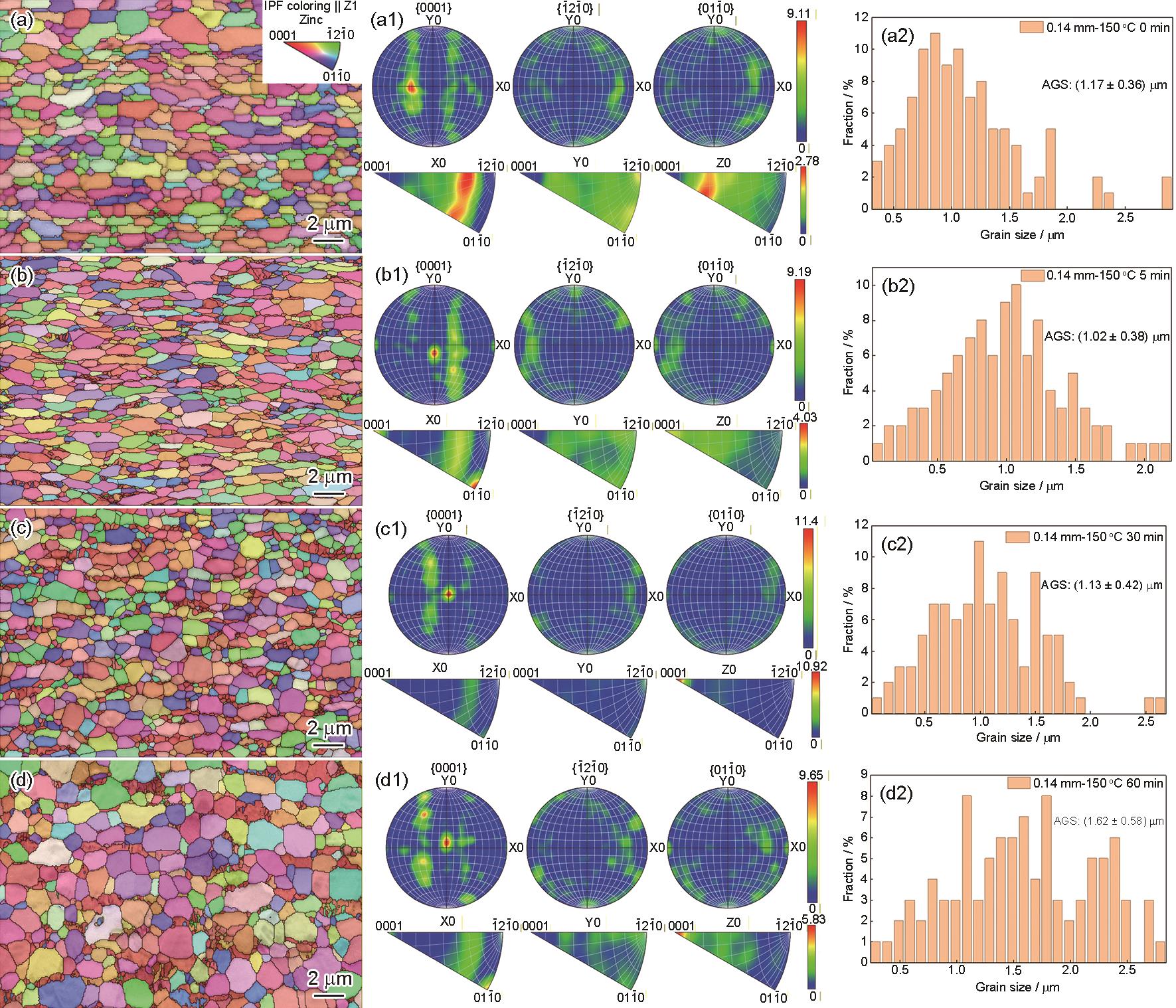
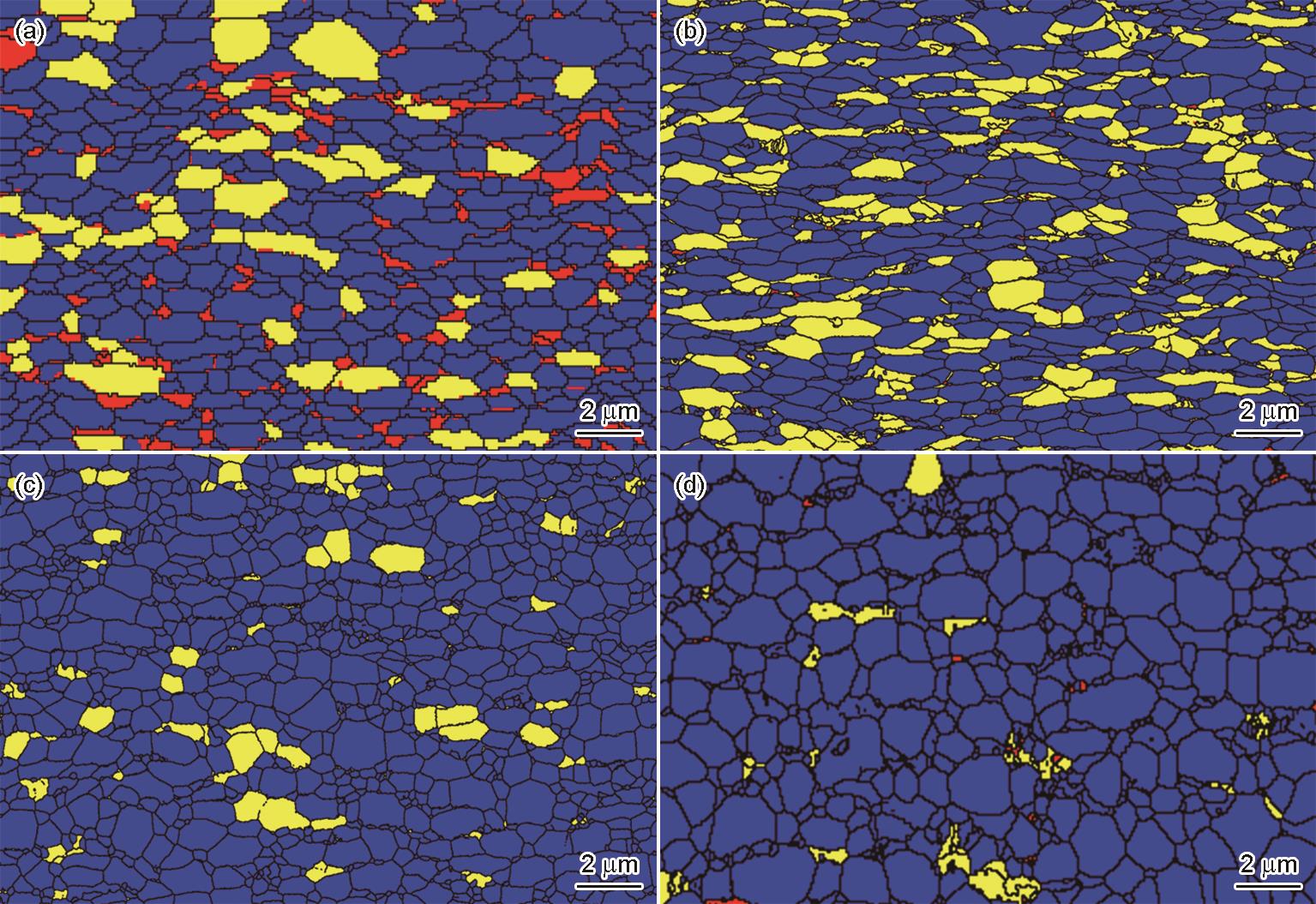
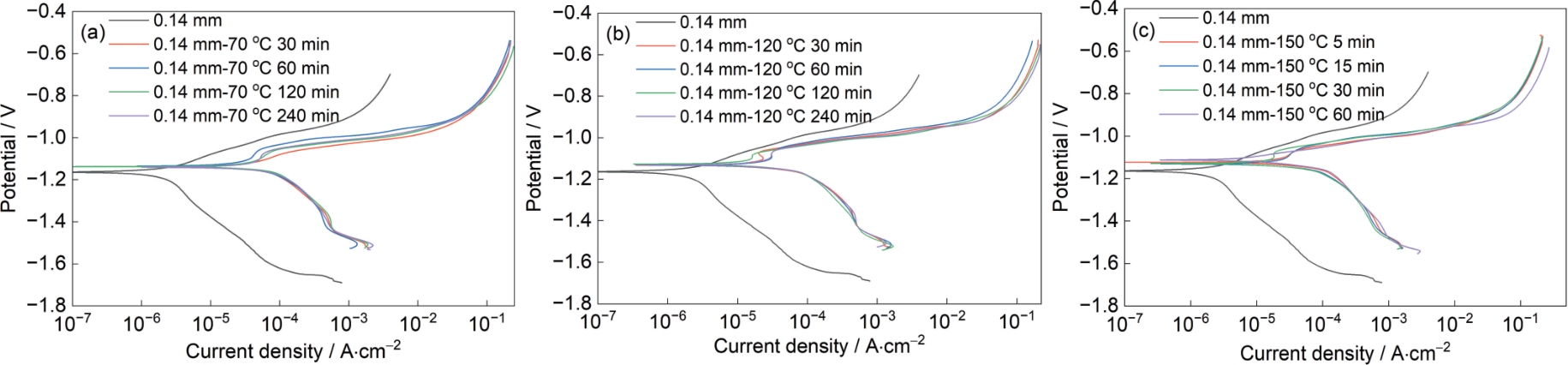
Abstract To tailor the microstructure and properties of Zn-Li alloy ultrafine wires for cardiovascular stent braiding, this study systematically investigates the effects of heat treatment at 70 oC, 120 oC, and 150 oC on the microstructure, mechanical properties, and electrochemical corrosion behavior of Zn-0.45Li alloy wires with a diameter of 0.14 mm. The results revealed that heat treatment at 70 oC only resulted in static recovery, whereas treatments at 120 oC and 150 oC sequentially induced partial recrystallization, full recrystallization, and grain growth as holding time increased. After heat treatment, the ultimate tensile strength of the wire increased significantly, whereas its ductility decreased. Higher treatment temperatures resulted in greater strength enhancement and a more pronounced reduction in ductility. The optimal comprehensive performance was achieved after holding at 150 oC for 30 min, with a maximum ultimate tensile strength of 706.9 MPa, approximately 90 MPa higher than that in the cold-drawn state, while the elongation after fracture remained at 38.5%. After heat treatment, the corrosion current density increased, and the corrosion rate accelerated with increasing treatment temperature, whereas the effect of holding time on corrosion behavior at the same temperature is relatively weak. The core mechanism underlying the evolution of strength and ductility is the obstruction of grain-boundary sliding by grain growth, while micro-galvanic corrosion induced by second-phase precipitation is the dominant factor contributing to accelerated degradation. These findings provide experimental evidence and theoretical support for the optimization of the heat treatment process of medical biodegradable Zn-Li alloy wires for stent applications.
|
|
Received: 26 March 2026
|
|
|
| Fund: Key Research and Development Program of Zhejiang Province(2024C03078);Ningbo Public Welfare Research Plan(2024S070) |
Corresponding Authors:
YANG Lijing, Tel: 15267855738, E-mail: yanglj@nimte.ac.cn;
LI Moucheng, Tel: 13918307362, E-mail: mouchengli@shu.edu.cn
|
| [1] |
Im S H, Jung Y, Kim S H. Current status and future direction of biodegradable metallic and polymeric vascular scaffolds for next-generation stents [J]. Acta Biomater., 2017, 60: 3
doi: S1742-7061(17)30456-7
pmid: 28716610
|
| [2] |
Fu J Y, Su Y C, Qin Y X, et al. Evolution of metallic cardiovascular stent materials: a comparative study among stainless steel, magnesium and zinc [J]. Biomaterials, 2020, 230: 119641
doi: 10.1016/j.biomaterials.2019.119641
|
| [3] |
Li Y F, Wang J F, Sheng K, et al. Optimizing structural design on biodegradable magnesium alloy vascular stent for reducing strut thickness and raising radial strength [J]. Mater. Des., 2022, 220: 110843
doi: 10.1016/j.matdes.2022.110843
|
| [4] |
Hu T Z, Yang C, Lin S, et al. Biodegradable stents for coronary artery disease treatment: recent advances and future perspectives [J]. Mater. Sci. Eng., 2018, 91C: 163
|
| [5] |
Pauck R G, Reddy B D. Computational analysis of the radial mechanical performance of PLLA coronary artery stents [J]. Med. Eng. Phys., 2015, 37(1): 7
doi: 10.1016/j.medengphy.2014.09.014
pmid: 25456397
|
| [6] |
Zheng Y F, Gu X N, Witte F. Biodegradable metals [J]. Mater. Sci. Eng., 2014, 77R: 1
|
| [7] |
Tong P D, Sheng Y L, Hou R Q, et al. Recent progress on coatings of biomedical magnesium alloy [J]. Smart Mater. Med., 2022, 3: 104
|
| [8] |
Kabir H, Munir K, Wen C E, et al. Recent research and progress of biodegradable zinc alloys and composites for biomedical applications: biomechanical and biocorrosion perspectives [J]. Bioact. Mater., 2021, 6(3): 836
doi: 10.1016/j.bioactmat.2020.09.013
pmid: 33024903
|
| [9] |
Tapiero H, Tew K D. Trace elements in human physiology and pathology: zinc and metallothioneins [J]. Biomed. Pharmacother., 2003, 57(9): 399
doi: 10.1016/s0753-3322(03)00081-7
pmid: 14652165
|
| [10] |
Jiang J M, Qian Y, Huang H, et al. Biodegradable Zn-Cu-Mn alloy with suitable mechanical performance and in vitro degradation behavior as a promising candidate for vascular stents [J]. Biomater. Adv., 2022, 133: 112652
doi: 10.1016/j.msec.2022.112652
|
| [11] |
Bowen P K, Drelich J, Goldman J. Zinc exhibits ideal physiological corrosion behavior for bioabsorbable stents [J]. Adv. Mater., 2013, 25(18): 2577
doi: 10.1002/adma.v25.18
|
| [12] |
Li Z, Shi Z Z, Hao Y, et al. Insight into role and mechanism of Li on the key aspects of biodegradable Zn-Li alloys: microstructure evolution, mechanical properties, corrosion behavior and cytotoxicity [J]. Mater. Sci. Eng., 2020, 114C: 111049
|
| [13] |
Zhao S, McNamara C T, Bowen P K, et al. Structural characteristics and in vitro biodegradation of a novel Zn-Li alloy prepared by induction melting and hot rolling [J]. Metall. Mater. Trans., 2017, 48A: 1204
|
| [14] |
Li W Y, Dai Y L, Cai W H, et al. Ultrahigh strength and uniform corrosion in Zn-Li alloys through ultrahigh pressure supersaturated solid solution treatment for biodegradable orthopedic applications [J]. Rare. Met., 2024, 43(10): 5284
doi: 10.1007/s12598-024-02753-2
|
| [15] |
Li Z, Shi Z Z, Hao Y, et al. High-performance hot-warm rolled Zn-0.8Li alloy with nano-sized metastable precipitates and sub-micron grains for biodegradable stents [J]. J. Mater. Sci. Technol., 2019, 35(11): 2618
doi: 10.1016/j.jmst.2019.06.009
|
| [16] |
Li B Y, Geng W B, Shi Z Z, et al. Tribocorrosion mechanism of biodegradable high-strength Zn-0.5Li alloy and pure Zn with bovine serum albumin adsorption [J]. npj Mater. Degrad., 2025, 9(1): 120
doi: 10.1038/s41529-025-00668-6
|
| [17] |
Zha Y, Zhou M R, Zhu Y X, et al. Effect of hot rolling temperature on microstructures, mechanical properties and corrosion resistance of bio-potential Zn-0.8Li alloy [J]. J. Alloy. Compd., 2026, 1062: 187411
doi: 10.1016/j.jallcom.2026.187411
|
| [18] |
Zhang J J, Wang Q Z, Jiao Z X, et al. Effects of combined use of inoculation and modification heat treatment on microstructure, damping and mechanical properties of Zn-Al eutectoid alloy [J]. Mater. Sci. Eng., 2020, 790A: 139740
|
| [19] |
Sun J, Zhang X, Shi Z Z, et al. Adjusting comprehensive properties of biodegradable Zn-Mn alloy through solution heat-treatment [J]. Mater. Today Commun., 2020, 23: 101150
|
| [20] |
Wątroba M, Bednarczyk W, Kawałko J, et al. Fine-tuning of mechanical properties in a Zn-Ag-Mg alloy via cold plastic deformation process and post-deformation annealing [J]. Bioact. Mater., 2021, 6(10): 3424
doi: 10.1016/j.bioactmat.2021.03.017
pmid: 33817418
|
| [21] |
Qiao Y Y, Song K X, Zhang Y M, et al. Effects of heat treatment on microstructure and mechanical properties of deformed Zn-Cu-Ti alloy [J]. J. Henan Univ. Sci. Technol. (Nat. Sci.), 2015, 36(1): 5
|
|
乔艳艳, 宋克兴, 张彦敏 等. 热处理对变形Zn-Cu-Ti合金组织和性能的影响 [J]. 河南科技大学学报(自然科学版), 2015, 36(1): 5
|
| [22] |
Mostaed E, Sikora-Jasinska M, Ardakani M S, et al. Towards revealing key factors in mechanical instability of bioabsorbable Zn-based alloys for intended vascular stenting [J]. Acta. Biomater., 2020, 105: 319
doi: S1742-7061(20)30043-X
pmid: 31982587
|
| [23] |
Paul P P, McShane E J, Colclasure A M, et al. A review of existing and emerging methods for lithium detection and characterization in Li-Ion and Li-Metal batteries [J]. Adv. Energy Mater., 2021, 11(17): 2100372
doi: 10.1002/aenm.v11.17
|
| [24] |
Bowen P K, Shearier E R, Zhao S, et al. Biodegradable metals for cardiovascular stents: from clinical concerns to recent Zn-Alloys [J]. Adv. Healthc. Mater., 2016, 5(10): 1121
doi: 10.1002/adhm.v5.10
|
| [25] |
Robson J D, Henry D T, Davis B. Particle effects on recrystallization in magnesium-manganese alloys: Particle-stimulated nucleation [J]. Acta Mater., 2009, 57(9): 2739
doi: 10.1016/j.actamat.2009.02.032
|
| [26] |
Yue R, Zhang J, Ke G Z, et al. Effects of extrusion temperature on microstructure, mechanical properties and in vitro degradation behavior of biodegradable Zn-3Cu-0.5Fe alloy[J]. Mater. Sci. Eng., 2019, 105C: 110106
|
| [27] |
Zheng R X, Du J P, Gao S, et al. Transition of dominant deformation mode in bulk polycrystalline pure Mg by ultra-grain refinement down to sub-micrometer [J]. Acta Mater., 2020, 198: 35
doi: 10.1016/j.actamat.2020.07.055
|
| [28] |
Jiang Y Q, Chen Q X, Zhu X L, et al. Effect of rotary forging on the tissue evolution, mechanical properties, degradation properties, and cytocompatibility of medical degradable Zn-0.45Mn alloys [J]. Corros. Commun., 2025, 20: 72
doi: 10.1016/j.corcom.2024.04.008
|
| [29] |
Liu Y Y, Yue R, Yang L J, et al. Effects of various rolling deformations on the microstructure, mechanical properties, corrosion behavior, and cytocompatibility of biodegradable Zn-0.5Mn alloys [J]. Corros. Commun., 2025, 18: 1
doi: 10.1016/j.corcom.2024.04.001
|
| No Suggested Reading articles found! |
|
|
Viewed |
|
|
|
Full text
|
|
|
|
|
Abstract
|
|
|
|
|
Cited |
|
|
|
|
| |
Shared |
|
|
|
|
| |
Discussed |
|
|
|
|