



石墨烯具有单原子层结构和独特的物理化学性能,可用于在铜及其他金属表面制备防腐涂层[18~20]。例如,在铜表面涂覆石墨烯生成钝化层[21~24],或用石墨烯与铜复合制备铜/石墨烯复合材料[25~27]。Kamboj等在钢表面制备的铜/石墨烯复合涂层,在3.5%氯化钠(NaCl)溶液中的耐腐蚀性比纯铜涂层提高43%以上[21]。Wu等[22]在铜表面制备氟化石墨烯薄膜,发现氟化石墨烯的低导电性和疏水性可显著提高铜表面的物理阻隔能力从而提高其耐腐蚀性能。Zheng等[23]在铜表面涂覆石墨烯-聚多巴胺复合材料,使其耐腐蚀性提高99.8%。Jin等[25]制备了具有“砖块-水泥”结构的铜/石墨烯复合材料(石墨烯体积分数为2.5%),在NaCl溶液中其腐蚀速率比纯铜降低约50%。
本文制备纯铜与铜/还原氧化石墨烯(Cu/rGO)复合材料,研究还原氧化石墨烯使铜基复合材料的耐腐蚀性能提高及其机理。
1 实验方法
1.1 试样的制备
实验用材料有:Cu粉(粒度为200目,纯度为99.9%)、rGO以及Cu/rGO复合粉末。
用于测试耐腐蚀性的块状Cu和Cu/rGO试样的制备:将0.5 g的Cu粉或Cu/rGO复合粉末放入石墨模具中,在真空度为10-4 Pa、温度为900 ℃、压力为50 MPa的条件下保温90 min,得到压实的圆柱形试样,直径为200 mm、厚度为100 mm。
将圆柱形块体在850~900 ℃锻造和轧制,然后切割成不同尺寸用于耐腐蚀性测试。
1.2 电化学腐蚀测试
用CHI660E电化学工作站进行电化学腐蚀测试,使用三电极体系在3.5%NaCl水溶液中进行动电位极化(塔菲尔,Tafel)测试和电化学阻抗谱(EIS)测试。对电极为铂片,参比电极为Ag/AgCl电极,工作电极为Cu或Cu/rGO块状试样。测试前,将块状试样表面镶嵌于冷镶嵌树脂中,只1 cm2面积与腐蚀介质接触。
进行EIS和Tafel测试前,保持试样在3.5%NaCl水溶液中的稳定开路电压(OCV)为1 mV。在开路电压下进行EIS测试,频率范围为105~10-2 Hz,干扰信号为10 mV;Tafel测试的扫描速率为5 mV·s-1。
1.3 盐雾腐蚀测试
在盐雾箱(Byes,60BS)中进行盐雾(SP)腐蚀测试,腐蚀气氛由3.5%NaCl水溶液产生。盐雾箱内的温度为35 ℃,Cu和Cu/rGO试样置于同一水平位置以确保腐蚀介质环境相同,使试样互相分离以避免干扰。在腐蚀过程中有两个交替循环:24 h盐雾暴露+24 h空气暴露。
1.4 性能表征
用场发射扫描电子显微镜(美国NOVA Nano SEM 230)观察Cu和Cu/rGO复合材料的组织;用光学显微镜(德国徕卡DM4000m)观察腐蚀过程中的形貌演变。将Cu/rGO复合材料在FeCl3/HCl水溶液中蚀刻30 min,以进行SEM观察。用万能实验机(德国LS 100)测定试样的应力-应变曲线。
2 结果和讨论
2.1 Cu和Cu/rGO颗粒的形貌
图1
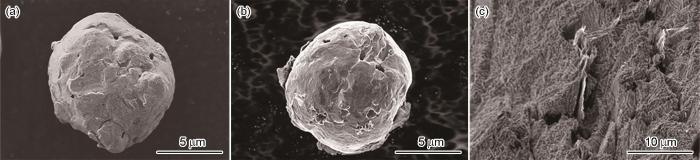
图1
Cu颗粒和Cu/rGO颗粒的SEM照片以及Cu/rGO块体在FeCl3/HCl溶液中蚀刻30 min后断裂区域的SEM照片
Fig.1
SEM images of Cu and Cu/rGO particles, respectively (a, b) and SEM images of fracture region of Cu/rGO bulk being etched in FeCl3/HCl solution for 30 min (c)
2.2 Cu和Cu/rGO块状试样的电化学腐蚀
图2
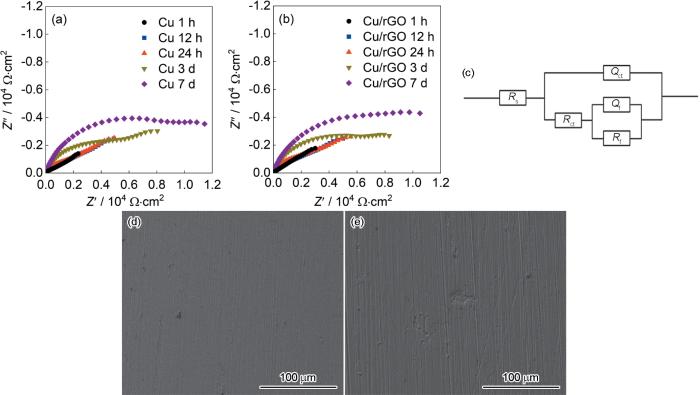
图2
Cu和Cu/rGO块体电化学蚀刻不同时间得到的Nyquist图、等效电路图、在3.5%的NaCl水溶液中蚀刻3 d后Cu和Cu/rGO块体表面的SEM照片
Fig.2
Nyquist plots of Cu and Cu/rGO bulk electrochemically etched for different time (a, b), equivalent electrical circuit (c), and SEM images of the surfaces of Cu and Cu/rGO bulk after being etched in 3.5%NaCl aqueous solution for 3 d (d, e)
表1 在电化学腐蚀环境Cu和Cu/rGO块体的EIS结果
Table 1
| Sample | Rs / Ω·cm2 | Qct / μF·cm-2 | nct | Rct / Ω·cm2 | Qf / μF·cm-2 | nf | Rf / Ω·cm2 | Error / % |
|---|---|---|---|---|---|---|---|---|
| Cu 1 h | 11.06 | 24.46 | 0.91 | 0.001025 | 830.7 | 0.3061 | 7.866 × 10¹⁰ | 2.53 |
| Cu 12 h | 8.36 | 65.91 | 0.78 | 498.3 | 455.1 | 0.3068 | 1.101 × 10¹¹ | 2.04 |
| Cu 24 h | 13.64 | 92.65 | 0.75 | 1048 | 558.4 | 0.3559 | 8.807 × 10¹⁰ | 1.88 |
| Cu 3 d | 8.57 | 103.4 | 0.77 | 5307 | 890.7 | 0.6229 | 1.054 × 10⁴ | 2.92 |
| Cu 7 d | 10.58 | 116.4 | 0.78 | 10560 | 1510 | 0.5659 | 6.734 × 10⁹ | 5.66 |
| Cu/rGO bulk-1 h | 7.79 | 27.07 | 0.89 | 7.5 | 767.4 | 0.3534 | 8.669 × 10¹¹ | 1.62 |
| Cu/rGO bulk-12 h | 7.56 | 86.34 | 0.77 | 566.4 | 450.2 | 0.3053 | 2.129 × 10¹¹ | 1.67 |
| Cu/rGO bulk-24 h | 8.11 | 102.1 | 0.77 | 1433 | 477.9 | 0.3292 | 4.013 × 10¹¹ | 1.87 |
| Cu/rGO bulk-3 d | 9.87 | 111.9 | 0.78 | 6003 | 821.3 | 0.5409 | 1.089 × 10⁴ | 2.56 |
| Cu/rGO bulk-7 d | 9.47 | 188.3 | 0.79 | 15222 | 390 | 0.2757 | 1.210 × 10¹⁰ | 3.52 |
表1中的Rs为3.5%NaCl水溶液的电阻;Rct为电解质与Cu或Cu/rGO界面的电荷转移电阻,其值越大表明腐蚀越难发生。由表1可见,随着浸泡时间的延长Cu和Cu/rGO的Rct都随之增大,表明发生腐蚀的难度逐渐提高;浸泡相同的时间,Cu/rGO的Rct始终比Cu的高,表明Cu/rGO的耐腐蚀性优于Cu。Q为非理想电容,n为频率弥散因子,二者表征在材料的蚀刻过程中表面的非均一性和表面反应活性[28,29]。其中Qct (电荷转移过程相关非理想电容)表征电极/电解质界面电荷转移过程的电容特性,nct (电荷转移过程频率弥散因子)反映该界面的非均一程度(nct越接近1,界面越均一);Qf (表面膜相关非理想电容)反映材料表面腐蚀产物膜或保护膜的电容特性,nf (表面膜过程频率弥散因子)反映该膜层的致密性与均匀性(nf越接近1,膜层越致密均匀)[30]。
本文的实验结果是,在高频段Cu/rGO的Qct大于Cu,表明Cu/rGO在电解质界面的电荷存储能力更强;随着浸泡时间延长,Cu与Cu/rGO的nct均逐渐降低,表明在腐蚀过程中材料表面产生的腐蚀坑数量逐渐增多(图2d、e),即Cu表面的腐蚀坑尺寸远比Cu/rGO的大,进一步表明Cu/rGO的耐腐蚀性更优。后续nct的数值回升,可能是腐蚀产物(CuCl x, x = 1或2)的堆积降低了材料表面粗糙度[26]。在低频段,Cu/rGO的Rf(表面膜电阻)比Cu的高,表明氯离子(Cl-)穿透Cu/rGO表面保护膜到达铜基体的难度更大[27]。而Cu和Cu/rGO的Qf以及对应的nf都无规律波动,可能是材料表面腐蚀产物的持续堆积和脱落或保护膜的多孔结构所致[31]。
图3a,b分别给出了Cu和Cu/rGO在3.5%NaCl水溶液中蚀刻不同时间的Tafel曲线。腐蚀电位Ecorr (V)表征材料的腐蚀敏感性;腐蚀电流Icorr (A·cm-2)为Tafel曲线阴极分支与阳极分支线性段外推的交点,其数值可用于计算电化学腐蚀速率(cm·a-1)
图3
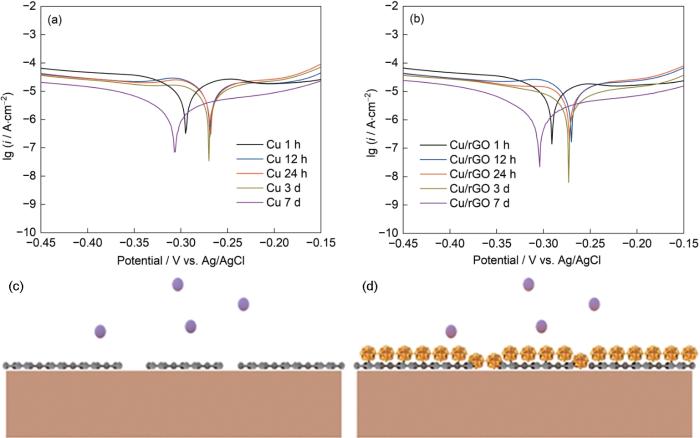
图3
Cu和Cu/rGO块体的Tafel曲线以及Cu/rGO块体在3.5%NaCl水溶液中电蚀刻3 d的示意图
Fig.3
Tafel plot of Cu and Cu/rGO bulks, respectively (a, b) and schematic diagram of Cu/rGO bulk etched electrochemically in 3.5%NaCl aqueous solution before and after 3 d (c, d)
式中K为常数(3270 mol·A-1),M为Cu的摩尔质量(64 g·mol-1),ρₘ为Cu (8.9 g·cm-3)或Cu/rGO块状材料(8.89 g·cm-3)的密度。耐蚀效率IE(%)表征材料的耐蚀性能提高的程度[32]
式中Icorr, c为Cu的腐蚀电流,Icorr, g为Cu/rGO块状材料的腐蚀电流。
由表2可见,Cu/rGO的腐蚀速率(1.89 cm·a-1)比Cu (2.9 cm·a-1)降低约34.8%,表明Cu/rGO中的rGO片层可保护铜基体免受3.5%NaCl水溶液的蚀刻。随着蚀刻时间的延长,Cu和Cu/rGO的Ecorr持续提高,表明材料的腐蚀敏感性提高。其原因可能是,材料在腐蚀过程中表面出现更多腐蚀活性位点,使腐蚀更容易发生;而Icorr持续减小,表明腐蚀速率降低。这可能是在表面堆积的腐蚀产物保护了基体。此外,腐蚀产物的堆积和脱落,使腐蚀速率随时间的变化趋势与Rf的变化趋势相同。
表2 电化学测量的腐蚀参数
Table 2
| Sample | Icorr / μA·cm-2 | Ecorr / mV | CR / cm·a-1 | IE / % |
|---|---|---|---|---|
| Cu-1 h | 123.4 | -295 | 2.90 | - |
| Cu-12 h | 55.89 | -269 | 1.31 | - |
| Cu-24 h | 32.37 | -268 | 0.76 | - |
| Cu-3 d | 23.31 | -270 | 0.55 | - |
| Cu-7 d | 5.962 | -307 | 0.14 | - |
| Cu/rGO bulk-1 h | 80.43 | -291 | 1.89 | 34.8 |
| Cu/rGO bulk-12 h | 38.15 | -270 | 0.90 | 31.7 |
| Cu/rGO bulk-24 h | 25.13 | -272 | 0.59 | 22.4 |
| Cu/rGO bulk-3 d | 17.92 | -273 | 0.44 | 23.1 |
| Cu/rGO bulk-7 d | 4.852 | -304 | 0.11 | 18.6 |
2.3 盐雾腐蚀及其对Cu/rGO块状材料力学性能的影响
图4a中的插图给出了Cu和Cu/rGO试样在35 ℃经历两个盐雾循环后的形貌。可以看出,两种材料腐蚀后表面都出现了大量腐蚀坑,但其形貌明显不同:清除Cu试样表面的腐蚀产物后可观察到较多的铜表面,而Cu/rGO表面无此现象。
图4
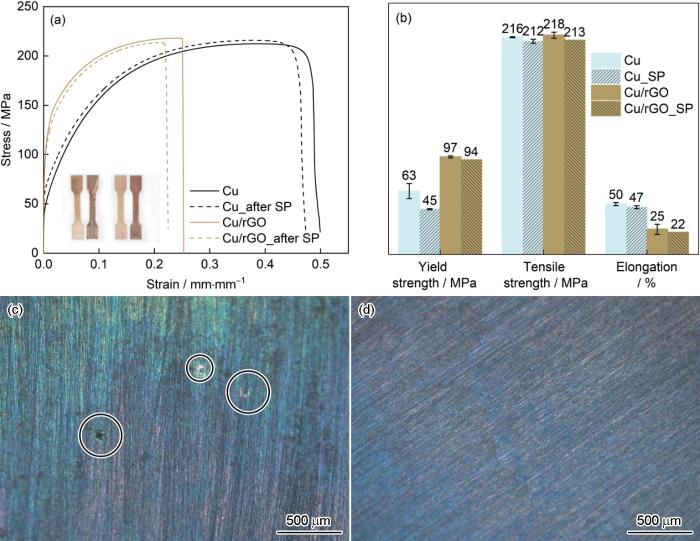
图4
在不同盐溶液中蚀刻前后Cu和Cu/rGO块体的拉伸应力-应变曲线、在不同盐溶液条件下蚀刻前后Cu和Cu/rGO块体的机械性能柱状图以及在3.5%的NaCl盐雾中Cu及Cu/rGO块体的光学显微镜照片
Fig.4
Tensile stress-strain curves of Cu and Cu/rGO bulks before and after etching under different salt pray conditions (a), comparative bar chart of mechanical properties of Cu and Cu/rGO bulks before and after etching under different salt pray conditions (b) and optical microscope images of Cu and Cu/rGO bulks composite in 3.5%NaCl SP (c, d)
用质量损失率
表3 盐雾处理前后Cu和Cu/rGO/氧化石墨烯块体的质量和电阻率
Table 3
| Sample | m1 / g | m2 / g | Rsp / g·cm-2·h-1 |
|---|---|---|---|
| Cu | 0.2679 | 0.2670 | 1.875 × 10⁻⁵ |
| Cu/rGO bulk | 0.3104 | 0.3101 | 0.625 × 10⁻⁵ |
3 结论
(1) 在NaCl水溶液中,Cu/rGO的耐腐蚀性能优于纯铜。rGO显著提高了复合材料界面的电荷转移电阻(Rct)和表面膜电阻(Rf),阻碍了Cl-的扩散和电化学反应,从而延缓了腐蚀。
(2) 均匀分布在铜基体中的rGO形成了物理屏障结构,浸入NaCl水溶液的初期隔离了腐蚀介质与铜基体的接触,在表面形成了腐蚀产物层,极为致密的rGO抑制了腐蚀的继续。在腐蚀过程中Qct和nct的变化表明,Cu/rGO的界面特性更为稳定。
(3) 在高温、高湿、高盐环境中Cu/rGO的防护性能良好。Cu/rGO表面的腐蚀坑数量少且尺寸小,减缓了应力集中而使其屈服强度降低的幅度远低于纯铜。虽然腐蚀坑使其有效承载界面减小而使两种材料的拉伸强度和伸长率均有所降低,但是Cu/rGO屈服强度有限的降低表明其结构稳定性和耐久性更优。
参考文献
Optical properties and electronic structure of dilute Cu-Au, Cu-Zn, Cu-Al, Cu-Ga, Cu-Si, Cu-Ge, Cu-Sn, and Cu-As alloys
[J].
Nanostructured Al and Cu alloys with superior strength and electrical conductivity
[J].
Copper-graphene composite (CGC) conductors: synthesis, microstructure, and electrical performance
[J].
Progress of highly conductive graphene-reinforced copper matrix composites: a review
[J].
Self-limiting oxidation of copper
[J].
The classical theory of Cabrera–Mott describes passivation film formation on metals, where they predicted that this film grows as a uniform layer due to a field-enhanced ionic transport mechanism. Here we present experimental evidence, based on in situ transmission electron microscopy of copper oxidation, that the passivation film nucleates and grows as oxide islands, not as a uniform layer. We propose an alternative phenomenological theory to describe passivation film formation, based on island growth followed by coalescence.
Oxidation of polycrystalline copper thin films at ambient conditions
[J].
Corrosion behavior of copper alloys in chloride media
[J].
Advancements in corrosion studies and protective measures for copper and copper-based alloys in varied environmental conditions
[J].
Coordination interaction of biologically important macromolecules with metals and alloys for corrosion protection: an extensive study
[J].
Developing process for coating copper particles with silver by electroless plating method
[J].
Electroless silver coating on fine copper powder and its effects on oxidation resistance
[J].
Composite coatings based on nickel and Y2O3 nanoparticles: a comprehensive analysis of developments in electrodeposition and functional property optimization
[J].
An historical perspective on the corrosion protection by paints
[J].
A review on bio-inspired corrosion resistant superhydrophobic coating on copper substrate: recent advances, mechanisms, constraints, and future prospects
[J].
Recent advances in protective technologies against copper corrosion
[J].Copper, one of the most frequently utilized non-ferrous metals, finds extensive applications in the electrical industry, mechanical engineering, construction industry, and arm production. Long-term exposure to corrosive environments including moisture, sulfur, chlorine, and microbes induces corrosion, a significant factor contributing to material deterioration. Consequently, numerous scientific endeavors have been directed towards the prevention of copper corrosion. Notably, coating copper with innovative materials like graphene, boron nitride, and various conductive polymers has proven effective in thwarting corrosion. Additionally, the introduction of new organic compounds, including azole derivatives, amino acids, and N-heterocyclic carbenes, has bolstered the eco-friendliness and efficiency of corrosion inhibitors and molecular passivation techniques. Furthermore, these approaches have been extensively investigated for their efficacy in antioxidation of copper nanomaterials. This study provides a comprehensive review of the latest advancements in protective technologies, such as anti-corrosion coatings, corrosion inhibitors, and molecular passivation layers, aimed at countering copper corrosion under aggressive conditions.
The wet‐oxidation of a Cu(111) foil coated by single crystal graphene
[J].
Electrochemical behaviour of chromium-graphene composite coating
[J].
Electrochemical behavior of Sn-graphene composite coating
[J].
Morphology, texture and corrosion behavior of nanocrystalline copper-graphene composite coatings
[J].
Fluorinated graphene film for corrosion control on copper: experimental and theoretical studies
[J].
Polydopamine improved anticorrosion of graphene on copper: inhibiting galvanic corrosion and healing structure defects
[J].
Improved corrosion resistance of copper coated by graphene
[J].
Enhanced corrosion resistance in metal matrix composites assembled from graphene encapsulated copper nanoflakes
[J].
In-situ synthesized graphene reinforced copper matrix composites with enhanced thermal properties and corrosion resistance
[J].
Corrosion and cavitation erosion behavior of GLNN/Cu composite in simulated seawater
[J].Herein, three-dimensional graphene-like nanosheet network (3D-GLNN)/copper (Cu) materials were synthesized using hop-pressing (HP) and hot-rolling (HR) methods and their corrosion resistance and mechanism were investigated using polarization curves, electrochemical impedance spectroscopy (EIS), and weight loss data after a cavitation corrosion test. Microstructural characterization results revealed that the 3D-GLNN structure was intact in the bulk composites, thereby restricting the effective grain growth of the Cu matrix. Compared with pure Cu, the Vickers hardness of 3D-GLNN/Cu fabricated using the HP and HR methods improved by 8% and 46%, respectively. Polarization curve results indicated that the anodic dissolution current of 3D-GLNN/Cu was considerably lower than that of pure Cu, indicating that 3D-GLNN/Cu exhibited better corrosion resistance. EIS measurements under a corrosion potential revealed that the electrode process kinetics was complex, with both charge and mass transfer controlling it. By extending the immersion time from 1 h to 9 d, the corrosion potential first became positive and then became negative. The capacitance arc at a high-frequency EIS range first increased and then decreased, attributed to the formation and detachment of a CuCl salt film. Diffusion impedance was observed in the low-frequency EIS range, with a phase angle of 18°-23°, indicating that the mass transfer process was not attributed to a single species but controlled by anodic and cathodic reactants. The constant phase angle element (CPE) behavior of the electrochemical system was further evaluated using the ohm-corrected phase angle and impedance modulus. The high-frequency phase angle was greater than -90 °, while the slope of impedance modulus was approximately -0.9; thus, the CPE was used to model the EIS data. The CPE behavior was attributed to the surface distribution of the charge transfer resistance and interface capacitance, implying a time-constant dispersion on the surface. Weight loss data after the cavitation corrosion test indicated that pure Cu showed better cavitation resistance than 3D-GLNN/Cu fabricated using the HR and HP methods. This is because of the difference in the elastic modulus between the graphene and Cu matrix that caused deformation dissonance during cavitation erosion.
三维石墨烯/Cu复合材料在模拟海水环境中的腐蚀和空蚀行为
[J].采用热压和热轧方法制备了三维石墨烯纳米片网络/Cu复合材料(3D-GLNN/Cu),组织表征结果表明,在块体复合材料中石墨烯网络结构保持完整,有效限制了Cu基体晶粒长大,热压态和热轧态3D-GLNN/Cu的硬度分别较纯Cu提高了8%和46%。采用电化学方法和空蚀失重分析研究了其在模拟海洋环境中的腐蚀和空蚀行为。极化曲线测试结果表明,3D-GLNN/Cu的阳极溶解电流与热压态纯Cu相比显著降低,热轧处理对复合材料的耐蚀性影响不大。腐蚀电位下的电化学阻抗谱(EIS)及电化学等效电路拟合分析结果表明,3D-GLNN/Cu的电极过程动力学较为复杂,主要受电荷转移和扩散过程共同控制。欧姆电阻校正后的Bode图结果表明,高频区的相位角大于-90°而阻抗模斜率约为-0.9,Cu及2种3D-GLNN/Cu复合材料在模拟海水中均存在常相位角元件(CPE)特征,这主要是因为电极表面材料结构和成分不均一性导致的局部界面电容和电荷转移电阻存在差异。随着浸泡时间延长(从1 h到9 d),EIS高频区容抗弧均是先增加后减小,主要是因为腐蚀生成的CuCl盐膜在表面的覆盖与局部脱落有关,EIS低频区出现扩散阻抗特征,且低频区相位角为18 °~23 °,说明电极过程不是单一反应物的Warburg扩散阻抗特征,而是受阴阳极传质过程共同控制。空蚀失重结果表明,热轧后的3D-GLNN/Cu与热压态的材料相比,耐空蚀性能显著下降,这主要是因为石墨烯与Cu基体的弹性模量的差异,在空蚀机械冲击力作用下形变不协调,易产生凹坑。
On the electrical capacitance of interfaces exhibiting constant phase element behaviour
[J].
General equivalent circuits for faradaic electrode processes under electrochemical reaction control
[J].
Electrochemical impedance spectroscopy─a tutorial
[J].
Electrochemical behaviour of copper-nickel alloy in chloride solution
[J].
Fabrication of functionalized graphene oxide/maleic anhydride grafted polypropylene composite film with excellent gas barrier and anticorrosion properties
[J].
An exploratory study of the corrosion of Mg alloys during interrupted salt spray testing
[J].
Research on local corrosion evolution and residual strength of 7005 aluminium
[D].
7005铝材局部腐蚀演变规律及剩余强度研究
[D].


