



非均质钢软硬相结合的特征,使其具有优异的强韧性匹配[4,5]。调节化学成分和制备工艺和调控双相或复相的组织占比、晶粒尺寸和结构形态,可提高材料的性能[6,7]。多段轧制控轧控冷一体化的热机械轧制工艺,可产生细小非均质组织[8]。在奥氏体-铁素体临界区的等温处理的临界热处理可获得双相或复相结构,是调控中厚板组织的重要手段[9]。Huang等[10]用循环退火-冷轧法制备纳米片层状钢,进行短时临界退火制备出兼具强度和延展性的超细晶非均质双相钢。Alibeyki等[11]对冷轧马氏体进行临界退火得到更高体积分数的马氏体,提高了材料的加工硬化速率和综合力学性能;Soleimani和Mirzadeh[12]进行交叉轧制+临界退火使双相钢具有细小再结晶铁素体晶粒和均匀分布马氏体岛结构,使其强韧性匹配大幅度提高;Gao等[13]用热轧+临界退火制备出具有高马氏体含量且晶粒细化的成双相钢,将低碳钢的强度提高到1.6 GPa。但是,目前对热机械控制工艺(Thermo-mechanical control process, TMCP)+临界热处理(Intercritical annealing, IA)新技术尚缺少系统和深入研究。本文研究临界退火工艺对500 MPa级风电用钢焊接接头断裂韧性的优化。
1 实验方法
实验用典型风电用Q500钢板的化学成分如表 1所示。用TMCP制备原始厚度为240 mm的钢板:在1200 ℃固溶2 h后进行7道次粗轧和4道次精轧,轧成25 mm厚钢板,命名为供货原始态(Original state, OR)。使用Thermo-calc软件模拟Q500相与温度间的变化关系(其Ac1和Ac3温度分别为650 ℃和826 ℃),设计三种临界退火工艺:分别加热至720 ℃、750 ℃和800 ℃保温15 min后水冷至室温。将上述OR和三种热处理后的钢板进行埋弧焊将V型坡口对接,分别得到OR-WM,720-WM,750-WM和800-WM的钢板,焊材为H08Mn2Mo。焊接电流为550~580 A,电压为30 V,焊接速度为30~42 cm/min。
表1 Q500的化学成分
Table 1
| C | Si | Mn | P | S | Cu | Ni | Cr | Nb | Fe |
|---|---|---|---|---|---|---|---|---|---|
| 0.09 | 0.22 | 1.60 | 0.008 | 0.002 | 0.01 | 0.20 | 0.35 | 0.04 | Bal. |
按照GB/T 228.1-2021使用型号为Instron 5982的设备进行常规室温拉伸实验。试样的尺寸示意图如图1a所示,其长度方向为钢板的轧制方向。在焊板上截取试样,至少一侧基体、热影响区及焊缝在标距段内。实验中的应变速率为10-3 s-1,拉伸速度为1.8 mm/min,引伸计跟踪至2%。每种材料测试三个试样,取其拉伸数据的平均值。
图1
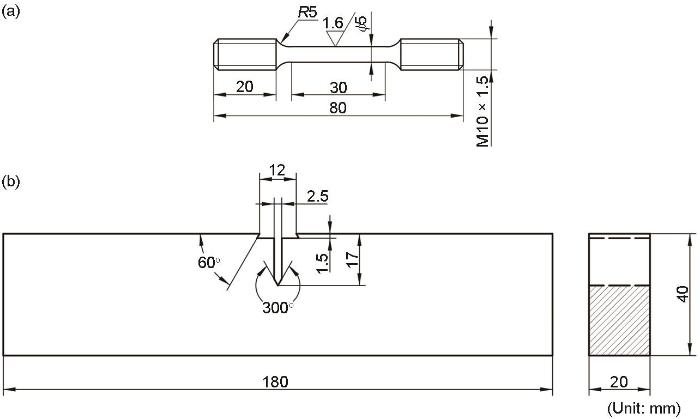
图1
试样尺寸的示意图
Fig.1
Dimension diagrams of specimens (a) tensile specimen, (b) CTOD specimen
使用全自动显微硬度测试系统Leco Amh43按照GB/T 4340.1-2024测试试样的维氏硬度,沿轧制方向测量焊缝试样的硬度,包括基体、热影响区和焊缝,不少于20个点,载荷为0.147 N,保载时长为13 s。
用Zeiss Sigma 500型场发射电子显微镜(Scanning electron microscope, SEM)观察试样的显微组织,加速电压为20 kV,工作距离为10~15 mm。用型号为JSM-6510的钨灯丝SEM观察拉伸试样断面和微观结构,加速电压为20 kV,工作距离为18~24 mm。用体视显微镜VHX-1000E观察CTOD试样断面的宏观组织。
2 结果和讨论
2.1 焊接接头的组织
OR-WM、720-WM、750-WM和800-WM的焊接接头,包括母材(Base material, BM)、热影响区(Heat affected zone, HAZ,分为细晶区与粗晶区)和焊缝(Weld material, WM),其组织如图2所示。其中OR-WM的母材即为OR,如图2a1所示,结构为针状铁素体、粒状贝氏体和少量马氏体组成的复相组织,呈现出明显的轧制条带。OR-WM的细晶区组织为铁素体+珠光体;粗晶区组织为板条状铁素体和粒状贝氏体的混合体。焊接时奥氏体晶粒严重长大,使其比母材的晶粒粗大;焊缝的组织为细小的针状铁素体和马氏体/奥氏体(M/A)组元,部分M/A组元的晶界带有尖角弥散。
图2
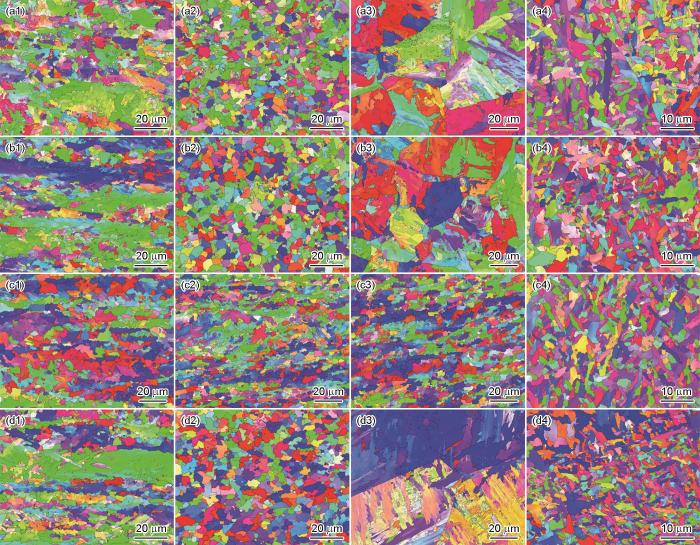
图2
各焊接试样母材、热影响区(细晶区和粗晶区)和焊缝区的微观组织
Fig.2
Microstructure of the base metal (1), the heat affected zone (fine-grained zone (2) and coarse-grained zone (3)), and the weld metal (4) of each welded specimens (a1-a4) OR-WM, (b1-b4) 720-WM, (c1-c4) 750-WM, (d1-d4) 800-WM
不同热处理后的720-WM、750-WM和800-WM的母材均具有铁素体和马氏体的软硬相结合的双相组织,其中的马氏体大多为团状,部分是临界铁素体内的马氏体岛。三者的细晶区均由铁素体与珠光体组成,其中720-WM和800-WM的组织大多为等轴晶,750-WM的组织大都为条状结构。720-WM和800-WM粗晶区的显微组织均由铁素体和少量贝氏体组成,原奥氏体晶界和平行排列的板条状铁素体清晰可见,其中750-WM的原奥氏体晶粒更为细小。而750-WM的结构为条状铁素体+等轴状珠光体。三种热处理后的材料其焊缝组织均为铁素体和多形态的M/A组元,720-WM的M/A组元多为带有尖角的条状,而750-WM和800-WM的M/A组元大多为块状。
2.2 焊接接头的显微硬度
OR和热处理后的焊接试样的硬度分布,如图3a~d所示。可以看出,OR-WM、720-WM、750-WM和800-WM母材的平均硬度分别为219、218、229和241HV,其中720-WM母材的硬度略比OR的低,而750-WM和800-WM母材的硬度明显提高。四种焊接接头焊缝的硬度接近,与焊接填充材料和工艺相同有关。热影响区的硬度变化较大,靠近焊缝的硬度较大,靠近母材的硬度最小。其原因是,焊缝旁热影响区的温度高于晶粒长大温度并低于固相线温度[15],使奥氏体晶粒长大,冷却后奥氏体发生相变形成板条组织,使韧性降低的同时还提高了硬度;而靠近母材的亚临界热影响区在热循环过程中热输入量小[16],在冷却过程中基体组织发生变化,热量引起的回复和再结晶使该处软化,因此硬度最低。
图3
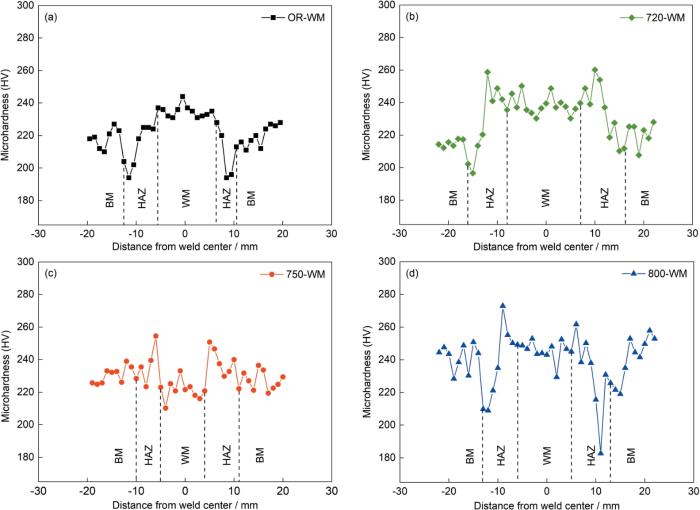
图3
各焊接接头的显微硬度分布
Fig.3
Microhardness distributing curves of the welded joints (a) OR-WM, (b) 720-WM, (c) 750-WM, (d) 800-WM
2.3 试样的拉伸性能
图4
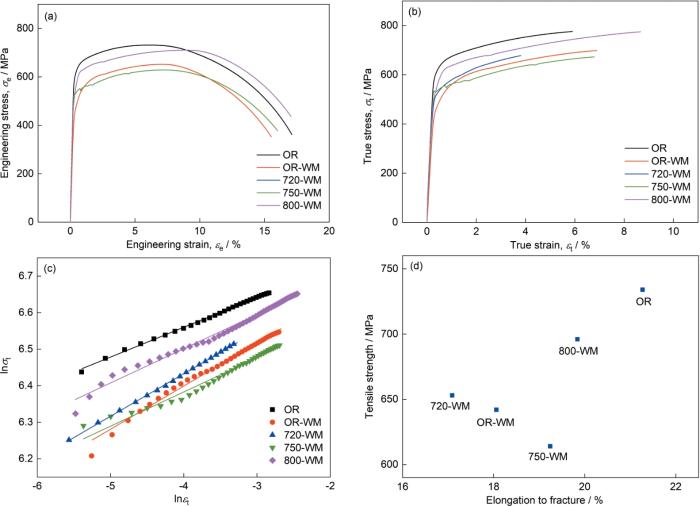
图4
工程应力-应变曲线、真应力-应变曲线、Hollomon分析曲线以及抗拉强度与伸长率的关系
Fig.4
Engineering stress-strain curves (a), true stress-strain curves (b), Hollomon analysis curves (c) and relation between tensile strength and elongation to fracture (d)
分析四种试样的均匀塑性阶段。式中σt为真应力;εt为真应变;K为硬化系数;n为应变硬化指数。
表2 Q500和热处理试样的拉伸性能
Table 2
| Specimen | σy / MPa | σb / MPa | At / % | Au / % | K | n |
|---|---|---|---|---|---|---|
| OR | 622 | 734 | 21.27 | 5.62 | 978 | 0.082 |
| OR-WM | 493 | 642 | 18.06 | 6.61 | 965 | 0.118 |
| 720-WM | 522 | 653 | 17.09 | 5.51 | 991 | 0.117 |
| 750-WM | 521 | 614 | 19.24 | 6.55 | 861 | 0.094 |
| 800-WM | 555 | 696 | 19.84 | 8.63 | 969 | 0.094 |
OR-WM、720-WM、750-WM和800-WM拉伸断口的宏观断面,如图5所示。可以看出,拉伸断裂处有明显的塑性变形和颈缩现象,均出现明显的纤维区和剪切唇。其中OR-WM和750-WM的断面接近正圆形,而720-WM和800-WM的断面则呈椭圆形。对试样剖面的观察可以确定,断裂位置在热影响区与母材间的硬度“洼地”附近。此处是热影响区等轴细晶与母材轧制条带结构的融合区域,试样断裂的圆形断口在等轴细晶区,而椭圆形断口则在轧制条带。在拉伸过程中发生的塑性形变使组织由单向应力转变为三向应力状态,结构取向的不同导致晶粒在各方向的变形不同,因此轧制条带组织的各向异性使其形成椭圆形拉伸断口。
图5
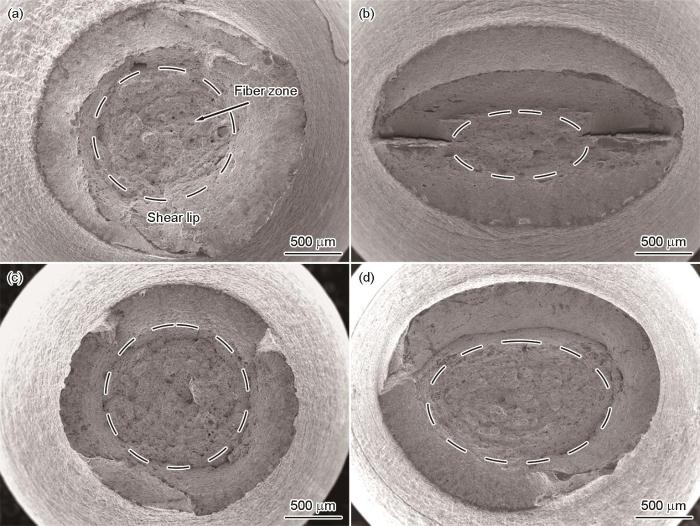
图5
各焊接材料的拉伸宏观断面
Fig.5
Macroscopic tensile fracture surface (a) OR-WM, (b) 720-WM, (c) 750-WM, (d) 800-WM
OR-WM、720-WM、750-WM和800-WM的拉伸纤维区形貌,如图6所示。可以看出,四种试样的纤维区均由大量的韧窝和孔洞组成。其中OR-WM、720WM和800-WM纤维区的韧窝深浅不一且有较大的孔洞,而750-WM则为较小的等轴韧窝且整体较为均匀且致密,表明其断裂位置的组织形貌较为均匀。
图 6
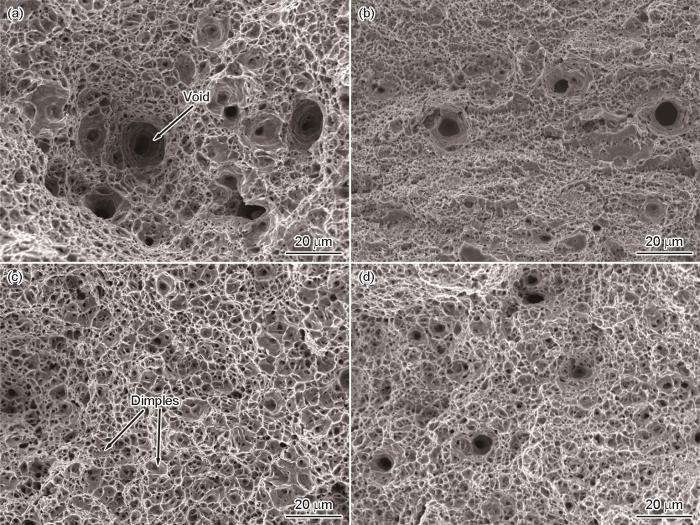
图 6
各焊接材料的拉伸纤维区形貌
Fig.6
Morphology of fibrous zone of tensile specimen (a) OR-WM, (b) 720-WM, (c) 750-WM, (d) 800-WM
2.4 CTOD的断裂韧性
OR、OR-WM、720-WM、750-WM和800-WM试样CTOD实验的裂纹位移与载荷Force (F-V)曲线如图7a所示。可以看出,OR-WM、750-WM和800-WM的加载曲线与工程应力-应变曲线相似,表明裂纹尖端经历了由弹性变形到塑性变形的过程,是典型的韧性断裂,并得到断裂最大值δm。而OR和720-WM在载荷上升至最大值前就失稳下降,表明在裂纹塑性扩展过程中突然以脆性方式裂开,其CTOD特征值对应脆性失稳值δu。
图7
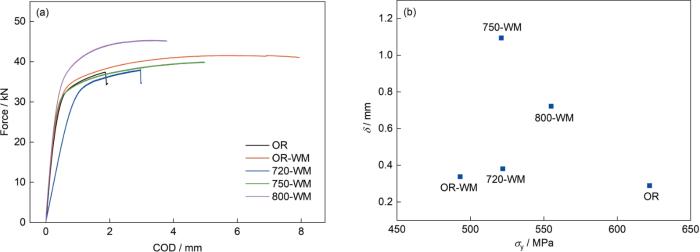
表3 初始裂纹的长度 (mm)
Table 3
| Specimen | a01 | a02 | a03 | a04 | a05 | a06 | a07 | a08 | a09 | a0 |
|---|---|---|---|---|---|---|---|---|---|---|
| OR | 21.98 | 22.79 | 22.99 | 23.08 | 23.08 | 22.99 | 22.79 | 22.38 | 21.37 | 22.72 |
| OR-WM | 22.22 | 22.69 | 22.70 | 22.58 | 22.58 | 22.74 | 22.80 | 22.55 | 21.97 | 22.59 |
| 720-WM | 22.02 | 22.41 | 22.04 | 20.89 | 21.10 | 22.58 | 23.21 | 23.22 | 22.63 | 22.22 |
| 750-WM | 21.85 | 22.23 | 22.28 | 21.87 | 21.67 | 22.57 | 22.96 | 22.56 | 22.11 | 22.27 |
| 800-WM | 21.62 | 22.10 | 22.24 | 22.16 | 21.95 | 22.04 | 22.07 | 21.99 | 21.43 | 22.20 |
表4 终止裂纹的长度 (mm)
Table 4
| Specimen | a1 | a2 | a3 | a4 | a5 | a6 | a7 | a8 | a9 | a |
|---|---|---|---|---|---|---|---|---|---|---|
| OR | 22.19 | 22.96 | 23.26 | 23.30 | 23.36 | 23.27 | 23.07 | 22.52 | 21.54 | 22.95 |
| OR-WM | 23.88 | 23.97 | 24.30 | 25.16 | 25.45 | 24.77 | 24.20 | 23.69 | 22.94 | 24.37 |
| 720-WM | 22.16 | 22.80 | 22.37 | 21.04 | 21.40 | 22.71 | 23.36 | 23.53 | 22.81 | 22.46 |
| 750-WM | 22.21 | 22.83 | 23.37 | 23.04 | 23.48 | 23.81 | 24.25 | 23.64 | 22.72 | 23.36 |
| 800-WM | 22.02 | 22.38 | 22.95 | 23.29 | 23.53 | 23.42 | 23.10 | 22.33 | 21.78 | 22.86 |
可分别计算出初始裂纹长度a0和终止裂纹长度a,二者之差为裂纹扩展量∆a。
OR和不同热处理CTOD实验用试样的厚度B、宽度W、跨距S,载荷F,转动半径R以及缺口张开位移塑性分量Vp,列于表5。由
表5 Q500和热处理试样的CTOD实验结果
Table 5
| Specimen | B / mm | W / mm | S / mm | a0 / mm | ∆a / mm | F / kN | R / mm | Vp / mm | δ / mm | Type |
|---|---|---|---|---|---|---|---|---|---|---|
| OR | 19.98 | 39.95 | 160 | 22.72 | 0.23 | -37.42 | 28.37 | 1.44 | 0.289 | u |
| OR-WM | 20.18 | 39.94 | 160 | 22.59 | 1.78 | -41.56 | 29.47 | 1.42 | 0.338 | m |
| 720-WM | 20.18 | 40.07 | 160 | 22.02 | 0.24 | -38.09 | 28.00 | 1.55 | 0.381 | u |
| 750-WM | 20.09 | 39.68 | 160 | 22.27 | 1.10 | -39.96 | 28.62 | 4.59 | 1.094 | m |
| 800-WM | 20.01 | 39.87 | 160 | 22.01 | 0.85 | -45.36 | 28.28 | 2.90 | 0.722 | m |
CTOD特征值表征材料中裂纹尖端扩展的抵抗能力。计算结果表明,断裂韧性高低的排序为OR、OR-WM、720-WM、800-WM和750-WM,均大于常规表中CTOD的参考值0.15 mm,表明本文实验用的焊接工艺优异,所得接头的断裂韧性较好。
五种试样的CTOD宏观断面形貌,如图8所示。根据断裂特征可将断面分为预制疲劳裂纹区、裂纹扩展区和剪切唇,其中预制疲劳裂纹区较为平整,裂纹扩展区位于断面的中心,剪切唇在边缘呈杯壁状。在宏观断面可观察到在焊缝试样的裂纹扩展区内均有较大的二次裂纹。因为这些试样中的韧性裂纹均先从中间扩展,在内部形成空洞使试样两侧向内挤压而产生二次裂纹。
图8
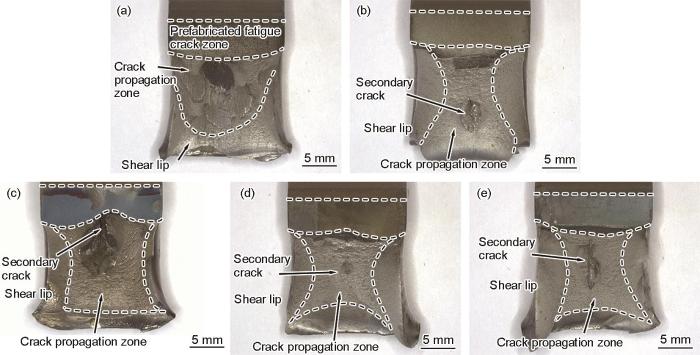
图8
CTOD试样的宏观断面
Fig.8
Macroscopic fracture surface of CTOD specimens (a) OR, (b) OR-WM, (c) 720-WM, (d) 750-WM, (e) 800-WM
各试样的预制疲劳裂纹区、裂纹扩展区和剪切唇的微观形貌,如图9所示。可以看出,在五种试样的预制疲劳裂纹区都生成了明显的二次裂纹且其扩展方向与其垂直;裂纹扩展区则由大小不同的等轴和椭圆形韧窝组成,表明其为韧性断裂。图9a3给出的OR试样剪切唇由河流花样、解理台阶和韧窝组成,表明其为韧脆结合断裂。Neves和Loureiro[21]在韧性较低的试样上发现断裂面具有脆性特征,与本文的结果相似。OR-WM的剪切唇(图9b3)韧窝呈椭圆形和抛物线形,比裂纹扩展区中的韧窝小而浅,表明其终断以剪切应力为主导。从图9c3、d3、e3可见,720-WM、750-WM和800-WM的剪切唇由等轴韧窝组成,比裂纹扩展区的韧窝小且密集,表明在断口边缘产生了塑性变形且仍以正应力为主导。
图9
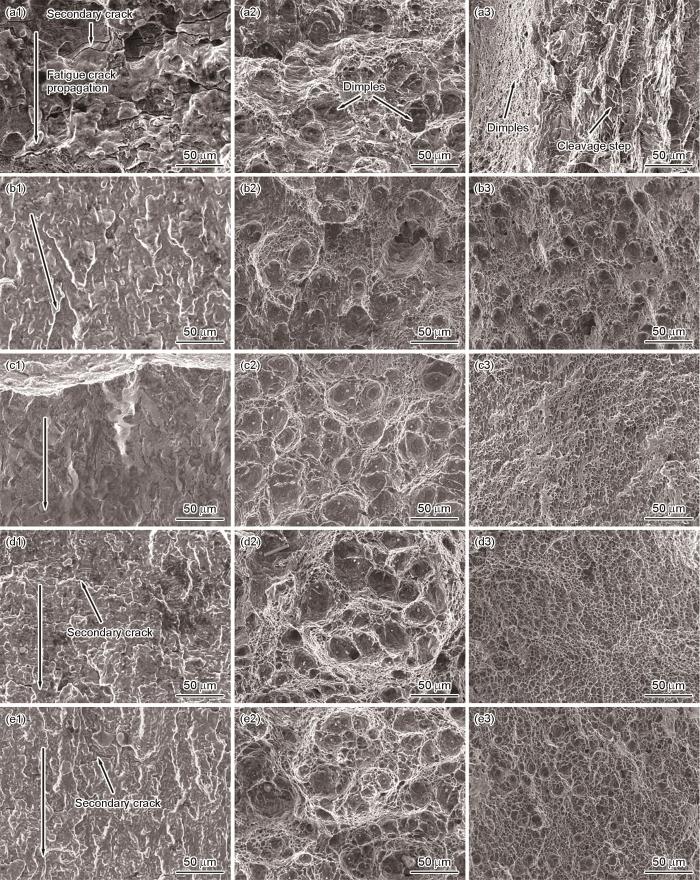
图9
各CTOD试样的预制疲劳裂纹区、裂纹扩展区和剪切唇的微观形貌
Fig.9
Microscopic morphology of prefabricated fatigue crack zone (1), crack propagation zone (2) and shear lip (3) of CTOD specimen (a1-a3) OR, (b1-b3) OR-WM, (c1-c3) 720-WM, (d1-d3) 750-WM, (e1-e3) 800-WM
CTOD试样剖面的裂纹扩展形貌,如图10所示。由图10a可见,OR组织内粒状贝氏体和晶界出现微孔,是塑性变形能力较强的基体铁素体与粒状贝氏体的硬度差产生的应力不均匀所致。在图10b的OR-WM中可见主裂纹向内扩展产生的二次裂纹,其扩展受M/A组元阻碍在晶界发生偏转。此外,部分裂纹在尖角型M/A组元处萌生和扩展,其原因是尖角型M/A组元严重阻碍塑性变形过程中的位错运动,导致位错塞积而产生局部应力集中。这种应力集中为微裂纹萌生提供条件,使其断裂韧性降低[22]。从图10c可见,裂纹穿过720-WM细晶区的铁素体和珠光体,其双相结构没有显著阻碍裂纹的扩展。在750-WM和800-WM (图10d,e)断面附近的铁素体发生了严重的塑性变形,导致在铁素体与M/A组元间产生了微小的孔洞。组织中的晶粒细小将孔洞的局部应力均匀化,小尺寸M/A组元抑制微孔长大使相互连接减小形成了裂纹[23,24],使断裂韧性提高。其中750-WM中的板条状铁素体和M/A组元在大量塑性变形过程中使板条束细化,增大了主裂纹在M/A组元和铁素体间连续扩展的阻力,使扩展路径的曲折程度和扩展所需能量显著提高,从而使其断裂韧性进一步提高。
图10
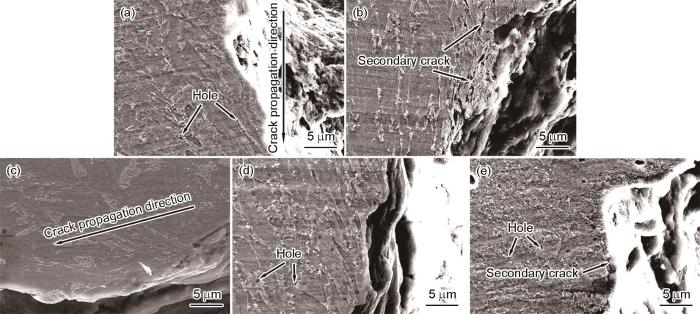
图10
CTOD试样剖面的裂纹扩展形貌
Fig.10
Crack propagation morphology on the section of the CTOD specimen (a) OR, (b) OR-WM, (c) 720-WM, (d) 750-WM, (e) 800-WM
3 结论
(1) 对用TMCP制备的500 MPa级别风电钢进行临界退火优化处理,可得到铁素体和马氏体岛组成的双相结构组织。焊接接头热影响区的组织以板条状铁素体为主。焊接接头中心由铁素体和M/A组元构成,其中750-WM和800-WM的M/A组元分别呈条状和块状结构。
(2) 800-WM焊缝的块状M/A组元和板条状铁素体可极大地提高其焊接强韧性,使其显著优于OR-WM。
(3) 在-20 ℃低温下,750-WM的CTOD特征值最优且其断裂韧性较好,源于热影响区和焊接区的晶粒细小,焊缝中的板条状铁素体和M/A组元在塑性变形中的束化使其断裂韧性提高。800-WM焊缝的小尺寸块状M/A组元抑制微孔长大和扩展使其断裂韧性提高。
参考文献
The 2024 China wind power installation capacity statistical brief
[J].
2024年中国风电吊装容量统计简报
[J].
Hydrogen storage in wind turbine towers
[J].
Low-temperature toughness properties of 500 MPa offshore steels and their simulated coarse-grained heat-affected zones
[J].
Ultrastrong low-carbon nanosteel produced by heterostructure and interstitial mediated warm rolling
[J].
We break the limit of grain refinement and strength of low-carbon steel by tuning deformation compatibility of heterostructure.
Towards strength-ductility synergy in a medium Mn steel through developing heterogeneous dual-morphology microstructure
[J].
Formation mechanism and control methods of acicular ferrite in HSLA steels: a review
[J].High strength low alloy (HSLA) steels have been widely used in pipelines, power plant components, civil structures and so on, due to their outstanding mechanical properties as high strength and toughness, and excellent weldability. Multi-phase microstructures containing acicular ferrite or acicular ferrite dominated phase have been proved to possess good comprehensive properties in HSLA steels. This paper mainly focuses on the formation mechanisms and control methods of acicular ferrite in HSLA steels. Effect of austenitizing conditions, continuous cooling rate, and isothermal quenching time and temperature on acicular ferrite transformation was reviewed. Furthermore, the modified process to control the formation of multi-phase microstructures containing acicular ferrite, as intercritical heat treatments, step quenching treatments and thermo-mechanical controlled processing, was summarized. The favorable combination of mechanical properties can be achieved by these modified treatments.
Segregation effects in a high-strength wind power steel: microstructure, mechanical properties, and hydrogen embrittlement sensitivity of base metal and simulated HAZ
[J].
Acquiring a low yield ratio well synchronized with enhanced strength of HSLA pipeline steels through adjusting multiple-phase microstructures
[J].
Dual-phase hetero-structured strategy to improve ductility of a low carbon martensitic steel
[J].
Fine-grained dual phase steel via intercritical annealing of cold-rolled martensite
[J].
Enhanced mechanical properties of dual phase steel via cross rolling and intercritical annealing
[J].
Strengthening and ductilization of laminate dual-phase steels with high martensite content
[J].The steels with excellent strength and ductility are expected to be achieved by tailoring the microstructural features. In this work, laminate dual-phase (DP) steels with high martensite content (laminate HMDP steels) were produced by a combination of warm rolling and intercritical annealing. Influence of rolling strain and annealing temperature on the microstructural evolution and mechanical properties of laminate HMDP steels were systematically studied. The strength of HMDP steels was significantly improved to ~1.6 GPa associated with a high uniform elongation of 7%, as long as the laminate structure is maintained. The strengthening and ductilizing mechanisms of laminate HMDP steels are discussed based on the influence of laminate structure and the high martensite content, which promote the development of internal stresses and can be correlated to the Bauschinger effect as measured by the cyclic loading-unloading-reloading experiments. Detailed transmission electron microscopy (TEM) observation was applied to characterize the dislocation structure in the deformed ferrite.
Study on microstructure and fracture toughness of welded joint of 30CrMo/Q420qE high performance bridge steel
[J].
30CrMo/Q420qE桥梁钢焊接接头显微组织及断裂韧性研究
[J].
Effect of heat input on low temperature toughness and corrosion resistance of Q1100 steel welded joints
[J].Welded joints of Q1100 ultra high strength steel were made via gas shielded arc welding with welding heat inputs of 10 kJ/cm and 15 kJ/cm respectively. The microstructure, mechanical properties and local corrosion behavior of welded joints were studied. The results show that the microstructure of weld zone for the two welded joints is mainly acicular ferrite and a small amount of granular bainite. The microstructure is lath bainite for the coarse grain zone, and lath bainite and granular bainite for the fine grain zone of the weld joints. The microstructure of the critical phase transition zone is a mixture of polygonal ferrite, Mayo islets and carbide. The charge transfer resistance of various portions of the two welded joints could be ranked as the following order: base metal > heat affected zone > weld zone. The base metal had the best corrosion resistance, followed by the heat affected zone, and the weld zone had the worst corrosion resistance. During the corrosion process, the weld zone was first corroded as an anode. After a certain time of corrosion, the corrosion position changed, and the anode corrosion area was transferred into the base metal, while the weld zone was protected as a cathode. The welded joint with heat input of 10 kJ/cm has better low temperature toughness and corrosion resistance. The impact energies are 46.5 J and 30.2 J for the weld zone and heat affected zone respectively at -40℃.
热输入对Q1100钢焊接接头低温韧性及耐蚀性能的影响
[J].
Investigation of crack propagation and mechanical field evolution at the tip of a growing crack under variable loading in dissimilar metal welded joints
[J].
Chapter 5 Crack-tip opening displacement (CTOD)
[A]. RitchieRO, LiuD.
Low temperature mechanical properties of 460 MPa polar ship steel and its welded joints
[J].
460 MPa极地船舶用钢及焊接接头低温力学性能
[J].极地船舶用钢及其焊接接头必须在低温环境下安全服役。为了研究极地低温环境对高强度极地船舶用钢及其焊接接头性能的影响,使用控轧控冷工艺(TMCP)生产了54 mm厚的460 MPa强度级别极地船舶用低温钢,采用埋弧自动焊(SMA)工艺对钢板进行焊接试验,分析母材、焊缝中心及焊接热影响区(HAZ)的组织形貌,测试母材及焊接接头在低温环境下的强度、断裂韧性及疲劳性能。结果表明,母材的组织以多边形铁素体(PF)、珠光体(P)及粒状贝氏体(GB)为主;焊接接头中心组织主要由针状铁素体(AF)和粒状贝氏体(GB)构成,焊接熔合线清晰,热影响粗晶区(CGHAZ)组织以贝氏体(B)为主,晶粒较粗大,热影响细晶区(FGHAZ)则呈现正火态组织。温度直接影响着极地船舶用钢母材及其焊接接头的力学性能。随着温度的下降,母材及焊接接头的强度上升、冲击功下降,在-70 ℃极端低温环境下,母材的屈服强度可达500 MPa以上;-10 ℃时,母材、焊缝中心、热影响区裂纹尖端张开位移(CTOD)的断裂最大值δ<sub>m</sub>分别为1.18、1.11、0.98 mm;随着温度的降低,材料抗断裂的能力显著下降,-40 ℃时,母材、焊缝中心、热影响区CTOD的脆性失稳值δ<sub>u</sub>分别为0.62、0.70、0.32 mm;在-70 ℃极端低温环境下,热影响区试样发生脆性断裂。母材的疲劳性能优于焊接接头,低温能提升材料抗拉强度,同时也能提升材料的疲劳极限强度。对于极地船舶用低温钢,必须重视焊接工艺和焊接质量,进而提高焊接接头的实际低温应用性能。
Fracture toughness of welds-effect of brittle zones and strength mismatch
[J].
Fracture toughness of welded joints of X100 high-strength pipeline steel
[J].<p>Fracture toughness of base metal, weld seam and heat-affected-zone (HAZ) in X100 high-strength pipeline steel welded joints was investigated by three-point crack tip opening displacement (CTOD) test. Microstructure and inclusion near fracture zones were observed by means of SEM and TEM. The results indicated that fracture toughness of X100 high-strength pipeline steel welded joints was greatly influenced by test temperature. At the same temperature, the numerical values of apparent crack initiation <em>δ</em><sub>0.05</sub>, conditional crack initiation <em>δ</em><sub>0.2</sub> and <em>δ</em><sub>0.2BL</sub> of base metal are higher than that of weld seam and HAZ, and low temperature fracture toughness of base metal is better than those of weld seam and HAZ. With temperature decreasing, the fracture toughness of base metal, weld seam and HAZ decreased. The microstructure of near fracture zones of base metal specimen was composed of granular bainite (GB), a small quasi polygonal ferrite (QF) and lath bainite ferrite (BF), and the fine and equally dispersed M-A structure distributed on the grain boundary. The microstructure of near fracture zones of weld seam specimen was composed of acicular ferrite (AF), and the form of M-A constituents shows diversity, sharp-angled clearly. The microstructure of near fracture zones of coarse-grain HAZ was composed of GB and parallel LBF, and the square, wedged and bar M-A constituents distributed on the interior of grain, grain boundary and lath boundary. The poor fracture toughness of weld seam and HAZ specimen results from large size and cusp type M-A structure. While the higher distribution of inclusion in weld seam makes fracture toughness worse.</p>
X100高强管线钢焊接接头的断裂韧性
[J].采用裂纹尖端张开位移(CTOD)实验对X100高强管线钢焊接接头母材、焊缝和热影响区(HAZ)进行了断裂韧性测试研究, 并使用SEM和TEM对CTOD试样近断口区组织及夹杂物进行了观察. 结果表明, 温度对X100高强管线钢焊接接头断裂韧性有显著影响. 在同一温度下, 条件启裂值δ<sub>0.2</sub>和δ<sub>0.2BL</sub>均呈现母材最大、热影响区次之、焊缝最小, 即母材低温断裂韧性最优、热影响区次之、焊缝最差, 但随温度降低, 其断裂韧性均下降. 母材试样近断口区显微组织为粒状贝氏体(GB)和少量准多边形铁素体(QF)及板条贝氏体铁素体(BF), 细小粒状M-A组元弥散分布于贝氏体铁素体板条界处; 焊缝试样近断口区组织为针状铁素体(AF), M-A组元形态多样, 尖角明显; 热影响区粗晶区近断口组织为粒状贝氏体和平行排列的板条状贝氏体铁素体, M-A组元呈方形、楔形、条形分布于晶内、晶界和板条界处. 大尺寸尖角型M--A组元是导致焊缝和热影响区粗晶区断裂韧性差的主要原因之一, 而较高的夹杂物分布则使焊缝具有较低的断裂韧性.
Influence of shielding gas composition on microstructure characteristics of 1000 MPa grade deposited metals
[J].In recent years, high and ultra-high strength steels have been developed and used in light-weight constructions such as the structural members of mobile equipment in order to reduce weight and fabrication costs and to enhance the performance. Welding of steels with yield strength of more than 900 MPa is particularly challenging because of the toughness requirements for the weld metal, which calls for welding consumables of high strength and good toughness. Weld metals have been produced for a variety of welding methods with yield strength up to or above 1000 MPa, but their impact toughness remained only at medium yield strengths. Proper microstructure is the key to meeting this requirement, and its final microstructure depends on the chemical composition and cooling rate. For the deposited metal produced by gas metal arc welding (GMAW), the composition is dependent on the welding wire and shielding gas. The cooling rate of the weld metal is controlled by a combination of heat input and heat extraction. It is known that the addition of CO2 to argon based shielding gas is effective for improvement of productivity in GMAW welding of steel. Through the chemical reaction in the welding arc, CO2 in the shielding gas can affect the chemical composition of the weld metal, and its microstructure. The 1000 MPa grade deposited metals was welded with GMAW, and the effects of shielding gas composition (Ar+(5%~30%)CO2, volume fraction) on the general compositional and microstructural characteristics of deposited metals, including nonmetallic inclusions, were experimentally characterized with SEM, EBSD and TEM. The microstructure of the deposited metals is mainly composed of martensite and bainite. With the increase of CO2 content (5%~30%), the strength of the deposited metals decrease slightly and the impact toughness increases first and then decreases. Meanwhile, the transformation range (B50-Ms) of the deposited metal increases, the bainite content increases (8%~29.6%) with the quantity of inclusions that are suitable for bainite nucleation increases, and the nucleation position changes from the original austenite grain boundary to the common nucleation on the original austenite grain boundary and inclusions within the grain. At the same time, the microstructure morphology of the deposited metal changes from parallel to intertexture, which presented an intersected configuration and microstructure refinement.
保护气成分对1000 MPa级高强熔敷金属组织特征的影响
[J].通过附带EDS的FEGSEM、EBSD、TEM等实验方法,研究了保护气成分(Ar+5%CO<sub>2</sub>、Ar+10%CO<sub>2</sub>、Ar+20%CO<sub>2</sub>、Ar+30%CO<sub>2</sub>,体积分数)对1000 MPa级高强熔敷金属组织特征的影响,阐明了保护气成分对组织转变的影响机制。结果表明,随着保护气中CO<sub>2</sub>含量增加,1000 MPa级熔敷金属强度略有下降,而冲击韧性先升高后降低。不同保护气熔敷金属均由马氏体/贝氏体混合组织及板条间残余奥氏体组成。随着保护气中CO<sub>2</sub>含量增加,熔敷金属中贝氏体相变体积分数为50%时的温度(B<sub>50</sub>)与马氏体相变开始温度(M<sub>s</sub>)相变温度区间增大,适宜贝氏体形核的夹杂物数量增多,随贝氏体含量(体积分数)由8%增加到29.6%,其形核位置从原始奥氏体晶界向原始奥氏体晶界及晶内夹杂物处共同形核转变,熔敷金属组织形貌由“平行状”向“交织状”转变,分割细化组织,有利于高强熔敷金属强韧性的改善。
Fracture toughness of weld metal of 440 MPa grade high-strength steel
[J].Weld joints of 440 MPa grade high-strength steel were prepared via metal active-gas welding technique with a homemade Si-Mn-Ni gas-shielded solid welding wire as filler. Then the fracture toughness of the weld metals was studied by impact test, fatigue crack growth rate test, and crack tip opening displacement test at different temperatures, aiming to clarify the relation of microstructure and fracture toughness, so that to provide data support for the engineering application of the welding wire. The results show that the ductile-brittle transition temperature of the weld metal is about -48.4oC; With the increase of constant amplitude load (13~17 kN), the number of load cycles(N) and the fatigue life decreases continuously. Moreover, when the stress intensity factor range (ΔK) keeps the same, the fatigue crack growth rate (da/dN) decreases gradually with the increase of constant amplitude load; The CTOD value (δ) of weld metal is 0.481~0.781 mm, the effective characteristic value (δ0.2BL) is 0.5103 mm, and the dispersion coefficient of CTOD value(δ) is only 16.5%, The weld metal has good fracture toughness and meets the technical requirements of marine engineering; Acicular ferrite has the strong ability to block crack propagation, thus improving fracture toughness, while quasi-polygonal ferrite has the weak ability to block crack propagation and M-A constituent is easy to induce microcracks, thus reducing fracture toughness.
440 MPa级高强钢焊缝金属的断裂韧性
[J].使用自研的Si-Mn-Ni气保护实心焊丝对440 MPa级高强钢进行MAG焊,并在系列温度下进行冲击试验、疲劳裂纹扩展速率试验和裂纹尖端张开位移试验,研究了焊缝金属的断裂韧性和显微组织对断裂韧性的影响。结果表明:焊缝金属的韧脆转变温度约为-48.4℃;随着恒幅载荷(13~17 kN)的增大载荷循环次数N减小、疲劳寿命降低,且在应力强度因子范围ΔK相同的情况下疲劳裂纹扩展速率da/dN总体上随着恒幅载荷的增大而减小;焊缝金属的CTOD值δ为0.481~0.781 mm,有效特征值δ<sub>0.2BL</sub>为0.5103 mm,CTOD值δ的离散系数仅为16.5%,表明焊缝金属的良好断裂韧性满足海洋工程的技术要求;阻碍裂纹扩展能力较强的针状铁素体使断裂韧性提高,而阻碍裂纹扩展能力较弱的准多边形铁素体和易诱发微裂纹的M-A组元使断裂韧性降低。


