Fabrication of hierarchical indium vanadate materials for supercapacitor application
1
2020
... 人类社会的发展导致能源过度消耗和严重的环境污染,因此亟需开发风能、太阳能等清洁能源.为此,研发高效能量储存技术势在必行[1~3].超级电容器是一种高功率密度( 10 kW·kg-1)和长循环寿命( 100,000次)的储能器件,得到了广泛的应用[2,4~7].超级电容器分为双电层超级电容器(EDLC)和赝电容超级电容器(PC)[8].与PC相比,EDLC的循环寿命较长和功率密度较高,应用更为广泛.影响超级电容器的成本和性能的关键因素,是电极材料.碳材料的倍率性能好、循环稳定性高,电子传导速度快、比表面积大、孔结构可控且价格低廉,可制造EDLC电极.当前,生产碳材料的主要原料是石油和煤.石油和煤价格昂贵、不可再生且制备过程污染环境.近年来,来源广泛、价格低廉、绿色环保、可规模化生产的生物质衍生多孔碳材料,受到了极大的关注[3,9].利用生物质材料的天然结构和元素组成,进行简单的修饰改性即可制备出性能优异的生物衍生碳材料.生物质衍生多孔碳材料分为植物基和动物基两大类.植物基多孔碳材料包括各种果皮、树叶和坚果壳,而动物基多孔碳材料包括动物尸体、骨骼和粪便等[9~17].宋传林等[17]将生物质未燃尽炭用KOH一步活化法制备出系列HYC-n (n为碱碳浸渍比)多孔碳材料.HYC-3.5多孔碳材料的比表面积较大(1982 m2·g-1),组装的电容器其质量比电容较高(207 F·g-1/1 A·g-1),充放电循环5000次的电容保持率为95.57%.Zhang等[18]以KOH为活化剂热解芦苇渣制备出系列C/T (T为焙烧温度,℃)多孔碳材料,并在6 mol·L-1 KOH电解液中考察其电化学性能.结果表明,这种C/600 ℃多孔碳是一种松树花状多孔纳米材料,比表面积高达2074.72 m2·g-1,组装的电容器质量比电容为228 F·g-1 / 1 A·g-1,循环稳定性好(98.1%,8000次循环).Wei等[19]用自模板耦合双氢氧化物(NaOH/KOH)活化法将螳螂虾壳废物转化为蜂窝状分级多孔碳MSHPC1.5-800.这种MSHPC1.5-800多孔碳的比表面积(2465.9 m2·g-1)较高.用其组装的对称超级电容器比电容较高(300.3 F·g-1/0.05 A·g-1),循环稳定性好(电容保持率为96.7%).Dai等[20]用一步碳化/活化法制备出蝗虫衍生N-O-S共掺杂多孔碳材料(A-LPCs).这种碳材料的石墨化程度高、比表面积大,组装成的电容器比电容高达433.7 F·g-1/1 A·g-1.用A-LPCs组装的对称超级电容器能量密度高达23.04 Wh·kg-1 (0.1 kW·kg-1). ...
Supercapacitor and electrochemical techniques: A brief review
1
2023
... 人类社会的发展导致能源过度消耗和严重的环境污染,因此亟需开发风能、太阳能等清洁能源.为此,研发高效能量储存技术势在必行[1~3].超级电容器是一种高功率密度( 10 kW·kg-1)和长循环寿命( 100,000次)的储能器件,得到了广泛的应用[2,4~7].超级电容器分为双电层超级电容器(EDLC)和赝电容超级电容器(PC)[8].与PC相比,EDLC的循环寿命较长和功率密度较高,应用更为广泛.影响超级电容器的成本和性能的关键因素,是电极材料.碳材料的倍率性能好、循环稳定性高,电子传导速度快、比表面积大、孔结构可控且价格低廉,可制造EDLC电极.当前,生产碳材料的主要原料是石油和煤.石油和煤价格昂贵、不可再生且制备过程污染环境.近年来,来源广泛、价格低廉、绿色环保、可规模化生产的生物质衍生多孔碳材料,受到了极大的关注[3,9].利用生物质材料的天然结构和元素组成,进行简单的修饰改性即可制备出性能优异的生物衍生碳材料.生物质衍生多孔碳材料分为植物基和动物基两大类.植物基多孔碳材料包括各种果皮、树叶和坚果壳,而动物基多孔碳材料包括动物尸体、骨骼和粪便等[9~17].宋传林等[17]将生物质未燃尽炭用KOH一步活化法制备出系列HYC-n (n为碱碳浸渍比)多孔碳材料.HYC-3.5多孔碳材料的比表面积较大(1982 m2·g-1),组装的电容器其质量比电容较高(207 F·g-1/1 A·g-1),充放电循环5000次的电容保持率为95.57%.Zhang等[18]以KOH为活化剂热解芦苇渣制备出系列C/T (T为焙烧温度,℃)多孔碳材料,并在6 mol·L-1 KOH电解液中考察其电化学性能.结果表明,这种C/600 ℃多孔碳是一种松树花状多孔纳米材料,比表面积高达2074.72 m2·g-1,组装的电容器质量比电容为228 F·g-1 / 1 A·g-1,循环稳定性好(98.1%,8000次循环).Wei等[19]用自模板耦合双氢氧化物(NaOH/KOH)活化法将螳螂虾壳废物转化为蜂窝状分级多孔碳MSHPC1.5-800.这种MSHPC1.5-800多孔碳的比表面积(2465.9 m2·g-1)较高.用其组装的对称超级电容器比电容较高(300.3 F·g-1/0.05 A·g-1),循环稳定性好(电容保持率为96.7%).Dai等[20]用一步碳化/活化法制备出蝗虫衍生N-O-S共掺杂多孔碳材料(A-LPCs).这种碳材料的石墨化程度高、比表面积大,组装成的电容器比电容高达433.7 F·g-1/1 A·g-1.用A-LPCs组装的对称超级电容器能量密度高达23.04 Wh·kg-1 (0.1 kW·kg-1). ...
Preparation of walnut shell activated carbons via combination of hydrothermal carbonization and KOH activation
2
2018
... 人类社会的发展导致能源过度消耗和严重的环境污染,因此亟需开发风能、太阳能等清洁能源.为此,研发高效能量储存技术势在必行[1~3].超级电容器是一种高功率密度( 10 kW·kg-1)和长循环寿命( 100,000次)的储能器件,得到了广泛的应用[2,4~7].超级电容器分为双电层超级电容器(EDLC)和赝电容超级电容器(PC)[8].与PC相比,EDLC的循环寿命较长和功率密度较高,应用更为广泛.影响超级电容器的成本和性能的关键因素,是电极材料.碳材料的倍率性能好、循环稳定性高,电子传导速度快、比表面积大、孔结构可控且价格低廉,可制造EDLC电极.当前,生产碳材料的主要原料是石油和煤.石油和煤价格昂贵、不可再生且制备过程污染环境.近年来,来源广泛、价格低廉、绿色环保、可规模化生产的生物质衍生多孔碳材料,受到了极大的关注[3,9].利用生物质材料的天然结构和元素组成,进行简单的修饰改性即可制备出性能优异的生物衍生碳材料.生物质衍生多孔碳材料分为植物基和动物基两大类.植物基多孔碳材料包括各种果皮、树叶和坚果壳,而动物基多孔碳材料包括动物尸体、骨骼和粪便等[9~17].宋传林等[17]将生物质未燃尽炭用KOH一步活化法制备出系列HYC-n (n为碱碳浸渍比)多孔碳材料.HYC-3.5多孔碳材料的比表面积较大(1982 m2·g-1),组装的电容器其质量比电容较高(207 F·g-1/1 A·g-1),充放电循环5000次的电容保持率为95.57%.Zhang等[18]以KOH为活化剂热解芦苇渣制备出系列C/T (T为焙烧温度,℃)多孔碳材料,并在6 mol·L-1 KOH电解液中考察其电化学性能.结果表明,这种C/600 ℃多孔碳是一种松树花状多孔纳米材料,比表面积高达2074.72 m2·g-1,组装的电容器质量比电容为228 F·g-1 / 1 A·g-1,循环稳定性好(98.1%,8000次循环).Wei等[19]用自模板耦合双氢氧化物(NaOH/KOH)活化法将螳螂虾壳废物转化为蜂窝状分级多孔碳MSHPC1.5-800.这种MSHPC1.5-800多孔碳的比表面积(2465.9 m2·g-1)较高.用其组装的对称超级电容器比电容较高(300.3 F·g-1/0.05 A·g-1),循环稳定性好(电容保持率为96.7%).Dai等[20]用一步碳化/活化法制备出蝗虫衍生N-O-S共掺杂多孔碳材料(A-LPCs).这种碳材料的石墨化程度高、比表面积大,组装成的电容器比电容高达433.7 F·g-1/1 A·g-1.用A-LPCs组装的对称超级电容器能量密度高达23.04 Wh·kg-1 (0.1 kW·kg-1). ...
... [3,9].利用生物质材料的天然结构和元素组成,进行简单的修饰改性即可制备出性能优异的生物衍生碳材料.生物质衍生多孔碳材料分为植物基和动物基两大类.植物基多孔碳材料包括各种果皮、树叶和坚果壳,而动物基多孔碳材料包括动物尸体、骨骼和粪便等[9~17].宋传林等[17]将生物质未燃尽炭用KOH一步活化法制备出系列HYC-n (n为碱碳浸渍比)多孔碳材料.HYC-3.5多孔碳材料的比表面积较大(1982 m2·g-1),组装的电容器其质量比电容较高(207 F·g-1/1 A·g-1),充放电循环5000次的电容保持率为95.57%.Zhang等[18]以KOH为活化剂热解芦苇渣制备出系列C/T (T为焙烧温度,℃)多孔碳材料,并在6 mol·L-1 KOH电解液中考察其电化学性能.结果表明,这种C/600 ℃多孔碳是一种松树花状多孔纳米材料,比表面积高达2074.72 m2·g-1,组装的电容器质量比电容为228 F·g-1 / 1 A·g-1,循环稳定性好(98.1%,8000次循环).Wei等[19]用自模板耦合双氢氧化物(NaOH/KOH)活化法将螳螂虾壳废物转化为蜂窝状分级多孔碳MSHPC1.5-800.这种MSHPC1.5-800多孔碳的比表面积(2465.9 m2·g-1)较高.用其组装的对称超级电容器比电容较高(300.3 F·g-1/0.05 A·g-1),循环稳定性好(电容保持率为96.7%).Dai等[20]用一步碳化/活化法制备出蝗虫衍生N-O-S共掺杂多孔碳材料(A-LPCs).这种碳材料的石墨化程度高、比表面积大,组装成的电容器比电容高达433.7 F·g-1/1 A·g-1.用A-LPCs组装的对称超级电容器能量密度高达23.04 Wh·kg-1 (0.1 kW·kg-1). ...
水热炭化-KOH活化制备核桃壳活性炭电极材料的研究
2
2018
... 人类社会的发展导致能源过度消耗和严重的环境污染,因此亟需开发风能、太阳能等清洁能源.为此,研发高效能量储存技术势在必行[1~3].超级电容器是一种高功率密度( 10 kW·kg-1)和长循环寿命( 100,000次)的储能器件,得到了广泛的应用[2,4~7].超级电容器分为双电层超级电容器(EDLC)和赝电容超级电容器(PC)[8].与PC相比,EDLC的循环寿命较长和功率密度较高,应用更为广泛.影响超级电容器的成本和性能的关键因素,是电极材料.碳材料的倍率性能好、循环稳定性高,电子传导速度快、比表面积大、孔结构可控且价格低廉,可制造EDLC电极.当前,生产碳材料的主要原料是石油和煤.石油和煤价格昂贵、不可再生且制备过程污染环境.近年来,来源广泛、价格低廉、绿色环保、可规模化生产的生物质衍生多孔碳材料,受到了极大的关注[3,9].利用生物质材料的天然结构和元素组成,进行简单的修饰改性即可制备出性能优异的生物衍生碳材料.生物质衍生多孔碳材料分为植物基和动物基两大类.植物基多孔碳材料包括各种果皮、树叶和坚果壳,而动物基多孔碳材料包括动物尸体、骨骼和粪便等[9~17].宋传林等[17]将生物质未燃尽炭用KOH一步活化法制备出系列HYC-n (n为碱碳浸渍比)多孔碳材料.HYC-3.5多孔碳材料的比表面积较大(1982 m2·g-1),组装的电容器其质量比电容较高(207 F·g-1/1 A·g-1),充放电循环5000次的电容保持率为95.57%.Zhang等[18]以KOH为活化剂热解芦苇渣制备出系列C/T (T为焙烧温度,℃)多孔碳材料,并在6 mol·L-1 KOH电解液中考察其电化学性能.结果表明,这种C/600 ℃多孔碳是一种松树花状多孔纳米材料,比表面积高达2074.72 m2·g-1,组装的电容器质量比电容为228 F·g-1 / 1 A·g-1,循环稳定性好(98.1%,8000次循环).Wei等[19]用自模板耦合双氢氧化物(NaOH/KOH)活化法将螳螂虾壳废物转化为蜂窝状分级多孔碳MSHPC1.5-800.这种MSHPC1.5-800多孔碳的比表面积(2465.9 m2·g-1)较高.用其组装的对称超级电容器比电容较高(300.3 F·g-1/0.05 A·g-1),循环稳定性好(电容保持率为96.7%).Dai等[20]用一步碳化/活化法制备出蝗虫衍生N-O-S共掺杂多孔碳材料(A-LPCs).这种碳材料的石墨化程度高、比表面积大,组装成的电容器比电容高达433.7 F·g-1/1 A·g-1.用A-LPCs组装的对称超级电容器能量密度高达23.04 Wh·kg-1 (0.1 kW·kg-1). ...
... [3,9].利用生物质材料的天然结构和元素组成,进行简单的修饰改性即可制备出性能优异的生物衍生碳材料.生物质衍生多孔碳材料分为植物基和动物基两大类.植物基多孔碳材料包括各种果皮、树叶和坚果壳,而动物基多孔碳材料包括动物尸体、骨骼和粪便等[9~17].宋传林等[17]将生物质未燃尽炭用KOH一步活化法制备出系列HYC-n (n为碱碳浸渍比)多孔碳材料.HYC-3.5多孔碳材料的比表面积较大(1982 m2·g-1),组装的电容器其质量比电容较高(207 F·g-1/1 A·g-1),充放电循环5000次的电容保持率为95.57%.Zhang等[18]以KOH为活化剂热解芦苇渣制备出系列C/T (T为焙烧温度,℃)多孔碳材料,并在6 mol·L-1 KOH电解液中考察其电化学性能.结果表明,这种C/600 ℃多孔碳是一种松树花状多孔纳米材料,比表面积高达2074.72 m2·g-1,组装的电容器质量比电容为228 F·g-1 / 1 A·g-1,循环稳定性好(98.1%,8000次循环).Wei等[19]用自模板耦合双氢氧化物(NaOH/KOH)活化法将螳螂虾壳废物转化为蜂窝状分级多孔碳MSHPC1.5-800.这种MSHPC1.5-800多孔碳的比表面积(2465.9 m2·g-1)较高.用其组装的对称超级电容器比电容较高(300.3 F·g-1/0.05 A·g-1),循环稳定性好(电容保持率为96.7%).Dai等[20]用一步碳化/活化法制备出蝗虫衍生N-O-S共掺杂多孔碳材料(A-LPCs).这种碳材料的石墨化程度高、比表面积大,组装成的电容器比电容高达433.7 F·g-1/1 A·g-1.用A-LPCs组装的对称超级电容器能量密度高达23.04 Wh·kg-1 (0.1 kW·kg-1). ...
Deep reinforcement learning based energy management strategy for fuel cell/battery/supercapacitor powered electric vehicle
1
2022
... 人类社会的发展导致能源过度消耗和严重的环境污染,因此亟需开发风能、太阳能等清洁能源.为此,研发高效能量储存技术势在必行[1~3].超级电容器是一种高功率密度( 10 kW·kg-1)和长循环寿命( 100,000次)的储能器件,得到了广泛的应用[2,4~7].超级电容器分为双电层超级电容器(EDLC)和赝电容超级电容器(PC)[8].与PC相比,EDLC的循环寿命较长和功率密度较高,应用更为广泛.影响超级电容器的成本和性能的关键因素,是电极材料.碳材料的倍率性能好、循环稳定性高,电子传导速度快、比表面积大、孔结构可控且价格低廉,可制造EDLC电极.当前,生产碳材料的主要原料是石油和煤.石油和煤价格昂贵、不可再生且制备过程污染环境.近年来,来源广泛、价格低廉、绿色环保、可规模化生产的生物质衍生多孔碳材料,受到了极大的关注[3,9].利用生物质材料的天然结构和元素组成,进行简单的修饰改性即可制备出性能优异的生物衍生碳材料.生物质衍生多孔碳材料分为植物基和动物基两大类.植物基多孔碳材料包括各种果皮、树叶和坚果壳,而动物基多孔碳材料包括动物尸体、骨骼和粪便等[9~17].宋传林等[17]将生物质未燃尽炭用KOH一步活化法制备出系列HYC-n (n为碱碳浸渍比)多孔碳材料.HYC-3.5多孔碳材料的比表面积较大(1982 m2·g-1),组装的电容器其质量比电容较高(207 F·g-1/1 A·g-1),充放电循环5000次的电容保持率为95.57%.Zhang等[18]以KOH为活化剂热解芦苇渣制备出系列C/T (T为焙烧温度,℃)多孔碳材料,并在6 mol·L-1 KOH电解液中考察其电化学性能.结果表明,这种C/600 ℃多孔碳是一种松树花状多孔纳米材料,比表面积高达2074.72 m2·g-1,组装的电容器质量比电容为228 F·g-1 / 1 A·g-1,循环稳定性好(98.1%,8000次循环).Wei等[19]用自模板耦合双氢氧化物(NaOH/KOH)活化法将螳螂虾壳废物转化为蜂窝状分级多孔碳MSHPC1.5-800.这种MSHPC1.5-800多孔碳的比表面积(2465.9 m2·g-1)较高.用其组装的对称超级电容器比电容较高(300.3 F·g-1/0.05 A·g-1),循环稳定性好(电容保持率为96.7%).Dai等[20]用一步碳化/活化法制备出蝗虫衍生N-O-S共掺杂多孔碳材料(A-LPCs).这种碳材料的石墨化程度高、比表面积大,组装成的电容器比电容高达433.7 F·g-1/1 A·g-1.用A-LPCs组装的对称超级电容器能量密度高达23.04 Wh·kg-1 (0.1 kW·kg-1). ...
What are batteries, fuel cells, and supercapacitors?
0
2004
How and where to use super-capacitors effectively, an integration of review of past and new characterization works on super-capacitors
0
2020
Electrode polymer binders for supercapacitor applications: a review
1
2023
... 人类社会的发展导致能源过度消耗和严重的环境污染,因此亟需开发风能、太阳能等清洁能源.为此,研发高效能量储存技术势在必行[1~3].超级电容器是一种高功率密度( 10 kW·kg-1)和长循环寿命( 100,000次)的储能器件,得到了广泛的应用[2,4~7].超级电容器分为双电层超级电容器(EDLC)和赝电容超级电容器(PC)[8].与PC相比,EDLC的循环寿命较长和功率密度较高,应用更为广泛.影响超级电容器的成本和性能的关键因素,是电极材料.碳材料的倍率性能好、循环稳定性高,电子传导速度快、比表面积大、孔结构可控且价格低廉,可制造EDLC电极.当前,生产碳材料的主要原料是石油和煤.石油和煤价格昂贵、不可再生且制备过程污染环境.近年来,来源广泛、价格低廉、绿色环保、可规模化生产的生物质衍生多孔碳材料,受到了极大的关注[3,9].利用生物质材料的天然结构和元素组成,进行简单的修饰改性即可制备出性能优异的生物衍生碳材料.生物质衍生多孔碳材料分为植物基和动物基两大类.植物基多孔碳材料包括各种果皮、树叶和坚果壳,而动物基多孔碳材料包括动物尸体、骨骼和粪便等[9~17].宋传林等[17]将生物质未燃尽炭用KOH一步活化法制备出系列HYC-n (n为碱碳浸渍比)多孔碳材料.HYC-3.5多孔碳材料的比表面积较大(1982 m2·g-1),组装的电容器其质量比电容较高(207 F·g-1/1 A·g-1),充放电循环5000次的电容保持率为95.57%.Zhang等[18]以KOH为活化剂热解芦苇渣制备出系列C/T (T为焙烧温度,℃)多孔碳材料,并在6 mol·L-1 KOH电解液中考察其电化学性能.结果表明,这种C/600 ℃多孔碳是一种松树花状多孔纳米材料,比表面积高达2074.72 m2·g-1,组装的电容器质量比电容为228 F·g-1 / 1 A·g-1,循环稳定性好(98.1%,8000次循环).Wei等[19]用自模板耦合双氢氧化物(NaOH/KOH)活化法将螳螂虾壳废物转化为蜂窝状分级多孔碳MSHPC1.5-800.这种MSHPC1.5-800多孔碳的比表面积(2465.9 m2·g-1)较高.用其组装的对称超级电容器比电容较高(300.3 F·g-1/0.05 A·g-1),循环稳定性好(电容保持率为96.7%).Dai等[20]用一步碳化/活化法制备出蝗虫衍生N-O-S共掺杂多孔碳材料(A-LPCs).这种碳材料的石墨化程度高、比表面积大,组装成的电容器比电容高达433.7 F·g-1/1 A·g-1.用A-LPCs组装的对称超级电容器能量密度高达23.04 Wh·kg-1 (0.1 kW·kg-1). ...
Research progress on biomass-based advanced carbon materials for energy storage
1
2023
... 人类社会的发展导致能源过度消耗和严重的环境污染,因此亟需开发风能、太阳能等清洁能源.为此,研发高效能量储存技术势在必行[1~3].超级电容器是一种高功率密度( 10 kW·kg-1)和长循环寿命( 100,000次)的储能器件,得到了广泛的应用[2,4~7].超级电容器分为双电层超级电容器(EDLC)和赝电容超级电容器(PC)[8].与PC相比,EDLC的循环寿命较长和功率密度较高,应用更为广泛.影响超级电容器的成本和性能的关键因素,是电极材料.碳材料的倍率性能好、循环稳定性高,电子传导速度快、比表面积大、孔结构可控且价格低廉,可制造EDLC电极.当前,生产碳材料的主要原料是石油和煤.石油和煤价格昂贵、不可再生且制备过程污染环境.近年来,来源广泛、价格低廉、绿色环保、可规模化生产的生物质衍生多孔碳材料,受到了极大的关注[3,9].利用生物质材料的天然结构和元素组成,进行简单的修饰改性即可制备出性能优异的生物衍生碳材料.生物质衍生多孔碳材料分为植物基和动物基两大类.植物基多孔碳材料包括各种果皮、树叶和坚果壳,而动物基多孔碳材料包括动物尸体、骨骼和粪便等[9~17].宋传林等[17]将生物质未燃尽炭用KOH一步活化法制备出系列HYC-n (n为碱碳浸渍比)多孔碳材料.HYC-3.5多孔碳材料的比表面积较大(1982 m2·g-1),组装的电容器其质量比电容较高(207 F·g-1/1 A·g-1),充放电循环5000次的电容保持率为95.57%.Zhang等[18]以KOH为活化剂热解芦苇渣制备出系列C/T (T为焙烧温度,℃)多孔碳材料,并在6 mol·L-1 KOH电解液中考察其电化学性能.结果表明,这种C/600 ℃多孔碳是一种松树花状多孔纳米材料,比表面积高达2074.72 m2·g-1,组装的电容器质量比电容为228 F·g-1 / 1 A·g-1,循环稳定性好(98.1%,8000次循环).Wei等[19]用自模板耦合双氢氧化物(NaOH/KOH)活化法将螳螂虾壳废物转化为蜂窝状分级多孔碳MSHPC1.5-800.这种MSHPC1.5-800多孔碳的比表面积(2465.9 m2·g-1)较高.用其组装的对称超级电容器比电容较高(300.3 F·g-1/0.05 A·g-1),循环稳定性好(电容保持率为96.7%).Dai等[20]用一步碳化/活化法制备出蝗虫衍生N-O-S共掺杂多孔碳材料(A-LPCs).这种碳材料的石墨化程度高、比表面积大,组装成的电容器比电容高达433.7 F·g-1/1 A·g-1.用A-LPCs组装的对称超级电容器能量密度高达23.04 Wh·kg-1 (0.1 kW·kg-1). ...
储能用生物质基先进碳材料的研究进展
1
2023
... 人类社会的发展导致能源过度消耗和严重的环境污染,因此亟需开发风能、太阳能等清洁能源.为此,研发高效能量储存技术势在必行[1~3].超级电容器是一种高功率密度( 10 kW·kg-1)和长循环寿命( 100,000次)的储能器件,得到了广泛的应用[2,4~7].超级电容器分为双电层超级电容器(EDLC)和赝电容超级电容器(PC)[8].与PC相比,EDLC的循环寿命较长和功率密度较高,应用更为广泛.影响超级电容器的成本和性能的关键因素,是电极材料.碳材料的倍率性能好、循环稳定性高,电子传导速度快、比表面积大、孔结构可控且价格低廉,可制造EDLC电极.当前,生产碳材料的主要原料是石油和煤.石油和煤价格昂贵、不可再生且制备过程污染环境.近年来,来源广泛、价格低廉、绿色环保、可规模化生产的生物质衍生多孔碳材料,受到了极大的关注[3,9].利用生物质材料的天然结构和元素组成,进行简单的修饰改性即可制备出性能优异的生物衍生碳材料.生物质衍生多孔碳材料分为植物基和动物基两大类.植物基多孔碳材料包括各种果皮、树叶和坚果壳,而动物基多孔碳材料包括动物尸体、骨骼和粪便等[9~17].宋传林等[17]将生物质未燃尽炭用KOH一步活化法制备出系列HYC-n (n为碱碳浸渍比)多孔碳材料.HYC-3.5多孔碳材料的比表面积较大(1982 m2·g-1),组装的电容器其质量比电容较高(207 F·g-1/1 A·g-1),充放电循环5000次的电容保持率为95.57%.Zhang等[18]以KOH为活化剂热解芦苇渣制备出系列C/T (T为焙烧温度,℃)多孔碳材料,并在6 mol·L-1 KOH电解液中考察其电化学性能.结果表明,这种C/600 ℃多孔碳是一种松树花状多孔纳米材料,比表面积高达2074.72 m2·g-1,组装的电容器质量比电容为228 F·g-1 / 1 A·g-1,循环稳定性好(98.1%,8000次循环).Wei等[19]用自模板耦合双氢氧化物(NaOH/KOH)活化法将螳螂虾壳废物转化为蜂窝状分级多孔碳MSHPC1.5-800.这种MSHPC1.5-800多孔碳的比表面积(2465.9 m2·g-1)较高.用其组装的对称超级电容器比电容较高(300.3 F·g-1/0.05 A·g-1),循环稳定性好(电容保持率为96.7%).Dai等[20]用一步碳化/活化法制备出蝗虫衍生N-O-S共掺杂多孔碳材料(A-LPCs).这种碳材料的石墨化程度高、比表面积大,组装成的电容器比电容高达433.7 F·g-1/1 A·g-1.用A-LPCs组装的对称超级电容器能量密度高达23.04 Wh·kg-1 (0.1 kW·kg-1). ...
Cyclohexane and benzene separation by fixed-bed adsorption on activated carbons prepared from coconut shell
2
2022
... 人类社会的发展导致能源过度消耗和严重的环境污染,因此亟需开发风能、太阳能等清洁能源.为此,研发高效能量储存技术势在必行[1~3].超级电容器是一种高功率密度( 10 kW·kg-1)和长循环寿命( 100,000次)的储能器件,得到了广泛的应用[2,4~7].超级电容器分为双电层超级电容器(EDLC)和赝电容超级电容器(PC)[8].与PC相比,EDLC的循环寿命较长和功率密度较高,应用更为广泛.影响超级电容器的成本和性能的关键因素,是电极材料.碳材料的倍率性能好、循环稳定性高,电子传导速度快、比表面积大、孔结构可控且价格低廉,可制造EDLC电极.当前,生产碳材料的主要原料是石油和煤.石油和煤价格昂贵、不可再生且制备过程污染环境.近年来,来源广泛、价格低廉、绿色环保、可规模化生产的生物质衍生多孔碳材料,受到了极大的关注[3,9].利用生物质材料的天然结构和元素组成,进行简单的修饰改性即可制备出性能优异的生物衍生碳材料.生物质衍生多孔碳材料分为植物基和动物基两大类.植物基多孔碳材料包括各种果皮、树叶和坚果壳,而动物基多孔碳材料包括动物尸体、骨骼和粪便等[9~17].宋传林等[17]将生物质未燃尽炭用KOH一步活化法制备出系列HYC-n (n为碱碳浸渍比)多孔碳材料.HYC-3.5多孔碳材料的比表面积较大(1982 m2·g-1),组装的电容器其质量比电容较高(207 F·g-1/1 A·g-1),充放电循环5000次的电容保持率为95.57%.Zhang等[18]以KOH为活化剂热解芦苇渣制备出系列C/T (T为焙烧温度,℃)多孔碳材料,并在6 mol·L-1 KOH电解液中考察其电化学性能.结果表明,这种C/600 ℃多孔碳是一种松树花状多孔纳米材料,比表面积高达2074.72 m2·g-1,组装的电容器质量比电容为228 F·g-1 / 1 A·g-1,循环稳定性好(98.1%,8000次循环).Wei等[19]用自模板耦合双氢氧化物(NaOH/KOH)活化法将螳螂虾壳废物转化为蜂窝状分级多孔碳MSHPC1.5-800.这种MSHPC1.5-800多孔碳的比表面积(2465.9 m2·g-1)较高.用其组装的对称超级电容器比电容较高(300.3 F·g-1/0.05 A·g-1),循环稳定性好(电容保持率为96.7%).Dai等[20]用一步碳化/活化法制备出蝗虫衍生N-O-S共掺杂多孔碳材料(A-LPCs).这种碳材料的石墨化程度高、比表面积大,组装成的电容器比电容高达433.7 F·g-1/1 A·g-1.用A-LPCs组装的对称超级电容器能量密度高达23.04 Wh·kg-1 (0.1 kW·kg-1). ...
... [9~17].宋传林等[17]将生物质未燃尽炭用KOH一步活化法制备出系列HYC-n (n为碱碳浸渍比)多孔碳材料.HYC-3.5多孔碳材料的比表面积较大(1982 m2·g-1),组装的电容器其质量比电容较高(207 F·g-1/1 A·g-1),充放电循环5000次的电容保持率为95.57%.Zhang等[18]以KOH为活化剂热解芦苇渣制备出系列C/T (T为焙烧温度,℃)多孔碳材料,并在6 mol·L-1 KOH电解液中考察其电化学性能.结果表明,这种C/600 ℃多孔碳是一种松树花状多孔纳米材料,比表面积高达2074.72 m2·g-1,组装的电容器质量比电容为228 F·g-1 / 1 A·g-1,循环稳定性好(98.1%,8000次循环).Wei等[19]用自模板耦合双氢氧化物(NaOH/KOH)活化法将螳螂虾壳废物转化为蜂窝状分级多孔碳MSHPC1.5-800.这种MSHPC1.5-800多孔碳的比表面积(2465.9 m2·g-1)较高.用其组装的对称超级电容器比电容较高(300.3 F·g-1/0.05 A·g-1),循环稳定性好(电容保持率为96.7%).Dai等[20]用一步碳化/活化法制备出蝗虫衍生N-O-S共掺杂多孔碳材料(A-LPCs).这种碳材料的石墨化程度高、比表面积大,组装成的电容器比电容高达433.7 F·g-1/1 A·g-1.用A-LPCs组装的对称超级电容器能量密度高达23.04 Wh·kg-1 (0.1 kW·kg-1). ...
Review of biochar production via crop residue pyrolysis: Development and perspectives
0
2023
Application of biochar derived from crops residues for biofuel production
0
2023
Research progress of biomass carbon@MnO2-based electrode materials for supercapacitors
0
2023
生物质炭@MnO2基超级电容器电极材料研究进展
0
2023
Research progress of biomass derived carbon in supercapacitors
0
2023
基于生物质衍生炭在超级电容器中的研究进展
0
2023
Biochar application: A sustainable approach to improve soil health
0
2023
A critical review of the transformation of biomass into commodity chemicals: Prominence of pretreatments
0
2023
Biomass for a sustainable bioeconomy: An overview of world biomass production and utilization
0
2021
Preparation of activated carbon from unburned carbon in biomass fly ash and its supercapacitor performance
2
2021
... 人类社会的发展导致能源过度消耗和严重的环境污染,因此亟需开发风能、太阳能等清洁能源.为此,研发高效能量储存技术势在必行[1~3].超级电容器是一种高功率密度( 10 kW·kg-1)和长循环寿命( 100,000次)的储能器件,得到了广泛的应用[2,4~7].超级电容器分为双电层超级电容器(EDLC)和赝电容超级电容器(PC)[8].与PC相比,EDLC的循环寿命较长和功率密度较高,应用更为广泛.影响超级电容器的成本和性能的关键因素,是电极材料.碳材料的倍率性能好、循环稳定性高,电子传导速度快、比表面积大、孔结构可控且价格低廉,可制造EDLC电极.当前,生产碳材料的主要原料是石油和煤.石油和煤价格昂贵、不可再生且制备过程污染环境.近年来,来源广泛、价格低廉、绿色环保、可规模化生产的生物质衍生多孔碳材料,受到了极大的关注[3,9].利用生物质材料的天然结构和元素组成,进行简单的修饰改性即可制备出性能优异的生物衍生碳材料.生物质衍生多孔碳材料分为植物基和动物基两大类.植物基多孔碳材料包括各种果皮、树叶和坚果壳,而动物基多孔碳材料包括动物尸体、骨骼和粪便等[9~17].宋传林等[17]将生物质未燃尽炭用KOH一步活化法制备出系列HYC-n (n为碱碳浸渍比)多孔碳材料.HYC-3.5多孔碳材料的比表面积较大(1982 m2·g-1),组装的电容器其质量比电容较高(207 F·g-1/1 A·g-1),充放电循环5000次的电容保持率为95.57%.Zhang等[18]以KOH为活化剂热解芦苇渣制备出系列C/T (T为焙烧温度,℃)多孔碳材料,并在6 mol·L-1 KOH电解液中考察其电化学性能.结果表明,这种C/600 ℃多孔碳是一种松树花状多孔纳米材料,比表面积高达2074.72 m2·g-1,组装的电容器质量比电容为228 F·g-1 / 1 A·g-1,循环稳定性好(98.1%,8000次循环).Wei等[19]用自模板耦合双氢氧化物(NaOH/KOH)活化法将螳螂虾壳废物转化为蜂窝状分级多孔碳MSHPC1.5-800.这种MSHPC1.5-800多孔碳的比表面积(2465.9 m2·g-1)较高.用其组装的对称超级电容器比电容较高(300.3 F·g-1/0.05 A·g-1),循环稳定性好(电容保持率为96.7%).Dai等[20]用一步碳化/活化法制备出蝗虫衍生N-O-S共掺杂多孔碳材料(A-LPCs).这种碳材料的石墨化程度高、比表面积大,组装成的电容器比电容高达433.7 F·g-1/1 A·g-1.用A-LPCs组装的对称超级电容器能量密度高达23.04 Wh·kg-1 (0.1 kW·kg-1). ...
... [17]将生物质未燃尽炭用KOH一步活化法制备出系列HYC-n (n为碱碳浸渍比)多孔碳材料.HYC-3.5多孔碳材料的比表面积较大(1982 m2·g-1),组装的电容器其质量比电容较高(207 F·g-1/1 A·g-1),充放电循环5000次的电容保持率为95.57%.Zhang等[18]以KOH为活化剂热解芦苇渣制备出系列C/T (T为焙烧温度,℃)多孔碳材料,并在6 mol·L-1 KOH电解液中考察其电化学性能.结果表明,这种C/600 ℃多孔碳是一种松树花状多孔纳米材料,比表面积高达2074.72 m2·g-1,组装的电容器质量比电容为228 F·g-1 / 1 A·g-1,循环稳定性好(98.1%,8000次循环).Wei等[19]用自模板耦合双氢氧化物(NaOH/KOH)活化法将螳螂虾壳废物转化为蜂窝状分级多孔碳MSHPC1.5-800.这种MSHPC1.5-800多孔碳的比表面积(2465.9 m2·g-1)较高.用其组装的对称超级电容器比电容较高(300.3 F·g-1/0.05 A·g-1),循环稳定性好(电容保持率为96.7%).Dai等[20]用一步碳化/活化法制备出蝗虫衍生N-O-S共掺杂多孔碳材料(A-LPCs).这种碳材料的石墨化程度高、比表面积大,组装成的电容器比电容高达433.7 F·g-1/1 A·g-1.用A-LPCs组装的对称超级电容器能量密度高达23.04 Wh·kg-1 (0.1 kW·kg-1). ...
生物质飞灰未燃尽炭制备活性炭及其超级电容性能研究
2
2021
... 人类社会的发展导致能源过度消耗和严重的环境污染,因此亟需开发风能、太阳能等清洁能源.为此,研发高效能量储存技术势在必行[1~3].超级电容器是一种高功率密度( 10 kW·kg-1)和长循环寿命( 100,000次)的储能器件,得到了广泛的应用[2,4~7].超级电容器分为双电层超级电容器(EDLC)和赝电容超级电容器(PC)[8].与PC相比,EDLC的循环寿命较长和功率密度较高,应用更为广泛.影响超级电容器的成本和性能的关键因素,是电极材料.碳材料的倍率性能好、循环稳定性高,电子传导速度快、比表面积大、孔结构可控且价格低廉,可制造EDLC电极.当前,生产碳材料的主要原料是石油和煤.石油和煤价格昂贵、不可再生且制备过程污染环境.近年来,来源广泛、价格低廉、绿色环保、可规模化生产的生物质衍生多孔碳材料,受到了极大的关注[3,9].利用生物质材料的天然结构和元素组成,进行简单的修饰改性即可制备出性能优异的生物衍生碳材料.生物质衍生多孔碳材料分为植物基和动物基两大类.植物基多孔碳材料包括各种果皮、树叶和坚果壳,而动物基多孔碳材料包括动物尸体、骨骼和粪便等[9~17].宋传林等[17]将生物质未燃尽炭用KOH一步活化法制备出系列HYC-n (n为碱碳浸渍比)多孔碳材料.HYC-3.5多孔碳材料的比表面积较大(1982 m2·g-1),组装的电容器其质量比电容较高(207 F·g-1/1 A·g-1),充放电循环5000次的电容保持率为95.57%.Zhang等[18]以KOH为活化剂热解芦苇渣制备出系列C/T (T为焙烧温度,℃)多孔碳材料,并在6 mol·L-1 KOH电解液中考察其电化学性能.结果表明,这种C/600 ℃多孔碳是一种松树花状多孔纳米材料,比表面积高达2074.72 m2·g-1,组装的电容器质量比电容为228 F·g-1 / 1 A·g-1,循环稳定性好(98.1%,8000次循环).Wei等[19]用自模板耦合双氢氧化物(NaOH/KOH)活化法将螳螂虾壳废物转化为蜂窝状分级多孔碳MSHPC1.5-800.这种MSHPC1.5-800多孔碳的比表面积(2465.9 m2·g-1)较高.用其组装的对称超级电容器比电容较高(300.3 F·g-1/0.05 A·g-1),循环稳定性好(电容保持率为96.7%).Dai等[20]用一步碳化/活化法制备出蝗虫衍生N-O-S共掺杂多孔碳材料(A-LPCs).这种碳材料的石墨化程度高、比表面积大,组装成的电容器比电容高达433.7 F·g-1/1 A·g-1.用A-LPCs组装的对称超级电容器能量密度高达23.04 Wh·kg-1 (0.1 kW·kg-1). ...
... [17]将生物质未燃尽炭用KOH一步活化法制备出系列HYC-n (n为碱碳浸渍比)多孔碳材料.HYC-3.5多孔碳材料的比表面积较大(1982 m2·g-1),组装的电容器其质量比电容较高(207 F·g-1/1 A·g-1),充放电循环5000次的电容保持率为95.57%.Zhang等[18]以KOH为活化剂热解芦苇渣制备出系列C/T (T为焙烧温度,℃)多孔碳材料,并在6 mol·L-1 KOH电解液中考察其电化学性能.结果表明,这种C/600 ℃多孔碳是一种松树花状多孔纳米材料,比表面积高达2074.72 m2·g-1,组装的电容器质量比电容为228 F·g-1 / 1 A·g-1,循环稳定性好(98.1%,8000次循环).Wei等[19]用自模板耦合双氢氧化物(NaOH/KOH)活化法将螳螂虾壳废物转化为蜂窝状分级多孔碳MSHPC1.5-800.这种MSHPC1.5-800多孔碳的比表面积(2465.9 m2·g-1)较高.用其组装的对称超级电容器比电容较高(300.3 F·g-1/0.05 A·g-1),循环稳定性好(电容保持率为96.7%).Dai等[20]用一步碳化/活化法制备出蝗虫衍生N-O-S共掺杂多孔碳材料(A-LPCs).这种碳材料的石墨化程度高、比表面积大,组装成的电容器比电容高达433.7 F·g-1/1 A·g-1.用A-LPCs组装的对称超级电容器能量密度高达23.04 Wh·kg-1 (0.1 kW·kg-1). ...
Effect of pyrolysis temperature on carbon materials derived from reed residue waste biomass for use in supercapacitor electrodes
2
2023
... 人类社会的发展导致能源过度消耗和严重的环境污染,因此亟需开发风能、太阳能等清洁能源.为此,研发高效能量储存技术势在必行[1~3].超级电容器是一种高功率密度( 10 kW·kg-1)和长循环寿命( 100,000次)的储能器件,得到了广泛的应用[2,4~7].超级电容器分为双电层超级电容器(EDLC)和赝电容超级电容器(PC)[8].与PC相比,EDLC的循环寿命较长和功率密度较高,应用更为广泛.影响超级电容器的成本和性能的关键因素,是电极材料.碳材料的倍率性能好、循环稳定性高,电子传导速度快、比表面积大、孔结构可控且价格低廉,可制造EDLC电极.当前,生产碳材料的主要原料是石油和煤.石油和煤价格昂贵、不可再生且制备过程污染环境.近年来,来源广泛、价格低廉、绿色环保、可规模化生产的生物质衍生多孔碳材料,受到了极大的关注[3,9].利用生物质材料的天然结构和元素组成,进行简单的修饰改性即可制备出性能优异的生物衍生碳材料.生物质衍生多孔碳材料分为植物基和动物基两大类.植物基多孔碳材料包括各种果皮、树叶和坚果壳,而动物基多孔碳材料包括动物尸体、骨骼和粪便等[9~17].宋传林等[17]将生物质未燃尽炭用KOH一步活化法制备出系列HYC-n (n为碱碳浸渍比)多孔碳材料.HYC-3.5多孔碳材料的比表面积较大(1982 m2·g-1),组装的电容器其质量比电容较高(207 F·g-1/1 A·g-1),充放电循环5000次的电容保持率为95.57%.Zhang等[18]以KOH为活化剂热解芦苇渣制备出系列C/T (T为焙烧温度,℃)多孔碳材料,并在6 mol·L-1 KOH电解液中考察其电化学性能.结果表明,这种C/600 ℃多孔碳是一种松树花状多孔纳米材料,比表面积高达2074.72 m2·g-1,组装的电容器质量比电容为228 F·g-1 / 1 A·g-1,循环稳定性好(98.1%,8000次循环).Wei等[19]用自模板耦合双氢氧化物(NaOH/KOH)活化法将螳螂虾壳废物转化为蜂窝状分级多孔碳MSHPC1.5-800.这种MSHPC1.5-800多孔碳的比表面积(2465.9 m2·g-1)较高.用其组装的对称超级电容器比电容较高(300.3 F·g-1/0.05 A·g-1),循环稳定性好(电容保持率为96.7%).Dai等[20]用一步碳化/活化法制备出蝗虫衍生N-O-S共掺杂多孔碳材料(A-LPCs).这种碳材料的石墨化程度高、比表面积大,组装成的电容器比电容高达433.7 F·g-1/1 A·g-1.用A-LPCs组装的对称超级电容器能量密度高达23.04 Wh·kg-1 (0.1 kW·kg-1). ...
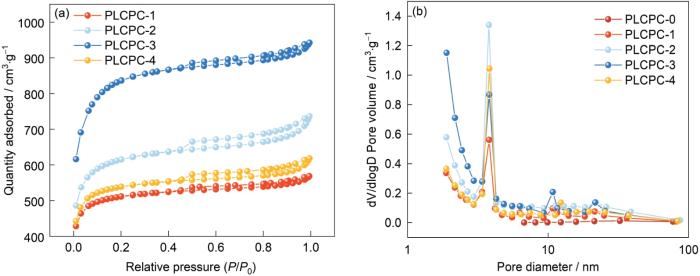
... 图4给出了PLCPC-3的N2吸脱附曲线和孔径分布.由图4a可见,所有PLCPC-x样品的等温线均有I型和IV型组合特征.相对压力(P/P0 0.2)较低时,氮气吸附量随着P/P0的提高急剧增大,是材料中的大量微孔所致;在中等相对压力下出现回滞环,表明存在介孔;相对压力较高(P/P0 0.9)时等温线微升,表明存在大孔[25,27,28].这表明,PLCPC-x具有微孔、介孔和大孔分级多孔结构.表1列出了PLCPC-x样品的BET分析结果.由表1可见,未活化的PLCPC-0样品的比表面积和孔容较小,表明结构中的孔隙较少.活化后的样品其比表面积和孔体积显著增大,且随着KOH添加量的增加呈先增后降的趋势.其中PLCPC-3的比表面积和孔容最大,其原因是KOH活化造孔过程经历3个阶段:(1)打开微孔,(2)形成新孔,(3)扩大微孔[18,19,29].活化剂的用量较少时,前两个阶段为主导;活化剂的用量较多时,第三阶段为主导.但是,过多的活化剂会使孔道坍塌.图4b给出了所有材料的孔径分布.可以看出,在活化样品中出现了大量的微孔和介孔.微孔的增加有利于离子的吸附/解吸,而中孔的增加为离子传输提供了更多的通道. ...
High performance hierarchical porous carbon derived from waste shrimp shell for supercapacitor electrodes
2
2023
... 人类社会的发展导致能源过度消耗和严重的环境污染,因此亟需开发风能、太阳能等清洁能源.为此,研发高效能量储存技术势在必行[1~3].超级电容器是一种高功率密度( 10 kW·kg-1)和长循环寿命( 100,000次)的储能器件,得到了广泛的应用[2,4~7].超级电容器分为双电层超级电容器(EDLC)和赝电容超级电容器(PC)[8].与PC相比,EDLC的循环寿命较长和功率密度较高,应用更为广泛.影响超级电容器的成本和性能的关键因素,是电极材料.碳材料的倍率性能好、循环稳定性高,电子传导速度快、比表面积大、孔结构可控且价格低廉,可制造EDLC电极.当前,生产碳材料的主要原料是石油和煤.石油和煤价格昂贵、不可再生且制备过程污染环境.近年来,来源广泛、价格低廉、绿色环保、可规模化生产的生物质衍生多孔碳材料,受到了极大的关注[3,9].利用生物质材料的天然结构和元素组成,进行简单的修饰改性即可制备出性能优异的生物衍生碳材料.生物质衍生多孔碳材料分为植物基和动物基两大类.植物基多孔碳材料包括各种果皮、树叶和坚果壳,而动物基多孔碳材料包括动物尸体、骨骼和粪便等[9~17].宋传林等[17]将生物质未燃尽炭用KOH一步活化法制备出系列HYC-n (n为碱碳浸渍比)多孔碳材料.HYC-3.5多孔碳材料的比表面积较大(1982 m2·g-1),组装的电容器其质量比电容较高(207 F·g-1/1 A·g-1),充放电循环5000次的电容保持率为95.57%.Zhang等[18]以KOH为活化剂热解芦苇渣制备出系列C/T (T为焙烧温度,℃)多孔碳材料,并在6 mol·L-1 KOH电解液中考察其电化学性能.结果表明,这种C/600 ℃多孔碳是一种松树花状多孔纳米材料,比表面积高达2074.72 m2·g-1,组装的电容器质量比电容为228 F·g-1 / 1 A·g-1,循环稳定性好(98.1%,8000次循环).Wei等[19]用自模板耦合双氢氧化物(NaOH/KOH)活化法将螳螂虾壳废物转化为蜂窝状分级多孔碳MSHPC1.5-800.这种MSHPC1.5-800多孔碳的比表面积(2465.9 m2·g-1)较高.用其组装的对称超级电容器比电容较高(300.3 F·g-1/0.05 A·g-1),循环稳定性好(电容保持率为96.7%).Dai等[20]用一步碳化/活化法制备出蝗虫衍生N-O-S共掺杂多孔碳材料(A-LPCs).这种碳材料的石墨化程度高、比表面积大,组装成的电容器比电容高达433.7 F·g-1/1 A·g-1.用A-LPCs组装的对称超级电容器能量密度高达23.04 Wh·kg-1 (0.1 kW·kg-1). ...
... 图4给出了PLCPC-3的N2吸脱附曲线和孔径分布.由图4a可见,所有PLCPC-x样品的等温线均有I型和IV型组合特征.相对压力(P/P0 0.2)较低时,氮气吸附量随着P/P0的提高急剧增大,是材料中的大量微孔所致;在中等相对压力下出现回滞环,表明存在介孔;相对压力较高(P/P0 0.9)时等温线微升,表明存在大孔[25,27,28].这表明,PLCPC-x具有微孔、介孔和大孔分级多孔结构.表1列出了PLCPC-x样品的BET分析结果.由表1可见,未活化的PLCPC-0样品的比表面积和孔容较小,表明结构中的孔隙较少.活化后的样品其比表面积和孔体积显著增大,且随着KOH添加量的增加呈先增后降的趋势.其中PLCPC-3的比表面积和孔容最大,其原因是KOH活化造孔过程经历3个阶段:(1)打开微孔,(2)形成新孔,(3)扩大微孔[18,19,29].活化剂的用量较少时,前两个阶段为主导;活化剂的用量较多时,第三阶段为主导.但是,过多的活化剂会使孔道坍塌.图4b给出了所有材料的孔径分布.可以看出,在活化样品中出现了大量的微孔和介孔.微孔的增加有利于离子的吸附/解吸,而中孔的增加为离子传输提供了更多的通道. ...
Three-dimensional porous carbon materials derived from locust for efficient NOS co-doped supercapacitors by facile self-template and in-situ doping method
1
2021
... 人类社会的发展导致能源过度消耗和严重的环境污染,因此亟需开发风能、太阳能等清洁能源.为此,研发高效能量储存技术势在必行[1~3].超级电容器是一种高功率密度( 10 kW·kg-1)和长循环寿命( 100,000次)的储能器件,得到了广泛的应用[2,4~7].超级电容器分为双电层超级电容器(EDLC)和赝电容超级电容器(PC)[8].与PC相比,EDLC的循环寿命较长和功率密度较高,应用更为广泛.影响超级电容器的成本和性能的关键因素,是电极材料.碳材料的倍率性能好、循环稳定性高,电子传导速度快、比表面积大、孔结构可控且价格低廉,可制造EDLC电极.当前,生产碳材料的主要原料是石油和煤.石油和煤价格昂贵、不可再生且制备过程污染环境.近年来,来源广泛、价格低廉、绿色环保、可规模化生产的生物质衍生多孔碳材料,受到了极大的关注[3,9].利用生物质材料的天然结构和元素组成,进行简单的修饰改性即可制备出性能优异的生物衍生碳材料.生物质衍生多孔碳材料分为植物基和动物基两大类.植物基多孔碳材料包括各种果皮、树叶和坚果壳,而动物基多孔碳材料包括动物尸体、骨骼和粪便等[9~17].宋传林等[17]将生物质未燃尽炭用KOH一步活化法制备出系列HYC-n (n为碱碳浸渍比)多孔碳材料.HYC-3.5多孔碳材料的比表面积较大(1982 m2·g-1),组装的电容器其质量比电容较高(207 F·g-1/1 A·g-1),充放电循环5000次的电容保持率为95.57%.Zhang等[18]以KOH为活化剂热解芦苇渣制备出系列C/T (T为焙烧温度,℃)多孔碳材料,并在6 mol·L-1 KOH电解液中考察其电化学性能.结果表明,这种C/600 ℃多孔碳是一种松树花状多孔纳米材料,比表面积高达2074.72 m2·g-1,组装的电容器质量比电容为228 F·g-1 / 1 A·g-1,循环稳定性好(98.1%,8000次循环).Wei等[19]用自模板耦合双氢氧化物(NaOH/KOH)活化法将螳螂虾壳废物转化为蜂窝状分级多孔碳MSHPC1.5-800.这种MSHPC1.5-800多孔碳的比表面积(2465.9 m2·g-1)较高.用其组装的对称超级电容器比电容较高(300.3 F·g-1/0.05 A·g-1),循环稳定性好(电容保持率为96.7%).Dai等[20]用一步碳化/活化法制备出蝗虫衍生N-O-S共掺杂多孔碳材料(A-LPCs).这种碳材料的石墨化程度高、比表面积大,组装成的电容器比电容高达433.7 F·g-1/1 A·g-1.用A-LPCs组装的对称超级电容器能量密度高达23.04 Wh·kg-1 (0.1 kW·kg-1). ...
Influence of Cape gooseberry (Physalis peruviana L.) addition on the chemical and sensory characteristics and mineral concentrations of ice cream
1
2012
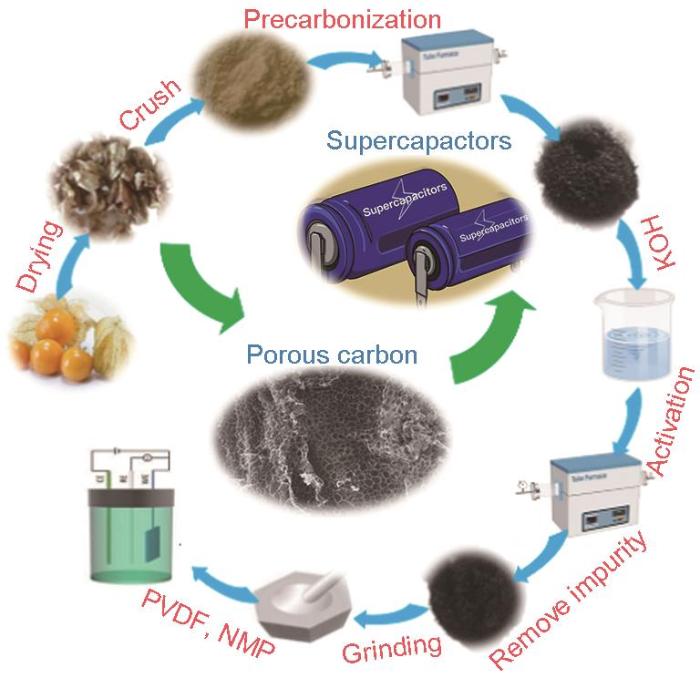
... 菇娘果(学名毛酸浆,Physalis Peruviana L.)是一种起源于南美洲的茄科植物,全世界每年的种植面积约为30000公顷,产量约16万吨.菇娘果营养丰富,且有一定的药用价值[21~24].菇娘果被一层纸质外皮包裹,极易剥离干燥.菇娘果的外皮还富含纤维素和杂原子,内部天然脉络发达且密度较低,是一种理想的生物质碳源.本文选用菇娘果外皮为碳源,采用预碳化-活化法(活化剂为KOH溶液)制备菇娘果外皮衍生多孔碳材料,研究活化剂的添加量对其形貌、孔道结构和电化学性能的影响. ...
Physalis peruviana Linnaeus, the multiple properties of a highly functional fruit: A review
0
2011
The potential protective effect of Physalis peruviana L. against carbon tetrachloride‐induced hepatotoxicity in rats is mediated by suppression of oxidative stress and downregulation of MMP‐9 expression
0
2014
Chemical composition and biological activity of Physalis peruviana L
1
2019
... 菇娘果(学名毛酸浆,Physalis Peruviana L.)是一种起源于南美洲的茄科植物,全世界每年的种植面积约为30000公顷,产量约16万吨.菇娘果营养丰富,且有一定的药用价值[21~24].菇娘果被一层纸质外皮包裹,极易剥离干燥.菇娘果的外皮还富含纤维素和杂原子,内部天然脉络发达且密度较低,是一种理想的生物质碳源.本文选用菇娘果外皮为碳源,采用预碳化-活化法(活化剂为KOH溶液)制备菇娘果外皮衍生多孔碳材料,研究活化剂的添加量对其形貌、孔道结构和电化学性能的影响. ...
N, O self-doped hierarchical porous carbon materials for high-performance super-capacitors
2
2021
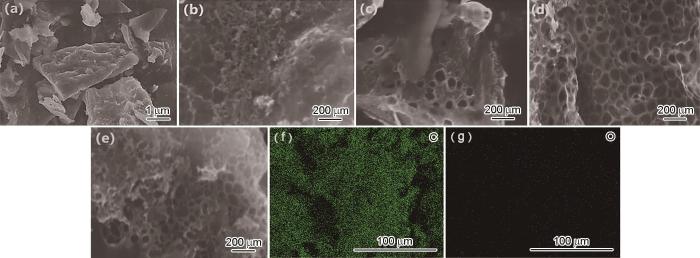
... 三维多孔结构碳材料的比表面积较大,有利于离子的自由穿梭和吸附.但是,KOH与PLCP的质量比过高(达到4∶1)时,材料中的孔道坍塌发生碎片化(图2e).图2f、g表明,在PLCPC-3材料有大量分布均匀的含氧官能团.大量含氧官能团能提高材料表面的润湿性并引入赝电容,使其电化学性能提高[25,26]. ...
... 图4给出了PLCPC-3的N2吸脱附曲线和孔径分布.由图4a可见,所有PLCPC-x样品的等温线均有I型和IV型组合特征.相对压力(P/P0 0.2)较低时,氮气吸附量随着P/P0的提高急剧增大,是材料中的大量微孔所致;在中等相对压力下出现回滞环,表明存在介孔;相对压力较高(P/P0 0.9)时等温线微升,表明存在大孔[25,27,28].这表明,PLCPC-x具有微孔、介孔和大孔分级多孔结构.表1列出了PLCPC-x样品的BET分析结果.由表1可见,未活化的PLCPC-0样品的比表面积和孔容较小,表明结构中的孔隙较少.活化后的样品其比表面积和孔体积显著增大,且随着KOH添加量的增加呈先增后降的趋势.其中PLCPC-3的比表面积和孔容最大,其原因是KOH活化造孔过程经历3个阶段:(1)打开微孔,(2)形成新孔,(3)扩大微孔[18,19,29].活化剂的用量较少时,前两个阶段为主导;活化剂的用量较多时,第三阶段为主导.但是,过多的活化剂会使孔道坍塌.图4b给出了所有材料的孔径分布.可以看出,在活化样品中出现了大量的微孔和介孔.微孔的增加有利于离子的吸附/解吸,而中孔的增加为离子传输提供了更多的通道. ...
Highly porous heteroatom doped-carbon derived from orange peel as electrode materials for high-performance supercapacitors
1
2020
... 三维多孔结构碳材料的比表面积较大,有利于离子的自由穿梭和吸附.但是,KOH与PLCP的质量比过高(达到4∶1)时,材料中的孔道坍塌发生碎片化(图2e).图2f、g表明,在PLCPC-3材料有大量分布均匀的含氧官能团.大量含氧官能团能提高材料表面的润湿性并引入赝电容,使其电化学性能提高[25,26]. ...
Green activation of sustainable resources to synthesize nitrogen-doped oxygen-riched porous carbon nanosheets towards high-performance supercapacitor
1
2021
... 图4给出了PLCPC-3的N2吸脱附曲线和孔径分布.由图4a可见,所有PLCPC-x样品的等温线均有I型和IV型组合特征.相对压力(P/P0 0.2)较低时,氮气吸附量随着P/P0的提高急剧增大,是材料中的大量微孔所致;在中等相对压力下出现回滞环,表明存在介孔;相对压力较高(P/P0 0.9)时等温线微升,表明存在大孔[25,27,28].这表明,PLCPC-x具有微孔、介孔和大孔分级多孔结构.表1列出了PLCPC-x样品的BET分析结果.由表1可见,未活化的PLCPC-0样品的比表面积和孔容较小,表明结构中的孔隙较少.活化后的样品其比表面积和孔体积显著增大,且随着KOH添加量的增加呈先增后降的趋势.其中PLCPC-3的比表面积和孔容最大,其原因是KOH活化造孔过程经历3个阶段:(1)打开微孔,(2)形成新孔,(3)扩大微孔[18,19,29].活化剂的用量较少时,前两个阶段为主导;活化剂的用量较多时,第三阶段为主导.但是,过多的活化剂会使孔道坍塌.图4b给出了所有材料的孔径分布.可以看出,在活化样品中出现了大量的微孔和介孔.微孔的增加有利于离子的吸附/解吸,而中孔的增加为离子传输提供了更多的通道. ...
Heteroatoms-doped hierarchical porous carbon derived from chitin for flexible all-solid-state symmetric supercapacitors
2
2020
... 图4给出了PLCPC-3的N2吸脱附曲线和孔径分布.由图4a可见,所有PLCPC-x样品的等温线均有I型和IV型组合特征.相对压力(P/P0 0.2)较低时,氮气吸附量随着P/P0的提高急剧增大,是材料中的大量微孔所致;在中等相对压力下出现回滞环,表明存在介孔;相对压力较高(P/P0 0.9)时等温线微升,表明存在大孔[25,27,28].这表明,PLCPC-x具有微孔、介孔和大孔分级多孔结构.表1列出了PLCPC-x样品的BET分析结果.由表1可见,未活化的PLCPC-0样品的比表面积和孔容较小,表明结构中的孔隙较少.活化后的样品其比表面积和孔体积显著增大,且随着KOH添加量的增加呈先增后降的趋势.其中PLCPC-3的比表面积和孔容最大,其原因是KOH活化造孔过程经历3个阶段:(1)打开微孔,(2)形成新孔,(3)扩大微孔[18,19,29].活化剂的用量较少时,前两个阶段为主导;活化剂的用量较多时,第三阶段为主导.但是,过多的活化剂会使孔道坍塌.图4b给出了所有材料的孔径分布.可以看出,在活化样品中出现了大量的微孔和介孔.微孔的增加有利于离子的吸附/解吸,而中孔的增加为离子传输提供了更多的通道. ...
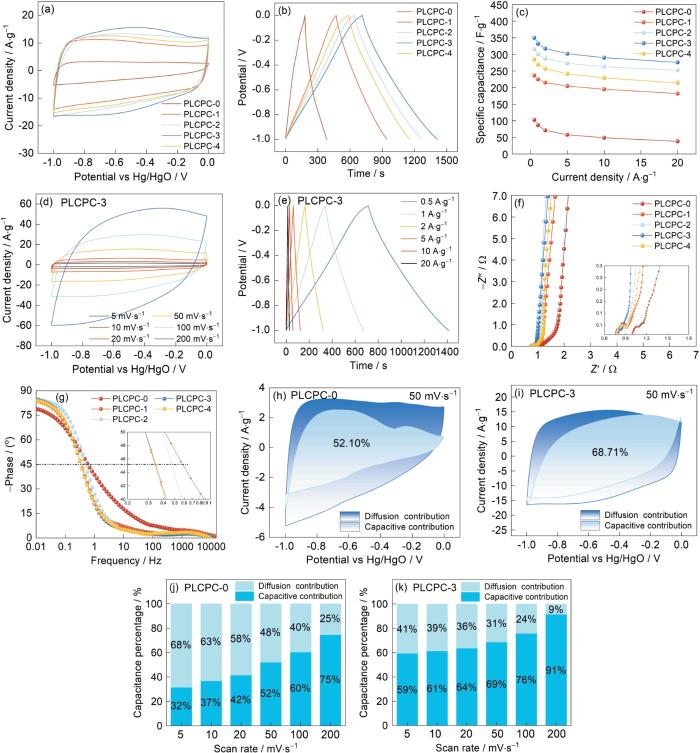
... 电极材料的电荷存储是表面电容和扩散电容的共同贡献,可根据i(V) = k1v + k2v1/2区分表面电容与扩散电容的贡献.式中i(V)为总电流响应,v为扫描速率,k1v和k2v1/2分别为表面电容和扩散控制过程的电流响应[28,44].在扫描速率为50 mV·s-1条件下,PLCPC-0和PLCPC-3的电荷存储由扩散控制和表面控制组成,后者的贡献率分别为52.10%和68.71%(图7h和i).在扫描速率为5~200 mV·s-1的条件下,PLCPC-0的表面电容贡献率都比PLCPC-3的低,其原因可能是PLCPC-0没有经KOH活化,较高的石墨化提供了更多的离子嵌入脱出的活性位点.随着扫描速率的提高,两种材料的表面电容对总电荷存储的贡献率随之提高.在200 mV·s-1的高扫描速率条件下,两种材料的表面电容贡献率分别达到75%和91% (图7j、k).其原因可能是扫描速率越高电极系统越偏离稳定状态,电子的积累速率高于消耗速率,从而抑制了扩散[44]. ...
Designing synthesis of porous biomass carbon from wheat straw and the functionalizing application in flexible, all-solid-state supercapacitors
1
2019
... 图4给出了PLCPC-3的N2吸脱附曲线和孔径分布.由图4a可见,所有PLCPC-x样品的等温线均有I型和IV型组合特征.相对压力(P/P0 0.2)较低时,氮气吸附量随着P/P0的提高急剧增大,是材料中的大量微孔所致;在中等相对压力下出现回滞环,表明存在介孔;相对压力较高(P/P0 0.9)时等温线微升,表明存在大孔[25,27,28].这表明,PLCPC-x具有微孔、介孔和大孔分级多孔结构.表1列出了PLCPC-x样品的BET分析结果.由表1可见,未活化的PLCPC-0样品的比表面积和孔容较小,表明结构中的孔隙较少.活化后的样品其比表面积和孔体积显著增大,且随着KOH添加量的增加呈先增后降的趋势.其中PLCPC-3的比表面积和孔容最大,其原因是KOH活化造孔过程经历3个阶段:(1)打开微孔,(2)形成新孔,(3)扩大微孔[18,19,29].活化剂的用量较少时,前两个阶段为主导;活化剂的用量较多时,第三阶段为主导.但是,过多的活化剂会使孔道坍塌.图4b给出了所有材料的孔径分布.可以看出,在活化样品中出现了大量的微孔和介孔.微孔的增加有利于离子的吸附/解吸,而中孔的增加为离子传输提供了更多的通道. ...
Hierarchical porous carbon materials derived from waste lentinus edodes by a hybrid hydrothermal and molten salt process for supercapacitor applications
1
2018
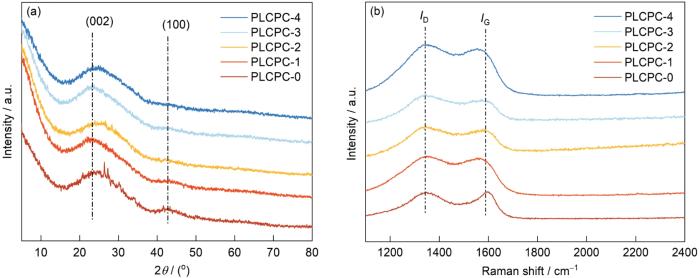
... 图5a给出了PLCPC-x样品的XRD谱.在谱中23°和43°附近均出现两个较宽的特征衍射峰,分别对应石墨的(002)与(100)晶面,表明样品具有无定型碳的特征和少量不规整的石墨微晶[30,31].图5b给出了PLCPC-x样品的Raman谱.可以看出,在所有样品的谱中1350与1590 cm-1处都出现了两个特征峰,分别对应碳材料的D带与G带.其中D带代表材料的无序和缺陷特征,G带则代表材料的石墨化结构.Raman谱的ID/IG比值(D峰和G峰的强度比)反映了材料的无序/缺陷程度或石墨化程度.该值越大,表明材料的无序/缺陷程度越高[32, 33].PLCPC-x的ID/IG值分别为0.993(PLCPC-0)、1.01(PLCPC-1)、1.03(PLCPC-2)、1.04(PLCPC-3)、1.02(PLCPC-4),表明活化后的样品其ID/IG均高于未活化的PLCPC-0,即活化材料中的缺陷/无序结构更多. ...
Large scale production of biomass-derived N-doped porous carbon spheres for oxygen reduction and supercapacitors
1
2014
... 图5a给出了PLCPC-x样品的XRD谱.在谱中23°和43°附近均出现两个较宽的特征衍射峰,分别对应石墨的(002)与(100)晶面,表明样品具有无定型碳的特征和少量不规整的石墨微晶[30,31].图5b给出了PLCPC-x样品的Raman谱.可以看出,在所有样品的谱中1350与1590 cm-1处都出现了两个特征峰,分别对应碳材料的D带与G带.其中D带代表材料的无序和缺陷特征,G带则代表材料的石墨化结构.Raman谱的ID/IG比值(D峰和G峰的强度比)反映了材料的无序/缺陷程度或石墨化程度.该值越大,表明材料的无序/缺陷程度越高[32, 33].PLCPC-x的ID/IG值分别为0.993(PLCPC-0)、1.01(PLCPC-1)、1.03(PLCPC-2)、1.04(PLCPC-3)、1.02(PLCPC-4),表明活化后的样品其ID/IG均高于未活化的PLCPC-0,即活化材料中的缺陷/无序结构更多. ...
Fabrication of carbon nanorods and graphene nanoribbons from a metal-organic framework
1
2016
... 图5a给出了PLCPC-x样品的XRD谱.在谱中23°和43°附近均出现两个较宽的特征衍射峰,分别对应石墨的(002)与(100)晶面,表明样品具有无定型碳的特征和少量不规整的石墨微晶[30,31].图5b给出了PLCPC-x样品的Raman谱.可以看出,在所有样品的谱中1350与1590 cm-1处都出现了两个特征峰,分别对应碳材料的D带与G带.其中D带代表材料的无序和缺陷特征,G带则代表材料的石墨化结构.Raman谱的ID/IG比值(D峰和G峰的强度比)反映了材料的无序/缺陷程度或石墨化程度.该值越大,表明材料的无序/缺陷程度越高[32, 33].PLCPC-x的ID/IG值分别为0.993(PLCPC-0)、1.01(PLCPC-1)、1.03(PLCPC-2)、1.04(PLCPC-3)、1.02(PLCPC-4),表明活化后的样品其ID/IG均高于未活化的PLCPC-0,即活化材料中的缺陷/无序结构更多. ...
One-step production of O-N-S co-doped three-dimensional hierarchical porous carbons for high-performance supercapacitors
1
2018
... 图5a给出了PLCPC-x样品的XRD谱.在谱中23°和43°附近均出现两个较宽的特征衍射峰,分别对应石墨的(002)与(100)晶面,表明样品具有无定型碳的特征和少量不规整的石墨微晶[30,31].图5b给出了PLCPC-x样品的Raman谱.可以看出,在所有样品的谱中1350与1590 cm-1处都出现了两个特征峰,分别对应碳材料的D带与G带.其中D带代表材料的无序和缺陷特征,G带则代表材料的石墨化结构.Raman谱的ID/IG比值(D峰和G峰的强度比)反映了材料的无序/缺陷程度或石墨化程度.该值越大,表明材料的无序/缺陷程度越高[32, 33].PLCPC-x的ID/IG值分别为0.993(PLCPC-0)、1.01(PLCPC-1)、1.03(PLCPC-2)、1.04(PLCPC-3)、1.02(PLCPC-4),表明活化后的样品其ID/IG均高于未活化的PLCPC-0,即活化材料中的缺陷/无序结构更多. ...
Nano-porous carbon materials derived from different biomasses for high performance supercapacitors
2
2020
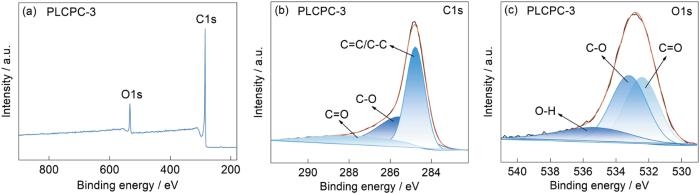
... 图6给出了PLCPC-3样品的XPS谱.由图6a可见,在PLCPC-3样品的谱中285和533 eV处出现两组峰,分别对应样品的C 1s和O 1s峰[34,35].图6b和c分别给出了C 1s和O 1s的高分辨XPS谱.其中C 1s谱可分解为C=C/C-C (284.8 eV)、C-O (285.5 eV)和C=O (288.1 eV)[35~37].O 1s谱可分解为C=O (532.4 eV)、C-O (533.2 eV)、O-H (535.3 eV)[37,38].这些含氧官能团的存在,表明样品表面有大量的氧原子.这些氧原子与碳原子的结合,产生了丰富的化学位点.这些位点有助于提高材料表面的润湿性使材料更易于与KOH电解液发生作用,还能参与氧化还原反应为材料提供额外的赝电容,从而提高材料的电化学性能[34,38,39]. ...
... [34,38,39]. ...
Preparation of highly porous activated carbons from peanut shells as low-cost electrode materials for supercapacitors
2
2021
... 图6给出了PLCPC-3样品的XPS谱.由图6a可见,在PLCPC-3样品的谱中285和533 eV处出现两组峰,分别对应样品的C 1s和O 1s峰[34,35].图6b和c分别给出了C 1s和O 1s的高分辨XPS谱.其中C 1s谱可分解为C=C/C-C (284.8 eV)、C-O (285.5 eV)和C=O (288.1 eV)[35~37].O 1s谱可分解为C=O (532.4 eV)、C-O (533.2 eV)、O-H (535.3 eV)[37,38].这些含氧官能团的存在,表明样品表面有大量的氧原子.这些氧原子与碳原子的结合,产生了丰富的化学位点.这些位点有助于提高材料表面的润湿性使材料更易于与KOH电解液发生作用,还能参与氧化还原反应为材料提供额外的赝电容,从而提高材料的电化学性能[34,38,39]. ...
... [35~37].O 1s谱可分解为C=O (532.4 eV)、C-O (533.2 eV)、O-H (535.3 eV)[37,38].这些含氧官能团的存在,表明样品表面有大量的氧原子.这些氧原子与碳原子的结合,产生了丰富的化学位点.这些位点有助于提高材料表面的润湿性使材料更易于与KOH电解液发生作用,还能参与氧化还原反应为材料提供额外的赝电容,从而提高材料的电化学性能[34,38,39]. ...
Unique elastic N-doped carbon nanofibrous microspheres with hierarchical porosity derived from renewable chitin for high rate supercapacitors
1
2016
... 图7给出了PLCPC-x样品的电化学性能.从图7a可见,PLCPC-x的CV曲线均近似矩形,表明其属于双电层电容储能[40,41].与PLCPC-0相比,活化后的PLCPC-x样品的CV曲线面积明显增大,表明其电容量明显提高.PLCPC-3的曲线面积最大,表明其电化学性能最好.从GCD曲线(图7b)可见PLCPC-3的放电时间(699.4 s)最长,表明其电容值更高.PLCPC-3优异的电化学性能与其超大的比表面积和发达的孔道结构密切相关.较大的比表面积可提供较大的电极-电解质界面,使活性电极材料的利用率提高.相互交联的多孔结构则使离子的扩散距离减小,促进了离子的扩散和传输.PLCPC-0、PLCPC-1、PLCPC-2、PLCPC-3和PLCPC-4在0.5 A·g-1下的质量比电容分别为(102.5 ± 0.7)、(236.5 ± 1.8)、(315.6 ± 3.5)、(349.7 ± 5.1)和(284.9 ± 2.8) F·g-1.而电流密度提高到20 A·g-1时,其质量比电容分别降至(38.0 ± 1.2)、(182.0 ± 4.5)、(252.0 ± 4.9)、(276.0 ± 5.6)和(214.0 ± 5.2) F·g-1,电容保持率分别为(37.1 ± 0.8)%、(77.0 ± 1.3)%、(79.8 ± 0.7)%、(78.9 ± 0.5)%和(75.1 ± 1.1)%(图7c).较高的电流密度使电极材料中离子的扩散速率降低,电荷不能及时传输到电极表面存储.同时,离子的高速迁移和累积可能堵塞电极材料内的孔道,进而增大离子的扩散路径和降低电荷的存储效率.活化后的PLCPC-x (x = 1~4)其电容保持率明显高于未活化的材料,表明其倍率性能更好,这源于其具有中孔微孔交联分布结构.图7d给出了PLCPC-3材料在不同扫描速率下的CV曲线.可以看出,高扫描速率的曲线形状几乎保持不变,表明该材料具有良好的倍率性能和电化学可逆性.图7e给出了PLCPC-3材料在不同电流密度下的GCD曲线.曲线的形状均近似等腰三角形,表明其遵循双电层储能机理.轻微的变形可能与材料表面的含氧官能团引入表面赝电容有关[40,42].图7f给出了在开路电压下PLCPC-x样品在105~10-2 Hz频率范围的Nyquist图.可以看出,PLCPC-x的Nyquist图均由一个小圆弧(高频区)和一条接近垂直线(低频区)构成.圆弧与横坐标轴的第一个交点给出了等效串联电阻(ESR)或内阻,包括电解质溶液的电阻、材料本身的电阻以及材料与集流体之间的电阻;圆弧直径表征电荷转移电阻(Rct);中间接近45°的直线给出扩散电阻或韦伯阻抗(Zw),表示电解质中的离子进入电极材料后的扩散电阻;尾部接近垂直的直线代表材料的理想电容行为[36,40].实验结果表明,PLCPC-x样品的ESR值较小(均小于1 Ω),且Zw斜率较大,表明材料的等效串联电阻和扩散电阻较小.同时,PLCPC-x (x = 1~4)样品的Rct值明显小于未加活化剂的PLCPC-0,表明KOH活化对材料电化学性能的影响较大,电荷在电极/电解质溶液界面处转移更快.其中PLCPC-3在高频区的半圆半径最小(ESR = (0.758 ± 0.025) Ω),在低频区的直线斜率最大,表明该电极的界面接触电阻最小和离子扩散性能最佳、导电性最高. ...
Hierarchically porous nitrogen-doped carbon derived from the activation of agriculture waste by potassium hydroxide and urea for high-performance supercapacitors
2
2018
... 图6给出了PLCPC-3样品的XPS谱.由图6a可见,在PLCPC-3样品的谱中285和533 eV处出现两组峰,分别对应样品的C 1s和O 1s峰[34,35].图6b和c分别给出了C 1s和O 1s的高分辨XPS谱.其中C 1s谱可分解为C=C/C-C (284.8 eV)、C-O (285.5 eV)和C=O (288.1 eV)[35~37].O 1s谱可分解为C=O (532.4 eV)、C-O (533.2 eV)、O-H (535.3 eV)[37,38].这些含氧官能团的存在,表明样品表面有大量的氧原子.这些氧原子与碳原子的结合,产生了丰富的化学位点.这些位点有助于提高材料表面的润湿性使材料更易于与KOH电解液发生作用,还能参与氧化还原反应为材料提供额外的赝电容,从而提高材料的电化学性能[34,38,39]. ...
... [37,38].这些含氧官能团的存在,表明样品表面有大量的氧原子.这些氧原子与碳原子的结合,产生了丰富的化学位点.这些位点有助于提高材料表面的润湿性使材料更易于与KOH电解液发生作用,还能参与氧化还原反应为材料提供额外的赝电容,从而提高材料的电化学性能[34,38,39]. ...
Superior supercapacitive performance of hollow activated carbon nanomesh with hierarchical structure derived from poplar catkins
2
2017
... 图6给出了PLCPC-3样品的XPS谱.由图6a可见,在PLCPC-3样品的谱中285和533 eV处出现两组峰,分别对应样品的C 1s和O 1s峰[34,35].图6b和c分别给出了C 1s和O 1s的高分辨XPS谱.其中C 1s谱可分解为C=C/C-C (284.8 eV)、C-O (285.5 eV)和C=O (288.1 eV)[35~37].O 1s谱可分解为C=O (532.4 eV)、C-O (533.2 eV)、O-H (535.3 eV)[37,38].这些含氧官能团的存在,表明样品表面有大量的氧原子.这些氧原子与碳原子的结合,产生了丰富的化学位点.这些位点有助于提高材料表面的润湿性使材料更易于与KOH电解液发生作用,还能参与氧化还原反应为材料提供额外的赝电容,从而提高材料的电化学性能[34,38,39]. ...
... ,38,39]. ...
Synthesis of 3D-interconnected hierarchical porous carbon from heavy fraction of bio-oil using crayfish shell as the biological template for high-performance supercapacitors
1
2021
... 图6给出了PLCPC-3样品的XPS谱.由图6a可见,在PLCPC-3样品的谱中285和533 eV处出现两组峰,分别对应样品的C 1s和O 1s峰[34,35].图6b和c分别给出了C 1s和O 1s的高分辨XPS谱.其中C 1s谱可分解为C=C/C-C (284.8 eV)、C-O (285.5 eV)和C=O (288.1 eV)[35~37].O 1s谱可分解为C=O (532.4 eV)、C-O (533.2 eV)、O-H (535.3 eV)[37,38].这些含氧官能团的存在,表明样品表面有大量的氧原子.这些氧原子与碳原子的结合,产生了丰富的化学位点.这些位点有助于提高材料表面的润湿性使材料更易于与KOH电解液发生作用,还能参与氧化还原反应为材料提供额外的赝电容,从而提高材料的电化学性能[34,38,39]. ...
Soybean meal-derived heteroatoms-doped porous carbons for supercapacitor electrodes
3
2022
... 图7给出了PLCPC-x样品的电化学性能.从图7a可见,PLCPC-x的CV曲线均近似矩形,表明其属于双电层电容储能[40,41].与PLCPC-0相比,活化后的PLCPC-x样品的CV曲线面积明显增大,表明其电容量明显提高.PLCPC-3的曲线面积最大,表明其电化学性能最好.从GCD曲线(图7b)可见PLCPC-3的放电时间(699.4 s)最长,表明其电容值更高.PLCPC-3优异的电化学性能与其超大的比表面积和发达的孔道结构密切相关.较大的比表面积可提供较大的电极-电解质界面,使活性电极材料的利用率提高.相互交联的多孔结构则使离子的扩散距离减小,促进了离子的扩散和传输.PLCPC-0、PLCPC-1、PLCPC-2、PLCPC-3和PLCPC-4在0.5 A·g-1下的质量比电容分别为(102.5 ± 0.7)、(236.5 ± 1.8)、(315.6 ± 3.5)、(349.7 ± 5.1)和(284.9 ± 2.8) F·g-1.而电流密度提高到20 A·g-1时,其质量比电容分别降至(38.0 ± 1.2)、(182.0 ± 4.5)、(252.0 ± 4.9)、(276.0 ± 5.6)和(214.0 ± 5.2) F·g-1,电容保持率分别为(37.1 ± 0.8)%、(77.0 ± 1.3)%、(79.8 ± 0.7)%、(78.9 ± 0.5)%和(75.1 ± 1.1)%(图7c).较高的电流密度使电极材料中离子的扩散速率降低,电荷不能及时传输到电极表面存储.同时,离子的高速迁移和累积可能堵塞电极材料内的孔道,进而增大离子的扩散路径和降低电荷的存储效率.活化后的PLCPC-x (x = 1~4)其电容保持率明显高于未活化的材料,表明其倍率性能更好,这源于其具有中孔微孔交联分布结构.图7d给出了PLCPC-3材料在不同扫描速率下的CV曲线.可以看出,高扫描速率的曲线形状几乎保持不变,表明该材料具有良好的倍率性能和电化学可逆性.图7e给出了PLCPC-3材料在不同电流密度下的GCD曲线.曲线的形状均近似等腰三角形,表明其遵循双电层储能机理.轻微的变形可能与材料表面的含氧官能团引入表面赝电容有关[40,42].图7f给出了在开路电压下PLCPC-x样品在105~10-2 Hz频率范围的Nyquist图.可以看出,PLCPC-x的Nyquist图均由一个小圆弧(高频区)和一条接近垂直线(低频区)构成.圆弧与横坐标轴的第一个交点给出了等效串联电阻(ESR)或内阻,包括电解质溶液的电阻、材料本身的电阻以及材料与集流体之间的电阻;圆弧直径表征电荷转移电阻(Rct);中间接近45°的直线给出扩散电阻或韦伯阻抗(Zw),表示电解质中的离子进入电极材料后的扩散电阻;尾部接近垂直的直线代表材料的理想电容行为[36,40].实验结果表明,PLCPC-x样品的ESR值较小(均小于1 Ω),且Zw斜率较大,表明材料的等效串联电阻和扩散电阻较小.同时,PLCPC-x (x = 1~4)样品的Rct值明显小于未加活化剂的PLCPC-0,表明KOH活化对材料电化学性能的影响较大,电荷在电极/电解质溶液界面处转移更快.其中PLCPC-3在高频区的半圆半径最小(ESR = (0.758 ± 0.025) Ω),在低频区的直线斜率最大,表明该电极的界面接触电阻最小和离子扩散性能最佳、导电性最高. ...
... [40,42].图7f给出了在开路电压下PLCPC-x样品在105~10-2 Hz频率范围的Nyquist图.可以看出,PLCPC-x的Nyquist图均由一个小圆弧(高频区)和一条接近垂直线(低频区)构成.圆弧与横坐标轴的第一个交点给出了等效串联电阻(ESR)或内阻,包括电解质溶液的电阻、材料本身的电阻以及材料与集流体之间的电阻;圆弧直径表征电荷转移电阻(Rct);中间接近45°的直线给出扩散电阻或韦伯阻抗(Zw),表示电解质中的离子进入电极材料后的扩散电阻;尾部接近垂直的直线代表材料的理想电容行为[36,40].实验结果表明,PLCPC-x样品的ESR值较小(均小于1 Ω),且Zw斜率较大,表明材料的等效串联电阻和扩散电阻较小.同时,PLCPC-x (x = 1~4)样品的Rct值明显小于未加活化剂的PLCPC-0,表明KOH活化对材料电化学性能的影响较大,电荷在电极/电解质溶液界面处转移更快.其中PLCPC-3在高频区的半圆半径最小(ESR = (0.758 ± 0.025) Ω),在低频区的直线斜率最大,表明该电极的界面接触电阻最小和离子扩散性能最佳、导电性最高. ...
... ,40].实验结果表明,PLCPC-x样品的ESR值较小(均小于1 Ω),且Zw斜率较大,表明材料的等效串联电阻和扩散电阻较小.同时,PLCPC-x (x = 1~4)样品的Rct值明显小于未加活化剂的PLCPC-0,表明KOH活化对材料电化学性能的影响较大,电荷在电极/电解质溶液界面处转移更快.其中PLCPC-3在高频区的半圆半径最小(ESR = (0.758 ± 0.025) Ω),在低频区的直线斜率最大,表明该电极的界面接触电阻最小和离子扩散性能最佳、导电性最高. ...
Cleanly synthesizing rotten potato-based activated carbon for supercapacitor by self-catalytic activation
1
2021
... 图7给出了PLCPC-x样品的电化学性能.从图7a可见,PLCPC-x的CV曲线均近似矩形,表明其属于双电层电容储能[40,41].与PLCPC-0相比,活化后的PLCPC-x样品的CV曲线面积明显增大,表明其电容量明显提高.PLCPC-3的曲线面积最大,表明其电化学性能最好.从GCD曲线(图7b)可见PLCPC-3的放电时间(699.4 s)最长,表明其电容值更高.PLCPC-3优异的电化学性能与其超大的比表面积和发达的孔道结构密切相关.较大的比表面积可提供较大的电极-电解质界面,使活性电极材料的利用率提高.相互交联的多孔结构则使离子的扩散距离减小,促进了离子的扩散和传输.PLCPC-0、PLCPC-1、PLCPC-2、PLCPC-3和PLCPC-4在0.5 A·g-1下的质量比电容分别为(102.5 ± 0.7)、(236.5 ± 1.8)、(315.6 ± 3.5)、(349.7 ± 5.1)和(284.9 ± 2.8) F·g-1.而电流密度提高到20 A·g-1时,其质量比电容分别降至(38.0 ± 1.2)、(182.0 ± 4.5)、(252.0 ± 4.9)、(276.0 ± 5.6)和(214.0 ± 5.2) F·g-1,电容保持率分别为(37.1 ± 0.8)%、(77.0 ± 1.3)%、(79.8 ± 0.7)%、(78.9 ± 0.5)%和(75.1 ± 1.1)%(图7c).较高的电流密度使电极材料中离子的扩散速率降低,电荷不能及时传输到电极表面存储.同时,离子的高速迁移和累积可能堵塞电极材料内的孔道,进而增大离子的扩散路径和降低电荷的存储效率.活化后的PLCPC-x (x = 1~4)其电容保持率明显高于未活化的材料,表明其倍率性能更好,这源于其具有中孔微孔交联分布结构.图7d给出了PLCPC-3材料在不同扫描速率下的CV曲线.可以看出,高扫描速率的曲线形状几乎保持不变,表明该材料具有良好的倍率性能和电化学可逆性.图7e给出了PLCPC-3材料在不同电流密度下的GCD曲线.曲线的形状均近似等腰三角形,表明其遵循双电层储能机理.轻微的变形可能与材料表面的含氧官能团引入表面赝电容有关[40,42].图7f给出了在开路电压下PLCPC-x样品在105~10-2 Hz频率范围的Nyquist图.可以看出,PLCPC-x的Nyquist图均由一个小圆弧(高频区)和一条接近垂直线(低频区)构成.圆弧与横坐标轴的第一个交点给出了等效串联电阻(ESR)或内阻,包括电解质溶液的电阻、材料本身的电阻以及材料与集流体之间的电阻;圆弧直径表征电荷转移电阻(Rct);中间接近45°的直线给出扩散电阻或韦伯阻抗(Zw),表示电解质中的离子进入电极材料后的扩散电阻;尾部接近垂直的直线代表材料的理想电容行为[36,40].实验结果表明,PLCPC-x样品的ESR值较小(均小于1 Ω),且Zw斜率较大,表明材料的等效串联电阻和扩散电阻较小.同时,PLCPC-x (x = 1~4)样品的Rct值明显小于未加活化剂的PLCPC-0,表明KOH活化对材料电化学性能的影响较大,电荷在电极/电解质溶液界面处转移更快.其中PLCPC-3在高频区的半圆半径最小(ESR = (0.758 ± 0.025) Ω),在低频区的直线斜率最大,表明该电极的界面接触电阻最小和离子扩散性能最佳、导电性最高. ...
Preparation of porous carbon from buckwheat husk and its electrochemical properties
1
2022
... 图7给出了PLCPC-x样品的电化学性能.从图7a可见,PLCPC-x的CV曲线均近似矩形,表明其属于双电层电容储能[40,41].与PLCPC-0相比,活化后的PLCPC-x样品的CV曲线面积明显增大,表明其电容量明显提高.PLCPC-3的曲线面积最大,表明其电化学性能最好.从GCD曲线(图7b)可见PLCPC-3的放电时间(699.4 s)最长,表明其电容值更高.PLCPC-3优异的电化学性能与其超大的比表面积和发达的孔道结构密切相关.较大的比表面积可提供较大的电极-电解质界面,使活性电极材料的利用率提高.相互交联的多孔结构则使离子的扩散距离减小,促进了离子的扩散和传输.PLCPC-0、PLCPC-1、PLCPC-2、PLCPC-3和PLCPC-4在0.5 A·g-1下的质量比电容分别为(102.5 ± 0.7)、(236.5 ± 1.8)、(315.6 ± 3.5)、(349.7 ± 5.1)和(284.9 ± 2.8) F·g-1.而电流密度提高到20 A·g-1时,其质量比电容分别降至(38.0 ± 1.2)、(182.0 ± 4.5)、(252.0 ± 4.9)、(276.0 ± 5.6)和(214.0 ± 5.2) F·g-1,电容保持率分别为(37.1 ± 0.8)%、(77.0 ± 1.3)%、(79.8 ± 0.7)%、(78.9 ± 0.5)%和(75.1 ± 1.1)%(图7c).较高的电流密度使电极材料中离子的扩散速率降低,电荷不能及时传输到电极表面存储.同时,离子的高速迁移和累积可能堵塞电极材料内的孔道,进而增大离子的扩散路径和降低电荷的存储效率.活化后的PLCPC-x (x = 1~4)其电容保持率明显高于未活化的材料,表明其倍率性能更好,这源于其具有中孔微孔交联分布结构.图7d给出了PLCPC-3材料在不同扫描速率下的CV曲线.可以看出,高扫描速率的曲线形状几乎保持不变,表明该材料具有良好的倍率性能和电化学可逆性.图7e给出了PLCPC-3材料在不同电流密度下的GCD曲线.曲线的形状均近似等腰三角形,表明其遵循双电层储能机理.轻微的变形可能与材料表面的含氧官能团引入表面赝电容有关[40,42].图7f给出了在开路电压下PLCPC-x样品在105~10-2 Hz频率范围的Nyquist图.可以看出,PLCPC-x的Nyquist图均由一个小圆弧(高频区)和一条接近垂直线(低频区)构成.圆弧与横坐标轴的第一个交点给出了等效串联电阻(ESR)或内阻,包括电解质溶液的电阻、材料本身的电阻以及材料与集流体之间的电阻;圆弧直径表征电荷转移电阻(Rct);中间接近45°的直线给出扩散电阻或韦伯阻抗(Zw),表示电解质中的离子进入电极材料后的扩散电阻;尾部接近垂直的直线代表材料的理想电容行为[36,40].实验结果表明,PLCPC-x样品的ESR值较小(均小于1 Ω),且Zw斜率较大,表明材料的等效串联电阻和扩散电阻较小.同时,PLCPC-x (x = 1~4)样品的Rct值明显小于未加活化剂的PLCPC-0,表明KOH活化对材料电化学性能的影响较大,电荷在电极/电解质溶液界面处转移更快.其中PLCPC-3在高频区的半圆半径最小(ESR = (0.758 ± 0.025) Ω),在低频区的直线斜率最大,表明该电极的界面接触电阻最小和离子扩散性能最佳、导电性最高. ...
Flexible porous carbon nanofibers derived from cuttlefish ink as self-supporting electrodes for supercapacitors
1
2024
... 图7g给出了PLCPC-x的Bode图.0.01 Hz对应的相位角越接近于-90°,表明材料的电容特性越好.5种材料的相位角分别为-78.9°(PLCPC-0)、-83.9°(PLCPC-1)、-83.9°(PLCPC-2)、-84.7°(PLCPC-3)、-84.0°(PLCPC-4).PLCPC-3的相位角最接近-90°,表明其电化学性能最佳.这可能与其比表面积和孔体积最大以及分级多孔结构适当相关.根据-45°相位角对应的频率计算出弛豫时间常数τ0(1/f0).τ0与电解质离子在电极孔中的吸附和解吸时间有关,数值越小表明材料的离子动力学性能越好[43].5种材料的τ0分别为1.69 s (PLCPC-0/0.591 Hz)、2.11 s (PLCPC-1/0.475 Hz)、2.87 s (PLCPC-2/0.349 Hz)、2.91 s (PLCPC-3/0.344 Hz)、2.90 s (PLCPC-4/0.345 Hz).PLCPC-0和PLCPC-1的τ0较小的原因,可能是其比电容小.在同等电流密度下比电容越小材料的充放电越快.PLCPC-2、PLCPC-3与PLCPC-4的τ0大小相近且较低,以及上述3种材料的比电容较高,表明这3种材料的倍率性能较好. ...
Ultra-thin highly-wrinkled graphene-like nanosheets for supercapacitor electrodes via 4-nitrocatechol and solvent-induced self-assembly
2
2023
... 电极材料的电荷存储是表面电容和扩散电容的共同贡献,可根据i(V) = k1v + k2v1/2区分表面电容与扩散电容的贡献.式中i(V)为总电流响应,v为扫描速率,k1v和k2v1/2分别为表面电容和扩散控制过程的电流响应[28,44].在扫描速率为50 mV·s-1条件下,PLCPC-0和PLCPC-3的电荷存储由扩散控制和表面控制组成,后者的贡献率分别为52.10%和68.71%(图7h和i).在扫描速率为5~200 mV·s-1的条件下,PLCPC-0的表面电容贡献率都比PLCPC-3的低,其原因可能是PLCPC-0没有经KOH活化,较高的石墨化提供了更多的离子嵌入脱出的活性位点.随着扫描速率的提高,两种材料的表面电容对总电荷存储的贡献率随之提高.在200 mV·s-1的高扫描速率条件下,两种材料的表面电容贡献率分别达到75%和91% (图7j、k).其原因可能是扫描速率越高电极系统越偏离稳定状态,电子的积累速率高于消耗速率,从而抑制了扩散[44]. ...
... [44]. ...
Porous carbon derived from cashew nut husk biomass waste for high-performance supercapacitors
3
2020
... 部分碳材料的电化学性能[45~52] ...
... Electrochemical properties of some reported carbon materials[45~52] ...
... 4000 cycles
[45] | | Chlorella | ZnCl2-KOH | 6 mol·L-1 ...
ZnCl2-KOH modulation of biomass-derived porous carbon for supercapacitors
1
2024
| [46] |
| Willow catkin | KOH | 6 mol·L-1 ...
Nitrogen and sulfur co-doped porous carbon nanosheets derived from willow catkin for supercapacitors
1
2016
| [47] |
| Coconut shell | KOH | 6 mol·L-1 ...
Preparation of hierarchical porous carbon through one-step KOH activation of coconut shell biomass for high-performance supercapacitor
1
2023
| [48] |
| Sword bean shells | KOH | 6 mol·L-1 ...
High performance supercapacitor electrodes based on B/N Co-doped biomass porous carbon materials by KOH activation and hydrothermal treatment
1
2021
| [49] |
| Corn husk | K2CO3 | 0.5 mol·L-1 ...
Sponge-like nanoporous activated carbon from corn husk as a sustainable and highly stable supercapacitor electrode for energy storage
1
2023
| [50] |
| Chinese fir sawdust | NaOH | 6 mol·L-1 ...
In-situ N, P co-doped porous carbon derived from biomass waste for supercapacitors
1
2024
| [51] |
| Orange peel | KOH | 6 mol·L-1 ...
Biomass-derived B/N/P co-doped porous carbons as bifunctional materials for supercapacitors and sodium-ion batteries
3
2024
... 部分碳材料的电化学性能[45~52] ...
... Electrochemical properties of some reported carbon materials[45~52] ...
... 10000 cycles | [52] |
| Physalis Peruviana L. calyx husk | KOH | 6 mol·L-1 ...
/
|
〈
|
![]()
|
〉
|
|