



锅炉燃烧高氯燃料产生的烟气中无机氯和有机氯分解后参与气相反应,生成氯化氢(HCl)和氯气(Cl2)。Liu等[12]研究了燃煤烟气中的HCl对金属的腐蚀。结果表明,HCl的浓度影响腐蚀速率,而高氯煤燃烧放出的HCl浓度极高。Nimmervoll等[13,14]指出,在锅炉的高温还原性条件下HCl气体显著加速金属的腐蚀,其机理涉及金属表面氧化物保护膜的破坏和铁基氯化物FeCl2的生成、挥发和迁移。这种打破原有氧化扩散平衡的过程,使金属基体暴露在腐蚀性气氛中而引发“活性氧化”腐蚀。目前的研究大多是HCl对金属的腐蚀,对Cl2腐蚀的研究较少。燃烧高氯煤、垃圾或生物质(如木材废弃物、农业废弃物)的锅炉,排放的含氯物质热解产生大量HCl气体。而在锅炉内氧含量较高区域的HCl氧化为Cl2,将炉内的腐蚀气氛复杂化而引发Cl2对金属的高温腐蚀[15,16]。锅炉中的Cl2和HCl与金属反应生成的金属氯化物在高温下与H2O (g)或H2O (g)-O2反应,使金属氯化物水解-分解释放出HCl,从而形成腐蚀循环[17]。Cl2是强氧化性介质,对金属的腐蚀比HCl更严重。现在关于Cl2的腐蚀机理大多是根据HCl的腐蚀机理推测的,没有实验数据支撑。鉴于此,本文研究高氯燃料烟气中不同形态的氯对锅炉换热管金属的高温腐蚀及其机理。
1 实验方法
表1 12Cr1MoVG钢的化学成分
Table 1
| Alloy steel | Fe | P | Cr | Si | Mn | S | C | Cu | Mo | V |
|---|---|---|---|---|---|---|---|---|---|---|
| 12Cr1MoVG | 97.67 | 0.009 | 0.98 | 0.28 | 0.47 | 0.002 | 0.12 | 0.08 | 0.28 | 0.17 |
图1
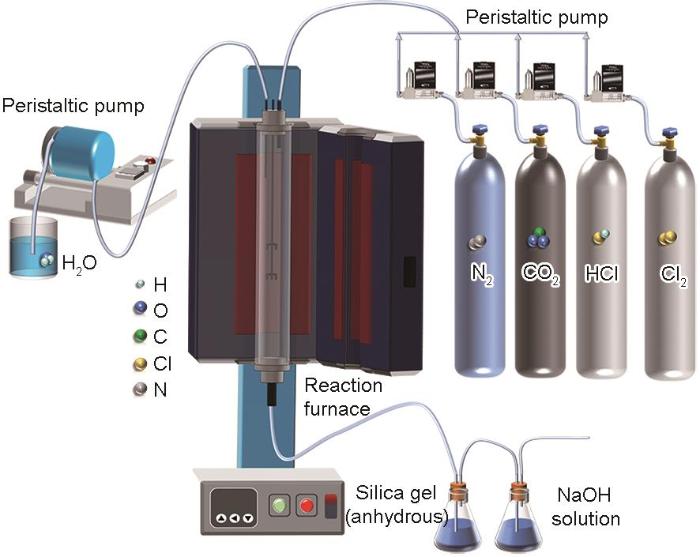
图1
可控气氛高温腐蚀实验台的示意图
Fig.1
Schematic diagram of a controlled atmosphere high-temperature corrosion test bench
表2 气体的组成和实验工况
Table 2
| Group | CO2 | H2O | HCl | Cl2 | N2 | T / oC | Total flow |
|---|---|---|---|---|---|---|---|
| N2 | 18% | 10% | / | / | Bal. | 550 650 | 250 mL/min |
| HCl | 18% | 10% | 0.05% | / | |||
| Cl2 | 18% | 10% | / | 0.05% |
立式管式炉系统的主要组件,包括石英管、热电偶、密封法兰以及内置可控温氧化铝内衬管。由蠕动泵输送蒸馏水至蒸发段汽化产生反应气体中的水蒸气。各种气体的组分用质量流量计分别控制,并用高纯氮气作为平衡气以确保混合气氛的浓度精准可控。用不锈钢丝将试样悬挂置在石英管恒温区中心,并使其最大表面平行于气流方向。用无水硅胶依次吸附尾气中的冷凝水,用饱和NaOH溶液吸收HCl、Cl2等酸性腐蚀组分以实现无害化排放[20]。
为了研究高温烟气中不同形态的氯对锅炉换热器的腐蚀,在温度分别为550 ℃和650 ℃和N2对照组、HCl和Cl2三种气氛中进行腐蚀实验。常规燃煤锅炉换热管附近的温度约为500 ℃,近换热管区域的温度通常约为600 ℃,而超超临界锅炉内的温度甚至能达700 ℃且易出现超温,因此在550 ℃和650 ℃进行实验[21]。为了避免HCl与O2在高温下反应生成Cl2,实验气氛中未引入O2[22]。实验中Cl2的浓度设定为0.05% (高氯燃煤的烟气中HCl体积占比为0.04%~0.2%,生成Cl2的转化率随锅炉内氧含量的提高而提高),为了比较在相同浓度的HCl和Cl2中的腐蚀性,HCl浓度亦设定为0.05%[15,23,24]。每组腐蚀实验的总时长为100 h,每隔20 h将试样取出一次,记录其宏观形貌。每种工况的实验使用两个平行试样。实验结束后,将一个试样表面的腐蚀产物去除并用XYSCALE. FA204型分析电子天平(精度0.1 mg)测量其质量损失;用Phenom pure型台式电镜-能谱一体机扫描电子显微镜(SEM-EDS)观测另一个(原始)试样表面的微观形貌,用布鲁克D8 Advance型X射线衍射仪(XRD)分析试样表面腐蚀产物的元素组成。由于金属表面腐蚀产物易脱落,用减重法评估腐蚀速率。实验结束后,测定腐蚀试件表面产物的XRD谱;用环氧树脂(与固化剂之比为2∶1)将试样镶嵌、切割和研磨后将横截面抛光,分析其微观结构和元素分布。
去除试样表面的腐蚀产物:根据GB/T 16545-2015,用盐酸(500mL, ρ = 1.19 g/mL)、环六亚甲基四胺(3.5 g)和蒸馏水配制1000 mL混合溶液,用其清洗试样的表面,温度为25 ℃,清洗时间为10 min。根据腐蚀前后试样质量的变化,腐蚀速率为
其中A为试样的表面积(cm2);W2为去除表面腐蚀产物后试样的质量(mg);W1为试样的初始质量(mg)。
2 结果和讨论
2.1 12Cr1MoVG钢试样腐蚀后的质量损失
图2给出了12Cr1MoVG钢试样分别在550 ℃、650 ℃和N2气氛、HCl气氛和Cl2气氛中腐蚀100 h的质量变化。可以看出,试样在N2气氛中腐蚀100 h,温度为550 ℃时质量损失为6.96 mg/cm2,温度为650 ℃时质量损失为28.22 mg/cm2。这表明,温度对质量损失有重要的影响;腐蚀气氛中有HCl或Cl2时,在550 ℃腐蚀100 h,试样的质量损失分别为18.97 mg/cm2 (HCl气氛)和22.54 mg/cm2 (Cl2气氛);在650 ℃腐蚀100 h,试样的质量损失分别为44.12 mg/cm2 (HCl气氛)和49.81 mg/cm2 (Cl2气氛)。这表明:温度越高,HCl和Cl2对试样的腐蚀越严重,而Cl2对试样的腐蚀程度比HCl的高。
图2
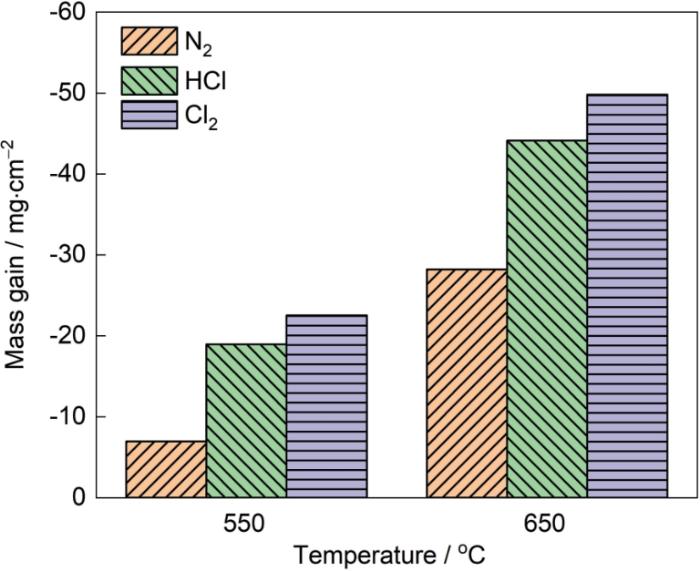
图2
12Cr1MoVG钢在550 ℃、650 ℃的N2、HCl、Cl2气氛中腐蚀100 h后的质量损失
Fig.2
Mass loss of 12Cr1MoVG steel after corrosion in N2, HCl, and Cl2 atmospheres at 550 oC and 650 oC for 100 h
试样在不同温度的质量损失表明,在N2气氛中在650 ℃试样的腐蚀程度显著高于550 ℃。其主要原因是,较高的温度促进了氧化膜的生成,长时间处于高温下氧化膜易起皮和剥落,使质量损失增多。在气氛中添加HCl或Cl2,使试样的质量损失均显著增加。在Cl2气氛中腐蚀更严重,因为氧化性较强的Cl2更易与氧化膜或金属基底反应生成挥发性铁基氯化物,使材料的质量损失增多[22]。以上数据揭示了温度与腐蚀性气氛的协同作用:温度决定腐蚀速率,而HCl和Cl2则加剧了腐蚀。综上所述,在550 ℃和650 ℃,三种气氛对12Cr1MoVG钢腐蚀严重程度的排序为:Cl2 > HCl > N2。
2.2 腐蚀试样的宏观形貌
试样高温腐蚀100 h后,其宏观形貌如图3所示。可以看出,在N2气氛中,在550 ℃腐蚀100 h后试样表面生成了较为完整的保护性氧化膜;在650 ℃腐蚀100 h后,出现氧化膜剥落。引入HCl气氛使试样表面的氧化膜明显起皮甚至局部脱落,并随着腐蚀时间的延长逐层剥落。在Cl2气氛中,在腐蚀初期即发生氧化膜脱落,温度为650 ℃时大面积剥落,表明Cl2对材料的腐蚀甚于HCl。同时,试样表面的颜色因腐蚀介质的不同显著不同:外层氧化膜多呈红褐色,在脱落区域暴露出银白色的内层氧化膜;在Cl2气氛中,腐蚀初期暴露出的氧化膜表面局部呈暗黄色。
图3
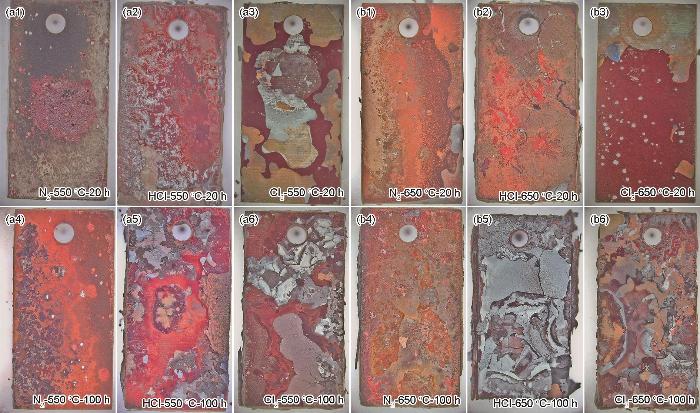
图3
12Cr1MoVG钢在N2、HCl、Cl2气氛中不同温度腐蚀20 h和100 h后的宏观形貌
Fig.3
Macroscopic morphologies of 12Cr1MoVG steel after corrosion in N2 (a1, a4, b1, b4), HCl (a2, a5, b2, b5), and Cl2 (a3, a6, b3, b6) atmospheres at 550 oC (a1-a6) and 650 oC (b1-b6) for 20 h (a1-a3, b1-b3) and 100 h (a4-a6, b4-b6)
上述试样表面氧化膜的形貌和颜色的变化,源于在不同腐蚀气氛中反应机理的差异。氧化膜起皮和脱落的主要原因,是生长应力和热应力使膜层间的结合强度降低;其次,HCl和Cl2与Fe反应生成的铁基氯化物挥发后留下的孔洞使氧化膜表面脆弱甚至脱落。氧化性较强的Cl2与Fe生成的FeCl3,比HCl与Fe反应生成的FeCl2更易挥发。铁基氯化物挥发产生的孔洞显著破坏氧化膜的致密结构,孔洞又使HCl和Cl2穿过氧化膜与Fe持续反应生成铁基氯化物,新生成的铁基氯化物在高温下再次挥发并拓展孔隙,形成了“HCl、Cl2渗透-铁基氯化物生成-挥发造孔-再渗透”的循环腐蚀机制。这种机制持续破坏氧化膜的结构完整性,降低氧化膜层与基底的结合强度,显著加速了氧化膜的分层和剥落。在宏观上,Cl2腐蚀试样比HCl腐蚀试样表面氧化膜的脱落更严重。腐蚀生成的铁基氯化物在高温下与水蒸气反应后生成HCl,进一步促进了腐蚀反应而出现自催化效应。此过程不断生成HCl,持续破坏氧化膜的结构。
2.3 试样高温腐蚀后的微观形貌
图4为试样腐蚀100 h后的表面形貌。可以看出,在不同条件下腐蚀后试样表面氧化膜的形貌显著不同,反映了温度和腐蚀气氛对氧化和破坏机制的共同影响。试样在N2气氛中在550 ℃腐蚀后,氧化膜体积膨胀导致晶粒粗化和膜层间隙增大(图4a);在650 ℃后氧化膜更为致密但是局部有孔洞,其原因是氧化膜剥落后内部又生成了致密氧化层(图4b)。在HCl气氛中在550 ℃氧化后氧化膜已出现裂纹(图4c);在650 ℃腐蚀后氧化膜完全剥落露出内层新的氧化膜并形成了浅层腐蚀坑和孔洞。在Cl2气氛中在550 ℃腐蚀,氧化膜已脱落并出现扩展裂纹(图4e);在650 ℃腐蚀后腐蚀孔洞进一步扩大并连接成深坑,内层氧化膜出现严重腐蚀的形貌。
图4

图4
12Cr1MoVG钢在N2、HCl、Cl2气氛中不同温度腐蚀100 h后的微观形貌
Fig.4
Microstructural morphologies of 12Cr1MoVG steel after corrosion in N2 (a, b), HCl (c, d), and Cl2 (e, f) atmospheres at 550 oC (a, c, e) and 650 oC (b, d, f) for 100 h
2.4 腐蚀100 h后试样表面氧化膜的组成
图5给出了试样腐蚀100 h后表面氧化膜的XRD谱。可以看出,在N2气氛中在550 ℃和650 ℃腐蚀的产物均以Fe2O3为主,谱中未出现单质Fe的衍射峰,表明基体表面有一层较为完整的保护性氧化膜。而在HCl和Cl2气氛中腐蚀的试样,其XRD谱中均出现了单质Fe的衍射峰且其强度随着温度的升高而显著增强。这表明,含氯气氛破坏了表面氧化膜的连续性,使局部金属基底暴露。值得注意的是,虽然腐蚀气氛中含有Cl2,但在所有的试样中均未检测到FeCl2、FeCl3以及FeCrCl2等物相。其原因是,一方面FeCl2和FeCl3的蒸气压较高而易挥发,难以在试样表面稳定存留[30];另一方面,HCl、Cl2向内渗透与金属基底反应生成的铁基氯化物一部分向外挥发,另一部分在氧化层内部与持续渗入基底的水蒸气反应生成HCl形成自催化循环腐蚀,导致在XRD谱中未出现FeCl2和FeCl3的衍射峰[31]。单质Fe衍射峰的出现,可归因于含氯气氛对氧化膜的破坏,尤其是在高温下氧化膜更易开裂和剥落,露出金属基体。
图5
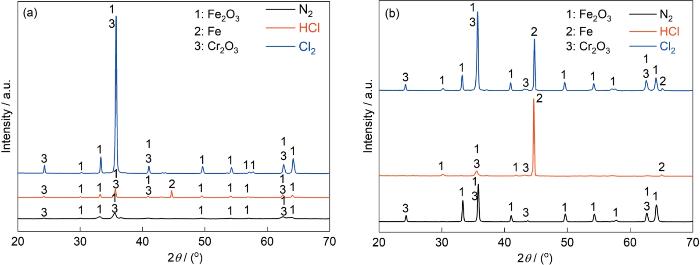
图5
12Cr1MoVG钢试样在N2、HCl、Cl2气氛中不同温度腐蚀100 h表面的XRD谱
Fig.5
XRD patterns of 12Cr1MoVG steel after corrosion in N2, HCl, and Cl2 atmospheres at 550 oC (a) and 650 oC (b) for 100 h
2.5 12Cr1MoVG钢高温腐蚀100 h后试样截面的形貌
图6

图6
12Cr1MoVG钢试样在550 ℃腐蚀100 h后截面的元素分布
Fig.6
Micro-element distribution in cross-sections of 12Cr1MoVG steel after corrosion in N2 (a), HCl (b), and Cl2 (c) atmospheres at 550 oC for 100 h
在550 ℃腐蚀,试样表面生成一层保护性氧化膜,在其表面产生了微裂纹等缺陷,为气体内外扩散提供了通道。HCl、Cl2、H2O通过氧化膜的缺陷向内渗透,HCl与金属基底反应生成FeCl2;具有强腐蚀性的Cl2与Fe反应生成FeCl3,随后与气氛中的H2O反应生成HCl,HCl参与腐蚀开始了“活性氧化”的循环[23,32]。生成的氯化物挥发,一部分沿着氧化膜上的孔洞向外扩散,另一部分与水蒸气反应释放新的HCl气体,使氧化膜内间隙处的饱和蒸气压越来越高而使孔洞越来越大,直至使横向氧化膜分层[33]。渗透作用较强的Cl2使氧化膜产生又深又宽的纵向裂纹(图6c)。同时,H2O沿着裂纹进入基底,与其反应生成更厚的氧化膜。
图7给出了试样在N2、HCl及Cl2气氛中在650 ℃腐蚀100 h后截面的元素分布。腐蚀层厚度的变化表明,腐蚀程度与腐蚀气氛有密切的关系,腐蚀层的厚度依次为233 µm (图7a)、245 µm (图7b)以及202 µm (图7c)。在HCl气氛中,氧化膜出现横纵交替的裂缝;而在Cl2气氛中氧化膜变薄且出现显著的分层-脱落。这表明,在650 ℃,Cl2对12Cr1MoVG钢的腐蚀程度高于HCl。同时,试样表面的氧化膜显著增厚,且微裂纹等缺陷更多,HCl、Cl2、H2O通过氧化膜上的缺陷向内渗透腐蚀基体。在N2气氛中,虽然试样表面不被腐蚀但是仍然出现分层,是高温下晶格结构失配和热膨胀系数不同所致[34]。在HCl气氛中,氧化膜内产生大量横纵交叉的裂纹。其原因是:在650 ℃活性显著提高的HCl更容易渗透到氧化膜内并与Fe反应生成FeCl2;生成的FeCl2一部分挥发破坏了氧化膜的结构,另一部分与水蒸气反应生成HCl。于是,在氧化膜内出现了横纵交叉的裂纹。由于后续反应生成的HCl较少,氧化膜没有分层只出现了横纵交叉的裂纹[35]。而在Cl2气氛中,氧化膜严重分层,因为Cl2穿过氧化膜上的孔洞与Fe反应生成了FeCl3;FeCl3又与水蒸气反应生成HCl而使氧化膜内的饱和蒸气压升高。于是,HCl和FeCl3向外膨胀使氧化膜出现起伏不平的“鼓包”;同时,HCl和FeCl3沿着孔洞向内渗透,HCl、Cl2、水蒸气也向内渗透,其结果是氧化膜分层和脱落[9]。
图7
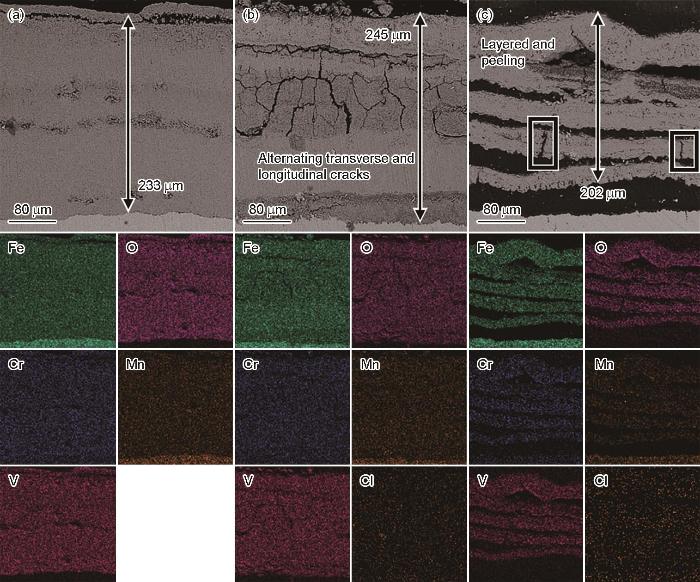
图7
12Cr1MoVG钢试样在650 ℃腐蚀100 h后截面的元素分布
Fig.7
Micro-element distribution in cross-sections of 12Cr1MoVG steel after corrosion in N2 (a), HCl (b), and Cl2 (c) atmospheres at 650 oC for 100 h
图8

图8
12Cr1MoVG钢试样在550 ℃腐蚀100 h后截面的线扫描图
Fig.8
Line scan of the cross-section of 12Cr1MoVG steel after corrosion in N2 (a), HCl (b), and Cl2 (c) atmospheres at 550 oC for 100 h
图9

图9
12Cr1MoVG钢试样在650 ℃下腐蚀100 h后截面的线扫描图
Fig.9
Line scan of the cross-section of 12Cr1MoVG steel after corrosion in N2 (a), HCl (b), and Cl2 (c) atmospheres at 650 oC for 100 h
2.6 HCl和Cl2 腐蚀12Cr1MoVG钢的化学反应
HCl和Cl2对12Cr1MoVG钢的腐蚀,是氯对合金中铁基化合物的氧化。为了研究氯的形态对12Cr1MoVG钢高温腐蚀的影响,使用HSC Chemistry 6.0中的Reaction Equations模块对腐蚀气体的种类与金属表面发生的反应进行热力学计算,以揭示腐蚀机理。腐蚀气体与金属表面发生的化学反应有
其中M分别为Fe、Cr、Mn、V,下同。
图10
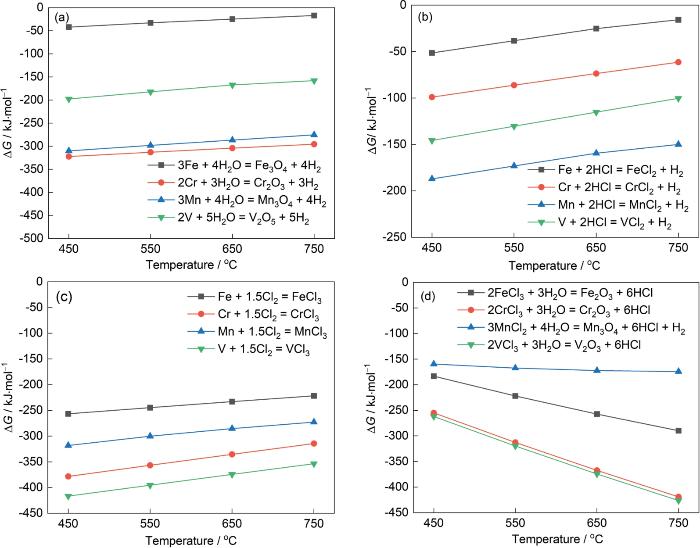
图10
Fe、Cr、Mn和V与H2O、HCl、Cl2及MCl x 与H2O在450 ℃~750 ℃反应的热力学参数
Fig.10
Thermodynamic parameters of reactions of Fe Cr, Mn, and V with H2O (a), HCl (b),Cl2 (c) and MCl x with H2O (d) in the temperature range of 450 oC to 750 oC
表3 铁、铬、锰氯化物的熔点和饱和蒸气压
Table 3
| Metal chlorides | Melting point / oC | Saturated vapor pressure / Pa | |
|---|---|---|---|
| 550 oC | 650 oC | ||
| FeCl2 | 676 | 2 × 101 | 5 × 10² |
| FeCl3 | 303 | 1.5 × 10⁴ | 8 × 10⁴ |
| CrCl2 | 820 | 1 × 10⁻³ | 5 × 10⁻² |
| CrCl3 | 1150 | 1.5 × 101 | 5 × 10² |
| MnCl2 | 650 | 3 × 100 | 8 × 101 |
| VCl3 | 1027 | 8 × 100 | 4.5 × 101 |
上述氯元素对金属的腐蚀,源于其诱导的“活性氧化”腐蚀机制。HCl与Fe反应生成的FeCl2在高温下挥发,使氧化膜的孔洞增多、结构疏松并最终剥落;腐蚀性更强的Cl2将Fe氧化生成FeCl3。氯化物的挥发形成贯通性孔道,为Cl2持续向内扩散提供了通道。在上述两种含氯气氛中氯不断向金属内迁移,持续腐蚀内层氧化膜和金属基体。腐蚀生成的金属氯化物中,一部分沿孔洞向外挥发,另一部分与水蒸气反应生成HCl,进一步破坏氧化膜最终导致金属材料失效。与HCl气氛相比,Cl2与Fe反应生成的FeCl3与水蒸气反应生成HCl的自发性显著高于HCl与Fe反应生成FeCl2。此反应生成的HCl继续参与腐蚀形成更强烈的循环腐蚀,使Cl2对材料的腐蚀程度显著高于HCl。
2.7 高氯煤烟中HCl和Cl2 腐蚀金属的机理
图11给出了12Cr1MoVG钢分别在HCl和Cl2气氛中高温腐蚀的机理。腐蚀始于合金表面生成以Fe2O3为主的保护性氧化膜,在腐蚀的初期这种氧化膜能阻隔腐蚀性气氛向材料内扩散。但是氧化膜出现的孔洞为HCl、Cl2或水蒸气的侵入提供了通道;渗入的HCl、Cl2与金属基体反应生成金属氯化物,而氯化物与水蒸气反应又生成HCl而引发循环腐蚀,使氧化膜逐渐疏松并产生微裂纹,为HCl、Cl2的持续渗透提供了通道。
图11

图11
12Cr1MoVG钢在HCl (a)、Cl2 (b)中的高温腐蚀机理
Fig.11
High-Temperature Corrosion Mechanism of 12Cr1MoVG steel in HCl (a) and Cl2 (b) environments
接着,材料的腐蚀进入“氯化-挥发-再氯化”阶段,并发生了“活性氧化”腐蚀循环。在HCl气氛中,HCl通过氧化膜缺陷扩散至金属基体界面与Fe反应生成FeCl2,FeCl2挥发后在氧化膜中的腐蚀进入“氯化-挥发-再氯化”阶段,并发生了“活性氧化”腐蚀循环。在HCl气氛中,HCl通过氧化膜缺陷扩散至金属基体界面与Fe反应生成FeCl2,FeCl2挥发后在氧化膜中留下孔洞。而挥发的FeCl2继而与气氛中的水蒸气反应生成HCl (
这一机制使Cl2不断侵蚀氧化膜和金属基体。低熔点、高蒸气压的铁基氯化物在高温下大量挥发,使材料中的孔洞扩展进而降低了氧化膜与基体的结合强度,最终使氧化膜剥落。氧化膜的剥落暴露出基体,使腐蚀损伤累积而最终导致材料失效。
3 结论
(1) 温度的提高使12Cr1MoVG钢的耐腐蚀性能显著降低,12Cr1MoVG在三种气氛中腐蚀严重程度的排序为Cl2 > HCl > N2。
(2) 12Cr1MoVG钢在HCl和Cl2气氛中的高温腐蚀形貌和破坏程度显著不同。在HCl气氛中腐蚀生成的氧化膜内裂纹横纵交叉和局部分层。在Cl2气氛中腐蚀生成的氧化层严重起皮、分层脱落和开裂,失去保护性功能;在腐蚀过程中生成的FeCl3与水蒸气反应生成新的HCl,加剧了对氧化膜的破坏。
(3) 在高温含氯气氛中,12Cr1MoVG钢腐蚀的主要机制是氯诱导的“活性氧化”腐蚀。含水蒸气的气氛促进金属的氯化和氧化反应进而引发循环腐蚀。HCl与Fe反应生成的FeCl2挥发后与H2O (g)反应驱动腐蚀循环。氧化性更强的Cl2与Fe反应生成FeCl3,挥发性更高的FeCl3在氧化膜间聚集导致局部蒸气压升高而引发薄膜起皮和分层,使腐蚀程度更为剧烈。挥发出的铁基氯化物与H2O (g)反应生成HCl,产生的次级腐蚀循环导致氧化膜破损和材料失效。
参考文献
Synergizing policies for carbon reduction, energy transition and pollution control: Evidence from Chinese power generation industry
[J].
Advancements in waste-to-energy (WtE) combustion technologies: A review of current trends and future developments
[J].
Investigation of the slagging and fouling aspects of co-firing coal and organic refuse-derived fuel
[J].
Reaction kinetics of chlorine corrosion to heating surfaces during coal and biomass cofiring
[J].
The roadmap towards the efficiency limit for supercritical carbon dioxide coal fired power plant
[J].
Enhancing steam boiler efficiency through comprehensive energy and exergy analysis: A review
[J].
Numerical study on the effects of primary air ratio on ultra-low-load combustion characteristics of a 1050 MW coal-fired boiler considering high-temperature corrosion
[J].
Modelling of catastrophic stress development due to mixed oxide growth in thermal barrier coatings
[J].
Stress analysis of the steam-side oxide of boiler tubes: Contributions from thermal strain, interface roughness, creep, and oxide growth
[J].
Corrosion of 15Mo3 carbon steel superheater tubes in waste incineration plants: A comparison between a field-returned tube and laboratory tests
[J].
Investigation on slagging and high-temperature corrosion prevention and control of a 1000 MW ultra supercritical double tangentially fired boiler
[J].
High-temperature corrosion properties of boiler steels under a simulated high-chlorine coal-firing atmosphere
[J].
High-temperature corrosion of austenitic alloys in HCl and H2S containing atmospheres under reducing conditions
[J].
High temperature corrosion behavior of alloys in reducing HCl and H2S containing environments: Thermodynamical and experimental assessment
[J].
Measurement of corrosive gaseous species in staged coal combustion
[J].
Chlorine emission characteristics and control status of coal-fired units
[J].
Chlorine is a harmful trace element in coal. During coal combustion, the chlorine undergoes complex changes and transfers to the gas, and forms chlorine-containing substances. This paper summarizes the field test data of chlorine emission from domestic coal-fired units, and analyzes the chlorine emission and control characteristics. The results show that during the combustion process, the chlorine in coal is released into flue gas, mainly HCl, and a small amount of Cl-2 and particulate Cl. Conventional pollutant control facilities affect the form and concentration of Cl. The impact of dust removal facilities on Cl is mainly reflected in the coordinated removal of particulate Cl. The impact of wet desulfurization facilities on Cl is mainly reflected in the coordinated removal of HCl. The Cl emission concentration in flue gas of coal-fired units is 0.85 mg/m(3), which meets the emission requirements. Chlorine is transferred from coal to fly ash, desulfurization wastewater and desulfurization gypsum, so the secondary pollution of chlorine should be paid much attention. HCl in coal-fired flue gas has an adverse effect on wet desulfurization facilities. Based on the material balance of chloride ions in absorption tower slurry, this paper proposes a technical idea for removing HCl from flue gas with alkaline absorbents. (C) 2021 The Author(s). Published by Elsevier Ltd.
The fate of chlorine during MSW incineration: Vaporization, transformation, deposition, corrosion and remedies
[J].
High-temperature corrosion of water-wall tubes in oxy-combustion atmosphere
[J].
Effect of Cr-content on microstructure of 12CrNi2 alloy steel prepared by laser additive manufacturing
[J].12CrNi2 alloy steel has been prepared by means of laser additive manufacturing (LAM) using a commercial alloy steel powder. The results show that the LAMed alloy steel contains a large number of pores intrinsically associated with the reaction of O and C, which form gases in molten pool of the laser melting alloy steel powder. The pore formation can be highly suppressed by adding into the steel powder with small amounts of Cr, because it preferentially reacts with O to form Cr2O3 and consequently prevents the gases formation in the molten pool. The Cr2O3 formation also refines the ferrite and the austenite phases of the LAMed alloy steel and increases its hardness.
Cr含量对激光增材制造12CrNi2合金钢的组织结构的影响
[J].对商用12CrNi2合金钢粉末进行激光增材制造时发现,在沉积态合金钢内部产生了大量的孔洞。这种孔洞的形成,主要与溶池中的O与C反应生成的气泡有关。合金钢粉末中增加Cr量后,它因与O亲和力大而在溶池中优先“捕捉”O析出Cr2O3,有效地抑制了成形合金钢中孔洞的形成;Cr2O3的析出使成形合金钢铁素体和奥氏体的组织细化,提高了合金钢的显微硬度。
Study on the high-temperature corrosion mechanism of boiler steel 15CrMoG in ammonia-coal co-firing environment
[J].
Metal materials application analysis of 700℃ level advanced ultra-supercritical coal-fired boiler
[J].
700℃等级超超临界燃煤锅炉用金属材料应用分析
[J].
Understanding the catalytic oxidation of hydrogen chloride to chlorine from thermodynamics and reaction kinetics
[J].
High-temperature corrosion characteristics and mechanisms of heating surfaces under ash deposition conditions in coal/biomass Co-firing utility boilers
[J].
Influence of surface condition on the high-temperature corrosion of 12Cr1MoVG, T91, and TP347H steels in waste-to-energy boilers
[J].
Corrosion and oxidation on iron surfaces in chloride contaminated electrolytes: Insights from ReaxFF molecular dynamic simulations
[J].
Corrosion of iron covered with iron oxide film by chlorine and hydrogen chloride gases: A molecular dynamics simulation study using the ReaxFF
[J].Flue gas produced by biomass fuel combustion contains various chlorine-containing substances and is an important factor causing biomass boiler corrosion. The corrosion processes of chlorine, hydrogen chloride and water on iron covered with an intact/damaged oxide film were investigated under the high temperature of 1300 K through reactive molecular dynamics simulation. The results show that the diffusion processes of oxygen and chlorine are similar and can be divided into three stages: rapid diffusion, continuous diffusion, and no oxide film (stable). Oxygen diffusion in Fe2O3 into a pure iron layer is the main cause of gas corrosion in iron/iron oxide systems. A complete oxide film can hinder iron corrosion by chlorine and hydrogen chloride. Damage in an oxide film significantly affects oxygen and chlorine diffusion and iron corrosion. However, such influence is gradually reduced. The integrity of a protective film is the key to alleviating corrosion. Water facilitates the dissociation of chlorine and hydrogen chloride, and it reacts with iron at high temperatures to enhance corrosion. This study improves the understanding of the iron oxide/iron corrosion from chlorine-containing gases from a microscopic perspective and is of great significance to metal corrosion protection and biomass combustion technologies.
Failure behavior analysis of oxide film formed on super-heater tubes of boiler during deep peak process
[J].
Effect of hydrogen chloride on corrosion behaviour of Fe-Cr alloys in wet CO2 gas at 650 oC
[J].
Kinetics of volatilization of high temperature corrosion products and its application to chlorine corrosion
[J].
Structural evolution of iron components and their action behavior on lignite combustion
[J].
Thermodynamic analysis of chloride corrosion in steel for energy system applications in Fe-O-Cl-Na environments
[J].The assumptions of contemporary energy policies are increasing the share of renewable energy sources. Biomass combustion is developing as an alternative to fossil fuels. However, it faces challenges such as limited corrosion resistance of steel boiler components due to chloride compounds in flue gases and fly ash. This paper provides a comprehensive thermodynamic analysis of chloride-induced corrosion in steel in the Fe-O-Cl-Na environment, focusing on the influence of steam concentration in the gas phase. The study was performed by using the general thermodynamic rules, the thermodynamic properties of the pure components involved in the reaction, and the properties of the solutions formed in the liquid and gas phases. The study also examined the impact of alkali metal chlorides, particularly NaCl, on the formation of NaFeO2 in the passive oxide scale layer Fe3O4/Fe2O3. Furthermore, it investigated the condensation of NaCl vapour formation of low-melting eutectic mixtures in deposits and the resulting consequences on the corrosion process. The role of HCl in the chlorination and oxidation process of steel in melted ash deposits was also discussed. The presented thermodynamic analysis was compared with assumptions of an “active oxidation” model. This study can be a valuable resource for experimental research planning and a guide for preventing corrosion in industrial settings.
Corrosion mechanism of alloy 310 austenitic steel beneath NaCl deposit under varying SO2 concentrations in an oxy-fuel combustion atmosphere
[J].
Effects of chloride on electrochemical and stress corrosion cracking behavior of 9Cr ferritic-martensitic steel
[J].The electrochemical and stress corrosion cracking behavior of 9Cr ferritic-martensitic steel is investigated in the chloride environment by using the traditional electrochemical method, the scanning vibrating electrode technique and the slow strain rate test (SSRT). Results of the static corrosion tests and corrosion morphology show that the prior austenite grain boundaries and martensite lath boundaries are the preferred sites for pit nucleation and growth in chloride environment. Results of SSRT coupled with in situ electrochemical test show that the transition from pitting corrosion to uniform corrosion, as well as the nucleation of stress corrosion crack, is the synergistic effects of the chloride and applied load. Stress corrosion cracking of the steel in the chloride environment can be divided into three different regions as follows: fast and uniform corrosion activity, microcrack nucleation and propagation, and active crack growth regions.
A time-resolved study of PbCl2-induced corrosion of low-alloyed steel in the presence of water vapour at 400 oC
[J].
Wet oxidation of TiZrHfNbTaV high-entropy alloys: Role of grain-boundary and interdendritic diffusion
[J].
Corrosion behavior of 316SS and Ni-based alloys in a ternary NaCl-KCl-MgCl2 molten salt
[J].
Long-term corrosion behaviors of Hastelloy-N and Hastelloy-B3 in moisture-containing molten FLiNaK salt environments
[J].
Corrosion behavior of iron-based and Ni-based alloys melted in NaCl-MgCl2-KCl mixed molten salt under vacuum atmosphere
[J].
Protective performance of a novel inorganic composite coatings on CB2 ferritic heat resistant steel at 650 oC in oxygen flow with water vapor
[J].
无机复合涂层对CB2铁素体耐热钢在650 ℃水蒸气中的防护
[J].采用物理共混工艺制备无机硅酸盐复合涂层,研究其对ZG12Cr9Mo1Co1NiVNbNB(CB2)铁素体耐热钢在650℃水蒸气中氧化的防护。结果表明,CB2钢在650°C水蒸气中的氧化严重,氧化过程分段遵循抛物线规律,生成了双层非保护性Fe2O3氧化膜。涂装无机硅酸盐复合涂层使CB2钢的氧化速率显著降低,涂层还具有良好的抗热震性能。在涂层与基体钢的界面处生长一层厚度约2 μm的富铬氧化层,使合金的抗氧化性能提高。


