



多孔金属中的孔洞和相互连通的三维网络,可用于调控其力学性能和功能特性[1,2]。根据内部的孔洞结构,可将多孔金属分为有序多孔金属和无序泡沫金属[3]。有序多孔金属的构成有支柱、板和壳,调控这些结构的拓扑结构和空间排布可调控其力学性能[4,5]。无序泡沫金属由大量大小不同、形状各异且随机分布的金属薄壁和孔洞组成。这种随机性的结构能阻碍各种波的传递,进而使其具有各种优异的功能[6,7]。有序多孔金属虽然具有优异的强度,但是组元较少时极易坍塌,很难实现轻质与平稳变形之间的平衡。无序泡沫金属内的薄壁结构使其负载时易发生塑性屈曲和断裂,从而降低其强度。但是,无序泡沫铝的应力响应过程是平稳的,因为随机的孔洞结构只可能局部失效而不是整体失效,即其失效模式是渐近式坍塌。这种渐进式坍塌材料的应力-应变曲线是平稳的,表明其能量吸收率较高[8]。
总之,有序多孔金属和无序泡沫金属的力学性能各有其优势。复合材料兼具轻质和高能量吸收性能[9~12],添加第二相或改变材料组合,可提高其力学性能。但是,无论是具有增强相的复合泡沫金属还是简单的相叠加组成的三明治结构,都忽略了相界面之间的交互作用[13~15]。三维连续互穿相复合材料(Interpenetrating phase composites, IPCs),其组成相在三维空间内连续且相互贯穿,承受负荷时各组元之间相互作用实现1 + 1 > 2的效果。同时,IPCs能保证结构的完整性,可最大限度地保留各组元的性能。因此,将有序多孔金属和无序泡沫金属相结合制备IPCs是提高综合力学性能的有效策略[16~19]。鉴于此,本文提出一种兼具ZL111合金和纯铝特性的多孔复合材料,ZL111合金以基于支柱的晶格结构贯穿于用纯铝制备的无序泡沫铝中,使其同时具有有序结构和无序结构。空心支柱较大的截面惯性矩能降低支柱的屈曲和弯曲倾向,将支柱中空化使结构效率进一步提高[20,21]。本文用准静态压缩实验表征这种具有不同晶格结构的多孔复合材料,研究其力学性能、变形模式和应力响应。
1 实验方法
1.1 试样的制备
以简单立方(SC)、面心立方(FCC)和体心立方(BCC)为基础构成杂化晶格结构,作为复合材料的强化结构设计三种杂化晶格结构,其三维模型如图1a所示。
图 1
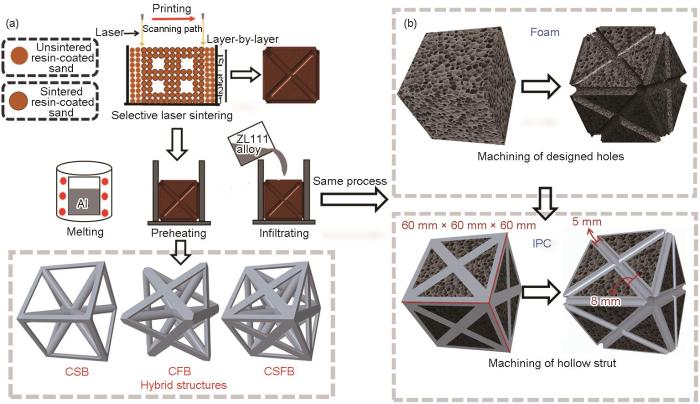
图 1
有序多孔铝和互穿相复合材料的制备工艺和结构设计策略
Fig.1
Fabrication process and structural design strategy for the lattice structures and interpenetrating phase composites (a) ordered porous aluminum, (b) interpenetrating phase composites
用相同的渗流铸造工艺制备互穿相复合材料。先用熔体发泡法制备纯铝基体的无序泡沫铝。将纯铝锭(纯度99.99%,质量分数)在电阻炉中熔化后在700 ℃保温,随后依次加入5.00% (质量分数)的钙和3.00% (质量分数)的镁将熔体增粘。待熔体冷却到700 ℃加入0.05% (质量分数)的TiH2并以1000 rad/min的速度搅拌120 s完成发泡,保温90 min后空冷得到泡沫铝锭。将泡沫铝锭线切割得到尺寸为60 mm × 60 mm × 60 mm的立方块,将其加工成晶格结构的反结构,即互穿相复合材料的预制体(图1b)。随后将温度为750 ℃的ZL111合金熔体以渗流铸造工艺浇注进泡沫铝预制体中得到支柱,待其凝固后加工出孔洞,得到具有中空支柱强化晶格结构的铝基互穿相复合材料(HSB, HFB, HSFB)。实验用ZL111合金的密度为2.68 g/cm3,合金的成分(质量分数)为:9.78%Si,1.51%Cu、0.51%Mg,0.20%Mn,0.16%Ti,其余为Al元素。泡沫铝的密度为0.29 g/cm3。所有试样的三维尺寸均为60 mm × 60 mm × 60 mm,晶格结构的支柱直径为8 mm,其中空心支柱的内径为5 mm,壁厚为1.5 mm。最终制备出的IPCs的密度为:HSB = 0.64 g/cm3,HFB = 0.79 g/cm3,HSFB = 0.92 g/cm3。
1.2 组织和性能的表征
用微米级X射线显微镜(μ-CT, Xradia 610 Versa)扫描试样。X射线管的电压为30~60 kV,功率为1~25 W。用AVIZO处理图像并进行三维重构。按照标准程序制备金相试样,用高分辨场发射扫描电子显微镜(SEM, JSM-IT800)观察其微观形貌。
按照GB/T 7314-2017用MTS E64.206万能试验机进行准静态压缩实验。试样位于两个平滑的刚性板中间,固定下板并用液压系统控制上板以1 × 10⁻³ s-1的应变率向下移动。在准静态压缩实验中,对于有序多孔铝对照组试样(CSB, CFB, CSFB),当其发生结构性失效、与压缩上压头完全失去接触时终止实验。此时,应力-应变曲线自然中止。对于IPCs(HSB, HFB, HSFB)和无序泡沫铝试样,应力-应变曲线进入致密化阶段终止实验。
2 实验结果
2.1 结构完整性
图2
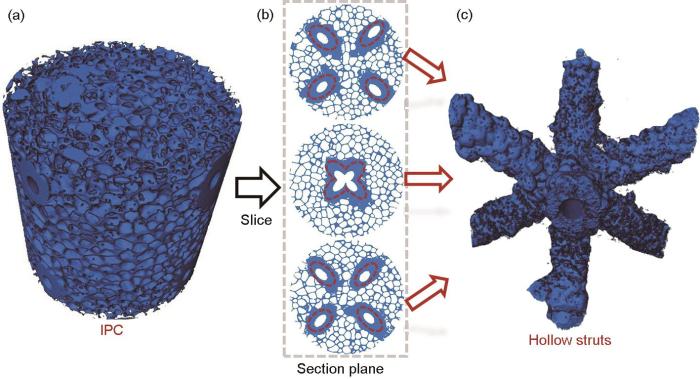
图2
具有中空支柱的铝基互穿相多孔复合材料的三维重构图
Fig.2
Three-dimensional reconstruction of the aluminum interpenetrating phase composites (a) IPC, (b) cross-sectional views at different positions of IPCs, (c) internal hollow strut of IPCs
2.2 变形模式
图3给出了三种具有空心支柱的IPCs (HSB, HFB, HSFB)和泡沫铝(Foam)的变形模式,可见晶格结构的引入完全改变了泡沫铝原有的变形模式。泡沫铝在变形过程中出现了明显的剪切带,呈现出一种逐层坍塌的失效模式。其原因是,泡沫铝承受载荷时,内部的无序薄壁不能合理的分散应力,使应力集中在结构的最薄弱处。达到最薄弱处的屈服强度或屈曲强度的应力,使该处发生断裂并扩展形成局部失效带,最终发展成图中所示的宏观剪切带。这种逐层坍塌的变形模式表明,这种结构负载时只有部分区域承载,使结构的效率降低。相比之下,本文制备的IPCs在变形过程中不产生剪切带,晶格结构能分散应力而使材料整体发生均匀一致的塑性变形,而不是局部先破坏。HSB的应变达到0.3时,垂直于加载方向的支柱已大量断裂和脱落;而在产生相同应变的情况下,HSFB中的同向支柱虽然从基体脱落,但是只发生弯曲而未完全断裂。产生这一差异的原因是,HSFB中的FCC支柱分散应力的能力良好。从图3可见其面心处明显开裂,从而延缓了整体结构断裂失效。值得注意的是,HFB中的FCC支柱在应变为0.3时未明显断裂,即使应变增至0.5也不似HSFB那样完全脱落。FCC支柱可视为一个塑性铰,局部转动吸收能量延缓了结构的整体断裂。如图3所示,HFB中的FCC支柱在应变从0.3增至0.5的过程中发生了显著的转动,而HSFB中的FCC支柱受SC支柱牵连只产生有限的转动便迅速断裂脱落。这表明,SC支柱限制了FCC支柱的塑性铰效应,导致其过早失效。此外,BCC支柱在变形过程中也形成塑性铰并与周围泡沫铝基体相互作用,提高了整体的抗变形能力。这也解释了为何本文制备的所有复合结构均以BCC作为基本结构。
图3
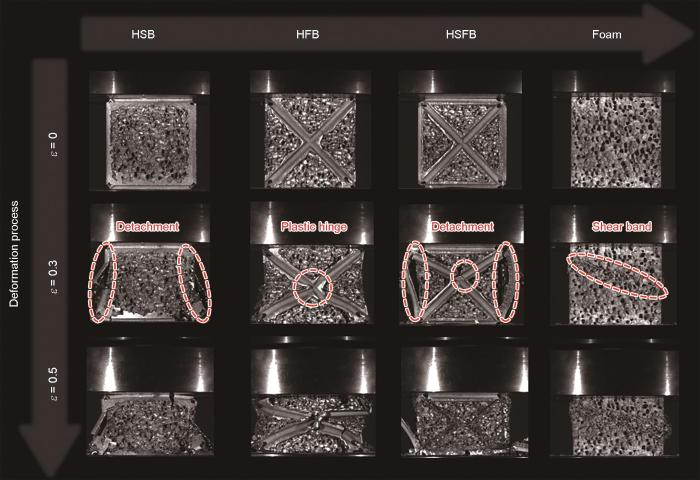
图3
三种IPCs和无序泡沫铝在准静态压缩载荷作用下的变形模式
Fig.3
Deformation modes of the three interpenetrating phase composites and the disordered aluminum foam under quasi-static compressive loading
总之,具有晶格结构的IPCs其变形模式与泡沫铝显著不同。IPCs内各组分之间良好的变形协调性,避免了局部应力集中引发剪切带破坏。同时,晶格结构本身对IPCs的变形有决定性的影响。与具有FCC支柱的HFB和HSFB相比,HSB上的支柱会更早发生断裂和脱落,这与其节点连通性较低、应力传递路径较为简单相关。值得注意的是,FCC支柱不受SC支柱约束时(如HFB中)能充分转动变形延缓断裂脱落,表现出典型的塑性铰链行为。这种转动,能促进能量持续耗散。相反,当FCC支柱和SC支柱同时存在时(如HSFB中),SC支柱的早期失效使FCC支柱过早断裂,使其塑性铰链的充分发展受到限制,最终导致复合材料的承载能力降低。
3 讨论
3.1 IPCs、泡沫铝和有序多孔铝的力学性能
图4a给出了IPCs、有序多孔铝(仅具有实心的支柱)以及泡沫铝的应力-应变曲线。可以看出,所有的IPCs和泡沫铝的应力-应变曲线都具有典型的多孔金属特点。这些应力-应变曲线,可分为三个阶段,分别为线弹性阶段、应力平台阶段和致密化阶段。图4b给出了单一有序多孔铝的应力-应变曲线,可见所有的曲线在达到峰值应力后都急剧下降,在0.2~0.3应变范围内中止。其原因是:其一,所有晶格结构均以ZL111合金为基体。ZL111合金的刚度和强度都比较高但是韧性较差,使支柱在变形中易发生脆性断裂;其二,所采用的结构均具有周期性晶格中的单胞构型,节点连通数较低不利于应力的传递。这些因素使有序多孔铝在压缩过程中发生突发性结构崩塌,导致试样与压头间不能接触,应力-应变曲线终止。从图4a还可见,与泡沫铝相比,IPCs的应力水平更高。所有IPCs的应力-应变曲线都出现多个应力峰值,因为IPCs上支柱的脆性断裂引起应力阶段性下降。值得注意的是,HSFB在弹性阶段的应力响应最高,而在其后塑性变形阶段HFB的应力水平逐渐上升并最终超过HSFB。这一力学性能,与两者的变形模式高度吻合:HFB中的FCC支柱在塑性变形过程中表现出更显著的转动能力和更长的结构完整性保持时间,形成了更有效的塑性铰链机制[22,23]。这种机制,通过持续的应力传递和能量耗散使HFB的应力水平更高。
图4
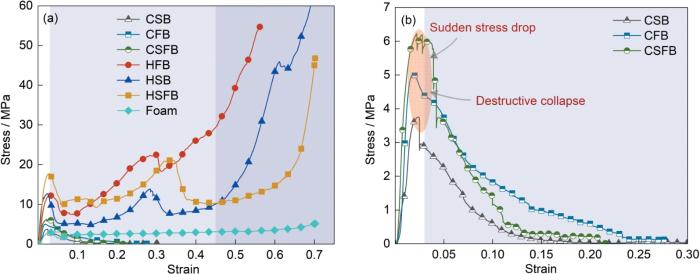
图4
IPCs、泡沫铝和有序多孔铝的应力-应变曲线
Fig.4
Stress-strain curves of the IPCs, aluminum foam, and ordered porous aluminum (a) stress-strain curves of all samples, (b) stress-strain curves of ordered porous aluminum samples
图5
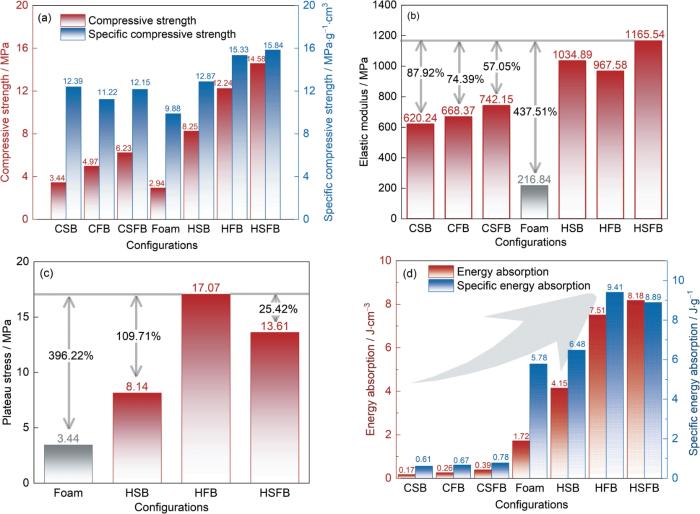
图5
IPCs、泡沫铝和有序多孔铝的力学性能
Fig.5
Mechanical properties of the IPCs, aluminum foam, and ordered porous aluminum (a) compressive strength and specific compressive strength, (b) elastic modulus, (c) plateau stress, (d) energy absorption and specific energy absorption
在各类IPCs中,HSFB的压缩强度和比压缩强度最高,其原因是其独特的结构设计。HSFB内较多的空心支柱不仅增加了承载单元的数量,还大幅度增大了有序-无序相间界面的面积。这些界面能提高负荷能力,还作为应力传递通道促进载荷从较弱的泡沫铝基体向高强度晶格结构转移,从而使协同效应最大化。
为了全面评估本文制备的复合材料的能量吸收性能,建立了多指标综合评价体系。先定义能量吸收(Energy absorption, EA)和比能量吸收(Specific energy absorption, SEA)。将应力表示为σ,应变表示为ε。则EA为
其中εD为致密化应变。比能量吸收定义为能量吸收与密度的比值。致密化应变定义为能量吸收效率(Energy absorption efficiency, EAE)曲线峰值对应的应变[24],可表示为
平台应力(Plateau stress, σpl)为[25]
3.2 有序多孔铝和无序泡沫铝之间的界面效应
如图6所示,ZL111合金与泡沫铝之间有一个明显的起伏界面。图2中的复合材料三维重构的图像表明,无序泡沫铝中的孔洞使浇注进去的ZL111合金熔体形成的不是一个完美的圆柱,其上有许多熔体填充孔洞造成的凸起,使泡沫铝与ZL111合金之间的界面稍有起伏。根据界面上Al和Si元素的分布ZL111合金与泡沫铝只有极少量的元素交换,表明此界面以机械结合为主,只有少量的冶金结合[26,27]。其原因是,在渗流铸造过程中高温ZL111合金熔体在冷却凝固过程中只有少量的泡沫铝薄壁熔化。在变形初期机械结合的界面中少量间隙为结构的变形提供了一定的空间,使耗散的能量增加。变形程度的提高使凹凸不平的界面阻碍双方的移动,可提高强度和变形过程中的应力水平。冶金结合的界面则在变形初期便阻碍变形,并且在后续大变形过程中承受更大的载荷。这样两种结合形式的界面使IPCs无论在弹性变形阶段还是塑性变形阶段都具有优异的力学性能,使其能量吸收性能远超两种组元性能的叠加。
图6
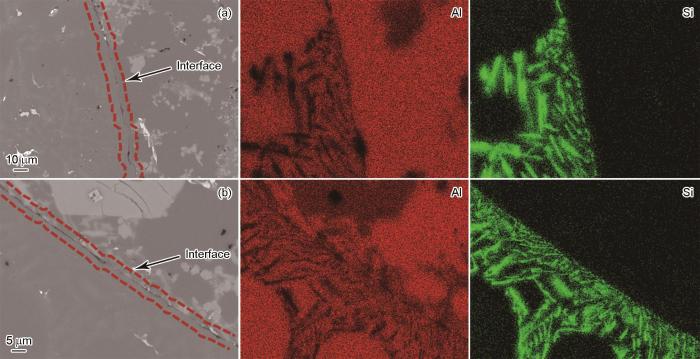
图6
ZL111合金和泡沫铝结合界面的微观形貌和元素分布
Fig.6
Microstructural morphology and corresponding elemental distribution maps across the ZL111/Al foam interface (a) 10 μm scale, (b) 5 μm scale
4 结论
(1) 这种具有中空支柱的互穿相多孔复合材料结合了晶格结构的高强度和无序泡沫结构稳定变形的特性,可克服单一有序结构的易脆性崩塌,使其具有优异的综合力学性能、更高的压缩强度和应力水平。
(2) 在复合材料的塑性变形阶段,SC的支柱在变形过程中易发生早期断裂和脱落,其对复合材料的主要贡献在弹性阶段和塑性变形初期;而FCC(面心立方)支柱形成的塑性铰链,能持续耗散能量并提高整体应力水平。SC支柱提前破坏使与之相连的FCC支柱失去支撑而过早脱落。
(3) ZL111晶格结构与泡沫铝之间的机械结合与冶金结合共存的复合界面,使复合材料在保证轻质特性的前提下具有远高于各组元的优异力学性能。
参考文献
Pore structure, mechanical and sound absorption performance for composite foam of 304 stainless steel fiber/ZL104 aluminum alloy
[J].
304不锈钢纤维/ZL104铝合金复合泡沫的孔结构、力学、吸声性能及其机理
[J].
A novel method of indirect rapid prototyping to fabricate the ordered porous aluminum with controllable dimension variation and their properties
[J].
Preparation of bi-continuous interpenetrating porous composite and its heat treatment enhancement
[J].
Foam metals have become a hot choice for protection due to their excellent specific strength and energy absorption capabilities, and the advancement of light-weighting has posed higher performance requirements and challenges for foam metals. Herein, the disordered-ordered interpenetrating porous composite (Al foam /ZL111 Al-alloy) was prepared via a combination technique of melt foaming and infiltration casting methods. The corresponding quasi-static mechanical properties of characteristic units were analyzed, and the mechanical properties of the composite structural characteristic units may be greatly improved compared to the single structure. The compressive strength of the composite is increased by 66% compared to the sum of their single components, and the plateau stresses were increased by 204%. In order to further improve the comprehensive mechanical properties of the composite structure, the characteristic unit was subjected to T6 heat-treatment and tested in quasi-static compression. The specific compressive strength, plateau stress, and energy-absorbing capacity of the T6 heated unit were enhanced by 73.54%, 107%, and 83.18%, respectively, compared with those before heat treatment. According to the microstructure examination, it can be seen that the eutectic silicon is transformed from the original lamellar to the equiaxed spherical shape after the T6 heat treatment, which reduces the elastic modulus of the material to a certain extent, but significantly improves the compressive strength and plateau stress of the material, and thus improves the energy-absorbing capacity of the composite structure. The interpenetrating porous composite structure can effectively retain the respective advantages of the single component and thus show excellent energy absorption ability, therefore, an appropriate heat treatment of the bi-continuous interpenetrating porous metal (alloy material) structure is an effective means to improve the comprehensive mechanical properties of the material.
双连续互穿铝基多孔复合材料的制备和热处理强化
[J].将熔体发泡和渗流铸造相结合制备双连续互穿多孔复合材料(泡沫铝/ZL111合金)并研究其特征单元的力学性能和热处理强化。结果表明,与单一构成的总和相比,复合材料的抗压强度提高了66%,平台应力提高了204%。为了进一步提高复合材料的综合力学性能,对特征单元进行了T6热处理。T6热处理后的特征单元其比压缩强度、平台应力和能量吸收比热处理前分别提高了73.54%、107%和83.18%。在T6热处理过程中共晶硅由片层状转变为等轴球状,这种转变降低了材料的弹性模量但是其压缩强度和平台应力显著提高,从而使其能量吸收性能提高。这表明,这种互穿多孔复合材料保留了单一构成的优势而具有优异的能量吸收能力。同时,对这种双连续互穿多孔金属(合金材料)复合材料的适当热处理可提高其综合力学性能。
Low-density, high-strength metal mechanical metamaterials beyond the Gibson-Ashby model
[J].
Anisotropic compression behaviors of bio-inspired modified body-centered cubic lattices validated by additive manufacturing
[J].
Research progress in preparation of porous metal materials by alloy phase separation
[J].This review summarizes the recent research progress in the preparation of porous metal materials by alloy phase separation. Combined with the phase separation mechanism of the alloy, the formation mechanism of the porous structure during the phase separation process was discussed based on the interfacial spinodal decomposition and diffusion-coupled growth. The effect of phase-separated alloy system, composition change and process parameter on the characteristics such as morphology, porosity and ligament size of the porous structure were systematically analyzed. Furthermore, the properties of phase-separated porous metal materials and their application prospects in the fields of catalysis, electrolytic capacitors, and biomedicine are summarized due to their large specific surface area and interconnected ligaments. Finally, the research and development trend of the preparation of porous metals by alloy phase separation is proposed.
合金相分离制备多孔金属材料的研究进展
[J].总结了合金相分离方法制备多孔金属材料的最新研究进展。结合合金相分离机理,探讨了相分离过程中界面调幅分解和扩散耦合生长对多孔拓扑结构的形成过程的影响。阐述了相分离合金体系、成分变化和工艺参数对多孔结构的形貌特征、孔隙率以及韧带尺寸特征的影响规律。同时,结合其大比表面积和互联韧带等特征,阐述了相分离多孔金属材料的性能及其在催化、电解质电容器、生物医学等领域的应用前景。最后针对合金相分离制备多孔金属的研究发展趋势进行了展望。
Properties and applications of additively manufactured metallic cellular materials: A review
[J].
Preparation of bi-continuous interpenetrated AF/ZAlSi9Cu2Mg with excellent energy absorption capacity via in situ method
[J].
Bi-continuous interpenetrated porous composite integrating the high strength and long plateau stress stage prepared by an in situ method
[J].
Interpenetrating phase composites with 3D printed triply periodic minimal surface (TPMS) lattice structures
[J].
Dynamic response of double-layer rectangular sandwich plates with graded foam cores under blast loading
[J].
Compressive properties and energy absorption behavior of Mg17Al12/Al ordered structure composites
[J].
Quasi-static compressive behavior of the ex-situ aluminum-alloy foam-filled tubes under elevated temperature conditions
[J].
The effects of foam filling on the dynamic response of metallic corrugated core sandwich panel under air blast loading-Experimental investigations
[J].
Compressive response and energy absorption of all-composite sandwich panels with channel cores
[J].
Unprecedented strength enhancement observed in interpenetrating phase composites of aperiodic lattice metamaterials
[J].
Design and compression properties of novel interpenetrating phase composite structures based on implicit function control
[J].
A comprehensive review of the mechanisms and structure of interpenetrating phase composites with emphasis on metal-metal and polymer-metal variants
[J].
Bioinspired interpenetrating-phase metal composites
[J].
Ultralight, ductile metal mechanical metamaterials with super elastic admissible strain (0.1)
[J].Mechanical metamaterials are architectured cellular materials with unusual properties. Herein we report another type of metal mechanical metamaterials—their elastic admissible strain (EAS) is on the order of 0.1, compared to about 0.01 for common metallic materials. Four conditions are required for a metal mechanical metamaterial to achieve this super EAS: (i) bending-dominated deformation; (ii) low density; (iii) an appropriate lattice topology, and (iv) an intrinsically high EAS for the lattice strut constituent material. The findings of this work extend perspectives on metal mechanical metamaterials.
Understanding the superior mechanical properties of hollow-strut metal lattice materials
[J].
Plastically isotropic mechanical metamaterials with discrete assemblies
[J].
Tunable bioinspired lattice metamaterials with excellent strength, energy absorption and vibration insulation
[J].
Bio-inspired vertex modified lattice with enhanced mechanical properties
[J].
Breaking the tradeoffs between different mechanical properties in bioinspired hierarchical lattice metamaterials
[J].
In situ preparations of bi-continuous interpenetrating porous composites with high energy absorption
[J].


