



通常采用冷轧或热轧工艺制造钛合金板材,轧制过程中发生的组织和织构演变影响其力学性能的各向异性。Ma等[8]分别用单向冷轧和两步交叉冷轧制备Ti-3.5Al-5Mo-6V-3Cr-2Sn-0.5Fe高强板材,发现两步交叉轧制工艺能降低组织的不均匀性,固溶+时效热处理则有助于使织构弱化。这两种因素的协同作用,使合金的各向异性显著降低。Zhang等[9]研究等温锻造Ti-22Al-25Nb合金棒材的拉伸各向异性机制时发现,屈服强度的各向异性主要受O相织构控制,具有高施密特因子的强[100]取向使AD(轴向)的屈服强度最低。Ju等[10]研究锻态(Ti, Nb) B/Ti2AlNb复合材料的织构和力学性能各向异性时发现,[100]O//CD的纤维织构使O相{1
1 实验方法
实验用材料是1 mm厚工业化Ti2AlNb合金板材,其名义成分为Ti-22Al-24Nb-0.5Mo (原子分数,%)。先将这种合金铸锭在B2单相区锻造成厚度为120 mm的板坯,随后继续在B2单相区开坯轧至60 mm厚;将其修磨处理后在(B2 + α2)低两相区进行多次换向轧制,最后进行包覆叠轧轧至成品厚度。实验所用板材是在960 ℃固溶热处理和表面处理后的固溶态板材,记为ST (Solution treated)。对固溶态板材在(B2 + O)两相区进行时效热处理,三种制度分别为750 ℃/4 h、800 ℃/4 h和850 ℃/4 h,将得到的试样分别标记为AT-750、AT-800、AT-850。
用电火花线切割从板材上切取如图1所示的拉伸试样,在TSE 105D微机控制的电子万能试验机上进行室温拉伸实验,在MTS E45.105万能试验机上进行高温拉伸实验。取样时定义板材的轧制方向为纵向(RD),垂直于轧面方向为法向(ND),垂直于RD、ND的方向为横向(TD)。为了确保数据的可靠性,每个取向上均制备两根平行拉伸试样,取其结果的平均值。
图1

图1
拉伸试样的尺寸和取样示意图
Fig.1
Schematic diagram of dimensions (mm) (a) and sampling (b)
为了分析板材的微观组织,先线切割试样得到待观察截面。将截面依次用150#、800#、2000#和3000#砂纸打磨后用50 nm SiO2乳浊液抛光至镜面。最后用体积比为HF∶HNO3∶H2O = 1∶1∶50的腐蚀液将其侵蚀。利用MERLIN Compact场发射扫描电镜观察试样的微观组织形貌。采用EBSD技术获取样品的微观织构信息,并使用Aztec Crystal软件采集和处理EBSD数据。
2 实验结果
2.1 ST态板材的微观组织
图2a和图2b分别给出了ST态板材RD-ND面和TD-ND面的微观组织。可以看出,该组织包含基体B2相、少量等轴α2相和多种形态的O相。根据其形貌特征,这些O相可分为等轴O相(长径比< 2)、短板条O相(长径比为2~5)、沿轧制方向分布的长条状O相(长径比> 5)以及环绕α2相的rim O等类型。从图2a中右上角的高倍SEM图像可以观察到,在固溶处理后的空冷过程中生成了少量纳米级针状O相(红圈标注所示)。观察板材中O相的形态可见,在ST态板材中分布着较多沿RD和TD方向的条状O相。与TD-ND面相比,RD-ND面的O相晶粒拉长得更显著且长板条O相的数量更多。经不同温度时效热处理后的板材,其微观组织形貌如图2c~h所示。可以看出,与ST态板材相比,时效处理诱发的组织演变体现在两个方面:其一,大量细小的二次针状O相从B2基体中析出,且随着时效温度的提高这些析出相发生粗化,同时其体积分数降低;其二,已有的初生板条状O相在时效过程中进一步粗化。
图2
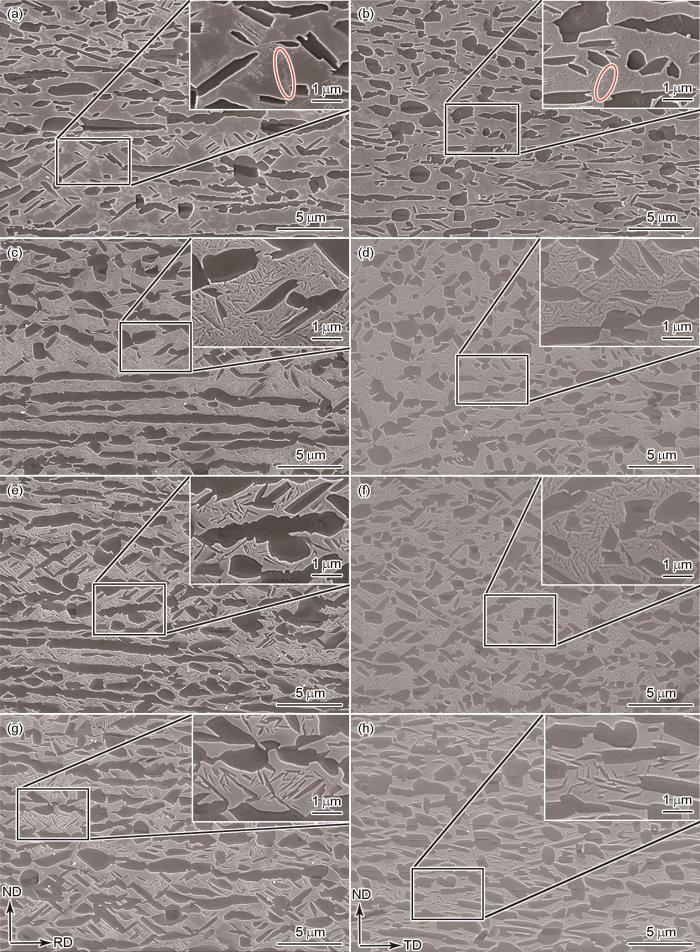
图2
不同热处理后Ti2AlNb板材的微观组织
Fig.2
Microstructures of RD-ND and TD-ND plane of Ti2AlNb sheets after different heat treatments (a, b) ST, (c, d) AT-750, (e, f) AT-800, (g, h) AT-850, Note that (a, c, e and g) are samples of RD-ND plane, and others are samples of TD-ND plane
2.2 板材中织构的特征
图3a给出了ST态板材的IPF-ND图。可以看出,沿ND方向不同深度的晶粒其颜色显著不同,表明板材中有多种类型的织构。结合图4中各相的极图分析织构的特征。图3b给出了B2相的IPF-ND图,图中蓝色的B2相晶粒对应{111}<uvw>织构(图4a中用菱形标记出其中一种变体{111}<1
图3

图3
ST态板材中各相的晶体取向
Fig.3
Crystal orientation map in the ST sheet (a) IPF-ND map of three phases, (b) B2 phase, (c) O phase, (d) α2 phase
图4
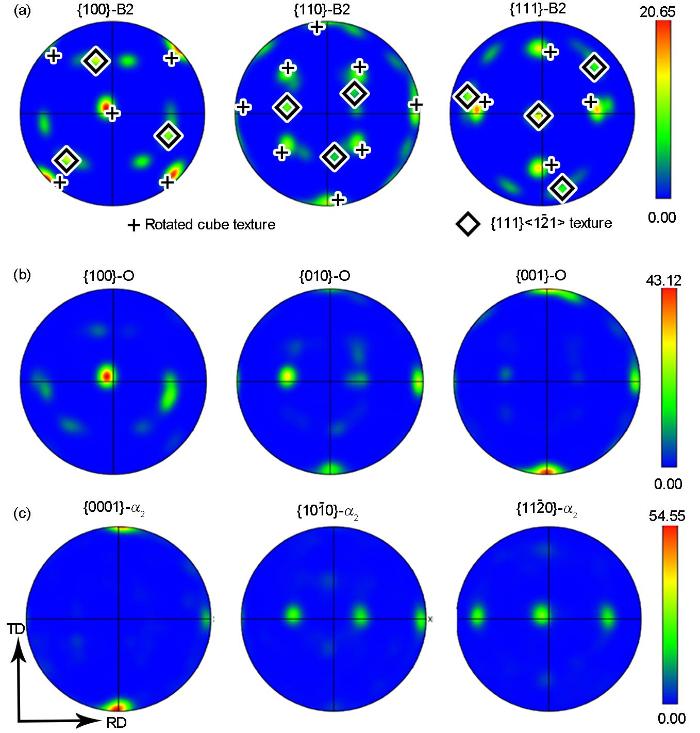
图4
ST态板材中各相的极图
Fig.4
Pole figure (PF) of different phases of the ST sheet (a) B2 phase, (b) O phase, (c) α2 phase
图5给出了在不同温度时效后板材中各相的极图。与ST态极图的对比可见,时效热处理后B2相和O相的织构类型基本不变,但是B2相的最大极密度有所降低,O相的最大极密度提高。这一变化可归因于在时效过程中析出了二次针状O相。大量细小的针状O相从B2基体析出,严格遵循Burgers位向关系(即{110}B2//{001}O,<1
图5

图5
在不同温度时效态板材中各相的极图分布
Fig.5
PF of various phases in the sheets after aging at 750 oC, 800 oC and 850 oC (a) B2-{100}, (b) O-{100}, (c) α2-{0001}
2.3 板材的拉伸性能
在不同条件下热处理的板材其室温和650 ℃ 拉伸性能列于表1和表2。对比TD和RD的数据可见,无论是ST态还是时效板材,其TD方向的拉伸强度均高于RD方向,表现出显著的各向异性。ST态板材TD和RD方向的室温屈服强度平均差值高达140 MPa,抗拉强度平均差值为95 MPa。时效热处理后,板材性能的差值显著减小:屈服强度的最大差值不超过62 MPa,抗拉强度的最大差值不超过20 MPa。这表明,时效热处理降低了板材拉伸强度的各向异性。对ST态板材的测试温度由室温升至650 ℃时,其屈服强度的各向异性差值从140 MPa急剧减小至25 MPa,抗拉强度的差值也从95 MPa降至37 MPa。这表明,随着拉伸温度的提高,板材的拉伸强度各向异性随之降低。
表1 不同热处理板材的室温拉伸性能
Table 1
Heat treatment | Rp0.2 / MPa | Rm / MPa | A / % | |||
|---|---|---|---|---|---|---|
| RD | TD | RD | TD | RD | TD | |
| ST | 973 | 1113 | 1080 | 1175 | 6.3 | 2.3 |
| AT-750 | 1096 | 1108 | 1136 | 1140 | 2.5 | 2.0 |
| AT-800 | 991 | 1002 | 1071 | 1072 | 4.5 | 3.5 |
| AT-850 | 832 | 894 | 946 | 966 | 6.0 | 4.0 |
表2 不同热处理板材的650 ℃拉伸性能
Table 2
Heat treatment | Rp0.2 / MPa | Rm / MPa | A / % | |||
|---|---|---|---|---|---|---|
| RD | TD | RD | TD | RD | TD | |
| ST | 776 | 801 | 960 | 997 | 4.0 | 3.5 |
| AT-750 | 764 | 780 | 933 | 961 | 8.0 | 4.5 |
| AT-800 | 702 | 708 | 874 | 880 | 10.0 | 5.0 |
| AT-850 | 676 | 700 | 814 | 847 | 14.0 | 8.0 |
基于表1和表2中强度的平均值数据,绘制了室温和高温拉伸强度的变化趋势(图6)。由图6可见,板材在RD和TD方向的拉伸强度随着时效温度的提高均呈单调下降的趋势。其原因是,随着时效温度的提高,从B2相基体中析出的二次针状O相发生粗化,其对位错运动阻碍的减弱使整体强度降低。但是,有一个值得注意的现象:与ST态板材相比,时效热处理后板材的室温强度并未出现预期的显著提高;特别是在850 ℃时效后,其屈服强度和抗拉强度甚至明显低于ST态。其原因是,时效过程中的析出强化(二次针状O相析出)与软化(初生O相粗化)相互抵消,导致净强化效果不明显。在850 ℃时效的试样(图2g)中,二次针状O相不仅尺寸更大,体积分数也显著降低,导致析出强化的贡献微弱。同时,初生板条O相的进一步粗化导致强度进一步降低。这两方面因素的共同作用,使其强度最终明显低于仅进行固溶处理的板材。
图6

图6
不同热处理板材的室温和650 ℃拉伸强度的变化趋势
Fig.6
Tensile strength at RT and 650 oC after different heat treatments (a) RT, (b) 650 oC
3 讨论
3.1 织构的形成机制
为了探究板材中不同类型织构的形成机制,采集了ST态板材RD-ND面的低倍数EBSD数据,结果如图7a所示。可以观察到,样品中存在明显的取向分层,即蓝色层和红色层沿ND方向交替分布。其中蓝色层的B2相为{111}<uvw>织构,红色层的B2相为{001}<110>旋转立方织构。
图7
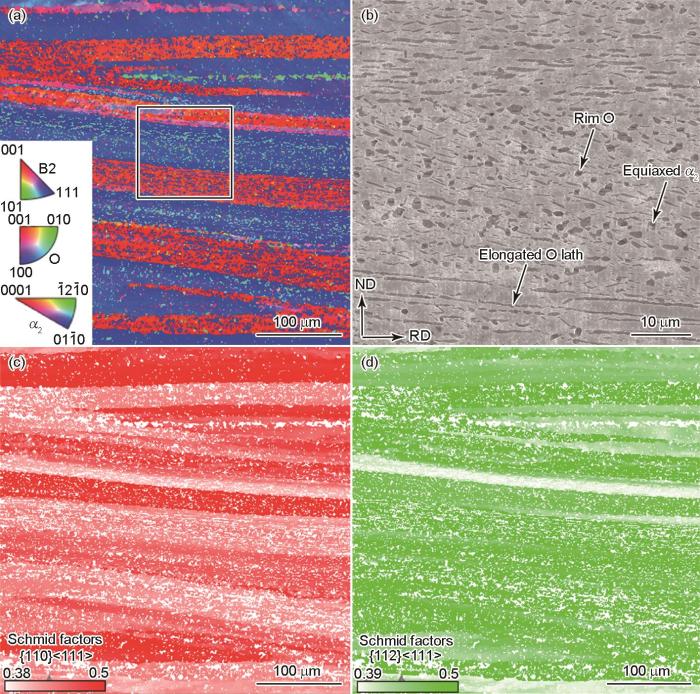
图7
板材RD-ND面的EBSD数据和微观组织
Fig.7
EBSD data and microstructures of RD-ND plate (a) IPF-ND map, (b) microstructures in the yellow-framed area of Fig.a, (c, d) distributions of SF for {110}<111> and {112}<111>
在高温下变形,变形织构的类型往往取决于开动的滑移系种类[19]。通常,特定滑移系启动的难易程度可由其临界分解剪切应力(Critical resolved shear stress, CRSS)量化,分解剪切应力(RSS, τ)大于此临界值时滑移系即可被激活。bcc结构的B2相中常见的滑移系为{110}<111>和{112}<111>[20],两者的CRSS值相近,使Schmid因子成为决定滑移系优先启动顺序的关键参数。图7c和图7d分别给出了板材{110}<111>和{112}<111>滑移系的Schmid因子分布。两种滑移系的Schmid因子平均值均高于0.43,表明其在热轧过程中均易激活。由图可见,{110}<111>滑移系在蓝色层区域的Schmid因子明显高于红色层区域,而{112}<111>滑移系的Schmid因子则未表现出明显的分层。上述结果表明,蓝色层的{111}<uvw>织构由{110}<111>和{112}<111>滑移协同主导;而红色层的{001}<110>旋转立方织构主要受{112}<111>滑移系激活的控制。这一机制与锻造钛合金中丝织构的形成机制类似[21,22]。
图7b给出了图7a中框线区域局部组织形貌的放大。可以看到,红色层中的O相呈沿轧向拉长的长板条状,而蓝色层中则以rim O和短板条O相为主。这种组织和织构的分层现象与板材的轧制过程相关[23]。板材在(B2 + α2)低两相区轧制时,表层区域受到强烈的剪切应力而变形。这种剪切变形不仅有利于B2相中{111}<uvw>织构的形成,还能促进α2相动态再结晶,从而生成细小的等轴再结晶α2晶粒。与之相对,心部区域则处于平面应变压缩状态,厚度方向的压应力尤为显著,使晶粒被压扁和拉长,此种变形有利于形成{001}<110>织构。在B2相中析出α2相时,二者之间遵循Burgers位向关系,即(0001) α2//(110)B2,此时α2相的基面与压缩轴平行,易于启动柱面滑移系{10
板材中的O相主要在轧制后的固溶处理过程中析出。在具有{111}<uvw>织构的层中,rim O由α2 + B2→O共析反应生成,而短板条状O相则直接从B2基体析出。在具有{001}<110>织构的层中,原有的长板条α2相在固溶过程中转变为长板条状O相。O相的析出严格遵循Burgers位向关系:与B2相之间为{110}B2//{001}O、<1
综上所述,板材分层织构的演化机制可归纳为:首先,轧制时表层和心部的不均匀变形分别诱发了B2相的{111}<uvw>织构和{001}<110>织构。其次,在轧制变形中启动的柱面<a>滑移主导了α2相T型织构的形成。在多道次轧制过程中,这种由应变分布不均匀引发的组织和织构不均匀不断积累。最后,在固溶热处理过程中,O相通过位向关系遗传继承了B2相与α2相的取向,进一步强化了板材的分层织构特征,最终在板材的厚度方向上形成了如图7a所示的红蓝交替的分层结构。
3.2 拉伸性能的各向异性及其影响因素
3.2.1 板材拉伸性能的各向异性
表1中的数据表明,ST态板材RD方向的室温拉伸强度明显低于TD方向,塑性则优于TD方向。板材力学性能的各向异性,通常可归因于其微观组织和织构的各向异性[25]。从图2a和图2b可以看出,尽管换向轧制板材沿RD与TD方向上的显微组织相似,但是最终沿RD方向的道次使板材中保留了较多沿该方向拉长的长板条状O相。Li等[26]对α2 + B2 + O三相合金的室温变形机制研究表明,在塑性变形初始阶段滑移线主要沿着不同取向的板条O相扩展;随着变形量的增大,滑移线会穿过O相呈锯齿状路径扩展。沿TD方向加载时,位错运动方向与这些O相板条的长轴大致垂直。位错线沿着这些长板条O相扩展和穿过O相时均受到较大的阻力,宏观上表现为TD方向拉伸强度的提高。
图8
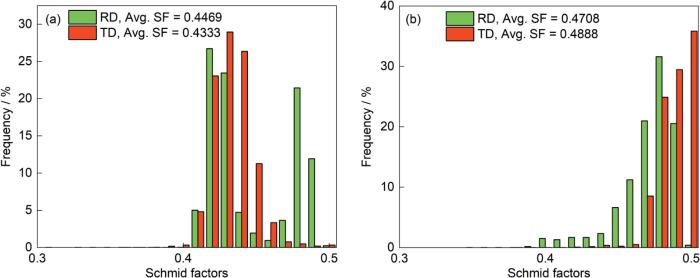
图8
B2相中各滑移系的Schmid因子分布
Fig.8
Schmid factors (SF) distributions of B2 phase under loading along RD and TD (a) {110}<111>, (b) {112}<111>
图9
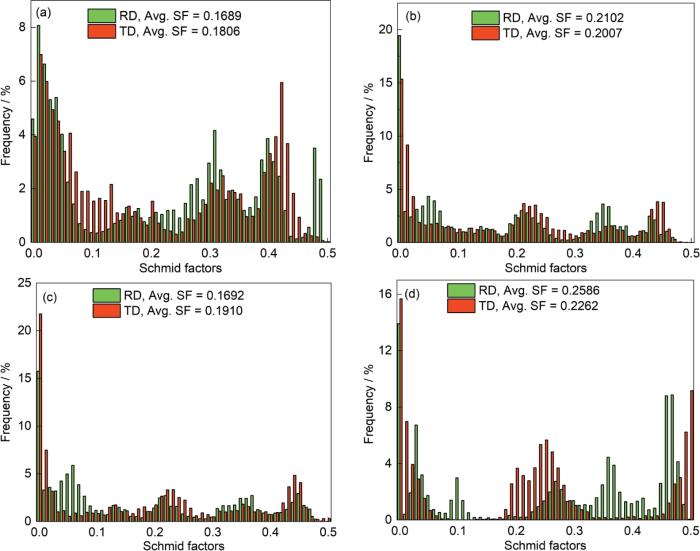
图9
O相中基面<a>滑移系和柱面<a>滑移系Schmid因子的分布
Fig.9
SF distributions of basal <a> slip and prismatic <a> slip of O phase under loading along RD and TD (a) {001}<100>, (b) {001}<110>, (c) {010}<100>, (d) {110}<1
图10

图10
O相中锥面<c + a>滑移系的Schmid因子分布
Fig.10
SF distributions of pyramidal <c + a> slip of O phase under loading along RD and TD (a) {131}<11
图11

图11
α2相各滑移Schmid因子的分布
Fig.11
SF distributions of α2 phase under loading along the RD and TD (a) basal <a> slip, (b) prismatic <a> slip, (c) pyramidal <c + a> slip
在室温拉伸的塑性变形过程中,α2相中通常激活的是基面<a>滑移和柱面<a>滑移[4,29]。图11给出了在RD和TD方向加载时α2相中不同滑移系的Schmid因子分布。由图11可见,α2相中分布在RD和TD方向的基面<a>滑移与锥面<c + a>滑移的Schmid因子较为接近(图11a, c),柱面<a>滑移的Schmid因子则表现出明显的方向性(图11b)。板材中α2相形成的T型织构表明,绝大多数α2相晶粒的c轴平行于TD方向。当沿TD方向拉伸即加载方向与c轴一致时,柱面滑移系和基面滑移系的Schmid因子理论值均为0。图11a和图11b中的统计分布表明,Schmid因子也高度集中在0~0.1的低值区间,导致这两种滑移系极难开动,从而使其拉伸强度较高。沿RD方向拉伸即c轴与加载方向夹角呈90°时,柱面滑移的Schmid因子显著增大,其值在0.4~0.5高区间的占比为58%;相比之下,基面<a>滑移系的Schmid因子仍然较低,图11a显示其在0~0.1区间的占比超过51%。因此,在RD方向拉伸时柱面<a>滑移易于启动,而基面<a>滑移仍难以启动。
综上所述,在室温拉伸变形时,影响ST态板材拉伸强度各向异性的主要是α2相织构。在RD方向加载时,α2相中的T型织构使柱面<a>滑移更易启动。这种滑移系启动的显著差异,使板材在TD方向上的室温强度远高于RD方向。
图12
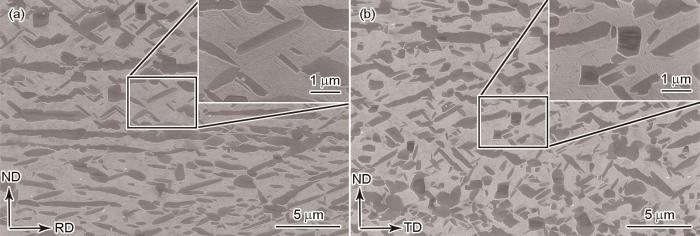
图12
ST态板材650 ℃拉伸后夹持端的微观组织
Fig.12
Gripped end microstructures of the ST sheet (650 oC tensile test) (a) RD-ND plane, (b) TD-ND plane
3.2.2 时效对拉伸性能各向异性的影响
在750 ℃和800 ℃时效的板材,其TD与RD方向室温拉伸屈服强度平均差值不超过12 MPa,抗拉强度平均值几乎相同;在650 ℃拉伸,其屈服强度与抗拉强度平均值的差值分别不超过16 MPa和28 MPa。这些数据表明,时效处理显著弱化了拉伸强度的各向异性。在850 ℃时效后,虽然TD与RD方向的室温强度平均值差值比在750 ℃和800 ℃时效略有回升,但是相比ST态其屈服强度平均值差值从140 MPa大幅度降至62 MPa,抗拉强度的平均值差值从95 MPa降至20 MPa,各向异性也降低。各向异性的降低源于微观组织的均匀化和织构演变。在750 ℃和800 ℃时效后B2相基体中析出的二次针状O相细小且弥散分布,组织均匀化的效果较好,因此板材TD与RD方向拉伸强度的差异很小;而在850 ℃时效后,二次针状O相的体积分数降低且尺寸显著增大,其组织均匀化较差,导致各向异性的降低不如前两者。其次,如前所述,α2相的T型织构引起柱面<a>滑移的Schmid因子差异,导致了板材室温拉伸性能的各向异性。时效处理后,根据α2相{0001}极图可知(图5c),其[0001]//RD取向的R型织构组分有所提高。对α2相柱面<a>滑移系的Schmid因子的计算结果汇总于表3中。可以看出,α2相柱面<a>滑移系沿不同加载方向的Schmid因子差值从0.13 (时效前)分别降为0.08、0.08、0.05,即时效处理诱导α2相织构由T型向R型的转变,使沿TD方向加载时柱面<a>滑移系的Schmid因子分布向高值区平移,降低了拉伸强度的取向依赖性,从而减小了由此产生的横、纵向拉伸性能的差异。
表3 时效处理板材中α2相柱面<a>滑移系沿不同加载方向的平均Schmid因子
Table 3
| Aging treatment | Slip system | Direction | Average SF |
|---|---|---|---|
| AT-750 | {10 | RD | 0.2923 |
| TD | 0.2107 | ||
| AT-800 | RD | 0.3015 | |
| TD | 0.2182 | ||
| AT-850 | RD | 0.2824 | |
| TD | 0.2316 |
4 结论
(1) Ti-22Al-24Nb-0.5Mo薄板中各相均呈现较强的择优取向。B2相的织构以{001}<110>旋转立方织构和{111}<uvw>织构为主;α2相为典型的T型织构;而O相因位向遗传效应继承了母相特征,表现出[100]//ND和[001]//TD的特征取向。
(2) 板材的显微组织和织构沿厚度方向交替分层分布。这种分层结构的物理本质是多道次轧制中应变场的不均匀分布:表层强烈的剪切变形促进了B2相{111}<uvw>织构的形成,而心部的平面压缩变形则主导了B2相{001}<110>旋转立方织构的演化。在随后固溶处理中O相因Burgers位向关系继承了B2相和α2相的取向和形貌,最终形成了这种分层结构。
(3) ST态板材室温强度的各向异性(TD > RD)受其组织和织构的影响:沿TD方向加载时α2相中的T型织构使柱面滑移系的Schmid因子极小,极大地提高了该方向的变形抗力;另一方面,沿TD方向拉伸时,沿轧向分布的长板条状O相对位错运动的几何阻碍作用更强。
(4) 时效处理是弱化薄板性能各向异性的有效途径。在B2相基体中析出的弥散二次针状O相,使横、纵向组织的均匀性显著提高;在时效过程中α2相中增强的R型织构弱化了柱面<a>滑移对加载方向的敏感性。这两者的协同效应使板材具有优异的强度,且横、纵向性能高度均衡。
参考文献
A new ordered orthorhombic phase in a Ti3Al Nb alloy
[J].
Part I. The microstructural evolution in Ti-Al-Nb O + Bcc orthorhombic alloys
[J].
Recent advances on microstructural controlling and hot forming of Ti2AlNb-based alloys
[J].
Ti2AlNb基合金微观组织调制及热成形研究进展
[J].
Phase transformation and microstructure control of Ti2AlNb-based alloys: A review
[J].
Preparation of Ti-22Al-25Nb solid solution powders using mechanical alloying and solid solution mechanism analysis
[J].
Electrically assisted superplastic forming/diffusion bonding of the Ti2AlNb alloy sheet
[J].
Mechanism of reheat cracking in electron beam welded Ti2AlNb alloys
[J].
Effect of cold rolling process on microstructure and mechanical properties of high strength β titanium alloy thin sheets
[J].
Research on tensile anisotropy of Ti-22Al-25Nb alloy isothermally forged in B2 phase region related with texture and variant selection
[J].
Anisotropic microstructure and mechanical properties of as-forged (Ti, Nb) B/Ti2AlNb composites
[J].
Texture and anisotropy of Ti-22Al-23Nb foil
[J].
Electron beam welding of Ti2AlNb based alloy sheet
[J].
Ti2AlNb合金板材的电子束焊接
[J].
Superplastic deformation behavior of annealed Ti2AlNb alloy sheet
[J].
退火态Ti2AlNb合金板材的超塑性变形行为
[J].
Tensile behavior of Ti-22Al-24Nb-0.5Mo in the range 25-650 oC
[J].
Comparative study on hot workability of powder metallurgy Ti-22Al-24Nb-0.5Mo alloy
[J].
Powder metallurgy (PM) Ti2AlNb alloy of Ti-22Al-24Nb-0.5Mo (atomic fraction, %) was prepared from pre-alloyed powder using hot isostatic pressing (HIPing). Compression tests of PM Ti2AlNb alloy, heat treated PM Ti2AlNb alloy and wrought Ti2AlNb alloy with the same chemical composition were conducted on Gleeble-3800 testing machine. The testing temperatures were from 930oC to 1050oC, strain rates varied from 0.001 s-1 to 10 s-1, and engineering strain was about 50% for each compression. The results show that the deformability of PM Ti2AlNb alloy is comparable to that of wrought alloy, and heat treatment has no obvious effect on the hot workability of PM Ti2AlNb alloy. The high temperature flow behavior of Ti2AlNb alloys prepared by different fabrication routes is similar in this work, while processing windows for PM Ti2AlNb alloy is broader than casting alloys especially at low temperature or relative high strain rate. PM Ti2AlNb billets for hot deformation were prepared by a typical powder metallurgy process, and were upset or drawn out to different deformation in two-phase region. Macrostructure of deformed PM Ti2AlNb billets were observed, no macro crack was found in deformed PM Ti2AlNb billets and the deformation was uniform. The results of tensile tests show that the deformed PM Ti2AlNb alloy after heat treatment presents better tensile properties.
粉末Ti-22Al-24Nb-0.5Mo合金热变形能力的对比研究
[J].采用预合金粉末热等静压工艺制备名义成分为Ti-22Al-24Nb-0.5Mo(原子百分数)的粉末Ti<sub>2</sub>AlNb合金, 对粉末合金、经热处理的粉末合金和同种成分的熔铸Ti<sub>2</sub>AlNb合金进行了压缩实验。结果表明, 粉末Ti<sub>2</sub>AlNb合金具有与熔铸变形合金相当的变形能力, 热处理对粉末Ti<sub>2</sub>AlNb合金的变形能力没有明显的影响, 粉末合金在低温和高应变速率下的变形抗力更低, 不易开裂。采用典型粉末成型工艺制备粉末Ti<sub>2</sub>AlNb热变形坯料, 在两相区进行了不同变形量的墩粗和拔长热变形。结果表明, 粉末Ti<sub>2</sub>AlNb坯料变形后没有宏观裂纹, 变形均匀。拉伸实验结果表明, 变形后经热处理的粉末Ti<sub>2</sub>AlNb合金表现出更好的拉伸性能。
Preparation of Ti2AlNb alloy by powder metallurgy and its rupture lifetime
[J].
粉末冶金Ti2AlNb合金的制备及持久寿命
[J].
Orthorhombic phase transformations in titanium alloys and their applications
[J].The link and difference between orthorhombic phase transformations in <em>β</em>-type titanium alloys and in Ti<sub>3</sub>Al containing high concentrations of transition metal elements such as Nb are first outlined in this paper. Recent investigations on these transformations conducted in the authors' group are reviewed followed by discussions of remaining problems. Three examples were presented to illustrate the applications of the orthorhombic phase transformations: design and development of superelastic titanium alloys for biomedical use, preparation of ultra-fine basketweave microstructure of titanium alloy wire for fastener manufacturing, and sheet and foil production of alloys based on Ti<sub>2</sub>AlNb.
钛合金中的正交相变及其应用
[J].
Texture of Ti2AlNb sheet and its effect on anisotropy of tensile properties
[J].
Ti2AlNb薄板的织构及其对拉伸性能各向异性的影响
[J].针对Ti<sub>2</sub>AlNb薄板拉伸性能不均匀的问题,研究了Ti<sub>2</sub>AlNb薄板的显微组织、织构及其对拉伸性能均匀性的影响。结果表明,Ti<sub>2</sub>AlNb合金薄板显微组织由α<sub>2</sub>、B2和O相三相组成,各相均存在强烈的织构。B2相形成有所偏转的立方织构,O相形成明显的与α<sub>2</sub>相和B2相取向相关的<100>//ND (ND为法向)相变织构,α<sub>2</sub>相形成轧制热变形导致的强烈的{112¯0}<uvtw>织构。板材的室温(24 ℃)和650 ℃高温拉伸性能均存在明显的各向异性,横向拉伸强度均高于纵向,但拉伸延伸率低于纵向,这是由于板材中的α<sub>2</sub>相近T型强织构和O相<100>//ND相变织构使各自的柱面<a>滑移在板材的横向方向更难启动所致。随拉伸实验温度升高到700 ℃,α<sub>2</sub>相和O相中锥面<c + a>滑移的启动显著削弱了拉伸性能的各向异性。
Modeling the transformation texture of Ti-64 sheets after rolling in the β-field
[J].
Annealing response of the intermetallic alloy Ti-22Al-25Nb
[J].
Effect of α precipitation on β texture evolution during β-processed forging in a near-β titanium alloy
[J].
Microstructure and texture development during hot-compression of Ti5321
[J].
Crystal orientation dependence of Young's modulus in Ti-Nb-based β-titanium alloy
[J].
Microstructure, texture and mechanical property of TA32 titanium alloy thick plate
[J].
TA32钛合金厚板的微观组织、织构与力学性能
[J].
Anisotropy of mechanical properties and influencing factors of hot rolling TC4 titanium alloy
[J].
热轧TC4钛合金力学性能各向异性及影响因素分析
[J].
Effects of heat treatment on microstructure evolution and mechanical properties of Ti-22Al-24Nb-0.5Mo alloy
[J].
In-situ investigation of tensile anisotropy mechanism in an advanced Ti2AlNb-based alloy associated with CRSS ratio and damage model
[J].
Deformation of the O and α2 phases in the Ti-Al-Nb system
[J].
In situ observation of tensile deformation of Ti-22Al-25Nb alloy and characterization of deformation in α2 phase
[J].The room temperature tensile deformation of Ti-22Al-25Nb alloy with an equiaxed α2 phase microstructure and the activated slip system of α2 particles were investigated by a combination of in situ tensile tests and electron backscatter diffraction experiments. The results demonstrate that only a few wide and long slip bands occur in the B2 matrix in the initial stage of yielding. With the tensile displacement increases, a large number of slip bands, including multiple- and cross-slip bands, appear in the B2 matrix and the distance between two adjacent slip bands decreases significantly. Meanwhile, the movement of the slip bands is hindered by the α2 particles and the B2 grain boundaries, and the slip bands appear only in a small number of the α2 particles. From the beginning of the tensile process to the final fracture, there are lots of α2 particles without slip bands. The slip bands penetrate the needle-like lamellar O phase without changing the slip direction. Compared with the α2 particles, the hindering effect of needle-like O phases on the motion of the slip bands is quite small. The microcracks nucleated at the α2/B2 phase boundaries or within the α2 particles, and microcracks propagated along the α2/B2 phase boundaries or across the α2 particles. The fracture surface shows the quasi-cleavage feature, which contains a large number of small and shallow dimples on planar facets. The analysis indicates that the plastic deformation of the alloy is mainly contributed by the B2 phase. For room temperature tensile deformation of α2 phase, there are three types of slip systems that can be activated, including the prism <a> type slip, the basal <a> type slip and the pyramidal <a+c> type slip. The prism <a> type slip is most likely to be activated, followed by the basal <a> type slip and finally the pyramidal <a+c> type slip. In addition, the critical resolved shear stress (CRSS) for the pyramidal <a+c> type slip is the highest among the three types of slip systems. Therefore, the deformation in the α2 phase is mainly contributed by the prism <a> type slip and the basal <a> type slip.


