



高熵合金独特的高熵效应、晶格畸变效应和迟滞扩散效应,使其具有高强度、高硬度、耐磨损以及高温稳定性等优异性能[1~3]。以钛(Ti)和锆(Zr)为主要组元的低密度Ti-Zr基高熵合金,加入V、Nb、Ta等元素产生的晶格畸变使其具有显著的固溶强化效应,从而实现了比强度与室温塑性之间的平衡。具有轻质、优异的力学性能和良好变形性能的Ti-Zr基高熵合金有极大的应用潜力[4~6],在其中添加增强相制备高熵合金基复合材料可使其力学性能进一步提高[7~13]。欧阳维等[14]采用机械球磨和放电等离子烧结工艺制备TiC/FeCrCoMnNi复合材料,研究了TiC含量和烧结温度对其组织和性能的影响。结果表明,添加适量的TiC和在适当的温度烧结可使增强相均匀分布,生成TiC和Cr23C6双碳化物实现协同强化,使材料的硬度和强度显著提高。W具有高熔点、高强度和较高的化学稳定性,可用作复合材料的增强相[15~17]。Chen等[18]发现,FeNiMnAlW高熵合金体系中均匀分布的W颗粒与FCC基体和有序B2相形成的良好协同作用,使其具有优异的力学性能。对于W颗粒/锆基非晶复合材料[19],随着W含量的提高其屈服强度虽有所降低但是极限强度和塑性提高,其原因是两相弹性模量的差异产生了剪切带增殖和W颗粒的塑性变形。
采用烧结工艺制备的复合材料中颗粒间的结合不紧密和孔隙率较高,限制了其性能的提高。热等静压工艺(HIP)的高温和高压有利于粉末颗粒间扩散结合和孔隙闭合,可制备出高性能致密材料[20~23]。与真空熔炼和传统无压烧结(PLS)相比,使用惰性气体(如氩气)传压介质的HIP能在颗粒表面施加高达100~200 MPa的均匀静水压力,使材料的密度接近理论值(相对密度通常≥ 99.5%)并能消除孔隙和微裂纹。HIP的工艺参数(包括温度、粉粒度等)对粉末冶金高温合金IN740H的显微组织和性能有显著的影响[24]。同时,与单向加压易产生显微结构各向异性的热压烧结(HP)相比,HIP尤其适用于制备均匀致密的复杂形状构件 [25]。本文采用HIP工艺制备W/TiZrVAl高熵合金复合材料,调控W与TiZrVAl高熵合金的摩尔比,系统研究W含量对其微观组织和力学性能的影响和强塑性的增强机制。
1 实验方法
1.1 W/TiZrVAl高熵合金复合材料的制备
W/TiZrVAl高熵合金复合材料的增强相是纯度高于99.99%形状不规则的钨(W)粉,颗粒尺寸为150~250 μm,基体是Ti7Zr1.5VAl0.5高熵合金(记为HEA)粉。这种高熵合金粉是用等离子旋转电极法(Plasma rotating electrode process, PREP)制备的,用230目筛网筛分得到粒径小于65 μm的粉末。
将摩尔比分别为1∶1、1.4∶1、1.6∶1和2∶1(分别记为WHC1、WHC2、WHC3和WHC4)的W和HEA以及球料比(质量比)为5∶1的钢球放入用氩气保护的三维混料机的混料罐中,混料5 h使W颗粒和HEA粉混合均匀。
将混好的复合粉装入不锈钢包套中并进行真空处理以降低粉中O、N及水蒸气等杂质,然后将其在温度为920 ℃、压力为120 MPa的条件下HIP烧结2 h。为了比较,在相同的HIP工艺条件下用纯HEA粉制备块体试样。烧结完成后去除不锈钢包套,用电火花线切割、快速切割锯制备出用于组织结构分析和性能表征的试样。
1.2 结构和性能表征
用MiniFlex600-C型X射线衍射仪测定复合材料的XRD谱,辐射光源为Cu Kα,电压为40 kV,电流为15 mA,扫描速率为10 (°)/min,扫描范围为20°~120°。用ThermoFisher Apreo2C场发射扫描电子显微镜(SEM)及其配备的Oxford Explore 30型能谱仪(EDS)观察试样的微观组织、断口形貌和元素分布。
在WANCE ETM205D微机控制的电子万能试验机上进行室温准静态压缩,试样的直径为4 mm 长度为8 mm,应变速率为5 × 10⁻⁴ /s。用Archimedes排水法测量试样的密度(
式中
各项测试均重复3次取其结果的平均值。
2 实验结果
2.1 HEA粉和W颗粒的形貌
图1

图2
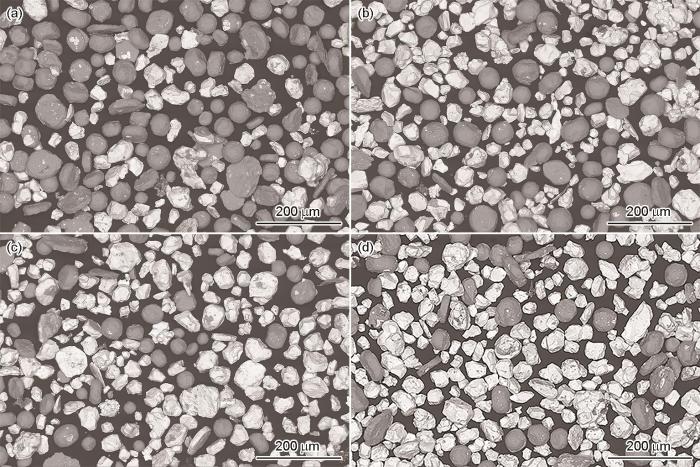
图2
不同比例的W颗粒与HEA粉混料5 h后的SEM照片
Fig.2
SEM images of W particle and HEA powder with different ratio after 5 h blending (a) WHC1, (b) WHC2, (c) WHC3, (d) WHC4
2.2 W/TiZrVAl高熵合金复合材料的微观结构
图3给出了W/TiZrVAl高熵合金复合材料的SEM照片和面扫描图,图中的灰色区域为HEA基体,亮白色区域为W增强相。可以观察到,W颗粒在基体中发生了一定程度的团聚。W含量较低时团聚不显著;随着W颗粒含量的提高,团聚显著且分布均匀性降低。图4给出了WHC1复合材料中增强相与基体界面的二次电子像及其对应线扫描结果。可以看出,W颗粒与基体之间界面结合良好。在界面区域发生了W、Zr和Ti等元素的互扩散,可能与Zr-W以及Ti-W之间负的混合焓有关[26,27]。HIP工艺的高温高压促进了W与Zr、Ti元素的互扩散,有利于形成稳定的界面结合。同时,在界面区域未生成脆性化合物。良好的界面结合有利于提高W颗粒与基体之间的结合强度和载荷的传递,使材料在变形过程中保持较高的强度。
图3

图3
高熵合金复合材料的SEM照片和EDS面扫描图
Fig.3
SEM images and corresponding EDS mapping of high-entropy alloy based composites (a) WHC1, (b) WHC2, (c) WHC3, (d) WHC4
图4
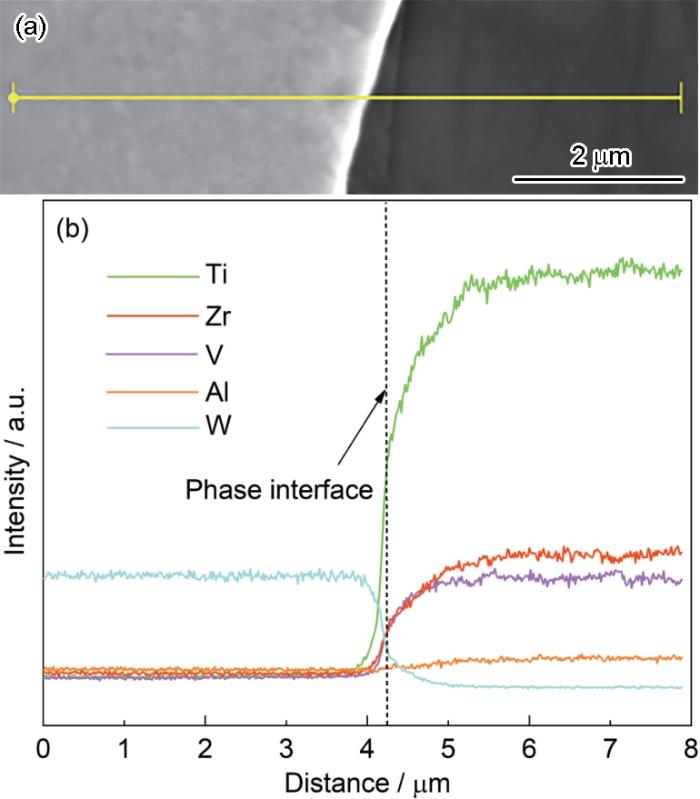
图4
WHC1复合材料的SEM照片和EDS线扫描图
Fig.4
SEM image (a) and EDS line scan (b) of WHC1 composite
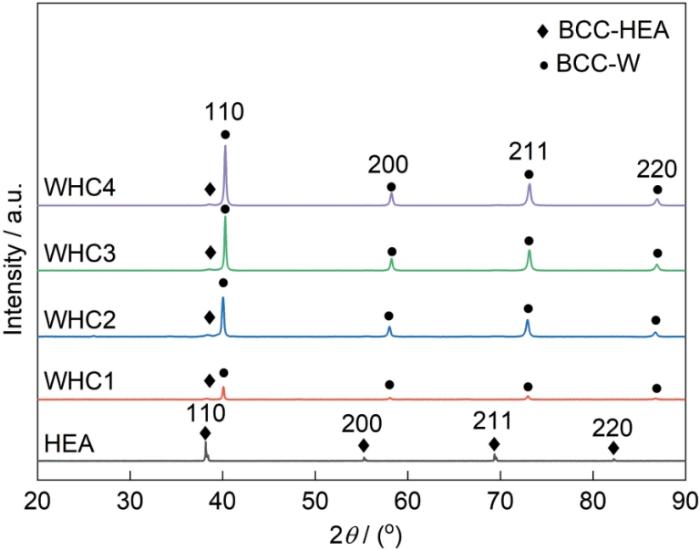
图5给出了高熵合金复合材料的XRD谱,可见其均具有体心立方(BCC)结构。与HEA基体相比,复合材料由BCC结构的W相和BCC结构的高熵合金相组成。
图5
2.3 W/TiZrVAl高熵合金复合材料的密度
表1列出了复合材料的
表1 W/HEA复合材料的理论密度和实际密度
Table 1
| Composites | |||
|---|---|---|---|
| WHC1 | 11.61 | 11.57 | 0.99 |
| WHC2 | 12.83 | 12.68 | 0.99 |
| WHC3 | 13.30 | 12.72 | 0.96 |
| WHC4 | 14.07 | 13.08 | 0.93 |
2.4 W/TiZrVAl高熵合金复合材料的压缩性能和断口形貌
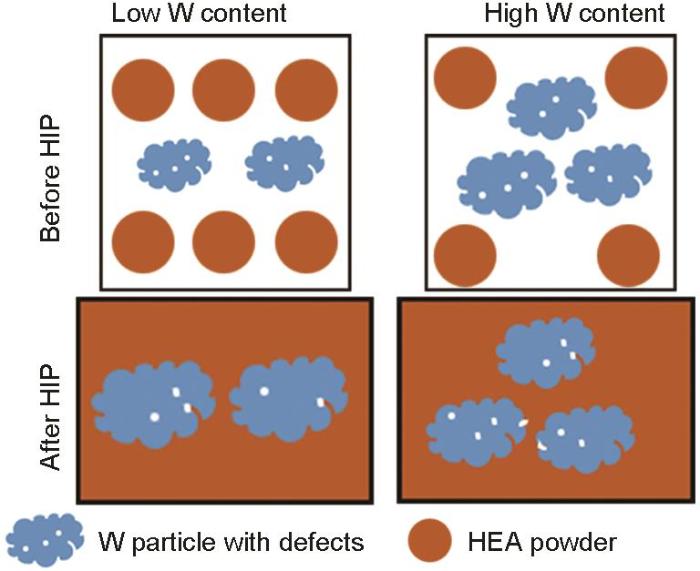
图6给出了高熵合金复合材料的室温压缩工程应力-应变曲线。可以看出,所有试样的屈服强度都比较高,但是屈服强度和塑性都随着W含量的提高逐渐降低(表2)。根据Chawla所述的复合材料混合定律[28],理论屈服强度应该随着W含量的提高而提高,但是实验结果却表明呈降低的趋势。除了摩尔比为2∶1的试样,其余试样的实际屈服强度均高于根据混合定律计算出的理论值。WHC3复合材料的塑性比HEA基体的稍低。W含量为2∶1的试样,其塑性显著降低(约7%)。W∶HEA的比例从1∶1提高到2∶1,复合材料的屈服强度由1146 MPa降低到892 MPa,断裂应变由36%降低到16%。力学性能降低的原因是,W含量的提高使材料的微观结构发生变化。对于W含量较低的试样,作为强化相的W颗粒通过载荷传递与位错的相互作用使基体的强度提高[29,30]。但是,随着W含量的进一步提高,材料中的孔隙随之增多。孔隙的聚集和连通成为应力集中源,也使材料的有效承载面积减小。外加载荷使孔隙结构失稳扩展并相互连接,从而使材料在较低的载荷下过早断裂,表现为屈服强度和塑性的降低。
图6

图6
W/HEA复合材料的室温压缩工程应力-应变曲线
Fig.6
Room-temperature compressive stress-strain curves of the W/HEA based composites
表 2 W/HEA复合材料的室温压缩力学性能
Table 2
| Composites | Theoretical yield stress / MPa | Yield stress/ MPa | Fracture strain / % |
|---|---|---|---|
| WHC1 | 855.8 | 1146 | 36 |
| WHC2 | 878.6 | 965 | 31 |
| WHC3 | 886.8 | 955 | 22 |
| WHC4 | 901.6 | 892 | 16 |
| HEA | - | 940 | 23 |
图7
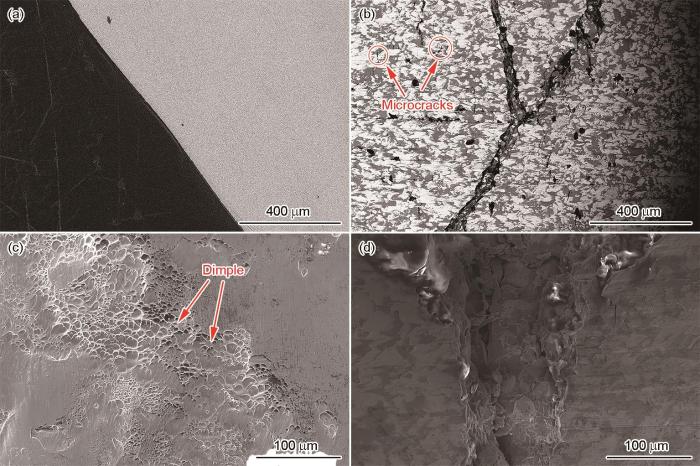
图7
HEA和WHC1复合材料在室温压缩断裂后的宏观和微观形貌
Fig.7
Macro- and micro-morphologies of fracture of HEA (a, c) and WHC1 composites (b, d) after compression at room temperature
3 讨论
3.1 W含量对复合材料致密度的影响
3.2 W颗粒团聚的形成及其对性能的影响
图8
3.3 孔隙和界面脱粘对强塑性的影响
4 结论
(1) 采用热等静压(HIP)可制备W颗粒增强Ti7Zr1.5VAl0.5高熵合金基复合材料,W颗粒与基体之间的结合界面良好。
(2) W与HEA含量比为1∶1的W/TiZrVAl高熵合金基复合材料综合力学性能最优。随着W含量的提高,材料的断裂机制由以韧性断裂为主逐渐向以脆性断裂为主转变。
(3) W含量的变化通过双重竞争机制影响这种复合材料的强韧性匹配。在W含量较低的材料中,W颗粒通过载荷传递和位错相互作用发挥强化作用,有利于使其强度提高。较高的W含量使材料中孔隙的数量增多和致密度降低,孔隙聚集形成的微裂纹网络导致强度和塑性降低。
参考文献
High-entropy alloy: challenges and prospects
[J].
A critical review of high entropy alloys and related concepts
[J].
Friction and wear behavior of a single-phase equiatomic TiZrHfNb high-entropy alloy studied using a nanoscratch technique
[J].
Cr addition-mediated simultaneous achievement of excellent strength and plasticity in non-equiatomic Nb-Ti-Zr-Ta-base refractory high-entropy alloys
[J].
Pressure effects on electronic structure and electrical conductivity of TiZrHfNb high-entropy alloy
[J].
Microstructure and mechanical properties of NbZrTi and NbHfZrTi alloys
[J].
Two medium‐entropy alloys, NbZrTi and NbHfZrTi, were prepared by arc melting. Both NbZrTi and NbHfZrTi alloys are composed of simple body‐centered cubic (bcc) solid solution phase and exhibit dendritic structure. After being homogenized, both NbZrTi and NbHfZrTi alloys are still composed of the single bcc solid solution phase, but the microstructure of the two alloys transforms from the dendritic structure into the polycrystalline structure. Two alloys display significantly work‐hardening effect during compression at room temperature and show relatively good deformation plasticity during compressive deformation at room temperature. For NbZrTi and NbHfZrTi alloys, the dynamic recrystallized grains form along the boundary during compression at the temperatures of 1073 and 1273 K.
A particle reinforced NbTaTiV refractory high entropy alloy based composite with attractive mechanical properties
[J].
Processing and mechanical properties of fine grained Al matrix composites reinforced with a uniform dispersion of nanocrystalline high-entropy alloy particles
[J].
Fabrication and characterization of WC-AlCoCrCuFeNi high-entropy alloy composites by spark plasma sintering
[J].
Preparation methods of high entropy alloy composites
[J].
高熵合金基复合材料及制备方法研究进展
[J].
Research progress of multi-principal component high-entropy alloy matrix composites
[J].
多主元高熵合金基复合材料的研究进展
[J].
A comprehensive review: Discussed the effect of high-entropy alloys as reinforcement on metal matrix composite properties, fabrication techniques, and applications
[J].
High strength refractory high-entropy alloy matrix composites reinforced with in-situ formed Al2O3 particles
[J].
Microstructure and mechanical properties of FeCrCoMnNi matrix composites reinforced by TiC particles
[J].
TiC颗粒增强FeCrCoMnNi基复合材料的微观组织与力学性能
[J].
Tungsten particle reinforced Al 5083 composite with high strength and ductility
[J].
Tungsten particle-reinforced 316L steel fabricated by laser melting deposition: Microstructure and mechanical properties
[J].
Aluminium matrix tungsten aluminide and tungsten reinforced composites by solid-state diffusion mechanism
[J].In-situ processing of tungsten aluminide and tungsten reinforced aluminium matrix composites from elemental tungsten (W) and aluminium (Al) was investigated by thermal analysis and pulsed current processing (PCP). The formation mechanism of tungsten aluminides in 80 at.% Al-20 at.% W system was controlled by atomic diffusion. The particle size of W and Al in the starting powder mixture regulated the phase formation and microstructure. PCP of micron sized elemental Al and W resulted in formation of particulate reinforcements, W, Al4W and Al12W, dispersed in Al matrix. W particles were surrounded by a similar to 3 mu m thick dual-layer structure of Al12W and Al4W. The hardness of Al matrix, containing Al12W reinforcements, was increased by 50% compared to pure Al, from 0.3 GPa to 0.45 GPa and W reinforcements showed a hardness of 4.35 GPa. On PCP of 80 at.% Al-20 at.% W mixture with particle size of W and Al similar to 70 nm, resulted in formation of Al4W as major phase along with small fractions of Al5W and unreacted W phase. This suggested strongly that the particle size of the starting elemental Al and W could be the controlling parameter in processing and tailoring of phase evolution, microstructure of particulate reinforced Al matrix composite.
Tungsten particles reinforced high-entropy alloy matrix composite prepared by in-situ reaction
[J].
Preparation and mechanical properties of tungsten-particle-reinforced Zr-based bulk-metallic-glass composites
[J].
Effects of hot isostatic pressing on microstructure and mechanical properties of selective laser melted Al-Mg-Mn-Sc-Zr alloy
[J].
Hot isostatic pressing of a refractory high entropy alloy
[J].
Fundamental aspects of hot isostatic pressing: An overview
[J].
Current development and prospects for titanium alloy powder metallurgy hot isostatic pressing technology
[J].
钛合金粉热等静压技术的发展现状及展望
[J].
Powder metallurgy HIP process study and mechanical property evaluations for IN740H
[J].
Microstructure and mechanical properties of high-entropy alloys (FeNiCoCr)100- x Al x (x=0, 5) prepared by hot-pressing sintering
[J].
热压烧结(FeNiCoCr)100- x Al x (x = 0、5)高熵合金的微观组织及力学性能
[J].采用低能球磨-热压烧结制备了(FeNiCoCr)<sub>100-</sub><sub>x</sub> Al <sub>x</sub> (x=0、5)高熵合金,并对其进行时效处理,研究了合金的组织结构与力学性能。结果表明:烧结态及时效态合金的微观组织均由FCC相和少量BCC相构成,其中FCC相中均存在孪晶,且未添加Al的合金中孪晶比例相对较高;添加Al的合金中BCC相较高,且时效处理后出现了大量小角度晶界。时效态FeNiCoCr合金具有最佳的综合性能,其压缩真屈服强度达545 MPa,弯曲强度和断裂韧性分别为1342±20 MPa和32.5±2.0 MPa·m<sup>1/2</sup>,优异的力学性能归因于FCC相中退火孪晶的形成以及BCC相的析出。
Chemical short-range order in derivative Cr-Ta-Ti-V-W high entropy alloys from the first-principles thermodynamic study
[J].The development of high-entropy alloys (HEAs) focuses on exploring compositional regions in multi-component systems with all alloy elements in equal or near-equal atomic concentrations. Initially it was based on the main idea that high mixing configurational entropy contributions to the alloy free energy could promote the formation of a single solid solution phase. By using the ab-initio based Cluster Expansion (CE) Hamiltonian model constructed for the quinary bcc Cr-Ta-Ti-V-W system in combination with Monte Carlo (MC) simulations, we show that the phase stability and chemical short-range order (SRO) of the equiatomic quinary and five sub-quaternary systems, as well as their derivative alloys, can dramatically change the order-disorder transition temperatures (ODTT) as a function of alloy compositions. In particular, it has been found, that the equiatomic quaternary Ta-Ti-V-W and Cr-Ta-Ti-W alloys had the lowest order-disorder transition temperature (500 K) among all the analysed equiatomic compositions. In all investigated alloy systems, the strongest chemical ordering has been observed between Cr and V, which led to the conclusion that decreasing the concentration of either Cr or V might be beneficial in terms of decreasing the ODTT. It also predicts that increasing concentration of Ti significantly decreases the ODTT. Our analysis of chemical SRO as a function of alloy composition allows to understand the microstructure evolution of HEAs as a function of temperature in excellent agreement with available experimental observations. Importantly, our free energy of mixing and SRO calculations predict that the origin of precipitates formed by Cr- and V-rich in the sub-quaternary Cr-Ta-V-W system is driven by the thermodynamics. The modelling results are in an excellent agreement with experimental observation of Cr and V segregation in the W0.38Ta0.36Cr0.15V0.11 alloy which in turns shows an exceptional radiation resistance.
Thermodynamic description of the Ta-W-Zr system
[J].The Ta–W, W–Zr and Ta–W–Zr systems are critically reviewed and modeled using the CALPHAD technique. The enthalpy of formation of the stoichiometric compound W2Zr in the W–Zr system is predicted from first-principles calculations. The solution phases (liquid, bcc and hcp) are modeled by the substitutional solution model. The compound W2Zr is treated with the formula (Ta,W)2Zr in the Ta–W–Zr system because of a significant solid solubility of Ta in W2Zr. All experimental data, including the Gibbs energy of formation, enthalpy of formation, activity of Ta and W of bcc phase at 1 200 K, Ta–W and W–Zr phase diagrams, and three isothermal sections of the Ta–W–Zr system at 1 073, 1 098, and 1 873 K, are reproduced in the present work. A set of self-consistent thermodynamic parameters of the Ta–W–Zr system is obtained.
Simulation on the effect of porosity in the elastic modulus of SiC particle reinforced Al matrix composites
[J].
Dislocation punching from spherical inclusions in a metal matrix composite
[J].
Diffusion mechanism for tungsten sintering kinetics
[J].
Investigation of the effect of inert inclusions on densification during solid-state sintering of metal matrix composites
[J].
Mixing and segregation in powders: evaluation, mechanisms and processes
[J].


