National Key Research and Development Program of China(2023YFA1406200) Liaoning Revitalization Talents Program(XLYC2403017) General Program of the Education Department of Liaoning Province(JYTMS20231627)
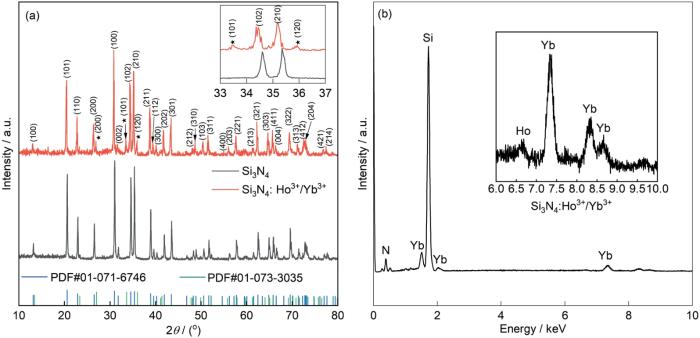
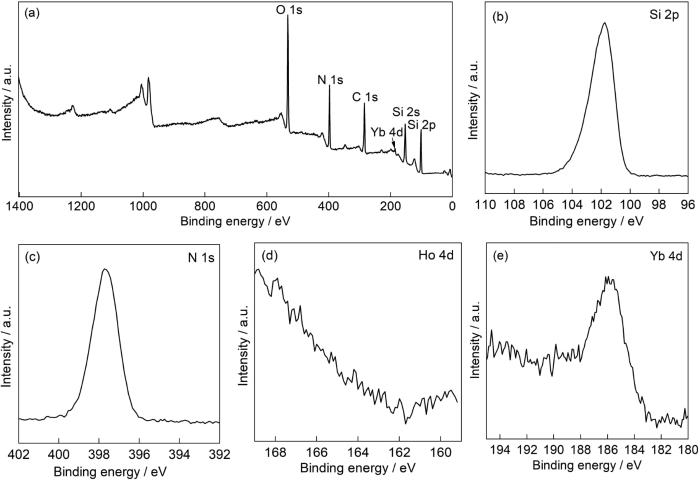
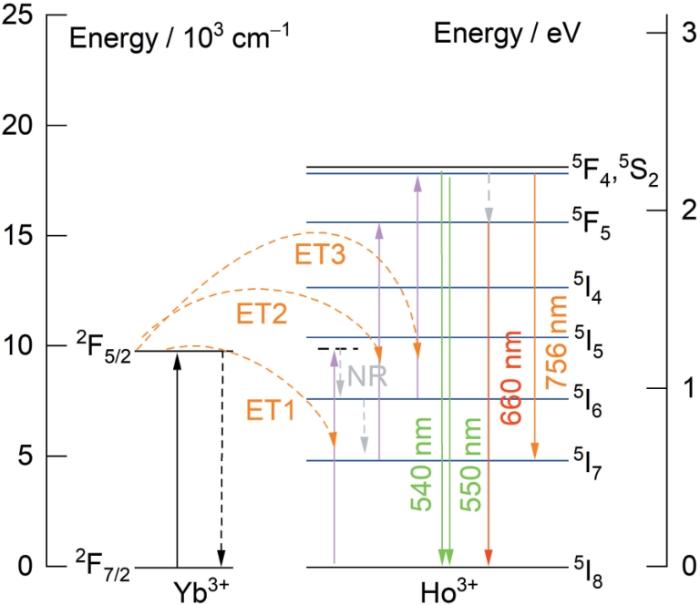
Herein, Ho3+/Yb3+ co-doped Si3N4 branched nanowires (Si3N4:Ho3+/Yb3+) were fabricated via plasma arc technique, and then characterized by means of X-ray diffraction, energy-dispersive X-ray spectroscopy, and X-ray photoelectron spectroscopy. Results indicate that the branched nanowires comprise a main trunk with multiple branches growing in parallel along both sides, while the Ho3+ and Yb3+ ions were successfully incorporated into the branched nanowire structure of Si3N4. Under 980 nm laser excitation, the Si3N4:Ho3+/Yb3+ branched nanowires exhibit three distinct up-conversion (UC) luminescence peaks: green emission at 540 nm corresponds to the (5F4,5S2→5I8) transition of Ho3+; while the red emissions at 660 nm and 756 nm are attributed to the (5F5→5I8) and (5F4→5I7) transitions, respectively. Based on the UC emission intensity ratio and decay lifetime, the optical temperature sensing performance of the Ho3+/Yb3+ co-doped Si3N4 branched nanowires was systematically investigated over the temperature range of 298-558 K. It follows that the method for temperature measurement based on the I540/I660 intensity ratio achieves a maximum relative sensitivity of 2.13% K-1. Meanwhile, the relative sensitivity based on the decay lifetime of the 540 nm emission peak reaches 1.10% K-1. The above findings prospect the great potential in application of the Ho3+/Yb3+ co-doped Si3N4 branched nanowires for optoelectronic devices, biomedicine, high-precision temperature sensing, and laser technologies.
ZHOU Minghan, CHEN Shuanglong, WANG Qiushi, WANG Xuejiao, LIU Cailong. Fabrication and Temperature Sensing Performance of Ho3+/Yb3+ Co-doped α-Si3N4 Branched Nanowires[J]. Chinese Journal of Materials Research, 2026, 40(7): 543-552 DOI:10.11901/1005.3093.2026.099
Fig.4
SEM images of Si3N4:Ho3+/Yb3+ branched nanowires (a, b), TEM image of branched nanowires (c), inset presents its corresponding SAED pattern (d) and HRTEM image of Si3N4:Ho3+/Yb3+ branched nanowire (e)
Fig.6
Up-conversion fluorescence emission spectra of Si3N4:Ho3+/Yb3+ branched nanowires under 980 nm laser excitation of different powers (a), and bilogarithmic relationship between excitation power and integral light intensity (b)
Fig.8
Up-conversion emission spectra of Si3N4:Ho3+/Yb3+ branched nanowires at different temperatures (a), changes in the intensity of each emission peak with temperature (b), the ratio of the emission peak at 660 nm to the emission peak at 540 nm as a function of temperature and the fitting curve (c), and the calculated relative sensitivity (d)
Fig.10
540 nm emission peak (a) fluorescence lifetime and temperature double reciprocal function and fitted curve, the relative sensitivities of the peaks are calculated in (b), respectively
Upconversion (UC) luminescent materials have emerged as captivating contenders in revolutionizing both photovoltaic (PV) solar cell efficiency and biological capabilities. Their unique ability to convert low-energy infrared light into high-energy visible or ultraviolet (UV) photons unlocks untapped resources in the solar spectrum and allows for deeper tissue penetration in biological imaging. By bridging the gap between recent advancements and remaining hurdles, we aim to inspire further research and accelerate the translation of these materials into practical and impactful applications for both energy and healthcare. This review delves into the recent trends propelling these materials forward. We explore advancements in UC efficiency through optimized material design, novel synthesis routes, and synergistic integration with existing technologies. In the domain of PVs, we shed light on strategies utilizing UC to address spectral mismatch and enhance light harvesting, paving the way for higher power conversion efficiencies. For biological applications, we illuminate the development of biocompatible and targeted UC probes, enabling deep tissue penetration, multimodality imaging, and theranostic potential. We critically analyze the current limitations and future directions of these materials, highlighting the challenges of toxicity, quenching, and scalability that remain to be tackled. By providing a comprehensive overview of the exciting progress and persistent hurdles in UC research, this review aims to guide future explorations and catalyze the widespread adoption of these materials in sustainable energy generation and advanced medical diagnostics.
ZhangY T, DuW N, LiuX F.
Photophysics and its application in photon upconversion
Temperature sensing based on upconversion properties of Yb3+/Ho3+/Tm3+ tri-doped Y2O3 micro particles phosphors obtained by conventional precipitation method
In this paper, La2Ce2O7 powders co-activated by Ho3+ and Yb3+ were synthesized by a high temperature solid-state reaction. Both Ho3+ and Yb3+ substitute the La3+ sites in the La2Ce2O7 lattice, where the Ho3+ concentration is 0.5 at.% and the Yb3+ concentration varies in the range of 10~18% at.%. Pumped by a 980 nm laser, the up-conversion (UC) green emission peak at 547 nm and the red emission at 661 nm were detected. When the doping concentration of Ho3+ and Yb3+ are 0.5 at.% and 14% at.%, respectively, the UC emission reaches the strongest intensity. The temperature-sensing performance of La2Ce2O7:Ho3+ with Yb3+ was studied in the temperature range of 303–483 K, where the highest relative sensitivity (Sr) is 0.0129 K−1 at 483 K. The results show that the powder La2Ce2O7:Ho3+, Yb3+ can be a potential candidate for remote temperature sensors.
ZhangJ, ZhuH Y, WuX X, et al.
Plasma-assisted synthesis and pressure-induced structural transition of single-crystalline SnSe nanosheets
Two-dimensional tin selenide (SnSe) nanosheets were synthesized using a plasma-assisted direct current arc discharge method. The structural characterization indicates that the nanosheets are single-crystalline with an average thickness of ~25 nm and a lateral dimension of 500 nm. The high pressure behaviors of the as-synthesized SnSe nanosheets were investigated by in situ high-pressure synchrotron angle-dispersive X-ray diffraction and Raman scattering up to ~30 GPa in diamond anvil cells at room temperature. A second-order isostructural continuous phase transition (Pnma → Cmcm) was observed at ~7 GPa, which is considerably lower than the transition pressure of bulk SnSe. The reduction of transition pressure is induced by the volumetric expansion with softening of the Poisson ratio and shear modulus. Moreover, the measured zero-pressure bulk modulus of the SnSe nanosheets coincides with bulk SnSe. This abnormal phenomenon is attributed to the unique intrinsic geometry in the nanosheets. The high-pressure bulk modulus is considerably higher than the theoretical value. The pressure-induced morphology change should be responsible for the improved bulk modulus.
SağlamÖ, KüçükcanB, OrhonA, et al.
Dimensionality and surface-state effect on upconversion and optical thermometry in Yb3+/Ho3+-doped KCa2Nb3O10 and its exfoliated two-dimensional nanoshee-ts
Ultra-long, single crystal, α-Si3N4 nanowires sheathed with amorphous silicon oxide were synthesised by an improved, simplified solid-liquid-solid (SLS) method at 1150 °C without using flowing gases (N2, CH4, Ar, NH3, etc.). Phases, chemical composition and structural characterisation using X-ray diffraction (XRD), field emission scanning electron microscopy (FESEM), transmission electron microscopy (TEM/HRTEM), Fourier-transform infrared spectroscopy (FT-IR) and X-ray photoelectron spectroscopy (XPS) showed that the nanowires had Si3N4@SiOx core-shell structures. The growth of the nanowires was governed by the solid-liquid-solid (SLS) mechanism. The room temperature photoluminescence (PL) and cathodoluminescence (CL) spectra showed that the optical properties of the α-Si3N4 nanowires can be changed along with the excitation wavelength or the excitation light source. This work can be useful, not only for simplifying the design and synthesis of Si-related nanostructures, but also for developing new generation nanodevices with changeable photoelectronic properties.
PaulyN, YuberoF, TougaardS.
Quantitative analysis of Yb 4d photoelectron spectrum of metallic Yb
Non-contact temperature sensors utilising the fluorescence intensity ratio and the unique up-conversion (UC) luminescence of rare-earth ions have numerous benefits; however, their operational temperature range has remained limited. In this study, NaLuF4:Yb3+/Ho3+ samples were prepared by the hydrothermal method. The samples exhibited exceptional UC luminescence properties at low temperatures. The intensity of the green emission (with peak wavelengths of 540 and 546 nm) gradually decreased with increasing temperature, and the green emissions showed a unique change at low temperatures. In addition, we studied the dependence of the UC luminescence intensity on the excitation power and the variation in the decay lifetime with temperature. The experiments revealed excellent luminous performance and significantly enhanced sensitivity at low temperatures; the maximum absolute sensitivity Sa and relative sensitivity Sr of the 540 and 546 nm thermally coupled energy levels were 1.02% and 0.55% K−1, respectively. The potential temperature sensing properties of Yb3+/Ho3+-co-doped NaLuF4 makes it suitable for temperature sensing applications at temperatures as low as 30 K. This study offers a novel approach for the advancement of temperature sensing technology at low temperatures.
LiuZ, JiangG C, WangR X, et al.
Temperature and concentration effects on upconversion photoluminescence properties of Ho3+ and Yb3+ codoped 0.67 Pb(Mg1/3Nb2/3)O3-PbTiO3 multifunctional ceramics
To develop new upconversion (UC) phosphors of high sensitivity for temperature sensing, a series of Yb3+-Er3+ and Yb3+-Ho3+ doped NaLaMgWO6 (NLMW) samples were designed via solid-state reaction method. The phase purity was examined by XRD patterns, indicating the obtained samples are all single-phase. The morphology was characterized by SEM and TEM techniques, revealing smooth particle surface. The electronic structure of NLMW was analyzed theoretically, and the optical bandgap obtained was compared with the experimental results. Upon 980 nm excitation, the characteristic transitions of Er(3+ )and Ho3+ were found, and their optimal concentrations were determined to be 2 and 3 mol%, respectively. By investigating the temperature-dependence of NLMW:0.1 Yb3+,0.02Er(3+), it was found that the thermally-coupled (2)H(11/2 )and S-4(3/2) levels of Er3+ cause a large fluorescence intensity ratio (FIR) for 528 and 550 nm emissions, which can generate a high absolute sensitivity (0.0107 K-1 at 508 K). The corresponding explanation was given by using the dependence of UC emissions on excitation power density. For the NLMW:0.1 Yb3+,0.03Ho(3+) phosphor, the non-thermally-coupled (F-5(4), S-5(2)) and (5)F(5 )levels were employed to character the temperature-sensing behavior of Ho3+. High absolute sensitivity of 8.9 x 10(-3) K-1 was gained at 548 K. The reason for the different change of 543 and 658 nm emissions intensities with temperature was conducted by the phonon-electron coupling. (C) 2018 Elsevier B.V.
HeA G, XiZ Z, LiX J, et al.
Temperature dependence of upconversion luminescence and sensing sensitivity of Ho3+/Yb3+ modified PSN-PMN-PT crystals
Herein, Na2YMg2(VO4)(3):Er3+,Yb3+ phosphors are reported for up-conversion (UC) luminescent material as optical thermometry relied on fluorescence intensity ratio (FIR) and fluorescence lifetime. Their structures, UC luminescent properties and temperature sensing properties have been systematically investigated. Heavy doping of Er3+ and Yb3+ ions with maximal content of 59% is realized, which is beneficial to obtain highly efficient UC luminescence. Excited by 980 nm laser, Er3+ and Er3+,Yb3+ doped phosphors give 525, 550 and 660 nm emissions, which are originated from H-2(11/2), S-4(3/2) and F-4(9/2) -> I-4(15/2) transitions of Er3+ ions, respectively. The reasonable UC mechanism is discussed in detail. What's more, the UC emissions of all samples dominate in green area from thermally coupled H-2(11/2)/S-4(3/2) levels of Er3+ ions, which is helpful to obtain better temperature sensing performances. And the maximal relative sensitivities of FIR and fluorescence lifetime methods reach 1.104 %K-1 (303 K) and 0.087 %K-1 (412 K), respectively. All results manifest that Na2YMg2(VO4)(3):Er3+,Yb3+ phosphors are good potential alternative for optical temperature sensors.
ChenH S, AnY, WangY H, et al.
Thermally enhanced upconversion luminescence in Sc2Mo3O12:Yb/Er thin film toward versatile and high-sensitivity luminescent temperature sensing
Understanding and effective tuning of red‐to‐green upconversion emission in Ho‐based halide double perovskite microcrystals
0
2024
Optimized luminescent intensity of NaLa(MoO4)2: Ho3+, Yb3+ upconversion phosphors by orthogonal design and quadratic universal rotary methodology [J] J
0
2025
Yb3+/Ho3+ doped Ba3Y2B4O12 phosphors: upconversion luminescence and temperature sensing properties
0
2024
Temperature sensing based on upconversion properties of Yb3+/Ho3+/Tm3+ tri-doped Y2O3 micro particles phosphors obtained by conventional precipitation method
Dimensionality and surface-state effect on upconversion and optical thermometry in Yb3+/Ho3+-doped KCa2Nb3O10 and its exfoliated two-dimensional nanoshee-ts
Temperature and concentration effects on upconversion photoluminescence properties of Ho3+ and Yb3+ codoped 0.67 Pb(Mg1/3Nb2/3)O3-PbTiO3 multifunctional ceramics
... Temperature sensing performance based on fluorescence lifetime for rare-earth ions co-doped in different host materialsTable 2
Materials
Transition
Temperature range / K
Sr / % K-1
Ref.
Ba9Y2Si6O24:Ho3+/Yb3+
2H11/2→4I15/2
303-483
0.14
[41]
AlN:Ho3+/Yb3+
5F5→5I8
298-503
0.43
[42]
Ca2MgWO6:Er3+/Yb3+
4S3/2→4I15/2
303-573
0.11
[46]
Na2YMg2(VO4):Er3+/Yb3+
4S3/2→4I15/2
323-573
0.087
[47]
Sc2Mo3O12:Er3+/Yb3+
4S3/2→4I15/2
300-560
1.28
[48]
LiGa5O8:Cr3+
4A2→4T2
301-463
0.58
[49]
KLu(WO4)2:Ho3+/Yb3+
5F4, 5S2→5I8
296-673
0.23
[50]
β-PbF2GC3:Tm3+/Yb3+
1G4→3H6
308-488
0.46
[51]
YAG:Mn3+/Mn4+
5T2→2E
120-570
3.34
[52]
ZnAl2O4:Mn2+/Ho3+/Yb3+
5F4, 5S2→5I8
80-300
1.89
[53]
CYS:Tm3+/Yb3+
3F2, 3S3→3H4
293-553
0.40
[54]
Si3N4:Ho3+/Yb3+
5F4, 5S2→5I8
298-558
1.10
This work
540 nm发射峰荧光寿命和温度双倒数函数及拟合曲线,以及相对灵敏度的计算值
540 nm emission peak (a) fluorescence lifetime and temperature double reciprocal function and fitted curve, the relative sensitivities of the peaks are calculated in (b), respectivelyFig.10
... Temperature sensing performance based on fluorescence lifetime for rare-earth ions co-doped in different host materialsTable 2
Materials
Transition
Temperature range / K
Sr / % K-1
Ref.
Ba9Y2Si6O24:Ho3+/Yb3+
2H11/2→4I15/2
303-483
0.14
[41]
AlN:Ho3+/Yb3+
5F5→5I8
298-503
0.43
[42]
Ca2MgWO6:Er3+/Yb3+
4S3/2→4I15/2
303-573
0.11
[46]
Na2YMg2(VO4):Er3+/Yb3+
4S3/2→4I15/2
323-573
0.087
[47]
Sc2Mo3O12:Er3+/Yb3+
4S3/2→4I15/2
300-560
1.28
[48]
LiGa5O8:Cr3+
4A2→4T2
301-463
0.58
[49]
KLu(WO4)2:Ho3+/Yb3+
5F4, 5S2→5I8
296-673
0.23
[50]
β-PbF2GC3:Tm3+/Yb3+
1G4→3H6
308-488
0.46
[51]
YAG:Mn3+/Mn4+
5T2→2E
120-570
3.34
[52]
ZnAl2O4:Mn2+/Ho3+/Yb3+
5F4, 5S2→5I8
80-300
1.89
[53]
CYS:Tm3+/Yb3+
3F2, 3S3→3H4
293-553
0.40
[54]
Si3N4:Ho3+/Yb3+
5F4, 5S2→5I8
298-558
1.10
This work
540 nm发射峰荧光寿命和温度双倒数函数及拟合曲线,以及相对灵敏度的计算值
540 nm emission peak (a) fluorescence lifetime and temperature double reciprocal function and fitted curve, the relative sensitivities of the peaks are calculated in (b), respectivelyFig.10
... Temperature sensing performance based on fluorescence lifetime for rare-earth ions co-doped in different host materialsTable 2
Materials
Transition
Temperature range / K
Sr / % K-1
Ref.
Ba9Y2Si6O24:Ho3+/Yb3+
2H11/2→4I15/2
303-483
0.14
[41]
AlN:Ho3+/Yb3+
5F5→5I8
298-503
0.43
[42]
Ca2MgWO6:Er3+/Yb3+
4S3/2→4I15/2
303-573
0.11
[46]
Na2YMg2(VO4):Er3+/Yb3+
4S3/2→4I15/2
323-573
0.087
[47]
Sc2Mo3O12:Er3+/Yb3+
4S3/2→4I15/2
300-560
1.28
[48]
LiGa5O8:Cr3+
4A2→4T2
301-463
0.58
[49]
KLu(WO4)2:Ho3+/Yb3+
5F4, 5S2→5I8
296-673
0.23
[50]
β-PbF2GC3:Tm3+/Yb3+
1G4→3H6
308-488
0.46
[51]
YAG:Mn3+/Mn4+
5T2→2E
120-570
3.34
[52]
ZnAl2O4:Mn2+/Ho3+/Yb3+
5F4, 5S2→5I8
80-300
1.89
[53]
CYS:Tm3+/Yb3+
3F2, 3S3→3H4
293-553
0.40
[54]
Si3N4:Ho3+/Yb3+
5F4, 5S2→5I8
298-558
1.10
This work
540 nm发射峰荧光寿命和温度双倒数函数及拟合曲线,以及相对灵敏度的计算值
540 nm emission peak (a) fluorescence lifetime and temperature double reciprocal function and fitted curve, the relative sensitivities of the peaks are calculated in (b), respectivelyFig.10
Na2YMg2(VO4)3: Er3+, Yb3+ phosphors: up-conversion and optical thermometry
1
2021
... Temperature sensing performance based on fluorescence lifetime for rare-earth ions co-doped in different host materialsTable 2
Materials
Transition
Temperature range / K
Sr / % K-1
Ref.
Ba9Y2Si6O24:Ho3+/Yb3+
2H11/2→4I15/2
303-483
0.14
[41]
AlN:Ho3+/Yb3+
5F5→5I8
298-503
0.43
[42]
Ca2MgWO6:Er3+/Yb3+
4S3/2→4I15/2
303-573
0.11
[46]
Na2YMg2(VO4):Er3+/Yb3+
4S3/2→4I15/2
323-573
0.087
[47]
Sc2Mo3O12:Er3+/Yb3+
4S3/2→4I15/2
300-560
1.28
[48]
LiGa5O8:Cr3+
4A2→4T2
301-463
0.58
[49]
KLu(WO4)2:Ho3+/Yb3+
5F4, 5S2→5I8
296-673
0.23
[50]
β-PbF2GC3:Tm3+/Yb3+
1G4→3H6
308-488
0.46
[51]
YAG:Mn3+/Mn4+
5T2→2E
120-570
3.34
[52]
ZnAl2O4:Mn2+/Ho3+/Yb3+
5F4, 5S2→5I8
80-300
1.89
[53]
CYS:Tm3+/Yb3+
3F2, 3S3→3H4
293-553
0.40
[54]
Si3N4:Ho3+/Yb3+
5F4, 5S2→5I8
298-558
1.10
This work
540 nm发射峰荧光寿命和温度双倒数函数及拟合曲线,以及相对灵敏度的计算值
540 nm emission peak (a) fluorescence lifetime and temperature double reciprocal function and fitted curve, the relative sensitivities of the peaks are calculated in (b), respectivelyFig.10
Thermally enhanced upconversion luminescence in Sc2Mo3O12:Yb/Er thin film toward versatile and high-sensitivity luminescent temperature sensing
1
2025
... Temperature sensing performance based on fluorescence lifetime for rare-earth ions co-doped in different host materialsTable 2
Materials
Transition
Temperature range / K
Sr / % K-1
Ref.
Ba9Y2Si6O24:Ho3+/Yb3+
2H11/2→4I15/2
303-483
0.14
[41]
AlN:Ho3+/Yb3+
5F5→5I8
298-503
0.43
[42]
Ca2MgWO6:Er3+/Yb3+
4S3/2→4I15/2
303-573
0.11
[46]
Na2YMg2(VO4):Er3+/Yb3+
4S3/2→4I15/2
323-573
0.087
[47]
Sc2Mo3O12:Er3+/Yb3+
4S3/2→4I15/2
300-560
1.28
[48]
LiGa5O8:Cr3+
4A2→4T2
301-463
0.58
[49]
KLu(WO4)2:Ho3+/Yb3+
5F4, 5S2→5I8
296-673
0.23
[50]
β-PbF2GC3:Tm3+/Yb3+
1G4→3H6
308-488
0.46
[51]
YAG:Mn3+/Mn4+
5T2→2E
120-570
3.34
[52]
ZnAl2O4:Mn2+/Ho3+/Yb3+
5F4, 5S2→5I8
80-300
1.89
[53]
CYS:Tm3+/Yb3+
3F2, 3S3→3H4
293-553
0.40
[54]
Si3N4:Ho3+/Yb3+
5F4, 5S2→5I8
298-558
1.10
This work
540 nm发射峰荧光寿命和温度双倒数函数及拟合曲线,以及相对灵敏度的计算值
540 nm emission peak (a) fluorescence lifetime and temperature double reciprocal function and fitted curve, the relative sensitivities of the peaks are calculated in (b), respectivelyFig.10
Yb3+/Ln3+/Cr3+ (Ln = Er, Ho) doped transparent glass ceramics: crystallization, Ln3+ sensitized Cr3+ upconversion emission and multi-modal temperature sensing
1
2017
... Temperature sensing performance based on fluorescence lifetime for rare-earth ions co-doped in different host materialsTable 2
Materials
Transition
Temperature range / K
Sr / % K-1
Ref.
Ba9Y2Si6O24:Ho3+/Yb3+
2H11/2→4I15/2
303-483
0.14
[41]
AlN:Ho3+/Yb3+
5F5→5I8
298-503
0.43
[42]
Ca2MgWO6:Er3+/Yb3+
4S3/2→4I15/2
303-573
0.11
[46]
Na2YMg2(VO4):Er3+/Yb3+
4S3/2→4I15/2
323-573
0.087
[47]
Sc2Mo3O12:Er3+/Yb3+
4S3/2→4I15/2
300-560
1.28
[48]
LiGa5O8:Cr3+
4A2→4T2
301-463
0.58
[49]
KLu(WO4)2:Ho3+/Yb3+
5F4, 5S2→5I8
296-673
0.23
[50]
β-PbF2GC3:Tm3+/Yb3+
1G4→3H6
308-488
0.46
[51]
YAG:Mn3+/Mn4+
5T2→2E
120-570
3.34
[52]
ZnAl2O4:Mn2+/Ho3+/Yb3+
5F4, 5S2→5I8
80-300
1.89
[53]
CYS:Tm3+/Yb3+
3F2, 3S3→3H4
293-553
0.40
[54]
Si3N4:Ho3+/Yb3+
5F4, 5S2→5I8
298-558
1.10
This work
540 nm发射峰荧光寿命和温度双倒数函数及拟合曲线,以及相对灵敏度的计算值
540 nm emission peak (a) fluorescence lifetime and temperature double reciprocal function and fitted curve, the relative sensitivities of the peaks are calculated in (b), respectivelyFig.10
Ho, Yb:KLu(WO4)2 nanoparticles: a versatile material for multiple thermal sensing purposes by luminescent thermometry
1
2015
... Temperature sensing performance based on fluorescence lifetime for rare-earth ions co-doped in different host materialsTable 2
Materials
Transition
Temperature range / K
Sr / % K-1
Ref.
Ba9Y2Si6O24:Ho3+/Yb3+
2H11/2→4I15/2
303-483
0.14
[41]
AlN:Ho3+/Yb3+
5F5→5I8
298-503
0.43
[42]
Ca2MgWO6:Er3+/Yb3+
4S3/2→4I15/2
303-573
0.11
[46]
Na2YMg2(VO4):Er3+/Yb3+
4S3/2→4I15/2
323-573
0.087
[47]
Sc2Mo3O12:Er3+/Yb3+
4S3/2→4I15/2
300-560
1.28
[48]
LiGa5O8:Cr3+
4A2→4T2
301-463
0.58
[49]
KLu(WO4)2:Ho3+/Yb3+
5F4, 5S2→5I8
296-673
0.23
[50]
β-PbF2GC3:Tm3+/Yb3+
1G4→3H6
308-488
0.46
[51]
YAG:Mn3+/Mn4+
5T2→2E
120-570
3.34
[52]
ZnAl2O4:Mn2+/Ho3+/Yb3+
5F4, 5S2→5I8
80-300
1.89
[53]
CYS:Tm3+/Yb3+
3F2, 3S3→3H4
293-553
0.40
[54]
Si3N4:Ho3+/Yb3+
5F4, 5S2→5I8
298-558
1.10
This work
540 nm发射峰荧光寿命和温度双倒数函数及拟合曲线,以及相对灵敏度的计算值
540 nm emission peak (a) fluorescence lifetime and temperature double reciprocal function and fitted curve, the relative sensitivities of the peaks are calculated in (b), respectivelyFig.10
Up-conversion luminescence lifetime thermometry based on the 1G4 state of Tm3+ modulated by cross relaxation processes
1
2019
... Temperature sensing performance based on fluorescence lifetime for rare-earth ions co-doped in different host materialsTable 2
Materials
Transition
Temperature range / K
Sr / % K-1
Ref.
Ba9Y2Si6O24:Ho3+/Yb3+
2H11/2→4I15/2
303-483
0.14
[41]
AlN:Ho3+/Yb3+
5F5→5I8
298-503
0.43
[42]
Ca2MgWO6:Er3+/Yb3+
4S3/2→4I15/2
303-573
0.11
[46]
Na2YMg2(VO4):Er3+/Yb3+
4S3/2→4I15/2
323-573
0.087
[47]
Sc2Mo3O12:Er3+/Yb3+
4S3/2→4I15/2
300-560
1.28
[48]
LiGa5O8:Cr3+
4A2→4T2
301-463
0.58
[49]
KLu(WO4)2:Ho3+/Yb3+
5F4, 5S2→5I8
296-673
0.23
[50]
β-PbF2GC3:Tm3+/Yb3+
1G4→3H6
308-488
0.46
[51]
YAG:Mn3+/Mn4+
5T2→2E
120-570
3.34
[52]
ZnAl2O4:Mn2+/Ho3+/Yb3+
5F4, 5S2→5I8
80-300
1.89
[53]
CYS:Tm3+/Yb3+
3F2, 3S3→3H4
293-553
0.40
[54]
Si3N4:Ho3+/Yb3+
5F4, 5S2→5I8
298-558
1.10
This work
540 nm发射峰荧光寿命和温度双倒数函数及拟合曲线,以及相对灵敏度的计算值
540 nm emission peak (a) fluorescence lifetime and temperature double reciprocal function and fitted curve, the relative sensitivities of the peaks are calculated in (b), respectivelyFig.10
Luminescence lifetime thermometry with Mn3+-Mn4+ co-doped nanocrystals
1
2018
... Temperature sensing performance based on fluorescence lifetime for rare-earth ions co-doped in different host materialsTable 2
Materials
Transition
Temperature range / K
Sr / % K-1
Ref.
Ba9Y2Si6O24:Ho3+/Yb3+
2H11/2→4I15/2
303-483
0.14
[41]
AlN:Ho3+/Yb3+
5F5→5I8
298-503
0.43
[42]
Ca2MgWO6:Er3+/Yb3+
4S3/2→4I15/2
303-573
0.11
[46]
Na2YMg2(VO4):Er3+/Yb3+
4S3/2→4I15/2
323-573
0.087
[47]
Sc2Mo3O12:Er3+/Yb3+
4S3/2→4I15/2
300-560
1.28
[48]
LiGa5O8:Cr3+
4A2→4T2
301-463
0.58
[49]
KLu(WO4)2:Ho3+/Yb3+
5F4, 5S2→5I8
296-673
0.23
[50]
β-PbF2GC3:Tm3+/Yb3+
1G4→3H6
308-488
0.46
[51]
YAG:Mn3+/Mn4+
5T2→2E
120-570
3.34
[52]
ZnAl2O4:Mn2+/Ho3+/Yb3+
5F4, 5S2→5I8
80-300
1.89
[53]
CYS:Tm3+/Yb3+
3F2, 3S3→3H4
293-553
0.40
[54]
Si3N4:Ho3+/Yb3+
5F4, 5S2→5I8
298-558
1.10
This work
540 nm发射峰荧光寿命和温度双倒数函数及拟合曲线,以及相对灵敏度的计算值
540 nm emission peak (a) fluorescence lifetime and temperature double reciprocal function and fitted curve, the relative sensitivities of the peaks are calculated in (b), respectivelyFig.10
Utilizing energy transfer in Mn2+/Ho3+/Yb3+ tri-doped ZnAl2O4 nanophosphors for tunable luminescence and highly sensitive visual cryogenic thermometry
1
2023
... Temperature sensing performance based on fluorescence lifetime for rare-earth ions co-doped in different host materialsTable 2
Materials
Transition
Temperature range / K
Sr / % K-1
Ref.
Ba9Y2Si6O24:Ho3+/Yb3+
2H11/2→4I15/2
303-483
0.14
[41]
AlN:Ho3+/Yb3+
5F5→5I8
298-503
0.43
[42]
Ca2MgWO6:Er3+/Yb3+
4S3/2→4I15/2
303-573
0.11
[46]
Na2YMg2(VO4):Er3+/Yb3+
4S3/2→4I15/2
323-573
0.087
[47]
Sc2Mo3O12:Er3+/Yb3+
4S3/2→4I15/2
300-560
1.28
[48]
LiGa5O8:Cr3+
4A2→4T2
301-463
0.58
[49]
KLu(WO4)2:Ho3+/Yb3+
5F4, 5S2→5I8
296-673
0.23
[50]
β-PbF2GC3:Tm3+/Yb3+
1G4→3H6
308-488
0.46
[51]
YAG:Mn3+/Mn4+
5T2→2E
120-570
3.34
[52]
ZnAl2O4:Mn2+/Ho3+/Yb3+
5F4, 5S2→5I8
80-300
1.89
[53]
CYS:Tm3+/Yb3+
3F2, 3S3→3H4
293-553
0.40
[54]
Si3N4:Ho3+/Yb3+
5F4, 5S2→5I8
298-558
1.10
This work
540 nm发射峰荧光寿命和温度双倒数函数及拟合曲线,以及相对灵敏度的计算值
540 nm emission peak (a) fluorescence lifetime and temperature double reciprocal function and fitted curve, the relative sensitivities of the peaks are calculated in (b), respectivelyFig.10
Temperature sensing based on upconversion luminescence of Er3+/Tm3+-Yb3+ doped Ca4Y6Si4O24 phosphors
1
2018
... Temperature sensing performance based on fluorescence lifetime for rare-earth ions co-doped in different host materialsTable 2
Materials
Transition
Temperature range / K
Sr / % K-1
Ref.
Ba9Y2Si6O24:Ho3+/Yb3+
2H11/2→4I15/2
303-483
0.14
[41]
AlN:Ho3+/Yb3+
5F5→5I8
298-503
0.43
[42]
Ca2MgWO6:Er3+/Yb3+
4S3/2→4I15/2
303-573
0.11
[46]
Na2YMg2(VO4):Er3+/Yb3+
4S3/2→4I15/2
323-573
0.087
[47]
Sc2Mo3O12:Er3+/Yb3+
4S3/2→4I15/2
300-560
1.28
[48]
LiGa5O8:Cr3+
4A2→4T2
301-463
0.58
[49]
KLu(WO4)2:Ho3+/Yb3+
5F4, 5S2→5I8
296-673
0.23
[50]
β-PbF2GC3:Tm3+/Yb3+
1G4→3H6
308-488
0.46
[51]
YAG:Mn3+/Mn4+
5T2→2E
120-570
3.34
[52]
ZnAl2O4:Mn2+/Ho3+/Yb3+
5F4, 5S2→5I8
80-300
1.89
[53]
CYS:Tm3+/Yb3+
3F2, 3S3→3H4
293-553
0.40
[54]
Si3N4:Ho3+/Yb3+
5F4, 5S2→5I8
298-558
1.10
This work
540 nm发射峰荧光寿命和温度双倒数函数及拟合曲线,以及相对灵敏度的计算值
540 nm emission peak (a) fluorescence lifetime and temperature double reciprocal function and fitted curve, the relative sensitivities of the peaks are calculated in (b), respectivelyFig.10