Rationally designing efficient electrocatalysts for direct seawater splitting: challenges, achievements, and promises
1
2022
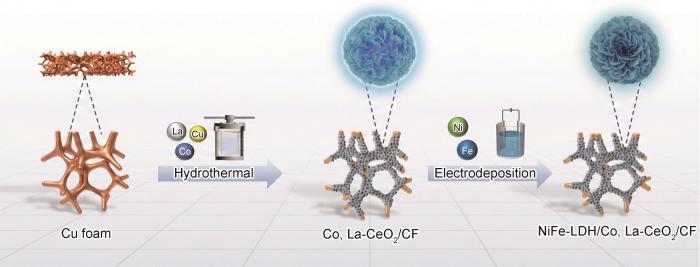
... 化石燃料的过度消耗已引起变暖和能源危机[1].电催化全解水制氢是规模化生产清洁能源的重要途径,但是析氧反应(OER)的多步质子-电子耦合过程繁琐,使反应缓慢且所需过电位较高[2,3].因此,急需开发高效、稳定的(OER)催化剂[4,5].当前Ir、Ru及其氧化物(IrO2、RuO2)等贵金属催化剂的OER活性优异,但是其储量过低成本高昂[6~8].因此,成本低廉的过渡金属(如Ni、Co、Fe)氧化物和氢氧化物逐渐受到关注[9~15].镍铁层状双氢氧化物(NiFe-LDHs)金属离子间产生协同效应,是碱性条件下较有潜力的OER催化剂[16,17].Liu等用镍(II)-次氮基三乙酸阴离子作为导向剂制备的非晶态NiFe-LDH,电流密度为10 mA/cm2时过电位仅为241 mV[18].但是,NiFe-LDH固有的层间堆叠效应和较低的本征导电性使其活性位点暴露和电子传输效率降低,在大电流密度下的催化活性和稳定性难以满足使用要求[19,20].为了解决上述问题,可构建NiFe-LDH与功能材料复合的异质结构[21~23].在载体材料中,化学稳定性和储放氧性能优异的稀土氧化物CeO2应用潜力较大[24~26].Ding等的研究表明,CeO2纳米颗粒能诱导强烈的界面电子相互作用,用其构建的CoP/CeO2异质结具有优于单组分CoP和贵金属RuO2的较低过电位(257 mV)[27].虽然Ce3+/Ce4+氧化还原有利于电子转移[28~31],但是CeO2本征电导率较低且易形成大颗粒,使其电催化性能降低[32].在材料中掺杂适量元素引入晶格应变和产生氧空位(Ov),可调控中间体的吸附能和提高其导电性[33~36].Swathi等发现,掺杂2%的Gd使CeO2电极的电导率提高[37].但是,掺杂元素的半径与本体差异过大引起的电荷补偿产生晶格畸变和缺陷结构,使材料的结构稳定性和耐久性降低[38~40].针对上述问题,本文用过渡金属Co和稀土元素La作为共掺杂剂,提出一种“晶格界面”协同调控策略,用一锅水热法合成Co, La-CeO2基底,再在其表面制备NiFe-LDH/Co, La-CeO2/CF异质结电催化材料并研究其性能. ...
Bifunctional electrocatalysts for overall and hybrid water splitting
1
2024
... 化石燃料的过度消耗已引起变暖和能源危机[1].电催化全解水制氢是规模化生产清洁能源的重要途径,但是析氧反应(OER)的多步质子-电子耦合过程繁琐,使反应缓慢且所需过电位较高[2,3].因此,急需开发高效、稳定的(OER)催化剂[4,5].当前Ir、Ru及其氧化物(IrO2、RuO2)等贵金属催化剂的OER活性优异,但是其储量过低成本高昂[6~8].因此,成本低廉的过渡金属(如Ni、Co、Fe)氧化物和氢氧化物逐渐受到关注[9~15].镍铁层状双氢氧化物(NiFe-LDHs)金属离子间产生协同效应,是碱性条件下较有潜力的OER催化剂[16,17].Liu等用镍(II)-次氮基三乙酸阴离子作为导向剂制备的非晶态NiFe-LDH,电流密度为10 mA/cm2时过电位仅为241 mV[18].但是,NiFe-LDH固有的层间堆叠效应和较低的本征导电性使其活性位点暴露和电子传输效率降低,在大电流密度下的催化活性和稳定性难以满足使用要求[19,20].为了解决上述问题,可构建NiFe-LDH与功能材料复合的异质结构[21~23].在载体材料中,化学稳定性和储放氧性能优异的稀土氧化物CeO2应用潜力较大[24~26].Ding等的研究表明,CeO2纳米颗粒能诱导强烈的界面电子相互作用,用其构建的CoP/CeO2异质结具有优于单组分CoP和贵金属RuO2的较低过电位(257 mV)[27].虽然Ce3+/Ce4+氧化还原有利于电子转移[28~31],但是CeO2本征电导率较低且易形成大颗粒,使其电催化性能降低[32].在材料中掺杂适量元素引入晶格应变和产生氧空位(Ov),可调控中间体的吸附能和提高其导电性[33~36].Swathi等发现,掺杂2%的Gd使CeO2电极的电导率提高[37].但是,掺杂元素的半径与本体差异过大引起的电荷补偿产生晶格畸变和缺陷结构,使材料的结构稳定性和耐久性降低[38~40].针对上述问题,本文用过渡金属Co和稀土元素La作为共掺杂剂,提出一种“晶格界面”协同调控策略,用一锅水热法合成Co, La-CeO2基底,再在其表面制备NiFe-LDH/Co, La-CeO2/CF异质结电催化材料并研究其性能. ...
Defects engineering of layered double hydroxide-based electrocatalyst for water splitting
1
2023
... 化石燃料的过度消耗已引起变暖和能源危机[1].电催化全解水制氢是规模化生产清洁能源的重要途径,但是析氧反应(OER)的多步质子-电子耦合过程繁琐,使反应缓慢且所需过电位较高[2,3].因此,急需开发高效、稳定的(OER)催化剂[4,5].当前Ir、Ru及其氧化物(IrO2、RuO2)等贵金属催化剂的OER活性优异,但是其储量过低成本高昂[6~8].因此,成本低廉的过渡金属(如Ni、Co、Fe)氧化物和氢氧化物逐渐受到关注[9~15].镍铁层状双氢氧化物(NiFe-LDHs)金属离子间产生协同效应,是碱性条件下较有潜力的OER催化剂[16,17].Liu等用镍(II)-次氮基三乙酸阴离子作为导向剂制备的非晶态NiFe-LDH,电流密度为10 mA/cm2时过电位仅为241 mV[18].但是,NiFe-LDH固有的层间堆叠效应和较低的本征导电性使其活性位点暴露和电子传输效率降低,在大电流密度下的催化活性和稳定性难以满足使用要求[19,20].为了解决上述问题,可构建NiFe-LDH与功能材料复合的异质结构[21~23].在载体材料中,化学稳定性和储放氧性能优异的稀土氧化物CeO2应用潜力较大[24~26].Ding等的研究表明,CeO2纳米颗粒能诱导强烈的界面电子相互作用,用其构建的CoP/CeO2异质结具有优于单组分CoP和贵金属RuO2的较低过电位(257 mV)[27].虽然Ce3+/Ce4+氧化还原有利于电子转移[28~31],但是CeO2本征电导率较低且易形成大颗粒,使其电催化性能降低[32].在材料中掺杂适量元素引入晶格应变和产生氧空位(Ov),可调控中间体的吸附能和提高其导电性[33~36].Swathi等发现,掺杂2%的Gd使CeO2电极的电导率提高[37].但是,掺杂元素的半径与本体差异过大引起的电荷补偿产生晶格畸变和缺陷结构,使材料的结构稳定性和耐久性降低[38~40].针对上述问题,本文用过渡金属Co和稀土元素La作为共掺杂剂,提出一种“晶格界面”协同调控策略,用一锅水热法合成Co, La-CeO2基底,再在其表面制备NiFe-LDH/Co, La-CeO2/CF异质结电催化材料并研究其性能. ...
Core-shell co-Co x P nanoparticle-embedded N-doped carbon nanowhiskers hollow sphere for efficient oxygen evolution electrocatalysis
1
2024
... 化石燃料的过度消耗已引起变暖和能源危机[1].电催化全解水制氢是规模化生产清洁能源的重要途径,但是析氧反应(OER)的多步质子-电子耦合过程繁琐,使反应缓慢且所需过电位较高[2,3].因此,急需开发高效、稳定的(OER)催化剂[4,5].当前Ir、Ru及其氧化物(IrO2、RuO2)等贵金属催化剂的OER活性优异,但是其储量过低成本高昂[6~8].因此,成本低廉的过渡金属(如Ni、Co、Fe)氧化物和氢氧化物逐渐受到关注[9~15].镍铁层状双氢氧化物(NiFe-LDHs)金属离子间产生协同效应,是碱性条件下较有潜力的OER催化剂[16,17].Liu等用镍(II)-次氮基三乙酸阴离子作为导向剂制备的非晶态NiFe-LDH,电流密度为10 mA/cm2时过电位仅为241 mV[18].但是,NiFe-LDH固有的层间堆叠效应和较低的本征导电性使其活性位点暴露和电子传输效率降低,在大电流密度下的催化活性和稳定性难以满足使用要求[19,20].为了解决上述问题,可构建NiFe-LDH与功能材料复合的异质结构[21~23].在载体材料中,化学稳定性和储放氧性能优异的稀土氧化物CeO2应用潜力较大[24~26].Ding等的研究表明,CeO2纳米颗粒能诱导强烈的界面电子相互作用,用其构建的CoP/CeO2异质结具有优于单组分CoP和贵金属RuO2的较低过电位(257 mV)[27].虽然Ce3+/Ce4+氧化还原有利于电子转移[28~31],但是CeO2本征电导率较低且易形成大颗粒,使其电催化性能降低[32].在材料中掺杂适量元素引入晶格应变和产生氧空位(Ov),可调控中间体的吸附能和提高其导电性[33~36].Swathi等发现,掺杂2%的Gd使CeO2电极的电导率提高[37].但是,掺杂元素的半径与本体差异过大引起的电荷补偿产生晶格畸变和缺陷结构,使材料的结构稳定性和耐久性降低[38~40].针对上述问题,本文用过渡金属Co和稀土元素La作为共掺杂剂,提出一种“晶格界面”协同调控策略,用一锅水热法合成Co, La-CeO2基底,再在其表面制备NiFe-LDH/Co, La-CeO2/CF异质结电催化材料并研究其性能. ...
Modulation of NiFe-LDH electrocatalyst stability by electrocatalyst-substrate interface engineering
1
2025
... 化石燃料的过度消耗已引起变暖和能源危机[1].电催化全解水制氢是规模化生产清洁能源的重要途径,但是析氧反应(OER)的多步质子-电子耦合过程繁琐,使反应缓慢且所需过电位较高[2,3].因此,急需开发高效、稳定的(OER)催化剂[4,5].当前Ir、Ru及其氧化物(IrO2、RuO2)等贵金属催化剂的OER活性优异,但是其储量过低成本高昂[6~8].因此,成本低廉的过渡金属(如Ni、Co、Fe)氧化物和氢氧化物逐渐受到关注[9~15].镍铁层状双氢氧化物(NiFe-LDHs)金属离子间产生协同效应,是碱性条件下较有潜力的OER催化剂[16,17].Liu等用镍(II)-次氮基三乙酸阴离子作为导向剂制备的非晶态NiFe-LDH,电流密度为10 mA/cm2时过电位仅为241 mV[18].但是,NiFe-LDH固有的层间堆叠效应和较低的本征导电性使其活性位点暴露和电子传输效率降低,在大电流密度下的催化活性和稳定性难以满足使用要求[19,20].为了解决上述问题,可构建NiFe-LDH与功能材料复合的异质结构[21~23].在载体材料中,化学稳定性和储放氧性能优异的稀土氧化物CeO2应用潜力较大[24~26].Ding等的研究表明,CeO2纳米颗粒能诱导强烈的界面电子相互作用,用其构建的CoP/CeO2异质结具有优于单组分CoP和贵金属RuO2的较低过电位(257 mV)[27].虽然Ce3+/Ce4+氧化还原有利于电子转移[28~31],但是CeO2本征电导率较低且易形成大颗粒,使其电催化性能降低[32].在材料中掺杂适量元素引入晶格应变和产生氧空位(Ov),可调控中间体的吸附能和提高其导电性[33~36].Swathi等发现,掺杂2%的Gd使CeO2电极的电导率提高[37].但是,掺杂元素的半径与本体差异过大引起的电荷补偿产生晶格畸变和缺陷结构,使材料的结构稳定性和耐久性降低[38~40].针对上述问题,本文用过渡金属Co和稀土元素La作为共掺杂剂,提出一种“晶格界面”协同调控策略,用一锅水热法合成Co, La-CeO2基底,再在其表面制备NiFe-LDH/Co, La-CeO2/CF异质结电催化材料并研究其性能. ...
Design of electrocatalysts for oxygen- and hydrogen-involving energy conversion reactions
1
2015
... 化石燃料的过度消耗已引起变暖和能源危机[1].电催化全解水制氢是规模化生产清洁能源的重要途径,但是析氧反应(OER)的多步质子-电子耦合过程繁琐,使反应缓慢且所需过电位较高[2,3].因此,急需开发高效、稳定的(OER)催化剂[4,5].当前Ir、Ru及其氧化物(IrO2、RuO2)等贵金属催化剂的OER活性优异,但是其储量过低成本高昂[6~8].因此,成本低廉的过渡金属(如Ni、Co、Fe)氧化物和氢氧化物逐渐受到关注[9~15].镍铁层状双氢氧化物(NiFe-LDHs)金属离子间产生协同效应,是碱性条件下较有潜力的OER催化剂[16,17].Liu等用镍(II)-次氮基三乙酸阴离子作为导向剂制备的非晶态NiFe-LDH,电流密度为10 mA/cm2时过电位仅为241 mV[18].但是,NiFe-LDH固有的层间堆叠效应和较低的本征导电性使其活性位点暴露和电子传输效率降低,在大电流密度下的催化活性和稳定性难以满足使用要求[19,20].为了解决上述问题,可构建NiFe-LDH与功能材料复合的异质结构[21~23].在载体材料中,化学稳定性和储放氧性能优异的稀土氧化物CeO2应用潜力较大[24~26].Ding等的研究表明,CeO2纳米颗粒能诱导强烈的界面电子相互作用,用其构建的CoP/CeO2异质结具有优于单组分CoP和贵金属RuO2的较低过电位(257 mV)[27].虽然Ce3+/Ce4+氧化还原有利于电子转移[28~31],但是CeO2本征电导率较低且易形成大颗粒,使其电催化性能降低[32].在材料中掺杂适量元素引入晶格应变和产生氧空位(Ov),可调控中间体的吸附能和提高其导电性[33~36].Swathi等发现,掺杂2%的Gd使CeO2电极的电导率提高[37].但是,掺杂元素的半径与本体差异过大引起的电荷补偿产生晶格畸变和缺陷结构,使材料的结构稳定性和耐久性降低[38~40].针对上述问题,本文用过渡金属Co和稀土元素La作为共掺杂剂,提出一种“晶格界面”协同调控策略,用一锅水热法合成Co, La-CeO2基底,再在其表面制备NiFe-LDH/Co, La-CeO2/CF异质结电催化材料并研究其性能. ...
Coordination polymer derived cobalt embedded in nitrogen-doped carbon nanotubes for efficient electrocatalysis of oxygen evolution reaction
0
2017
A perovskite oxide optimized for oxygen evolution catalysis from molecular orbital principles
1
2011
... 化石燃料的过度消耗已引起变暖和能源危机[1].电催化全解水制氢是规模化生产清洁能源的重要途径,但是析氧反应(OER)的多步质子-电子耦合过程繁琐,使反应缓慢且所需过电位较高[2,3].因此,急需开发高效、稳定的(OER)催化剂[4,5].当前Ir、Ru及其氧化物(IrO2、RuO2)等贵金属催化剂的OER活性优异,但是其储量过低成本高昂[6~8].因此,成本低廉的过渡金属(如Ni、Co、Fe)氧化物和氢氧化物逐渐受到关注[9~15].镍铁层状双氢氧化物(NiFe-LDHs)金属离子间产生协同效应,是碱性条件下较有潜力的OER催化剂[16,17].Liu等用镍(II)-次氮基三乙酸阴离子作为导向剂制备的非晶态NiFe-LDH,电流密度为10 mA/cm2时过电位仅为241 mV[18].但是,NiFe-LDH固有的层间堆叠效应和较低的本征导电性使其活性位点暴露和电子传输效率降低,在大电流密度下的催化活性和稳定性难以满足使用要求[19,20].为了解决上述问题,可构建NiFe-LDH与功能材料复合的异质结构[21~23].在载体材料中,化学稳定性和储放氧性能优异的稀土氧化物CeO2应用潜力较大[24~26].Ding等的研究表明,CeO2纳米颗粒能诱导强烈的界面电子相互作用,用其构建的CoP/CeO2异质结具有优于单组分CoP和贵金属RuO2的较低过电位(257 mV)[27].虽然Ce3+/Ce4+氧化还原有利于电子转移[28~31],但是CeO2本征电导率较低且易形成大颗粒,使其电催化性能降低[32].在材料中掺杂适量元素引入晶格应变和产生氧空位(Ov),可调控中间体的吸附能和提高其导电性[33~36].Swathi等发现,掺杂2%的Gd使CeO2电极的电导率提高[37].但是,掺杂元素的半径与本体差异过大引起的电荷补偿产生晶格畸变和缺陷结构,使材料的结构稳定性和耐久性降低[38~40].针对上述问题,本文用过渡金属Co和稀土元素La作为共掺杂剂,提出一种“晶格界面”协同调控策略,用一锅水热法合成Co, La-CeO2基底,再在其表面制备NiFe-LDH/Co, La-CeO2/CF异质结电催化材料并研究其性能. ...
Advanced transition metal-based OER electrocatalysts: current status, opportunities, and challenges
1
2021
... 化石燃料的过度消耗已引起变暖和能源危机[1].电催化全解水制氢是规模化生产清洁能源的重要途径,但是析氧反应(OER)的多步质子-电子耦合过程繁琐,使反应缓慢且所需过电位较高[2,3].因此,急需开发高效、稳定的(OER)催化剂[4,5].当前Ir、Ru及其氧化物(IrO2、RuO2)等贵金属催化剂的OER活性优异,但是其储量过低成本高昂[6~8].因此,成本低廉的过渡金属(如Ni、Co、Fe)氧化物和氢氧化物逐渐受到关注[9~15].镍铁层状双氢氧化物(NiFe-LDHs)金属离子间产生协同效应,是碱性条件下较有潜力的OER催化剂[16,17].Liu等用镍(II)-次氮基三乙酸阴离子作为导向剂制备的非晶态NiFe-LDH,电流密度为10 mA/cm2时过电位仅为241 mV[18].但是,NiFe-LDH固有的层间堆叠效应和较低的本征导电性使其活性位点暴露和电子传输效率降低,在大电流密度下的催化活性和稳定性难以满足使用要求[19,20].为了解决上述问题,可构建NiFe-LDH与功能材料复合的异质结构[21~23].在载体材料中,化学稳定性和储放氧性能优异的稀土氧化物CeO2应用潜力较大[24~26].Ding等的研究表明,CeO2纳米颗粒能诱导强烈的界面电子相互作用,用其构建的CoP/CeO2异质结具有优于单组分CoP和贵金属RuO2的较低过电位(257 mV)[27].虽然Ce3+/Ce4+氧化还原有利于电子转移[28~31],但是CeO2本征电导率较低且易形成大颗粒,使其电催化性能降低[32].在材料中掺杂适量元素引入晶格应变和产生氧空位(Ov),可调控中间体的吸附能和提高其导电性[33~36].Swathi等发现,掺杂2%的Gd使CeO2电极的电导率提高[37].但是,掺杂元素的半径与本体差异过大引起的电荷补偿产生晶格畸变和缺陷结构,使材料的结构稳定性和耐久性降低[38~40].针对上述问题,本文用过渡金属Co和稀土元素La作为共掺杂剂,提出一种“晶格界面”协同调控策略,用一锅水热法合成Co, La-CeO2基底,再在其表面制备NiFe-LDH/Co, La-CeO2/CF异质结电催化材料并研究其性能. ...
Construction of hierarchical bundle-like CoNi layered double hydroxides for the efficient oxygen evolution reaction
0
2019
The current state of transition metal-based electrocatalysts (oxides, alloys, POMs, and MOFs) for oxygen reduction, oxygen evolution, and hydrogen evolution reactions
0
2024
Regulating electronic states of nitride/hydroxide to accelerate kinetics for oxygen evolution at large current density
0
2023
Exploring the potential of cobalt hydroxide and its derivatives as a cost-effective and abundant alternative to noble metal electrocatalysts in oxygen evolution reactions: a review
0
2024
Progress of nonprecious-metal-based electrocatalysts for oxygen evolution in acidic media
0
2021
Recent advances in electrocatalytic hydrogen evolution using nanoparticles
1
2020
... 化石燃料的过度消耗已引起变暖和能源危机[1].电催化全解水制氢是规模化生产清洁能源的重要途径,但是析氧反应(OER)的多步质子-电子耦合过程繁琐,使反应缓慢且所需过电位较高[2,3].因此,急需开发高效、稳定的(OER)催化剂[4,5].当前Ir、Ru及其氧化物(IrO2、RuO2)等贵金属催化剂的OER活性优异,但是其储量过低成本高昂[6~8].因此,成本低廉的过渡金属(如Ni、Co、Fe)氧化物和氢氧化物逐渐受到关注[9~15].镍铁层状双氢氧化物(NiFe-LDHs)金属离子间产生协同效应,是碱性条件下较有潜力的OER催化剂[16,17].Liu等用镍(II)-次氮基三乙酸阴离子作为导向剂制备的非晶态NiFe-LDH,电流密度为10 mA/cm2时过电位仅为241 mV[18].但是,NiFe-LDH固有的层间堆叠效应和较低的本征导电性使其活性位点暴露和电子传输效率降低,在大电流密度下的催化活性和稳定性难以满足使用要求[19,20].为了解决上述问题,可构建NiFe-LDH与功能材料复合的异质结构[21~23].在载体材料中,化学稳定性和储放氧性能优异的稀土氧化物CeO2应用潜力较大[24~26].Ding等的研究表明,CeO2纳米颗粒能诱导强烈的界面电子相互作用,用其构建的CoP/CeO2异质结具有优于单组分CoP和贵金属RuO2的较低过电位(257 mV)[27].虽然Ce3+/Ce4+氧化还原有利于电子转移[28~31],但是CeO2本征电导率较低且易形成大颗粒,使其电催化性能降低[32].在材料中掺杂适量元素引入晶格应变和产生氧空位(Ov),可调控中间体的吸附能和提高其导电性[33~36].Swathi等发现,掺杂2%的Gd使CeO2电极的电导率提高[37].但是,掺杂元素的半径与本体差异过大引起的电荷补偿产生晶格畸变和缺陷结构,使材料的结构稳定性和耐久性降低[38~40].针对上述问题,本文用过渡金属Co和稀土元素La作为共掺杂剂,提出一种“晶格界面”协同调控策略,用一锅水热法合成Co, La-CeO2基底,再在其表面制备NiFe-LDH/Co, La-CeO2/CF异质结电催化材料并研究其性能. ...
Recent progress on preparation and applications of layered double hydroxides
1
2022
... 化石燃料的过度消耗已引起变暖和能源危机[1].电催化全解水制氢是规模化生产清洁能源的重要途径,但是析氧反应(OER)的多步质子-电子耦合过程繁琐,使反应缓慢且所需过电位较高[2,3].因此,急需开发高效、稳定的(OER)催化剂[4,5].当前Ir、Ru及其氧化物(IrO2、RuO2)等贵金属催化剂的OER活性优异,但是其储量过低成本高昂[6~8].因此,成本低廉的过渡金属(如Ni、Co、Fe)氧化物和氢氧化物逐渐受到关注[9~15].镍铁层状双氢氧化物(NiFe-LDHs)金属离子间产生协同效应,是碱性条件下较有潜力的OER催化剂[16,17].Liu等用镍(II)-次氮基三乙酸阴离子作为导向剂制备的非晶态NiFe-LDH,电流密度为10 mA/cm2时过电位仅为241 mV[18].但是,NiFe-LDH固有的层间堆叠效应和较低的本征导电性使其活性位点暴露和电子传输效率降低,在大电流密度下的催化活性和稳定性难以满足使用要求[19,20].为了解决上述问题,可构建NiFe-LDH与功能材料复合的异质结构[21~23].在载体材料中,化学稳定性和储放氧性能优异的稀土氧化物CeO2应用潜力较大[24~26].Ding等的研究表明,CeO2纳米颗粒能诱导强烈的界面电子相互作用,用其构建的CoP/CeO2异质结具有优于单组分CoP和贵金属RuO2的较低过电位(257 mV)[27].虽然Ce3+/Ce4+氧化还原有利于电子转移[28~31],但是CeO2本征电导率较低且易形成大颗粒,使其电催化性能降低[32].在材料中掺杂适量元素引入晶格应变和产生氧空位(Ov),可调控中间体的吸附能和提高其导电性[33~36].Swathi等发现,掺杂2%的Gd使CeO2电极的电导率提高[37].但是,掺杂元素的半径与本体差异过大引起的电荷补偿产生晶格畸变和缺陷结构,使材料的结构稳定性和耐久性降低[38~40].针对上述问题,本文用过渡金属Co和稀土元素La作为共掺杂剂,提出一种“晶格界面”协同调控策略,用一锅水热法合成Co, La-CeO2基底,再在其表面制备NiFe-LDH/Co, La-CeO2/CF异质结电催化材料并研究其性能. ...
Unveiling the critical role of the Mn dopant in a NiFe(OH)2 catalyst for water oxidation
1
2020
... 化石燃料的过度消耗已引起变暖和能源危机[1].电催化全解水制氢是规模化生产清洁能源的重要途径,但是析氧反应(OER)的多步质子-电子耦合过程繁琐,使反应缓慢且所需过电位较高[2,3].因此,急需开发高效、稳定的(OER)催化剂[4,5].当前Ir、Ru及其氧化物(IrO2、RuO2)等贵金属催化剂的OER活性优异,但是其储量过低成本高昂[6~8].因此,成本低廉的过渡金属(如Ni、Co、Fe)氧化物和氢氧化物逐渐受到关注[9~15].镍铁层状双氢氧化物(NiFe-LDHs)金属离子间产生协同效应,是碱性条件下较有潜力的OER催化剂[16,17].Liu等用镍(II)-次氮基三乙酸阴离子作为导向剂制备的非晶态NiFe-LDH,电流密度为10 mA/cm2时过电位仅为241 mV[18].但是,NiFe-LDH固有的层间堆叠效应和较低的本征导电性使其活性位点暴露和电子传输效率降低,在大电流密度下的催化活性和稳定性难以满足使用要求[19,20].为了解决上述问题,可构建NiFe-LDH与功能材料复合的异质结构[21~23].在载体材料中,化学稳定性和储放氧性能优异的稀土氧化物CeO2应用潜力较大[24~26].Ding等的研究表明,CeO2纳米颗粒能诱导强烈的界面电子相互作用,用其构建的CoP/CeO2异质结具有优于单组分CoP和贵金属RuO2的较低过电位(257 mV)[27].虽然Ce3+/Ce4+氧化还原有利于电子转移[28~31],但是CeO2本征电导率较低且易形成大颗粒,使其电催化性能降低[32].在材料中掺杂适量元素引入晶格应变和产生氧空位(Ov),可调控中间体的吸附能和提高其导电性[33~36].Swathi等发现,掺杂2%的Gd使CeO2电极的电导率提高[37].但是,掺杂元素的半径与本体差异过大引起的电荷补偿产生晶格畸变和缺陷结构,使材料的结构稳定性和耐久性降低[38~40].针对上述问题,本文用过渡金属Co和稀土元素La作为共掺杂剂,提出一种“晶格界面”协同调控策略,用一锅水热法合成Co, La-CeO2基底,再在其表面制备NiFe-LDH/Co, La-CeO2/CF异质结电催化材料并研究其性能. ...
Amorphous NiFe-layered double hydroxides nanosheets for oxygen evolution reaction
1
2020
... 化石燃料的过度消耗已引起变暖和能源危机[1].电催化全解水制氢是规模化生产清洁能源的重要途径,但是析氧反应(OER)的多步质子-电子耦合过程繁琐,使反应缓慢且所需过电位较高[2,3].因此,急需开发高效、稳定的(OER)催化剂[4,5].当前Ir、Ru及其氧化物(IrO2、RuO2)等贵金属催化剂的OER活性优异,但是其储量过低成本高昂[6~8].因此,成本低廉的过渡金属(如Ni、Co、Fe)氧化物和氢氧化物逐渐受到关注[9~15].镍铁层状双氢氧化物(NiFe-LDHs)金属离子间产生协同效应,是碱性条件下较有潜力的OER催化剂[16,17].Liu等用镍(II)-次氮基三乙酸阴离子作为导向剂制备的非晶态NiFe-LDH,电流密度为10 mA/cm2时过电位仅为241 mV[18].但是,NiFe-LDH固有的层间堆叠效应和较低的本征导电性使其活性位点暴露和电子传输效率降低,在大电流密度下的催化活性和稳定性难以满足使用要求[19,20].为了解决上述问题,可构建NiFe-LDH与功能材料复合的异质结构[21~23].在载体材料中,化学稳定性和储放氧性能优异的稀土氧化物CeO2应用潜力较大[24~26].Ding等的研究表明,CeO2纳米颗粒能诱导强烈的界面电子相互作用,用其构建的CoP/CeO2异质结具有优于单组分CoP和贵金属RuO2的较低过电位(257 mV)[27].虽然Ce3+/Ce4+氧化还原有利于电子转移[28~31],但是CeO2本征电导率较低且易形成大颗粒,使其电催化性能降低[32].在材料中掺杂适量元素引入晶格应变和产生氧空位(Ov),可调控中间体的吸附能和提高其导电性[33~36].Swathi等发现,掺杂2%的Gd使CeO2电极的电导率提高[37].但是,掺杂元素的半径与本体差异过大引起的电荷补偿产生晶格畸变和缺陷结构,使材料的结构稳定性和耐久性降低[38~40].针对上述问题,本文用过渡金属Co和稀土元素La作为共掺杂剂,提出一种“晶格界面”协同调控策略,用一锅水热法合成Co, La-CeO2基底,再在其表面制备NiFe-LDH/Co, La-CeO2/CF异质结电催化材料并研究其性能. ...
Layered double hydroxide materials: A review on their preparation, characterization, and applications
1
2023
... 化石燃料的过度消耗已引起变暖和能源危机[1].电催化全解水制氢是规模化生产清洁能源的重要途径,但是析氧反应(OER)的多步质子-电子耦合过程繁琐,使反应缓慢且所需过电位较高[2,3].因此,急需开发高效、稳定的(OER)催化剂[4,5].当前Ir、Ru及其氧化物(IrO2、RuO2)等贵金属催化剂的OER活性优异,但是其储量过低成本高昂[6~8].因此,成本低廉的过渡金属(如Ni、Co、Fe)氧化物和氢氧化物逐渐受到关注[9~15].镍铁层状双氢氧化物(NiFe-LDHs)金属离子间产生协同效应,是碱性条件下较有潜力的OER催化剂[16,17].Liu等用镍(II)-次氮基三乙酸阴离子作为导向剂制备的非晶态NiFe-LDH,电流密度为10 mA/cm2时过电位仅为241 mV[18].但是,NiFe-LDH固有的层间堆叠效应和较低的本征导电性使其活性位点暴露和电子传输效率降低,在大电流密度下的催化活性和稳定性难以满足使用要求[19,20].为了解决上述问题,可构建NiFe-LDH与功能材料复合的异质结构[21~23].在载体材料中,化学稳定性和储放氧性能优异的稀土氧化物CeO2应用潜力较大[24~26].Ding等的研究表明,CeO2纳米颗粒能诱导强烈的界面电子相互作用,用其构建的CoP/CeO2异质结具有优于单组分CoP和贵金属RuO2的较低过电位(257 mV)[27].虽然Ce3+/Ce4+氧化还原有利于电子转移[28~31],但是CeO2本征电导率较低且易形成大颗粒,使其电催化性能降低[32].在材料中掺杂适量元素引入晶格应变和产生氧空位(Ov),可调控中间体的吸附能和提高其导电性[33~36].Swathi等发现,掺杂2%的Gd使CeO2电极的电导率提高[37].但是,掺杂元素的半径与本体差异过大引起的电荷补偿产生晶格畸变和缺陷结构,使材料的结构稳定性和耐久性降低[38~40].针对上述问题,本文用过渡金属Co和稀土元素La作为共掺杂剂,提出一种“晶格界面”协同调控策略,用一锅水热法合成Co, La-CeO2基底,再在其表面制备NiFe-LDH/Co, La-CeO2/CF异质结电催化材料并研究其性能. ...
Porous NiFe-LDH grown on graphene oxide towards highly efficient OER electrocatalysis
1
2021
... 化石燃料的过度消耗已引起变暖和能源危机[1].电催化全解水制氢是规模化生产清洁能源的重要途径,但是析氧反应(OER)的多步质子-电子耦合过程繁琐,使反应缓慢且所需过电位较高[2,3].因此,急需开发高效、稳定的(OER)催化剂[4,5].当前Ir、Ru及其氧化物(IrO2、RuO2)等贵金属催化剂的OER活性优异,但是其储量过低成本高昂[6~8].因此,成本低廉的过渡金属(如Ni、Co、Fe)氧化物和氢氧化物逐渐受到关注[9~15].镍铁层状双氢氧化物(NiFe-LDHs)金属离子间产生协同效应,是碱性条件下较有潜力的OER催化剂[16,17].Liu等用镍(II)-次氮基三乙酸阴离子作为导向剂制备的非晶态NiFe-LDH,电流密度为10 mA/cm2时过电位仅为241 mV[18].但是,NiFe-LDH固有的层间堆叠效应和较低的本征导电性使其活性位点暴露和电子传输效率降低,在大电流密度下的催化活性和稳定性难以满足使用要求[19,20].为了解决上述问题,可构建NiFe-LDH与功能材料复合的异质结构[21~23].在载体材料中,化学稳定性和储放氧性能优异的稀土氧化物CeO2应用潜力较大[24~26].Ding等的研究表明,CeO2纳米颗粒能诱导强烈的界面电子相互作用,用其构建的CoP/CeO2异质结具有优于单组分CoP和贵金属RuO2的较低过电位(257 mV)[27].虽然Ce3+/Ce4+氧化还原有利于电子转移[28~31],但是CeO2本征电导率较低且易形成大颗粒,使其电催化性能降低[32].在材料中掺杂适量元素引入晶格应变和产生氧空位(Ov),可调控中间体的吸附能和提高其导电性[33~36].Swathi等发现,掺杂2%的Gd使CeO2电极的电导率提高[37].但是,掺杂元素的半径与本体差异过大引起的电荷补偿产生晶格畸变和缺陷结构,使材料的结构稳定性和耐久性降低[38~40].针对上述问题,本文用过渡金属Co和稀土元素La作为共掺杂剂,提出一种“晶格界面”协同调控策略,用一锅水热法合成Co, La-CeO2基底,再在其表面制备NiFe-LDH/Co, La-CeO2/CF异质结电催化材料并研究其性能. ...
Constructing a hetero-interface composed of oxygen vacancy-enriched Co3O4 and crystalline-amorphous NiFe-LDH for oxygen evolution reaction
1
2021
... 化石燃料的过度消耗已引起变暖和能源危机[1].电催化全解水制氢是规模化生产清洁能源的重要途径,但是析氧反应(OER)的多步质子-电子耦合过程繁琐,使反应缓慢且所需过电位较高[2,3].因此,急需开发高效、稳定的(OER)催化剂[4,5].当前Ir、Ru及其氧化物(IrO2、RuO2)等贵金属催化剂的OER活性优异,但是其储量过低成本高昂[6~8].因此,成本低廉的过渡金属(如Ni、Co、Fe)氧化物和氢氧化物逐渐受到关注[9~15].镍铁层状双氢氧化物(NiFe-LDHs)金属离子间产生协同效应,是碱性条件下较有潜力的OER催化剂[16,17].Liu等用镍(II)-次氮基三乙酸阴离子作为导向剂制备的非晶态NiFe-LDH,电流密度为10 mA/cm2时过电位仅为241 mV[18].但是,NiFe-LDH固有的层间堆叠效应和较低的本征导电性使其活性位点暴露和电子传输效率降低,在大电流密度下的催化活性和稳定性难以满足使用要求[19,20].为了解决上述问题,可构建NiFe-LDH与功能材料复合的异质结构[21~23].在载体材料中,化学稳定性和储放氧性能优异的稀土氧化物CeO2应用潜力较大[24~26].Ding等的研究表明,CeO2纳米颗粒能诱导强烈的界面电子相互作用,用其构建的CoP/CeO2异质结具有优于单组分CoP和贵金属RuO2的较低过电位(257 mV)[27].虽然Ce3+/Ce4+氧化还原有利于电子转移[28~31],但是CeO2本征电导率较低且易形成大颗粒,使其电催化性能降低[32].在材料中掺杂适量元素引入晶格应变和产生氧空位(Ov),可调控中间体的吸附能和提高其导电性[33~36].Swathi等发现,掺杂2%的Gd使CeO2电极的电导率提高[37].但是,掺杂元素的半径与本体差异过大引起的电荷补偿产生晶格畸变和缺陷结构,使材料的结构稳定性和耐久性降低[38~40].针对上述问题,本文用过渡金属Co和稀土元素La作为共掺杂剂,提出一种“晶格界面”协同调控策略,用一锅水热法合成Co, La-CeO2基底,再在其表面制备NiFe-LDH/Co, La-CeO2/CF异质结电催化材料并研究其性能. ...
Regulating the electronic state of SnO2@NiFe-LDH heterojunction: activating lattice oxygen for efficient oxygen evolution reaction
0
2024
Phosphorylated Co(OH)2@NiFe-LDH core-shell heterostructure for highly efficient alkaline water splitting
1
2024
... 化石燃料的过度消耗已引起变暖和能源危机[1].电催化全解水制氢是规模化生产清洁能源的重要途径,但是析氧反应(OER)的多步质子-电子耦合过程繁琐,使反应缓慢且所需过电位较高[2,3].因此,急需开发高效、稳定的(OER)催化剂[4,5].当前Ir、Ru及其氧化物(IrO2、RuO2)等贵金属催化剂的OER活性优异,但是其储量过低成本高昂[6~8].因此,成本低廉的过渡金属(如Ni、Co、Fe)氧化物和氢氧化物逐渐受到关注[9~15].镍铁层状双氢氧化物(NiFe-LDHs)金属离子间产生协同效应,是碱性条件下较有潜力的OER催化剂[16,17].Liu等用镍(II)-次氮基三乙酸阴离子作为导向剂制备的非晶态NiFe-LDH,电流密度为10 mA/cm2时过电位仅为241 mV[18].但是,NiFe-LDH固有的层间堆叠效应和较低的本征导电性使其活性位点暴露和电子传输效率降低,在大电流密度下的催化活性和稳定性难以满足使用要求[19,20].为了解决上述问题,可构建NiFe-LDH与功能材料复合的异质结构[21~23].在载体材料中,化学稳定性和储放氧性能优异的稀土氧化物CeO2应用潜力较大[24~26].Ding等的研究表明,CeO2纳米颗粒能诱导强烈的界面电子相互作用,用其构建的CoP/CeO2异质结具有优于单组分CoP和贵金属RuO2的较低过电位(257 mV)[27].虽然Ce3+/Ce4+氧化还原有利于电子转移[28~31],但是CeO2本征电导率较低且易形成大颗粒,使其电催化性能降低[32].在材料中掺杂适量元素引入晶格应变和产生氧空位(Ov),可调控中间体的吸附能和提高其导电性[33~36].Swathi等发现,掺杂2%的Gd使CeO2电极的电导率提高[37].但是,掺杂元素的半径与本体差异过大引起的电荷补偿产生晶格畸变和缺陷结构,使材料的结构稳定性和耐久性降低[38~40].针对上述问题,本文用过渡金属Co和稀土元素La作为共掺杂剂,提出一种“晶格界面”协同调控策略,用一锅水热法合成Co, La-CeO2基底,再在其表面制备NiFe-LDH/Co, La-CeO2/CF异质结电催化材料并研究其性能. ...
Interface engineering of heterogeneous CeO2-CoO nanofibers with rich oxygen vacancies for enhanced electrocatalytic oxygen evolution performance
1
2021
... 化石燃料的过度消耗已引起变暖和能源危机[1].电催化全解水制氢是规模化生产清洁能源的重要途径,但是析氧反应(OER)的多步质子-电子耦合过程繁琐,使反应缓慢且所需过电位较高[2,3].因此,急需开发高效、稳定的(OER)催化剂[4,5].当前Ir、Ru及其氧化物(IrO2、RuO2)等贵金属催化剂的OER活性优异,但是其储量过低成本高昂[6~8].因此,成本低廉的过渡金属(如Ni、Co、Fe)氧化物和氢氧化物逐渐受到关注[9~15].镍铁层状双氢氧化物(NiFe-LDHs)金属离子间产生协同效应,是碱性条件下较有潜力的OER催化剂[16,17].Liu等用镍(II)-次氮基三乙酸阴离子作为导向剂制备的非晶态NiFe-LDH,电流密度为10 mA/cm2时过电位仅为241 mV[18].但是,NiFe-LDH固有的层间堆叠效应和较低的本征导电性使其活性位点暴露和电子传输效率降低,在大电流密度下的催化活性和稳定性难以满足使用要求[19,20].为了解决上述问题,可构建NiFe-LDH与功能材料复合的异质结构[21~23].在载体材料中,化学稳定性和储放氧性能优异的稀土氧化物CeO2应用潜力较大[24~26].Ding等的研究表明,CeO2纳米颗粒能诱导强烈的界面电子相互作用,用其构建的CoP/CeO2异质结具有优于单组分CoP和贵金属RuO2的较低过电位(257 mV)[27].虽然Ce3+/Ce4+氧化还原有利于电子转移[28~31],但是CeO2本征电导率较低且易形成大颗粒,使其电催化性能降低[32].在材料中掺杂适量元素引入晶格应变和产生氧空位(Ov),可调控中间体的吸附能和提高其导电性[33~36].Swathi等发现,掺杂2%的Gd使CeO2电极的电导率提高[37].但是,掺杂元素的半径与本体差异过大引起的电荷补偿产生晶格畸变和缺陷结构,使材料的结构稳定性和耐久性降低[38~40].针对上述问题,本文用过渡金属Co和稀土元素La作为共掺杂剂,提出一种“晶格界面”协同调控策略,用一锅水热法合成Co, La-CeO2基底,再在其表面制备NiFe-LDH/Co, La-CeO2/CF异质结电催化材料并研究其性能. ...
Modifying redox properties and local bonding of Co3O4 by CeO2 enhances oxygen evolution catalysis in acid
0
2021
Manipulation of Mott-Schottky Ni/CeO2 heterojunctions into N-doped carbon nanofibers for high-efficiency electrochemical water splitting
1
2022
... 化石燃料的过度消耗已引起变暖和能源危机[1].电催化全解水制氢是规模化生产清洁能源的重要途径,但是析氧反应(OER)的多步质子-电子耦合过程繁琐,使反应缓慢且所需过电位较高[2,3].因此,急需开发高效、稳定的(OER)催化剂[4,5].当前Ir、Ru及其氧化物(IrO2、RuO2)等贵金属催化剂的OER活性优异,但是其储量过低成本高昂[6~8].因此,成本低廉的过渡金属(如Ni、Co、Fe)氧化物和氢氧化物逐渐受到关注[9~15].镍铁层状双氢氧化物(NiFe-LDHs)金属离子间产生协同效应,是碱性条件下较有潜力的OER催化剂[16,17].Liu等用镍(II)-次氮基三乙酸阴离子作为导向剂制备的非晶态NiFe-LDH,电流密度为10 mA/cm2时过电位仅为241 mV[18].但是,NiFe-LDH固有的层间堆叠效应和较低的本征导电性使其活性位点暴露和电子传输效率降低,在大电流密度下的催化活性和稳定性难以满足使用要求[19,20].为了解决上述问题,可构建NiFe-LDH与功能材料复合的异质结构[21~23].在载体材料中,化学稳定性和储放氧性能优异的稀土氧化物CeO2应用潜力较大[24~26].Ding等的研究表明,CeO2纳米颗粒能诱导强烈的界面电子相互作用,用其构建的CoP/CeO2异质结具有优于单组分CoP和贵金属RuO2的较低过电位(257 mV)[27].虽然Ce3+/Ce4+氧化还原有利于电子转移[28~31],但是CeO2本征电导率较低且易形成大颗粒,使其电催化性能降低[32].在材料中掺杂适量元素引入晶格应变和产生氧空位(Ov),可调控中间体的吸附能和提高其导电性[33~36].Swathi等发现,掺杂2%的Gd使CeO2电极的电导率提高[37].但是,掺杂元素的半径与本体差异过大引起的电荷补偿产生晶格畸变和缺陷结构,使材料的结构稳定性和耐久性降低[38~40].针对上述问题,本文用过渡金属Co和稀土元素La作为共掺杂剂,提出一种“晶格界面”协同调控策略,用一锅水热法合成Co, La-CeO2基底,再在其表面制备NiFe-LDH/Co, La-CeO2/CF异质结电催化材料并研究其性能. ...
CeO2 nanoparticles-decorated CoP nanocubes for accelerating alkaline electrocatalytic oxygen evolution reaction
2
2023
... 化石燃料的过度消耗已引起变暖和能源危机[1].电催化全解水制氢是规模化生产清洁能源的重要途径,但是析氧反应(OER)的多步质子-电子耦合过程繁琐,使反应缓慢且所需过电位较高[2,3].因此,急需开发高效、稳定的(OER)催化剂[4,5].当前Ir、Ru及其氧化物(IrO2、RuO2)等贵金属催化剂的OER活性优异,但是其储量过低成本高昂[6~8].因此,成本低廉的过渡金属(如Ni、Co、Fe)氧化物和氢氧化物逐渐受到关注[9~15].镍铁层状双氢氧化物(NiFe-LDHs)金属离子间产生协同效应,是碱性条件下较有潜力的OER催化剂[16,17].Liu等用镍(II)-次氮基三乙酸阴离子作为导向剂制备的非晶态NiFe-LDH,电流密度为10 mA/cm2时过电位仅为241 mV[18].但是,NiFe-LDH固有的层间堆叠效应和较低的本征导电性使其活性位点暴露和电子传输效率降低,在大电流密度下的催化活性和稳定性难以满足使用要求[19,20].为了解决上述问题,可构建NiFe-LDH与功能材料复合的异质结构[21~23].在载体材料中,化学稳定性和储放氧性能优异的稀土氧化物CeO2应用潜力较大[24~26].Ding等的研究表明,CeO2纳米颗粒能诱导强烈的界面电子相互作用,用其构建的CoP/CeO2异质结具有优于单组分CoP和贵金属RuO2的较低过电位(257 mV)[27].虽然Ce3+/Ce4+氧化还原有利于电子转移[28~31],但是CeO2本征电导率较低且易形成大颗粒,使其电催化性能降低[32].在材料中掺杂适量元素引入晶格应变和产生氧空位(Ov),可调控中间体的吸附能和提高其导电性[33~36].Swathi等发现,掺杂2%的Gd使CeO2电极的电导率提高[37].但是,掺杂元素的半径与本体差异过大引起的电荷补偿产生晶格畸变和缺陷结构,使材料的结构稳定性和耐久性降低[38~40].针对上述问题,本文用过渡金属Co和稀土元素La作为共掺杂剂,提出一种“晶格界面”协同调控策略,用一锅水热法合成Co, La-CeO2基底,再在其表面制备NiFe-LDH/Co, La-CeO2/CF异质结电催化材料并研究其性能. ...
... Comparison of OER performance of NiFe-LDH/Co, La-CeO
2/CF with reported electrocatalysts
Table 1| Catalyst | j / mA·cm-2 | η / mV | Electrolysts | Reference |
|---|
| NiFe-LDH/Co, La-CeO2/CF | 50 | 230 | 1 mol/L KOH | This work |
| 10 | 172 |
| NiFe-LDH/Co/C@NF | 50 | 244 | 1 mol/L KOH | [52] |
| 10 | |
| NiFeLDH/NiCoP@NC/NF | 50 | | 1 mol/L KOH | [53] |
| 10 | 210 |
| Ce-CoP@CC | 50 | | 1 mol/L KOH | [54] |
| 10 | 240 |
| NiFeCe-LDH@CP | 50 | 255 | 1 mol/L KOH | [55] |
| 10 | 232 |
| Co3O4@NiFe-LDH/NF | 50 | 270 | 1 mol/L KOH | [56] |
| 10 | |
| CoP/CeO2-20 | 50 | 298 | 1 mol/L KOH | [27] |
| 10 | 257 |
| 2%Gd-CeO2 | 50 | | 1 mol/L KOH | [37] |
| 10 | 369 |
| Ce(OH)3@NiFe LDH | 50 | | 1 mol/L KOH | [57] |
| 10 | 220 |
| Ce-Ni3S2/MnS/NF | 50 | 245 | 1 mol/L KOH | [58] |
| 10 | 194 |
| S-FeCoNiO x | 50 | | 1 mol/L KOH | [59] |
| 10 | 221 |
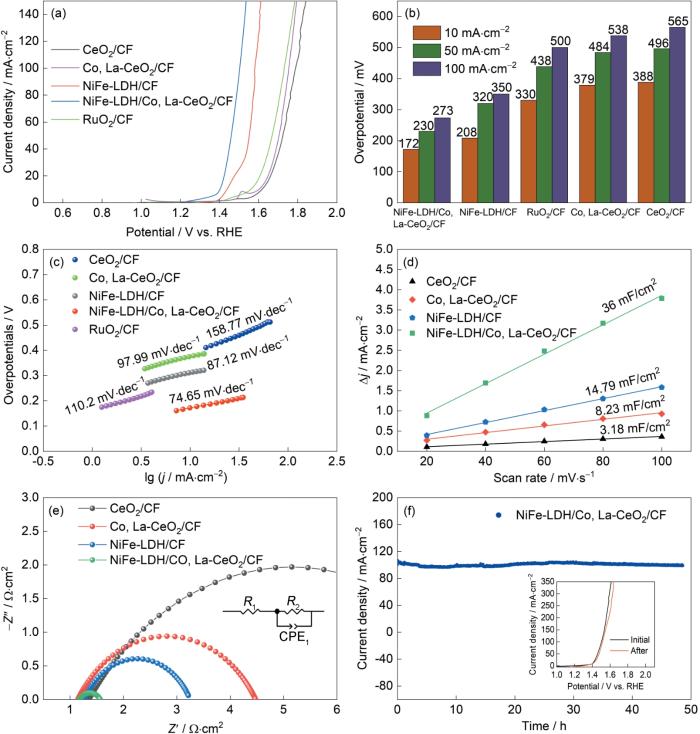
图8b比较了电流密度为10、50和100 mA·cm-2时的过电位.可以看出,电流密度为10和100 mA·cm-2时NiFe-LDH/Co, La-CeO2/CF只需172 mV和273 mV的过电位,优于NiFe-LDH/CF (208, 350 mV)、Co, La-CeO2/CF (379, 538 mV)、CeO2/CF (388, 565 mV)和RuO2/CF (330, 500 mV),表明其在碱性条件下优异的催化效率.根据LSV曲线的Tafel斜率评估了反应动力学.图8c给出了不同样品Tafel斜率的对比.可以看出,NiFe-LDH/Co, La-CeO2/CF电极的Tafel斜率(74.65 mV·dec-1)最低,而CeO2/CF (158.77 mV·dec-1)、Co, La-CeO2/CF (97.99 mV·dec-1)、NiFe-LDH/CF (87.12 mV·dec-1)和RuO2/CF (110.2 mV·dec-1)的Tafel斜率都比较高,表明其析氧反应动力学显著优于其他电极,证实了NiFe-LDH/Co, La-CeO2/CF在电催化过程中的电子传输速率较高和能量势垒较低.电化学活性表面积(ECSA)是评价催化性能的重要参数,可根据双电层电容(Cdl)确定[50].Cdl与ECSA值成正比,对不同扫描速率的循环伏安曲线进行线性拟合,比较了各样品的Cdl值.如图8d所示,NiFe-LDH/Co, La-CeO2/CF的Cdl值为36 mF·cm-2,显著比NiFe-LDH/CF (14.79 mF·cm-2)、Co, La-CeO2/CF (8.23 mF·cm-2)和CeO2/CF (3.18 mF·cm-2)的高.测试结果表明,富含缺陷的Co, La-CeO2结构与NiFe-LDH形成的异质结构能暴露出更多的活性位点,从而使材料的催化活性显著提高.在电化学反应中,材料的导电性起着至关重要的作用.因此,使用电化学阻抗谱评估了样品的电荷转移动力学,其中催化剂的电荷转移电阻对应Nyquist图中半圆的直径[51].如图8e中的等效电路Nyquist图所示,与NiFe-LDH/CF、Co, La-CeO2/CF和CeO2/CF相比,NiFe-LDH/Co, La-CeO2/CF的半圆直径小得多,表明其电荷转移电阻较低,即电子转移更快.表2列出了所有样品EIS数据的总结,其中NiFe-LDH/Co, La-CeO2/CF的Rct为0.47 Ω·cm2,显著比NiFe-LDH/CF (1.94 Ω·cm2)、Co, La-CeO2/CF (3.27 Ω·cm2)和CeO2/CF (7.57 Ω·cm2)的低.这些结果表明,NiFe-LDH/Co, La-CeO2/CF复合催化剂在OER过程中显著加速了电荷转移过程,从而使其催化效率提高. ...
Surface reconstruction of Co4N coupled with CeO2 toward enhanced alkaline oxygen evolution reaction
1
2022
... 化石燃料的过度消耗已引起变暖和能源危机[1].电催化全解水制氢是规模化生产清洁能源的重要途径,但是析氧反应(OER)的多步质子-电子耦合过程繁琐,使反应缓慢且所需过电位较高[2,3].因此,急需开发高效、稳定的(OER)催化剂[4,5].当前Ir、Ru及其氧化物(IrO2、RuO2)等贵金属催化剂的OER活性优异,但是其储量过低成本高昂[6~8].因此,成本低廉的过渡金属(如Ni、Co、Fe)氧化物和氢氧化物逐渐受到关注[9~15].镍铁层状双氢氧化物(NiFe-LDHs)金属离子间产生协同效应,是碱性条件下较有潜力的OER催化剂[16,17].Liu等用镍(II)-次氮基三乙酸阴离子作为导向剂制备的非晶态NiFe-LDH,电流密度为10 mA/cm2时过电位仅为241 mV[18].但是,NiFe-LDH固有的层间堆叠效应和较低的本征导电性使其活性位点暴露和电子传输效率降低,在大电流密度下的催化活性和稳定性难以满足使用要求[19,20].为了解决上述问题,可构建NiFe-LDH与功能材料复合的异质结构[21~23].在载体材料中,化学稳定性和储放氧性能优异的稀土氧化物CeO2应用潜力较大[24~26].Ding等的研究表明,CeO2纳米颗粒能诱导强烈的界面电子相互作用,用其构建的CoP/CeO2异质结具有优于单组分CoP和贵金属RuO2的较低过电位(257 mV)[27].虽然Ce3+/Ce4+氧化还原有利于电子转移[28~31],但是CeO2本征电导率较低且易形成大颗粒,使其电催化性能降低[32].在材料中掺杂适量元素引入晶格应变和产生氧空位(Ov),可调控中间体的吸附能和提高其导电性[33~36].Swathi等发现,掺杂2%的Gd使CeO2电极的电导率提高[37].但是,掺杂元素的半径与本体差异过大引起的电荷补偿产生晶格畸变和缺陷结构,使材料的结构稳定性和耐久性降低[38~40].针对上述问题,本文用过渡金属Co和稀土元素La作为共掺杂剂,提出一种“晶格界面”协同调控策略,用一锅水热法合成Co, La-CeO2基底,再在其表面制备NiFe-LDH/Co, La-CeO2/CF异质结电催化材料并研究其性能. ...
CeO2 nanoparticles anchored in cation-vacancies NiFe-LDH toward efficient oxygen evolution reactions in green sustainable seawater electrolysis
0
2024
Interface engineering for enhancing electrocatalytic oxygen evolution reaction of CoS/CeO2 heterostructures
0
2022
CeO2/(NiFe)3Se4 heterostructures for overall water splitting
1
2024
... 化石燃料的过度消耗已引起变暖和能源危机[1].电催化全解水制氢是规模化生产清洁能源的重要途径,但是析氧反应(OER)的多步质子-电子耦合过程繁琐,使反应缓慢且所需过电位较高[2,3].因此,急需开发高效、稳定的(OER)催化剂[4,5].当前Ir、Ru及其氧化物(IrO2、RuO2)等贵金属催化剂的OER活性优异,但是其储量过低成本高昂[6~8].因此,成本低廉的过渡金属(如Ni、Co、Fe)氧化物和氢氧化物逐渐受到关注[9~15].镍铁层状双氢氧化物(NiFe-LDHs)金属离子间产生协同效应,是碱性条件下较有潜力的OER催化剂[16,17].Liu等用镍(II)-次氮基三乙酸阴离子作为导向剂制备的非晶态NiFe-LDH,电流密度为10 mA/cm2时过电位仅为241 mV[18].但是,NiFe-LDH固有的层间堆叠效应和较低的本征导电性使其活性位点暴露和电子传输效率降低,在大电流密度下的催化活性和稳定性难以满足使用要求[19,20].为了解决上述问题,可构建NiFe-LDH与功能材料复合的异质结构[21~23].在载体材料中,化学稳定性和储放氧性能优异的稀土氧化物CeO2应用潜力较大[24~26].Ding等的研究表明,CeO2纳米颗粒能诱导强烈的界面电子相互作用,用其构建的CoP/CeO2异质结具有优于单组分CoP和贵金属RuO2的较低过电位(257 mV)[27].虽然Ce3+/Ce4+氧化还原有利于电子转移[28~31],但是CeO2本征电导率较低且易形成大颗粒,使其电催化性能降低[32].在材料中掺杂适量元素引入晶格应变和产生氧空位(Ov),可调控中间体的吸附能和提高其导电性[33~36].Swathi等发现,掺杂2%的Gd使CeO2电极的电导率提高[37].但是,掺杂元素的半径与本体差异过大引起的电荷补偿产生晶格畸变和缺陷结构,使材料的结构稳定性和耐久性降低[38~40].针对上述问题,本文用过渡金属Co和稀土元素La作为共掺杂剂,提出一种“晶格界面”协同调控策略,用一锅水热法合成Co, La-CeO2基底,再在其表面制备NiFe-LDH/Co, La-CeO2/CF异质结电催化材料并研究其性能. ...
Review of recent research work on CeO2-based electrocatalysts in liquid-phase electrolytes
1
2020
... 化石燃料的过度消耗已引起变暖和能源危机[1].电催化全解水制氢是规模化生产清洁能源的重要途径,但是析氧反应(OER)的多步质子-电子耦合过程繁琐,使反应缓慢且所需过电位较高[2,3].因此,急需开发高效、稳定的(OER)催化剂[4,5].当前Ir、Ru及其氧化物(IrO2、RuO2)等贵金属催化剂的OER活性优异,但是其储量过低成本高昂[6~8].因此,成本低廉的过渡金属(如Ni、Co、Fe)氧化物和氢氧化物逐渐受到关注[9~15].镍铁层状双氢氧化物(NiFe-LDHs)金属离子间产生协同效应,是碱性条件下较有潜力的OER催化剂[16,17].Liu等用镍(II)-次氮基三乙酸阴离子作为导向剂制备的非晶态NiFe-LDH,电流密度为10 mA/cm2时过电位仅为241 mV[18].但是,NiFe-LDH固有的层间堆叠效应和较低的本征导电性使其活性位点暴露和电子传输效率降低,在大电流密度下的催化活性和稳定性难以满足使用要求[19,20].为了解决上述问题,可构建NiFe-LDH与功能材料复合的异质结构[21~23].在载体材料中,化学稳定性和储放氧性能优异的稀土氧化物CeO2应用潜力较大[24~26].Ding等的研究表明,CeO2纳米颗粒能诱导强烈的界面电子相互作用,用其构建的CoP/CeO2异质结具有优于单组分CoP和贵金属RuO2的较低过电位(257 mV)[27].虽然Ce3+/Ce4+氧化还原有利于电子转移[28~31],但是CeO2本征电导率较低且易形成大颗粒,使其电催化性能降低[32].在材料中掺杂适量元素引入晶格应变和产生氧空位(Ov),可调控中间体的吸附能和提高其导电性[33~36].Swathi等发现,掺杂2%的Gd使CeO2电极的电导率提高[37].但是,掺杂元素的半径与本体差异过大引起的电荷补偿产生晶格畸变和缺陷结构,使材料的结构稳定性和耐久性降低[38~40].针对上述问题,本文用过渡金属Co和稀土元素La作为共掺杂剂,提出一种“晶格界面”协同调控策略,用一锅水热法合成Co, La-CeO2基底,再在其表面制备NiFe-LDH/Co, La-CeO2/CF异质结电催化材料并研究其性能. ...
Promoting formation of oxygen vacancies in two-dimensional cobalt-doped ceria nanosheets for efficient hydrogen evolution
1
2020
... 化石燃料的过度消耗已引起变暖和能源危机[1].电催化全解水制氢是规模化生产清洁能源的重要途径,但是析氧反应(OER)的多步质子-电子耦合过程繁琐,使反应缓慢且所需过电位较高[2,3].因此,急需开发高效、稳定的(OER)催化剂[4,5].当前Ir、Ru及其氧化物(IrO2、RuO2)等贵金属催化剂的OER活性优异,但是其储量过低成本高昂[6~8].因此,成本低廉的过渡金属(如Ni、Co、Fe)氧化物和氢氧化物逐渐受到关注[9~15].镍铁层状双氢氧化物(NiFe-LDHs)金属离子间产生协同效应,是碱性条件下较有潜力的OER催化剂[16,17].Liu等用镍(II)-次氮基三乙酸阴离子作为导向剂制备的非晶态NiFe-LDH,电流密度为10 mA/cm2时过电位仅为241 mV[18].但是,NiFe-LDH固有的层间堆叠效应和较低的本征导电性使其活性位点暴露和电子传输效率降低,在大电流密度下的催化活性和稳定性难以满足使用要求[19,20].为了解决上述问题,可构建NiFe-LDH与功能材料复合的异质结构[21~23].在载体材料中,化学稳定性和储放氧性能优异的稀土氧化物CeO2应用潜力较大[24~26].Ding等的研究表明,CeO2纳米颗粒能诱导强烈的界面电子相互作用,用其构建的CoP/CeO2异质结具有优于单组分CoP和贵金属RuO2的较低过电位(257 mV)[27].虽然Ce3+/Ce4+氧化还原有利于电子转移[28~31],但是CeO2本征电导率较低且易形成大颗粒,使其电催化性能降低[32].在材料中掺杂适量元素引入晶格应变和产生氧空位(Ov),可调控中间体的吸附能和提高其导电性[33~36].Swathi等发现,掺杂2%的Gd使CeO2电极的电导率提高[37].但是,掺杂元素的半径与本体差异过大引起的电荷补偿产生晶格畸变和缺陷结构,使材料的结构稳定性和耐久性降低[38~40].针对上述问题,本文用过渡金属Co和稀土元素La作为共掺杂剂,提出一种“晶格界面”协同调控策略,用一锅水热法合成Co, La-CeO2基底,再在其表面制备NiFe-LDH/Co, La-CeO2/CF异质结电催化材料并研究其性能. ...
Strain engineering in electrocatalysts: fundamentals, progress, and perspectives
0
2022
Lattice-strain engineering for heterogenous electrocatalytic oxygen evolution reaction
0
2023
Strain engineering of high-entropy oxides enriches highly active lattice oxygen for electrocatalytic water oxidation
1
2024
... 化石燃料的过度消耗已引起变暖和能源危机[1].电催化全解水制氢是规模化生产清洁能源的重要途径,但是析氧反应(OER)的多步质子-电子耦合过程繁琐,使反应缓慢且所需过电位较高[2,3].因此,急需开发高效、稳定的(OER)催化剂[4,5].当前Ir、Ru及其氧化物(IrO2、RuO2)等贵金属催化剂的OER活性优异,但是其储量过低成本高昂[6~8].因此,成本低廉的过渡金属(如Ni、Co、Fe)氧化物和氢氧化物逐渐受到关注[9~15].镍铁层状双氢氧化物(NiFe-LDHs)金属离子间产生协同效应,是碱性条件下较有潜力的OER催化剂[16,17].Liu等用镍(II)-次氮基三乙酸阴离子作为导向剂制备的非晶态NiFe-LDH,电流密度为10 mA/cm2时过电位仅为241 mV[18].但是,NiFe-LDH固有的层间堆叠效应和较低的本征导电性使其活性位点暴露和电子传输效率降低,在大电流密度下的催化活性和稳定性难以满足使用要求[19,20].为了解决上述问题,可构建NiFe-LDH与功能材料复合的异质结构[21~23].在载体材料中,化学稳定性和储放氧性能优异的稀土氧化物CeO2应用潜力较大[24~26].Ding等的研究表明,CeO2纳米颗粒能诱导强烈的界面电子相互作用,用其构建的CoP/CeO2异质结具有优于单组分CoP和贵金属RuO2的较低过电位(257 mV)[27].虽然Ce3+/Ce4+氧化还原有利于电子转移[28~31],但是CeO2本征电导率较低且易形成大颗粒,使其电催化性能降低[32].在材料中掺杂适量元素引入晶格应变和产生氧空位(Ov),可调控中间体的吸附能和提高其导电性[33~36].Swathi等发现,掺杂2%的Gd使CeO2电极的电导率提高[37].但是,掺杂元素的半径与本体差异过大引起的电荷补偿产生晶格畸变和缺陷结构,使材料的结构稳定性和耐久性降低[38~40].针对上述问题,本文用过渡金属Co和稀土元素La作为共掺杂剂,提出一种“晶格界面”协同调控策略,用一锅水热法合成Co, La-CeO2基底,再在其表面制备NiFe-LDH/Co, La-CeO2/CF异质结电催化材料并研究其性能. ...
Gadolinium doped CeO2 for efficient oxygen and hydrogen evolution reaction
2
2022
... 化石燃料的过度消耗已引起变暖和能源危机[1].电催化全解水制氢是规模化生产清洁能源的重要途径,但是析氧反应(OER)的多步质子-电子耦合过程繁琐,使反应缓慢且所需过电位较高[2,3].因此,急需开发高效、稳定的(OER)催化剂[4,5].当前Ir、Ru及其氧化物(IrO2、RuO2)等贵金属催化剂的OER活性优异,但是其储量过低成本高昂[6~8].因此,成本低廉的过渡金属(如Ni、Co、Fe)氧化物和氢氧化物逐渐受到关注[9~15].镍铁层状双氢氧化物(NiFe-LDHs)金属离子间产生协同效应,是碱性条件下较有潜力的OER催化剂[16,17].Liu等用镍(II)-次氮基三乙酸阴离子作为导向剂制备的非晶态NiFe-LDH,电流密度为10 mA/cm2时过电位仅为241 mV[18].但是,NiFe-LDH固有的层间堆叠效应和较低的本征导电性使其活性位点暴露和电子传输效率降低,在大电流密度下的催化活性和稳定性难以满足使用要求[19,20].为了解决上述问题,可构建NiFe-LDH与功能材料复合的异质结构[21~23].在载体材料中,化学稳定性和储放氧性能优异的稀土氧化物CeO2应用潜力较大[24~26].Ding等的研究表明,CeO2纳米颗粒能诱导强烈的界面电子相互作用,用其构建的CoP/CeO2异质结具有优于单组分CoP和贵金属RuO2的较低过电位(257 mV)[27].虽然Ce3+/Ce4+氧化还原有利于电子转移[28~31],但是CeO2本征电导率较低且易形成大颗粒,使其电催化性能降低[32].在材料中掺杂适量元素引入晶格应变和产生氧空位(Ov),可调控中间体的吸附能和提高其导电性[33~36].Swathi等发现,掺杂2%的Gd使CeO2电极的电导率提高[37].但是,掺杂元素的半径与本体差异过大引起的电荷补偿产生晶格畸变和缺陷结构,使材料的结构稳定性和耐久性降低[38~40].针对上述问题,本文用过渡金属Co和稀土元素La作为共掺杂剂,提出一种“晶格界面”协同调控策略,用一锅水热法合成Co, La-CeO2基底,再在其表面制备NiFe-LDH/Co, La-CeO2/CF异质结电催化材料并研究其性能. ...
... Comparison of OER performance of NiFe-LDH/Co, La-CeO
2/CF with reported electrocatalysts
Table 1| Catalyst | j / mA·cm-2 | η / mV | Electrolysts | Reference |
|---|
| NiFe-LDH/Co, La-CeO2/CF | 50 | 230 | 1 mol/L KOH | This work |
| 10 | 172 |
| NiFe-LDH/Co/C@NF | 50 | 244 | 1 mol/L KOH | [52] |
| 10 | |
| NiFeLDH/NiCoP@NC/NF | 50 | | 1 mol/L KOH | [53] |
| 10 | 210 |
| Ce-CoP@CC | 50 | | 1 mol/L KOH | [54] |
| 10 | 240 |
| NiFeCe-LDH@CP | 50 | 255 | 1 mol/L KOH | [55] |
| 10 | 232 |
| Co3O4@NiFe-LDH/NF | 50 | 270 | 1 mol/L KOH | [56] |
| 10 | |
| CoP/CeO2-20 | 50 | 298 | 1 mol/L KOH | [27] |
| 10 | 257 |
| 2%Gd-CeO2 | 50 | | 1 mol/L KOH | [37] |
| 10 | 369 |
| Ce(OH)3@NiFe LDH | 50 | | 1 mol/L KOH | [57] |
| 10 | 220 |
| Ce-Ni3S2/MnS/NF | 50 | 245 | 1 mol/L KOH | [58] |
| 10 | 194 |
| S-FeCoNiO x | 50 | | 1 mol/L KOH | [59] |
| 10 | 221 |
图8b比较了电流密度为10、50和100 mA·cm-2时的过电位.可以看出,电流密度为10和100 mA·cm-2时NiFe-LDH/Co, La-CeO2/CF只需172 mV和273 mV的过电位,优于NiFe-LDH/CF (208, 350 mV)、Co, La-CeO2/CF (379, 538 mV)、CeO2/CF (388, 565 mV)和RuO2/CF (330, 500 mV),表明其在碱性条件下优异的催化效率.根据LSV曲线的Tafel斜率评估了反应动力学.图8c给出了不同样品Tafel斜率的对比.可以看出,NiFe-LDH/Co, La-CeO2/CF电极的Tafel斜率(74.65 mV·dec-1)最低,而CeO2/CF (158.77 mV·dec-1)、Co, La-CeO2/CF (97.99 mV·dec-1)、NiFe-LDH/CF (87.12 mV·dec-1)和RuO2/CF (110.2 mV·dec-1)的Tafel斜率都比较高,表明其析氧反应动力学显著优于其他电极,证实了NiFe-LDH/Co, La-CeO2/CF在电催化过程中的电子传输速率较高和能量势垒较低.电化学活性表面积(ECSA)是评价催化性能的重要参数,可根据双电层电容(Cdl)确定[50].Cdl与ECSA值成正比,对不同扫描速率的循环伏安曲线进行线性拟合,比较了各样品的Cdl值.如图8d所示,NiFe-LDH/Co, La-CeO2/CF的Cdl值为36 mF·cm-2,显著比NiFe-LDH/CF (14.79 mF·cm-2)、Co, La-CeO2/CF (8.23 mF·cm-2)和CeO2/CF (3.18 mF·cm-2)的高.测试结果表明,富含缺陷的Co, La-CeO2结构与NiFe-LDH形成的异质结构能暴露出更多的活性位点,从而使材料的催化活性显著提高.在电化学反应中,材料的导电性起着至关重要的作用.因此,使用电化学阻抗谱评估了样品的电荷转移动力学,其中催化剂的电荷转移电阻对应Nyquist图中半圆的直径[51].如图8e中的等效电路Nyquist图所示,与NiFe-LDH/CF、Co, La-CeO2/CF和CeO2/CF相比,NiFe-LDH/Co, La-CeO2/CF的半圆直径小得多,表明其电荷转移电阻较低,即电子转移更快.表2列出了所有样品EIS数据的总结,其中NiFe-LDH/Co, La-CeO2/CF的Rct为0.47 Ω·cm2,显著比NiFe-LDH/CF (1.94 Ω·cm2)、Co, La-CeO2/CF (3.27 Ω·cm2)和CeO2/CF (7.57 Ω·cm2)的低.这些结果表明,NiFe-LDH/Co, La-CeO2/CF复合催化剂在OER过程中显著加速了电荷转移过程,从而使其催化效率提高. ...
Cr-doped CeO2 nanocrystals supported on reduced graphene oxide nanosheets for electrocatalytic hydrogen evolution
1
2024
... 化石燃料的过度消耗已引起变暖和能源危机[1].电催化全解水制氢是规模化生产清洁能源的重要途径,但是析氧反应(OER)的多步质子-电子耦合过程繁琐,使反应缓慢且所需过电位较高[2,3].因此,急需开发高效、稳定的(OER)催化剂[4,5].当前Ir、Ru及其氧化物(IrO2、RuO2)等贵金属催化剂的OER活性优异,但是其储量过低成本高昂[6~8].因此,成本低廉的过渡金属(如Ni、Co、Fe)氧化物和氢氧化物逐渐受到关注[9~15].镍铁层状双氢氧化物(NiFe-LDHs)金属离子间产生协同效应,是碱性条件下较有潜力的OER催化剂[16,17].Liu等用镍(II)-次氮基三乙酸阴离子作为导向剂制备的非晶态NiFe-LDH,电流密度为10 mA/cm2时过电位仅为241 mV[18].但是,NiFe-LDH固有的层间堆叠效应和较低的本征导电性使其活性位点暴露和电子传输效率降低,在大电流密度下的催化活性和稳定性难以满足使用要求[19,20].为了解决上述问题,可构建NiFe-LDH与功能材料复合的异质结构[21~23].在载体材料中,化学稳定性和储放氧性能优异的稀土氧化物CeO2应用潜力较大[24~26].Ding等的研究表明,CeO2纳米颗粒能诱导强烈的界面电子相互作用,用其构建的CoP/CeO2异质结具有优于单组分CoP和贵金属RuO2的较低过电位(257 mV)[27].虽然Ce3+/Ce4+氧化还原有利于电子转移[28~31],但是CeO2本征电导率较低且易形成大颗粒,使其电催化性能降低[32].在材料中掺杂适量元素引入晶格应变和产生氧空位(Ov),可调控中间体的吸附能和提高其导电性[33~36].Swathi等发现,掺杂2%的Gd使CeO2电极的电导率提高[37].但是,掺杂元素的半径与本体差异过大引起的电荷补偿产生晶格畸变和缺陷结构,使材料的结构稳定性和耐久性降低[38~40].针对上述问题,本文用过渡金属Co和稀土元素La作为共掺杂剂,提出一种“晶格界面”协同调控策略,用一锅水热法合成Co, La-CeO2基底,再在其表面制备NiFe-LDH/Co, La-CeO2/CF异质结电催化材料并研究其性能. ...
Oxygen vacancies induced by charge compensation tailoring Ni-doped Co3O4 nanoflakes for efficient hydrogen evolution
0
2022
Nitrogen-doped cobalt diselenide with cubic phase maintained for enhanced alkaline hydrogen evolution
1
2021
... 化石燃料的过度消耗已引起变暖和能源危机[1].电催化全解水制氢是规模化生产清洁能源的重要途径,但是析氧反应(OER)的多步质子-电子耦合过程繁琐,使反应缓慢且所需过电位较高[2,3].因此,急需开发高效、稳定的(OER)催化剂[4,5].当前Ir、Ru及其氧化物(IrO2、RuO2)等贵金属催化剂的OER活性优异,但是其储量过低成本高昂[6~8].因此,成本低廉的过渡金属(如Ni、Co、Fe)氧化物和氢氧化物逐渐受到关注[9~15].镍铁层状双氢氧化物(NiFe-LDHs)金属离子间产生协同效应,是碱性条件下较有潜力的OER催化剂[16,17].Liu等用镍(II)-次氮基三乙酸阴离子作为导向剂制备的非晶态NiFe-LDH,电流密度为10 mA/cm2时过电位仅为241 mV[18].但是,NiFe-LDH固有的层间堆叠效应和较低的本征导电性使其活性位点暴露和电子传输效率降低,在大电流密度下的催化活性和稳定性难以满足使用要求[19,20].为了解决上述问题,可构建NiFe-LDH与功能材料复合的异质结构[21~23].在载体材料中,化学稳定性和储放氧性能优异的稀土氧化物CeO2应用潜力较大[24~26].Ding等的研究表明,CeO2纳米颗粒能诱导强烈的界面电子相互作用,用其构建的CoP/CeO2异质结具有优于单组分CoP和贵金属RuO2的较低过电位(257 mV)[27].虽然Ce3+/Ce4+氧化还原有利于电子转移[28~31],但是CeO2本征电导率较低且易形成大颗粒,使其电催化性能降低[32].在材料中掺杂适量元素引入晶格应变和产生氧空位(Ov),可调控中间体的吸附能和提高其导电性[33~36].Swathi等发现,掺杂2%的Gd使CeO2电极的电导率提高[37].但是,掺杂元素的半径与本体差异过大引起的电荷补偿产生晶格畸变和缺陷结构,使材料的结构稳定性和耐久性降低[38~40].针对上述问题,本文用过渡金属Co和稀土元素La作为共掺杂剂,提出一种“晶格界面”协同调控策略,用一锅水热法合成Co, La-CeO2基底,再在其表面制备NiFe-LDH/Co, La-CeO2/CF异质结电催化材料并研究其性能. ...
Pr-doped NiFe-layered double hydroxide on plasma-etched nickel foam as a high-efficiency electrocatalyst for oxygen evolution reaction
1
2026
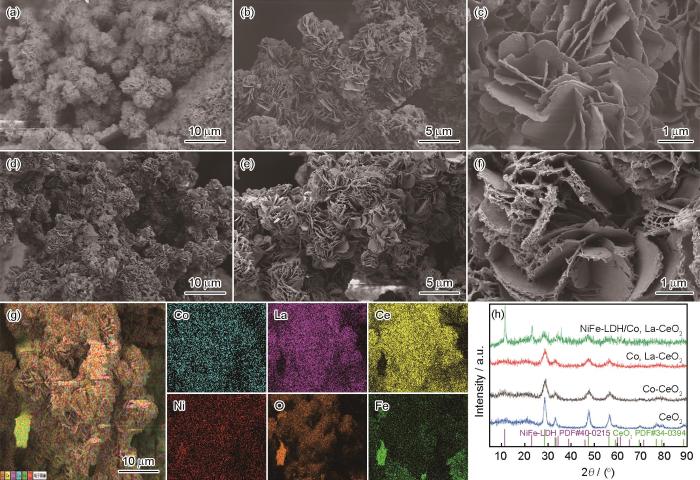
... 图3h给出了NiFe-LDH/Co,La-CeO2样品的XRD谱.可以看出,谱中CeO2的所有衍射峰均与立方萤石结构的标准卡片(PDF#34-0394)匹配,表明样品具有高纯度和高结晶性.引入Co和La使CeO2的特征主峰向高角度轻微偏移,是离子半径不同引起的晶格收缩和晶格应变所致.在NiFe-LDH/Co, La-CeO2复合材料的谱中出现了新的特征衍射峰.位于2θ = 11.5°和23.3°等处的强峰分别对应NiFe-LDH (PDF#40-0215)的(003)和(006)晶面,位于34.6°,39.0°,46.4°,60.3°,和61.3°的衍射峰则分别对应(012)、(015)、(018)、(110)和(113)晶面[41].这表明,已经成功地构建出LDH结构.XRD谱表明,NiFe-LDH相在掺杂后的CeO2载体表面成功生成,在复合过程载体的本征结构没有受到破坏. ...
Atomic-scale insights into the interfacial charge transfer in a NiO/CeO2 heterostructure for electrocatalytic hydrogen evolution
1
2023
... 图7a给出了Ce 3d 的XPS谱,在谱中885.5 eV、898.8 eV和908.0 eV附近CeO2、Co, La-CeO2和NiFe-LDH/Co, La-CeO2的特征峰,可归属为Ce3+和Ce4+物种[42].Co, La-CeO2样品Ce3+峰的强度显著高于CeO2样品Ce3+峰的强度,表明Co和La掺杂促进了CeO2的部分还原,产生了更多的Ce3+和氧空位[43].在NiFe-LDH/Co, La-CeO2复合材料的谱中,除了Ce的主要信号在879.8 eV和873.6 eV处还出现两个额外峰.这表明,NiFe-LDH与CeO2之间的强界面相互作用提高了Ce3+的含量[44].Ce价态的变化为氧空位和表面活性氧的生成提供更多的反应位点,从而加速了反应动力学过程.与纯CeO2相比,共掺杂Co和La使Co, La-CeO2中Ov和Oads的相对面积显著增加(图7b).与NiFe-LDH构建异质界面使这些组分进一步增强,表明异价掺杂(La3+、Co2+/3+)的电荷补偿与界面电子再分布协同促进了更多氧空位和表面活性氧物种的生成.同时,NiFe-LDH/Co, La-CeO2的O 1s结合能发生负移,是Ce-O-Ni结构引起的晶格氧电子态的变化所致[45].这种调控优化了OH-/O-/OOH-在Ni位点的吸附能,通过晶格氧机制促进表面氧循环并可逆调节Ce4+/Ce3+-Ov,从而从机理上提高了复合材料的OER活性且不降低其结构稳定性. ...
Fe-doping induced morphological changes, oxygen vacancies and Ce3+-Ce3+ pairs in CeO2 for promoting electrocatalytic nitrogen fixation
1
2020
... 图7a给出了Ce 3d 的XPS谱,在谱中885.5 eV、898.8 eV和908.0 eV附近CeO2、Co, La-CeO2和NiFe-LDH/Co, La-CeO2的特征峰,可归属为Ce3+和Ce4+物种[42].Co, La-CeO2样品Ce3+峰的强度显著高于CeO2样品Ce3+峰的强度,表明Co和La掺杂促进了CeO2的部分还原,产生了更多的Ce3+和氧空位[43].在NiFe-LDH/Co, La-CeO2复合材料的谱中,除了Ce的主要信号在879.8 eV和873.6 eV处还出现两个额外峰.这表明,NiFe-LDH与CeO2之间的强界面相互作用提高了Ce3+的含量[44].Ce价态的变化为氧空位和表面活性氧的生成提供更多的反应位点,从而加速了反应动力学过程.与纯CeO2相比,共掺杂Co和La使Co, La-CeO2中Ov和Oads的相对面积显著增加(图7b).与NiFe-LDH构建异质界面使这些组分进一步增强,表明异价掺杂(La3+、Co2+/3+)的电荷补偿与界面电子再分布协同促进了更多氧空位和表面活性氧物种的生成.同时,NiFe-LDH/Co, La-CeO2的O 1s结合能发生负移,是Ce-O-Ni结构引起的晶格氧电子态的变化所致[45].这种调控优化了OH-/O-/OOH-在Ni位点的吸附能,通过晶格氧机制促进表面氧循环并可逆调节Ce4+/Ce3+-Ov,从而从机理上提高了复合材料的OER活性且不降低其结构稳定性. ...
An advanced and highly efficient Ce assisted NiFe-LDH electrocatalyst for overall water splitting
1
2020
... 图7a给出了Ce 3d 的XPS谱,在谱中885.5 eV、898.8 eV和908.0 eV附近CeO2、Co, La-CeO2和NiFe-LDH/Co, La-CeO2的特征峰,可归属为Ce3+和Ce4+物种[42].Co, La-CeO2样品Ce3+峰的强度显著高于CeO2样品Ce3+峰的强度,表明Co和La掺杂促进了CeO2的部分还原,产生了更多的Ce3+和氧空位[43].在NiFe-LDH/Co, La-CeO2复合材料的谱中,除了Ce的主要信号在879.8 eV和873.6 eV处还出现两个额外峰.这表明,NiFe-LDH与CeO2之间的强界面相互作用提高了Ce3+的含量[44].Ce价态的变化为氧空位和表面活性氧的生成提供更多的反应位点,从而加速了反应动力学过程.与纯CeO2相比,共掺杂Co和La使Co, La-CeO2中Ov和Oads的相对面积显著增加(图7b).与NiFe-LDH构建异质界面使这些组分进一步增强,表明异价掺杂(La3+、Co2+/3+)的电荷补偿与界面电子再分布协同促进了更多氧空位和表面活性氧物种的生成.同时,NiFe-LDH/Co, La-CeO2的O 1s结合能发生负移,是Ce-O-Ni结构引起的晶格氧电子态的变化所致[45].这种调控优化了OH-/O-/OOH-在Ni位点的吸附能,通过晶格氧机制促进表面氧循环并可逆调节Ce4+/Ce3+-Ov,从而从机理上提高了复合材料的OER活性且不降低其结构稳定性. ...
Rational design of nanoarray architectures for electrocatalytic water splitting
1
2019
... 图7a给出了Ce 3d 的XPS谱,在谱中885.5 eV、898.8 eV和908.0 eV附近CeO2、Co, La-CeO2和NiFe-LDH/Co, La-CeO2的特征峰,可归属为Ce3+和Ce4+物种[42].Co, La-CeO2样品Ce3+峰的强度显著高于CeO2样品Ce3+峰的强度,表明Co和La掺杂促进了CeO2的部分还原,产生了更多的Ce3+和氧空位[43].在NiFe-LDH/Co, La-CeO2复合材料的谱中,除了Ce的主要信号在879.8 eV和873.6 eV处还出现两个额外峰.这表明,NiFe-LDH与CeO2之间的强界面相互作用提高了Ce3+的含量[44].Ce价态的变化为氧空位和表面活性氧的生成提供更多的反应位点,从而加速了反应动力学过程.与纯CeO2相比,共掺杂Co和La使Co, La-CeO2中Ov和Oads的相对面积显著增加(图7b).与NiFe-LDH构建异质界面使这些组分进一步增强,表明异价掺杂(La3+、Co2+/3+)的电荷补偿与界面电子再分布协同促进了更多氧空位和表面活性氧物种的生成.同时,NiFe-LDH/Co, La-CeO2的O 1s结合能发生负移,是Ce-O-Ni结构引起的晶格氧电子态的变化所致[45].这种调控优化了OH-/O-/OOH-在Ni位点的吸附能,通过晶格氧机制促进表面氧循环并可逆调节Ce4+/Ce3+-Ov,从而从机理上提高了复合材料的OER活性且不降低其结构稳定性. ...
Highly water-resistant La-doped Co3O4 catalyst for CO oxidation
1
2019
... 在图7c给出的Co 2p谱中,778.75 eV和793.43 eV处的峰对应Co3+,而781.15 eV和796.58 eV处的峰则对应Co2+ [46].与Co, La-CeO2相比,NiFe-LDH/Co,La-CeO2中Co2+/Co3+的比例提高,表明NiFe-LDH的引入调控了Co的电子密度并促进了电子转移.在La 3d的谱中(图7d) 834 eV和851 eV处出现特征峰[47],表明La3+成功掺入Co, La-CeO2晶格.在NiFe-LDH/Co, La-CeO2的谱中该峰展宽并轻微偏移,表明组分间的相互作用改变了La的电子环境.这种电子调控,可能有助于提高材料的电催化性能.在Ni 2p区(图7e),873.6 eV与855.9 eV处的特征峰分别对应Ni2+的Ni 2p1/2和Ni 2p3/2[48],而在880.1 eV和861.8 eV处还出现了典型的伴峰.在Fe 2p谱(图7f)中的725.9 eV、718.2 eV与712.9 eV处出现的峰分别对应Fe 2p1/2、伴峰及Fe 2p3/2,表明复合材料中的Fe主要以Fe3+形式存在[49]. ...
XPS characterisation of in situ treated lanthanum oxide and hydroxide using tailored charge referencing and peak fitting procedures
1
2011
... 在图7c给出的Co 2p谱中,778.75 eV和793.43 eV处的峰对应Co3+,而781.15 eV和796.58 eV处的峰则对应Co2+ [46].与Co, La-CeO2相比,NiFe-LDH/Co,La-CeO2中Co2+/Co3+的比例提高,表明NiFe-LDH的引入调控了Co的电子密度并促进了电子转移.在La 3d的谱中(图7d) 834 eV和851 eV处出现特征峰[47],表明La3+成功掺入Co, La-CeO2晶格.在NiFe-LDH/Co, La-CeO2的谱中该峰展宽并轻微偏移,表明组分间的相互作用改变了La的电子环境.这种电子调控,可能有助于提高材料的电催化性能.在Ni 2p区(图7e),873.6 eV与855.9 eV处的特征峰分别对应Ni2+的Ni 2p1/2和Ni 2p3/2[48],而在880.1 eV和861.8 eV处还出现了典型的伴峰.在Fe 2p谱(图7f)中的725.9 eV、718.2 eV与712.9 eV处出现的峰分别对应Fe 2p1/2、伴峰及Fe 2p3/2,表明复合材料中的Fe主要以Fe3+形式存在[49]. ...
Ultrafast room-temperature synthesis of self-supported NiFe-layered double hydroxide as large-current-density oxygen evolution electrocatalyst
1
2022
... 在图7c给出的Co 2p谱中,778.75 eV和793.43 eV处的峰对应Co3+,而781.15 eV和796.58 eV处的峰则对应Co2+ [46].与Co, La-CeO2相比,NiFe-LDH/Co,La-CeO2中Co2+/Co3+的比例提高,表明NiFe-LDH的引入调控了Co的电子密度并促进了电子转移.在La 3d的谱中(图7d) 834 eV和851 eV处出现特征峰[47],表明La3+成功掺入Co, La-CeO2晶格.在NiFe-LDH/Co, La-CeO2的谱中该峰展宽并轻微偏移,表明组分间的相互作用改变了La的电子环境.这种电子调控,可能有助于提高材料的电催化性能.在Ni 2p区(图7e),873.6 eV与855.9 eV处的特征峰分别对应Ni2+的Ni 2p1/2和Ni 2p3/2[48],而在880.1 eV和861.8 eV处还出现了典型的伴峰.在Fe 2p谱(图7f)中的725.9 eV、718.2 eV与712.9 eV处出现的峰分别对应Fe 2p1/2、伴峰及Fe 2p3/2,表明复合材料中的Fe主要以Fe3+形式存在[49]. ...
Defected NiFe layered double hydroxides on N-doped carbon nanotubes as efficient bifunctional electrocatalyst for rechargeable zinc-air batteries
1
2022
... 在图7c给出的Co 2p谱中,778.75 eV和793.43 eV处的峰对应Co3+,而781.15 eV和796.58 eV处的峰则对应Co2+ [46].与Co, La-CeO2相比,NiFe-LDH/Co,La-CeO2中Co2+/Co3+的比例提高,表明NiFe-LDH的引入调控了Co的电子密度并促进了电子转移.在La 3d的谱中(图7d) 834 eV和851 eV处出现特征峰[47],表明La3+成功掺入Co, La-CeO2晶格.在NiFe-LDH/Co, La-CeO2的谱中该峰展宽并轻微偏移,表明组分间的相互作用改变了La的电子环境.这种电子调控,可能有助于提高材料的电催化性能.在Ni 2p区(图7e),873.6 eV与855.9 eV处的特征峰分别对应Ni2+的Ni 2p1/2和Ni 2p3/2[48],而在880.1 eV和861.8 eV处还出现了典型的伴峰.在Fe 2p谱(图7f)中的725.9 eV、718.2 eV与712.9 eV处出现的峰分别对应Fe 2p1/2、伴峰及Fe 2p3/2,表明复合材料中的Fe主要以Fe3+形式存在[49]. ...
Nickel-vanadium monolayer double hydroxide for efficient electrochemical water oxidation
1
2016
... 图8b比较了电流密度为10、50和100 mA·cm-2时的过电位.可以看出,电流密度为10和100 mA·cm-2时NiFe-LDH/Co, La-CeO2/CF只需172 mV和273 mV的过电位,优于NiFe-LDH/CF (208, 350 mV)、Co, La-CeO2/CF (379, 538 mV)、CeO2/CF (388, 565 mV)和RuO2/CF (330, 500 mV),表明其在碱性条件下优异的催化效率.根据LSV曲线的Tafel斜率评估了反应动力学.图8c给出了不同样品Tafel斜率的对比.可以看出,NiFe-LDH/Co, La-CeO2/CF电极的Tafel斜率(74.65 mV·dec-1)最低,而CeO2/CF (158.77 mV·dec-1)、Co, La-CeO2/CF (97.99 mV·dec-1)、NiFe-LDH/CF (87.12 mV·dec-1)和RuO2/CF (110.2 mV·dec-1)的Tafel斜率都比较高,表明其析氧反应动力学显著优于其他电极,证实了NiFe-LDH/Co, La-CeO2/CF在电催化过程中的电子传输速率较高和能量势垒较低.电化学活性表面积(ECSA)是评价催化性能的重要参数,可根据双电层电容(Cdl)确定[50].Cdl与ECSA值成正比,对不同扫描速率的循环伏安曲线进行线性拟合,比较了各样品的Cdl值.如图8d所示,NiFe-LDH/Co, La-CeO2/CF的Cdl值为36 mF·cm-2,显著比NiFe-LDH/CF (14.79 mF·cm-2)、Co, La-CeO2/CF (8.23 mF·cm-2)和CeO2/CF (3.18 mF·cm-2)的高.测试结果表明,富含缺陷的Co, La-CeO2结构与NiFe-LDH形成的异质结构能暴露出更多的活性位点,从而使材料的催化活性显著提高.在电化学反应中,材料的导电性起着至关重要的作用.因此,使用电化学阻抗谱评估了样品的电荷转移动力学,其中催化剂的电荷转移电阻对应Nyquist图中半圆的直径[51].如图8e中的等效电路Nyquist图所示,与NiFe-LDH/CF、Co, La-CeO2/CF和CeO2/CF相比,NiFe-LDH/Co, La-CeO2/CF的半圆直径小得多,表明其电荷转移电阻较低,即电子转移更快.表2列出了所有样品EIS数据的总结,其中NiFe-LDH/Co, La-CeO2/CF的Rct为0.47 Ω·cm2,显著比NiFe-LDH/CF (1.94 Ω·cm2)、Co, La-CeO2/CF (3.27 Ω·cm2)和CeO2/CF (7.57 Ω·cm2)的低.这些结果表明,NiFe-LDH/Co, La-CeO2/CF复合催化剂在OER过程中显著加速了电荷转移过程,从而使其催化效率提高. ...
Inducing the SnO2-based electron transport layer into NiFe LDH/NF as efficient catalyst for OER and methanol oxidation reaction
1
2022
... 图8b比较了电流密度为10、50和100 mA·cm-2时的过电位.可以看出,电流密度为10和100 mA·cm-2时NiFe-LDH/Co, La-CeO2/CF只需172 mV和273 mV的过电位,优于NiFe-LDH/CF (208, 350 mV)、Co, La-CeO2/CF (379, 538 mV)、CeO2/CF (388, 565 mV)和RuO2/CF (330, 500 mV),表明其在碱性条件下优异的催化效率.根据LSV曲线的Tafel斜率评估了反应动力学.图8c给出了不同样品Tafel斜率的对比.可以看出,NiFe-LDH/Co, La-CeO2/CF电极的Tafel斜率(74.65 mV·dec-1)最低,而CeO2/CF (158.77 mV·dec-1)、Co, La-CeO2/CF (97.99 mV·dec-1)、NiFe-LDH/CF (87.12 mV·dec-1)和RuO2/CF (110.2 mV·dec-1)的Tafel斜率都比较高,表明其析氧反应动力学显著优于其他电极,证实了NiFe-LDH/Co, La-CeO2/CF在电催化过程中的电子传输速率较高和能量势垒较低.电化学活性表面积(ECSA)是评价催化性能的重要参数,可根据双电层电容(Cdl)确定[50].Cdl与ECSA值成正比,对不同扫描速率的循环伏安曲线进行线性拟合,比较了各样品的Cdl值.如图8d所示,NiFe-LDH/Co, La-CeO2/CF的Cdl值为36 mF·cm-2,显著比NiFe-LDH/CF (14.79 mF·cm-2)、Co, La-CeO2/CF (8.23 mF·cm-2)和CeO2/CF (3.18 mF·cm-2)的高.测试结果表明,富含缺陷的Co, La-CeO2结构与NiFe-LDH形成的异质结构能暴露出更多的活性位点,从而使材料的催化活性显著提高.在电化学反应中,材料的导电性起着至关重要的作用.因此,使用电化学阻抗谱评估了样品的电荷转移动力学,其中催化剂的电荷转移电阻对应Nyquist图中半圆的直径[51].如图8e中的等效电路Nyquist图所示,与NiFe-LDH/CF、Co, La-CeO2/CF和CeO2/CF相比,NiFe-LDH/Co, La-CeO2/CF的半圆直径小得多,表明其电荷转移电阻较低,即电子转移更快.表2列出了所有样品EIS数据的总结,其中NiFe-LDH/Co, La-CeO2/CF的Rct为0.47 Ω·cm2,显著比NiFe-LDH/CF (1.94 Ω·cm2)、Co, La-CeO2/CF (3.27 Ω·cm2)和CeO2/CF (7.57 Ω·cm2)的低.这些结果表明,NiFe-LDH/Co, La-CeO2/CF复合催化剂在OER过程中显著加速了电荷转移过程,从而使其催化效率提高. ...
NiFe-LDH/co/C@NF composite electrocatalyst with enhanced oxygen evolution reaction performance
1
2025
... Comparison of OER performance of NiFe-LDH/Co, La-CeO
2/CF with reported electrocatalysts
Table 1| Catalyst | j / mA·cm-2 | η / mV | Electrolysts | Reference |
|---|
| NiFe-LDH/Co, La-CeO2/CF | 50 | 230 | 1 mol/L KOH | This work |
| 10 | 172 |
| NiFe-LDH/Co/C@NF | 50 | 244 | 1 mol/L KOH | [52] |
| 10 | |
| NiFeLDH/NiCoP@NC/NF | 50 | | 1 mol/L KOH | [53] |
| 10 | 210 |
| Ce-CoP@CC | 50 | | 1 mol/L KOH | [54] |
| 10 | 240 |
| NiFeCe-LDH@CP | 50 | 255 | 1 mol/L KOH | [55] |
| 10 | 232 |
| Co3O4@NiFe-LDH/NF | 50 | 270 | 1 mol/L KOH | [56] |
| 10 | |
| CoP/CeO2-20 | 50 | 298 | 1 mol/L KOH | [27] |
| 10 | 257 |
| 2%Gd-CeO2 | 50 | | 1 mol/L KOH | [37] |
| 10 | 369 |
| Ce(OH)3@NiFe LDH | 50 | | 1 mol/L KOH | [57] |
| 10 | 220 |
| Ce-Ni3S2/MnS/NF | 50 | 245 | 1 mol/L KOH | [58] |
| 10 | 194 |
| S-FeCoNiO x | 50 | | 1 mol/L KOH | [59] |
| 10 | 221 |
图8b比较了电流密度为10、50和100 mA·cm-2时的过电位.可以看出,电流密度为10和100 mA·cm-2时NiFe-LDH/Co, La-CeO2/CF只需172 mV和273 mV的过电位,优于NiFe-LDH/CF (208, 350 mV)、Co, La-CeO2/CF (379, 538 mV)、CeO2/CF (388, 565 mV)和RuO2/CF (330, 500 mV),表明其在碱性条件下优异的催化效率.根据LSV曲线的Tafel斜率评估了反应动力学.图8c给出了不同样品Tafel斜率的对比.可以看出,NiFe-LDH/Co, La-CeO2/CF电极的Tafel斜率(74.65 mV·dec-1)最低,而CeO2/CF (158.77 mV·dec-1)、Co, La-CeO2/CF (97.99 mV·dec-1)、NiFe-LDH/CF (87.12 mV·dec-1)和RuO2/CF (110.2 mV·dec-1)的Tafel斜率都比较高,表明其析氧反应动力学显著优于其他电极,证实了NiFe-LDH/Co, La-CeO2/CF在电催化过程中的电子传输速率较高和能量势垒较低.电化学活性表面积(ECSA)是评价催化性能的重要参数,可根据双电层电容(Cdl)确定[50].Cdl与ECSA值成正比,对不同扫描速率的循环伏安曲线进行线性拟合,比较了各样品的Cdl值.如图8d所示,NiFe-LDH/Co, La-CeO2/CF的Cdl值为36 mF·cm-2,显著比NiFe-LDH/CF (14.79 mF·cm-2)、Co, La-CeO2/CF (8.23 mF·cm-2)和CeO2/CF (3.18 mF·cm-2)的高.测试结果表明,富含缺陷的Co, La-CeO2结构与NiFe-LDH形成的异质结构能暴露出更多的活性位点,从而使材料的催化活性显著提高.在电化学反应中,材料的导电性起着至关重要的作用.因此,使用电化学阻抗谱评估了样品的电荷转移动力学,其中催化剂的电荷转移电阻对应Nyquist图中半圆的直径[51].如图8e中的等效电路Nyquist图所示,与NiFe-LDH/CF、Co, La-CeO2/CF和CeO2/CF相比,NiFe-LDH/Co, La-CeO2/CF的半圆直径小得多,表明其电荷转移电阻较低,即电子转移更快.表2列出了所有样品EIS数据的总结,其中NiFe-LDH/Co, La-CeO2/CF的Rct为0.47 Ω·cm2,显著比NiFe-LDH/CF (1.94 Ω·cm2)、Co, La-CeO2/CF (3.27 Ω·cm2)和CeO2/CF (7.57 Ω·cm2)的低.这些结果表明,NiFe-LDH/Co, La-CeO2/CF复合催化剂在OER过程中显著加速了电荷转移过程,从而使其催化效率提高. ...
3D amorphous NiFe LDH nanosheets electrodeposited on in situ grown NiCoP@NC on nickel foam for remarkably enhanced OER electrocatalytic performance
1
2020
... Comparison of OER performance of NiFe-LDH/Co, La-CeO
2/CF with reported electrocatalysts
Table 1| Catalyst | j / mA·cm-2 | η / mV | Electrolysts | Reference |
|---|
| NiFe-LDH/Co, La-CeO2/CF | 50 | 230 | 1 mol/L KOH | This work |
| 10 | 172 |
| NiFe-LDH/Co/C@NF | 50 | 244 | 1 mol/L KOH | [52] |
| 10 | |
| NiFeLDH/NiCoP@NC/NF | 50 | | 1 mol/L KOH | [53] |
| 10 | 210 |
| Ce-CoP@CC | 50 | | 1 mol/L KOH | [54] |
| 10 | 240 |
| NiFeCe-LDH@CP | 50 | 255 | 1 mol/L KOH | [55] |
| 10 | 232 |
| Co3O4@NiFe-LDH/NF | 50 | 270 | 1 mol/L KOH | [56] |
| 10 | |
| CoP/CeO2-20 | 50 | 298 | 1 mol/L KOH | [27] |
| 10 | 257 |
| 2%Gd-CeO2 | 50 | | 1 mol/L KOH | [37] |
| 10 | 369 |
| Ce(OH)3@NiFe LDH | 50 | | 1 mol/L KOH | [57] |
| 10 | 220 |
| Ce-Ni3S2/MnS/NF | 50 | 245 | 1 mol/L KOH | [58] |
| 10 | 194 |
| S-FeCoNiO x | 50 | | 1 mol/L KOH | [59] |
| 10 | 221 |
图8b比较了电流密度为10、50和100 mA·cm-2时的过电位.可以看出,电流密度为10和100 mA·cm-2时NiFe-LDH/Co, La-CeO2/CF只需172 mV和273 mV的过电位,优于NiFe-LDH/CF (208, 350 mV)、Co, La-CeO2/CF (379, 538 mV)、CeO2/CF (388, 565 mV)和RuO2/CF (330, 500 mV),表明其在碱性条件下优异的催化效率.根据LSV曲线的Tafel斜率评估了反应动力学.图8c给出了不同样品Tafel斜率的对比.可以看出,NiFe-LDH/Co, La-CeO2/CF电极的Tafel斜率(74.65 mV·dec-1)最低,而CeO2/CF (158.77 mV·dec-1)、Co, La-CeO2/CF (97.99 mV·dec-1)、NiFe-LDH/CF (87.12 mV·dec-1)和RuO2/CF (110.2 mV·dec-1)的Tafel斜率都比较高,表明其析氧反应动力学显著优于其他电极,证实了NiFe-LDH/Co, La-CeO2/CF在电催化过程中的电子传输速率较高和能量势垒较低.电化学活性表面积(ECSA)是评价催化性能的重要参数,可根据双电层电容(Cdl)确定[50].Cdl与ECSA值成正比,对不同扫描速率的循环伏安曲线进行线性拟合,比较了各样品的Cdl值.如图8d所示,NiFe-LDH/Co, La-CeO2/CF的Cdl值为36 mF·cm-2,显著比NiFe-LDH/CF (14.79 mF·cm-2)、Co, La-CeO2/CF (8.23 mF·cm-2)和CeO2/CF (3.18 mF·cm-2)的高.测试结果表明,富含缺陷的Co, La-CeO2结构与NiFe-LDH形成的异质结构能暴露出更多的活性位点,从而使材料的催化活性显著提高.在电化学反应中,材料的导电性起着至关重要的作用.因此,使用电化学阻抗谱评估了样品的电荷转移动力学,其中催化剂的电荷转移电阻对应Nyquist图中半圆的直径[51].如图8e中的等效电路Nyquist图所示,与NiFe-LDH/CF、Co, La-CeO2/CF和CeO2/CF相比,NiFe-LDH/Co, La-CeO2/CF的半圆直径小得多,表明其电荷转移电阻较低,即电子转移更快.表2列出了所有样品EIS数据的总结,其中NiFe-LDH/Co, La-CeO2/CF的Rct为0.47 Ω·cm2,显著比NiFe-LDH/CF (1.94 Ω·cm2)、Co, La-CeO2/CF (3.27 Ω·cm2)和CeO2/CF (7.57 Ω·cm2)的低.这些结果表明,NiFe-LDH/Co, La-CeO2/CF复合催化剂在OER过程中显著加速了电荷转移过程,从而使其催化效率提高. ...
Ce-Induced differentiated regulation of Co sites via gradient orbital coupling for bifunctional water-splitting reactions
1
2023
... Comparison of OER performance of NiFe-LDH/Co, La-CeO
2/CF with reported electrocatalysts
Table 1| Catalyst | j / mA·cm-2 | η / mV | Electrolysts | Reference |
|---|
| NiFe-LDH/Co, La-CeO2/CF | 50 | 230 | 1 mol/L KOH | This work |
| 10 | 172 |
| NiFe-LDH/Co/C@NF | 50 | 244 | 1 mol/L KOH | [52] |
| 10 | |
| NiFeLDH/NiCoP@NC/NF | 50 | | 1 mol/L KOH | [53] |
| 10 | 210 |
| Ce-CoP@CC | 50 | | 1 mol/L KOH | [54] |
| 10 | 240 |
| NiFeCe-LDH@CP | 50 | 255 | 1 mol/L KOH | [55] |
| 10 | 232 |
| Co3O4@NiFe-LDH/NF | 50 | 270 | 1 mol/L KOH | [56] |
| 10 | |
| CoP/CeO2-20 | 50 | 298 | 1 mol/L KOH | [27] |
| 10 | 257 |
| 2%Gd-CeO2 | 50 | | 1 mol/L KOH | [37] |
| 10 | 369 |
| Ce(OH)3@NiFe LDH | 50 | | 1 mol/L KOH | [57] |
| 10 | 220 |
| Ce-Ni3S2/MnS/NF | 50 | 245 | 1 mol/L KOH | [58] |
| 10 | 194 |
| S-FeCoNiO x | 50 | | 1 mol/L KOH | [59] |
| 10 | 221 |
图8b比较了电流密度为10、50和100 mA·cm-2时的过电位.可以看出,电流密度为10和100 mA·cm-2时NiFe-LDH/Co, La-CeO2/CF只需172 mV和273 mV的过电位,优于NiFe-LDH/CF (208, 350 mV)、Co, La-CeO2/CF (379, 538 mV)、CeO2/CF (388, 565 mV)和RuO2/CF (330, 500 mV),表明其在碱性条件下优异的催化效率.根据LSV曲线的Tafel斜率评估了反应动力学.图8c给出了不同样品Tafel斜率的对比.可以看出,NiFe-LDH/Co, La-CeO2/CF电极的Tafel斜率(74.65 mV·dec-1)最低,而CeO2/CF (158.77 mV·dec-1)、Co, La-CeO2/CF (97.99 mV·dec-1)、NiFe-LDH/CF (87.12 mV·dec-1)和RuO2/CF (110.2 mV·dec-1)的Tafel斜率都比较高,表明其析氧反应动力学显著优于其他电极,证实了NiFe-LDH/Co, La-CeO2/CF在电催化过程中的电子传输速率较高和能量势垒较低.电化学活性表面积(ECSA)是评价催化性能的重要参数,可根据双电层电容(Cdl)确定[50].Cdl与ECSA值成正比,对不同扫描速率的循环伏安曲线进行线性拟合,比较了各样品的Cdl值.如图8d所示,NiFe-LDH/Co, La-CeO2/CF的Cdl值为36 mF·cm-2,显著比NiFe-LDH/CF (14.79 mF·cm-2)、Co, La-CeO2/CF (8.23 mF·cm-2)和CeO2/CF (3.18 mF·cm-2)的高.测试结果表明,富含缺陷的Co, La-CeO2结构与NiFe-LDH形成的异质结构能暴露出更多的活性位点,从而使材料的催化活性显著提高.在电化学反应中,材料的导电性起着至关重要的作用.因此,使用电化学阻抗谱评估了样品的电荷转移动力学,其中催化剂的电荷转移电阻对应Nyquist图中半圆的直径[51].如图8e中的等效电路Nyquist图所示,与NiFe-LDH/CF、Co, La-CeO2/CF和CeO2/CF相比,NiFe-LDH/Co, La-CeO2/CF的半圆直径小得多,表明其电荷转移电阻较低,即电子转移更快.表2列出了所有样品EIS数据的总结,其中NiFe-LDH/Co, La-CeO2/CF的Rct为0.47 Ω·cm2,显著比NiFe-LDH/CF (1.94 Ω·cm2)、Co, La-CeO2/CF (3.27 Ω·cm2)和CeO2/CF (7.57 Ω·cm2)的低.这些结果表明,NiFe-LDH/Co, La-CeO2/CF复合催化剂在OER过程中显著加速了电荷转移过程,从而使其催化效率提高. ...
Lattice distortion induced Ce-doped NiFe-LDH for efficient oxygen evolution
1
2023
... Comparison of OER performance of NiFe-LDH/Co, La-CeO
2/CF with reported electrocatalysts
Table 1| Catalyst | j / mA·cm-2 | η / mV | Electrolysts | Reference |
|---|
| NiFe-LDH/Co, La-CeO2/CF | 50 | 230 | 1 mol/L KOH | This work |
| 10 | 172 |
| NiFe-LDH/Co/C@NF | 50 | 244 | 1 mol/L KOH | [52] |
| 10 | |
| NiFeLDH/NiCoP@NC/NF | 50 | | 1 mol/L KOH | [53] |
| 10 | 210 |
| Ce-CoP@CC | 50 | | 1 mol/L KOH | [54] |
| 10 | 240 |
| NiFeCe-LDH@CP | 50 | 255 | 1 mol/L KOH | [55] |
| 10 | 232 |
| Co3O4@NiFe-LDH/NF | 50 | 270 | 1 mol/L KOH | [56] |
| 10 | |
| CoP/CeO2-20 | 50 | 298 | 1 mol/L KOH | [27] |
| 10 | 257 |
| 2%Gd-CeO2 | 50 | | 1 mol/L KOH | [37] |
| 10 | 369 |
| Ce(OH)3@NiFe LDH | 50 | | 1 mol/L KOH | [57] |
| 10 | 220 |
| Ce-Ni3S2/MnS/NF | 50 | 245 | 1 mol/L KOH | [58] |
| 10 | 194 |
| S-FeCoNiO x | 50 | | 1 mol/L KOH | [59] |
| 10 | 221 |
图8b比较了电流密度为10、50和100 mA·cm-2时的过电位.可以看出,电流密度为10和100 mA·cm-2时NiFe-LDH/Co, La-CeO2/CF只需172 mV和273 mV的过电位,优于NiFe-LDH/CF (208, 350 mV)、Co, La-CeO2/CF (379, 538 mV)、CeO2/CF (388, 565 mV)和RuO2/CF (330, 500 mV),表明其在碱性条件下优异的催化效率.根据LSV曲线的Tafel斜率评估了反应动力学.图8c给出了不同样品Tafel斜率的对比.可以看出,NiFe-LDH/Co, La-CeO2/CF电极的Tafel斜率(74.65 mV·dec-1)最低,而CeO2/CF (158.77 mV·dec-1)、Co, La-CeO2/CF (97.99 mV·dec-1)、NiFe-LDH/CF (87.12 mV·dec-1)和RuO2/CF (110.2 mV·dec-1)的Tafel斜率都比较高,表明其析氧反应动力学显著优于其他电极,证实了NiFe-LDH/Co, La-CeO2/CF在电催化过程中的电子传输速率较高和能量势垒较低.电化学活性表面积(ECSA)是评价催化性能的重要参数,可根据双电层电容(Cdl)确定[50].Cdl与ECSA值成正比,对不同扫描速率的循环伏安曲线进行线性拟合,比较了各样品的Cdl值.如图8d所示,NiFe-LDH/Co, La-CeO2/CF的Cdl值为36 mF·cm-2,显著比NiFe-LDH/CF (14.79 mF·cm-2)、Co, La-CeO2/CF (8.23 mF·cm-2)和CeO2/CF (3.18 mF·cm-2)的高.测试结果表明,富含缺陷的Co, La-CeO2结构与NiFe-LDH形成的异质结构能暴露出更多的活性位点,从而使材料的催化活性显著提高.在电化学反应中,材料的导电性起着至关重要的作用.因此,使用电化学阻抗谱评估了样品的电荷转移动力学,其中催化剂的电荷转移电阻对应Nyquist图中半圆的直径[51].如图8e中的等效电路Nyquist图所示,与NiFe-LDH/CF、Co, La-CeO2/CF和CeO2/CF相比,NiFe-LDH/Co, La-CeO2/CF的半圆直径小得多,表明其电荷转移电阻较低,即电子转移更快.表2列出了所有样品EIS数据的总结,其中NiFe-LDH/Co, La-CeO2/CF的Rct为0.47 Ω·cm2,显著比NiFe-LDH/CF (1.94 Ω·cm2)、Co, La-CeO2/CF (3.27 Ω·cm2)和CeO2/CF (7.57 Ω·cm2)的低.这些结果表明,NiFe-LDH/Co, La-CeO2/CF复合催化剂在OER过程中显著加速了电荷转移过程,从而使其催化效率提高. ...
Nanostructured Co3O4@NiFe-LDH heterojunction catalysts for improving oxygen evolution reaction in alkaline environment
1
2024
... Comparison of OER performance of NiFe-LDH/Co, La-CeO
2/CF with reported electrocatalysts
Table 1| Catalyst | j / mA·cm-2 | η / mV | Electrolysts | Reference |
|---|
| NiFe-LDH/Co, La-CeO2/CF | 50 | 230 | 1 mol/L KOH | This work |
| 10 | 172 |
| NiFe-LDH/Co/C@NF | 50 | 244 | 1 mol/L KOH | [52] |
| 10 | |
| NiFeLDH/NiCoP@NC/NF | 50 | | 1 mol/L KOH | [53] |
| 10 | 210 |
| Ce-CoP@CC | 50 | | 1 mol/L KOH | [54] |
| 10 | 240 |
| NiFeCe-LDH@CP | 50 | 255 | 1 mol/L KOH | [55] |
| 10 | 232 |
| Co3O4@NiFe-LDH/NF | 50 | 270 | 1 mol/L KOH | [56] |
| 10 | |
| CoP/CeO2-20 | 50 | 298 | 1 mol/L KOH | [27] |
| 10 | 257 |
| 2%Gd-CeO2 | 50 | | 1 mol/L KOH | [37] |
| 10 | 369 |
| Ce(OH)3@NiFe LDH | 50 | | 1 mol/L KOH | [57] |
| 10 | 220 |
| Ce-Ni3S2/MnS/NF | 50 | 245 | 1 mol/L KOH | [58] |
| 10 | 194 |
| S-FeCoNiO x | 50 | | 1 mol/L KOH | [59] |
| 10 | 221 |
图8b比较了电流密度为10、50和100 mA·cm-2时的过电位.可以看出,电流密度为10和100 mA·cm-2时NiFe-LDH/Co, La-CeO2/CF只需172 mV和273 mV的过电位,优于NiFe-LDH/CF (208, 350 mV)、Co, La-CeO2/CF (379, 538 mV)、CeO2/CF (388, 565 mV)和RuO2/CF (330, 500 mV),表明其在碱性条件下优异的催化效率.根据LSV曲线的Tafel斜率评估了反应动力学.图8c给出了不同样品Tafel斜率的对比.可以看出,NiFe-LDH/Co, La-CeO2/CF电极的Tafel斜率(74.65 mV·dec-1)最低,而CeO2/CF (158.77 mV·dec-1)、Co, La-CeO2/CF (97.99 mV·dec-1)、NiFe-LDH/CF (87.12 mV·dec-1)和RuO2/CF (110.2 mV·dec-1)的Tafel斜率都比较高,表明其析氧反应动力学显著优于其他电极,证实了NiFe-LDH/Co, La-CeO2/CF在电催化过程中的电子传输速率较高和能量势垒较低.电化学活性表面积(ECSA)是评价催化性能的重要参数,可根据双电层电容(Cdl)确定[50].Cdl与ECSA值成正比,对不同扫描速率的循环伏安曲线进行线性拟合,比较了各样品的Cdl值.如图8d所示,NiFe-LDH/Co, La-CeO2/CF的Cdl值为36 mF·cm-2,显著比NiFe-LDH/CF (14.79 mF·cm-2)、Co, La-CeO2/CF (8.23 mF·cm-2)和CeO2/CF (3.18 mF·cm-2)的高.测试结果表明,富含缺陷的Co, La-CeO2结构与NiFe-LDH形成的异质结构能暴露出更多的活性位点,从而使材料的催化活性显著提高.在电化学反应中,材料的导电性起着至关重要的作用.因此,使用电化学阻抗谱评估了样品的电荷转移动力学,其中催化剂的电荷转移电阻对应Nyquist图中半圆的直径[51].如图8e中的等效电路Nyquist图所示,与NiFe-LDH/CF、Co, La-CeO2/CF和CeO2/CF相比,NiFe-LDH/Co, La-CeO2/CF的半圆直径小得多,表明其电荷转移电阻较低,即电子转移更快.表2列出了所有样品EIS数据的总结,其中NiFe-LDH/Co, La-CeO2/CF的Rct为0.47 Ω·cm2,显著比NiFe-LDH/CF (1.94 Ω·cm2)、Co, La-CeO2/CF (3.27 Ω·cm2)和CeO2/CF (7.57 Ω·cm2)的低.这些结果表明,NiFe-LDH/Co, La-CeO2/CF复合催化剂在OER过程中显著加速了电荷转移过程,从而使其催化效率提高. ...
Role of Ce in the enhanced performance of the water oxidation reaction and urea oxidation reaction for NiFe layered double hydroxides
1
2022
... Comparison of OER performance of NiFe-LDH/Co, La-CeO
2/CF with reported electrocatalysts
Table 1| Catalyst | j / mA·cm-2 | η / mV | Electrolysts | Reference |
|---|
| NiFe-LDH/Co, La-CeO2/CF | 50 | 230 | 1 mol/L KOH | This work |
| 10 | 172 |
| NiFe-LDH/Co/C@NF | 50 | 244 | 1 mol/L KOH | [52] |
| 10 | |
| NiFeLDH/NiCoP@NC/NF | 50 | | 1 mol/L KOH | [53] |
| 10 | 210 |
| Ce-CoP@CC | 50 | | 1 mol/L KOH | [54] |
| 10 | 240 |
| NiFeCe-LDH@CP | 50 | 255 | 1 mol/L KOH | [55] |
| 10 | 232 |
| Co3O4@NiFe-LDH/NF | 50 | 270 | 1 mol/L KOH | [56] |
| 10 | |
| CoP/CeO2-20 | 50 | 298 | 1 mol/L KOH | [27] |
| 10 | 257 |
| 2%Gd-CeO2 | 50 | | 1 mol/L KOH | [37] |
| 10 | 369 |
| Ce(OH)3@NiFe LDH | 50 | | 1 mol/L KOH | [57] |
| 10 | 220 |
| Ce-Ni3S2/MnS/NF | 50 | 245 | 1 mol/L KOH | [58] |
| 10 | 194 |
| S-FeCoNiO x | 50 | | 1 mol/L KOH | [59] |
| 10 | 221 |
图8b比较了电流密度为10、50和100 mA·cm-2时的过电位.可以看出,电流密度为10和100 mA·cm-2时NiFe-LDH/Co, La-CeO2/CF只需172 mV和273 mV的过电位,优于NiFe-LDH/CF (208, 350 mV)、Co, La-CeO2/CF (379, 538 mV)、CeO2/CF (388, 565 mV)和RuO2/CF (330, 500 mV),表明其在碱性条件下优异的催化效率.根据LSV曲线的Tafel斜率评估了反应动力学.图8c给出了不同样品Tafel斜率的对比.可以看出,NiFe-LDH/Co, La-CeO2/CF电极的Tafel斜率(74.65 mV·dec-1)最低,而CeO2/CF (158.77 mV·dec-1)、Co, La-CeO2/CF (97.99 mV·dec-1)、NiFe-LDH/CF (87.12 mV·dec-1)和RuO2/CF (110.2 mV·dec-1)的Tafel斜率都比较高,表明其析氧反应动力学显著优于其他电极,证实了NiFe-LDH/Co, La-CeO2/CF在电催化过程中的电子传输速率较高和能量势垒较低.电化学活性表面积(ECSA)是评价催化性能的重要参数,可根据双电层电容(Cdl)确定[50].Cdl与ECSA值成正比,对不同扫描速率的循环伏安曲线进行线性拟合,比较了各样品的Cdl值.如图8d所示,NiFe-LDH/Co, La-CeO2/CF的Cdl值为36 mF·cm-2,显著比NiFe-LDH/CF (14.79 mF·cm-2)、Co, La-CeO2/CF (8.23 mF·cm-2)和CeO2/CF (3.18 mF·cm-2)的高.测试结果表明,富含缺陷的Co, La-CeO2结构与NiFe-LDH形成的异质结构能暴露出更多的活性位点,从而使材料的催化活性显著提高.在电化学反应中,材料的导电性起着至关重要的作用.因此,使用电化学阻抗谱评估了样品的电荷转移动力学,其中催化剂的电荷转移电阻对应Nyquist图中半圆的直径[51].如图8e中的等效电路Nyquist图所示,与NiFe-LDH/CF、Co, La-CeO2/CF和CeO2/CF相比,NiFe-LDH/Co, La-CeO2/CF的半圆直径小得多,表明其电荷转移电阻较低,即电子转移更快.表2列出了所有样品EIS数据的总结,其中NiFe-LDH/Co, La-CeO2/CF的Rct为0.47 Ω·cm2,显著比NiFe-LDH/CF (1.94 Ω·cm2)、Co, La-CeO2/CF (3.27 Ω·cm2)和CeO2/CF (7.57 Ω·cm2)的低.这些结果表明,NiFe-LDH/Co, La-CeO2/CF复合催化剂在OER过程中显著加速了电荷转移过程,从而使其催化效率提高. ...
Synthesis of ultrathin nanosheet Ce-Ni3S2/MnS/NF for efficient oxygen evolution catalyst
1
2025
... Comparison of OER performance of NiFe-LDH/Co, La-CeO
2/CF with reported electrocatalysts
Table 1| Catalyst | j / mA·cm-2 | η / mV | Electrolysts | Reference |
|---|
| NiFe-LDH/Co, La-CeO2/CF | 50 | 230 | 1 mol/L KOH | This work |
| 10 | 172 |
| NiFe-LDH/Co/C@NF | 50 | 244 | 1 mol/L KOH | [52] |
| 10 | |
| NiFeLDH/NiCoP@NC/NF | 50 | | 1 mol/L KOH | [53] |
| 10 | 210 |
| Ce-CoP@CC | 50 | | 1 mol/L KOH | [54] |
| 10 | 240 |
| NiFeCe-LDH@CP | 50 | 255 | 1 mol/L KOH | [55] |
| 10 | 232 |
| Co3O4@NiFe-LDH/NF | 50 | 270 | 1 mol/L KOH | [56] |
| 10 | |
| CoP/CeO2-20 | 50 | 298 | 1 mol/L KOH | [27] |
| 10 | 257 |
| 2%Gd-CeO2 | 50 | | 1 mol/L KOH | [37] |
| 10 | 369 |
| Ce(OH)3@NiFe LDH | 50 | | 1 mol/L KOH | [57] |
| 10 | 220 |
| Ce-Ni3S2/MnS/NF | 50 | 245 | 1 mol/L KOH | [58] |
| 10 | 194 |
| S-FeCoNiO x | 50 | | 1 mol/L KOH | [59] |
| 10 | 221 |
图8b比较了电流密度为10、50和100 mA·cm-2时的过电位.可以看出,电流密度为10和100 mA·cm-2时NiFe-LDH/Co, La-CeO2/CF只需172 mV和273 mV的过电位,优于NiFe-LDH/CF (208, 350 mV)、Co, La-CeO2/CF (379, 538 mV)、CeO2/CF (388, 565 mV)和RuO2/CF (330, 500 mV),表明其在碱性条件下优异的催化效率.根据LSV曲线的Tafel斜率评估了反应动力学.图8c给出了不同样品Tafel斜率的对比.可以看出,NiFe-LDH/Co, La-CeO2/CF电极的Tafel斜率(74.65 mV·dec-1)最低,而CeO2/CF (158.77 mV·dec-1)、Co, La-CeO2/CF (97.99 mV·dec-1)、NiFe-LDH/CF (87.12 mV·dec-1)和RuO2/CF (110.2 mV·dec-1)的Tafel斜率都比较高,表明其析氧反应动力学显著优于其他电极,证实了NiFe-LDH/Co, La-CeO2/CF在电催化过程中的电子传输速率较高和能量势垒较低.电化学活性表面积(ECSA)是评价催化性能的重要参数,可根据双电层电容(Cdl)确定[50].Cdl与ECSA值成正比,对不同扫描速率的循环伏安曲线进行线性拟合,比较了各样品的Cdl值.如图8d所示,NiFe-LDH/Co, La-CeO2/CF的Cdl值为36 mF·cm-2,显著比NiFe-LDH/CF (14.79 mF·cm-2)、Co, La-CeO2/CF (8.23 mF·cm-2)和CeO2/CF (3.18 mF·cm-2)的高.测试结果表明,富含缺陷的Co, La-CeO2结构与NiFe-LDH形成的异质结构能暴露出更多的活性位点,从而使材料的催化活性显著提高.在电化学反应中,材料的导电性起着至关重要的作用.因此,使用电化学阻抗谱评估了样品的电荷转移动力学,其中催化剂的电荷转移电阻对应Nyquist图中半圆的直径[51].如图8e中的等效电路Nyquist图所示,与NiFe-LDH/CF、Co, La-CeO2/CF和CeO2/CF相比,NiFe-LDH/Co, La-CeO2/CF的半圆直径小得多,表明其电荷转移电阻较低,即电子转移更快.表2列出了所有样品EIS数据的总结,其中NiFe-LDH/Co, La-CeO2/CF的Rct为0.47 Ω·cm2,显著比NiFe-LDH/CF (1.94 Ω·cm2)、Co, La-CeO2/CF (3.27 Ω·cm2)和CeO2/CF (7.57 Ω·cm2)的低.这些结果表明,NiFe-LDH/Co, La-CeO2/CF复合催化剂在OER过程中显著加速了电荷转移过程,从而使其催化效率提高. ...
Sulfur-doped FeCoNiO x nanosheets improve their catalytic oxygen evolution reaction performance
1
2024
... Comparison of OER performance of NiFe-LDH/Co, La-CeO
2/CF with reported electrocatalysts
Table 1| Catalyst | j / mA·cm-2 | η / mV | Electrolysts | Reference |
|---|
| NiFe-LDH/Co, La-CeO2/CF | 50 | 230 | 1 mol/L KOH | This work |
| 10 | 172 |
| NiFe-LDH/Co/C@NF | 50 | 244 | 1 mol/L KOH | [52] |
| 10 | |
| NiFeLDH/NiCoP@NC/NF | 50 | | 1 mol/L KOH | [53] |
| 10 | 210 |
| Ce-CoP@CC | 50 | | 1 mol/L KOH | [54] |
| 10 | 240 |
| NiFeCe-LDH@CP | 50 | 255 | 1 mol/L KOH | [55] |
| 10 | 232 |
| Co3O4@NiFe-LDH/NF | 50 | 270 | 1 mol/L KOH | [56] |
| 10 | |
| CoP/CeO2-20 | 50 | 298 | 1 mol/L KOH | [27] |
| 10 | 257 |
| 2%Gd-CeO2 | 50 | | 1 mol/L KOH | [37] |
| 10 | 369 |
| Ce(OH)3@NiFe LDH | 50 | | 1 mol/L KOH | [57] |
| 10 | 220 |
| Ce-Ni3S2/MnS/NF | 50 | 245 | 1 mol/L KOH | [58] |
| 10 | 194 |
| S-FeCoNiO x | 50 | | 1 mol/L KOH | [59] |
| 10 | 221 |
图8b比较了电流密度为10、50和100 mA·cm-2时的过电位.可以看出,电流密度为10和100 mA·cm-2时NiFe-LDH/Co, La-CeO2/CF只需172 mV和273 mV的过电位,优于NiFe-LDH/CF (208, 350 mV)、Co, La-CeO2/CF (379, 538 mV)、CeO2/CF (388, 565 mV)和RuO2/CF (330, 500 mV),表明其在碱性条件下优异的催化效率.根据LSV曲线的Tafel斜率评估了反应动力学.图8c给出了不同样品Tafel斜率的对比.可以看出,NiFe-LDH/Co, La-CeO2/CF电极的Tafel斜率(74.65 mV·dec-1)最低,而CeO2/CF (158.77 mV·dec-1)、Co, La-CeO2/CF (97.99 mV·dec-1)、NiFe-LDH/CF (87.12 mV·dec-1)和RuO2/CF (110.2 mV·dec-1)的Tafel斜率都比较高,表明其析氧反应动力学显著优于其他电极,证实了NiFe-LDH/Co, La-CeO2/CF在电催化过程中的电子传输速率较高和能量势垒较低.电化学活性表面积(ECSA)是评价催化性能的重要参数,可根据双电层电容(Cdl)确定[50].Cdl与ECSA值成正比,对不同扫描速率的循环伏安曲线进行线性拟合,比较了各样品的Cdl值.如图8d所示,NiFe-LDH/Co, La-CeO2/CF的Cdl值为36 mF·cm-2,显著比NiFe-LDH/CF (14.79 mF·cm-2)、Co, La-CeO2/CF (8.23 mF·cm-2)和CeO2/CF (3.18 mF·cm-2)的高.测试结果表明,富含缺陷的Co, La-CeO2结构与NiFe-LDH形成的异质结构能暴露出更多的活性位点,从而使材料的催化活性显著提高.在电化学反应中,材料的导电性起着至关重要的作用.因此,使用电化学阻抗谱评估了样品的电荷转移动力学,其中催化剂的电荷转移电阻对应Nyquist图中半圆的直径[51].如图8e中的等效电路Nyquist图所示,与NiFe-LDH/CF、Co, La-CeO2/CF和CeO2/CF相比,NiFe-LDH/Co, La-CeO2/CF的半圆直径小得多,表明其电荷转移电阻较低,即电子转移更快.表2列出了所有样品EIS数据的总结,其中NiFe-LDH/Co, La-CeO2/CF的Rct为0.47 Ω·cm2,显著比NiFe-LDH/CF (1.94 Ω·cm2)、Co, La-CeO2/CF (3.27 Ω·cm2)和CeO2/CF (7.57 Ω·cm2)的低.这些结果表明,NiFe-LDH/Co, La-CeO2/CF复合催化剂在OER过程中显著加速了电荷转移过程,从而使其催化效率提高. ...