



用不同成分的钎料均能可靠连接单晶高温合金:Lu等[12]用Ni基钎料钎焊了CMSX-4合金;Co基钎料连接DD90合金的性能良好[13];Ren等[14]用NiCoCrAlNbTi高熵合金钎料连接了DD6合金。将Ni-Cr-Ta钎料与高温合金粉末混合可用于钎焊DD5单晶高温合金[15]。钎焊镍基单晶高温合金,选用的是镍基钎料。但是,为了DD10合金的钎焊接头具有更高的抗热腐蚀性能,须使用钴基钎料[16]。BCo45可用于连接高温合金。潘晖和赵海生[17]用BCo45钎料并预填FGH95合金粉实现了K465合金的大间隙钎焊,适当延长保温时间可优化接头的组织和力学性能;毛唯等[18]的研究结果表明,使用BCo45钎料的接头性能最优。用超声雾化法制备的粉末状钎料粒度均匀、工艺可控性强,本文用(超声雾化法制备的)BCo45粉末钎料钎焊DD10单晶高温合金,研究接头的微观组织和力学性能。
1 实验方法
实验用(定向凝固制备的) [001]晶向DD10单晶高温合金试棒(母材)的主要成分(质量分数,%)为:13Cr,4Co,7.8 (Al + Ti),11~13 (Ta + W + Mo),微量元素C和B,Ni余量。
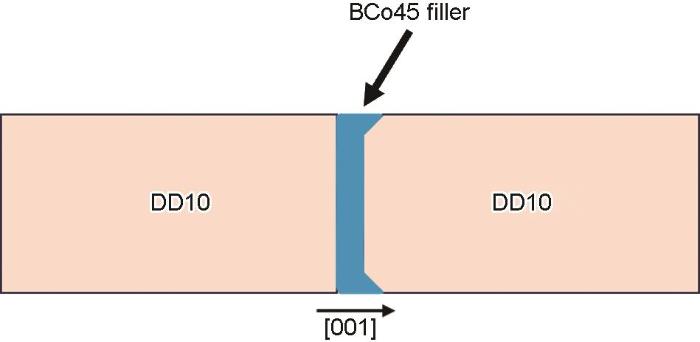
对试棒的固溶热处理制度为:1200 ℃/4 h + 1240 ℃/4 h + 1260 ℃/6 h 空冷(AC);一级时效制度为:1100 ℃/4 h (AC);二级时效制度为:870 ℃/24 h(AC)。热处理后试棒的显微组织如图1所示。(用超声气体雾化法制备的) BCo45粉末钎料的名义成分(质量分数,%)为:20Cr,20Ni,12W,2B,Co余量,颗粒度≤ 80 μm。钎料粉末的形貌,如图2a所示。用差示扫描量热法测定BCo45钎料的固相线为1122 ℃,液相线为1211 ℃,如图2b所示。DSC测试条件为:样品的质量61.49 mg,气氛为氩气,以10 ℃/min的速率升温至1300 ℃,再以10 ℃/min的速率降温至1000 ℃。将DD10试棒加工成直径为15.5 mm、长度为35 mm的圆柱型试样,用800#砂纸打磨待焊表面后用酒精超声清洗10 min。将粉末钎料与粘结剂混合后按图3装配入炉。以10 ℃/min的速度将炉温升至钎焊温度1220 ℃,(保温)钎焊15 min后随炉冷却。钎焊后接头的热处理制度,与母材的相同。
图1
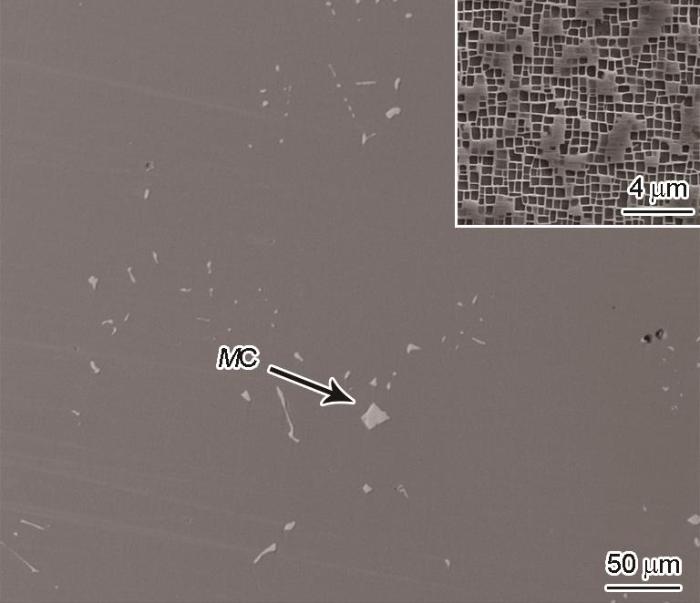
图2
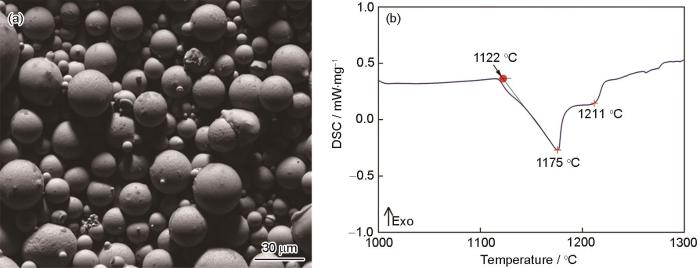
图3
用4 g CuSO4 + 20 mL HCl + 20 mL H2O腐蚀液蚀刻抛光后的钎焊试样。用Tescan CLARA场发射扫描电镜(SEM)表征接头的显微组织,并用配套的能谱仪(EDS)和JXA-Ihp200f场发射电子探针(EPMA)进行微区成分分析。用Smart Lab型X射线衍射仪(XRD)鉴定接头中的析出相,测试断口的XRD谱。用JEM-2100Plus型透射电子显微镜(TEM)进行选区电子衍射分析。用电解双喷法减薄制备TEM样品,电解液是10%HClO4与90%C2H5OH混合液,用液氮冷却,电解电压20 V,温度-20 ℃;使用695.C型离子减薄仪进一步减薄制备出TEM样品。根据GB/T228.1-2021和GB/T228.2-2015,使用INSTRON5582万能试验机进行室温与950 ℃高温拉伸试验,每组3个试样,取其平均值为实验结果。
2 实验结果
2.1 钎焊接头的显微组织
图4
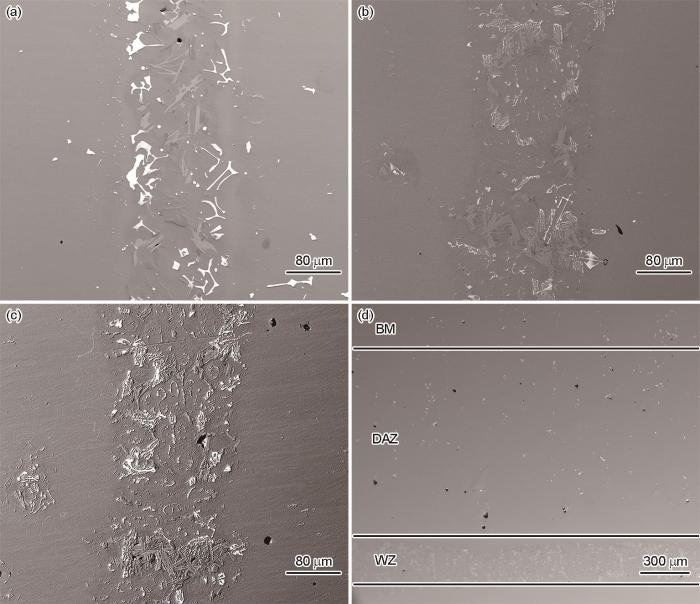
图4
DD10合金钎焊接头的微观组织
Fig.4
Microstructure of DD10 alloy brazed joint (a) before heat treatment, (b) without etching, (c) after etching, (d) joint zoning
图5给出了钎焊接头的EPMA面扫描元素分布,图6和表1分别给出了钎焊接头的局部组织和各相的EPMA定量结果。EPMA分析表明,在1220 ℃/15 min钎焊和热处理后,焊缝中基体(图6 A点)与DAZ(图6 B点)的Co、Cr、Ti元素分布基本相同,元素发生了充分扩散。EPMA定量分析(表1)确定了组成焊缝区的3种析出相:白色块状相(图6 D点)呈现典型的MC型碳化物特征(Ti0.57Ta0.43C),其碳含量为40%~45%;白色骨架状相(图6 E点)成分分析(Cr 32%,W 14%)确认为M3B2型硼化物(W0.74Ti0.20Ni0.34Cr1.72B2);而黑色相(图6 F点)则因其高Cr含量(57%)和低W含量(1.8%)确定为M5B3型硼化物(Cr4.91Mo0.09B3)[19]。
图5
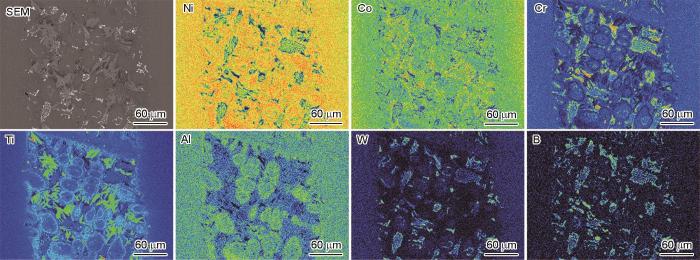
图5
1220 ℃/15 min DD10合金钎焊接头中元素的分布
Fig.5
Element distribution in DD10 superalloy brazed joint at 1220 oC for 15 min
图6
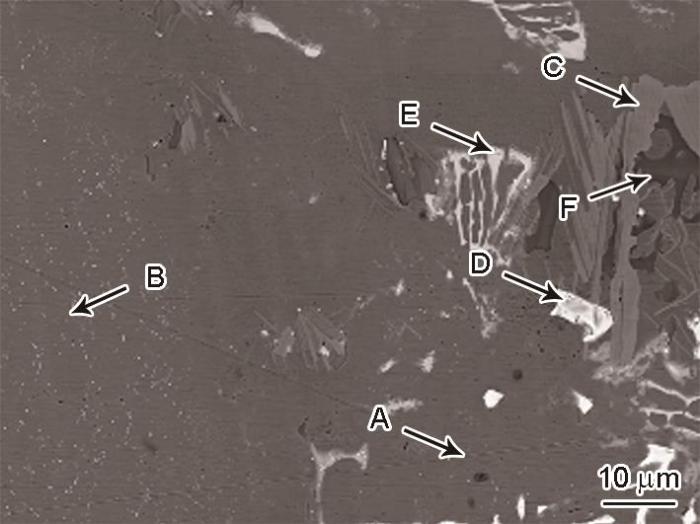
表1 图6中各点的EPMA分析结果
Table 1
| Position | Ni | Co | Cr | Ti | Al | W | Ta | Mo | C | B |
|---|---|---|---|---|---|---|---|---|---|---|
| A | 59.24 | 10.76 | 12.61 | 6.71 | 6.92 | 1.32 | 1.32 | 0.19 | 0.92 | 0.00 |
| B | 58.26 | 12.03 | 15.28 | 4.72 | 6.02 | 1.58 | 0.99 | 0.22 | 0.60 | 0.00 |
| C | 64.37 | 8.65 | 2.89 | 14.21 | 4.57 | 0.82 | 3.39 | 0.06 | 1.05 | 0.00 |
| D | 2.86 | 0.29 | 1.90 | 25.57 | 0.02 | 7.85 | 19.62 | 0.22 | 41.31 | 0.35 |
| E | 6.52 | 3.40 | 32.59 | 3.90 | 0.00 | 14.03 | 2.05 | 2.59 | 0.00 | 34.91 |
| F | 2.92 | 1.86 | 56.90 | 1.73 | 0.10 | 1.79 | 0.14 | 1.03 | 0.00 | 33.53 |
图7
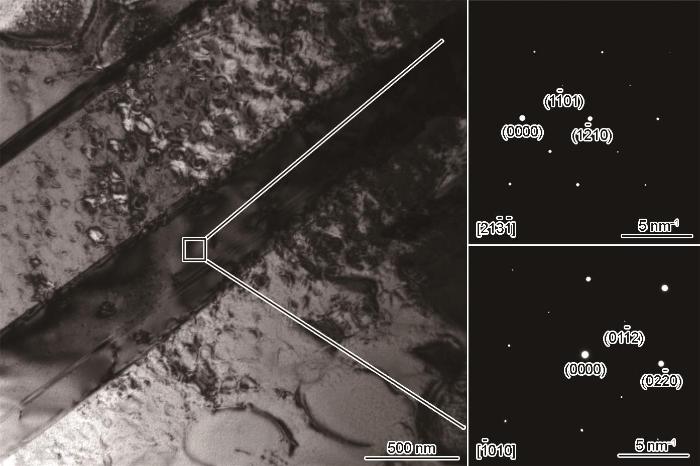
图7
Ni3Ti相的TEM和选区电子衍射图像
Fig.7
TEM and selected-area electron diffraction (SAED) patterns of Ni3Ti
图8
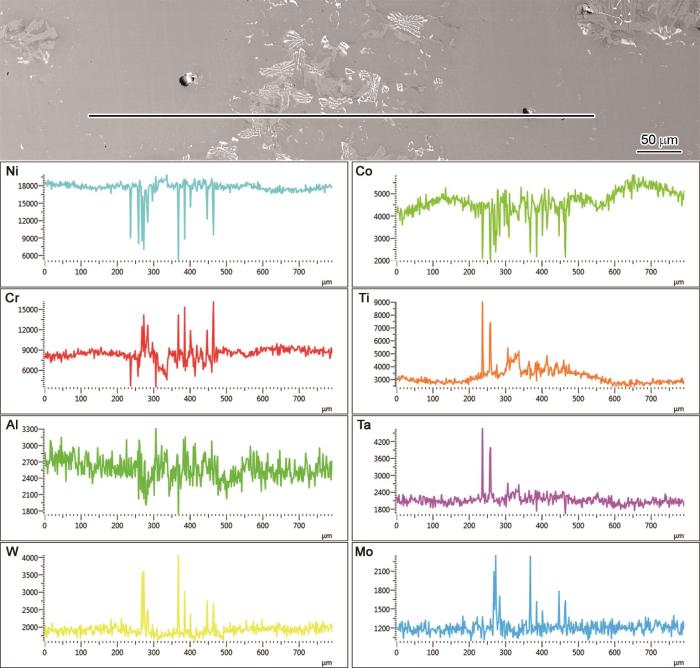
图8
热处理后的钎焊接头和基体线扫描元素分布
Fig.8
Elemental line-scanning profiles across the brazed joint and base metal after heat treatment
从图9可见,在基体扩散影响区形成了熔池组织。EPMA面扫描分析结果表明,在该区域出现了显著的Ni、Al贫化和Co、Ti、W、B富集,组织的构成与焊缝相同。焊后热处理使B元素扩散到该区域,使局部熔点降低并与基体元素反应生成了硼化物,最终形成熔池组织。Co元素在该区域的扩散呈现出明显的各向异性:虽然其整体扩散速度较低,但是邻近焊缝的熔池组织显著促进了Co元素向基体扩散,扩散距离远超其他区域,表明该组织具有“扩散岛”效应[21]。这些熔池组织的尺寸分布范围较广(数微米至数百微米),在距焊缝1000 μm处仍能观察到熔池组织,可见B元素的扩散距离可达1000 μm。这表明,除了在焊缝区生成了硼化物,热处理还使B元素向母材扩散。
图9
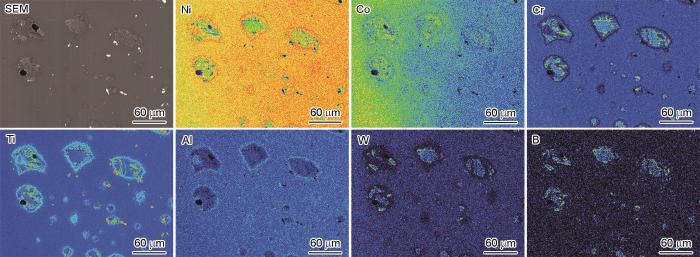
图9
扩散影响区内的熔池组织及其元素分布
Fig.9
Morphology and composition mapping of the molten pool in the DAZ
2.2 钎焊接头的力学性能和断口分析
表2 热处理后钎焊接头的断裂强度
Table 2
| Sample | Temperature | Rm / MPa |
|---|---|---|
| 1 | Room temperature | 606 |
| 2 | 893 | |
| 3 | 908 | |
| 4 | 950 oC | 531 |
| 5 | 567 | |
| 6 | 486 |
图10
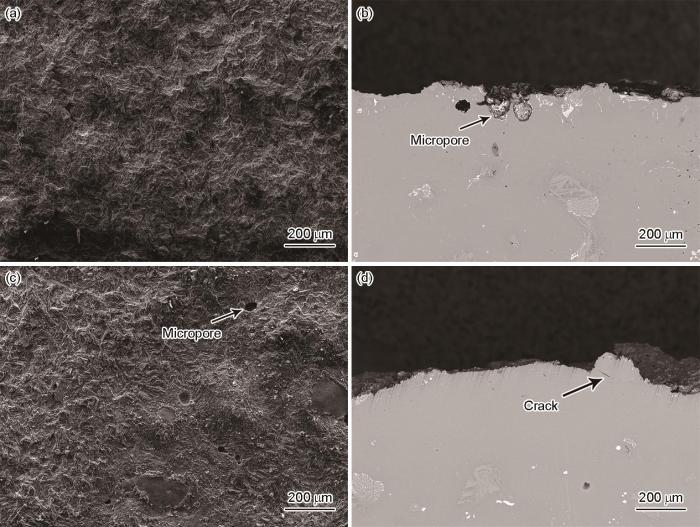
图10
钎焊接头断口的形貌
Fig.10
Fracture morphology of brazed joints (a) room temperature fracture surface, (b) cross-sectional view of room temperature fracture, (c) 950 oC high-temperature fracture surface, (d) cross-sectional view of 950 oC fracture
图11
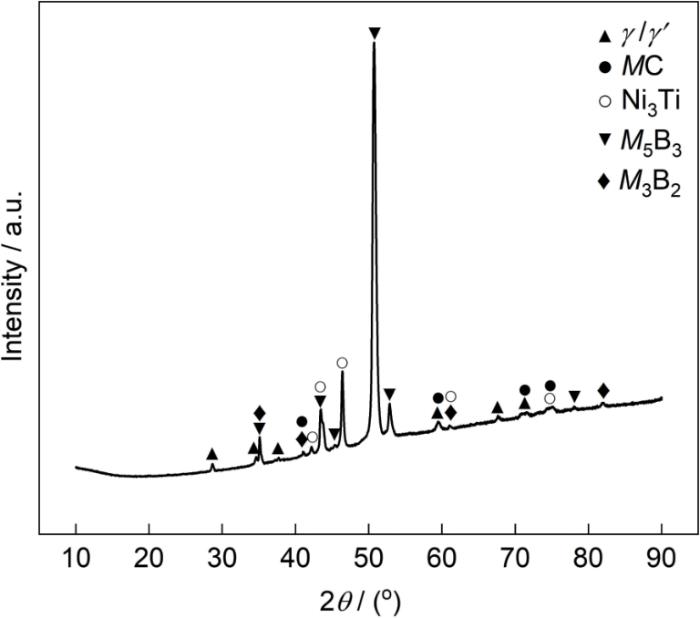
图11
钎焊接头断口的XRD谱
Fig.11
XRD pattern of the fracture surface of the brazed joint
3 讨论
钎焊时,升温达到1122 ℃时钎料融化形成液相,随着温度的提高钎料加快熔解。液相钎料在毛细作用下填充到钎焊间隙中。从图4a可见,焊缝与母材之间未出现明显的界面,表明在钎焊过程中发生了等温凝固。在钎焊的保温阶段,钎料与母材间因浓度梯度而发生元素的互扩散,液相钎料中的轻元素B扩散到钎料/母材的L/S界面母材一侧,降熔元素(Melting point depressant element, MPD) B使母材的熔点降低而熔为液相。当降熔元素在液固两相内的浓度达到相图上的平衡浓度时母材的熔解至最大宽度,液相中的浓度也是母材熔解稀释MPD所能达到的最低极限浓度[23]。扩散使焊缝间隙内B元素的浓度降低和钎料的熔点升高,当液体的平衡熔化温度达到接合温度时开始等温凝固[24]。在近母材区域,先在母材表面形核、凝固,L/S界面向液相中心线推进。由于L/S界面在此过程中不存在过冷,元素不会发生非平衡偏聚而生成第二相,因此等温凝固生成的相是固溶体单相[25,26]。但是,钎焊时保温时间只有15 min,接头中生成了大量析出相(图4a),表明等温凝固没有完成。保温结束后,随着温度的降低液相中先析出γ相,随后正偏析元素Cr、B和Ta、Al、Ti、C (来自母材熔解及扩散)逐渐在液相中富集。当这些元素的活度达到一定值时,发生共晶反应生成MC型碳化物和硼化物。特别是,Cr与B的强结合性使富Cr型硼化物优先生成。由于母材中少量的C扩散道焊缝,生成MC型碳化物后过剩的Ti元素在液相富集。Ti的浓度超过Ni3Ti相的溶解极限时,则生成Ni3Ti相。由于保温时间仅为15 min的钎焊过程中B元素的扩散距离极小,因此在钎焊接头中并未观察到明显的扩散影响区。
热处理时最高可达1260 ℃的固溶温度使焊缝发生重熔,这个过程类似于对焊缝再次进行TLP连接。根据Tuah-Poku等[27]推导的传统TLP等温凝固时间
非稳态扩散遵循Fick第二定律,扩散速率受扩散元素浓度的影响。例如,B在Ni中的溶解度在1125 ℃为0.032%,而在1225 ℃下降到0.021%。溶解度的降低使扩散浓度降低,从而延长了等温凝固的时间[31]。在等温凝固过程中,如果两种元素的固溶度和扩散系数差异较大,则总等温凝固时间主要由扩散较慢的元素控制。其原因是,在高温下母材的熔解和元素扩散将更多的母材元素带入液相中,从而延长了等温凝固时间。但是,尽管在固溶阶段等温凝固有足够的时间,但是以上原因的综合作用使等温凝固并未在固溶阶段完成。因此,固溶阶段结束后在冷却过程中在残留的液相中析出了共晶相。
在时效过程中B继续向母材扩散,但是时效温度不足以使焊缝重熔,因此发生析出相的转变。Ojo等[33]研究Ni-Cr-B在1130 ℃焊接IN738LC合金时发现,焊缝/母材界面处生成了复杂面心结构的Cr-Mo-W碳硼化物。另外,在硼化物中几乎不溶解的Al和Ti在焊缝与扩散影响区的硼化物周围发生富集。Al和Ti无法进入硼化物晶体结构中而被排挤到硼化物的周围区域,形成焊缝和熔池组织。
4 结论
使用BCo45钎料可钎焊DD10合金单晶合金,接头中的析出相有M3B2、M5B3、MC和Ni3Ti。焊后的热处理使接头中的元素显著扩散,Co、Cr、W和B元素向基体扩散,而Ti、Al、Ta等元素向焊缝扩散。B元素的充分扩散,使扩散影响区局部的熔点降低形成熔池组织。
参考文献
Mechanism and optimization methods of gas turbine cooling structures
[D].
燃气轮机透平冷却结构作用机制与设计优化方法
[D].
Status and prospect of heavy duty gas turbine
[J].
重型燃气轮机发展现状及展望
[J].
Status and development trend of the heavy duty gas turbine
[J].
重型燃气轮机现状与发展趋势
[J].
Present situation and development trend of heavy duty gas turbine
[J].
重型燃气轮机现状与发展趋势
[J].
Review of gas turbine power generation technology
[J].
燃气轮机发电技术综述
[J].
Quantitative investigation of the effects of CR, EGR and spark timing strategies on performance, combustion and NOx emissions characteristics of a heavy-duty natural gas engine fueled with 99% methane content
[J].
Microstructure and properties of hot corrosion resistant nickel base single crystal superalloy DD10
[D].
抗热腐蚀镍基单晶高温合金DD10组织与性能的研究
[D].
Brazing process of high temperature brazing filler metal BCo45NiCrWB
[J].
BCo45NiCrWB高温钎料的钎焊工艺性能
[J].
Brazing of Ni-based single crystal superalloy with high carbon content γ layer
[J].
Microstructure evolution and interfacial formation mechanism of wide gap brazing of DD5 single crystal superalloy
[J].
Ni-based single-crystal superalloy DD5 has excellent high temperature properties, which is the preferred raw material for aero-engine turbine blade in recent year. In this research, DD5 superalloy was brazed by different contents of Ni-Co-Cr-W-B+DD99 mixed powder filler alloy. The microstructure evolution and interfacial formation mechanism of DD5 superalloy brazing joint were analyzed by SEM and EPMA. The mechanical properties of joint after solid solution treatment and aging treatment were tested. The results show that γ-Ni primary phase formed firstly in the Ni-Co-Cr-W-B/DD99 interface during the brazing process, and then B element segregated and precipitated to fine granular M3B2 type boride. The residual liquid phase solidified and formed lastly to the M3B2 phase, γ+γ′ eutectic phase and γ-Ni+Ni3B+CrB eutectic phase during cooling. With increasing the ratio of DD99 in mixed powder filler alloy, the low melting point eutectic phase and borides in the joint decrease and the uniformity of composition and microstructure of joint improve. When the ratio of DD99 increased to 70% (mass fraction) in the mixed powder filler alloy, it can be observed that element of B diffused to DD99 additive powder which result ed in the decrease of low melting point eutectic phases and brittle compounds. The high temperature tensile properties of joint is 1010 MPa at 870 ℃.
DD5单晶高温合金大间隙钎焊的组织演变与界面形成机制
[J].
Uncovering the high-temperature microstructural evolution and creep-fatigue damage mechanism of CMSX-4 brazed joints
[J].
Microstructures and mechanical behaviors of Ni-based single-crystal superalloy DD90 joints brazed with a Co-based interlayer
[J].
Fast epitaxial brazing of DD6 single crystal superalloy using novel NiCoCrAlNbTi high entropy filler alloy
[J].
High-performance brazing of single crystal superalloys with Ni-Cr-Ta filler material
[J].
Microstructural evolution of a Ni-base alloy DZ468 joint bonded with a new Co-base filler
[J].<p>Ni-base alloy DZ468 has been joined by transient liquid phase bonding technique with a newly developed Co-based filler. The microstructures of the Co-base filler and the joint, the effects of heat treatment on microstructure and hardness of the joint have been investigated by various experimental methods. Results show that the Co-base filler consists of γ, <em>M</em><sub>2</sub>B, <em>M</em><sub>5</sub>B<sub>3</sub> and <em>M</em><sub>23</sub>B<sub>6</sub> phases. Because of the interdiffusion between the base metal and the filler, γ, <em>M</em>C, <em>M</em><sub>5</sub>B<sub>3</sub> and <em>M</em><sub>23</sub>B<sub>6</sub> phases are formed in the bonding zone. And localized liquidation of substrate occurs in the diffusion affected zone, with <em>M</em>C and <em>M</em><sub>3</sub>B<sub>2</sub> precipitating in this area. During heat treatment, the volume of the intermetallic phases in the bonding zone resulting from incomplete isothermal solidification decreases obviously. On the contrary, the width of the diffusion affected zone increases at the solution stage and subsequently decreases at the aging stages.</p>
Microstructure and mechanical properties of wide-gap brazed joints of K465 alloy using cobalt-base brazing alloy
[J].
钴基钎料钎焊K465合金大间隙接头组织与性能
[J].
Vaccum brazing of a directionally solidified Ni3Al-base superalloy IC6A
[J].
定向凝固Ni3Al基高温合金IC6A的真空钎焊
[J].
Study of Ni-Cr-Co-W-Mo-B interlayer alloy and its bonding behaviour for a Ni-base single crystal superalloy
[J].
Effect of bonding time on the microstructure and isothermal solidification completion during transient liquid phase bonding of dissimilar nickel-based superalloys IN738LC and Nimonic 75
[J].
Microstructure and mechanical property of the second-generation single-crystal superalloy DD6 joint
[J].
第二代单晶高温合金DD6高性能钎焊接头的组织及力学性能
[J].采用新设计的镍基钎料在1220℃、30 min条件下钎焊了第二代单晶高温合金DD6,分析了不同钎缝间隙(0.05、0.10和0.15 mm)对接头组织和性能的影响。结果表明,新镍基钎料获得的DD6高温合金钎焊接头的钎缝基体为与DD6母材相似的γ + γ′双相组织。随钎缝间隙的增大,脆性硼化物相逐渐增多,且由断续条状转变成粗大的鱼骨状;在0.15 mm间隙内预填FGH95高温合金粉末后,鱼骨状硼化物相变得细小、弥散。当钎缝间隙由0.05 mm增至0.10 mm,内部γ + γ′双相组织更细小,且钎缝中γ′相强化元素Al、Ti、Ta的总量高,对接头起到了良好的强化作用,钎焊接头在980℃的高温拉伸强度为694 MPa。按DD6母材标准热处理制度对钎缝间隙为0.10 mm的钎焊接头进行焊后时效处理,钎缝基体组织中的γ + γ′双相组织形貌得到有效调控,γ′立方化程度增加,接头在980℃的高温拉伸强度为807 MPa,与DD6母材自身的强度相当。
Effect of gap size and process parameters on diffusion brazing of Inconel 738
[J].The influence of gap size and brazing parameters (temperature and time), on the microstructure and properties of diffusion-brazed Inconel 738 (IN-738) superalloy, was investigated using two commercial brazing alloys, Amdry ‘DF3’ and Nicrobraz 150. The residual liquid present at brazing temperature was observed to transform on cooling into centreline eutectic constituents in ‘NB 150’ brazement while three different dispersed intermetallic phases were observed in the ‘DF3’ joint. The volume fraction of the second phases increased with gap size in both ‘NB 150’ and ‘DF3’ brazements. In addition to the centreline eutectic constituents, nickel and chromium rich borides were observed at the melt back zone in samples brazed below the Ni3B eutectic temperature of 1093°C, and above this temperature only chromium rich borides were observed. Joints containing the second phase intermetallics in ‘NB 150’ and ‘DF3’ brazed materials were found to exhibit tensile properties inferior to that of the base alloy.
Characteristics of isothermal solidification stage and analytical solutions for the stage in transient liquid phase bonding process
[J].
液相扩散焊等温凝固阶段的特征及解析解
[J].
Solidification and solid state phenomena during TLP bonding of IN718 superalloy using Ni-Si-B ternary filler alloy
[J].
Microstructural development in transient liquid-phase bonding
[J].
Phase transformations during diffusion brazing of IN718/Ni-Cr-B/IN718
[J].The production of robust joints after diffusion brazing necessitates the advanced understanding of phase transformations during the bonding process. This paper aims to investigate the solidification and the solid state precipitation during diffusion brazing of wrought IN718 nickel base superalloy using Ni–15Cr–4B (wt-) filler alloy. It was found that intermetallics containing eutectic type microconstituents were formed in the joint centreline by solidification which is controlled by segregation behaviour of B and its low solubility in Ni rich solid solution. In addition, extensive Cr–Mo–Nb rich precipitates were formed in the substrate region by solid state precipitation induced by B diffusion into base metal. The implications of the phase transformations on the joint properties are discussed.
A study of the transient liquid phase bonding process applied to a Ag/Cu/Ag sandwich joint
[J].
Effect of bonding temperature on microstructure development during TLP bonding of a nickel base superalloy
[J].
High temperature diffusion induced liquid phase joining of a heat resistant alloy
[J].
Influence of process parameters on microstructure of transient liquid phase bonded Inconel 738LC superalloy with Amdry DF-3 interlayer
[J].
Diffusion brazing in the nickel-boron system
[J].
Microstructural evolution in the transient-liquid-phase bonding area of IN-738LC/BNi-3/IN-738LC
[J].
Isothermal solidification during transient liquid phase bonding of Inconel 738 superalloy
[J].An investigation was carried out on transient liquid phase brazing of IN-738 superalloy with Ni–Cr–B filler. Conventional models used to model the Transient Liquid Phase (TLP) bonding process assume that boride precipitation does not occur during the joining process. However, a significant deviation from this assumption was observed in all brazed samples as extensive intragranular and intergranular precipitation of chromium and boron rich particles was observed to occur within the base alloy in regions beside the braze/ base metal interface. Application of two diffusion models to the isothermal solidification stage was successful in reasonably predicting the time required to achieve complete isothermal solidification of the liquid insert, which is vital in preventing the formation of deleterious centreline eutectic. Diffusion analysis showed that the boron rich particles formed as a result of substantial solute diffusion into the base metal before equilibration of the liquid–solid phases.


