



高速飞行器在巡航和重返大气层的过程中受到严重的气动加热,其热防护部件在高温有氧条件下发生长时间的氧化烧蚀[1]。C/SiC复合材料具有良好的热稳定性、耐高温性、抗氧化性以及优异的力学和耐烧蚀性能[2,3]。在有氧环境中,材料表面生成的致密二氧化硅玻璃层使其长期使用温度可达1650 ℃。但是,在高于1650 ℃的低氧分压条件下SiC由被动氧化转变为主动氧化,氧化膜的热稳定性急剧下降,玻璃保护层的大量挥发导致材料的结构严重损伤[4,5]。用碳纤维、界面和陶瓷-金属基体制备的C/SiC-Cu是一种新型防热复合材料,在高温热环境中低熔点和高相变潜热的Cu蒸发时带走大量热量且其表面生成的玻璃氧化膜能抵抗氧化冲蚀,使其在2200~2500 ℃的超高温长时有氧条件下具有零烧蚀特性[6]。值得注意的是,在用反应熔渗法制备C/SiC-Cu复合材料时,其界面相为热解碳(PyC)。在高温反应熔渗过程中,过薄的PyC界面与Cu-Si合金反应而丧失保护作用,导致部分碳纤维刻蚀而使制备出的复合材料力学性能降低。相反,过厚的PyC界面虽能保护碳纤维并显著提高其力学性能,却不利于材料的耐烧蚀性能[7,8]。
本文以硼酸和尿素为原料用一步焙烧法制备h-BN粉体,研究原料配比和氮化温度对h-BN产物的纯度和结晶度的影响以及反应机理,并研究h-BN与Cu-Si合金之间的润湿性和h-BN结晶度对润湿性的影响。
1 实验方法
1.1 BN粉体的合成
以硼酸(H3BO3,分析纯)为硼源,尿素((CO(NH2)2,分析纯)和氮气(纯度为99.5%)为氮源制备六方氮化硼粉体。用玛瑙研钵将一定比例的硼酸和尿素粉末充分研磨混合均匀后,置于氧化铝坩埚中并转移至高温炉内。在N2气氛中以5~10 ℃/min的升温速率加热至1000~1400 ℃保温2 h,冷却至室温得到焙烧产物。将硼酸和尿素的摩尔比为3∶1、2∶1、1∶2和1∶3的样品编号为PN31、PN21、PN12和PN13。在1400 ℃、1200 ℃和1000 ℃氮化制备的h-BN,分别记为BN1400、BN1200和BN1000。
1.2 性能表征
用D/Max-2500PC型X射线衍射(XRD)仪鉴定样品的物相,用Labram HR800型激光拉曼光谱仪分析其结晶度,用ESCALAB250型X射线光电子能谱(XPS)仪测定样品的元素组成和原子成键情况,用STA449-F5型热重-差热(TG-DTA)综合分析仪监测合成过程中样品的质量变化和热效应,用FEI Talos F200x型透射电子显微镜(TEM)观察样品的精细微观结构。
用TA-Z16B01型高温接触角测试仪和座滴法测定h-BN与Cu-Si合金之间的接触角。将Cu-Si合金粉末压制成直径为5 mm的圆柱状试样,并将其放置在涂覆h-BN的基板上。该涂覆h-BN基板的制备流程如下:首先,将所合成的h-BN粉体分散于无水乙醇中制得稳定的浆料;随后,将该浆料均匀涂覆于石墨基板表面,经室温静置使乙醇完全挥发,最终在基板表面获得一层连续且致密的h-BN。将装配好的试样置于高温管式炉腔内以5~10 ℃/min的升温速率加热至1450 ℃保温30 min。在整个过程中实时记录h-BN与Cu-Si合金熔体液滴之间的接触角(θ)随时间(t)的动态变化。
2 结果和讨论
2.1 硼酸-尿素摩尔比对 h-BN纯度的影响
图1给出了在1000 ℃和1200 ℃保温2 h不同摩尔比的硼酸-尿素h-BN的XRD谱。从图1a可见,标准h-BN的最强衍射峰出现在2θ ≈ 26.7°,对应(002)晶面。硼酸与尿素的摩尔比为3∶1和2∶1的谱中除在2θ ≈ 26.5°出现衍射峰外,还在2θ ≈ 21.7°处出现了杂峰。其原因是,尿素用量的不足使硼酸不能完全转化为氮化硼,残留在样品中的剩余硼酸或其脱水产物(如B2O3)引起杂峰。硼酸与尿素摩尔比为1∶2的样品在2θ ≈ 25.7°处的衍射峰强度较高,半高宽较小,且无杂峰,表明制备出的h-BN纯度较高。硼酸与尿素的摩尔比进一步提高至1∶3,谱中衍射峰的强度降低,半高宽增大,且最强峰位置偏移至2θ ≈ 24.9°,与标准谱的差异显著,表明h-BN的降低。氮化温度为1200 ℃,硼酸与尿素摩尔比对h-BN纯度的影响,与氮化温度为1000 ℃时的变化趋势(图1a)相同。这表明,合成纯度较高六方氮化硼的最佳硼酸与尿素的摩尔比为1∶2。
图1
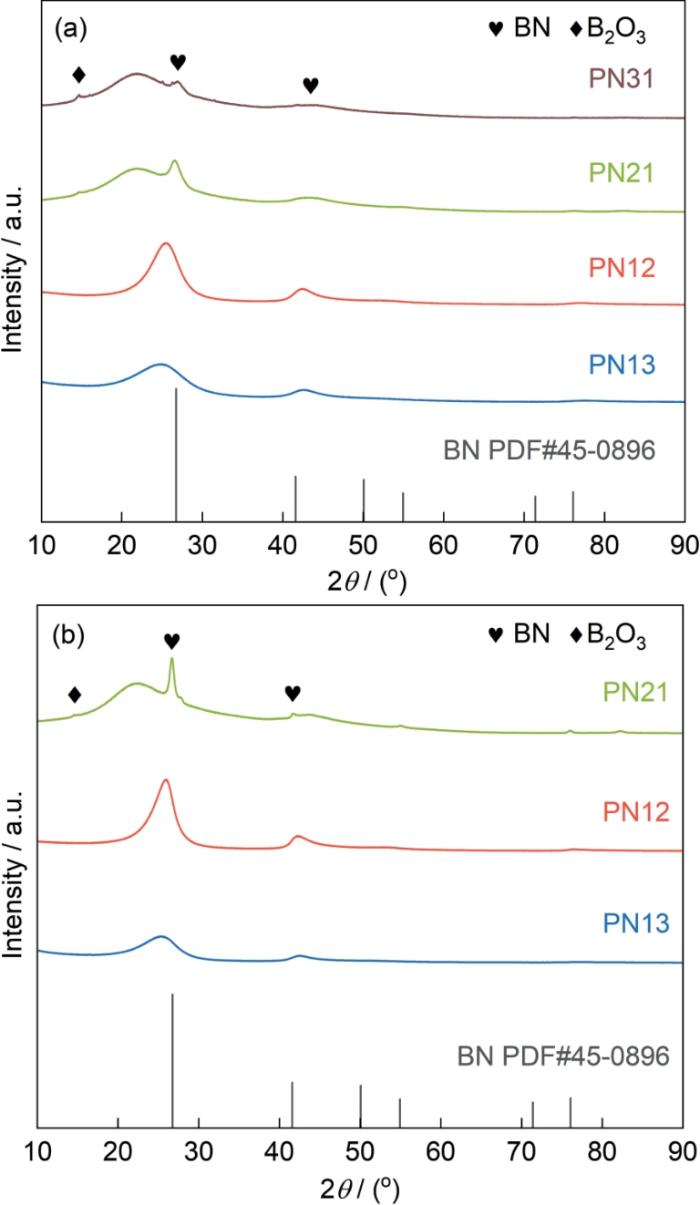
图1
氮化温度为1000 ℃和1200 ℃,用不同摩尔比的硼酸-尿素制备的h-BN的XRD谱
Fig.1
XRD patterns of h-BN products from urea and boric acid with different molar ratios at 1000 oC(a) and 1200 oC (b)
2.2 氮化温度对 h-BN结晶度的影响
图2给出了硼酸与尿素摩尔比为1∶2,在不同温度氮化制备出的h-BN样品的XRD谱。可以看出,在氮化温度为1400 ℃样品的谱中2θ ≈ 26.5°处出现一个尖锐的衍射峰,对应h-BN的(002)晶面;在2θ ≈ 42°、55°和76°也出现了清晰的衍射峰,表明h-BN的结晶度较高。相比之下,氮化温度为1200 ℃和1000 ℃的谱中(002)晶面衍射峰的位置分别向低角度偏移至2θ ≈ 26.1°和2θ ≈ 25.7°,且衍射峰强度减弱、半高宽增大,表明合成的h-BN结晶度较低。
图2

图2
在不同氮化温度制备的h-BN样品的XRD谱
Fig.2
XRD patterns of h-BN samples prepared at different nitridation temperatures
图3给出了硼酸与尿素摩尔比为1∶2、氮化温度不同的h-BN样品的拉曼光谱。可以看出,谱中h-BN的拉曼特征峰位于约1370 cm-1处,归属于面内B-N键振动引起的E2g模式。随着氮化温度从1400 ℃降至1000 ℃,特征峰逐渐向高波数方向移动且峰形有所宽化,表明h-BN的结晶度降低。
图3
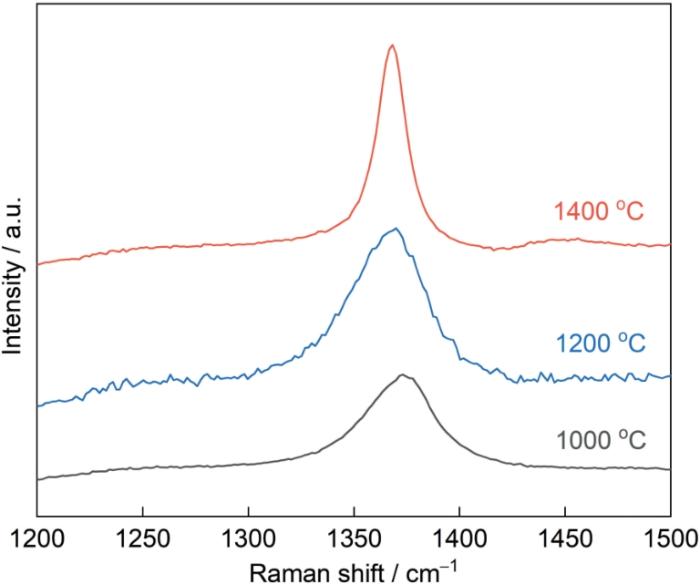
图3
在不同氮化温度制备的h-BN样品的拉曼光谱
Fig.3
Raman spectra of h-BN samples prepared at different nitridation temperatures
图4给出了在1400 ℃、1200 ℃和1000 ℃氮化制备的样品BN1400、BN1200和BN1000的XPS全谱。从图4可见,除了B和N元素,三种样品中还有C和O元素。C元素的峰可归因于样品表面吸附的污染碳,O元素峰则可归因于样品表面的吸附氧和B2O3等氧化物。图5给出了BN1400、BN1200和BN1000的B 1s、N 1s及O 1s精细谱的分峰拟合结果。对BN1400的B 1s谱分峰拟合得到两个特征峰(图5a),结合能分别为190.75 eV和191.71 eV,分别对应B-N键和B-O键;N 1s精细谱在398.44 eV的单一主峰(图5b)归属于N-B键;O 1s谱在533.00 eV处的单一主峰(图5c)归属于对应O-B键。BN1200的B 1s精细谱(图5d)可分峰拟合为190.63 eV和192.28 eV两个峰,分别归属于B-N和B-O键;N 1s谱(图5e)在398.28 eV处出现单一N-B峰;O 1s谱(图5f)则在533.00 eV处出现单一O-B峰。BN1000的B 1s精细谱(图5g)可分峰拟合为190.72 eV和192.69 eV两个峰,分别对应B-N和B-O键;N 1s谱(图5h)在398.31 eV处出现单一N-B峰;O 1s谱(图5i)在532.94 eV处出现单一O-B峰。上述分峰拟合结果表明,BN1400,BN1200和BN1000样品中除含有BN,还有少量的B2O3。由表1可知,BN1400中O元素的含量为7.61%,BN1200中O元素的含量为11.30%,而BN1000中O元素的含量高达17.98%,表明BN1000中B2O3的含量最高。B2O3以无定型态存在,与XRD谱(图2)和拉曼谱(图3)给出的结论一致,进一步表明提高氮化温度有助于提高h-BN的纯度。
图4

图4
三种h-BN样品的XPS全谱
Fig.4
XPS full spectra of h-BN samples (a) BN1400, (b) BN1200, (c) BN1000
图5
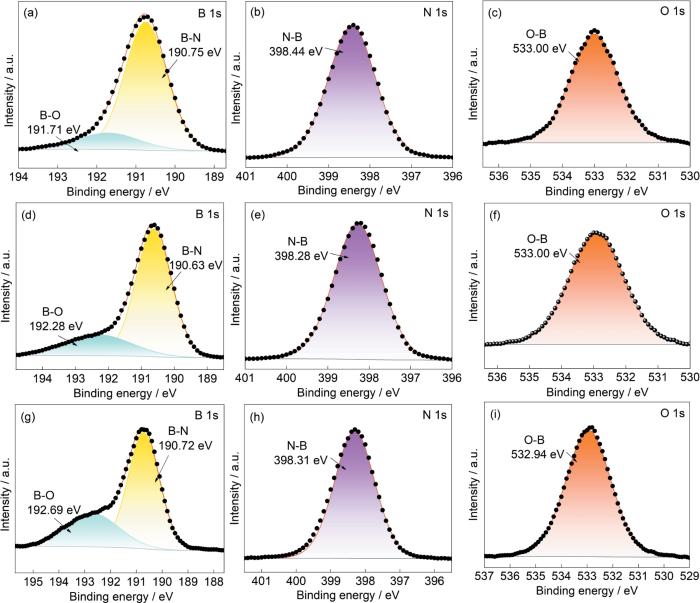
图5
BN1400, BN1200和BN1000样品的XPS精细谱
Fig.5
XPS fine spectra of BN1400 (a-c), BN1200 (d-f), and BN1000 (g-i) samples (a, d, g) B 1s, (b, e, h) N 1s, (c, f, i) O 1s
表1 对XPS全谱分析得到的元素组成
Table 1
| Sample | B | C | N | O |
|---|---|---|---|---|
| BN1400 | 46.24 | 10.41 | 35.74 | 7.61 |
| BN1200 | 48.46 | 8.26 | 31.98 | 11.30 |
| BN1000 | 45.03 | 11.95 | 25.04 | 17.98 |
图6给出了样品BN1400和BN1000的高分辨透射电子显微镜(HRTEM)照片和选区电子衍射(SAED)花样。根据沿a轴方向的平面尺寸(La)和沿c轴方向的堆叠厚度(Lc),可评估h-BN的结晶度。如图6a所示,在1400 ℃氮化制备的h-BN具有高度有序的晶体结构,其晶格条纹平直、排列规整,尺寸达60 nm,c轴方向的堆叠厚度超过25 nm。测得BN1400的(002)晶面间距d002 = 0.333 nm,与完全结晶h-BN的理论值相同。在BN1400的SAED花样中可清晰观察到(002)、(100)、(004)及(110)晶面的衍射环。这些衍射环连续且锐利,其中(002)和(004)晶面衍射环上斑点清晰可辨,进一步表明BN1400的结晶度较高。
图6

图6
BN1400和BN1000样品的HRTEM图像和SAED花样
Fig.6
HRTEM images and SAED patterns of BN1400 (a) and BN1000 (b) samples
2.3 h-BN的合成机理
图7
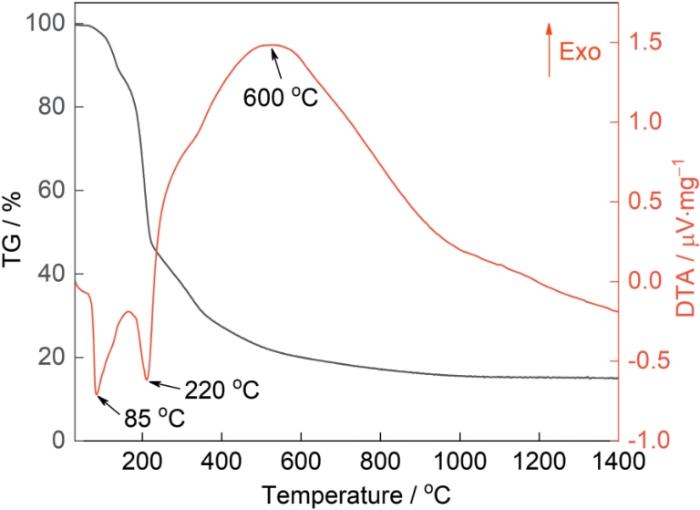
图7
摩尔比为1∶2的硼酸-尿素混合物的TG-DTA曲线
Fig.7
TG-DTA curves of the boric acid and urea mixture (molar ratio 1:2)
温度进一步升高氧化硼与氨气反应生成无定型氮化硼放出热量
并在DTA曲线的600 ℃附近出现放热峰。温度高于800 ℃后TG曲线趋于平缓,随着温度的升高和时间的延长无定形氮化硼逐渐转变为六方氮化硼。
2.4 h-BN结晶度对BN与Cu-Si合金润湿性的影响
图8给出了测试润湿过程中Cu-Si合金形貌的动态变化。可以看出,随着温度的升高Cu-Si合金依次经历固态、开始熔化、部分熔化和完全熔化三个阶段:温度低于1300 ℃时合金为初始固态形貌;温度高于1300 ℃后合金开始熔化,至1400 ℃以上完全熔化。在熔化过程中,合金的形状由圆柱形逐渐转变为球形,即使在1450 ℃的高温Cu-Si合金也未铺展在基板上,表明其与两种h-BN样品(BN1400和BN1000)都不润湿。
图8

图9

图9
Cu-Si合金与BN1400和BN1000之间的润湿曲线
Fig.9
Wetting curves of Cu-Si alloy on BN1400 (a) and BN1000 (b)
固-液-气三相界面张力与接触角之间的关系符合Young方程
其中γSV为固-气界面张力(即固体表面能),γSL为固-液界面张力,γLV为液-气界面张力(即液体表面张力),θ为固-液接触角。γSV远小于γLV时接触角θ大于90°,表现为不润湿行为。
3 结论
(1) 以硼酸和尿素为原料可制备h-BN粉体。在硼酸-尿素摩尔比为1∶2、氮化温度为1400 ℃条件下制备的h-BN的纯度和结晶度最高、晶体结构高度有序,晶格条纹高度平直、排列规整;而在1000 ℃合成的h-BN纯度和结晶度都较低,原子排列的有序度也较低,微观结构呈准各向同性特征且其晶格条纹扭曲和无序。
(2) 硼酸-尿素合成h-BN的反应分为四个阶段:在70~130 ℃区间硼酸分步脱水,在130~220 ℃尿素发生缩合与水解并释放氨气;温度高于220~380 ℃硼酸完全脱水生成氧化硼且聚脲进一步水解;在约600 ℃氧化硼与氨气反应生成无定形氮化硼;温度高于800 ℃无定形氮化硼转变为结晶完整的六方氮化硼。
(3) h-BN与Cu-Si合金的润湿性对其结晶度变化不敏感。h-BN的表面没有悬空键、表面能极低且在不同氮化温度合成的h-BN的本征表面属性相似,Cu-Si合金与两者都不润湿,在1450 ℃接触角稳定在~135°。
参考文献
Thermal protection systems for space vehicles: a review on technology development, current challenges and future prospects
[J].
High temperature C/C-SiC composite by liquid silicon infiltration: a literature review
[J].
Construction of sandwich-structured C/C-SiC and C/C-SiC-ZrC composites with good mechanical and anti-ablation properties
[J].
Ablation behavior of three-dimensional braided C/SiC composites by oxyacetylene torch under different environments
[J].
Effect of surface ablation products on the ablation resistance of C/C-SiC composites under oxyacetylene torch
[J].
Construction of C/SiC-Cu3Si-Cu interpenetrating composites for long-duration thermal protection at 2500 oC by cooperative active-passive cooling
[J].
Effect of pyrolytic carbon interface thickness on conductivity and mechanical and wear properties of copper mesh modified carbon/carbon composite
[J].
Fracture mechanical and ablation behaviors of C/SiC-Cu3Si-Cu interpenetrating composites and their dependence on metal addition and interface thickness
[J].
Wetting of ceramics by molten silicon and silicon alloys: a review
[J].
Wetting and adhesion of Si on Si3N4 and BN substrates
[J].
Silicon as a phase change material: performance of h-BN ceramic during multi-cycle melting/solidification of silicon
[J].
Silicon has recently been recognized as a potentially attractive phase change material for ultra-high-temperature latent heat thermal energy storage (LHTES) and conversion systems. It has been proposed that the utilization of silicon's latent heat should drastically increase the performance of LHTES devices in terms of operational temperatures and available energy density. Nevertheless, in order to ensure a high reliability and long lifetime of the system, proper ceramic materials that are able to withstand contact heating and cooling cycles during consecutive melting/solidification steps need to be examined and selected. Previously, we have documented that hexagonal boron nitride (h-BN) is the only ceramic that shows non-wettability and limited reactivity in contact with molten silicon at temperatures up to 1650 degrees C. In this work, we present for the first time the results of experimental research on the performance of a Si/h-BN system upon cycling melting/solidification processes. For this reason, the Si/h-BN couple was subjected to a sessile drop experiment containing 15 cycles of heating/cooling between 1300 degrees C and 1450 degrees C. During the test, temperatures of specific events as well as contact angle values were recorded. After the test, the structure and surface morphology of the solidified Si/h-BN couple were characterized by means of scanning electron microscopy.
Wetting behavior and reactivity of molten silicon with h-BN substrate at ultrahigh temperatures up to 1750 oC
[J].
Interfacial zone in continuous fiber-reinforced ceramic composites
[J].
纤维增韧碳化硅陶瓷基复合材料的界面区研究
[J].
Advances in boron nitride interphases in ceramic matrix composites
[J].
陶瓷基复合材料中氮化硼界面相研究进展
[J].
Preparation and oxidation behaviors of C/SiC-BN composites
[J].
C/SiC-BN复合材料的制备及氧化行为
[J].
Effects of h-BN particles on the structure, oxidation behaviour, and kinetics of C/C composites fabricated via CVI
[J].
Oxidation behavior of carbon/carbon-boron nitride composites fabricated by additives and chemical vapor infiltration
[J].
Dip-coating of boron nitride interphase and its effects on mechanical properties of SiCf/SiC composites
[J].
Synthesis of nanostructural turbostratic and hexagonal boron nitride coatings on carbon fiber cloths by dip-coating
[J].
Mechanical and microwave dielectric properties of SiCf/SiC composites with BN interphase prepared by dip-coating process
[J].
Vapour pressure and standard enthalpy of sublimation of H3BO3
[J].
Synthesis of boron nitride coatings on quartz fibers: thickness control and mechanism research
[J].
Three dimensional hexagonal boron nitride nanosheet/carbon nanotube composites with light weight and enhanced microwave absorption performance
[J].
Structure, properties and applications of two-dimensional hexagonal boron nitride
[J].
Graphene, hexagonal boron nitride, and their heterostructures: properties and applications
[J].
Surface tension and density measurement of liquid Si-Cu binary alloys
[J].


