



高温合金的类型、晶粒取向、组织和温度等因素影响合金中疲劳裂纹的扩展路径。高温合金中疲劳裂纹的扩展路径可分为晶体学扩展模式和非晶体学扩展模式[4,5]。晶体学扩展模式的裂纹其扩展方向取决于晶粒取向,沿着{111}<110>滑移系的{111}面扩展[6~11];而非晶体学扩展模式的裂纹,其扩展模式不取决于晶粒状态,某些合金中裂纹的扩展模式还可能发生转换[9,12]。影响裂纹非晶体学模式扩展的因素很多,如碳化物、晶界等。碳化物的强度高、塑性低,疲劳变形过程中产生的位错在碳化物和基体的界面塞积使碳化物开裂或脱粘而降低合金的疲劳寿命[13,14]。碳化物引起的应力集中以及自身的开裂会加速合金中疲劳裂纹的扩展[15~18]。此外,裂纹扩展路径还受碳化物分布的影响。枝晶干的组织致密、结合强度高,而枝晶间和晶界有较多强度较低的碳化物和共晶组织,因此裂纹倾向于通过枝晶间和晶界扩展[19,20]。
目前,关于Ta元素对疲劳裂纹扩展速率影响的研究较少,对定向合金在不同温度的疲劳裂纹扩展也缺少深入的研究。本文研究在室温、450 ℃和900 ℃下Ta含量对定向合金DZ411疲劳裂纹扩展的影响及其机理。
1 实验方法
表1 不同Ta含量DZ411合金板的化学成分
Table 1
| Alloy | Al | Co | Cr | Mo | Ta | Ti | W | B | C | Ni |
|---|---|---|---|---|---|---|---|---|---|---|
| 3Ta | 3.24 | 9.53 | 13.85 | 1.50 | 3.0 | 4.90 | 3.79 | 0.01 | 0.10 | Bal. |
| 3.5Ta | 3.20 | 9.54 | 13.87 | 1.49 | 3.5 | 4.87 | 3.80 | 0.01 | 0.10 | Bal. |
| 4Ta | 3.19 | 9.52 | 13.86 | 1.49 | 4.0 | 4.86 | 3.79 | 0.01 | 0.10 | Bal. |
图1

在常压下对合金进行标准热处理,热处理制度为:1220 ℃/2 h,空冷(AC) + 1120 ℃/2 h,AC + 850 ℃/24 h,AC。
图2

图2
用于不同温度CT试样的图纸
Fig.2
CT specimen drawing (a) room temperature CT specimen, (b) high temperature CT specimen
式中da/dN(mm/cycle)为裂纹扩展速率,a为裂纹长度(mm),N为循环次数,ΔK为应力强度因子范围(MPa·m0.5),C和m为裂纹扩展参数,参数n无量纲。
用配备Oxford X-max能谱仪的MIRA3 TESCAN场发射扫描电子显微镜(SEM)观察合金的热处理态组织、断口形貌以及断口附近的晶粒取向。将热处理后的样品机械抛光后用SEM观察MC碳化物的形貌,用放大倍数为200倍的至少5张图像计算MC的体积分数;将试样用王水甘油电解腐蚀(30 mL HCl + 10 mL HNO3 + 40 mL C3H8O3, 4 V/10 s)后观察γ′相,并用γ′相粒子的面积与所在矩形框的面积之比表征立方度。用无水乙醇超声清洗疲劳断口,将900 ℃断口两次喷金,在SEM下观察断口的形貌。用电子背散射衍射(EBSD)研究断口附近晶粒的取向。将EBSD试样机械磨抛,随后再用VibroMet 2振动抛光机在SiO2悬浮液中振动抛光4 h去除残余应力后进行EBSD观察。
2 实验结果
2.1 合金的热处理态组织
图3

图3
三种不同Ta含量合金的组织
Fig.3
Microstructure characteristics of alloys (a-c) morphology of γ′phase, (d-f) MC carbide, (a, d) 3Ta alloy, (b, e) 3.5Ta alloy, (c, f) 4Ta alloy
表2 不同Ta含量合金的γ′相含量、立方度以及碳化物含量
Table 2
| Alloy | γ′ phase cubicity / % | γ′ phase area fraction / % | Carbide area fraction / % |
|---|---|---|---|
| 3Ta | 85.3 ± 1.3 | 43.3 ± 0.8 | 0.68 ± 0.07 |
| 3.5Ta | 87.3 ± 1.0 | 44.9 ± 0.7 | 0.88 ± 0.11 |
| 4Ta | 90.1 ± 0.9 | 46.9 ± 1.2 | 0.97 ± 0.14 |
2.2 疲劳裂纹扩展da/dN-ΔK 曲线
图4给出了三种合金分别在室温、450 ℃和900 ℃疲劳裂纹扩展的da/dN-ΔK曲线。从图4a可见,室温疲劳裂纹扩展曲线的线性分布特征较为良好;在ΔK相同的条件下,三种合金试样的裂纹扩展速率从低到高依次为3Ta,3.5Ta和4Ta。这表明,随着Ta含量提高这种合金在室温下抵抗疲劳裂纹扩展的能力逐渐下降,ΔK大于1.6时曲线有所上扬,表明裂纹扩展出现加速的趋势。从450 ℃曲线(图4b)前端的裂纹萌生阶段可见,裂纹开始扩展的门槛值随着Ta含量的提高而降低,高Ta含量合金的裂纹较易开始扩展;但是在稳态扩展阶段裂纹扩展不稳定,曲线的线性较差,三种合金的裂纹扩展速率相似。900 ℃曲线(图4c)呈现出波动上升的特征,三种合金的裂纹扩展速率从低到高的排序依次为4Ta、3.5Ta和3Ta。这表明,随着Ta含量的提高合金在900 ℃抵抗疲劳裂纹扩展的能力提高。
图4

图4
不同温度的da/dN-ΔK曲线
Fig.4
da/dN-ΔK curves for different temperatures (a) room temperature, (b) 450 oC, (c) 900 oC
对比不同温度下的曲线可以发现,在900 ℃裂纹扩展最快,而在室温和450 ℃裂纹稳态扩展阶段的速率相似。
2.3 合金的宏观断口形貌
图5给出了三种合金在室温、450 ℃和900 ℃裂纹扩展断裂后宏观断口的形貌。可以看出,断口由预制裂纹区、裂纹稳态扩展区和裂纹失稳扩展区组成。预制裂纹区极短,因此断口主要由裂纹稳态扩展区和裂纹失稳扩展区组成,黑色虚线前为裂纹稳态扩展区,黑色虚线后为裂纹失稳扩展区。
图5

图5
三种合金在不同温度下疲劳断口的宏观形貌
Fig.5
Morphology of macroscopic fracture of three alloys at different temperatures. Front view (a1-c1) room temperature,(d1-f1) 450 oC, (g1-i1) 900 oC, Side view (a2-c2) room temperature, (d2-f2) 450 oC, (g2-i2) 900 oC, (a, d, g) 3Ta, (b, e, h) 3.5Ta, (c, f, i) 4Ta
由图5可见,室温断口未氧化,呈银白色光泽;450 ℃断口因氧化而呈金黄色;900 ℃断口的氧化加剧,呈暗淡的灰黄色。此外,室温断口较为平直,断口平面与L向平行,可见沿L向的枝晶形貌和沿L向平直的晶界;450 ℃断口的前段(黑色虚线前)倾斜扩展,与L向呈一定的角度,表面平滑,有些晶粒消失,有些晶粒的宽度增大,而黑色虚线后的断口与L向平行但其表面较为粗糙,可见部分沿L向的枝晶形貌;900 ℃断口平直,预制裂纹区明显,断口前部表面平坦很快过渡到表面粗糙的后部(图中黑色虚线附近),可见沿L向的枝晶形貌。虽然三组温度宏观断口之间的差异明显,但是不同Ta含量合金在相同温度下的宏观断口没有明显的区别。
2.4 合金的微观断口形貌
图6给出了三种合金在室温下失稳断裂后断口的微观形貌。由于试样的人工预制缺口的等效裂纹长度为6 mm,因此后续用“6+x mm”代表裂纹长度。由图6a~c可见,6+6 mm处的断口表面平坦,碳化物的密度显著比热处理态的高,图中能分辨出无碳化物的枝晶干和碳化物沿L向链状分布的枝晶间,裂纹穿过枝晶干和二次枝晶臂。由图6d~f可见,6+12 mm处断口的表面凹凸不平。断口表面的碳化物密度提高,无碳化物的枝晶干区域减小且出现L向的“沟壑”,裂纹倾向于绕过一次枝晶且截断垂直断口平面的二次枝晶扩展。由图6g~i可见,6+24 mm处断口的表面密布碳化物,裂纹沿着枝晶间的碳化物扩展,最后将枝晶干剥离形成L向间距为200~300 μm的“沟壑”。此外,由图6中的虚线框放大图可见,合金中的碳化物以“草书体”形貌为主且在对角线方向有内部裂纹,部分碳化物与附近的基体齐平,而与较远处基体有高度差(图6c,e)。
图6
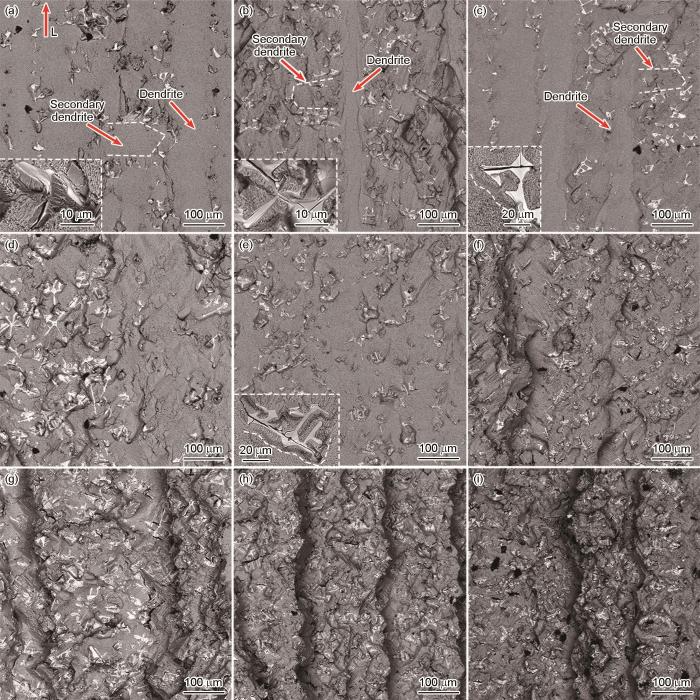
图6
裂纹长度不同的三种成分合金试样的室温疲劳断口的微观形貌
Fig.6
Morphology of microscopic fracture of three alloys at room temperature (a-c) 6+6 mm, (d-f) 6+12 mm, (g-i) 6+24 mm,(a, d, g) 3Ta alloy, (b, e, h) 3.5Ta alloy, (c, f, i) 4Ta alloy
图7给出了三种合金在450 ℃失稳断裂后断口的微观形貌。由图7a~c可见,6+6 mm的断口总体平坦,裂纹沿着碳化物扩展。在断口表面既有骨架状碳化物也有块状碳化物,虽然没有出现脱粘但是部分碳化物与基体间出现裂纹。碳化物的分布比室温断口更均匀,无法由碳化物的分布分辨出枝晶结构。由图7d~f可见,6+12 mm处的断口表面碳化物的数量增多,沿着L向“链状”分布着碳化物,但是整体上与6+6 mm处断口的情况类似。由图7g~i可见,在6+24 mm处断口表面出现平行于L向的“沟壑”,但是起伏不如室温断口剧烈;还可见大量台阶棱与L向呈现45°角的解理台阶,台阶面与载荷方向的夹角为45°~90°。从图7h的背散射(BSD)图可见,断口表面碳化物的数量远不如室温断口,且难以根据碳化物的分布分辨枝晶结构。
图7
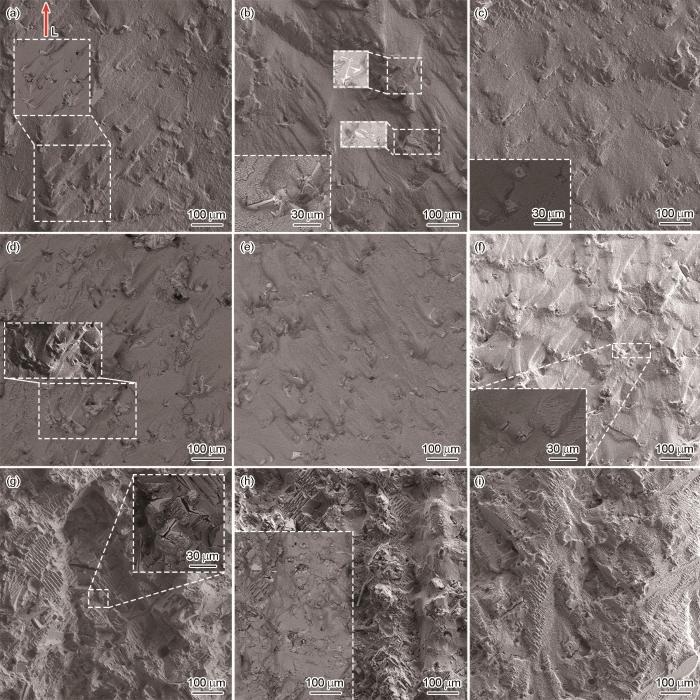
图7
裂纹长度不同的三种成分合金试样450 ℃疲劳断口的微观形貌
Fig.7
Morphology of microscopic fracture of three alloys at 450 oC (a-c) 6+6 mm, (d-f) 6+12 mm, (g-i) 6+24 mm, (a, d, g)3Ta, (b, e, h) 3.5Ta, (c, f, i) 4Ta
对3.5Ta合金试样的450 ℃断口后部切样进行EBSD观测,结果如图8所示。可以看出,裂纹倾向于在低施密特因子与高施密特因子晶粒之间的晶界和高施密特因子的晶粒内扩展。
图8
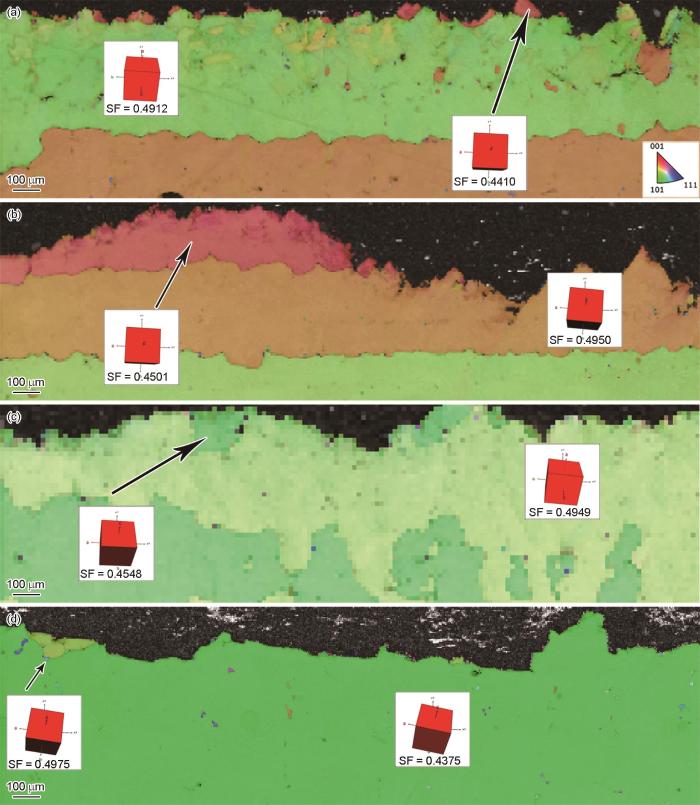
图8
3.5Ta合金试样450 ℃断口后段的EBSD图谱
Fig.8
EBSD maps of the posterior fracture surface of 3.5Ta alloy at 450 oC (a-d) show the results of different parallel specimens
图9给出了三种合金的900 ℃断口的微观形貌。在6+6 mm处的断口表面可见没有碳化物的枝晶干,还可见沿着碳化物剥离二次枝晶留下的凹坑,碳化物破碎且与基体间出现缝隙。6+12 mm处断口的表面粗糙程度提高,碳化物的数量增加,碳化物与基体间有裂缝,断口断面以下的块状碳化物裸露到了表面。6+24 mm处断口出现“沟壑”形貌,但“起伏”程度远不及室温断口,断口表面仍有大面积碳化物稀疏区域,也有二次枝晶壁被截断的区域。
图9
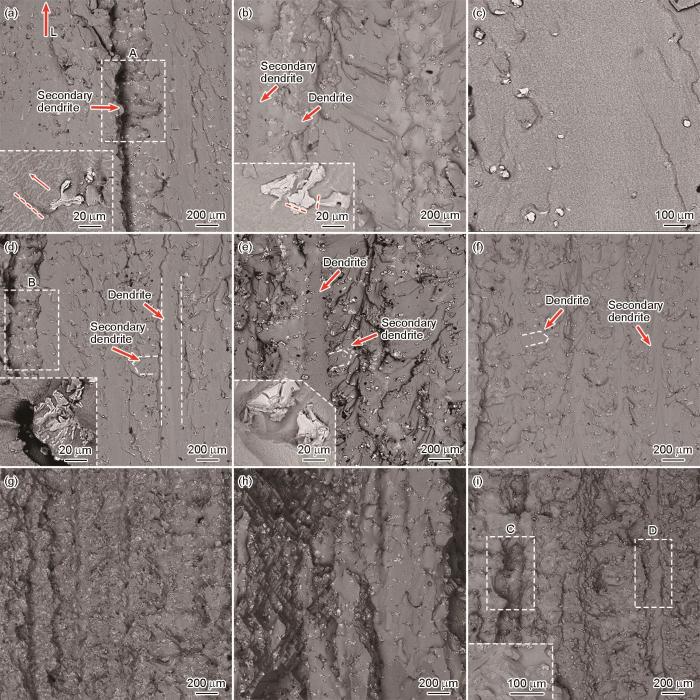
图9
不同裂纹长度的三种成分合金试样900 ℃疲劳断口的微观形貌
Fig.9
Morphology of microscopic fracture of three alloys at 900 oC (a-c) 6+6 mm, (d-f) 6+12 mm, (g-i) 6+24 mm, (a, d, g)3Ta, (b, e, h) 3.5Ta, (c, f, i) 4Ta
3 讨论
3.1 Ta对室温疲劳裂纹扩展行为的影响
碳化物对裂纹扩展路径的影响极大[26]。室温疲劳断口表面单个碳化物的暴露面积远比热处理态的大,且断口中碳化物与基体之间并未出现明显的缝隙。这表明,在循环应变时碳化物内先发生断裂[16],部分骨架状碳化物沿着中心棱形结构的对角线方向开裂,而块状碳化物沿着裂纹扩展方向开裂[27]。裂纹的扩展方向与L向平行,而在枝晶间平行于L向“链状”分布的碳化物恰好为裂纹扩展提供了低阻力通道。在扩展初期裂纹受载荷方向的力约束,抑制其在垂直于裂纹平面的方向扩展,断口上呈现出大量没有碳化物的枝晶干区域。随着裂纹的扩展断口碳化物显著增多,无碳化物的枝晶干区域减少,表明裂纹扩展路径逐渐绕过枝晶干沿枝晶间扩展。三种合金的室温裂纹扩展路径相似,大致经历3个阶段,如图10所示:I,纵穿一次枝晶干;II,绕过一次枝晶干并截断二次枝晶臂;III,完全绕过枝晶干沿枝晶间扩展。
图10
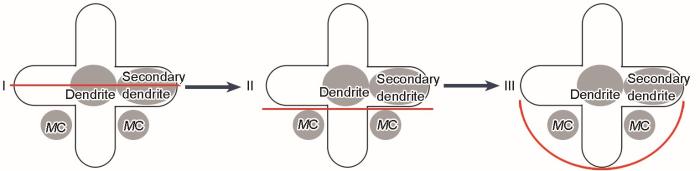
Ta元素影响碳化物和γ′相,进而影响疲劳裂纹的扩展。在室温,虽然Ta元素通过沉淀强化在一定程度上提高了基体的强度,但是碳化物的内部开裂产生裂纹而加速了裂纹的扩展。根据上述分析,在室温碳化物是影响疲劳裂纹扩展最主要的因素。而Ta含量的提高促进了碳化物的析出,因此在室温下合金抵抗裂纹扩展的能力随着Ta含量的提高而下降。
3.2 Ta对450 ℃疲劳裂纹扩展的影响
与在室温紧凑拉伸不同,在450 ℃紧凑拉伸时碳化物内以及碳化物与基体之间均出现了裂纹。这表明,在循环变形过程中部分碳化物使周围的基体产生应力集中而导致裂纹萌生和扩展,在此情况下基体的强度更直接影响裂纹的产生和扩展。随着Ta含量的提高,碳化物含量提高产生的负面作用与基体强度提高引起的正面作用部分抵消,导致Ta含量对450 ℃紧凑拉伸疲劳裂纹的扩散没有显著的影响。此外,在450 ℃紧凑拉伸时三种合金的da/dN-ΔK曲线部分基本重合,进一步说明Ta含量与裂纹稳态扩展速率的相关性较低。在疲劳裂纹的萌生阶段,碳化物比基体更早开裂,因此高Ta含量产生的高碳化物含量使裂纹萌生的门槛值更低。此外,3种合金紧凑拉伸断口的宏观形貌和微观形貌相似,说明Ta元素未改变裂纹扩展的模式。另外,在450 ℃紧凑拉伸断口前段碳化物的数量和形状与前期并没有明显的不同,说明前期碳化物并非影响裂纹宏观扩展路径的最主要因素。从断口前段的倾斜扩展可知,在450 ℃紧凑拉伸前期疲劳裂纹的扩展主要受晶体取向的影响。当载荷方向与[001]方向呈22.5°时施密特因子最大,滑移系开动所需的应力最小,而断口后段的台阶棱和台阶面的方向与计算出的施密特因子大的晶粒取向相对应。EBSD结果证实,裂纹确实进入了施密特因子大的晶粒和晶界。不同取向晶粒的“软硬”差别和力学约束的共同作用使断口前端倾斜开裂,进入了施密特因子大的晶粒和晶界。
3.3 Ta对900 ℃疲劳裂纹扩展的影响
在900 ℃紧凑拉伸碳化物开裂的现象消失,碳化物与基体之间出现明显的裂隙且碳化物与断口表面不在一个平面上。这表明,碳化物对裂纹扩展的促进由直接开裂转变为诱导基体开裂,基体强度对裂纹的产生和扩展的影响更为直接。在900 ℃紧凑拉伸时,裂纹虽然倾向于进入碳化物富集区,存在穿过枝晶干、截断垂直断面的二次枝晶和绕过枝晶干三个阶段,但是这个转变较慢,在断口后段依然存在I模式和II模式,表明碳化物对裂纹扩展路径的影响降低。随着紧凑拉伸温度的提高基体强度降低,晶粒取向的不同造成的“软硬”差别对裂纹扩展的影响下降。而Ta元素对沉淀强化和固溶强化的正面作用使高Ta合金碳化物附近的基体在应力集中作用下更难开裂。最终的结果是,在900 ℃紧凑拉伸合金抵抗疲劳裂纹扩展的能力随着Ta含量的提高而提高。
4 结论
(1) 温度是改变疲劳裂纹扩展路径的重要因素,随着温度从室温提高到450 ℃和900 ℃,DZ411合金中裂纹的扩展速率随之提高。在室温,合金中的脆性相碳化物在形变中开裂,合金抗疲劳裂纹扩展的能力随着Ta含量的提高而下降。裂纹扩展经历了三个阶段:I,纵穿一次枝晶干;II,绕过一次枝晶干并截断二次枝晶臂;III,完全绕开枝晶干沿枝晶间扩展。
(2) 在450 ℃,Ta含量对合金的疲劳裂纹稳态扩展速率没有显著的影响,但是使裂纹扩展的门槛值提高。裂纹优先进入施密特因子较大的晶粒及其晶界随后沿L向扩展。脆性相碳化物先开裂,作为硬质相产生应力集中诱发基体开裂。
(3) 在900 ℃,碳化物对裂纹扩展路径的影响降低,合金的抗裂纹扩展能力随着Ta含量的提高而提高。碳化物周围的基体受到应力集中的影响而开裂,Ta元素促进γ'相的体积分数和立方度的提高,从而提高了合金基体强度,使基体抵御应力集中的能力提高。
参考文献
Book Reviews: Jet propulsion: a simple guide to the aerodynamic and thermodynamic design and performance of jet engines
[J].
Review on superalloys for combustor chamber of heavy duty gas engine
[J].
重型燃气轮机燃烧室用高温合金研究进展
[J].
Review and prospect on developments of cast superalloys
[J].
铸造高温合金发展的回顾与展望
[J].回顾了20世纪40年代以来铸造高温合金发展中的若干重大事件:叶片以铸代锻;真空熔炼技术;定向凝固及单晶合金;合金成分设计;Ni3Al基铸造高温合金;合金凝固过程数值模拟;细晶铸造.展望了铸造高温合金21世纪的发展:单晶高温合金仍然是最重要的涡轮叶片材料;继续靠工艺的发展挖掘合金潜力;发展有希望的替代材料.
Comparison of low-cycle fatigue behaviors between two nickel-based single-crystal superalloys
[J].
Investigation on thermo-mechanical fatigue behavior of GH4169 alloy
[J].The thermo-mechanical fatigue behavior of GH4169 alloy was investigated via MTS809 fatigue testing machine by applied multiple test loads at different temperature range. It is found that the hysteresis loops of GH4169 alloy have obvious asymmetry in tension and compression under thermo-mechanical condition. The material bears compressive stress when the mechanical strain amplitude in phase, whilst tensile stress for out of phase. The tensile stress is the main cause affecting the fatigue life. The average stress relaxation occurs at higher strain amplitude. In the high temperature half cycle, the alloy softens first and then becomes stable. In the low temperature half cycle, the alloy tends to be stable.
镍基高温合金GH4169的热机械疲劳行为
[J].在不同温度区间、不同条件下进行GH4169合金的热机械疲劳实验测试其热机械疲劳数据,研究了这种合金的热机械疲劳行为。结果表明:GH4169合金在热机械条件下的迟滞回线具有明显的拉压不对称性;同相位时材料承受压应力,反相位时承受拉应力。拉应力,是影响疲劳寿命的主要因素。应变幅较高时GH4169合金出现平均应力松弛,在高温半周为先循环软化后循环稳定,在低温半周始终趋于循环稳定。
Effect of skew angle of holes on the thermal fatigue behavior of a Ni-based single crystal superalloy
[J].
Thermal fatigue behavior of the ZGH451 Ni-based superalloy fabricated by direct energy deposition in the temperature range of 900-1100℃
[J].
Low cycle fatigue behavior of cast nickel base superalloy K52
[J].

Low cycle fatigue (LCF) behaviors of cast nickel-base superalloy K52at different temperatures were investigated, and the fatigue parameterswere given by analyzing its cyclic stress-strain curves andstrain-life curves. Cyclic stress response curves show that the alloyexhibited cyclic hardening and softening behaviors at room temperatureand 900℃, respectively. OM and SEM observations indicated that LCF cracksinitiated predominantly on the surface of specimen or at the near-surfacedefects. Once initiated, cracks would propagate perpendicularly to theloading direction and the specimens exhibited transgranular fracture.
铸造镍基高温合金K52的低周疲劳行为
[J].
Temperature effect on the low cycle fatigue behavior of a directionally solidified nickel-base superalloy
[J].
Effect of notch orientation and temperature on thermal fatigue behavior of a third-generation single crystal superalloy DD33
[J].The crack initiation and propagation behavior of a third-generation single crystal superalloy DD33 with V-notches of different orientations ([100], [210] and [110]) during thermal fatigue tests: samples were hold at different high-temperatures (1000oC, 1100oC and 1200oC respectively) for 60 s and then quick quenching into water as one cycle, was investigated by OM, SEM and EDS. The results show that the thermal fatigue properties of DD33 show obvious anisotropy tested at different high-temperatures. The initiation and propagation behavior of thermal fatigue cracks in samples with different notch orientations show the dependence of crystallographic orientation. At 1000oC/1100oC/1200oC, the [100] orientated specimens exhibit the best thermal fatigue performance. The thermal fatigue performance of the [210] oriented sample is the worst at 1100oC, while the thermal fatigue performance of the [110] oriented sample is the worst at 1000oC and 1200oC. The thermal stress, oxidation, and the operation of slip systems result in the difference in crack growth rate of samples with different notch orientations.
缺口取向及温度对第三代单晶高温合金DD33热疲劳行为的影响
[J].使用OM、SEM和EDS等手段,研究了第三代镍基单晶高温合金DD33不同V型缺口取向([100]、[210]和[110])片状试样从室温到不同上限温度(1000℃、1100℃和1200℃)的热疲劳过程中裂纹的萌生和扩展行为。结果表明,在三种上限温度,DD33合金的热疲劳性能均出现明显的各向异性。在三个上限温度[100]取向试样均表现出最好的热疲劳性能;上限温度为1000℃和1200℃[110]取向试样的热疲劳性能最差,上限温度为1100℃[210]取向试样的热疲劳性能最差。不同取向试样的热疲劳裂纹的萌生和扩展行为,均呈现出一定的晶体学取向规律。热应力、氧化以及滑移系的开动,导致不同取向试样裂纹的扩展速率不同。
The low-cycle fatigue deformation mechanisms of two single crystal superalloys at room temperature and 600℃
[J].
Crystallographic analysis for fatigue small crack growth behaviors of a nickel-based single crystal by in situ SEM observation
[J].
Role of shrinkage pores, carbides on cyclic deformation behaviour of conventionally cast nickel base superalloy CM247LC® at 870 oC
[J].
Effect of post-solutionizing cooling rate on microstructure and low cycle fatigue behavior of a cast nickel based superalloy
[J].
Low cycle fatigue and high cycle fatigue of K4750 Ni-based superalloy at 600 oC: analysis of fracture behavior and deformation mechanism
[J].
Data rich imaging approaches assessing fatigue crack initiation and early propagation in a DS superalloy at room temperature
[J].
Fatigue crack initiation behavior at intermediate temperature under high stress amplitude for single crystal superalloy DD413
[J].The fatigue crack initiation behavior of a single crystal superalloy DD413 was investigated under high stress amplitude at intermediate temperature. The fracture surfaces and longitudinal section morphologies of the test specimens were characterized by scanning electron microscope (SEM). It was found that fatigue cracks mostly initiate from the cracked blocky carbides on the surface as well as the cracked skeleton-like carbides at subsurface. All the carbides on the surface of testing specimen crack due to the combined effect of oxidation and cyclic loading. Besides, at the subsurface of testing specimen, the carbides located on the propagation path of a micro-crack can crack as a result of oxidation and cyclic loading. The micro-crack connected to the surface in the specimen is the transportation channel of oxygen for the oxidation of the carbides at the subsurface. Carbides cracked and the micro-crack initiated at the early stage of fatigue, which induced the final failure.
第一代单晶高温合金中温高应力幅下的疲劳裂纹萌生行为
[J].通过应力控制的疲劳实验探究第一代镍基单晶高温合金DD413在中温(760℃)高应力幅下的疲劳裂纹萌生行为,并使用扫描电子显微镜观察和表征了疲劳样品的断口形貌和纵截面的显微组织。结果表明:在高应力幅条件下,疲劳裂纹主要萌生于表面开裂的块状碳化物和次表面开裂的骨架状碳化物。在疲劳过程中,氧化和循环加载的共同作用使样品表面的碳化物都发生了开裂。在样品的次表面,只有位于表面微裂纹扩展路径上的碳化物发生开裂,其原因也与氧化和循环加载有关。样品表面产生的微裂纹,是次表面碳化物发生氧化所需氧气的运输通道。在疲劳的早期阶段碳化物即发生开裂并产生微裂纹,最终使样品发生疲劳断裂。
Low-cycle fatigue behavior of a cast Ni-based superalloy K4169 at 650 oC
[J].
K4169合金的高温低周疲劳行为
[J].在650℃进行镍基铸造高温合金K4169的低周疲劳实验,使用SEM、TEM等手段表征合金变形前后的微观组织和断裂特征,研究了这种合金的高温低周疲劳行为。结果表明,这种合金的疲劳寿命随着应变的增大逐渐降低,应变为0.5%和0.6%时在循环前2~200周次内出现硬化现象,随后出现循环稳定和循环软化;应变为0.8%和1.0%时,合金出现连续的循环软化;初期的循环硬化与γ″强化相对位错运动的阻碍有关,而循环软化则归因于位错反复剪切γ″相。这种合金的塑性应变幅与疲劳失效反向数的Coffin-Manson方程表现出双线性关系。对微观变形结构的观察表明,这种合金在高应变和低应变下的循环变形模式均为位错剪切γ″相和滑移,且其在不同应变下的疲劳失效均表现为穿晶断裂。这种合金表现出双线性的原因可能是变形均匀性的转变,非Masing特性证明了这种转变。
Thermal fatigue behaviors of three cast nickel base superalloys
[J].Thermal fatigue (TF) behaviors of three Ni-based cast superalloys were investigated in the temperature ranges of 850, 900 and 950℃ to 20℃, respectively. OM and SEM were used to observe the microstructures and TF cracks of the tested specimens. The results demonstrated that the main style of crack initiation is the formation, gathering and interconnecting of oxidation cavities induced by thermal stress. Carbides, $\gamma$+$\gamma^{\prime}$ eutectics and grain boundaries can promote the initiation and propagation of TF cracks. The three alloys showed different mechanisms of TF crack propagation due to the distinct chemical compositions and microstructures. The TF cracks of equiaxial IN738 alloy propagate intergranularly, while those of the directional solidification (DS) DZ444 alloy propagate along interdendritical regions. The paths of TF crack propagation of DZ445 transfer from interdendrite to crystallographic orientation with increasing temperatures, <em>i.e</em>. (111)<110>, which is the easy slip system of face centered cubic alloy. The interaction of high-temperature oxidation and thermal stress is the main fractural mechanism in TF process. Some microstructural evolution at 950℃ accelerates the reduction of the TF property of three alloys.
3种铸造镍基高温合金热疲劳行为研究
[J].
On the low cycle fatigue behaviors of Ni-based superalloy at room temperature: deformation and fracture mechanisms
[J].
Effect of Al, Ti and Ta contents on the microstructure in Ni-base single crystal superalloy during aging
[J].
Al、Ti和Ta含量对镍基单晶高温合金时效组织的影响
[J].
Effect of Ta content on γ′ phase coarsening during long-term thermal exposure of DZ411 cast superalloys
[J].
Ta含量对铸造高温合金DZ411长期热暴露过程中γ′相粗化的影响
[J].借鉴材料基因工程中高通量实验的做法,采用快速凝固技术和定向凝固技术制备含Ta浓度梯度的定向合金,并在900℃进行长期热暴露实验,研究不同Ta浓度对铸造高温合金热暴露中γ′相生长速率的影响。通过对不同热暴露时间γ′相尺寸变化的统计,结合粒子粗化理论计算发现,随着Ta浓度增加,粗化速率常数一直在减小。通过合金中有效扩散系数计算发现,热暴露前期,高Ta浓度处的γ′相形成元素平均扩散系数较低,使得γ′相生长速率放缓。在长期热暴露后期,高Ta浓度处γ′相生长速率依旧缓慢,并且γ相基体间产生了大量位错,经测量,两相的相界面间的晶格错配度减小,阻碍了相形成元素向γ′相内迁移,导致γ′相生长速率减缓。
Effect of Cr/Mo/W on the thermal stability of γ/γ′ coherent microstructure in Ni-based superalloys
[J].
Cr/Mo/W元素对镍基高温合金γ/γ′共格组织热稳定性的影响
[J].近年来,随着航空航天发动机的持续发展,对其关键热端部件的承温能力要求越来越高,而高温合金共格组织热稳定性是影响其力学性能的关键因素,本工作在团簇成分式[Al-Ni<sub>12</sub>](Al<sub>1</sub>(Ti, Nb, Ta)<sub>0.5</sub>(Cr, Mo, W)<sub>1.5</sub>)基础上,保持其他元素含量不变,改变Cr、Mo、W的含量设计了系列镍基高温合金(含Cr<sub>1.0</sub>Mo<sub>0.5</sub>的S1-CM、Cr<sub>1.0</sub>W<sub>0.5</sub>的S2-CW和含Cr<sub>0.7</sub>Mo<sub>0.4</sub>W<sub>0.4</sub>的S3-CMW),研究Cr、Mo、W含量变化对合金γ /γ′共格组织热稳定性的影响。采用非自耗真空电弧炉制备合金铸锭,并对其在1300℃固溶15 h后在900℃下进行长期时效处理,并对时效态样品进行微观组织表征和力学性能测试。结果表明,这3个合金的微观组织均表现为高体积分数(f > 70%)的γ′粒子均匀地分布在fcc-γ基体中。其中,S1-CM和S2-CW合金在900℃、50 h时效后γ′粒子形貌均呈椭球形,而S3-CMW合金则表现为方形,这是由于后者具有更负的γ /γ′点阵错配度(后者δ = -0.47%,前者δ = -0.25%~-0.33%)。500 h长期时效后,各合金中的γ′粒子形貌没有发生变化,且都具有较慢的粗化速率(K = 10~18 nm<sup>3</sup>/s);尤其S3-CMW合金表现出最高的γ /γ′共格组织稳定性(γ′粒子的粗化速率K = 10.02 nm<sup>3</sup>/s),且晶界处的第二相粒子析出明显低于其他合金。系列合金的硬度基本不随时效时间发生变化,也进一步表明了共格组织的稳定性;其中S3-CMW合金的显微硬度为397~418 HV,时效200 h后的室温压缩屈服强度为818 MPa。
Effect of Ta content on microstructure and properties of hot corrosion resistant superalloy DZ411
[D].
Ta含量对抗热腐蚀高温合金DZ411组织与性能的影响
[D].
Effects of Ta and Ti content on microstructure and properties of multicomponent Co-Ni-based superalloys
[J].
A critical analysis of crack propagation laws
[J].The practice of attempting validation of crack-propagation laws (i.e., the laws of Head, Frost and Dugdale, McEvily and Illg, Liu, and Paris) with a small amount of data, such as a few single specimen test results, is questioned. It is shown that all the laws, though they are mutually contradictory, can be in agreement with the same small sample of data. It is suggested that agreement with a wide selection of data from many specimens and over many orders of magnitudes of crack-extension rates may be necessary to validate crack-propagation laws. For such a wide comparison of data a new simple empirical law is given which fits the broad trend of the data.


