



分子内电荷转移(Intramolecular charge transfer, ICT)化合物是一类由电子给体(Donor, D)、电子受体(Acceptor, A)和共轭桥结构组成的有机分子[1~4]。由于在分子体系中引入了电子给-受体,光激发化合物,促进分子内的电子从给体转移到受体,发生电荷转移跃迁而产生显著的偶极矩变化[5~7]。改变电荷转移的效率可调控分子的光电性能,在非线性光学器件、光电转换与能源、化学生物传感等领域有广阔的应用前景[8~11]。α,β不饱和酮作为羟醛缩合反应的重要中间体[12],广泛应用于非线性光学(NLO)材料的共轭桥单元[13~15]。这种NLO材料独特的优势,得益于其共轭体系、分子内电荷转移特性和可调控性[16~18]。吩噻嗪是一类由富电子的N和S原子组成的供电能力较强的杂环结构,常用作电子给体。吩噻嗪具有优异的热稳定性和化学易修饰等特点,受到极大的关注[19,20]。在小分子或聚合物中引入吩噻嗪单元可调控材料的带宽和电子传输性能[21,22],从而提高其光电性能[23,24]。本文以吩噻嗪为电子给体,设计并合成具有不饱和酮构型的对称性有机分子(1E,4E)-1,5-双(4-(10H-吩噻嗪-10-基)苯基)戊-1,4-二烯-3-酮(COP),研究受体增强后分子内电荷转移对超快非线性光学吸收的影响,并结合前沿分子轨道、空穴-电子分析和跃迁偶极矩(TDM)研究其构效关系。
1 实验方法
1.1 实验用仪器
实验用仪器:核磁共振谱仪,Bruker AVANCE III 400 M spectrometers;高分辨电喷雾质谱,Exactive Plus LC-MS (ESI);稳态/瞬态荧光光谱仪,EI FLS980;荧光分光光度计,Hitachi F4600;紫外可见分光光度计,PerkinElmer LAMBDA-750。
1.2 化合物合成和性能测试
化合物COP和CNP的合成路线如图1所示,用薄层色谱板监测反应。(1E,4E)-1,5-双(4-(10H-吩噻嗪-10-基)苯基)戊-1,4-二烯-3-酮(COP)的合成:将反应瓶中的4-(10H-吩噻嗪-10-基)苯甲醛(分析纯,364 mg,1.2 mmol)溶于乙醇(15 mL)中,加入丙酮(分析纯,35 mg, 0.6 mmol)后搅拌并缓慢滴加KOH水溶液(2 mL,0.04 mol·L-1),继续搅拌使其在60 ℃反应12 h。在反应过程中,反应液逐渐变成橙红色并析出固体。反应完成后,待反应液和析出的固体降至室温后倒入100 mL水中,用二氯甲烷(分三次,每次30 mL)萃取后用无水Na2SO4干燥得到的有机相。然后,进行减压蒸馏除去二氯甲烷。用100~200目硅胶将粗产物纯化分离,用石油醚/二氯甲烷(PE/DCM)体积比为1∶1的洗脱剂将其洗脱,得到黄色的固体产物COP,产率为83%,熔点:106 ℃。1H NMR (400 MHz, CDCl3) δ 7.77 (d, J= 15.9 Hz, 2H), 7.73 -7.69 (m, 4H), 7.33-7.29 (m, 4H), 7.17 (dd, J = 7.6, 1.6 Hz, 4H), 7.07 (d, J = 15.9 Hz, 2H), 7.02 (ddd, J= 8.0, 7.3, 1.6 Hz, 4H), 6.95 (td, J = 7.5, 1.3 Hz, 4H), 6.63 (dd, J = 8.1, 1.3 Hz, 4H).13C NMR (126 MHz, CDCl3) δ 188.62, 144.74, 143.13, 142.46, 132.32, 130.51, 127.66, 127.13, 126.11, 125.27, 125.25, 124.02, 119.87.HRMS (ESI): m/z calcd for C41H29N2OS2 [M+H]+: 629.1716; Found: 629.1711。
图1
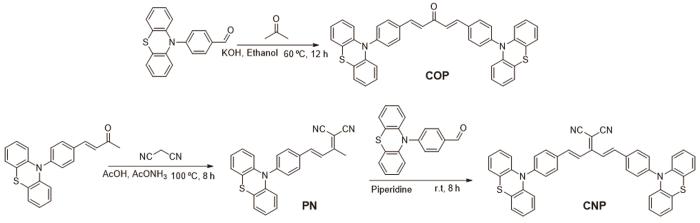
(E)-2-(4-(4-(10H-吩噻嗪-10-基)苯基)丁-3-烯-2-亚基)丙二腈(PN)的合成:将(E)-4-(4-(10H-吩噻嗪-10-基)苯基)丁-3-烯-2-酮(172.3 mg, 0.5 mmol)、丙二腈(66.7 mg,1 mmol)和乙酸铵(175.6 mg,2.25 mmol)加到反应瓶中,除去反应瓶中的水和空气后在N2保护下加入乙酸(0.5 mL)和甲苯(5 mL),搅拌并加热至100 ℃反应8 h。待反应体系降至室温后进行后处理:用水和饱和NaHCO3溶液洗涤,用DCM萃取,用无水Na2SO4干燥。用硅胶柱色谱(100~200目)将粗产物纯化,用PE/DCM洗脱剂(体积比为3∶1)分离后得到橙色固体产物,产率为75%。1H NMR (500 MHz, CDCl3) δ 7.60-7.54 (m, 2H), 7.35-7.28 (m, 4H), 7.22-7.16 (m, 4H), 7.10 (td, J = 7.5, 1.4 Hz, 2H), 7.01 (dd, J = 8.0, 1.4 Hz, 2H), 2.46 (s, 3H).HRMS (ESI): m/z calcd for C25H18N3S [M+H]+:392.1216; Found: 392.1227。
2-((1E,4E)-1,5-双(4-(10H-吩噻嗪-10-基)苯基)戊-1,4-二烯-3-亚基)丙二腈(CNP)的合成:将反应瓶中的PN (78.1 mg,0.2 mmol)和4-(10H-吩噻嗪-10-基)苯甲醛(99.7 mg,0.3 mmol)溶于氯仿(5 mL)中,向反应瓶中加入哌啶(分析纯,0.1 mL)后在室温下搅拌反应2 h。反应完成后,用水和饱和NaCl溶液洗涤、用DCM萃取、用无水Na2SO4干燥。用100~200目的硅胶进行柱层析纯化,用PE/DCM = 1∶1的洗脱剂进行洗脱后得到黑色固体产物CNP,产率为56%,熔点:255 ℃。1H NMR (500 MHz, CDCl3) δ 7.65-7.60 (m, 4H), 7.36 (d, J= 15.8 Hz, 2H), 7.29-7.24 (m, 8H), 7.21 (d, J = 15.8 Hz, 2H), 7.12 (td, J = 7.7, 1.6 Hz, 4H), 7.04 (td, J = 7.5, 1.3 Hz, 4H), 6.85 (dd, J = 8.0, 1.3 Hz, 4H).13C NMR (126 MHz, CDCl3) δ 146.08, 144.07, 142.50, 130.80, 130.37, 128.07,127.66, 127.23, 124.73, 123.49, 121.70, 121.00, 114.01.HRMS (ESI):m/z calcd for C44H28N2 S2 [M+H]+: 676.1750; Found: 676.1750。
理论计算方法和基组:使用Gaussian 09W对分子进行量子化学计算,使用Multiwfn处理波函数,使用VMD绘制图形。使用B3LYP/6-31g (d)优化分子结构并进行密度泛函理论(DFT)的量化计算。根据含时密度泛函理论(TD-DFT)在长程校正泛函CAM-B3LYP/6-311G (d)和PBE(0)/TZVP水平上进一步计算分子的激发态,以得到电子跃迁的相关信息。
使用模式锁定Nd:YAG 532 nm激光器和RJ-7620能量探头测试非线性光学性能。将样品溶解于二氯甲烷中(COP的浓度为:8.26 × 10⁻⁴ mol/L,CNP的浓度为2.13 × 10-3 mol/L)。将溶液置于2 mm厚的比色皿中并沿Z轴穿过透镜的焦平面区域移动。进行对比实验,以排除二氯甲烷溶剂引起的非线性吸收。测试化合物COP和CNP在四氢呋喃溶液(1.0 × 10⁻⁵ mol/L)中室温下的紫外吸收和荧光发射光谱。
2 结果和讨论
2.1 紫外吸收和荧光发射
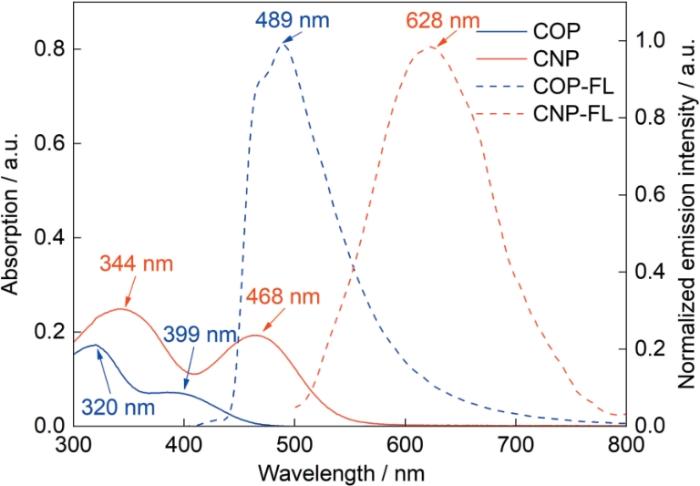
从图2可以看出,在COP的谱中320和399 nm处各出现一个明显的吸收峰,CNP谱中的最大吸收峰分别出现在344和468 nm处。这4个吸收峰都来源于吩噻嗪分子内发生的电荷转移[25,26],而与COP相比CNP发生的红移主要决定于π-共轭体系的大小和不同程度的给受电子[27,28]。与酮羰基相比,二氰基亚乙基吸电子的能力更强,在其推拉作用下化合物CNP的最大吸收波长红移了69 nm,且其吸收系数也较强。与吸收光谱相比,荧光发射光谱都发生了较大的Stokes位移(λst),表明在光激发下分子构型在基态和激发态之间发生了很大的改变[29]。根据分子结构,这类分子主要由给体和受体组成,在光的激发下电荷很容易从给体(吩噻嗪)转移到受体(丙二腈)。
图2
2.2 非线性光学性能
图3
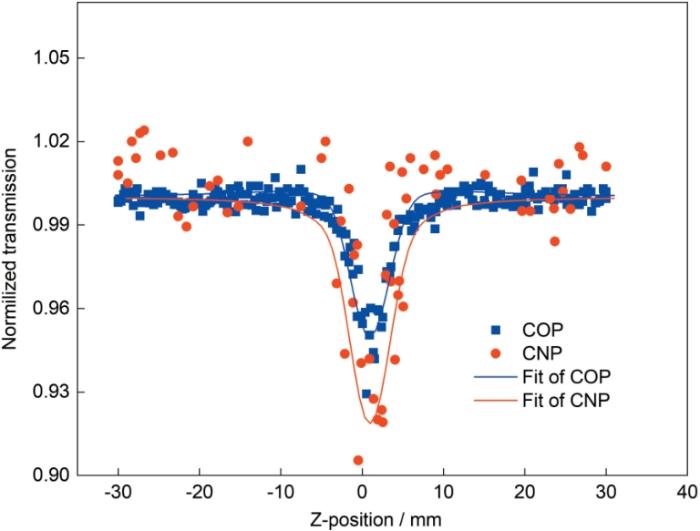
图3
532 nm 波长下的开孔 Z 扫描实验数据
Fig.3
Normalized open-aperture Z-scan curves of COP and CNP (The solid lines are the fitting curves)
拟合Z扫描实验结果[33]。式中T为透过率,I0为焦点处光强,Leff为有效厚度,Z为样品在仪器台上与焦点处发生位移的距离。拟合结果表明,CNP的透光率(0.26)远比COP(0.65)的低,其原因是,氰基的引入使其紫外吸收光谱发生红移,使发色团颜色变深和透光性较差。拟合得到的有效非线性吸收系数(βeff)表明,CNP(4.0 × 10⁻¹¹ m/W)的非线性响应明显强于COP (1.2 × 10⁻¹¹ m/W),即引入氰基提高了羰基结构的非线性响应。
2.3 瞬态吸收
测试瞬态吸收谱(TAS)可检测样品在不同延迟时间对不同波长光的吸收,从而构建出三维吸收谱。分析谱的数据,可深入了解材料内部分子的动力学行为,例如分子内电荷转移、能量传递等超高速过程。在TAS中,正信号(红色、黄色和绿色区域,∆mOD > 0)代表激发态吸收(Excited-state absorption, ESA),而负信号(蓝色区域,∆mOD < 0)通常来源于基态漂白(GSB)效应或受激发射(SE)效应[34]。两种化合物在二氯甲烷中的瞬态吸收光谱如图4a所示,发色团COP的瞬态吸收光谱在490 nm附近呈现强烈的ESA信号。在0.2 ps内ESA峰的蓝移跨度较大,直到0.4 ps才停止;强度在4 ps提高到最大值,持续10 ps开始减小。瞬态吸收光谱的蓝移,主要是激发态分子结构的弛豫引起的。CNP的TAS(图4c)显示,520 nm中心附近的ESA信号以饱和吸收(Saturable absorption, SA)为主[35]。在0.7 ps内520 nm的激发态吸收逐渐增强,且其分布范围直至检测上限。在2.5 ps内激发态吸收信号逐渐红移到550 nm处,可能是激发态分子结构弛豫引起的[36]。在680 nm处出现了较弱的SA信号,根据荧光发射光谱在630 nm的发射峰可将其归因于激发态吸收与受激辐射的竞争[37]。随着时间的延迟,在200 ps该信号逐渐衰减(图4d)。
图4
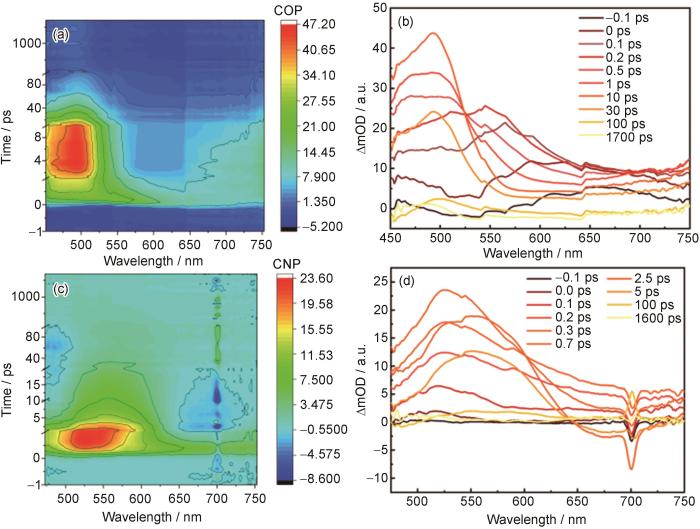
图4
COP和CNP的飞秒瞬态吸收光谱和瞬态吸收光谱随时间变化的演化曲线
Fig.4
Femtosecond TAS and evolution curves of TAS with time change for COP (a, b) and CNP (c, d)
2.4 分子的前沿轨道、电子空穴、跃迁密度矩阵热力图
进行理论计算,分析了分子的前沿轨道、电子空穴、跃迁密度矩阵热力图。使用Guassian 09W软件作图[38],使用软件Multiwfn[39]和图形渲染软件VMD处理波函数[40]。从图5可以看出,COP分子中最高占据分子轨道(HOMO)的电子云集中分布在给体单元吩噻嗪中,而最低未占据分子轨道(LUMO)的电子云主要分布在分子结构中心的酮羰基和烯烃键。CNP的HOMO轨道的电子云的主要分布与COP相同,集中在供体吩噻嗪中,而LUMO轨道的电子云主要分布在丙二腈。HOMO的能级随着分子的推拉作用增强或者共轭链的延长而升高,而LUMO的能级随着电子受体的能力增强而降低[41~43]。与COP(4.94 eV)相比,CNP的Egap(4.35 eV)更小。一般地,Egap越小则极化率越高,CNP呈现出更高的极化率。
图5
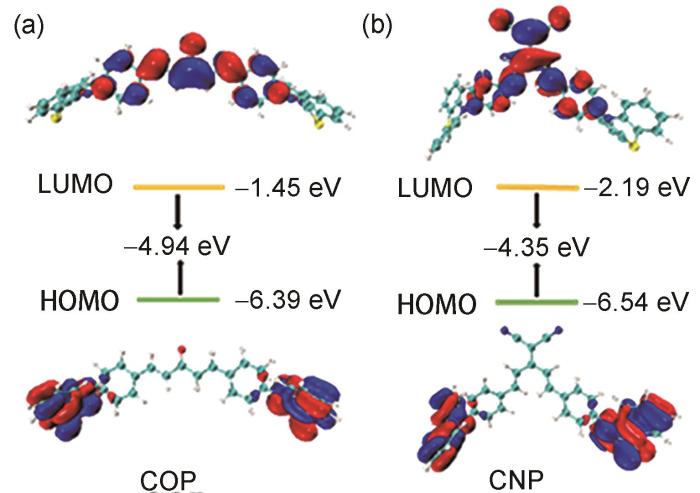
图5
COP和CNP的HOMOs和LUMOs的电子密度分布
Fig.5
Geometry and the HOMO and LUMO surface plots for COP (a) and CNP (b)
进一步计算了TD-DFT以分析激发态数据。COP和CNP前4个主要激发态的相关数据,如图6所示。根据振子强度可判断(f < 0.01时,分子处于跃迁禁阻状态),COP在激发态的吸收主要来自S0-S4,CNP的激发态吸收主要来自S0-S3和S0-S4。
图6
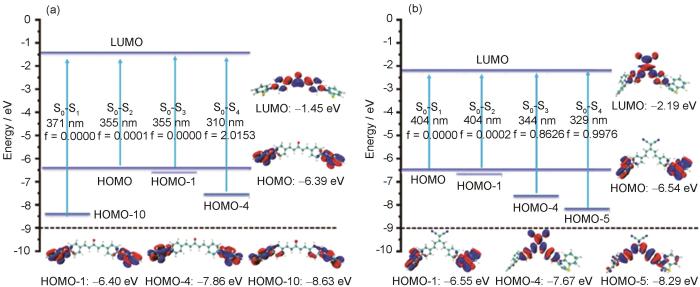
图6
COP和CNP的前沿分子轨道的电子云分布
Fig.6
Electron cloud distribution of frontier molecular orbitals of COP (a) and CNP (b)
根据对空穴-电子的分析研究了COP和CNP的电子跃迁特性。使用Multiwfn程序导出了电子-空穴分布(Sr)、电荷转移长度(D)、空穴和电子的分离度(t)指数、电子与空穴的总体平均分布广度(H)、空穴离域指数(HDI)和电子离域指数(EDI)(表1)。空穴-电子的分布如图7所示,图中的红色区域代表电子密度在激发态比基态有所增加,而蓝色区域则表示电子密度的降低。发色团COP的S0-S4的跃迁主要由HOMO-4→LUMO能级组成,D = 0.0466 nm、Sr
表1 COP和CNP中的电子和空穴数据
Table 1
| Sample | Excited state | D / nm | Sr | H / nm | t / nm | HDI | EDI | E / eV |
|---|---|---|---|---|---|---|---|---|
| COP | S0-S1 | 0.0777 | 0.478 | 0.215 | -0.0211 | 24.1 | 10.7 | 3.41 |
| S0-S2 | 0.197 | 0.194 | 0.683 | 0.0845 | 6.65 | 5.85 | 3.49 | |
| S0-S3 | 0.196 | 0.213 | 0.683 | 0.0820 | 6.62 | 5.85 | 3.49 | |
| S0-S4 | 0.0466 | 0.774 | 0.398 | -0.0533 | 6.23 | 7.21 | 4.00 | |
| CNP | S0-S1 | 0.412 | 0.137 | 0.582 | 0.227 | 6.55 | 5.79 | 3.07 |
| S0-S2 | 0.412 | 0.136 | 0.582 | 0.227 | 6.55 | 5.79 | 3.07 | |
| S0-S3 | 0.0034 | 0.832 | 0.345 | -0.227 | 6.71 | 7.12 | 3.60 | |
| S0-S4 | 0.150 | 0.679 | 0.356 | -0.0383 | 6.20 | 6.73 | 3.76 |
图7
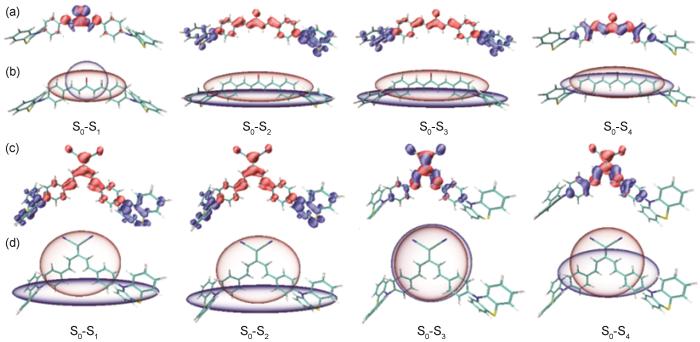
图7
COP和CNP的电子和空穴分布以及正负电荷中心
Fig.7
Electron and hole distribution (a, c), and positive and negative charge centers (b, d) of COP (a, b) and CNP (c, d)
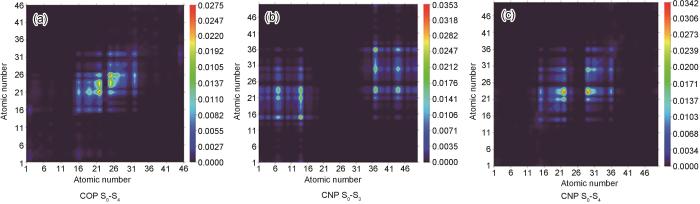
根据激发态电子的特征绘制了主要的跃迁密度矩阵(TDM)热图,以研究COP和CNP发色团中电荷转移的主要方向。从图8可以看出,COP的S0-S3的激发态是局域激发,未涉及吩噻嗪给体。激发时电子由烯烃共轭桥上的C原子向中间的羰基转移,小部分电子从两侧的共轭桥苯环向中间转移。CNP从S0-S3到S0-S4激发态的电子转移,明显不同于COP。S0-S3激发时电子从吩噻嗪上的N原子和S原子向取代苯环上的C原子和中间的双键共轭桥转移,最终到达丙二腈的C原子上。S0-S4激发时电子由烯烃共轭桥上的C原子向丙二腈上的C原子转移。这样的电荷转移距离,远大于COP激发时电荷转移的距离。
图8
对化合物COP和CNP的理论计算结果表明, CNP的激发态性质更优。非线性光学性质直接依赖于分子的激发态行为[44],因此CNP更强的激发态特性预示出其非线性光学响应更显著。实际上,这一预测与独立的Z扫描测试结果一致,证实CNP的非线性响应明显优于COP。
3 结论
以吩噻嗪为电子给体可合成具有α,β-不饱和酮构型的对称性有机分子COP和CNP。引入更强的电子受体二氰基亚乙基,可使CNP分子具有比COP更强的非线性响应。CNP分子结构中电子受体能力的增强,使紫外吸收峰红移、前线分子轨道能量差减小、电荷转移距离增加和电子离域能力增强。CNP分子的非线性吸收,主要源于激发态下的电荷转移。
参考文献
Spatial donor/acceptor architecture for intramolecular charge-transfer emitter
[J].
Recent developments on understanding charge transfer in molecular electron donor-acceptor systems
[J].
Understanding molecular and electrochemical charge transfer: theory and computations
[J].
Twisted intramolecular charge transfer (TICT) and twists beyond TICT: from mechanisms to rational designs of bright and sensitive fluorophores
[J].
Charge-transfer mediated J-aggregation in red emitting ultra-small-single-benzenic meta-fluorophore crystals
[J].
Ultrafast bridge planarization in donor-π-acceptor copolymers drives intramolecular charge transfer
[J].
Fast intramolecular charge transfer with a planar rigidized electron donor/acceptor molecule
[J].
Aggregation induced emission and nonlinear optical properties of an intramolecular charge-transfer compound
[J].
Twisted thiophene-based chromophores with enhanced intramolecular charge transfer for cooperative amplification of third-order optical nonlinearity
[J].
Ultrastable near‐infrared nonlinear organic chromophore nanoparticles with intramolecular charge transfer for dually photoinduced tumor ablation
[J].
Unveiling the effects of conjugated gradient bridges: Inducing intramolecular charge transfer significantly enhances nonlinear response
[J].
Chalcone synthesis, properties and medicinal applications: a review
[J].
Investigation of ultrafast optical nonlinearities in novel bis-chalcone derivatives
[J].
Synthesis and characterization of a new chalcone-based nonlinear optical crystal: BBC
[J].
Large enhancement of nonlinear optical absorption and refraction in planar chalcone structure with terminal substitution
[J].
Enhancing nonlinear optical responses via methoxy positional isomerism in chalcone-based materials
[J].
Growth, characterizations and nonlinear optical studies of dimethylamine substituted anthracene chalcone single crystals
[J].
Tuning the nonlinear optical properties by engineering donor-acceptor configurations in nitrochalone derivatives
[J].
Modulating room-temperature phosphorescence of phenothiazine dioxide via external heavy atoms
[J].
High performance phenothiazine-based battery materials achieved by synergistic steric blocking and extended conjugation
[J].
Synthesis and photophysical properties of luminescent phenothiazinyl merocyanine substituted polyacetylenes
[J].
Achieving TADF and RTP with stimulus-responsiveness and tunability from phenothiazine-based donor-acceptor molecules
[J].
Extremely simple phenothiazine molecules with room-temperature phosphorescence for understanding mechanoluminescence excitation process
[J].
Luminescent behavior elucidation of a disilane-bridged D-A-D triad composed of phenothiazine and thienopyrazine
[J].
Design, synthesis and properties of twisted D-A-D' arylamine derivatives with solvatochromism
[J].
Revisiting dual intramolecular charge-transfer fluorescence of phenothiazine-triphenyltriazine derivatives
[J].
Charge transfer and intersystem crossing in compact naphthalenediimide-phenothiazine triads: synthesis and study of the photophysical property with transient optical and electron paramagnetic resonance spectroscopic methods
[J].
Star-shaped triphenylamine-tetracyanobutadiene-phenothiazine push-pull systems: role of terminal phenothiazine in improving charge transfer
[J].
Aggregation-induced emission on benzothiadiazole dyads with large third-order optical nonlinearity
[J].
Synthesis, optoelectronic properties and third-order nonlinear optical behaviors of the functionalized acene derivatives
[J].
Synthesis, characterization and third-order nonlinear optical behaviour of three novel ethyne-linked donor/acceptor chromophores
[J].
Excellent ultrafast broadband optical limiting of functionalized twistacenes based on two-photon absorption-induced excited state absorption
[J].
Study of ultrafast nonlinear optical response and transient dynamics of pyrene derivatives with intramolecular charge transfer characteristics
[J].
Study on excited state kinetics and optical limiting performance of triphenylamine-based chalcone derivatives: effect of the molecular π-conjugated structure
[J].
Doubly 1, 3-butadiyne-bridged ditwistacene with enhanced ultrafast broadband reverse saturable absorption
[J].
Improved ultrafast carrier relaxation and charge transfer dynamics in CuI films and their heterojunctions via Sn doping
[J].
Enhanced ultrafast broadband reverse Saturable absorption in twistacenes with enlarged π-conjugated central bridge
[J].
Multiwfn: a multifunctional wavefunction analyzer
[J].
VMD store-A VMD plugin to browse, discover, and install VMD extensions
[J].
Photophysical property of photoactive molecules with multibranched push-pull structures
[J].
Novel triazine derivatives with deep LUMO energy levels as the electron-accepting components of exciplexes
[J].
Tuning the HOMO and LUMO energy levels of organic chromophores for dye sensitized solar cells
[J].


