



镍基ODS合金的力学性能优异、耐腐蚀性较高、表面稳定性以及抗热蠕变能力良好[1,2],可用在高温、高应力、氧化和腐蚀条件下。ODS合金,分为铁基和镍基ODS合金。镍基ODS高温合金又分为两类[3]。一类是以纳米氧化物弥散强化为主的镍基ODS高温合金,如:MA754、MA758和PM1000,其中纳米氧化物Y2O3的含量均为0.6%(质量分数)[4];另一类是γ′相和纳米氧化物复合强化的镍基ODS高温合金,其中高温强度比第一类有很大的提高,纳米氧化物的含量比第一类镍基ODS高温合金的高,MA6000合金的Y2O3含量为1.1% (质量分数)[4]。目前,MA753、MA754、MA6000和MA956镍基ODS高温合金已经商业化生产。MA754在20世纪70年代用于制造美国军用发动机F404和F110的高温部件中,是第一商业化的镍基ODS合金;MA754合金还可用于航空航天、钢铁、石油、化工、玻璃加工、热处理等领域以及制造先进气冷核反应堆的第二流动循环的承压轨道[5~8]。在这种航空发动机热端部件中,镍基粉末高温合金约占所有构件重量的50%[9,10]。
ODS合金基体中分散的细小氧化物粒子使其强化,这些粒子不仅使其高温强度提高,还能捕获辐照产生的缺陷而提高其辐照耐受性[11~13]。在20世纪70年代至90年代中后期,用机械合金化在合金中添加Al2O3、Y2O3、ZrO2、TiO2、MgO、SiO2等氧化物[14,15],发现含Y的弥散氧化物其抗辐照分解能力较强,添加Y2O3的合金其强度更高且能抗氧化层剥落[16]。Y2O3是制备ODS合金常用的弥散剂,在机械合金化过程中Y2O3分解成Y和O原子固溶于基体中,Y与基体中Al、Ti、Cr等元素生成富Y-Al-O或Y-Ti-O等纳米氧化物粒子,能阻碍晶界和位错的运动而使合金的强度和组织稳定性提高[17,18]。Bae等[19]比较研究了用粉末冶金工艺制备的Ni-16Mo和ODS合金的微观组织和拉伸性能,发现添加Ti和Y2O3可显著细化晶粒尺寸并生成纳米级Y-Ti-O氧化物颗粒,使合金的拉伸强度提高。Li等[20]研究表明,添加Y2O3使合金的晶粒尺寸减小且抑制热处理过程中晶粒的长大。添加Y2O3,可使合金的屈服强度提高。
我国核电事业的发展对镍基ODS合金的需求量增大,但是MA754材料的力学性能还不能满足要求。因此,需要优化MA754材料的成分和制备工艺,以提高其力学性能和降低成本。Park等[21]研究表明,用球磨工艺制备的镍基ODS合金其晶粒尺寸明显减小,硬度和高温抗压强度更高。为此,本文采用球磨工艺制备新型镍基ODS合金并研究制备工艺对其组织和性能的影响。
1 实验方法
实验用材料是自主研发的新型镍基合金。用气雾化及机械合金化方法(球料比10∶1,球磨转速350 r/min,球磨时间10 h)制备两种含O量不同的合金粉末(将用气雾化工艺制备的低氧含量合金编号为M1,用机械合金化工艺制备的高氧含量合金编号为MA4),化学成分列于表1。再用热等静压工艺(HIP,1180 ℃ × 150 MPa × 3 h)制备合金锭,并将其在1140 ℃锻造成直径为18 mm的圆棒。从圆棒上切取试样分别进行制度为1100 ℃ × 2 h WQ、1100 ℃ × 10 h WQ的固溶处理和1100 ℃ × 2 h WQ + 800 ℃ × 1 h AC (WQ表示水冷,AC表示空冷)的时效处理。
表1 合金粉末的化学成分
Table 1
| Designation | C | Cr | Mo | Ti | Al | Fe | W | Y | Zr | Nb | N | O | Ni |
|---|---|---|---|---|---|---|---|---|---|---|---|---|---|
| M1 | 0.045-0.055 | 17.15 | 2.0 | 0.5 | 0.3 | 1.50 | 4.0 | 0.9 | 0.15 | < 0.010 | < 0.005 | 0.01 | Bal. |
| MA4 | 0.045-0.055 | 17.15 | 2.0 | 0.5 | 0.3 | 1.50 | 4.0 | 1.0 | 0.15 | < 0.010 | < 0.005 | 0.52 | Bal |
分别用光学显微镜(GX 53)、扫描电子显微镜(SEM, Quanta 650)、透射电子显微镜(TEM, FEI Tecnai G2 F20)等手段观察粉末、HIP态、锻造态以及不同热处理态合金样品的微观组织;对锻造态和不同热处理态的试样进行室温拉伸(WDW-300E电子万能实验机)、高温拉伸(GNT300微机控制电子万能实验机)并测试其洛氏硬度(数显洛氏硬度计TH300,载荷150 kg,保压时间5 s)。参照标准GB/T 228.1-2021和GB/T 228.2-2015进行室温和高温拉伸。用红外吸收法测量MA4合金中的氧含量。
2 结果和讨论
2.1 M1和MA4合金粉末的微观组织
图1给出了M1和MA4合金粉末的SEM形貌。可见,用气雾化法制备的M1合金粉末大多是球形或近球形,只是个别粉末有卫星粉;机械合金化的合金粉末颗粒尺寸较大,呈扁平状。M1和MA4合金粉末的平均尺寸,分别为40.24和108.65 μm。
图1

图1
M1和MA4合金粉末的形貌及其粒径分布
Fig.1
Powder morphologies (a, b) and particle size distributions (c, d) of M1 (a, c) and MA4 (b, d) alloys
图2
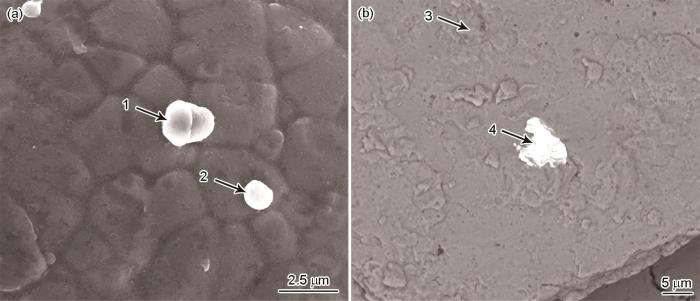
图2
M1和MA4合金粉末表面的SEM照片
Fig.2
Surface morphologies of M1 (a) and MA4 (b) alloy powders
表2 粉末表面析出物的EDS结果
Table 2
| Point | Cr | W | Mo | Fe | Y | Zr | Ti | Al | O | Ni |
|---|---|---|---|---|---|---|---|---|---|---|
| 1 | 17.2 | 6.1 | 1.6 | 1.6 | 1.5 | 0.8 | 0.2 | 0.4 | - | Bal. |
| 2 | 15.2 | 4.4 | 1.4 | 1.8 | 1.0 | - | 0.3 | 0.8 | 2.4 | Bal. |
| 3 | 16.8 | - | 1.2 | 1.5 | 2.1 | 9.4 | 0.4 | 0.6 | 2.6 | Bal. |
| 4 | 16.9 | 7.1 | 1.1 | 1.5 | 1.1 | - | 0.4 | 1.2 | - | Bal. |
图3

图3
M1和MA4合金粉末截面的SEM照片和元素分布
Fig.3
Cross-sectional morphologies and element distribution of M1 (a) and MA4 (b) alloy powders
2.2 MA4合金和M1合金的微观组织
图4
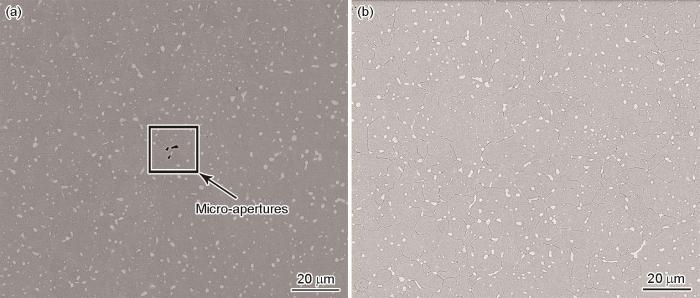
图4
HIP态镍基合金的显微组织
Fig.4
Microstructure of nickel-based alloy in HIP state (a) M1, (b) MA4
图5

图5
1140 ℃锻造态镍基合金的显微组织
Fig.5
Microstructure of nickel alloy forged at 1140 oC (a, c) M1, (b, d) MA4
图6和7给出了合金中纳米析出相颗粒的TEM照片。两种合金的TEM照片表明,大多数细小的颗粒分散在晶粒内部,大颗粒则在晶界附近析出;MA4合金中纳米粒子的分布更弥散。其原因是,在MA4合金的机械合金化过程中合金粉末和氧化物(如Y2O3)经历了严重的塑性变形、碰撞和剪切,使氧化物粒子分散到基体金属中并将其细化[24,25]。图6b中箭头所指颗粒的衍射斑分析显示,M1中的纳米第二相颗粒主要由YAlO3组成且在其周围有Cr23C6相颗粒(图6c和d)。图7表明,MA4合金中的纳米第二相颗粒为Y4Al2O9。文献[26~29]的研究结果表明,在ODS合金内可能生成了Y-X(Ti,Al,Zr)-O氧化物。在本文制备的两种合金中均未检测到含钛氧化物,可能与元素含量和相应氧化物的标准生成焓有关。Y-Al-O颗粒的标准生成焓(Y4Al2O9,-5546 kJ/mol[30])远比Y-Ti-O颗粒的(Y2Ti2O7,-3874 kJ/mol[31])的低。因此,在理论上氧化物生成的优先性排序为:含铝氧化物>含钛氧化物。
图6
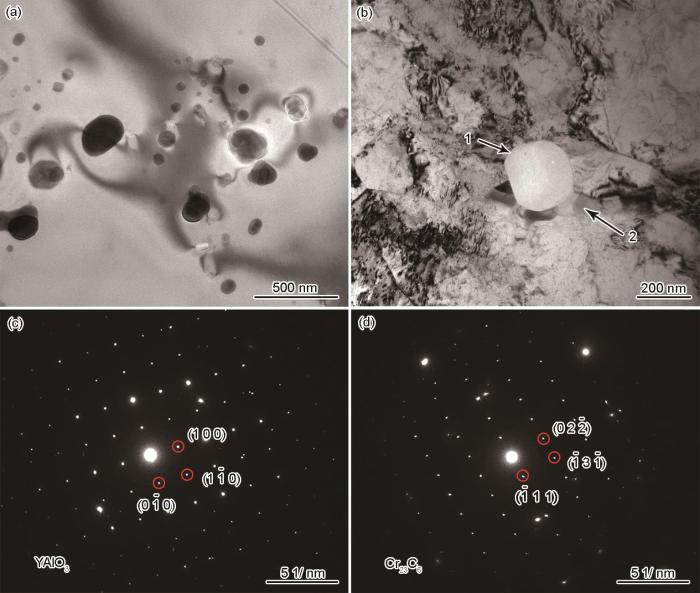
图6
锻造态M1合金的TEM照片
Fig.6
TEM images of as-forged M1 alloy (a) morphology of nanoparticle, (b) precipitated particles at the grain boundary, (c) SAED results of particle 1 in (b), (d) SAED results of particle 2 in (b)
图7
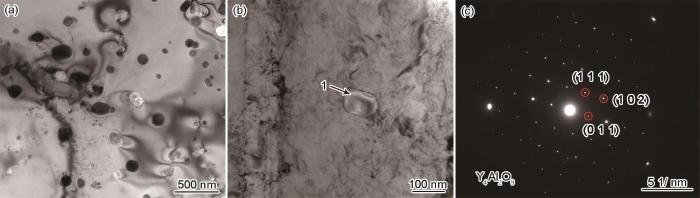
图7
锻态MA4合金的TEM照片
Fig.7
TEM images of as-forged MA4 alloy (a) morphology of nanoparticle, (b) precipitated phase particles, (c) SAED results of particle 1 in (b)
2.3 固溶处理/固溶+时效处理对合金微观组织的影响
图8给出了固溶处理后M1和MA4合金的光学显微镜照片。可以看出,经过1100 ℃ × 2 h WQ + 800 ℃ × 1 h AC时效处理后,两种合金的晶粒仍为等轴晶,M1和MA4合金的平均晶粒尺寸分别为23.11和10.10 μm。热处理后,氧化物颗粒的尺寸减小。由图8a,c可见,与1100 ℃ × 2 h WQ处理后的组织相比,1100 ℃ × 10 h WQ处理后M1合金中晶粒内的第二相颗粒数量大幅度减少。这表明,大多数晶粒内的析出相固溶进基体,并且晶界析出相的形貌由HIP态和热锻态的块片状变成了带状。由图8e,f可见,1100 ℃ × 2 h WQ + 800 ℃ × 1 h AC处理后合金中的第二相重新析出,比锻造态合金中的第二相的尺寸更细小。但是,M1合金的组织均匀性降低且局部晶粒异常长大,大晶粒的尺寸约为100 μm。局部晶粒异常长大的原因是,晶界上的初始第二相颗粒分布不均匀,使局部区域中的第二相对晶界的钉扎失效,对晶界迁移阻力的减小使晶粒选择性长大[32]。MA4合金中晶界上的第二相颗粒更加细小,分布更均匀更密集,晶界不容易迁移,时效后晶粒没有明显长大,其大小也比较均匀。
图8

图8
固溶和固溶+时效处理合金的金相组织
Fig.8
Metallographic structure of M1 (a, c, e) and MA4 (b, d, f) alloys treated by solid solution and solid solution+aging (a, b) 1100 oC × 2 h WQ, (c, d) 1100 oC × 10 h WQ, (e, f) 1100 oC × 2 h WQ + 800 oC × 1 h AC
图9
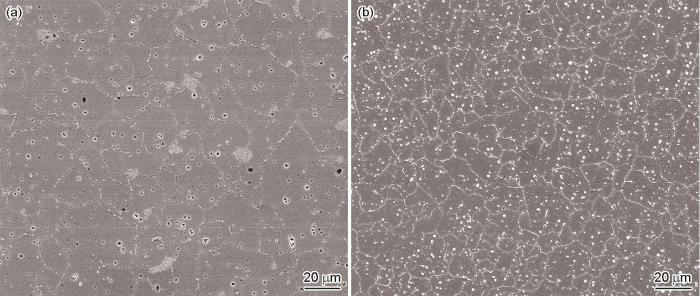
图9
M1和MA4合金1100 ℃固溶10 h的SEM照片
Fig.9
SEM images of M1 (a) and MA4 (b) alloys treated by solid solution at 1100 oC for 10 h
2.4 合金的力学性能
镍基ODS合金的主要强化机制,有弥散强化、细晶强化、位错强化以及固溶强化等[33,34]。两种合金中的纳米氧化物颗粒数量和尺寸有较大的不同,使合金的弥散强化效果也不同。M1和MA4合金的室温拉伸性能,如图10所示。可以看出,固溶处理后两种合金的延展性都明显提高,但是其强度降低。与M1合金比较,各工艺阶段MA4合金的强度均优于M1合金的强度,而且固溶和固溶+时效后前者比后者的抗拉和屈服强度高出的比例更大,由锻态、固溶态到固溶+时效态,MA4合金比M1合金的抗拉强度分别高出13.7%、13.1%和19.9%,屈服强度分别高出24.1%、30.8%和59.0%;MA4合金的延伸率低于或略低于M1合金的延伸率。固溶+时效处理后,MA4合金的延伸率仅约低于M1合金延伸率的12.9%。MA4合金在1000 ℃的抗拉强度达到105 MPa,屈服强度达到55 MPa,延伸率高达31.5%。时效处理后MA4合金的室温强度提高,但是M1合金的强度没有提高,因为时效处理后M1合金组织不均匀,晶粒尺寸差也较大。图11给出了M1和MA4合金锻造态的室温拉伸断口形貌。可以看出,两种合金的断口均有大量的韧窝。这表明,M1和MA4合金均为韧性断裂,但是M1合金的断口韧窝底部第二相颗粒比较粗大,有些颗粒上还出现了二次裂纹,并且M1合金断口上的韧窝比MA4合金断口上的深,这可能是M1合金的延伸率稍高的原因。
图10

图10
M1和MA4合金的室温拉伸性能
Fig.10
Ultimate tensile strength (a), yield strength (b) and total elongation (c) of M1 and MA4 alloys at room temperature
图11
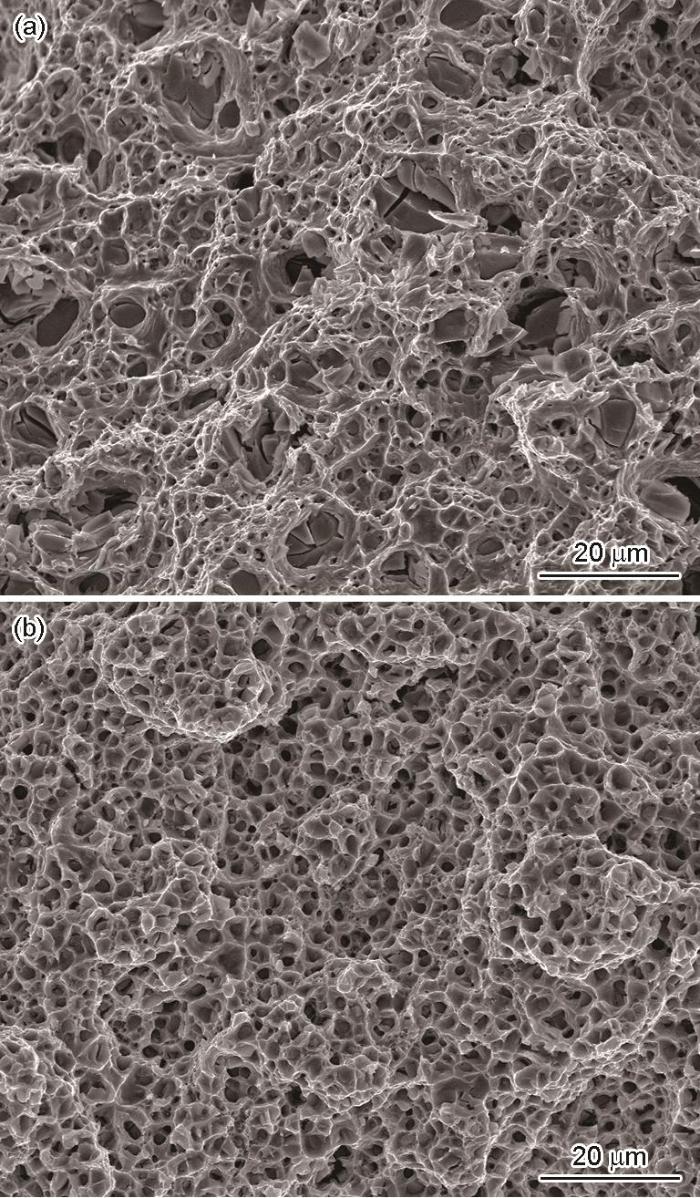
图11
锻态M1和MA4合金的室温拉伸断口形貌
Fig.11
Fracture morphologies of the forged M1 (a) and MA4 (b) alloys at room temperature
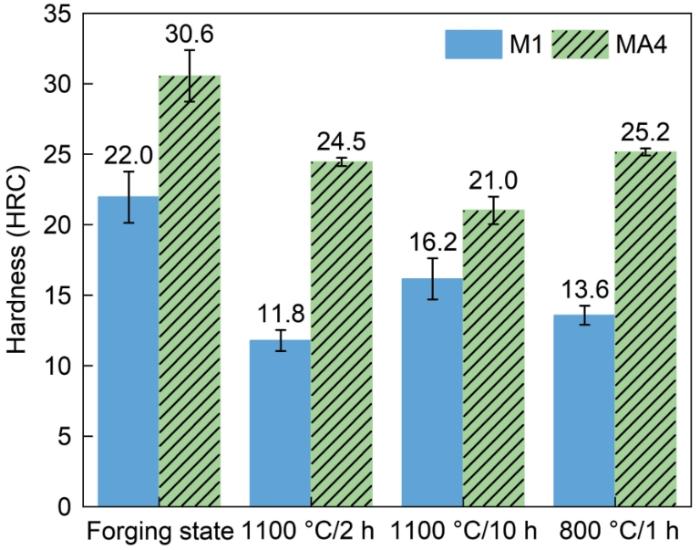
由图12可见,锻态M1和MA4合金的硬度分别为22.0HRC和30.6HRC,均比其固溶和固溶+时效处理态的硬度高,与拉伸强度的变化趋势一致。合金的硬度越高其抗拉强度越高,其原因是硬度表征材料抵抗局部变形的能力,决定于塑性变形抗力。随着材料抗拉强度的提高其抵抗变形的能力随之提高,硬度也相应的提高。两者都受材料微观结构的影响,因此会出现特殊情况:如M1合金经过时效处理后硬度增大但是抗拉强度降低,因为其组织均匀性降低。经过1100 ℃ × 2 h固溶后两者的硬度都明显降低,且随着固溶时间的延长MA4合金的硬度随之降低。经800 ℃ × 1 h时效后,M1和MA4合金的硬度分别为13.6HRC、25.2HRC,比只固溶2 h的硬度11.8HRC和24.5HRC有所提高。在时效过程中合金中析出第二相产生了沉淀强化,使合金的硬度提高。
图12
3 结论
(1) 用机械合金化工艺制备的MA4合金的组织稳定性和细化程度比用气雾化工艺制备的M1合金高,使MA4合金的抗拉强度和屈服强度高于M1合金;用固溶和固溶+时效热处理的MA4合金,其力学性能优异。
(2) 机械合金化比气雾化更适合制备镍基ODS合金。MA4和M1合金固溶处理后其延伸率均明显提高;时效后两者的延伸率均略有降低。
(3) 与M1合金相比,各工艺阶段的MA4合金中第二相颗粒分布更加弥散,第二相颗粒尺寸更小、数量更多,对晶界的钉扎作用更强,能抑制固溶处理和时效处理过程中晶界的迁移,使MA4合金的晶粒更细小更均匀和综合力学性能更优异。
参考文献
Fatigue crack growth mechanisms in powder metallurgy Ni-based superalloys—A review
[J].
The effect of the solution and aging treatments on the microstructures and microhardness of nickel-based superalloy
[J].
Oxide dispersion strengthened superalloys
[J].
氧化物弥散强化高温合金
[J].
Analysis and structural design of various turbine blades under variable conditions: A review
[J].
Overview of mechanical, microstructural, oxidation properties and high-temperature applications of superalloys
[J].
Status and development of powder metallurgy nickel-based disk superalloys
[J].
Nickel-based superalloys are crucial materials for the development of aero-engine components, since their excellent properties can meet the demands of turbine disks. For the formation of such alloys, powder metallurgy is considered as the ideal method, due to the resultant uniform composition and structure, fine grain, high yield strength, and good fatigue performance. This paper provides a critical review of the development of powder metallurgy nickel-based disk superalloys, their composition, as well as the evolution of the nickel-based superalloys' microstructure in the past few decades. Moreover, the influence of various elements on the material properties and the three major defects of powder metallurgy superalloys are reviewed. The analysis indicates that these defects may be directly or indirectly caused by the quality of the powder. Therefore, the innovative powder techniques of electrode induction melting gas atomization and spark plasma discharge spheroidization are presented, in order to prepare ceramic-free and superfine nickel-based superalloy powders. The powders prepared by electrode induction melting gas atomization and spark plasma discharge spheroidization have been found to be beneficial in improving the properties of powder metallurgy nickel-based disk superalloys.
Effect of orientation on the tensile and creep properties of coarse-grained INCONEL alloy MA754
[J].
Research progress of ODS nickel based superalloy
[J].Oxide Dispersion Strengthening(ODS) nickel-base superalloy strengthened by γ′ and oxide dispersion exhibits excellent creep resistance above 1000℃,which can be used as turbine blade material in advance jet engine.The fabrication process and three-step heat treatment to obtain coarse elongated grain were introduced.The main focus was on the special recrystallization behaviour and the effects of preannealing were analyzed,the moving speed of hot zone and the content of γ′ and Y<sub>2</sub>O<sub>3</sub> on secondary rescystallization were analyzed.Three kinds of theories including secondary rescystallization induced by the dissolution of γ′ or the coarsening of dispersion and the grain boundary nucleation theory were discussed.The high rescystallization temperature and high activation energy was explained.Finally,the mechanical properties of the material with fine grain and coarse elongated grain,as well as the effects of orientation and strain rate were analyzed.
ODS镍基超合金的研究进展
[J].
ALLVAC 718 Plus™ superalloy for aircraft engine applications
[J].
Elevated temperature strength of fine-grained INCONEL alloy MA754
[J].
Irradiation damage concurrent challenges with RAFM and ODS steels for fusion reactor first-wall/blanket: a review
[J].
Research progress on preparation technology of oxide dispersion strengthened steel for nuclear energy
[J].
Current research status of additive manufacturing of 316L stainless steel powder for nuclear power
[J].
核电用316L不锈钢粉末增材制造研究现状
[J].
Effect of oxide species and thermomechanical treatments on the strength properties of mechanically alloyed Fe-17%Cr ferritic ODS materials
[J].
Effect of three kinds of oxide on the strength properties of mechanically alloyed 17% Cr ferritic ODS materials
[J].
Research progress of dispersed oxides in ODS ferritic steels
[J].
ODS铁素体钢中弥散氧化物的研究进展
[J].
Improvement of high temperature mechanical properties of Ni-based oxide dispersion strengthened alloys by preferential formation of Y-Ti-O complex oxide
[J].
Preparation and performance of nickel-based oxide dispersion strengthened alloys
[D].
镍基氧化物弥散强化合金的制备与性能研究
[D].
Microstructural and tensile property differences between Ni-16Mo and ODS alloys fabricated by the powder metallurgy processes
[J].
Microstructure and mechanical properties of Y2O3 strengthened Inconel 625 alloy fabricated by selective laser melting
[J].
Effect of high-energy ball milling on the microstructure and mechanical properties of Ni-based ODS alloys fabricated using gas-atomized powder
[J].
Effect of vacuum degassing on hot workability of hot isostatic pressed powder metallurgy superalloy
[J].
真空脱气对热等静压态粉末高温合金热加工性能的影响
[J].
Mechanical properties and microstructural evolution of nickel-based superalloys
[J].
Effect of mechanical alloying on the microstructural evolution of a ferritic ODS steel with (Y-Ti-Al-Zr) addition processed by Spark Plasma Sintering (SPS)
[J].
Effect of mechanical alloying on the microstructural properties of powder particles for oxide dispersion strengthened ferritic steels
[J].
机械合金化对ODS铁素体钢粉末的微观形貌和结构的影响
[J].
Influence of Zr addition on the microstructure and mechanical properties of 9CrTi-ODS steels
[J].
Role of Al addition and Y2O3 on the intergranular corrosion behavior of AFA-ODS steel in the supercritical water
[J].
Effects of Al addition on high temperature oxidation behavior of 16Cr ODS steel
[J].
Effect of Ti addition on thermal stability and phase evolution of super-invar based yttria added ODS alloys developed by mechanical alloying and spark plasma sintering
[J].
Phase equilibria and thermodynamics in the Y2O3-Al2O3-SiO2 system
[J].
The comparison of microstructures and mechanical properties between 14Cr-Al and 14Cr-Ti ferritic ODS alloys
[J].
Effects of hot deformation and heat treatment on grain structure evolution of GH4080A superalloy
[J].
热变形和热处理对GH4080A高温合金微观组织演化的影响
[J].
Recrystallization activation energy in mechanically alloyed oxide-dispersion-strengthened metals measured by differential scanning calorimetry
[J].
Electron force-induced dislocations annihilation and regeneration of a superalloy through electrical in-situ transmission electron microscopy observations
[J].What effect does electric current do on dislocation evolution of metals keeps being a confusing question to be answered and proved. To this end, the dislocation evolution of a superalloy with electric current was directly observed by electrical in-situ transmission electron microscopy in this work. Dislocations annihilation at first and then regeneration was found for the first time, which directly proves the existence of electron force during the electrically-assisted manufacturing. Dislocations regeneration would be driven by the electron force and the resistance softening by the local Joule heating effect. Resultantly, a base could be provided for future electrically-assisted research.


