



应用应变时效工艺,可大幅度提高钢的屈服强度。应变时效,是钢在塑性变形时或变形后其中的溶质组元与位错的弹性交互作用使其性能发生变化[5]。也就是,钢发生塑性变形后晶格出现了滑移层而扭曲,使其对固溶合金元素的溶解能力下降,呈现出饱和或过饱和状态而使被溶物质扩散和析出。加热使原子的活力提高,使固溶体内的过饱和物质加速析出而产生时效,从而使材料的屈服强度提高。王娇娇[6]研究了不同预应变对一种高强塑积含Al中锰钢的影响。结果表明,预应变量的增大使钢内铁素体中的位错密度提高,稳定性较低的大尺寸奥氏体先发生相变,使屈服强度由预应变量为0%时的732 MPa提高到预应变量为25%时的1106 MPa。Lee和Su[7]研究AISI 4340高强度合金钢时发现,回火温度和保温时间显著影响其组织结构和力学性能,回火马氏体的强度和硬度随着回火温度的提高和保温时间的延长而降低。Euser等[8]发现,4340钢的延展性随着回火温度的提高和保温时间的延长而提高。Liu等[9]对中锰钢进行应变时效处理,使其屈服强度高达2294 MPa,均匀延伸率超过10%。对大型构件进行热处理时,控制回火时间至关重要[10]。回火时间过短,大型构件不能达到目标温度,而时间过长则使热处理效率降低。本文设计并制备一种Fe-0.34C-7.4Mn-1Si-0.2V马氏体/奥氏体中锰钢,研究预应变后回火时间不同的试样的微观组织、力学性能及其机制,以及烘烤硬化(BH)效应对其强度的影响。
1 实验方法
实验用中锰钢的设计成分(质量分数,%)为Fe-0.34C-7.4Mn-1Si-0.2V(其中的C/Mn可提高奥氏体的稳定性、Si能抑制碳化物形成,V可细化晶粒促进析出强化)。使用Thermal-Calc软件计算出其完全奥氏体化温度Ae3为655 ℃。用真空感应熔炼实验用中锰钢。将钢坯锻造后切割成尺寸为100 mm(长) × 60 mm(宽) × 60 mm(高)的坯料用于轧制。如图1所示:轧制前,将坯料放入温度为1200 ℃的箱式炉中保温2 h。使用Ф450二辊可逆式热轧机进行两阶段控制轧制,将60 mm厚的坯料热轧至4 mm厚。第一阶段,将坯料的厚度轧至20 mm,终轧温度为1100 ℃;待温度降至850 ℃开始第二阶段轧制,将坯料的厚度轧至4 mm,终轧温度约为800 ℃。轧制完成后,将坯料空冷至室温。从热轧板上取料制成标距为10 mm的拉伸试样,并对其进行4%的预应变。再将预应变试样在200 ℃回火不同时间(20 min、1 h、 2 h)。对每组试样进行三次拉伸,取其结果的平均值。
图1

将从坯料上截取的金相试样在4%硝酸酒精溶液腐蚀,然后用FEI QUANTA 600扫描电镜(SEM)观察其显微组织。用电子背散射衍射(EBSD)观察奥氏体分布并测定晶粒尺寸和位错密度,步长为0.12 μm。使用X射线衍射仪(XRD)测定钢的XRD谱,Cu靶,扫描角度为40°~105°。将XRD和EBSD试样机械研磨后在900 mL酒精和100 mL高氯酸混合溶液中进行电解抛光,工作电压为22 V、抛光时间为25 s。计算奥氏体(200)γ、(220)γ、(311)γ衍射峰、铁素体(200)α和(211)α衍射峰的积分强度。残余奥氏体的体积分数为[11]
计算平均位错密度。式中
式中
式中h、k和l为衍射峰的Miller指数。根据线性拟合直线的斜率可计算位错密度[14]
式中m为拟合直线的斜率, b 为Burgers矢量,结构为BCC取值为0.248 nm,结构为FCC取值为0.25 nm[15]。
用AG-X plus 100 kN拉伸机进行拉伸实验,根据ASTM A370-14标准拉伸试样的标距为10 mm,平行段长度为12 mm,平行段的宽度为4 mm,拉伸速率为1 mm/min,用视频引伸计测定伸长率。
2 结果和讨论
2.1 回火时间对实验钢组织的影响
图2给出了热轧态在200 ℃回火1 h试样和4%预应变后回火不同时间试样的SEM照片。可以看出,沿轧制方向分布着少量发亮的细长条带状组织,在其周围有黑色的树枝状组织,是典型的热轧带状形貌。这种组织中绝大部分是板条马氏体,奥氏体分布在马氏体之间。4%预应变试样的回火时间延长后,在SEM下难以观察到组织的变化。
图2

图2
不同回火时间试样的SEM照片
Fig.2
SEM microstructure of sample of different tempering time (a) initial sample; (b) 20 min; (c) 1 h; (d) 2 h
图3给出了热轧态在200 ℃回火1 h试样和4%预应变后回火不同时间试样的组织,其中红色部分为FCC相,蓝色部分为BCC相,黑色部分为未识别区域。从图3a可以看出,未预应变的初始试样其组织中奥氏体较多且大部分为块状,其晶粒尺寸较大平均尺寸为1.3 μm。而预应变试样发生TRIP(相变诱导塑性)效应,大块不稳定的奥氏体转变为马氏体后分解为细小的片状,使其体积分数降低和晶粒尺寸减小。随着回火时间由20 min延长到1 h,奥氏体晶粒的尺寸有所增大但是体积分数没有明显的变化。图4统计了不同回火时间试样中奥氏体的晶粒尺寸。可以看出,回火时间为20 min、1 h、2 h的试样中奥氏体晶粒的面积加权平均尺寸分别为0.4 μm、0.6 μm、1 μm。随着回火时间的延长,奥氏体的晶粒尺寸随之增大。其主要原因是,在回火过程中元素的配分导致FCC/BCC的界面迁移[16,17]。图3e给出了预应变试样的透射电镜照片,可见薄膜状纳米级奥氏体析出物。
图3

图3
不同回火时间试样的组织
Fig.3
Microstructure of sample of different tempering time (a) initial sample; (b) 20 min; (c) 1 h; (d) 2 h; (e) 1 h
图4

图4
不同回火时间试样RA尺寸统计
Fig.4
Statistics of RA size of samples of different tempering time (a) initial sample; (b) 20 min; (c) 1 h; (d) 2 h
图5

图5
初始试样和回火时间不同的预应变试样的XRD谱和奥氏体体积分数
Fig.5
XRD patterns (a) and austenite volume fraction (b) of the initial samples and pre-strained samples at different tempering times
2.2 预应变后的回火时间对实验钢拉伸性能的影响
图6a给出了原始试样的工程应力-应变曲线,图6b给出了预应变后不同回火时间试样的拉伸应力-应变曲线,其力学性能列于表1。可以看出,未预应变试样的屈服强度为1025 MPa,而预应变后回火20 min试样的屈服强度为2198 MPa。其原因是,预应变使试样中产生了高密度的位错。在时效过程中,碳原子扩散形成的Cottrell气团锁定位错而使屈服强度显著提高。不同回火时间的试样其拉伸曲线表明,随着回火时间的延长预应变试样的屈服强度提高,由回火20 min的2198 MPa提高到回火2 h时的2311 MPa;均匀延伸率呈下降的趋势,由回火20 min时的10.3%下降到回火2 h时的9.1%。屈服强度提高的原因是,回火时间的延长促进了C原子的扩散。C原子的充分扩散使沉积在可动位错附近的固溶C原子数量增多和提高了BH效应,从而使屈服强度提高。延伸率下降的原因是,一方面回火时间的延长使奥氏体的体积分数降低和TRIP效应减弱,宏观上表现为塑性降低;另一方面,虽然充分回火可提高材料屈服强度,但是过长的回火时间使C原子偏聚或生成过渡碳化物[18]。过渡碳化物对位错极强的钉扎使其在变形过程中难以形成位错胞结构,在一定程度上降低了材料的加工硬化性能而使延伸率降低[19]。预应变后回火20 min、1 h、2 h的试样其强塑积分别为44.8 GPa·%、42.6 GPa·%、39.3 GPa·%,其中预应变后在200 ℃回火1 h的试样其综合力学性能最优,屈服强度达到2300 MPa级别,均匀延伸率达到10%。随着回火时间的延长,预应变实验钢试样的屈服强度和抗拉强度的波动幅度小于5%,其均匀延伸率稳定在9.1%~10.3%,表明其性能对回火时间的敏感性较低。这种优异的时效稳定性源于预应变引入的高密度位错与BH效应的协同作用,使力学性能在较宽的时间窗口(20 min~2 h)内趋于平稳。
图6
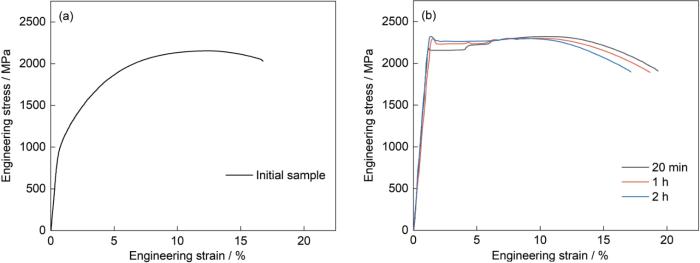
图6
不同回火时间试样的工程应力-工程应变曲线
Fig.6
Engineering stress-engineering strain curves of samples at different times (a) initial sample; (b) pre-strained samples
表1 不同回火时间试样的力学性能
Table 1
| Process | Yield strength / MPa | Tensile strength / MPa | Uniform elongation / % | Total elongation / % |
|---|---|---|---|---|
| Initial sample | 1025 | 2154 | 12.5 | 16.7 |
| 20 min | 2198 | 2321 | 10.3 | 19.3 |
| 1 h | 2301 | 2289 | 10 | 18.6 |
| 2 h | 2311 | 2297 | 9.1 | 17.1 |
图7给出了初始试样和预应变时效试样的加工硬化率曲线。可以看出,初始试样的加工硬化率呈现稳定下降的趋势,含量较高且稳定性适当的奥氏体使初始的均匀延伸率较高(达到了12.5%)。而预应变试样的加工硬化率分为三个阶段:第Ⅰ阶段,加工硬化率急速下降。随着真应变的增大进入第Ⅱ阶段,表现为屈服点延伸。第二阶段开始时预应变试样加工硬化率的变化较为平缓,开始形成吕德斯带,几乎不发生TRIP效应[9,18]。随着应变量的提高残余奥氏体相变变为马氏体,TRIP效应的发生使生成的硬相马氏体加工硬化性能更好;同时,奥氏体发生相变转变为马氏体,产生的体积膨胀和马氏体内位错密度的提高增强了各相之间的协调变形,使加工硬化指数不断提高。在第Ⅲ阶段先发生TRIP效应,表现为加工硬化率的提高,延伸率继续提高到大约10%,使加工硬化不足以抵抗真应力而使加工硬化率的降低,从而使材料发生颈缩。
图7

2.3 预应变后的回火时间对实验钢硬化行为的影响
预应变试样低温回火后发生显著的BH效应。拉伸变形提高了位错密度,低温烘烤促进了碳原子的扩散使其在位错附近形成气团。这种气团钉扎住位错而增大了进一步开动位错的应力,在宏观上表现为试样的强度提高。可进行拉伸实验测定BH值,即实验钢发生一定的变形和烘烤后进行拉伸。烘烤后的屈服强度与烘烤前的预应变应力的差值,就是BH值。烘烤时间对预应变试样BH值的影响,如图8所示。可以看出,烘烤时间从20 min延长到2 h其BH值从460 MPa增大到573 MPa,显著高于现有应变时效钢的BH值(0~250 MPa)[20~23]。其原因是,本文实验用钢预应变产生的新鲜马氏体其碳含量更高且位错密度也明显提高。烘烤时间决定了固溶C原子的扩散数量。烘烤时间越长则扩散的C原子越多,使沉积在可动位错附近的固溶C原子数量越多,则参与形成Cottrell气团的固溶C原子数量随之增多,从而使BH值增大,进而使试样的屈服强度提高。随着回火时间的延长C原子达到饱和,时效行为也随之饱和[24]。
图8
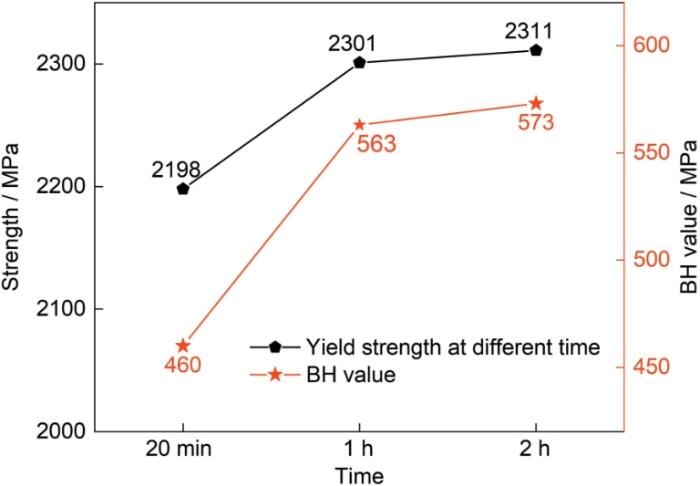
图8
不同回火时间应变试样的BH值
Fig.8
BH values of pre-strained samples under different tempering times
预应变后回火不同时间的试样其屈服强度均高于2000 MPa,位错演变的作用至关重要。位错演变,影响预应变试样在加载过程中的位错强化和烘烤硬化。由图9可见,预应变提高了初始试样中的位错密度而产生位错强化,从而提高了试样的屈服强度。而延长预应变试样的回火时间,虽然发生的位错回复使马氏体中的位错密度不断降低,但是BH效应也进一步提高。位错强化和BH的协调变化,影响材料最终的屈服强度。可根据
计算位错强化。其中G为剪切模量(GPa); b 为Burgers矢量;α为常数;M为Taylor因子;ρ为位错密度(cm-2)。其中Gα 取值为80 GPa,Gγ 取值为72 GPa;Burgers矢量 b,结构为BCC取值为0.248 nm,结构为FCC取值为0.25 nm;αα = 0.25,αγ = 0.35;Mα 取值为3,Mγ 取值为3.06。
图9

图9
不同回火时间应变试样马氏体中的位错密度
Fig.9
Dislocation density of martensite in pre-strained samples under different tempering times
由表2可以看出,初始试样的位错强化值为440 MPa,而4%预应变后回火20 min、1 h、2 h试样的位错强化值分别为1086 MPa、979 MPa、947 MPa。
表2 对屈服强度的贡献
Table 2
| Sample | BH/ MPa | YS/ MPa | ||||
|---|---|---|---|---|---|---|
| Initial | 440 | - | - | - | 1025 | - |
| 20 min | 1086 | 646 | 460 | 1106 | 2198 | 1173 |
| 1 h | 979 | 539 | 563 | 1102 | 2301 | 1276 |
| 2 h | 947 | 507 | 573 | 1080 | 2311 | 1286 |
3 结论
(1) 这种中锰钢热轧后空冷,初始试样回火后的组织为板条马氏体/奥氏体。4%预应变使试样中的奥氏体体积分数由31%降低到约8%。在预应变过程中奥氏体发生TRIP效应转变为马氏体,使奥氏体的体积分数降低和尺寸减小。
(2) 回火时间的延长使预应变试样中的奥氏体体积分数略微降低。随着回火时间的延长试样的屈服强度提高,其性能对回火时间的敏感性较低,工艺窗口较宽。
(3) 预应变后回火试样的屈服强度大幅度提高,烘烤时间的延长使试样的BH值增大。屈服强度提高的主要原因,是预应变引起的位错强化和BH效应。
参考文献
Precipitate evolution and strengthening behavior during aging process in a 2.5 GPa grade maraging steel
[J].
Ultrastrong low-carbon nanosteel produced by heterostructure and interstitial mediated warm rolling
[J].
We break the limit of grain refinement and strength of low-carbon steel by tuning deformation compatibility of heterostructure.
A novel medium-Mn steel with superior mechanical properties and marginal oxidization after press hardening
[J].
High dislocation density-induced large ductility in deformed and partitioned steels
[J].A wide variety of industrial applications require materials with high strength and ductility. Unfortunately, the strategies for increasing material strength, such as processing to create line defects (dislocations), tend to decrease ductility. We developed a strategy to circumvent this in inexpensive, medium manganese steel. Cold rolling followed by low-temperature tempering developed steel with metastable austenite grains embedded in a highly dislocated martensite matrix. This deformed and partitioned (D and P) process produced dislocation hardening but retained high ductility, both through the glide of intensive mobile dislocations and by allowing us to control martensitic transformation. The D and P strategy should apply to any other alloy with deformation-induced martensitic transformation and provides a pathway for the development of high-strength, high-ductility materials.Copyright © 2017 The Authors, some rights reserved; exclusive licensee American Association for the Advancement of Science. No claim to original U.S. Government Works.
Effect of pre-strain on microstructure, properties and hydrogen embrittlement of a novel Al-containing medium Mn steels
[D].
预应变对含Al中锰钢组织性能与氢脆敏感性的影响
[D].
Mechanical properties and microstructural features of AISI 4340 high-strength alloy steel under quenched and tempered conditions
[J].
Effects of short-time tempering on impact toughness, strength, and phase evolution of 4340 steel within the tempered martensite embrittlement regime
[J].
Correlation of TRIP effect and Lüders band in a 2.3 GPa ultra-high yield strength medium Mn steel with martensite matrix
[J].
Properties optimization of 9CrV steel for large piston based on microstructure and structure control
[J].In order to solve the imbalance between strength and toughness in different cross sections of a large size piston for hydraulic crushing hammer, the influence of heat treatment and microstructural adjustmen/control on the microstructure and mechanical properties of 9CrV steel near-real shaped piston with a diameter of 190 mm was studied. The results show that when the piston were austenitized at 850℃ for 5 h and quenched at 230℃ for 4 h, then tempered at 230℃ for 4 h, the microstructure of a piston consists of bainite, bainite + troostite + residual austenite and pearlite respectively, from the surface to the core. The tensile strength of the piston surface layer is 1442 MPa, the impact absorbed energy is 11 J, the impact toughness in the piston core part is poor, and the impact toughness is the lowest at 2/3 R of the piston. When the austenitizing temperature is decreased to 800℃ and tempering temperature is increased to 400℃, the tensile strength of the piston surface layer increased to 1610 MPa, and the impact absorbed energy decreased to 7.4 J. The impact toughness of the piston core shows an increasing tendency, while the strength will decrease. When the piston is austenitized at 800℃ for 5 h and followed by quenching at 230℃ for 4 h, then tempering first at 230℃ for 4 h and then at 400℃ for 4 h, the tensile strength of the piston surface layer becomes 1672 MPa, the impact absorbed energy becomes 9.8 J. The impact toughness of piston core part has been improved, and the combination of strength and toughness of the piston tend to balance. It is found that with the lower austenitizing temperature a large number of undissolved carbide particles will be retained, it will hinder austenite growing, but refine grains. With the increasing tempering temperature, the dislocation tangles to pearlite ferrite will be restored, and the toughness of piston core can be improved. The carbon-rich residual austenite film in the bainite of piston surface layer is stable. When it is tempered at 400℃, the carbide thin film will precipitate during the decomposition of residual austenite, which is easy to become a rapid crack propagation path and reduce the impact toughness. The residual austenite was transformed into lower bainite by tempering at 230℃ to prevent the formation of thin-film carbides by tempered at 400℃ to improve the impact resistance of piston core, so that the toughness becomes balance in the different cross section parts of a piston. Based on the combination of optimizing and controlling of piston microstructure and heat treatment process, the strength and toughness of the piston are balanced.
基于组织和结构调控9CrV钢大尺寸活塞性能的优化
[J].
Effects of hot deformation and subsequent austempering on mechanical properties of high silicon and low silicon TRIP steel
[J].\n In the present paper, effects of hot deformation and subsequent austempering on the mechanical properties of high silicon and low silicon transformation induced plasticity (TRIP) steel were investigated. The results have shown that polygonal ferrite, granular bainite and a large amount of stabilised retained austenite can be obtained by thermomechanical processing (TMP). Mechanical properties increase with increasing finish rolling reduction and decreasing finish rolling temperature because of the stabilisation of retained austenite. The tensile strength and the total elongation of both steels reach the maximum (791, 794 MPa and 36, 37% respectively). Isothermal holding for 20 min at 400°C after hot deformation is the optimal process. Low silicon TRIP steel shows a larger uniform elongation owing to a stable\n n\n value, and it exhibits better mechanical properties than conventional high silicon TRIP steel.\n
The effect of dislocation contrast on x-ray line broadening: a new approach to line profile analysis
[J].The x-ray line profiles of an ultrafine grained copper crystal, produced by equal-channel angular pressing, were measured by a special high resolution diffractometer with negligible instrumental line broadening. The analysis of the line breadths and the Fourier coefficients have shown that taking into account the contrast caused by dislocations on line profiles gives new scaling factors in the Williamson–Hall plot and in the Warren–Averbach analysis, respectively. When strain is caused by dislocations the new procedure proposed here enables a straightforward determination of particle size and strain, the latter in terms of the dislocation density.
An improved X-ray diffraction analysis method to characterize dislocation density in lath martensitic structures
[J].
Obtaining ultrastrong and ductile steel with hierarchical lamellar duplex phase microstructure by two-stage martensitic transformation mechanism
[J].
Microstructure-mechanical properties relationships for quenching and partitioning (Q&P) processed steel
[J].
In situ austenite-martensite interface mobility study during annealing
[J].
Influence of interface mobility on the evolution of austenite–martensite grain assemblies during annealing
[J].
Achieving unprecedented yield strength of 2.2 GPa with high ductility in formed parts using strain-aging
[J].
The effect of structure on the deformation of as-quenched and tempered martensite in an Fe-0.2 pct C alloy
[J].
On the low temperature strain aging of bainite in the TRIP steel
[J].
Static strain aging phenomena in cold-rolled dual-phase steels
[J].
Bake hardening of 7Mn-3Al-0.2C steel: influence of intercritical annealing temperature
[J].
The anisotropic kinetics of strain aging in a martensitic steel
[J].


