



交联聚乙烯(XLPE)的力学性能和电学性能优异,广泛用于制造高压电缆[1]。但是,在XLPE的使用过程中出现三个问题[2,3]:(1) 对高载流能力需求的不断提高使其长期工作温度高于当时XLPE的额定工作温度(约为90 ℃),这加速了材料的老化甚至击穿并限制其在更高电压下的应用。(2) 在交联过程中产生的副产物(如甲烷和苯酚)易在直流电场下积累空间电荷,使其内部电场畸变而导致老化和出现故障。虽然在制造过程中进行高温脱气可去除副产物,但是使成本提高。(3) XLPE作为一种热固性材料很难回收利用,焚烧和填埋造成环境污染。因此,为了进一步提高电缆的性能和不污染环境,亟须开发新型可回收电缆绝缘材料[4]。
半导电屏蔽层是电缆的关键组成部分,能防止电荷在绝缘层和导体之间的界面上积聚而避免局部放电,可保护绝缘层提高电缆的稳定性[16,17]。制造绝缘层,需用具有高兼容性和适用性的半导电屏蔽材料。制造电力电缆采用三层共挤工艺,即将外屏蔽、绝缘层、内屏蔽同时挤出成型,要求三部分的加工工艺保持一致。因此,须开发与PP绝缘层匹配的半导电屏蔽层材料。碳黑含量较高的PP较脆且加工流动性较差,不利于碳黑的分散。混合弹性体,可改善炭黑分散性和提高PP韧性 [18,19]。作为新一代弹性体,OBC比POE等传统弹性体的机械性能和热性能更好[20]。OBC中特殊的嵌段分子结构使其具有比其他弹性体(POE、SEBS等)更好的抗冲击性、抗压缩变形性和更高的耐热温度[21]。本文选择不同含量的OBC作为弹性体并使用CB导电填料制备PP基半导电屏蔽材料,研究OBC含量对其电学、热学和力学性能的影响。
1 实验方法
1.1 材料的制备
实验用材料:PP F401,熔体流动指数约为2.0~3.0 g/10 min (230 ℃,2.16 kg),拉伸强度约为30 MPa,密度约为0.90 g/cm3;OBC Infuse 9507,密度为0.866 g/cm3,熔体流动指数约为5 g/10 min (190 ℃/2.16 kg),拉伸强度约为7 MPa,断裂伸长率约为1900%;CB Vulcan XC72r,碘吸附253 mg/g,油吸附192 cc/100 g,325目残留物< 10 × 10-6。
表1 各试样的成分
Table 1
| Sample | PP / % | OBC / % | CB / % |
|---|---|---|---|
| OBC-21 | 49 | 21 | 30 |
| OBC-28 | 42 | 28 | 30 |
| OBC-35 | 35 | 35 | 30 |
1.2 性能表征
使用平板硫化机将材料压制成厚度约为1 mm的薄片。将试样分为两组,对其中一组的脆断表面进行真空喷金;另一组脆断后浸入80 ℃的正庚烷中保持30 min,然后用酒精将其清洗并对刻蚀表面进行真空喷金。用扫描电子显微镜S4800分析其表面。
使用白光干涉仪Micro XAM 3D观察注塑成型样品表面的三维形貌。
使用Q20热分析仪分析样品的热行为,在实验过程中用高纯度氮气保护。在30 ℃平衡5 min后以10 ℃/min的速率升温至200 ℃,然后以相同的速率冷却至30 ℃,重复两次。实时记录热流,重点分析第二周期的数据以确保结果的可靠性。
使用WSM-20 kN电子万能实验机测试表面光滑、无明显缺陷的哑铃形试样的力学性能,拉伸速度为50 mm/min,测试5次取其结果的平均值。试样的厚度为4 mm,宽度为5 mm,平行部分的长度为40 mm。
使用Q800型动态力学分析仪测试试样的动态力学性能。测试前,将试样放入80 ℃的真空干燥箱中干燥12 h以去除残留水分,以3 ℃/min 的速度将试样的温度从30 ℃升至165 ℃。实验在氮气环境中的应变控制模式下进行以保持试样的接触稳定性。振动频率为1 Hz,预载为0.01 N。
使用万用表UT 131A测试试样的体电阻率,试样的尺寸为40 mm × 10 mm × 1 mm,在其两端贴导电铜箔。将试样的温度从30 ℃升至140 ℃,每隔5 ℃收集一个数据点。试样的体电阻率(Ω·cm)为
其中Rv 为试样的电阻(Ω);W、d、L分别为试样的宽度、厚度和长度(cm)。
表征半导电屏蔽材料的电阻率对温度的依赖性[22]。式中ρ0为材料的室温电阻率(Ω·cm),ρmax为材料测试中的最大电阻率(Ω·cm)。
以不同成分的屏蔽材料为电极,用脉冲电声法(PEA)和空间电荷测试仪HY-PEA-DPT01测试纯PP标准试样的空间电荷和内部电场的时空分布。实验温度为30 ℃。在试样两端施加直流高压将其极化600 s,试样处于10、20、30和40 kV/mm的电场中。不同OBC含量的屏蔽层对PP绝缘层的空间注入不同的电荷,PP中电荷体积密度的平均值[23]为
其中Q为电荷体积密度的平均值(C/m3),L为绝缘层的厚度(m),ρ(x,t)为用PEA测得的电荷密度(C/m3),x为位置(m),t为极化时间(s)。
2 结果和讨论
2.1 OBC对CB在基体中分布的影响
图1给出了不同试样的脆断表面,图中标注的点为CB颗粒。可以看出,复合材料中的CB颗粒以团簇的形式分布,团簇之间相互连接形成了导电网络。在OBC-21样品中,在特定区域CB颗粒明显聚集,在其他区域较少。随着OBC含量的提高,CB的分布区域扩大。这表明,CB颗粒选择性地分布在复合材料中。与PP相比,OBC与CB之间较高的结合能使CB倾向于优先分布在OBC相中。
图1
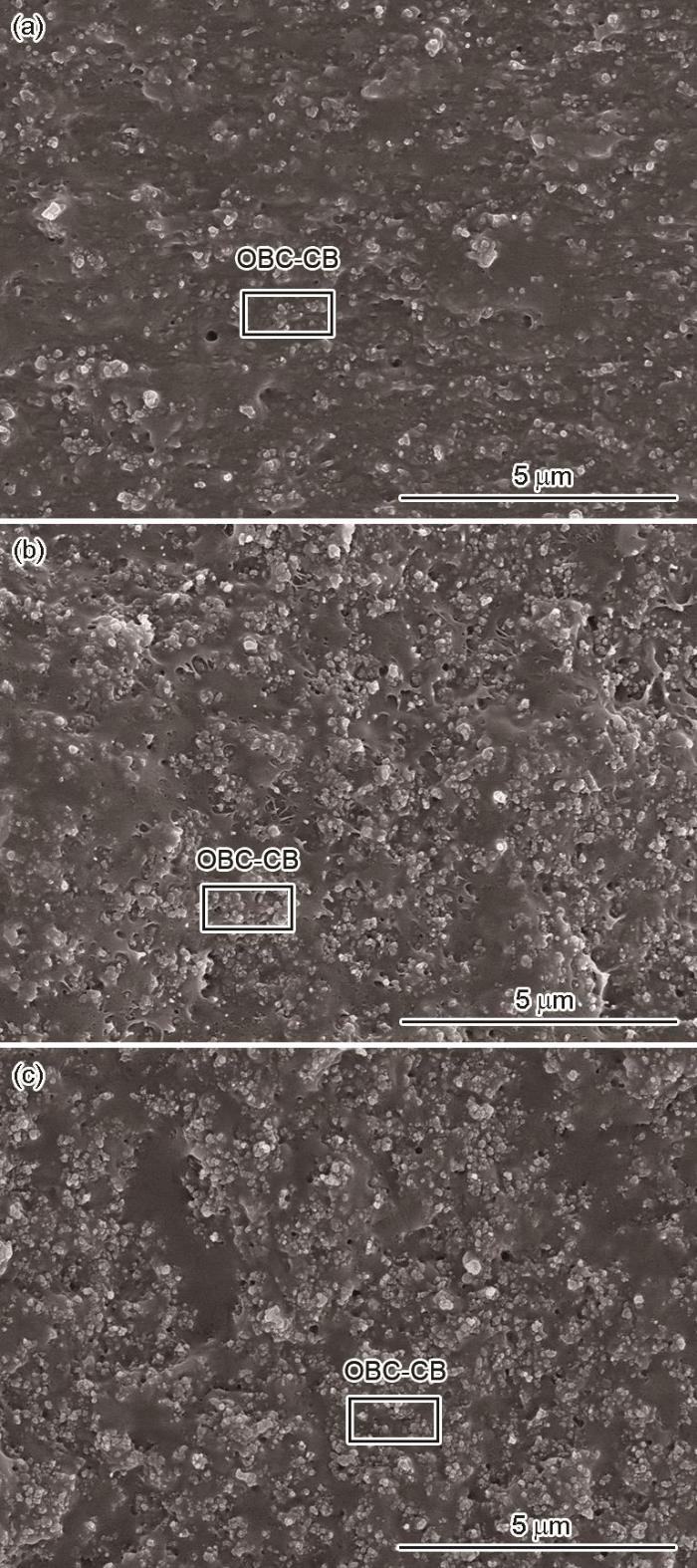
图1
样品脆断表面的扫描电子显微镜照片
Fig.1
Scanning electron microscope images of the brittle fracture surfaces of the samples (a) OBC-21, (b) OBC-28, (c) OBC-35
为了更加清晰地观察CB在聚合物基体中的分布,将脆断后的试样浸入正庚烷中刻蚀。如图2所示,正庚烷溶解了OBC而保留了PP的结构,能更清晰地观察到弹性体和导电填料的分布。明显可见,材料中出现了蜂窝状结构,是蚀刻的OBC。随着OBC含量的提高蚀刻区域的体积随之增大。同时可见,蚀刻OBC在PP中形成了网络状结构。OBC-21的连接部分尺寸较小,而OBC-35则形成了连接较好的网络,在PP中的体积较大。蚀刻掉OBC暴露出CB颗粒,可见CB主要分布在OBC相中。
图2

图2
样品浸入正庚烷并在80 ℃保持30min后脆断表面的扫描电镜照片
Fig.2
Scanning electron microscope images of the brittle fracture surfaces of the samples after immersed in n-heptane and kept at 80 oC for 30 min (a) OBC-21, (b) OBC-28, (c) OBC-35
2.2 OBC对材料表面粗糙度的影响
表面粗糙度是评估屏蔽层效果的重要参数。屏蔽层的表面越光滑,电场均匀化的能力就越强。如图3所示,材料表面有褶皱状起伏。表面轮廓的算术平均偏差(Sa)是评估表面粗糙度的主要参数。OBC的含量越高,样品表面越粗糙。OBC-21、OBC-28、OBC-35样品的Sa分别为0.6440 μm、0.6700 μm和0.9830 μm。在结晶过程中,结晶区和无定形区的收缩率不同。结晶区的分子链有序而紧密,体积的收缩更为明显;无定形区的分子链无序,自由体积较大,因此收缩速度较低。这种差异,使材料表面出现褶皱状起伏。
图3
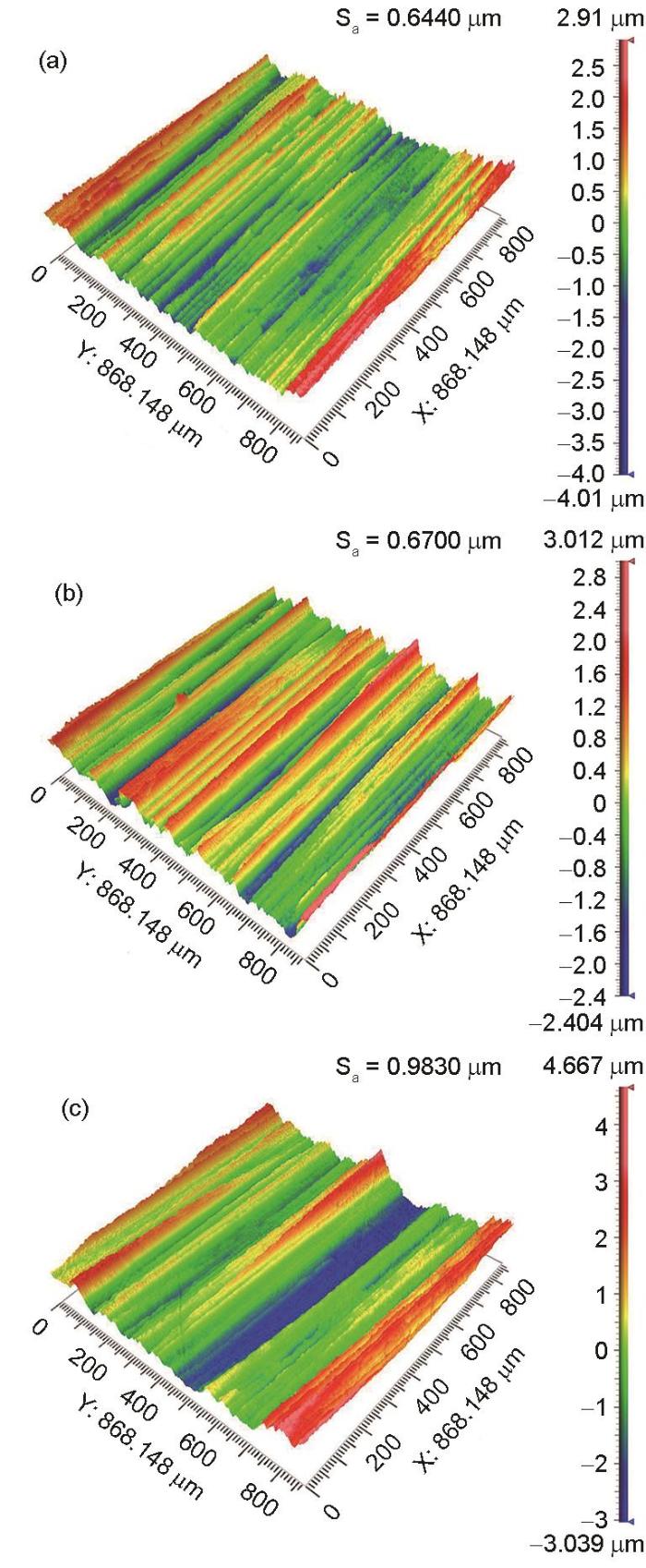
图3
各试样的表面粗糙度
Fig.3
Surface roughness of each specimen (a) OBC-21, (b) OBC-28, (c) OBC-35
2.3 OBC对材料力学性能的影响
如图4所示,随着OBC含量的提高复合材料的断裂伸长率显著提高,符合弹性体增韧的一般规律。但是,拉伸强度则略有下降,其原因是:一方面,高填充量的CB (30%)缓解了体系中弹性体含量提高所致的拉伸强度的降低;另一方面,OBC中的硬段保证弹性体相具有一定的强度和耐热性,不像完全无定形橡胶那样过度削弱复合材料的整体强度。例如,OBC-21的断裂伸长率为241%,而OBC-35则大幅提高到了396%。同时,OBC-21的拉伸强度为13.05 MPa,而OBC-35的则下降到12.82 MPa。
图4
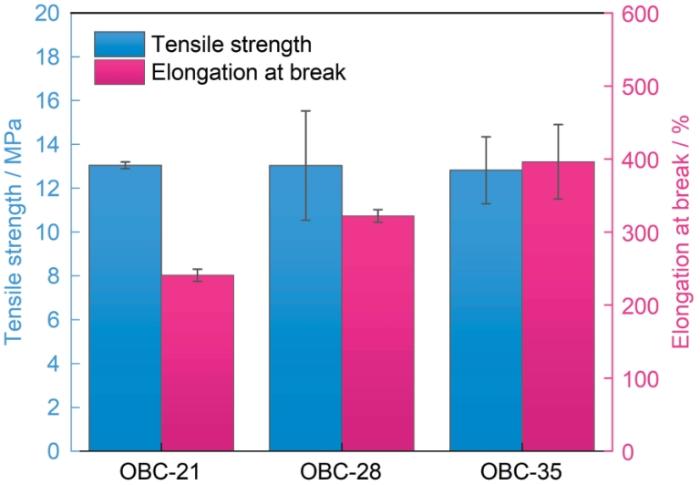
图4
OBC含量对复合材料力学性能的影响
Fig.4
Effect of OBC content on mechanical properties of composites
有研究表明,OBC等弹性体还能诱导PP基体形成β型结晶,增大塑性变形能力。Zhang等[24]发现,PP/EPDM共混物中加入15份OBC使PP生成β晶型结构。β晶的形变能力远高于常规α晶,可增强材料的韧性。因此,本文体系中OBC的加入促进PP生成β晶型结构,是断裂伸长率随OBC增加而显著提高的原因。对比文献报道的实验室配方,如PP/POP/CB复合材料约14.44 MPa的拉伸强度和420%的断裂伸长率[19],PP/POE/CB复合材料约16 MPa的拉伸强度和约508%的断裂伸长率[25],PP/SEBS/CB复合材料约24 MPa的拉伸强度和约709%的断裂伸长率[25],以及某商用热塑性半导电料产品的拉伸强度约13.5 MPa,断裂伸长率约420%。本文材料的力学性能,与商用材料的性能相近。
2.4 OBC对材料动态力学性能的影响
用DMA测量了试样在固定频率应力作用下的储能模量和损耗模量随温度的变化,以得到试样分子链的运动状态。这种材料的DMA曲线如图5所示。可以看出,储能模量随着OBC含量的提高而降低。这表明,OBC含量的提高降低了系统的刚性,从而使其免于开裂。同时,损耗模量随着温度的升高而下降的趋势,反映出温度升高使材料的能量耗散增强。损耗因子进一步凸显了OBC对材料动态力学性能的重要影响。在低温区域损耗因子较低,表明在此温度范围内材料的弹性优异;但是,随着温度的升高,尤其是在高温区域,损耗因子明显增大,可归因于OBC的熔融行为。总之,OBC-21的存储模量和损耗模量较低,在高温下的损耗较小能更好地抵抗热引起的变形,并表现出更均衡的动态力学特性。
图5
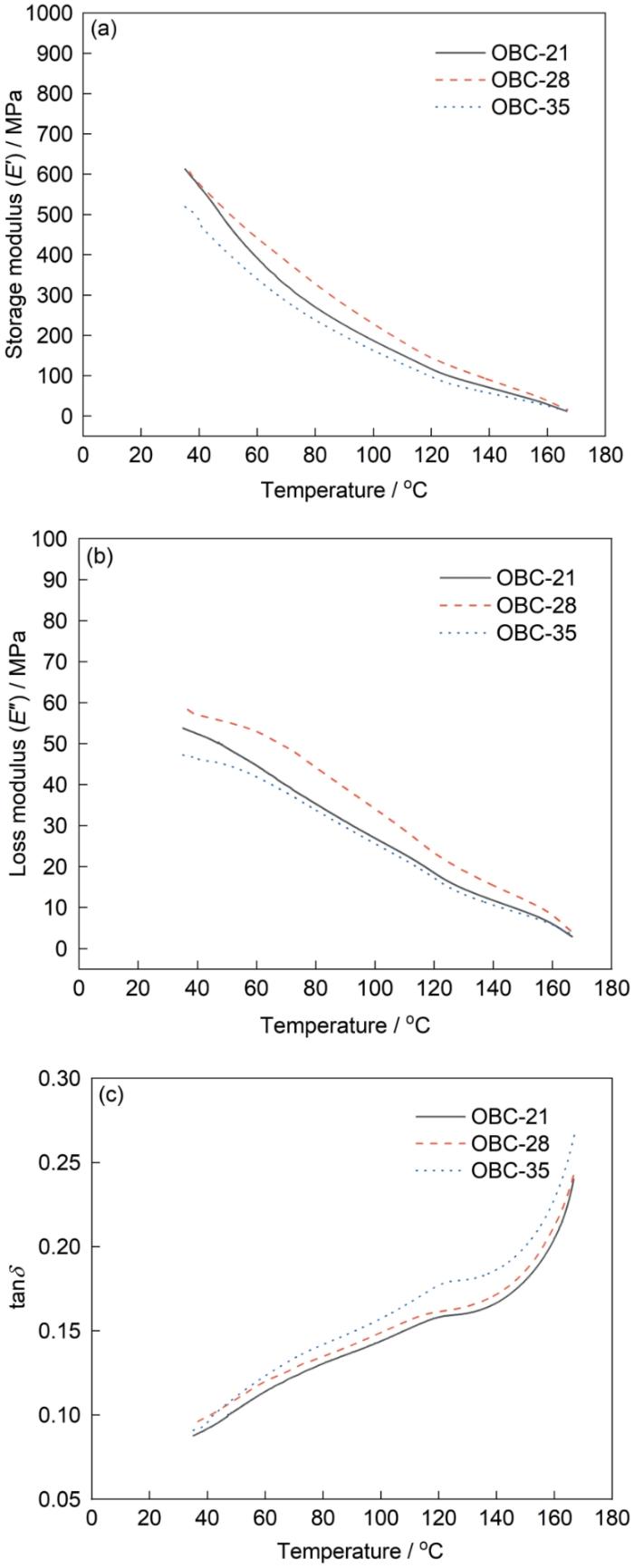
图5
半导电屏蔽材料的 DMA 曲线
Fig.5
DMA curve of semi-conductive shielding material (a) storage modulus (E′), (b) loss modulus (E″), (c) loss factor (tanδ)
2.5 OBC对材料结晶特性的影响
如图6所示,反映材料熔化过程的DSC曲线出现两个不同的峰值。位于160 ℃和170 ℃之间的峰是PP的熔融峰,而位于110 ℃和130 ℃之间不太明显的峰是OBC的熔融峰。这表明,随着OBC含量的提高PP的结晶温度向低温方向移动。这一现象,可归因于OBC的无定形软段阻碍了PP分子链的运动。如图中的箭头所示,随着OBC含量的提高OBC的熔化和结晶温度逐渐向高温移动。其原因是,OBC含量低于PP时PP处于“海”相,OBC的结晶行为受到限制而不能生成完整的晶体。
图6
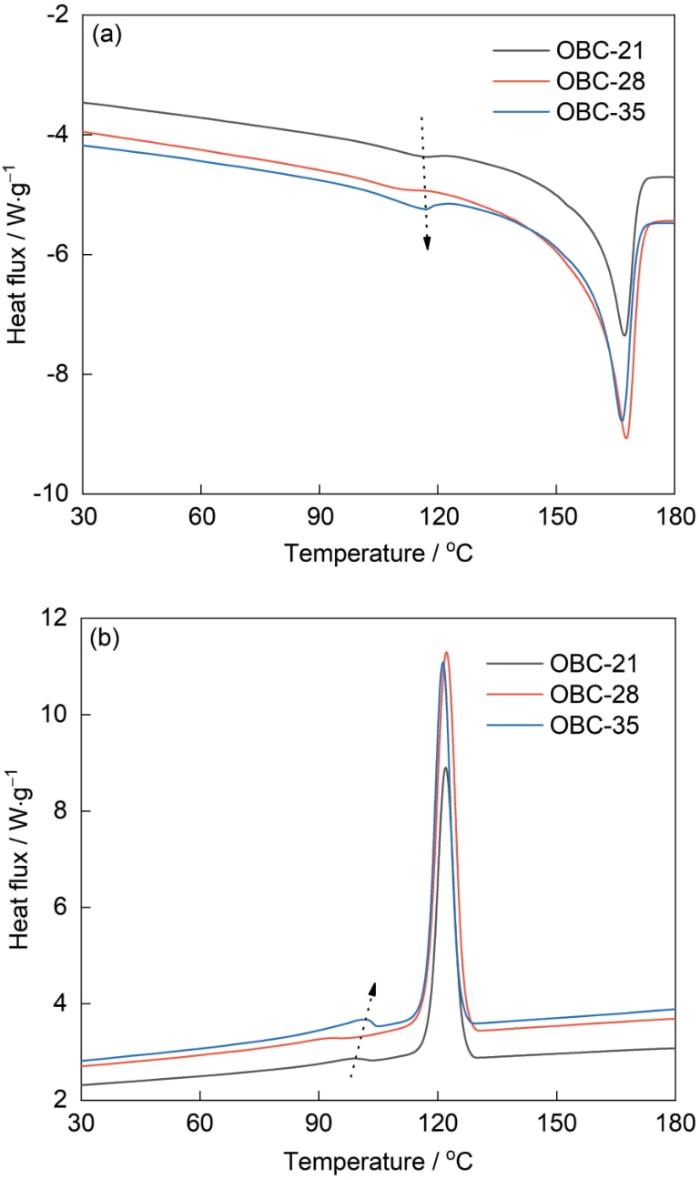
图6
半导电屏蔽材料的DSC曲线
Fig.6
DSC curves of semi-conducting shielding material (a) melting process, (b) crystallization process
2.6 OBC对材料体积电阻率的影响
CB填充的半导电聚合物复合材料具有PTC效应[26]。温度升高时聚合物分子链在局部区域内的热运动加剧,基体的热膨胀系数超过CB使相邻CB粒子之间的接触断开而破坏了导电网络,聚合物的体积电阻率随之增大。过于显著的PTC效应,可能使屏蔽材料的性能降低甚至完全失效。
屏蔽材料不同温度的体积电阻率,如图7所示。SEM观察表明,OBC-21的OBC相贯穿形成了纤细的网络。这种网络被PP基体包覆,使其在中温区受热膨胀时的形变受限,炭黑颗粒间的导电路径稳定贯通。随着温度从室温升至60~90 ℃,OBC软段始终处于橡胶态(Tg远低于室温)且硬段尚未熔融(在约110~120 ℃才熔化)。但是OBC-28和OBC-35中含量较高的OBC使PP约束减弱和更易破坏导电网络。温度高于60 ℃后OBC相的热膨胀和链段运动加剧,使OBC-28/35中选择性分布在OBC相中的炭黑网络较快断裂,使体积电阻率随之提高而呈现典型的PTC效应。与其相比,OBC-21中的刚性PP延缓了导电通路的破坏,在60~90 ℃电阻率极缓慢提高。达到最大电阻率后,随着温度的继续提高熔化加剧,使导电填料迁移到无定形区域形成新的导电通路,使屏蔽材料的体积电阻率降低[27]。
图7
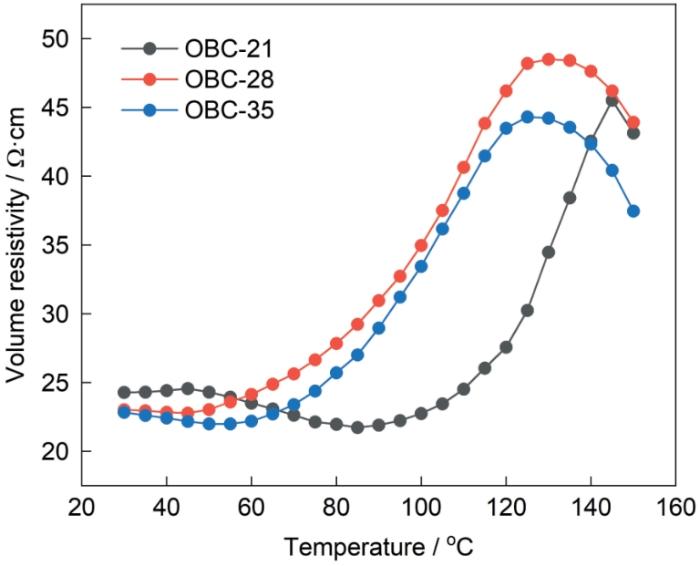
图7
半导电屏蔽材料的体积电阻率-温度曲线
Fig.7
Volume resistivity-temperature curve of semi-conducting shielding material
表2总结了屏蔽材料的室温电阻率、最大电阻率和PTC强度。可以看出,随着OBC含量的提高,材料的室温体积电阻率随之降低。其原因是,CB颗粒的极性使其优先分散在相同极性的OBC相中。随着含量的提高OBC在PP基体中的体积随之增大而形成了更加完善的网络结构,使CB颗粒之间的平均距离缩短从而降低了材料的整体电阻率。OBC含量的提高,使屏蔽材料的PTC强度随之提高。其原因是,OBC分子链段在高温下的流动性增强而使导电网络被明显破坏,从而使材料的PTC效应更强。
表2 几种屏蔽材料的电性能
Table 2
| Samples | ρ0 / Ω·cm | ρmax / Ω·cm | IPTC |
|---|---|---|---|
| OBC-21 | 24.29 | 42.55 | 0.2435 |
| OBC-28 | 23.02 | 48.50 | 0.3236 |
| OBC-35 | 22.84 | 44.31 | 0.2878 |
2.7 半导电屏蔽层对PP绝缘层电荷注入特性的影响
如图8所示,在试样的两个电极附近都出现了电荷积累。随着极化时间的延长电荷注入量随之增加,阳极的注入量明显比阴极的大。此外,长时间极化导致电荷包迁移,电荷注入的深度逐渐增加。PP材料内的杂质电离也产生异极性电荷。根据极化2400 s时的空间电荷曲线计算了电荷注入。在测试过程中,电极的挤压使PP绝缘层的厚度发生变化,故计算PP绝缘层电荷体积密度的平均值。在OBC-21、OBC-28和OBC-35半导电屏蔽层的作用下,PP绝缘层电荷体积密度的平均值分别为2.486、6.093和3.082 C/m3。OBC含量的提高使材料表面变得粗糙,从而增大了电荷积累和电场畸变,使电荷传输效率降低和注入PP绝缘层的空间电荷密度提高。而PP中的杂质也使电荷峰迁移和变形。
图8

图8
加压极化结束时PP中空间电荷的分布
Fig.8
Space charge distribution in PP at end of pressurization polarization (a) OBC-21, (b) OBC-28, (c) OBC-35
3 结论
(1) OBC在PP中生成连续相,而CB选择性地分布在OBC相中。OBC含量的提高有利于CB在屏蔽层中的均匀分散和形成导电网络,使三种屏蔽材料的室温电阻率降低。
(2) 样品的体积电阻率最初随着温度的提高而增大,随后减小。
(3) OBC中的无定形软段具有柔性分子链和较大自由体积,导致OBC含量越高其表面粗糙度越高和损耗因子越大,最终使材料抑制绝缘层空间电荷注入的能力降低。
参考文献
Advances in high-field insulating polymeric materials over the past 50 years
[J].
Electrical tree initiation in XLPE cable insulation under constant DC, grounded DC, and at elevated temperature
[J].
Polymeric insulation materials for HVDC cables: development, challenges and future perspective
[J].
Polypropylene based thermoplastic polymers for potential recyclable HVDC cable insulation applications
[J].
Evaluation of polypropylene/polyolefin elastomer blends for potential recyclable HVDC cable insulation applications
[J].
Enhanced electrical properties of styrene-grafted polypropylene insulation for bulk power transmission HVDC cables
[J].
Comprehensive performance comparisons of polypropylene-based HVDC cable insulating materials adopting different modification technical routes
[J].
不同改性技术路线的聚丙烯基高压直流电缆绝缘材料综合性能比较
[J].
Origins and effects of deep traps in functional group grafted polymeric dielectric materials
[J].
Mechanism of highly improved electrical properties in polypropylene by chemical modification of grafting maleic anhydride
[J].
Improvement of space charge suppression of polypropylene for potential application in HVDC cables
[J].
Surface-modification effect of MgO nanoparticles on the electrical properties of polypropylene nanocomposite
[J].
Effect of different nanoparticles on tuning electrical properties of polypropylene nanocomposites
[J].
Thermoplastic isotactic polypropylene/ethylene-octene polyolefin copolymer nanocomposite for recyclable HVDC cable insulation
[J].
Aramid nanofiber-reinforced graphene oxide frameworks for durable and flame-resistant fire warning sensors
[J].
Enhanced mechanical and anti-corrosion performance of polyurea nanocomposite coatings via amino-functionalization of boron carbide nanosheets
[J].
Research progress and prospect of semi-conductive shielding composites for high-voltage cables
[J].
高压电缆半导电屏蔽材料研究进展与展望
[J].
Segmenting the semi-conductive shielding layer of cable slice images using the convolutional neural network
[J].
Being an important part of aerial insulated cable, the semiconductive shielding layer is made of a typical polymer material and can improve the cable transmission effects; the structural parameters will affect the cable quality directly. Then, the image processing of the semiconductive layer plays an essential role in the structural parameter measurements. However, the semiconductive layer images are often disturbed by the cutting marks, which affect the measurements seriously. In this paper, a novel method based on the convolutional neural network is proposed for image segmentation. In our proposed strategy, a deep fully convolutional network with a skip connection algorithm is defined as the main framework. The inception structure and residual connection are employed to fuse features extracted from the receptive fields with different sizes. Finally, an improved weighted loss function and refined algorithm are utilized for pixel classification. Experimental results show that our proposed algorithm achieves better performance than the current algorithms.
Effect of rubber interparticle distance distribution on toughening behavior of thermoplastic polyolefin elastomer toughened polypropylene
[J].
Electrical and mechanical properties of POP-toughening semi-conductive shielding layer for PP cables
[J].
Catalytic production of olefin block copolymers via chain shuttling polymerization
[J].We report a catalytic system that produces olefin block copolymers with alternating semicrystalline and amorphous segments, achieved by varying the ratio of alpha-olefin to ethylene in the two types of blocks. The system uses a chain shuttling agent to transfer growing chains between two distinct catalysts with different monomer selectivities in a single polymerization reactor. The block copolymers simultaneously have high melting temperatures and low glass transition temperatures, and therefore they maintain excellent elastomeric properties at high temperatures. Furthermore, the materials are effectively produced in economically favorable, continuous polymerization processes.
Comparing elastomeric behavior of block and random ethylene-octene copolymers
[J].
Studies on preparation and adaptive thermal control performance of novel PTC (positive temperature coefficient) materials with controllable Curie temperatures
[J].
A space-charge based method for the estimation of apparent mobility and trap depth as markers for insulation degradation-theoretical basis and experimental validation
[J].
Compatibilization by olefin block copolymer (OBC) in polypropylene/ethylene-propylene-diene terpolymer (PP/EPDM) blends
[J].
Structure-performance relationship of polypropylene/elastomer/carbon black composites as high voltage cable shielding layer
[J].
Manufacturing and performance criteria for medium voltage power cable semiconducting shields
[J].
Effect of particle size and shape on positive temperature coefficient (PTC) of conductive polymer composites (CPC) - a model study
[J].
Space charge trapping and conduction in low-density polyethylene/silica nanocomposite
[J].
Simulation of space charge dynamic in polyethylene under DC continuous electrical stress
[J].
Effects of mechanical stretching on space charge behaviors of PP/POE blend for HVDC cables
[J].


