



目前,高熵合金的研究主要集中于其微观组织结构和性能表征[9~11]。近年来,高熵合金作为涂层材料的应用逐渐成为研究热点。采用表面涂层技术可在基材表面构建防护层,显著提升材料的耐久性与装饰性能[12,13]。其中,激光熔覆技术利用高能量密度激光束快速熔化预置或同步输送的合金粉末,使其在基材表面迅速凝固并形成冶金结合良好的熔覆层。其快速加热与冷却特性可有效抑制高熵合金凝固过程中金属间化合物的析出与长大,促进晶粒细化,进一步提升涂层的综合性能[14,15]。在常见高熵合金体系中,Co、Cr、Fe和Ni等元素熔点相对较低且原子半径相近,易于形成均匀固溶体相。典型CoCrFeNi合金表现为单一FCC结构,相稳定性高,并在低温条件下表现出良好的延展性。然而,该合金硬度较低、耐磨性欠佳,而引入Al、Ti和Si等合金化元素进行改性,可有效调控其微观组织与相组成,提升硬度、强度及耐磨性等特定性能[16~18]。Zhu等[19]采用激光定向能量沉积技术制备了AlxCoCrFeNi高熵合金熔覆层。研究发现,随着Al的加入,熔覆层物相从FCC相转变为B2相,由柱状晶转变为等轴晶的同时伴随着晶粒细化。Al的加入起到了增加强度和可塑性的双重效果。
激光冲击强化(Laser shock peening, LSP)是一种利用高能脉冲激光诱导等离子体冲击波对金属材料进行表面改性处理的先进技术,可显著提升材料的抗疲劳性能、耐磨损性及抗腐蚀能力。与传统的喷丸强化等技术相比,LSP具有高可控性、无热影响区、非接触加工、应变率极高以及强化效果显著等突出优势[20,21]。Zhang等[22]对M300钢激光冲击强化处理后,发现LSP后的钢材会产生高密度位错,位错运动主导变形过程。织构强度降低,低角度晶界增加,LSP后引起晶粒细化。其显微硬度比未强化前提升24.8%。Fu等[23]研究发现激光冲击强化能有效改善合金的机械性能,冲击后的CoCrFeNiMn0.75Cu0.25高熵合金表面的硬度提升了33%,Tong等[24]使用LSP加工了CoCrFeNiMn高熵合金,研究发现LSP形成了较厚的硬化层,具有较高的显微硬度。且LSP后合金表面形成了纳米级晶粒,微观结构明显细化,强化效果明显。
目前,针对激光冲击强化处理高熵合金熔覆层的系统性研究仍相对有限。本文采用激光冲击强化技术对激光熔覆制备的AlxCoCrFeNi (x = 0、0.3和0.7)高熵合金熔覆层进行表面改性,系统研究激光冲击对该合金微观组织演化、力学性能及耐磨性能的影响规律,以期为激光冲击强化技术在高熵合金表面改性领域的应用提供理论依据。
1 实验方法
实验采用304不锈钢作为基体材料,其成分如表1所示。基材尺寸为100 mm × 50 mm × 10 mm,实验前去除基材表面氧化物。制备AlxCoCrFeNi (x = 0、 0.3和0.7)熔覆层所用粉末材料采用100-270目,纯度99.9%的Al单质粉末及CoCrFeNi气雾化粉末,通过调控Al单质金属粉末以及CoCrFeNi气雾化粉末的含量实现各高熵合金体系原始粉末的制备,使用等量递加法使用研钵按摩尔配比对Al单质金属粉末和CoCrFeNi气雾化粉末进行均匀化处理。激光熔覆实验前,将复合粉末放于真空干燥箱中进行24 h干燥处理。
表1 304不锈钢的化学成分
Table 1
| Element | C | Si | Mn | P | S | Fe | Ni | Mo | Cu | N |
|---|---|---|---|---|---|---|---|---|---|---|
| Composition | 0.046 | 0.42 | 1.12 | 0.026 | 0.004 | 18.22 | 8 | 0.014 | 0.12 | 0.047 |
激光熔覆实验在YSL-4000光纤激光器及其配套设施上进行,工艺参数列于表2,实验完成后,使用刨床加工使熔覆层表面平整,采用YS0805-R200A型激光表面强化设备进行激光冲击强化实验,冲击路径如图1a所示,工艺参数列于表3。激光冲击后所得熔覆层表面形貌如图1b所示,激光冲击前后,分别使用线切割切取10 mm × 10 mm × 10 mm正方体试样,并对熔覆层表面以及截面进行打磨抛光处理。使用的腐蚀液为王水,采用D8ADVANCE-A25型X射线衍射仪检测熔覆层表面相结构。使用Phenom-XL-SED型扫描电子显微镜(SEM)的背散射模式(BSE)对激光冲击前后高熵合金熔覆层截面的显微组织和激光冲击前后熔覆层表面摩擦磨损后的磨痕形貌进行表征,使用能谱测量仪(EDS)对熔覆层截面进行元素分析。使用Oxford C-nano型电子背散射衍射仪(EBSD)对熔覆层微观组织结构进行分析。使用线切割切取尺寸为5 mm × 10 mm × 3 mm的Al0.3CoCrFeNi高熵合金熔覆层薄片,对激光冲击前熔覆层样品的测试面进行电解抛光处理,激光冲击后的熔覆层样品测试面进行氩离子抛光处理,以获得质量更好的图像。
表2 激光熔覆实验工艺参数
Table 2
| Laser power P / W | Scanning speed V / mm·min-1 | Spot diameter / mm | Overlap ratio |
|---|---|---|---|
| 600 | 200 | 3 | 50% |
图1
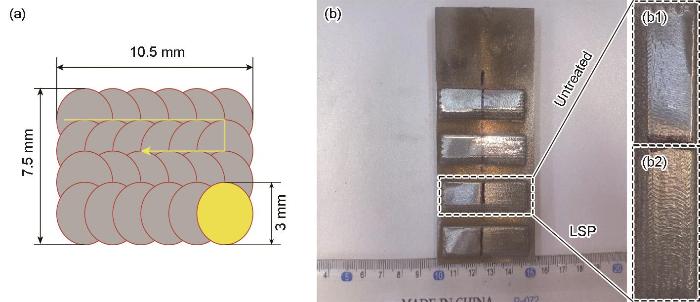
图1
激光冲击强化路径及激光冲击前后AlxCoCrFeNi系高熵合金熔覆层表面形貌
Fig.1
Laser shock processing path and surface characteristics of the AlxCoCrFeNi high-entropy alloy cladding layer (a) schematic diagram of the LSP trajectory, (b) surface morphology of the cladding layer before and after laser shock peening
表3 激光冲击强化实验工艺参数
Table 3
| Process parameters | Laser energy / J | Spot diameter / mm | Overlapping ratio / % | Pulse width / ns | Number of laser shocks |
|---|---|---|---|---|---|
| Parameter values | 4 | 3 | 50 | 18 | 3 |
使用Qness Q10A+型维氏硬度计从熔覆层顶部至基材,纵向相隔100 μm进行维氏硬度测试,施加载荷200 g,载荷保持时间10 s。单个测试样品水平间隔50 μm进行三组平行实验,取同一水平线上三个测试点的算数平均值作为硬度测量结果。采用Rtec MFT5000型多功能摩擦磨损试验机进行旋转运动的摩擦磨损实验。实验在室温干滑动摩擦条件下进行,摩擦副为直径4 mm的SiC球,施加载荷10 N,转速120 r/min,磨擦时间60 min,摩擦次数7200次,摩擦总行程90.432 m。采用Bruker GT-X白光干涉仪获取各试样磨痕表面三维磨痕形貌图,利用Origin软件计算熔覆层磨损体积。通过SEM分析磨损后熔覆层磨痕处微观形貌,进一步探讨熔覆层磨损机理。其中磨损率ω可结合V(磨痕磨损体积,mm3),结合以下公式[25]得出:
式中:L为摩擦总行程(m);F为法相载荷(N)。
2 结果和讨论
2.1 激光冲击强化对熔覆层物相组成的影响
图2为AlxCoCrFeNi (x = 0、0.3和0.7)冲击前熔覆层截面上部的XRD图谱。由图2a可知,不同Al元素含量的熔覆层的相组成略有不同。x = 0及x = 0.3时相结构主要为FCC单相,x = 0.7时,熔覆层中出现了FCC+BCC双相结构,这是由于较低含量的Al元素加入引起的晶格畸变效应不足,且激光熔覆快速冷却的特点使相变反应的时间变短,同时FCC相在高温下具有较高的熵稳定性所导致[26]。另外,Al元素的加入引发了较为剧烈的晶格畸变效应,熔覆层合金的价电子浓度(VEC)也会进一步降低,随着Al元素含量不断升高,熔覆层合金的VEC由8.25 (x = 0)降低为7.89 (x = 0.3)及7.47 (x = 0.7),这些因素共同促进了BCC相的形成。
图2
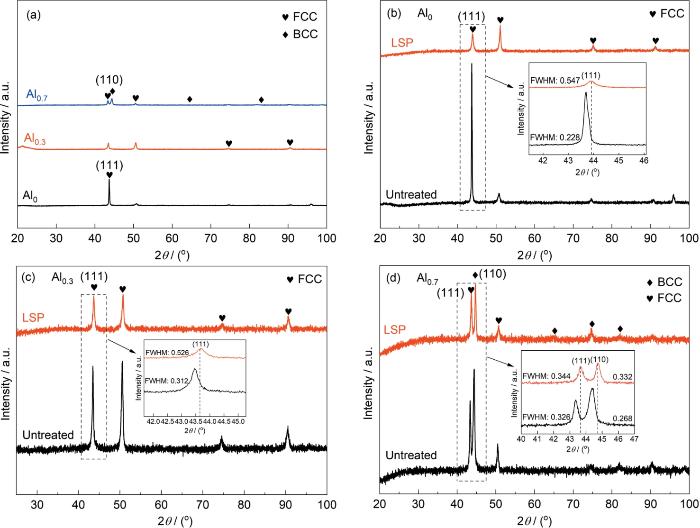
图2
AlxCoCrFeNi系高熵合金熔覆层XRD结果及激光冲击后对比结果
Fig.2
XRD results of AlxCoCrFeNi high-entropy alloy cladding layers and comparison results after laser shock (a) XRD results of AlxCoCrFeNi high-entropy alloy cladding layer (x = 0, 0.3, 0.7) before laser shock, (b-d) when the Al content x = 0, 0.3, 0.7, the comparison results after laser shock and the local magnification of the diffraction peak are shown
图2b~d为激光冲击处理前后AlₓCoCrFeNi高熵合金熔覆层的XRD图谱对比结果。结果表明,冲击前后熔覆层的相组成未发生改变,说明激光冲击强化处理并未引起相变。然而,激光冲击显著影响了其晶体学特性:FCC相的(111)晶面与BCC相的(110)晶面衍射峰均向高角度偏移。对熔覆层主要衍射峰半峰宽(FWHM)进行了统计,当Al元素含量x = 0时,(111)峰的半峰宽由LSP处理前的0.228°增大至0.547°,x = 0.3时(111)峰半峰宽由0.312°增大至0.526°,x = 0.7时(111)峰半峰宽由0.326°增大至0.344°,(110)峰的半峰宽由0.268°增大至0.332°。以上变化说明LSP处理后熔覆层晶粒尺寸减小、位错密度升高,材料表层晶格间距发生了变化。根据Bragg定律,衍射峰向高角度偏移说明晶格常数减小,推测主要原因是由于激光冲击过程中高能冲击波诱发的塑性变形,使晶格在压应力作用下产生压缩性畸变,导致晶面间距减小,从而加剧了熔覆层固有的晶格畸变效应。此外,激光冲击后衍射峰强度普遍降低,且Bragg衍射峰出现明显宽化。这主要源于高应变率塑性变形过程中晶粒破碎与原子面排列规则性下降,导致衍射时散射增强,引起峰强减弱与宽化[23,27]。综上,激光冲击强化虽不改变熔覆层的相结构,但可诱发显著的压缩性晶格畸变,增强固溶强化效果;同时达到晶粒细化的效果,从而提升熔覆层的综合性能。
2.2 激光冲击强化对熔覆层显微组织的影响
图3为激光冲击前后AlxCoCrFeNi (x = 0、0.3和0.7)高熵合金熔覆层截面中上部的SEM形貌。冲击后熔覆层仍保持等轴晶组织,表明激光冲击未改变其整体晶粒形貌。然而,从图3a~c可见,冲击后熔覆层顶部存在塑性变形区(冲击影响区),结合SEM观测的晶粒尺寸改变及显微硬度变化共同判断,影响区深度范围约为150~250 μm。该区域内由表层向内部发生晶粒细化,这是因为高能量密度激光诱导的等离子体冲击波使表层发生严重塑性变形,引起位错增殖并形成高密度位错墙与缠结结构。这些缺陷在晶内累积,将原始晶粒分割为多个亚晶,使晶粒细化[28]。为了进一步探究激光冲击强化对激光熔覆高熵合金熔覆层微观组织的影响,选取冲击前后的Al0.3CoCrFeNi高熵合金熔覆层试样进行EBSD测量。其IPF图和晶粒尺寸分布图如图4所示,从图4a和b可以看出,熔覆层由表层向内部延伸至200 μm左右的区域中出现了晶粒细化现象。由图4a1和b1可知,冲击前熔覆层平均晶粒尺寸为100.4 μm,冲击后熔覆层平均晶粒尺寸为49.9 μm,这是由于激光冲击使得熔覆层的晶格畸变加剧,这会导致晶格能的增加,从而阻碍原子的扩散效率,晶粒的生长被阻碍,此结果表明激光冲击后熔覆层晶粒产生细化,这与SEM结果相符合。结合XRD结果进一步分析,当Al元素含量x = 0时,熔覆层为单一FCC相,层错能较低、强度较差,故冲击影响区深度较大;x = 0.3时,因Al元素的大原子半径加剧晶格畸变,熔覆层强度提高,在相同激光能量下塑性变形区范围减小;x = 0.7时,熔覆层为FCC+BCC双相结构,其强度进一步提高,冲击影响区范围进一步缩小。此外,由表4激光冲击前后Al0.7CoCrFeNi熔覆层的EDS结果及图5a和b面扫描和元素分布对比可知,激光冲击并未改变熔覆层的元素分布规律。
图3
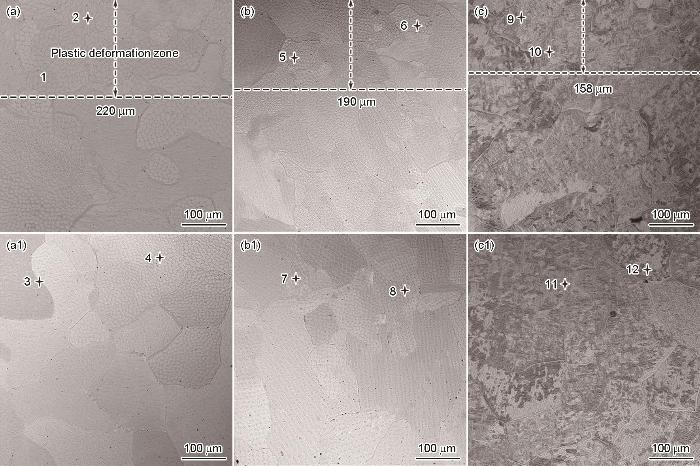
图3
激光冲击前后AlxCoCrFeNi系高熵合金熔覆层截面中上部SEM图
Fig.3
SEM images of the upper and middle sections of AlxCoCrFeNi high-entropy alloy cladding layer before and after laser shock (a) x = 0 before shock, (a1) x = 0 after impact, (b) x = 0.3 before impact, (b1) x = 0.3 after impact, (c) x = 0.7 before impact, (c1) x = 0.7 after shock
图4

图4
激光冲击前后Al0.3CoCrFeNi高熵合金熔覆层IPF和晶粒尺寸分布图
Fig.4
Distribution of IPF and grain size of Al0.3CoCrFeNi high entropy alloy cladding layer before and after laser shock processing (a) IPF before impact, (a1) grain size distribution before impact, (b) IPF after impact, (b1) grain size distribution after impact
表4 激光冲击前后AlxCoCrFeNi系高熵合金熔覆层截面中上部EDS点扫结果
Table 4
| x | Region | Co | Cr | Fe | Ni | Al |
|---|---|---|---|---|---|---|
| x = 0 | 1 | 24.42 | 24.50 | 26.37 | 24.71 | 0 |
| 2 | 24.47 | 23.36 | 26.99 | 25.18 | 0 | |
| 3 | 24.22 | 26.68 | 26.29 | 22.81 | 0 | |
| 4 | 25.39 | 26.81 | 25.07 | 22.73 | 0 | |
| x = 0.3 | 5 | 22.13 | 22.83 | 24.19 | 23.89 | 6.95 |
| 6 | 24.34 | 23.68 | 24.17 | 22.58 | 6.23 | |
| 7 | 22.37 | 22.62 | 24.85 | 23.59 | 6.56 | |
| 8 | 22.98 | 21.66 | 24.85 | 23.97 | 6.54 | |
| x = 0.7 | 9 | 20.88 | 19.93 | 24.89 | 23.92 | 10.38 |
| 10 | 21.90 | 19.20 | 24.22 | 23.34 | 11.34 | |
| 11 | 19.42 | 22.45 | 24.50 | 19.20 | 14.43 | |
| 12 | 21.46 | 19.69 | 25.81 | 23.38 | 10.30 |
图5
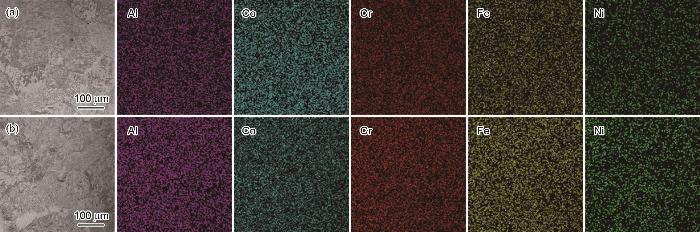
图5
激光冲击前后Al0.7CoCrFeNi高熵合金熔覆层中上部面扫描和元素分布
Fig.5
Scanning and element distribution of middle and upper surface of Al0.7CoCrFeNi high entropy alloy cladding layer before and after laser shock processing (a) before impact, (b) after impact
2.3 激光冲击强化对熔覆层硬度的影响
图6a为激光冲击前AlxCoCrFeNi (x = 0、0.3和0.7)高熵合金熔覆层截面显微硬度图。AlxCoCrFeNi高熵合金熔覆层截面的平均显微硬度数据分别为180.67HV0.2、253.89HV0.2和372.49HV0.2,随着Al元素含量的增加,熔覆层的显微硬度显著提升。分别为基材显微硬度的0.82倍、1.16倍和1.49倍。熔覆层硬度提高的最主要原因是Al元素的加入引起的固溶强化和组织细化。大原子半径的Al元素加入会促使高熵合金本身的晶格畸变加剧,引起固溶强化,而剧烈的晶格畸变则会阻碍原子的扩散,使晶粒细化[29]。结合XRD图谱分析,Al元素的增加促进了物相的转变。熔覆层由强度低的FCC相逐渐转变为强度高的BCC相,以上原因共同导致了熔覆层显微硬度的提升。此外,熔覆层的硬度还存在一定的波动,这主要是由于熔覆层微观组织的不均匀性所致,而热影响区的显微硬度也显著高于基材,这是由于熔覆过程中元素向基材扩散,导致热影响区产生晶格畸变和固溶强化效应,使该区域的显微硬度提升[30]。
图6

图6
激光冲击前后AlxCoCrFeNi高熵合金熔覆层显微硬度图
Fig.6
Microhardness distribution of the AlxCoCrFeNi high-entropy alloy cladding layer before and after laser shock peening (a) microhardness profile of the as-cladded HEA layer with x = 0, 0.3, and 0.7, (b-d) comparison of microhardness following LSP treatment at each aluminum content (x = 0, 0.3, 0.7)
激光冲击处理后,从图6b~d可见,AlxCoCrFeNi (x = 0、0.3和0.7)高熵合金熔覆层的显微硬度均显著提高。x = 0时,最大显微硬度由191.9HV0.2增至295.4HV0.2,增幅达53.9%;x = 0.3时,由254.5HV0.2增至361.4HV0.2,其增幅为42.1%;x = 0.7时,由415.8HV0.2增至523HV0.2,其增幅为25.8%。显微硬度的提升幅度随Al含量增加而递减,这主要与相组成和变形机制相关:CoCrFeNi为单一FCC相,塑性好、强度低、层错能低及滑移系多,更易发生位错增殖,因此激光冲击的强化效果最为显著;Al0.3CoCrFeNi仍为FCC结构,但大原子半径Al元素加剧了晶格畸变,其塑性有所下降,导致强化效果减弱;Al0.7CoCrFeNi则由FCC+BCC双相组成,BCC相强度高、塑性低和层错能高,对激光冲击的响应能力降低,硬度增幅最小。此外,显微硬度沿深度方向呈梯度分布,在距表层约200 μm范围内提升最为显著,200~300 μm区间影响逐渐减弱,超过300 μm后无明显变化。塑性变形区硬度提升主要源于激光冲击诱导的高能量等离子体冲击波使表层发生严重塑性变形,引起高位错密度增殖,形成高密度位错堆积、缠结及胞状结构。随着应变积累,位错重组形成小角度晶界,进一步分割原始晶粒形成亚结构,共同贡献出位错强化、细晶强化与固溶强化效应[31]。
2.4 激光冲击强化对熔覆层耐磨性能影响
图7

图7
激光冲击前后AlxCoCrFeNi系高熵合金熔覆层摩擦系数对比
Fig.7
Comparative analysis of the friction coefficient of the AlxCoCrFeNi high-entropy alloy cladding layer before and after laser shock peening (LSP) (a) friction coefficient of the as-cladded HEA layer prior to LSP, (b-d) evolution of the friction coefficient with Al content (x = 0, 0.3, 0.7) before and after LSP treatment
图8
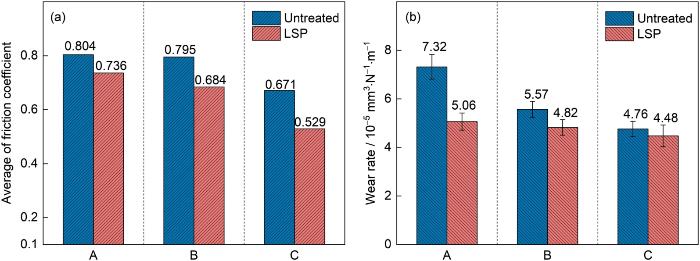
图8
激光冲击前后AlxCoCrFeNi系高熵合金熔覆层平均摩擦系数及磨损率对比
Fig.8
Comparative analysis of the average friction coefficient (a) and wear rate (b) of the AlxCoCrFeNi high-entropy alloy cladding layer before and after laser shock peening across varying aluminum contents (A) x = 0, (B) x = 0.3, (C) x = 0.7
图8b为激光冲击前后AlxCoCrFeNi系高熵合金熔覆层的磨损率结果。激光冲击后AlxCoCrFeNi系高熵合金熔覆层的磨损率均有所下降,与激光冲击前后熔覆层的摩擦系数变化趋势一致,说明激光冲击强化提升了高熵合金熔覆层的摩擦磨损性能。这是因为熔覆层在高能量密度激光诱导产生的等离子冲击波下产生了塑性变形,这使得熔覆层本身的晶格畸变效应加剧,而严重的晶格畸变效应又会加强熔覆层本身的固溶强化效应,同时还产生了晶粒细化和位错强化,以上因素共同导致了高熵合金熔覆层耐磨性能的提升;另一方面,根据Archard定律可知,合金材料显微硬度越高,合金材料的磨损率越低[32],而冲击后熔覆层的显微硬度均得到提升,这会减少摩擦副与熔覆层发生粘着效应,减少熔覆层大面积的金属剥落现象,使熔覆层的磨损率降低。
图9为激光冲击冲击前后AlxCoCrFeNi (x = 0、0.3和0.7)高熵合金熔覆层磨损表面的SEM形貌。当x = 0时,冲击前熔覆层表面存在大面积金属剥落、裂纹、犁沟及磨屑;经激光冲击后,其磨损机制由冲击前的粘着磨损主导转变为以粘着磨损为主、兼有少量磨粒磨损的混合机制。机制出现转变的原因是由于激光冲击引起的熔覆层显微硬度提高、摩擦系数及磨损率降低,激光冲击显著减轻了材料的大面积剥落;在Al元素含量为0.3时,冲击前后均观察到金属剥落、裂纹、犁沟与磨屑,但冲击后剥落与裂纹数量显著减少,犁沟与磨屑数量增多。其磨损机制由冲击前的粘着磨损为主、磨粒磨损为辅的混合机制,转变为冲击后粘着磨损与磨粒磨损共同作用的复合机制。其转变原因与CoCrFeNi熔覆层在激光冲击后的磨损机制演变规律一致;当x = 0.7时,冲击前后均以磨粒磨损为主、粘着磨损为辅的混合机制为主要磨损形式,但冲击后剥落与裂纹明显减少,犁沟与磨屑增多。这主要源于激光冲击进一步提高了熔覆层的显微硬度;然而由于其物相仍由FCC+BCC双相组成,其中FCC相强度较低,在摩擦热效应下易与对磨擦副发生粘着,在剪切作用下仍倾向于出现局部剥落与裂纹。
图9
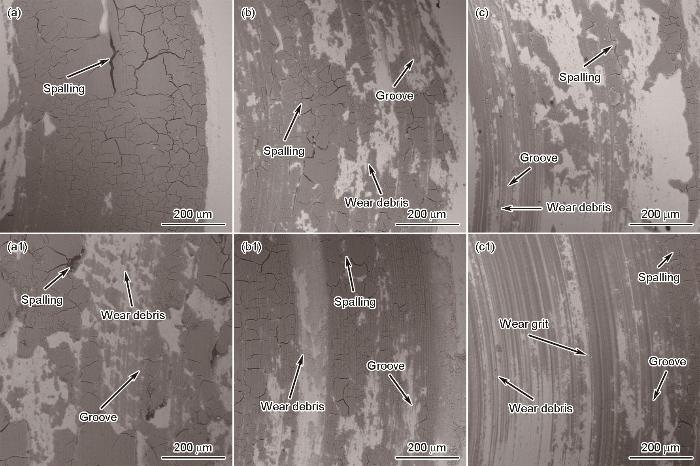
图9
激光冲击前后AlxCoCrFeNi系高熵合金熔覆层磨损表面SEM图
Fig.9
SEM images of the wear surface of AlxCoCrFeNi high entropy alloy cladding layer before and after laser shock (a) the wear surface of the cladding layer when x = 0 before shock, (a1) the wear surface of the cladding layer when x = 0 after impact, (b) the wear surface of the cladding layer when x = 0.3 before impact, (b1) the wear surface of the cladding layer when x = 0.3 after impact, (c) the wear surface of the cladding layer when x = 0.7 before impact, (c1) wear surface of cladding layer when x = 0.7 after impact
3 结论
(1) 对于用激光熔覆技术在304不锈钢表面制备的AlxCoCrFeNi (x = 0、0.3和0.7)熔覆层,激光冲击强化不改变合金熔覆层相组成,但会使熔覆层产生明显的压缩型晶格畸变效应提升其性能。不同Al元素含量下,合金熔覆层组织均由柱状晶和等轴晶组成,Al的加入使晶粒转变更加均匀,熔覆层中上部晶粒更加细小,Al含量为0和0.3时,合金由单一FCC相构成,0.7时转变为FCC和BCC两相共存。
(2) 激光冲击强化可以有效改善激光熔覆层中的非平衡组织,通过晶粒细化和位错强化等机制显著提高其显微硬度。随着熔覆层中Al元素含量增加,引起的晶格畸变和相转变会影响激光冲击的强化效果,表现为激光冲击对熔覆层的强化效果逐渐减弱,显微硬度提升幅度由53.9%降至25.8%,同时激光冲击强化的影响区深度也逐渐变小。
(3) 合金的耐磨性能随着Al元素的加入而提高,表现为磨损率和摩擦系数降低,磨损表面形貌由大面积金属剥落逐渐转变为以犁沟和磨屑为主。激光冲击后熔覆层摩擦系数和磨损率进一步下降,熔覆层的磨损机制向磨粒磨损和粘着磨损混合的磨损机制转变。
参考文献
Nanostructured high-entropy alloys with multiple principal elements: novel alloy design concepts and outcomes
[J].
Relative effects of enthalpy and entropy on the phase stability of equiatomic high-entropy alloys
[J].
High-entropy alloys: a critical review
[J].
Microstructural development in equiatomic multicomponent alloys
[J].
Microstructural control and properties optimization of high-entrop alloys
[J].
Development of high entropy alloys (HEAs): current trends
[J].
The use of high-entropy alloys in additive manufacturing
[J].
High-entropy alloys for advanced nuclear applications
[J].
The expanded compositional freedom afforded by high-entropy alloys (HEAs) represents a unique opportunity for the design of alloys for advanced nuclear applications, in particular for applications where current engineering alloys fall short. This review assesses the work done to date in the field of HEAs for nuclear applications, provides critical insight into the conclusions drawn, and highlights possibilities and challenges for future study. It is found that our understanding of the irradiation responses of HEAs remains in its infancy, and much work is needed in order for our knowledge of any single HEA system to match our understanding of conventional alloys such as austenitic steels. A number of studies have suggested that HEAs possess ‘special’ irradiation damage resistance, although some of the proposed mechanisms, such as those based on sluggish diffusion and lattice distortion, remain somewhat unconvincing (certainly in terms of being universally applicable to all HEAs). Nevertheless, there may be some mechanisms and effects that are uniquely different in HEAs when compared to more conventional alloys, such as the effect that their poor thermal conductivities have on the displacement cascade. Furthermore, the opportunity to tune the compositions of HEAs over a large range to optimise particular irradiation responses could be very powerful, even if the design process remains challenging.
Microstructure and high-temperature wear behavior of TiZrNbAlx light-weight refractory high-entropy alloy coatings prepared by laser cladding on Ti6Al4V titanium alloy
[J].
Mechanical properties and high temperature structure evolution of FeCrAlMoNb high entropy alloy coatings with different Mo contents for accident tolerant fuel cladding
[J].
Microstructure and wide temperature range tribological properties of CoCrFeNiTi high-entropy alloy coating by laser cladding
[J].
High-entropy alloys: properties and prospects of application as protective coatings
[J].
Research and progress of laser cladding on engineering alloys: a review
[J].
Microstructure and properties of CoCrFeNiAlx Mo2- x high-entropy alloy coating by laser cladding
[J].
Laser cladding technology for high entropy alloys: effect and applications
[J].
Twinning- and transformation-induced high cryogenic strength and ductility of the CoCrFeNi high-entropy alloy: experiment and MD simulation
[J].
Recent developments in CoCrFeNi-based high entropy alloy coatings: design, synthesis, and properties
[J].
Microstructure and wear resistance of CoCrFeNiTi x high entropy alloy coating
[J].
CoCrFeNiTi x 高熵合金涂层的显微组织和耐磨性能
[J].用激光熔覆工艺在40Cr钢表面制备CoCrFeNiTi x (x=0、0.2、0.5、0.8)高熵合金涂层并计算其热力学参数,使用X射线衍射仪(XRD)、扫描电镜(SEM)、能谱仪(EDS)、显微硬度仪、摩擦磨损试验机等手段检测合金的物相组成、组织、元素分布、硬度及耐磨性,研究了Ti元素含量对其显微组织和耐磨性能的影响。结果表明:随着Ti元素含量的提高,合金物相在面心立方(FCC)结构的基础上形成了体心立方(BCC)结构,熔覆层中部的组织由晶界明显、晶粒分布均匀的等轴晶组成,最后形成了柱状树枝晶;随着Ti元素含量的提高,合金横截面的硬度逐渐提高,最高为412.32 HV0.2,比基体的硬度提高了1.8倍;涂层的磨损量和摩擦系数均随之降低,Ti含量为0.8时涂层其耐磨性能最优,磨损量最小为6.8 mg,摩擦系数为0.35。涂层的磨损机制,以磨粒磨损、粘着磨损和氧化磨损为主。
Roles of Al on microstructures, mechanical properties and oxidation resistances of FCC AlxCoCrNiFe high entropy alloy coatings prepared by laser directed energy deposition
[J].
Progressive developments, challenges and future trends in laser shock peening of metallic materials and alloys: a comprehensive review
[J].
Impact of laser shock peening on mechanical properties of wire arc additive manufactured grade 91 Steel and monel-400 bimetallic components
[J].
Microstructural evolution, mechanical behaviors and strengthening mechanism of 300 M steel subjected to multi-pass laser shock peening
[J].
Strengthening CrFeCoNiMn0.75Cu0.25 high entropy alloy via laser shock peening
[J].
Microstructure, microhardness and residual stress of laser additive manufactured CoCrFeMnNi high-entropy alloy subjected to laser shock peening
[J].
Investigation of variable-temperature wear characteristics of austenitic stainless steel coatings fabricated via laser energy deposition
[J].
Comparative studies on microstructure and properties of CoCrFeMnNi high entropy alloy coatings fabricated by high-speed laser cladding and normal laser cladding
[J].
Effects of different contact film thicknesses on the surface roughness evolution of LY2 aluminum alloy milled surface subjected to laser shock wave planishing
[J].
The new technologies developed from laser shock processing
[J].Laser shock processing (LSP) is an advanced material surface hardening technology that can significantly improve mechanical properties and extend service life by using the stress effect generated by laser-induced plasma shock waves, which has been increasingly applied in the processing fields of metallic materials and alloys. With the rapidly development of modern industry, many new technologies developed from LSP have emerged, which broadens the application of LSP and enriches its technical theory. In this work, the technical theory of LSP was summarized, which consists of the fundamental principle of LSP and the laser-induced plasma shock wave. The new technologies, developed from LSP, are introduced in detail from the aspect of laser shock forming (LSF), warm laser shock processing (WLSP), laser shock marking (LSM) and laser shock imprinting (LSI). The common feature of LSP and these new technologies developed from LSP is the utilization of the laser-generated stress effects rather than the laser thermal effect. LSF is utilized to modify the curvature of metal sheet through the laser-induced high dynamic loading. The material strength and the stability of residual stress and micro-structures by WLSP treatment are higher than that by LSP treatment, due to WLSP combining the advantages of LSP, dynamic strain aging (DSA) and dynamic precipitation (DP). LSM is an effective method to obtain the visualized marks on the surface of metallic materials or alloys, and its critical aspect is the preparation of the absorbing layer with a designed shape and suitable thickness. At the high strain rates induced by LSP, LSI has the ability to complete the direct imprinting over the large-scale ultrasmooth complex 3D nanostructures arrays on the surface of crystalline metals. This work has important reference value and guiding significance for researchers to further understand the LSP theory and the new technologies developed from LSP.
Effect of Al addition on mechanical properties and microstructure of refractory Alx HfNbTaTiZr alloys
[J].
Effects of Nb content on the microstructure and properties of CoCrFeMnNiNb x high-entropy alloy coatings by laser cladding
[J].
Microstructural evolution and wear resistance improvement of laser additive-manufactured 316L stainless steel subject to laser shock processing
[J].


