



聚苯胺(PANI)以其可逆掺杂-去掺杂行为、工艺友好与环境稳定性成为代表性的导电高分子材料[3]。研究表明,PANI在金属表面能够通过阳极保护诱导形成致密钝化膜,同时,其氧化还原缓冲可防止金属被腐蚀[4]。掺杂态PANI提供电子传输以降低界面电阻,去掺杂转为绝缘态时又有助于隔绝腐蚀电流,从而在酸性介质中兼具导电与抑腐双效[5]。尽管PANI在金属防护领域展现出巨大潜力,但其实际应用仍面临一些关键性挑战。许多PANI涂层在长期暴露于侵蚀性介质时,其结构稳定性不足,可能导致防护网络降解,从而限制其长效防腐性能。并且PANI与金属基底之间的界面相互作用通常较弱,主要依赖较弱的物理吸附或有限的配位键,导致涂层附着力欠佳,易发生剥离失效[6]。此外,PANI的微观结构较难精确调控,这在一定程度上制约了其屏障性能与活性抑制功能的协同优化。
近年来,金属有机框架(MOFs)及其衍生物因结构可调、高比表面积和功能可设计性,在防腐领域引起关注[7,8]。ZIF-8作为MOFs材料的典型代表,其由Zn2+与咪唑配体通过配位自组装而成,具有高比表面积、规整孔道与可化学功能化等特征[9]。其纳米孔道可被精确设计为功能分子的纳米储库,并基于材料的刺激响应性,实现腐蚀抑制剂在特定条件下的按需释放,构成一种先进的主动防护策略[10],骨架的有机/无机双重特性有助于与聚合物基体相容,提升涂层致密性与力学稳定。然而,ZIF-8在酸性介质中的水稳定性与骨架完整性可能受限[11],需要通过复合和后续修饰等策略以降低骨架降解速率、延长服役期并增强其主动缓蚀能力。1,10-菲罗啉(Phen)是经典的含氮螯合配体,可与Fe2+形成显色络合物,实现腐蚀位点的可视化指示[12];Phen/金属离子的络合物可吸附并覆盖在新生金属表面,形成保护膜,起到兼具缓蚀与自修复的主动防护作用[13]。将Phen负载于ZIF-8或其衍生纳米容器中,可利用pH或缺陷触发实现按需释放,从而在局部损伤处及时“补膜”,显著延缓点蚀与缝隙腐蚀的发展[14]。氧化石墨烯(GO)是石墨烯的含氧衍生物,表面富含羟基、环氧与羧基等官能团,利于在树脂中稳定分散并与MOFs或PANI构筑界面相互作用[15]。其二维片层在涂层内部构建“迷宫效应”[16],能极大延长腐蚀介质的渗透路径,从而提高屏障性能[17]。在适当条件下GO可改善涂层的电学连续性与电子传输,有助于在不增加厚度的情况下保持低界面电阻[18]。GO与PANI之间的π-π作用、与MOFs之间的异质界面耦合,还能提升涂层致密均匀性与抗开裂能力[19]。
本文选用ZIF-8/GO/Phen作为功能纳米填料与环氧丙烯酸树脂(EA)基体复合以获得致密均匀的底层屏障,继而在其表面电沉积PANI面层,构建PANI/ZIF-8/GO/Phen-EA双层复合涂层体系;通过FT-IR、XPS及SEM等对结构与界面进行表征,并通过电化学测量系统评估其在酸性环境中的防腐性能和自修复性质。
1 实验方法
1.1 原材料
实验用原材料包括:二水乙酸锌、1,10-菲罗啉(Phen)(99%)及植酸(70%);2-甲基咪唑、苯胺;碳纳米管(CNT)分散液(0.4%);环氧改性丙烯酸树脂(EA);甲醇。
1.2 ZIF-8/GO纳米粒子的合成
GO通过改进的Hummers法制备[20]。将1.9 g二水乙酸锌溶于20 mL的甲醇中,得到无色透明溶液,随后向其中加入10 mL浓度为4 mg/mL的GO分散液,搅拌1 h后,得到均匀分散的棕黑色溶液A。将7.38 g二甲基咪唑溶于30 mL甲醇中,得到无色透明溶液B。将溶液B倒入溶液A中混合,置于25 ℃水浴搅拌反应24 h后,在8000 r/min条件下离心10 min去除上清液,并用甲醇多次洗涤,洗涤后的产物置于60 ℃的真空烘箱中干燥12 h,得到灰黑色ZIF-8/GO粉末材料。
1.3 ZIF-8/GO/Phen纳米粒子的合成
将1.00 g的Phen溶于20 mL甲醇中,得到无色透明溶液,再向其中加入0.20 g的ZIF-8/GO粉末,得到混合溶液。将混合溶液剧烈搅拌30 min直至完全分散,真空条件下反应6 h。随后,将混合溶液在8000 r/min条件下离心10 min,去除上清液,并用甲醇多次洗涤,洗涤后的产物置于60 ℃烘箱中干燥12 h,得到ZIF-8/GO/Phen材料。
1.4 304SS不锈钢的表面处理与防腐涂层的构建
1.4.1 不锈钢的表面处理
选取304不锈钢(304SS)为金属基材,使用由低到高目数的SiC砂纸对304SS不锈钢进行表面处理,单方向打磨去除不锈钢表面的氧化层,进行抛光处理,依次使用去离子水和无水乙醇对不锈钢表面进行冲洗处理,待其干燥进行涂层构建。
1.4.2 ZIF-8/GO/Phen-EA防腐涂层的构建
将一定量的碳管分散液与环氧丙烯酸树脂混合,搅拌至混合均匀后,向其中加入一定量的ZIF-8/GO/Phen纳米粒子,搅拌24 h后至粒子均匀分散,得到防腐涂料,其中CNT含量为1.7%。利用辊涂法将所制备涂料涂覆于打磨后的304SS不锈钢表面,确保涂层的均匀、平整和无气泡。随后放置于60 ℃烘箱中干燥24 h,得到不同填料配比的ZIF-8/GO/Phen-EA防腐涂层,分别标记为0.5%ZIF-8/GO/Phen-EA、1.0%ZIF-8/GO/Phen-EA、1.5%ZIF-8/GO/Phen-EA和2.0%ZIF-8/GO/Phen-EA。
1.4.3 PANI/ZIF-8/GO/Phen-EA防腐涂层的构建
选取防腐效果最佳的ZIF-8/GO/Phen-EA涂层体系,在其表面构建PANI面层。首先配制含0.3 mol/L的苯胺单体及0.4 mol/L的植酸的混合电解液,以涂覆的ZIF-8/GO/Phen-EA涂层的304SS为工作电极,铂片为对电极,Ag/AgCl电极为参比电极,采用恒电流沉积法,将PANI沉积于涂层表面,沉积电流密度为1 mA/cm2。沉积完成后,用去离子水冲洗表面,待其干燥即可得PANI/ZIF-8/GO/Phen-EA涂层。
1.5 性能测量
利用Fourier红外吸收光谱仪(FTIR)及X线光电子能谱(XPS)表征复合涂层的成分,根据吸收峰的位置及强度来分析涂层的成分。其中FTIR波数为400~4000 cm-1。利用扫描电子显微镜(SEM)对涂层的微观形貌进行表征,通过观察不同倍数的微观形貌,对比涂层表面的致密性和平整性。
以0.1 mol/L的稀盐酸模拟酸性腐蚀环境,采用三电极体系测量样品的动电位极化曲线和电化学阻抗谱(EIS)。其中,工作电极为附有复合防腐蚀涂层的待测304SS样品,测量面积为1 cm × 1 cm,Ag/AgCl电极为参比电极,铂网电极为对电极。EIS中以稳定的OCP值为初始电压,测量频率范围为105~10-2 Hz,振幅为5 mV。
通过人为划伤,在涂层表面划出5 mm的划痕,确保划痕平整光滑及基底裸露。利用EIS测量,采用稳定的开路电压为基准,振幅设置为10 mV,频率范围为105~10-2 Hz,通过观察涂层阻抗变化,剖析涂层的自修复性能。
2 结果和讨论
2.1 纳米粒子结构及成分分析
图1
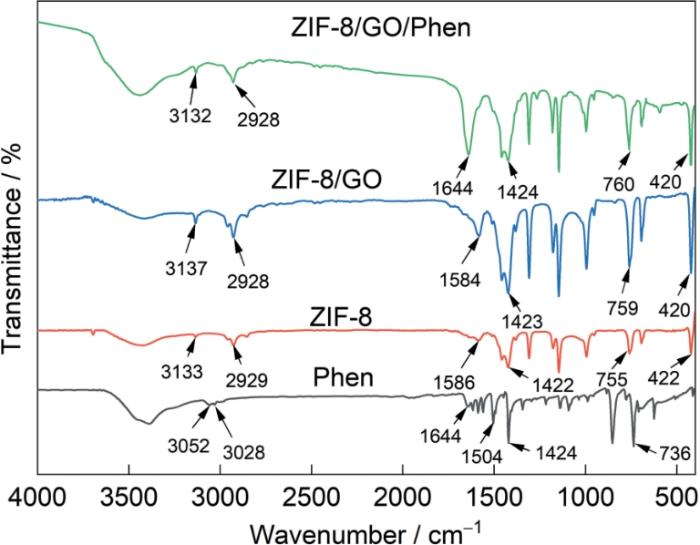
图1
ZIF-8体系纳米粒子与Phen的红外光谱图
Fig.1
Infrared spectra of ZIF-8 system nanoparticles and Phen
Phen在FT-IR谱图中于约2900~3100 cm-1范围内呈现C-H伸缩振动吸收峰,1420~1650 cm-1范围内出现C=C伸缩振动峰,1500~1600 cm-1范围内可见C=N伸缩振动峰,而约736 cm-1处则对应C-H弯曲振动特征峰[22]。通过对比ZIF-8/GO/Phen与纯Phen的红外谱图可知,复合样在约1424 cm-1处出现的特征峰归属于C=C伸缩振动,1644 cm-1附近峰位对应C=N伸缩振动,760 cm-1处的峰归因于C-H弯曲振动,且420 cm-1处依然可见Zn-N伸缩振动信号。上述结果表明,Phen已成功引入并与ZIF-8/GO结构实现复合,同时保持了ZIF-8骨架的配位结构完整性。
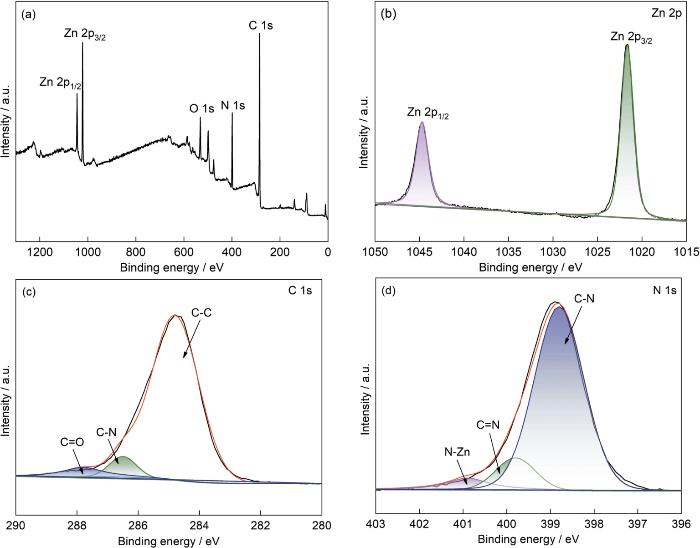
通过XPS进一步验证ZIF-8/GO/Phen纳米粒子的成分。图2a中XPS的全谱中出现了Zn、O、N和C四种元素的电子结合能信号峰,表明这四种元素是ZIF-8/GO/Phen材料的主要成分。图2b为ZIF-8/GO/Phen纳米粒子的Zn 2p光谱,在1044.8和1022.6 eV处显示了2个结合能峰,这符合Zn 2p1/2和Zn 2p3/2的旋光-轨道耦合特性[23]。图2c为ZIF-8/GO/Phen纳米粒子C 1s光谱,可以发现在288.3、286.5和284.7 eV处出现了3个结合能峰,分别来自于GO中的C=O键,以及杂环中的C-N 键和C-C键[24]。研究表明,ZIF-8与GO之间的相互作用之一是共价键结合,支撑了ZIF-8在GO纳米片上的化学吸附。图2d为ZIF-8/GO/Phen纳米粒子N 1s光谱,由3个特征峰组成,分别位于400.9、399.8和398.8 eV处,来自于Zn-N、C=N和C-N键,这与Phen的存在相关。以上结果进一步证明ZIF-8/GO/Phen纳米粒子的成功制备。
图2
2.2 纳米粒子及涂层的形貌分析
图3
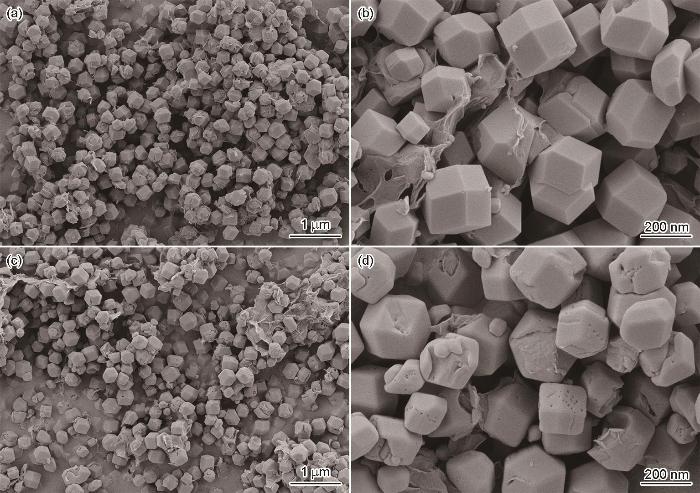
图3
ZIF-8/GO和ZIF-8/GO/Phen的SEM图
Fig.3
SEM images of ZIF-8/GO (a, b) and ZIF-8/GO/Phen (c, d)
采用SEM对ZIF-8/GO/Phen-EA和PANI/ZIF-8/GO/Phen-EA两种涂层的表面形貌进行对比表征分析,不同放大倍数下的微观形貌如图4所示。从SEM图像(图4a和b)可见,PANI/ZIF-8/GO/Phen-EA复合涂层表面的聚苯胺呈无规则团簇状结构,均匀且致密地覆盖于涂层表面。该形貌有利于形成有效的物理屏障,从而协同提升防腐性能。作为对比,ZIF-8/GO/Phen-EA涂层(图4c和d)表面亦呈现较为均匀平整的特征,其中层状石墨烯可有效延长腐蚀介质扩散路径,促进缓蚀剂可控释放,进一步强化涂层防护功能。然而,由图4c可见,涂层表面分布有微观孔隙,这些孔隙作为结构缺陷,会成为腐蚀介质渗透的优先通道,从而从根本上降低涂层的服役寿命。
图4
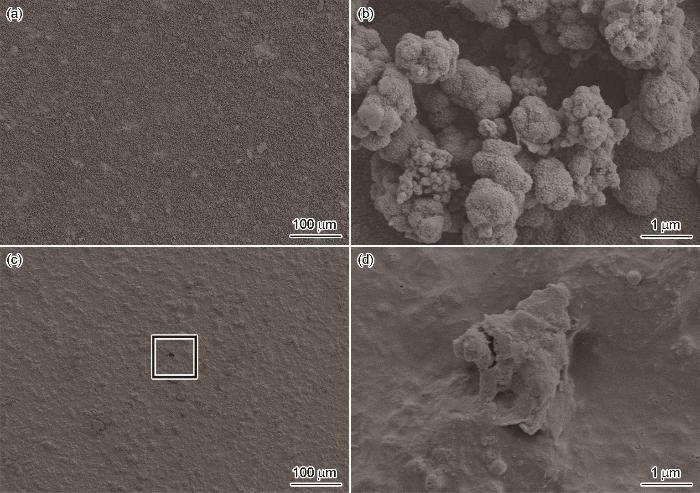
图4
PANI/ZIF-8/GO/Phen-EA和ZIF-8/GO/Phen-EA涂层的SEM图
Fig.4
SEM images of PANI/ZIF-8/GO/Phen-EA (a, b) and ZIF-8/GO/Phen-EA (c, d) coatings
2.3 防腐性能研究
采用0.1 mol/L HCl溶液模拟酸性腐蚀环境,系统评估不同涂层的腐蚀防护性能。利用电化学工作站对PANI/ZIF-8/GO/Phen-EA和ZIF-8/GO/Phen-EA两种复合涂层体系进行系统的电化学表征,包括开路电位(OCP)监测、电化学阻抗谱(EIS)分析以及动电位极化曲线测量。此外,通过长期浸泡实验进一步考察涂层体系的腐蚀防护稳定性,以评估其在模拟实际工况条件下的耐久性能。
2.3.1 电化学阻抗谱分析(EIS)
图5展示了四种不同ZIF-8/GO/Phen-EA配比复合涂层的Nyquist图。据文献报道,EIS图谱高频区容抗弧半径与涂层电阻呈正相关,其半径增大表明涂层致密性高,更能有效地阻止腐蚀介质的渗透,从而提升涂层的耐蚀性能[27]。对比可见,随着ZIF-8/GO/Phen填料含量的增加,涂层体系的容抗弧半径呈现先增大后减小的变化趋势。其中,1.5%ZIF-8/GO/Phen-EA复合涂层展现出最佳的阻抗特性,这可能是由于其填料分散均匀且与树脂基体相容性良好,形成更完整的物理阻隔网络。根据优化结果,选取1.5%的填料配比进行后续PANI外层的电沉积,构建了PANI/ZIF-8/GO/Phen-EA复合涂层,重点考察了1.5%ZIF-8/GO/Phen-EA及PANI/ZIF-8/GO/Phen-EA涂层在30 d长期浸泡实验中的腐蚀防护稳定性。
图5

图5
不同配比ZIF-8/GO/Phen-EA复合涂层的Nyquist图
Fig.5
Nyquist plots of ZIF-8/GO/Phen-EA composite coatings with different ratios
图6
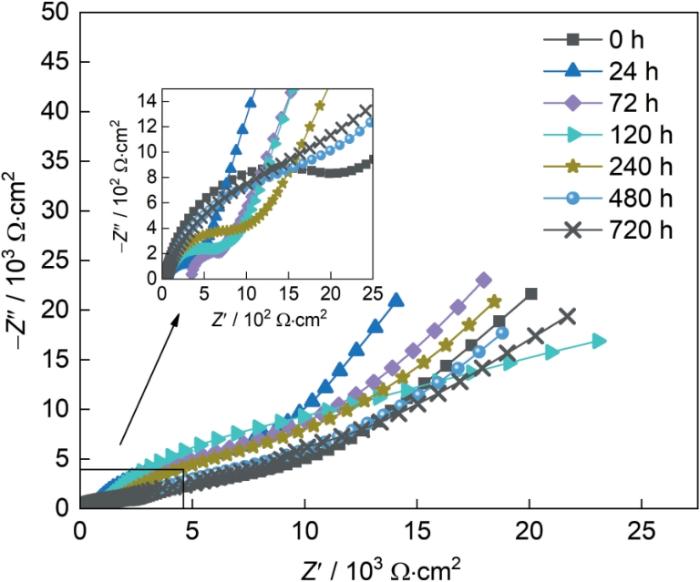
图6
1.5%ZIF-8/GO/Phen-EA复合涂层长期服役的Nyquist图
Fig.6
Nyquist plots of 1.5%ZIF-8/GO/Phen-EA composite coating during long-term service
图7

图7
ZIF-8/GO/Phen-EA及PANI/ZIF-8/GO/Phen-EA涂层体系的拟合电路图
Fig.7
Equivalent circuit diagrams for the ZIF-8/GO/Phen-EA (a) and PANI/ZIF-8/GO/Phen-EA (b) coating systems
表1 1.5%ZIF-8/GO/Phen-EA涂层长期服役期间的EIS拟合参数
Table1
| Time / h | Rs / Ω·cm2 | CPEc / Ω-1·cm-2·s-n | Rc / Ω·cm2 | CPEdl / Ω-1·cm-2·s-n | Rct / Ω·cm2 | Zd-R / Ω·cm2 |
|---|---|---|---|---|---|---|
| 0 | 26.49 | 1.17 × 10⁻⁶ | 2310 | 4.42 × 10⁻⁵ | 9843 | - |
| 24 | 51.76 | 7.41 × 10⁻⁶ | 388.7 | 9.34 × 10⁻⁵ | 15512 | 2.50 × 10⁵ |
| 72 | 376.7 | 1.73 × 10⁻⁶ | 384.5 | 8.20 × 10⁻⁵ | 17384 | 1.63 × 10⁵ |
| 120 | 41.36 | 7.10 × 10⁻⁶ | 778.8 | 1.22 × 10⁻⁴ | 46433 | - |
| 240 | 35.08 | 5.13 × 10⁻⁶ | 1124 | 7.78 × 10⁻⁵ | 17003 | 1.48 × 10⁵ |
| 480 | 33.02 | 4.23 × 10⁻⁶ | 1862 | 7.22 × 10⁻⁵ | 17426 | 1.47 × 10⁵ |
| 720 | 38.95 | 4.76 × 10⁻⁶ | 1960 | 3.63 × 10⁻⁵ | 8621 | 1.41 × 10⁵ |
表1的电化学参数分析表明,ZIF-8/GO/Phen-EA涂层表现出独特的电化学响应特性。在浸泡初期(0~72 h),Rc从初始值显著降低至384.5 Ω·cm2,这种变化主要由于腐蚀性电解质溶液的持续侵入,破坏了涂层的完整性,导致其绝缘性能下降。随着浸泡时间延长(> 72 h),Rc值呈现稳定上升趋势,这一现象揭示了多重防护机制的协同作用,GO纳米片的物理阻隔效应有效延长了腐蚀介质的扩散路径;ZIF-8框架中的咪唑配体与Phen分子通过配位作用实现缓蚀剂的控释;金属表面形成的致密钝化膜进一步增强了防护性能。
ZIF-8/GO/Phen-EA复合涂层Rct数值的动态变化完整揭示了其防护性能的演化机制。在腐蚀初期,Rct从初始值9843 Ω·cm2显著攀升至峰值46433 Ω·cm2,该现象归因于电解液渗透激活了涂层中功能填料的协同防护机制:二维片层材料GO与ZIF-8颗粒构建了高效的物理阻隔层,极大延长了腐蚀介质的扩散路径;同时,PANI的引入诱使金属基体表面生成致密的钝化膜,共同显著抑制了界面电荷转移反应,使涂层达到最佳防护状态。随后,Rct稳定在约17000 Ω·cm2的高位平台期,表明填料网络与钝化膜处于协同作用的稳定阶段,持续提供有效防护。浸泡末期,Rct急剧降至8621 Ω·cm2,标志着涂层失效的开始,界面处电解液的积聚导致钝化膜发生局部点蚀破坏,形成了低电阻的腐蚀通道,涂层防护性能由此衰退[30]。
图8为PANI/ZIF-8/GO/Phen-EA复合涂层的长期服役Nyquist图,其在0~48 h服役时的拟合电路如图7a所示,48~720 h服役时间内的EIS特征则通过图7b中的电路图进行拟合,主要的拟合参数列于表2中。由图8可知,涂层在长期服役阶段,高频区域容抗弧稳步增大,表明涂层防腐性能优越,外层PANI接触腐蚀介质后,发生的氧化还原反应能够促使钝化膜的生成,阻挡腐蚀粒子侵入,并保持高度的稳定性[31]。并且低频区域出现近乎垂直于实轴的直线,而不是典型的韦伯扩散特征,表明涂层具有良好的屏障性能,能有效阻挡腐蚀性离子的渗透,从而延长金属基体的防护寿命[32]。由表2分析可知,在长期服役时,PANI/ZIF-8/GO/Phen-EA涂层电阻逐渐升高,在720 h时达到2321 Ω·cm2,并表现出持续增长的趋势。Rc的增大,体现了涂层优异的防腐性能。Zd-R的增长与稳定,涂层的致密性以及结构稳定性强,有利于材料的防腐强化。
图8

图8
1.5%PANI/ZIF-8/GO/Phen-EA复合涂层长期服役的Nyquist图
Fig.8
Nyquist plots of 1.5%PANI/ZIF-8/GO/Phen-EA composite coating during long-term service
表2 1.5%PANI/ZIF-8/GO/Phen-EA复合涂层长期服役期间的EIS拟合参数
Table2
Time / h | Rs / Ω·cm2 | CPEc / Ω-1·cm-2·s-n | Rc / Ω·cm2 | Zd-R / Ω·cm2 |
|---|---|---|---|---|
| 0 | 26.12 | 1.38 × 10⁻⁵ | 241.8 | 4976 |
| 48 | 40.7 | 1.71 × 10⁻⁴ | 555.6 | 5709 |
| 96 | 40.27 | 1.52 × 10⁻⁴ | 662.5 | 6107 |
| 360 | 40.34 | 8.53 × 10⁻⁵ | 732.6 | 5695 |
| 480 | 42.5 | 6.75 × 10⁻⁵ | 1042 | 4875 |
| 600 | 39.03 | 5.93 × 10⁻⁵ | 1611 | 4552 |
| 720 | 37.86 | 5.22 × 10⁻⁵ | 2321 | 4115 |
2.3.2 动电位极化分析
图9展示了不同配比ZIF-8/GO/Phen-EA复合涂层及PANI/ZIF-8/GO/Phen-EA复合涂层的动电位极化曲线,通过Tafel外推法拟合得到各自的自腐蚀电位(Ecorr)与自腐蚀电流密度(icorr)数据(表3)。对于0.5%ZIF-8/GO/Phen-EA,腐蚀电流密度为1.13 × 10-6 A/cm2,随着防腐填料含量的增加,复合涂层的自腐蚀电位明显正移。电沉积PANI外层后,PANI/ZIF-8/GO/Phen-EA涂层体系的腐蚀电流密度为1.64 × 10-6 A/cm2。这种涂层的腐蚀电流密度均大于裸不锈钢基底的腐蚀电流密度,这是由于通过涂层基底的Tafel线外推法估算出的腐蚀电流密度实际上是PANI涂层的氧化还原反应产生的电流(iredox)与基体溶解产生的电流(imatrix)之和。由于PANI具有优异的氧化还原性能,icorr的主要来源为iredox[33]。结合Ematrix综合分析可知,PANI/ZIF-8/GO/Phen-EA复合涂层在系列样品中具有最优异的耐腐蚀性与防护性能。
图9
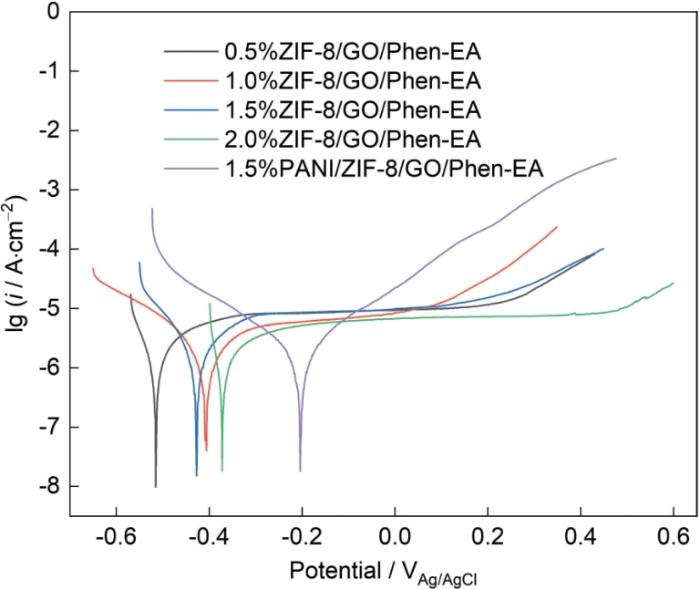
图9
PANI/ZIF-8/GO/Phen-EA复合涂层和四种不同配比ZIF-8/GO/Phen-EA涂层的动电位极化曲线
Fig.9
Potentiodynamic polarization curves of PANI/ZIF-8/GO/Phen-EA composite coatings and four ZIF-8/GO/Phen-EA coatings with different ZIF-8/GO/Phen ratios
表3 不同配比ZIF-8/GO/Phen-EA涂层和PANI/ZIF-8/GO/Phen-EA复合涂层的动电位极化曲线拟合数据
Table3
| Samples | Ecorr / mV | icorr / A·cm-2 |
|---|---|---|
| 0.5%ZIF-8/GO/Phen-EA | -521 | 1.13 × 10⁻⁶ |
| 1.0%ZIF-8/GO/Phen-EA | -408 | 1.03 × 10⁻⁶ |
| 1.5%ZIF-8/GO/Phen-EA | -433 | 1.06 × 10⁻⁶ |
| 2.0%ZIF-8/GO/Phen-EA | -380 | 1.09 × 10⁻⁶ |
| 1.5%PANI/ZIF-8/GO/Phen-EA | -201 | 1.64 × 10⁻⁶ |
2.3.3 长期服役后涂层的形貌分析
图10对比展示了PANI/ZIF-8/GO/Phen-EA和ZIF-8/GO/Phen-EA两种涂层经30 d长期服役后的表面形貌演变。这是由于PANI的引入显著优化了ZIF-8/GO/Phen-EA复合涂层的结构性能,通过分子层面的界面修饰作用,有效增强了填料与基体间的界面结合强度,构建了更为致密的三维阻隔网络,使涂层的介质渗透率降低[34]。由图10a和b可知,服役前后PANI/ZIF-8/GO/Phen-EA涂层的形貌没有太大变化,依旧保持良好的致密性。而从图10c和d可以观察到,长期服役后的ZIF-8/GO/Phen-EA涂层表面出现更多微孔,且粗糙度增大,表明该涂层长期服役时物理屏障作用降低,防腐性能衰减,与EIS测量结果一致。
图10

图10
长期服役后PANI/ZIF-8/GO/Phen-EA和ZIF-8/GO/Phen-EA涂层的SEM图像
Fig.10
SEM images of PANI/ZIF-8/GO/Phen-EA (a, b) and ZIF-8/GO/Phen-EA (c, d) coatings after long-term service
2.3.4 涂层自修复性能分析
为测量防腐涂层的自修复特性,人为在PANI/ZIF-8/GO/Phen-EA和ZIF-8/GO/Phen-EA涂层表面分别划5 mm的划痕,确保涂层被划破且划痕平整光滑。利用电化学工作站对两类涂层进行一周EIS和OCP测量,探究涂层的自修复特性。如图11a1、b1和c1所示,划伤发生后,1.5%ZIF-8/GO/Phen-EA涂层完整性被破坏,腐蚀介质迅速渗透至金属基底,因此,高频区域涂层体系的容抗弧在0~48 h内迅速变小,涂层电阻显著降低至5172 Ω·cm2,表明腐蚀进程加速。在之后的48~120 h内,涂层的容抗弧增大,表明界面腐蚀反应受到抑制。并且OCP逐渐升高,在120 h时,低频区域涂层模值(|Z|0.01 Hz)达到最高且趋于稳定,这是由于涂层中GO的阻隔和缓蚀剂的释放,诱导涂层损伤处腐蚀抑制剂的累积,阻隔了腐蚀进程[35]。随着防腐粒子的发挥作用,涂层的防腐性能增强并趋于稳定,在划伤情况下,具备自主修复效应。
图11
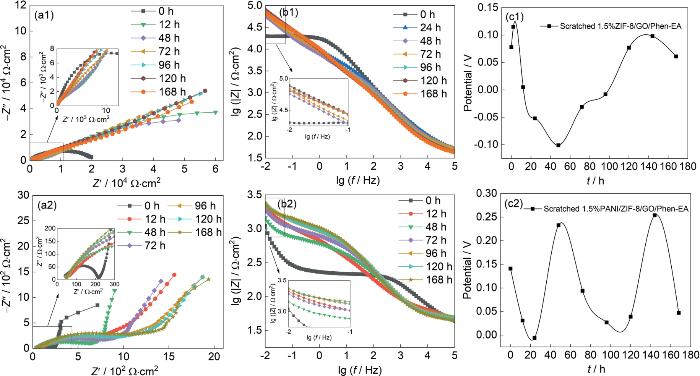
图11
划伤的1.5%ZIF-8/GO/Phen-EA复合涂层和1.5%PANI/ZIF-8/GO/Phen-EA涂层的Nyquist图、Bode图和开路电位随时间的变化趋势
Fig.11
Nyquist plots, Bode plots and OCP curves versus time of scratched 1.5%ZIF-8/GO/Phen-EA composite coatings (a1-c1) and 1.5%PANI/ZIF-8/GO/Phen-EA coatings (a2-c2)
从图11a2、b2和c2可知,划伤后PANI/ZIF-8/GO/Phen-EA复合涂层在0~12 h内容抗弧迅速增大,这是由于涂层中PANI分子直接与腐蚀介质接触,通过发挥阳极保护作用促进金属表面形成钝化膜,阻隔腐蚀粒子的渗入,降低了腐蚀速率[36]。在12 h之后,涂层的容抗弧稳定增大,突出其优异的主动防腐机制。此外,在测试的一周内,PANI/ZIF-8/GO/Phen-EA复合涂层的OCP显著高于ZIF-8/GO/Phen-EA涂层,体现了其内和外层涂层的协同作用。内层复合粒子ZIF-8/GO/Phen作为功能单元,可通过多级机制实现高效防护,其中ZIF-8作为pH响应型载体,在腐蚀初期酸性环境下释放Phen抑制剂使之迁移至涂层损伤处,GO则凭借其二维片层结构形成致密物理屏障,显著延缓介质渗透。此外,外层PANI涂层则通过阳极保护作用促进涂层损伤处基地的钝化,参与界面不溶性保护层的形成。
利用Zview软件拟合两种划伤涂层的Nyquist图,其中ZIF-8/GO/Phen涂层在服役0~12 h和12~168 h的拟合电路如图7a和b所示,具体拟合参数如下表4所示。PANI/ZIF-8/GO/Phen复合涂层则通过图7b中的电路图对其服役0~168 h的阻抗特征进行拟合,拟合参数列于表5中。由表4可知,划伤的ZIF-8/GO/Phen涂层在初期显示出极大的涂层电阻(21387 Ω·cm2),表明涂层防腐的即时性,在接触腐蚀粒子时,涂层快速响应,促使缓蚀粒子的释放修复腐蚀位点,提升涂层的防腐性能[37]。在96 h时降到最低(5571 Ω·cm2)并在后续维持相近数值,表明涂层自修复性能有限。
表4 划伤的1.5%ZIF-8/GO/Phen-EA涂层服役一周的EIS拟合参数
Table 4
| Time / h | Rs / Ω·cm2 | CPEc / Ω-1·cm-2·s-n | Rc / Ω·cm2 | CPEdl / Ω-1·cm-2·s-n | Rct / Ω·cm2 | Zd-R / Ω·cm2 |
|---|---|---|---|---|---|---|
| 0 | 45.07 | 7.4 × 10⁻⁶ | 21387 | - | - | 2.8 × 10⁴ |
| 12 | 38.82 | 1.3 × 10⁻⁵ | 9822 | 4.1 × 10⁻⁵ | 9.5 × 10⁴ | - |
| 48 | 39.08 | 1.2 × 10⁻⁵ | 5172 | 6.3 × 10⁻⁵ | 1.9 × 10⁵ | - |
| 72 | 40.88 | 1.6 × 10⁻⁵ | 5725 | 5.0 × 10⁻⁵ | 1.1 × 10¹³ | - |
| 96 | 35.66 | 1.7 × 10⁻⁵ | 5571 | 3.6 × 10⁻⁵ | 1.0 × 10²¹ | - |
| 120 | 35.69 | 1.9 × 10⁻⁵ | 8184 | 4.4 × 10⁻⁶ | 1.5 × 10⁴ | 1.0 × 10⁴ |
| 168 | 35.63 | 1.9 × 10⁻⁵ | 9601 | 3.7 × 10⁻⁶ | 8.5 × 10⁻³ | 4.9 × 10⁴ |
表5 划伤的PANI/ZIF-8/GO/Phen-EA复合涂层服役一周的EIS拟合参数
Table 5
| Time / h | Rs / Ω·cm2 | CPEc / Ω-1·cm-2·s-n | Rc / Ω·cm2 | Zd-R / Ω·cm2 |
|---|---|---|---|---|
| 0 | 32.93 | 1.74 × 10⁻⁵ | 189.6 | 2320 |
| 12 | 41.23 | 4.76 × 10⁻⁴ | 1260 | 9745 |
| 48 | 44.76 | 1.41 × 10⁻⁴ | 657 | 4616 |
| 72 | 40.67 | 1.22 × 10⁻⁴ | 893 | 5836 |
| 96 | 42.41 | 1.14 × 10⁻⁴ | 1065 | 6210 |
| 120 | 41.5 | 1.08 × 10⁻⁴ | 1107 | 6842 |
| 168 | 40.59 | 41.17 × 10⁻⁴ | 1322 | 5405 |
根据表5数据可知,划伤的PANI/ZIF-8/GO/Phen复合涂层的阻抗在12 h内显著增长,达到1260 Ω·cm2,外层PANI中植酸掺杂剂的脱掺杂及其特有的阳极保护功能赋予了涂层服役初期的自修复功能[38]。在12~48 h服役期间内,涂层体系Rc的降低表明涂层损伤处所形成的具有保护作用的氧化物层防护性能有限,涂层体系耐蚀性降低。然而随着时间的增长,Rc值又呈现增大趋势,这与缓蚀剂的释放及内外层涂层的协同作用有关,表明该涂层自修复性质得以强化。对比表4和表5的数据可知,PANI/ZIF-8/GO/Phen复合涂层的Rc值比ZIF-8/GO/Phen涂层的Rc值小了一个数量级左右,这是由于外层PANI具有良好的导电性所致[39]。因此,PANI/ZIF-8/GO/Phen-EA复合涂层能够保持优异的主动防护性质,在腐蚀发生时快速响应及积极应答,展现良好的自修复效应。
2.4 PANI/ZIF-8/GO/Phen涂层的防腐机理
PANI/ZIF-8/GO/Phen-EA复合涂层的防腐蚀机理示意图如图12所示,其中内层涂层中的ZIF-8/GO/Phen填料和PANI面层可发挥协同作用,维持涂层长效、主动的腐蚀防护作用。首先,内层涂层中片状的GO能够发挥二维阻隔作用延长腐蚀性物质的扩散路径,且所引入的碳纳米管一步增加了介质的扩散曲折度,二者共同构建了高效的“迷宫效应”;此外,ZIF-8作为负载缓蚀剂Phen的纳米容器,当涂层受损或局部pH发生变化时,将诱导2-甲基咪唑配体及Phen缓蚀剂的释放,在涂层损伤处与金属基底溶出的Fe2+络合,实现涂层的自修复防护作用。其次,复合涂层中外层的PANI可填补内层ZIF-8/GO/Phen-EA涂层的孔隙和裂纹,提高涂层的致密性。在接触腐蚀性介质时,通过PANI自身的氧化还原反应可使植酸分子脱掺杂,参与涂层/金属基底界面处钝化膜及Fe基不溶性复合物的形成,从而抑制金属基底的阳极溶解过程,提高涂层的主动防护功能。
图12

图12
PANI/ZIF-8/GO/Phen-EA防腐涂层的防腐机理示意图
Fig.12
Schematic diagram of the anticorrosion mechanism of PANI/ZIF-8/GO/Phen-EA composite coating
3 结论
(1) 构建了兼具高效物理屏障、主动防护及智能响应修复功能的多级防御机制的PANI/ZIF-8/GO/Phen复合涂层,并成功合成ZIF-8/GO/Phen纳米粒子。
(2) 当内层涂层中ZIF-8/GO/Phen纳米粒子含量为1.5%时,涂层具有最佳的耐蚀性,且在引入PANI外层之后涂层具有长效及稳定的防腐蚀性质。单层涂层在划伤后电阻出现明显下降,双层涂层的电阻在划伤后反而出现上升并最终保持稳定。
(3) PANI/ZIF-8/GO/Phen-EA复合涂层的腐蚀电位最高,为-201 mV,相较于ZIF-8/GO/Phen-EA单层涂层显著正移约300 mV,腐蚀电位的正移直接体现了材料耐腐蚀性能的提升。
(4) 1.5%ZIF-8/GO/Phen单层涂层涂层电阻从21387 Ω·cm2下降至9601 Ω·cm2,表明其自修复效果有限。PANI/ZIF-8/GO/Phen-EA复合涂层的涂层电阻由189.6 Ω·cm2上升至1322 Ω·cm2且趋于稳定,表明该涂层能有效抑制电解液渗透,并通过自修复作用持续提升基底金属的耐腐蚀性。
参考文献
Preparation of phosphorus-containing graphene and corrosion resistance of composite coating
[J].
The phosphorus-containing graphene (PhA-G) was prepared by pyrolysis method with phytic acid (PhA) as raw material, and next the PhA-G/SiR composite anticorrosion coating was prepared with silicone resin (SiR) as film forming material. The structure and morphology of phosphorus-containing graphene was characterized by means of Raman spectroscope, X-ray photoelectron spectroscope (XPS), scanning electron microscope (SEM), transmission electron microscope (TEM) and atomic force microscope (AFM). The prepared coatings with the different additive amount of PhA-G (1%~4% in mass fraction), were comparatively examined by means of measurements of contact angle, water absorption, potentiodynamic polarization curves, electrochemical impedance spectroscopy (EIS), as well as salt spray test. The results show that the protectiveness of PhA-G/SiR composite coatings for metal substrate is greater than that of the plain SiR coating, and graphene oxide/silicone resin (GO/SiR) coating. The PhA-G/SiR composite coating exhibits good hydrophobicity and excellent corrosion resistance when the mass fraction of PhA-G is 3%. Correspondingly, which exhibits hydrophobic contact angle of 103.5° and water absorption rate of 3.72%, while corrosion current density of 3.53×10⁻¹⁰ A/cm2 and electrochemical impedance as high as 3.82×10⁷ Ω·cm2 in 3.5%(mass fraction) NaCl solution. Furthermore, the PhA-G/SiR composite coating presents excellent resistance to salt spray testing, up to above 960 h.
含磷石墨烯的制备及复合涂层的耐蚀性能
[J].以植酸(PhA)为原料,采用热解法制备含磷石墨烯(PhA-G),并以硅树脂(SiR)为成膜物制备含磷石墨烯/硅树脂(PhA-G/SiR)复合防腐蚀涂层。通过拉曼光谱和XPS分析含磷石墨烯的结构,通过SEM、TEM和AFM观察含磷石墨烯的形貌,通过接触角、吸水率、电化学阻抗谱、极化曲线和盐雾实验等研究复合涂层的耐蚀性能。结果表明:相比于纯SiR涂层和氧化石墨烯/硅树脂(GO/SiR)复合涂层,PhA-G/SiR复合涂层对金属的保护作用更好;当含磷石墨烯添加量为3%(质量分数)时,PhA-G/SiR复合涂层表现出较好的疏水性和优异的防腐蚀性能,其接触角为103.5°,吸水率为3.72%;腐蚀电流密度为3.53×10-10 A/cm2,电化学阻抗值达到3.82×107 Ω·cm2,耐盐雾达到960 h。
Preparation and corrosion resistance of graphene/acetic acid doped polyaniline
[J].The primary doped products of RGO/PANI were synthesized via in situ polymerization method in acetic acid with graphene (RGO) and different proportions aniline (ANI) as raw materials, and then the secondary doped products of RGO/PANI were obtained via de-doping with ammonia and afterwards re-doping with acetic acid. The structure and morphology of the prepared products were characterized by IR, UV and SEM. Their anticorrosion performance was assessed by electrochemical workstation. The results show that the primary doped products with the mass ratio 1:10 of RGO to ANI had the best morphology and anti-corrosion property. The polyaniline grown on the surface of graphene is about 300~650 nm in length and 70~100 nm in diameter, and the corrosion inhibition efficiency was up to 73.19%. The products obtained by secondary doping of acetic acid had better morphology, higher corrosion inhibition efficiency and excellent corrosion resistance performance. The corrosion inhibition efficiency is up to 80.21%.
石墨烯/醋酸掺杂态聚苯胺的制备及其防腐性能
[J].在醋酸体系中用原位聚合法将石墨烯(RGO)与不同比例的苯胺(ANI)合成RGO/PANI一次掺杂态产物,用氨水解掺杂后再掺杂醋酸制备出RGO/PANI二次掺杂态产物。使用红外光谱、紫外光谱和扫描电镜等手段表征产物的结构和形貌并用电化学技术测试其防腐性能。结果表明,RGO与ANI质量比为1:10时生成的一次掺杂态产物形貌最好,防腐效果最佳;RGO表面生长的聚苯胺长度为300~650 nm,直径为70~100 nm,产物的缓蚀效率可达73.19%;RGO/PANI二次掺杂态产物为石墨烯/醋酸掺杂态聚苯胺;醋酸掺杂可明显改善产物的结构和形貌并提高其缓蚀效率,缓蚀效率可达到80.21%,防腐性能优异。
Nanomaterials via ZIF-8: preparations, catalytic and drug delivery applications
[J].
Fabrication and properties of PANI-ZnO/SiO2 photothermal corrosion-resistant integrated coating on aluminum alloy surfaces
[J].The PZS surface can provide excellent photothermal deicing performance and corrosion resistance for aluminum alloys.
Electrodeposition of conductive polyaniline films for corrosion protection of copper bipolar plates in simulated proton exchange membrane fuel cells environment
[J].
Polyaniline-based hybrid coatings for corrosion protection: Breakthroughs in nanocomposite design, self-healing, and corrosion sensing
[J].
Research progress and prospects of metal-organic framework materials in corrosion protection
[J].This review outlines the synthesis strategies and functional applications of MOF-based anticorrosion materials, and the roles of MOFs in enhancing coating performance through nanofilling, inhibition, and self-healing functionalities are highlighted.
Recent progress in metal-organic frameworks for corrosion protection: from synthetic strategies to applications
[J].
PEI-functionalized surface coating on carbonized ZIF-8 for enhanced adsorption of methyl orange
[J].The contamination of water resources by high concentrations of organic dyes poses severe threats to human health, making the removal of these pollutants critical. Metal–organic frameworks (MOFs) have shown promising potential in dye adsorption due to their high surface area and chemical stability. Zeolitic imidazolate framework-8 (ZIF-8), a typical MOF, is known for its thermal stability and is frequently used in removing organic dyes. To enhance its adsorption performance, ZIF-8 is often carbonized to form porous carbon-based materials. However, carbonized ZIF-8 (CZ) often demonstrates restricted adsorption capacity and sluggish kinetics. To address these limitations, we chemically modified low-temperature carbonized ZIF-8 (CZ-550) with polyethyleneimine (PEI) using cyanuric chloride (CC) as a crosslinking agent, producing a novel composite (CZ@PEI/CC-7) featuring abundant amine-rich active sites for adsorption. This study evaluated the adsorption performance of CZ@PEI/CC-7 in removing methyl orange (MO) dye. Our findings reveal that CZ@PEI/CC-7 exhibits accelerated adsorption kinetics aligning with the pseudo-second-order kinetic model, while its isotherms fit the Freundlich and Temkin models, highlighting a favorable multilayer adsorption. Significantly, CZ@PEI/CC-7 achieved an adsorption capacity of 3150 mg/g for MO, compared to 1100 mg/g for unmodified CZ-550. Furthermore, the composite demonstrated excellent acid-base stability across a broad pH range (2–12), retaining structural integrity and adsorption efficiency. These findings suggest that CZ@PEI/CC-7 is a promising candidate for efficient MO removal from water.
Synergetic inhibition and corrosion-sensing abilities based on pH-sensitive ZIF-8@CeO2 core-shell nanocontainers toward intelligent coating
[J].
Surface coating of ZIF-8 nanoparticles with polyacrylic acid: a facile approach to enhance chemical stability for biomedical applications
[J].
A novel smart anti-corrosive coating based on the beanpod-inspired microcontainers with self-reporting and self-healing abilities
[J].
Fabrication of metal-organic gel (MOG) nanoparticles-enhanced epoxy coating as a pH-sensitive corrosion inhibitor under diverse environmental conditions
[J].
Self-healing and early corrosion warning bi-functional waterborne epoxy coatings via intercomponent synergy between pH-sensitive Phen/BTA-loaded CaCO3 nanocontainer@ZIF-8 and graphene oxide for long-lasting protection of Q235 carbon steel
[J].
In situ synthesis and long-term corrosion inhibition performance of GO-PANI@ZP composite
[J].
Enhanced corrosion resistance of water-based aluminum phosphate coatings via graphene oxide modification: Mechanisms and long-term performance
[J].In this study, we have developed a water-based aluminum phosphate (WAP) coating consisting of a base layer and a surface layer. Graphene oxide (GO) was used to modify the base layer. Three different GO concentrations—0.5, 0.75, and 1 wt.%—were employed to assess their impact on the corrosion resistance of the coating and to explore the underlying mechanisms. The corrosion resistance mechanism was also examined. In the coating, GO combined with phosphate to form large blocks that effectively blocked the pores, and the porosity decreased with the increase in GO content. This led to an improvement in the substrate protection efficiency by over 10%. Impedance spectroscopy revealed that the main mechanism behind the enhanced corrosion resistance was the shielding effect of GO, which created a “maze effect” that improved the coating’s protective properties. However, an excessive amount of GO reduced the corrosion resistance of the coating. Overall, the WAP coating modified with 0.75 wt.% GO exhibited the best corrosion resistance.
Preparation and properties of cerium dioxide-graphene oxide hybrid materials (CeO2-GO)/epoxy resin anti-corrosive composite coating
[J].
CeO2-GO/EP防腐复合涂层的制备和性能
[J].用3-氨丙基三乙氧基硅烷和3-缩水甘油醚氧丙基三甲氧基硅烷分别对氧化石墨烯(GO)和二氧化铈(CeO2)纳米粒子表面进行共价化学修饰,氨基与环氧基之间的开环反应将CeO2纳米粒子锚定在GO的表面得到CeO2-GO杂化材料,将其引入环氧树脂基体中制备出CeO2-GO杂化材料/环氧树脂防腐复合涂层(CeO2-GO/EP)防腐复合涂层。使用FT-IR、XPS和SEM等手段对其表征。结果表明,CeO2-GO杂化材料均匀分散在环氧树脂基体中。CeO2-GO/EP涂层的吸水率和摩擦系数明显比纯环氧树脂涂层的低。1.0% CeO2-GO/EP (质量分数)具有较低的腐蚀电流密度(Icorr)值(8.42 × 10⁻¹³ A·cm-2)和较高的腐蚀电位(Ecorr)值(-65 mV)。在3.5%NaCl (质量分数)溶液中浸泡60 d后的CeO2-GO/EP涂层样品,其阻抗|Z|0.01 Hz值为7.41 × 10⁹ Ω·cm2,是纯环氧树脂涂层|Z|0.01 Hz值(6.56 × 10⁶ Ω·cm2)的1000倍。主动和被动双重防腐机制使CeO2-GO/EP涂层具有长效防腐性能。
Ultrasonic spray coating of graphene oxide for lithium metal battery separators
[J].
A novel hybrid composite of Co-MOF@GO/PANI: synthesis and electrochemical evaluation as an electrode material for supercapacitors
[J].
GO-functionalized MXene towards superior anti-corrosion coating
[J].MXene flakes shows the great potential in corrosion protection area owing to their lamellar structure and remarkable mechanical features. However, these flakes are highly susceptible to oxidation, which results in their structure degradation and restrict their application in anti-corrosion field. Herein, graphene oxide (GO) was used to functionalize TiCT MXene through TiOC bonding to fabricate GO-TiCT nanosheets, which proved by Raman, X-ray photoelectron spectroscopy (XPS), and Fourier transform infrared spectroscopy (FT-IR). GO-TiCT nanosheet inclusion into the epoxy coating and their corrosion performance in 3.5 wt.% NaCl solution with 5 MPa pressure was evaluated through electrochemical techniques including open circuit potential (OCP) and electrochemical impedance spectroscopy (EIS) along with salt spray. Results indicated that GO-TiCT/EP presented superior anti-corrosion capability, the impedance modulus at low frequency (|Z|) was above 10 Ω cm after 8 days' immersion in 5 MPa environment, which was 2 orders of magnitude higher than that of the pure epoxy coating. Scanning electron microscope (SEM) and salt spray images demonstrated that the epoxy coating loaded with GO-TiCT nanosheet could provide robust corrosion protection for Q235 steel via the physical barrier effect.Copyright © 2023 Elsevier Inc. All rights reserved.
Constructing hollow structures and coordination defects in ZIF-8 through a uniquely gas-phase etching strategy to achieve efficient CO2-to-CO conversion across a wide potential range
[J].
New zinc(II) coordination compound with 1,10-phenanthroline and maleate: comprehensive structural analysis, periodic-DFT calculations, and evaluation of biological potential
[J].
A smart epoxy coating based on Zn-imidazole metal-organic framework/graphene oxide nanocomposite for corrosion protection
[J].
Modified organic coating with polypyrrole and ZIF-67 decorated graphene oxide fillers for sustainable corrosion protection
[J].
Multifunctional epoxy/PVDF smart coatings using ZIF-8 nanosensor for corrosion protection of mild steel: a study on synthesis and performance
[J].
Interfacially engineered polypyrrole/ZIF-8 based bilayer nanocomposite coating for sustained active-passive protection of stainless steel
[J].
Mechanisms of friction and corrosion resistance in superhydrophobic waterborne polyurethane modified fluorinated polyurethane coatings
[J].
Room-temperature self-healing epoxy coating enhanced by cerium-doped ZIF-8 modified graphene oxide nanosheets toward passive/active anti-corrosion
[J].
Mechanism of long-term corrosion protection for silicone epoxy coatings reinforced by BN-PDA-CeO2 ternary composites in harsh environments
[J].Corrosion in harsh environments causes global economic losses exceeding 3 trillion US dollars annually. Traditional silicone epoxy (SE) coatings are prone to failure due to insufficient physical barrier properties and lack of active protection. In this study, cerium dioxide (CeO2) was in situ grown on the surface of hexagonal boron nitride (h-BN) mediated by polydopamine (PDA) to prepare BN-PDA-CeO2 ternary nanocomposites, which were then incorporated into SE coatings to construct a multi-scale synergistic corrosion protection system. Fourier transform infrared spectroscopy (FT-IR), X-ray diffraction (XRD), and transmission electron microscopy (TEM) confirmed the successful preparation of the composites, where PDA inhibited the agglomeration of h-BN and CeO2 was uniformly loaded. Electrochemical tests showed that the corrosion inhibition efficiency of the extract of this composite for 2024 aluminum alloy reached 99.96%. After immersing the composite coating in 3.5 wt% NaCl solution for 120 days, the coating resistance (Rc) and charge transfer resistance (Rct) reached 8.5 × 10⁹ Ω·cm2 and 1.2 × 10¹⁰ Ω·cm2, respectively, which were much higher than those of pure SE coatings and coatings filled with single/binary fillers. Density functional theory (DFT) calculations revealed the synergistic mechanisms: PDA enhanced interfacial dispersion (adsorption energy of −0.58 eV), CeO2 captured Cl− (adsorption energy of −4.22 eV), and Ce3+ formed a passive film. This study provides key technical and theoretical support for the design of long-term corrosion protection coatings in harsh environments such as marine and petrochemical industries.
Innovative PDC coatings for corrosion protection in the oil and gas industry
[J].One of the major issues in the energy intensive industries (EIIs) operation is corrosion control. Particularly, in refineries, corrosion causes 33% of malfunctions, especially due to the deterioration of the metallic materials and, therefore, the shortening of the useful life of equipment and installations. To face this problem, novel polymer-derived ceramic (PDC) coatings have been formulated, developed and characterized by physical and chemical tests. Different formulations were analyzed on a lab-scale through accelerated corrosion tests under acidic environments using electrochemical impedance spectroscopy (EIS) to evaluate their corrosion performance when exposed to near-real operating conditions. The optimized formulation will be used as a barrier in stainless-steel pipelines to improve the energy performance of EIIs by reducing energy losses due to excess cooling of components, maximizing the thermal efficiency of equipment, increasing the service life of equipment and reducing operation and maintenance (O&M) costs and downtime.
Facile fabrication of polyaniline-MXene bilayer coatings for enhanced corrosion protection and self-healing on steel substrates
[J].
Assessment of corrosion protection of Ti3C2T x @CoAl-LDH composite coatings formed on steel sheets
[J].Multiple kinds of layered materials have acquired much attention in the field of corrosion inhibition due to their distinctive two-dimensional (2D) structure.
A novel superior corrosion resistance and spot-weldable polyimide-polyaniline composite coating for low alloy mild steel
[J].
Enhanced anti-corrosion performance of epoxy coating with the incorporation of novel carbon nitride/PANI fillers
[J].
Toward self-healing two dimensional MXene coatings for corrosion protection on metals: Design strategies and mechanisms
[J].
Dual-action self-healing anticorrosive coating based on polyaniline microcapsules
[J].
基于聚苯胺微胶囊的双重自修复防腐涂层
[J].
Dynamic polymer/metal–organic framework hybrid microcapsules for self-healing anticorrosion coatings
[J].
Photothermal self-healing and anti-corrosion coating based on phytic acid-doped polyaniline
[J].
基于植酸掺杂聚苯胺的光热自修复防腐涂层
[J].
Synergetic effects of inorganic sepiolite filler and electroactive polyaniline on the physical and charge transport properties of polyaniline-layered phosphonated PVA-sepiolite membranes
[J].Novel sepiolite based cation exchange membranes with PANI layering at the surface to withstand high thermo-mechanical stresses in PEMFCs and showing good electrochemical properties for charge transport.


