



与传统铸造或锻造工艺相比,粉末冶金(Powder metallurgy, PM)可用于制备复杂形状的Ti2AlNb合金构件。PM可细化晶粒并使合金元素均匀分布形成细小均匀的显微组织,从而使粉末合金具有优异的力学性能[6,7]。粉末Ti2AlNb合金的制备方法,包括热等静压法(Hot isostatic pressing, HIP)、放电等离子烧结法(Spark plasma sintering, SPS)以及增材制造法(Additive manufacturing, AM)。SPS法的优势是烧结快,但是制造出的大尺寸构件组织不均匀[8~10]。AM法中的固液相变容易产生凝固类缺陷,使制备出的Ti2AlNb合金构件成分偏析和孔隙率较高[11,12]。相比之下,HIP法中的高温高压协同作用能消除孔隙并改善组织均匀性,可制造近净成形复杂构件,还能提高材料的利用率[13~15]。
但是,目前关于用HIP技术制备高性能Ti2AlNb合金构件的研究较少。采用典型HIP制备的Ti2AlNb合金的力学性能不稳定,尤其是其室温塑性(延伸率)的稳定性不高。Ti2AlNb合金属于低塑性金属间化合物,对缺陷和应力集中的敏感性较高。航空发动机的高温构件,在装配、启停热循环或偶发过载等工况下会产生附加的应力。适当的室温塑性,使材料具有足够的应变容纳能力、防止脆性断裂、保障结构完整性和安全裕度。研究表明[16],在钛合金的热等静压过程中温度对其显微组织和力学性能的影响极为显著。在温度较高的条件下,压力主要影响合金的致密度而对其力学性能的影响较小。鉴于此,本文研究HIP参数(温度、保温时间)和二次HIP对Ti2AlNb粉末合金显微组织和力学性能的影响并揭示其机制。
1 实验方法
实验用Ti2AlNb合金的名义成分为Ti-22Al-24Nb-0.5Mo (原子分数,%)。Ti2AlNb合金的制备:先将特定比例的海绵钛(包含Ti箔)、Al-Nb、Ti-Nb和Al-Mo中间合金混合均匀,随后用液压机械压制成重约4.5 kg的电极。将其组装焊接和真空自耗电弧熔炼三次以上得到Ti2AlNb合金的铸锭。将铸锭在B2相区开坯后在(α2 + B2)相区锻造,再进行精细的机械加工得到制粉电极。
用无坩埚电极感应熔炼惰性气体雾化(Electrode induction-melting inert gas atomization, EIGA)技术制备预合金粉末。在制粉过程中,雾化气体为高纯氩气(纯度≥ 99.999%),雾化压力为4.0~4.5 MPa,使球形粉末的粒度合理分布。将制备出的预合金粉末装填在内径为40 mm、高度为150 mm的圆柱形低碳钢包套中,然后将包套在220 ℃真空脱气(真空度≤ 10-2 Pa),并保温8 h以充分去除粉末表面吸附的气体和水分。最后对包套进行钨极惰性气体保护焊(Tungsten inert gas welding, TIG)(即封焊)将其密封。然后,将包套放入RD750型热等静压设备中进行致密化处理,用不同参数的HIP制备合金,压力不低于130 MPa。
将用HIP制备的合金在980 ℃的KC-GWL800高温真空炉中进行固溶热处理,保温2 h后炉冷至室温。
用Kroll试剂(2%HF + 8%HNO3 + 90%H2O,体积分数)腐蚀,制备扫描电镜(SEM)样品。用电解抛光(抛光电压30 V,抛光时间45 s)制备电子背散射衍射(EBSD)样品。用IT800型场发射SEM观察合金的显微组织。用IT800配备的EBSD探头采集样品的晶体学信息,扫描步长设置为0.15 μm,使用Aztec Crystal软件处理EBSD数据,以统计不同参数HIP制备的粉末合金的相体积分数和晶粒尺寸分布。用双喷减薄法制备透射电子显微镜(TEM)样品,用FEI Talos F200X型TEM (工作电压200 kV)精细表征样品的显微组织和选区电子衍射分析。用ONH836型氧氮氢分析仪测试粉末和制粉电极的化学成分和O、N、H等间隙元素的含量。用Mastersizer 3000型激光衍射粒度分析仪测定预合金粉末的粒度分布,用Inspect F50场发射SEM表征粉末的表面形貌。用Ver-saXRM-500型X射线三维成像系统(X-ray micro computed tomography, micro-CT)通过断层扫描技术无损检测粉末的内部缺陷。用Nordlys Max3型EBSD系统和EPMA-1600型场发射电子探针测试粉末表面相组成及元素分布。用STA449F3型超高温综合热分析仪测定预合金粉末的差示扫描量热(Differential scanning calorimetry, DSC)曲线,测试条件:粉末质量为54.41 mg,气氛为氩气,以10 ℃/min的升温速率从室温加热至1200 ℃。分别用TSE 105D微机控制电子万能试验机和MTS E45.105型万能试验机测试样品的室温和650 ℃拉伸性能,至少测试3个平行样品取其数据的平均值。按照GB/T 228.1-2021标准加工拉伸试样,分别按GB/T 228.1A223和GB/T 228.2A113标准进行实验。拉伸试样标距段的直径为5 mm,标距长度为25 mm。
2 结果和讨论
2.1 预合金粉末的性能
表1列出了Ti2AlNb制粉电极、预合金粉末以及粉末压坯中的间隙元素含量。可以看出,在雾化过程中粉末表面积的增加使粉末的氧含量比电极略有提高,但是整体的氧含量仍然较低。H和N等其他间隙元素的含量仍然极低。HIP后的合金中,O、N、H的含量与粉末相比没有显著的提高。这表明,这种EIGA制粉工艺能控制粉末的氧氮污染,可制备出高性能的Ti2AlNb合金。
表1 Ti2AlNb预合金粉末和压坯中杂质的含量
Table 1
| Sample | H | N | O |
|---|---|---|---|
| Electrode | 0.0017 | 0.013 | 0.054 |
| Powder | 0.0013 | 0.014 | 0.072 |
| Powder compacts | 0.0017 | 0.022 | 0.074 |
图1a表明,粉末的粒径为10~200 μm,呈对数正态分布。在规则球形粉末的表面,有少量粒径小于5 μm的卫星颗粒。这种宽粒度分布和较高的球形度有利于实现多级颗粒填充,从而缩短HIP过程中的扩散距离,有利于提高致密度[17]。用EIGA工艺制备预合金粉末,难以完全避免生成空心粉。此类缺陷在后续的HIP过程中也难以完全消除,易成为微观孔隙。图1b给出了粉末的micro-CT三维断层扫描结果。可以看出,只在少数粒径较大的粉末颗粒中检测到微量空心粉,表明粉末的质量良好。图1c给出的EBSD物相分析揭示了粉末的相组成:在EIGA雾化过程中液滴高达103~104 K/s的冷却速率抑制了熔体凝固过程平衡相的析出,形成了粉末以高温亚稳态B2相(体心立方有序相)为主的组织。图1d给出了EPMA元素分布,可见Nb元素在枝晶间和晶界区域富集形成了显微偏析。在后续的HIP过程中这种成分不均匀性将使α2相和O相在贫Nb区域优先析出,影响合金最终的相平衡。
图1
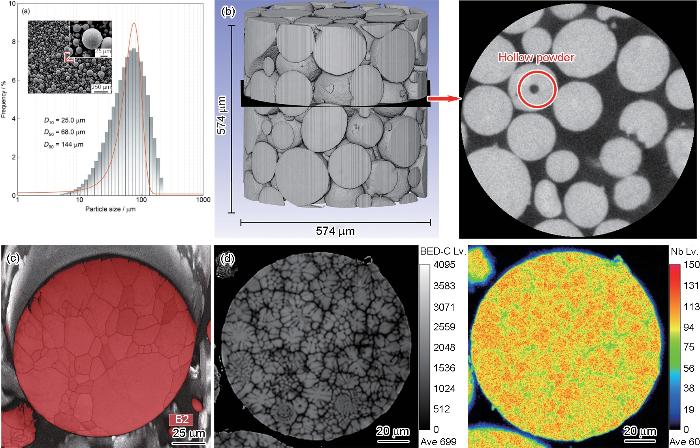
图1
Ti2AlNb预合金粉末的表征
Fig.1
Ti2AlNb pre-alloyed powders (a) particle size distribution and surface morphology, (b) micro-CT graph, (c) EBSD, (d) EPMA
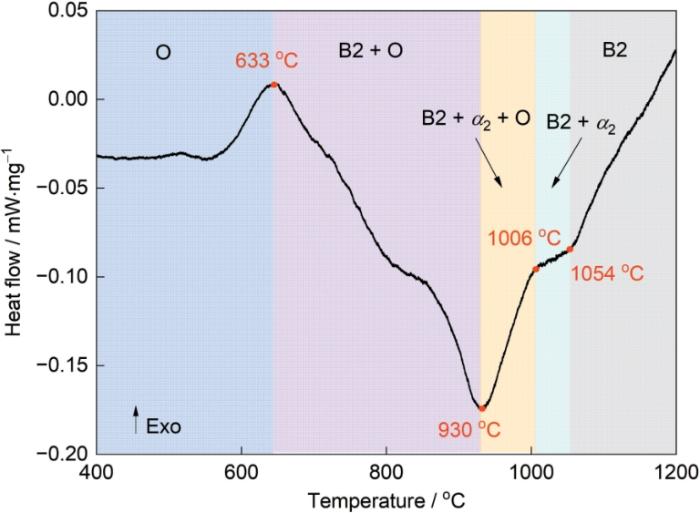
为了确定HIP的温度窗口,测定了预合金粉末在升温过程中的相变温度(图2)。可以看出,在粉末的升温DSC曲线中出现了四个特征热效应峰,吸热峰位于633 ℃和1006 ℃,放热峰则位于930 ℃和1054 ℃,分别对应粉末在不同温度区间的相变[2]。结合Ti-Al-Nb的三元相图[18,19],确定了这种合金粉末的关键相变点:1054 ℃为B2单相区的起始温度,1006~1054 ℃为B2 + α2两相区,930~1006 ℃为B2 + α2 + O三相平衡区。这些相变温度数据,为优化HIP温度提供了理论依据。预合金粉末的显微组织是亚稳态的,后续的HIP和热处理使其发生固态相变可调整其相组成和显微组织。选择略低于β转变温度进行HIP,可形成在B2基体上弥散分布α2 + O强化相的理想组织。
图2
2.2 HIP工艺参数对合金的组织和性能的影响
表2 制备粉末Ti2AlNb合金的HIP工艺参数
Table 2
| Process | Temperature | Pressure | Holding time | Cooling method |
|---|---|---|---|---|
| HIP1 | 1010 oC/1 h | 140-150 MPa | 3 h | Furnace cooling |
| HIP2 | 1010 oC/1 h | 140-150 MPa | 3 h | Furnace cooling |
| HIP3 | 1010 oC/1 h | 140-150 MPa | 5 h | Furnace cooling |
| Secondary HIP | 930 oC/2 h | 140-150 MPa | 1 h | Controlled cooling |
图3

2.2.1 HIP温度对合金组织的影响
HIP温度控制合金中原子的扩散速率和相变,影响晶粒尺寸、相组成和分布;HIP的压力使合金中的孔隙闭合,使其致密化。根据图2给出的Ti-22Al-24Nb-0.5Mo (原子分数,%)粉末的DSC曲线和相关文献的研究结果,HIP温度高于B2相转变温度时晶粒将显著粗化,使合金的拉伸性能降低;而过低的HIP温度则难以有效消除颗粒表面致密的氧化膜[20,21]。因此,本文的实验在α2 + B2两相区内选取接近B2相转变温度的1050 ℃作为HIP温度。将两种不同HIP温度的Ti2AlNb合金在980 ℃固溶处理后,其SEM表征结果如图4所示。图4中的灰白色为B2相,灰黑色为O相,黑色为α2相。与图4a和图4c中的低倍SEM图像对比可见,与HIP1工艺的合金相比,HIP2工艺的合金固溶后显微组织中B2相的体积分数显著提高。从图4b、d给出的高倍SEM照片可见,两种HIP工艺的Ti2AlNb合金固溶处理后其显微组织,是在B2相上分布着板条状O相,在晶界可见等轴状α2相。O相有两种类型:一类是由晶界向晶内析出,另一类是在晶内形核析出。沿晶界向内生长的板条状O相,较宽且较长;而晶内析出的O相则较为细小[22]。从高倍SEM照片可见,HIP2合金固溶处理后两类O相的尺寸均减小,从晶内析出的O相更为细小且较为均匀。
图4

图4
用两种HIP工艺制备的Ti2AlNb合金的显微组织
Fig.4
Microstructures of the Ti2AlNb alloy under HIP1 (a, b) and HIP2 (c, d) conditions
图5

图5
用两种HIP工艺制备的Ti2AlNb合金相的相对含量和晶粒尺寸
Fig.5
Phase composition and grain size of Ti2AlNb alloy under different HIP conditions (a, b) EBSD phase maps and phase fractions for HIP1 (a) and HIP2 (b) condition, (c, d) grain size distribution for O phase (c) and α2 phase (d)
上述实验结果表明,提高HIP温度可改变Ti2AlNb合金的相组成和使O相晶粒细化。HIP温度从1030 ℃提高到1050 ℃,使B2相的体积分数提高。根据Ti-22Al-xNb的伪二元相图[24]:在α2 + B2两相区内1050 ℃比1030 ℃更接近B2单相区,因此提高温度使合金更倾向于处在B2相稳定的区域,α2相将向B2相转变。同时,较高的温度使原子的扩散增强和加速体系向平衡状态的转变,使B2相的平衡体积分数提高。虽然HIP过程中的炉冷速率(约3 ℃/min)较低,在冷却过程中会从B2相析出α2相和O相,但是因为1050 ℃更接近B2单相区,在冷却过程中在高温生成的更多的B2相得以保留,使固溶后的合金中B2相的含量提高。更为重要的是,从较高的HIP温度(1050 ℃)缓慢的炉冷过程中,合金得以在B2 + α2两相区内发生充分的扩散型相变,使α2相从过饱和B2基体中析出。此析出过程伴随着显著的溶质再分配,在α2相周围形成局部的Nb元素富集区。这种成分起伏为O相的形核创造了有利的热力学条件,使形核点的密度显著提高。同时,已生成的α2相成为微观障碍物,可阻碍O相晶粒的进一步粗化。上述机制的协同作用,最终形成细小的O相晶粒组织。细化的O相通过相界强化机制提高了合金的强度,细小且均匀分布的O相有助于协调变形过程中的应变分配,从而提高合金的塑性。
2.2.2 HIP保温时间对合金组织的影响
保温时间影响组织的均匀化与缺陷的消除。保温时间过短使相变不充分、元素扩散不均匀;而保温时间过长则易引起晶粒粗化。HIP温度比保温时间对晶界有害相的消除和相组成的影响更显著,适当延长保温时间则有利于致密化和元素的扩散[14,25,26]。为此,本文将保温时间延长到5 h。进行EBSD表征固溶后HIP3合金样品的显微组织。EBSD的定量分析结果,如图6b,c所示。可以看出,HIP3合金中α2相的含量从15.7%降低到12.0%,而B2相的含量相应地提高。对晶粒尺寸的统计结果表明,HIP3合金中O相和α2相的晶粒尺寸均比HIP1合金有所增大,大于5 μm的O相晶粒和约为1.5 μm的α2相晶粒明显增多。延长保温时间影响Ti2AlNb合金的显微组织和性能,其原因是:一,促进了相转变向平衡态的演化,二,提高了组织的均匀性。相含量的变化符合α2 + B2两相区的热力学平衡规律。较长的保温使原子有充足的时间扩散和合金组织更接近该温度下的平衡态,并使相的分布更均匀。
图6
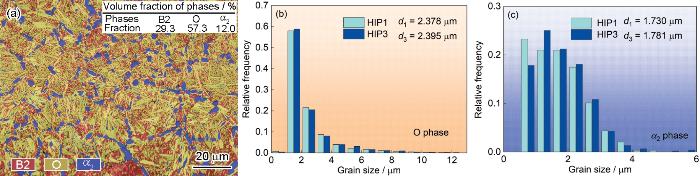
图6
用HIP3工艺制备的Ti2AlNb合金的显微组织和晶粒统计
Fig.6
Microstructure and grain statistics of Ti2AlNb alloy under HIP3 (a) EBSD phase map, (b, c) grain size distribution for O phase (b) and α2phase (c)
2.2.3 HIP工艺参数对合金力学性能的影响
三种HIP合金固溶后的拉伸性能,如表3所示。可以看出,提高HIP温度使合金的室温抗拉强度提高了约5%,塑性基本上不变。650 ℃的合金强度没有显著的提高,但是塑性提高了约30%。这个结果,与显微组织的表征结果一致。室温强度的略微提高源于O相晶粒的细化,即Hall-Petch效应和界面强化使合金的室温强度提高;高温塑性的大幅度提高的原因,则是B2相含量的提高。在高温下BCC结构的B2相更多的滑移系得以启动,有利于位错滑移。
表3 不同HIP 参数的Ti2AlNb合金的力学性能
Table 3
| Process | Ultimate tensile strength / MPa | Elongation / % | ||
|---|---|---|---|---|
| Room temperature | 650 oC | Room temperature | 650 oC | |
| HIP1 | 1141 ± 26 | 817 ± 20 | 5.4 ± 2.7 | 8.8 ± 1.0 |
| HIP2 | 1168 ± 17 | 821 ± 5 | 5.8 ± 2.4 | 11.2 ± 0.3 |
| HIP3 | 1108 ± 14 | 810 ± 8 | 7.1 ± 1.2 | 8.5 ± 1.0 |
值得注意的是,保温时间的延长使晶粒尺寸有所增大从而使强度降低,但是α2相含量的显著降低使塑性显著改善。密排六方结构的α2相,其独立滑移系数量较少,限制了Ti2AlNb合金室温塑性的提高。α2相含量的降低使合金中滑移系丰富的B2相增多,有利于在变形过程中协调应变分配,从而使室温塑性显著提高。更重要的是,延长保温时间可显著提高合金性能的稳定性。延长保温时间使合金的室温抗拉强度降低约10%,室温塑性提高约25%。多次重复的实验结果表明,与较短的保温时间相比,保温5 h可使合金室温延伸率的稳定性显著提高。表3中的统计结果表明,保温5 h的合金,其室温延伸率的标准差从±2.7%降低到±1.2%。其原因是,延长保温时间可促进Al、Nb等合金元素的充分扩散使显微组织的不均匀性降低,从而提高合金性能的稳定性。
2.2.4 二次热等静压的影响
表4 二次HIP前后Ti2AlNb合金的持久寿命
Table 4
| Process | τ / h | ||||||
|---|---|---|---|---|---|---|---|
| Before secondary HIP | 43.98 | 48.20 | 48.20 | 49.59 | 58.58 | 69.13 | 52.95 |
| After secondary HIP | 42.18 | 49.95 | 65.13 | 66.98 | 68.58 | 70.65 | 60.58 |
图7给出了对二次HIP样品的EBSD表征结果。可以看出,与一次HIP相比,二次HIP后合金的显微组织发生了显著变化。从图7a可见,二次HIP后Ti2AlNb粉末合金中B2相的含量降低,α2相的含量提高。其原因是,在二次HIP中1010 ℃的热力学平衡条件下B2相的体积分数降低,α2相的体积分数提高。图7b、c中的统计结果表明,O相的晶粒尺寸明显增大,而α2相晶粒的平均尺寸变化不大。但是,在二次HIP过程中析出了大量直径小于1.1 μm的细小α2相,还生成了一些直径大于3.3 μm的α2相。可根据动力学角度理解这种宽化的单峰分布:在二次HIP的高温条件下,新的α2相从过饱和的B2相中析出,较高的形核密度使晶粒细小;同时,部分α2相颗粒通过Ostwald熟化机制或晶界迁移发生粗化。这种宽化单峰分布的α2相组织,可能对合金的性能产生复杂的影响:细小弥散的α2相有利于强化,而适量的粗大α2相可能在某些取向上提供滑移路径[31]。
图7
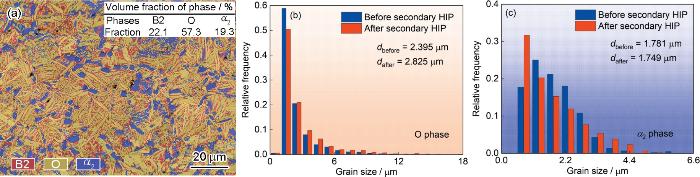
图7
二次HIP后Ti2AlNb合金的显微组织和晶粒尺寸分布
Fig.7
Microstructure and corresponding grain size distribution of Ti2AlNb alloy under secondary HIP (a) EBSD phase map, (b, c) grain size distribution for O phase (b) and α2 phase (c)
对二次HIP前后的合金进行了精细的TEM表征,以揭示其组织形成的微观机制。图8a与图8b的比较清晰地表明,二次HIP使合金的组织发生了显著的变化。在未经二次HIP的样品中O相为短小交错的板条状/针状,其板条宽度较窄且界面粗糙不太清晰(图8a)。值得注意的是,与α2相邻近的O相尺寸较大,与α2相周围因溶质再分配形成的Nb富集区为O相提供了优先形核和生长条件有关。二次HIP使组织形貌发生了变化,O相变得粗大、光滑的连续板条状(图8b, c)。其原因,是小尺寸O相颗粒的溶解(Ostwald熟化)和板条界面的定向迁移降低了总界面能使系统趋于稳定。此外,二次HIP后α2相的尺寸分布明显宽化,组织中同时存在细小的新生α2相颗粒和粗化了的原始α2相(图8b)。这与上述EBSD统计结果一致,表明该过程同时引起了α2相的动态析出和粗化。值得指出的是,在二次HIP前后均可观察到α2相内部的层状衬度。这种衬度,源于α2相基体内Nb原子的扩散引起的成分调制,使其局域分解为Nb贫化区和Nb富集区。根据Ti-Al-Nb三元相图,富Nb区域在热力学上不稳定,可转变为正交结构的O相而在α2相内形成层状O/α2复相组织[32,33]。
图8
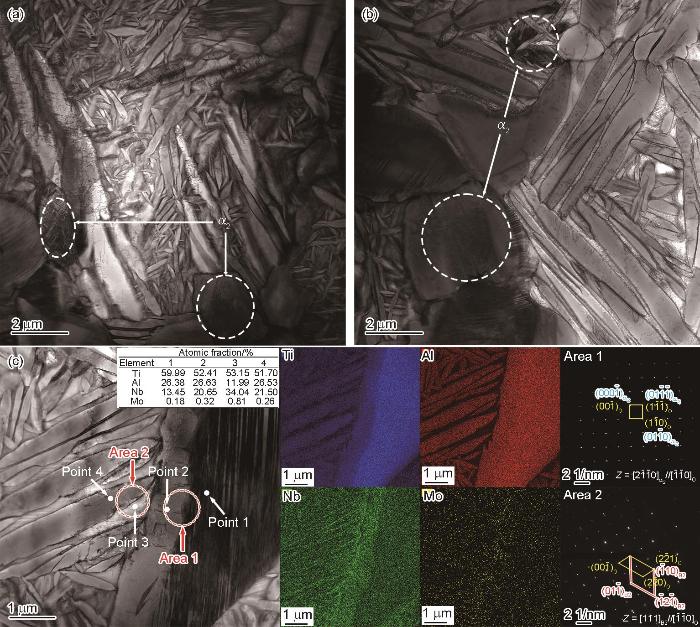
图8
二次HIP前后Ti2AlNb合金的TEM照片
Fig.8
TEM images of Ti2AlNb alloy before (a) and after (b, c) re-HIP treatment
图9给出了对比二次HIP前后的室温和高温应力-应变曲线。可以看出,二次HIP的合金,其室温和高温延伸率都显著提高。其原因是,二次HIP诱发了显微组织演变,特别是O相的形貌和分布的改变优化了合金的变形。结合显微组织的形貌可知,二次HIP使O相充分粗化形成了更为光滑、粗大的板条状形貌。与细小、不连续的O相相比,粗大的板条状O相在变形过程中更能协调应变。虽然O相的独立滑移系数远少于B2相,但是已显著比密排六方α2相的多。这些滑移系在粗大O相中更易开动,降低了相界处的应力集中、延缓了微裂纹的形核,从而使室温塑性提高。而在高温下塑性的提高,主要源于B2相与粗化O相的协同变形。粗大O相的高温变形能力增强和对B2基体的“割裂”效应减弱,协调了大规模的塑性变形和避免了局部应力集中导致的早期断裂,从而使合金的高温塑性提高[35,36]。
图9
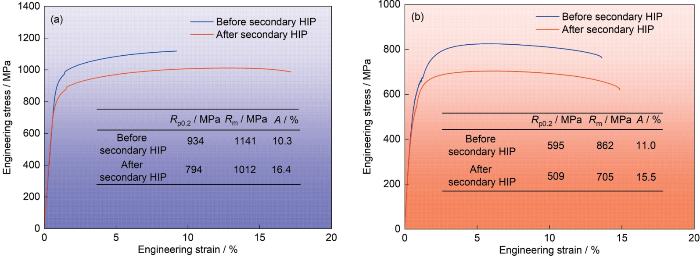
图9
二次HIP前后Ti2AlNb合金的力学性能
Fig.9
Tensile properties of Ti2AlNb alloys before and after re-HIP (a) room temperature, (b) 650 oC
综上所述,第一次HIP和第二次HIP通过调控热力学驱动力与动力学过程,共同决定了Ti2AlNb合金中B2相、O相、α2相的形貌与含量。图10给出了不同工艺参数HIP合金显微组织演变的示意图。温度可促进O相细化并提高B2相的含量;延长保温时间则使O相和与α2相粗化。二次HIP使O相和α2相显著粗化,α2相的粗化和再析出使粗化的原始α2相与新析出的细小α2相在最终的组织中共存。
图10
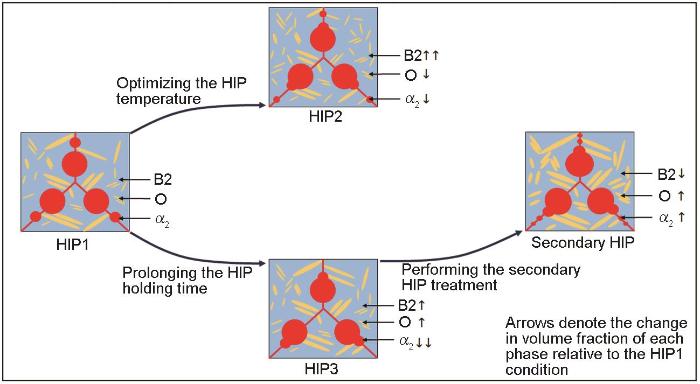
图10
用不同参数的HIP工艺制备的Ti2AlNb合金的显微组织演变示意图
Fig.10
Schematic diagram showing microstructural evolution of Ti2AlNb alloy with various HIP conditions
2.2.5 Ti2AlNb粉末合金复杂构件的成形
对于制备粉末合金构件,设计合理的包套结构至关重要:确保粉末压坯各部位完全致密化,达到近净成形要求。作为粉末合金HIP成形的模具,包套的结构决定其冶金质量和尺寸精度。在HIP致密化过程中,工艺参数的变化使导致不同区域的致密化进程不同。对于大尺寸复杂构件的制备,这一现象尤为突出。其原因是,包套的复杂结构使粉末坯体从表面到内部产生"不均匀致密化",使构件的各部位致密度和收缩不同,进而影响构件的力学性能。本文将EIGA粉末HIP1制备了多种类型的Ti2AlNb粉末冶金构件(图11),其关键部位的尺寸偏差小于2%,表面粗糙度低于同类铸造合金。进行有限元模拟辅助设计包套结构[14],在整个成形过程中实现了均匀致密化,避免了"不均匀致密化",保证了构件整体性能的一致性。
图11

图11
用Ti2AlNb粉末合金制造的叶轮、叶盘和矩形环
Fig.11
Ti2AlNb components prepared from powder metallurgy route (a) unshrouded impeller, (b) impeller bladed disk, (c) rectangular ring
3 结论
(1) 用EIGA法制备的Ti2AlNb预合金粉末由亚稳B2相组成,粉末的球形度高、氧含量低,其粒径近似正态分布,满足HIP成形要求。
(2) 提高HIP温度可促进B2相的生成和使O相细化,使合金的强度和高温塑性同步提高;延长保温时间可显著降低α2相的含量,在保持高强度的同时可大幅度提高其室温塑性和性能稳定性。
(3) 二次HIP处理可促进O相在α2/B2相界的优先析出,并形成尺寸分布呈单峰特征且峰宽增加的α2相组织。O相与母相之间的特定晶体学取向关系[2
参考文献
Microstructure evolution and strengthening mechanism of pulsed current diffusion bonding TiAl/Ti2AlNb joints with in-situ rapid hot deformation
[J].
Microstructure design and heat response of powder metallurgy Ti2AlNb alloys
[J].
Synergistic effect of B2 phase and O phase in hot-rolled Ti2AlNb alloy and its influences on mechanical properties
[J].
Microstructure evolution and property strengthening of Ti2AlNb alloys prepared by multi-wire arc-directed energy deposition
[J].
Fully dense P/M components produced by hot isostatic pressing
[J].
Hot isostatic pressing of GH4099 alloy powders and preparation of thin-walled cylinders
[J].
Two pre-powders of GH4099 alloy were prepared via techniques of plasma rotating electrode process (PREP) and electrode induction melting gas atomization (EIGA) respectively. Then, the powders were subjected to hot isostatic pressing (HIP) to prepare bulk GH4099 alloy (PM GH4099 alloy), and the effect of HIP temperature on the microstructure and tensile properties of PM GH4099 alloy was investigated. The results show that in comparison with EIGA process, the GH4099 powder prepared by PREP process has better powder sphericity with thinner surface oxide scale, which is more suitable for hot isostatic pressing preparation of workpiece of PM GH4099 alloys. With the increasing HIP temperature within the range of 1165oC~1230oC, the porosity and prior particle boundaries (PPBs) of the acquired PM GH4099 alloy decreases significantly, therewith, the corresponding tensile properties at 900oC were improved. Finally, with the help of finite element modeling (FEM) to assist the envelope design and make, and finally thin-walled cylinders of PM GH4099 were successfully fabricated with the PREP powder via HIP at 1230oC/150 MPa/4 h. The FEM predicted dimensional shrinkages are consistent with that of the actual made thin-walled cylinders of PM GH4099, and the deviation between the corresponding key dimensions is less than 5%.
GH4099合金粉末的热等静压成形和薄壁筒体的制造
[J].分别采用等离子旋转电极雾化法(PREP)和无坩埚感应熔炼超声气体雾化法(EIGA)制备出GH4099洁净预合金粉末,再将其热等静压(HIP)制备GH4099合金,研究了热等静压温度对其显微组织和拉伸性能的影响。采用优选的热等静压制度1230℃/150 MPa/4 h进行有限元模拟辅助包套设计,用PREP粉末制造出GH4099薄壁筒体。结果表明,与EIGA法相比,用PREP法制备的GH4099粉末球形度更好、表面氧化层更薄,更适合进行热等静压成形。在1165℃~1230℃随着热等静压温度的提高GH4099合金的孔隙和原始颗粒边界数量显著减少,使其在900℃的拉伸性能提高。用PREP粉末制造的GH4099薄壁筒体,其关键尺寸与实际薄壁筒体的相对偏差小于5%。
Effect of solution-and aging-treatment on microstructure and microhardness of a powder metallurgy Ti-22Al-25Nb alloy
[J].
固溶+时效处理对粉末冶金Ti-22Al-25Nb合金显微硬度的影响
[J].采用放电等离子烧结技术(SPS)在950℃/80 MPa/10 min条件下制备粉末冶金Ti-22Al-25Nb(原子分数,%)合金作为初始材料,将其分别在940~1100℃、10~120 min和800℃/8 h条件下进行固溶处理和时效处理,研究了固溶+时效处理对粉末冶金Ti-22Al-25Nb (原子分数,%) 合金的微观组织和显微硬度的影响,并建立了显微硬度的演变模型。结果表明,随着固溶温度的提高和保温时间的延长B2相的晶粒尺寸增大、均匀度提高,在940~1010℃晶粒长大的速率最低,在1100℃晶粒尺寸的均匀度达到最大值0.84。板条O相的尺寸和数量对合金的性能有显著影响。在(B2+O)两相区时效后,其尺寸和数量显著影响合金性能的次生板条O相的体积分数提高、尺寸减小,尤其是相互交叉、缠结的O/O相数量的增多,使合金的显微硬度提高;在1060℃/60 min/Water cooling(WC)+ 800℃/8 h/Furnace cooling(FC)条件下处理的合金,其显微硬度达到最大值434.92 HV。
Fabrication of a powder metallurgy Ti2AlNb-based alloy by spark plasma sintering and associated microstructure optimization
[J].
Microstructure, densification and mechanical properties of in situ TiBw/Ti2AlNb composites fabricated by spark plasma sintering
[J].
Dual-droplet transition control for improving forming quality and composition homogenizing in dual-wire additive manufacturing of Ti2AlNb alloy
[J].
Selective laser melting of Ti2AlNb-based intermetallic alloy using elemental powders: effect of process parameters and post-treatment on microstructure, composition, and properties
[J].
Microstructure and elevated-temperature mechanical properties of in situ Ti2AlNb-reinforced TiAl-matrix composite prepared by powder metallurgy
[J].
Progress in hot isostatic pressing technology of titanium alloy powder
[J].
钛合金粉末热等静压近净成形研究进展
[J].
Effect of phase transition caused by different treatment process on mechanical properties of powder metallurgy Ti-22Al-24Nb-0.5Mo (at.%) alloys
[J].
Effect of hot isostatic pressing conditions and cooling rate on microstructure and properties of Ti-6Al-4V alloy from atomized powder
[J].The effects of temperature and pressure on density, microstructure and mechanical properties of powder compacts during hot isostatic pressing (HIPping) were investigated. Optimized HIPping parameters of temperature range from 900 to 940 °C, pressure over 100 MPa and holding time of 3 h, were obtained. Tensile properties after different heat treatments show that both the geometry of samples and cooling rate have a significant influence on mechanical properties. Finite element method was used to predict the temperature field distribution during HIPped sample cooling, and the experimental results are in agreement with simulation prediction. The interaction of HIPping parameters was analyzed based on the response surface methodology (RSM) in this study.
Effect of powder particle size on forming titanium alloy shrouded impeller
[J].A shrouded impeller is an essential component of a liquid rocket, mainly responsible for transporting and pressurizing liquid fuel or oxidant. Owing to the low temperature and high-rotation speed of the working environment, materials with high performance are required for fabricating the impeller. With its excellent low temperature mechanical properties and high specific strength, Ti-5Al-2.5Sn extra-low interstitial (ELI) alloy has been widely applied in fabricating liquid rocket components, including the shrouded impeller. Considering the geometric complexity of the impeller, the powder metallurgy-hot isostatic pressing (PM-HIP) route is a suitable method for impeller formation. PM-HIP technology has a similar forming capability as precision casting but avoids casting defects, realizing the parts with reliable service performance. However, the mechanical properties and dimensional accuracy of the impeller may be influenced by the variation of powder particle sizes. Herein, three kinds of Ti-5Al-2.5Sn ELI prealloyed powders with different particle size distributions (average particle size D50 = 125, 94, and 73 μm) were prepared by adjusting the process parameters of gas atomization and screen meshes. Then, their corresponding shrouded impellers were manufactured via the PM-HIP route at 940 oC, 120 MPa for 3 h. Subsequently, the impellers were annealed at 815 oC for 1.5 h, followed by air cooling. The effect of powder particle sizes on the mechanical properties of shrouded impellers was analyzed using cryogenic-temperature tensile tests. The porosity defect of impeller slices was detected using industrial computed tomography. The microstructure of the impellers was characterized using SEM and TEM. Meanwhile, the mechanism of low temperature deformation was also discussed. All three impellers exhibited homogeneous microstructure with fine grains, and their mechanical properties were comparable to the level of wrought alloys; specifically, the tensile strength was about 1300 MPa, and the elongation was 20% at 77 K. In addition, many twins were found in the deformation zones, including the types of {101¯2}, {101¯1}, and {112¯2}. PM-HIP impeller size was calculated using the finite element method in the modified Gurson model and compared with the size of the actual impeller. Dimensional shrinkage was consistent between the finite element simulation result and the actual part, and the deviation in the flow channel was < 0.3 mm.
粉末粒度对钛合金闭式叶轮成形的影响
[J].为了考察粉末不同批次间的粒度差异对成形钛合金产品的性能和尺寸影响,本工作选取了3种粒度(平均粒度D50 = 125、94和73 μm)的Ti-5Al-2.5Sn ELI预合金粉末,采用粉末冶金热等静压工艺在940 ℃、120 MPa、3 h的制度下制备了闭式叶轮,对各叶轮进行了815 ℃、1.5 h的退火热处理,通过X射线检测等技术探测了叶轮中可能存在的孔隙缺陷,利用SEM和TEM对显微组织进行观察,并结合低温拉伸实验分析了粉末粒度对闭式叶轮本体力学性能的影响。结果表明,采用不同粒度粉末制备出的叶轮各部位显微组织均匀,本体取样力学性能均达到变形态合金水平,77 K下试棒的抗拉强度约1300 MPa,延伸率可达20%,在拉伸断口附近的组织中观察到{101¯2}、{101¯1}、{112¯2}孪晶。对成形的闭式叶轮尺寸的测绘结果表明,叶轮的尺寸收缩特点与粉末粒度相关,粉末的平均粒度(D50:70~130 μm)越小,体积收缩越大。采用有限元方法对粉末冶金热等静压成形后叶轮尺寸进行预测,并与制备的叶轮实测尺寸进行对比。结果表明,模拟预测的收缩规律与实际尺寸收缩一致,其中内部流道区域预测偏差值小于0.3 mm。
The α2-to-O transformation in Ti-Al-Nb alloys
[J].
Part I. The microstructural evolution in Ti-Al-Nb O+Bcc orthorhombic alloys
[J].
Effect of temperature and powder particle size on mechanical properties and microstructure of PM Ti2AlNb alloy prepared via hot isostatic pressing
[J].
热等静压温度和粉末粒度对Ti2AlNb合金组织与性能的影响
[J].采用无坩埚感应熔炼超声气体雾化法制备了成分为Ti-22Al-24Nb-0.5Mo(原子分数, %)的预合金粉末,通过预合金粉末热等静压工艺制备了Ti2AlNb粉末冶金合金。研究结果表明,热等静压温度显著影响Ti2AlNb粉末冶金合金的显微组织,需严格控制。为了对比研究,选取了平均粒度分别为70 μm和200 μm的两种Ti2AlNb预合金粉末,制备坯料并测试性能,探讨了粉末粒度的选取原则,分析了粉末粒度对Ti2AlNb粉末冶金合金显微组织和力学性能的影响。研究结果表明,粉末粒度对合金室温拉伸强度无显著影响,但会对高温拉伸强度和高温持久寿命产生显著影响,由粗粉(平均粒度200 μm)制成的合金高温持久寿命较细粉(平均粒度70 μm)的降低大约40%。
Influence of hot isostatic pressing temperature on microstructure and mechanical properties of Ti-6.5Al-3.5Mo-1.5Zr-0.3Si alloy
[J].
Phase transformation and tensile behavior of Ti-22Al-25Nb alloys with bimodal size lamellar O-phase precipitates
[J].
Spheroidization behavior and hardening mechanism of the lath Ti2AlNb alloy during multi-directional Isothermal forging
[J].
Ti2AlNb合金等温多向锻造板条O相球化行为和硬化机制研究
[J].
The polythermal section of Ti-22Al-xNb (30-78at.%Ti) in Ti-Al-Nb system
[J].The polythermal section of Ti-22Al-xNb (30–78 at.% Ti) in the Ti-Al-Nb system was studied using X-ray diffraction analysis (XRD), differential thermal analysis (DSC), and electron probe micro-analysis (EPMA). No new ternary compounds were found in this work. The polythermal section has five three-phase regions, nine two-phase regions, and three single-phase regions. The O phase transition is confirmed to occur below 1000 °C. A four-phase invariant reaction β + σ → O + δ was found at 931 °C.
Preparation and mechanical properties influencing of Ti2AlNb powder alloy
[J].
Ti2AlNb粉末合金制备及力学性能影响
[J].
A comparison of field assisted hot pressing and hot isostatic pressing for gas atomized Ti-22Al-26Nb (at.%) and Ti-22Al-26Nb-5B (at.%) powders
[J].
Separation of the impact of residual stress and microstructure on the fatigue performance of LPBF Ti-6Al-4V at elevated temperature
[J].
Improving high-temperature mechanical properties of laser powder bed-fused Inconel 738 alloy by hot isostatic pressing: tailoring precipitates and healing defects
[J].
The effects of microstructure and porosity on the competing fatigue failure mechanisms in powder metallurgy Ti-6Al-4V
[J].
Effect of thermal induced porosity on high-cycle fatigue and very high-cycle fatigue behaviors of hot-isostatic-pressed Ti-6Al-4V powder components
[J].The present work reports the effect of thermal induced porosity (TIP) on the high-cycle fatigue (HCF) and very high-cycle fatigue (VHCF) behaviors of hot-isostatic-pressed (HIPed) Ti-6Al-4V alloy from gas-atomized powder. The results show that the residual pores in the as-HIPed powder compacts present no obvious effect on the HCF life. The regrowth of the residual pores can be observed after solution heat treatment. The pore location ranks the most harmful for the fatigue life compared with the other initiating defects. The maximum stress intensity factors were calculated. The plastic zone size of fine granular area (FGA) is much less than the characteristic size of the microstructure, and the crucial size of the internal pores in this study is about 40 μm. The failure types of fatigue specimens in the VHCF regime were classified, and the competition of different failure types was described based on the modified Poisson distribution.
Characterization of deformation in primary α phase and crack initiation and propagation of TC21 alloy using in-situ SEM experiments
[J].
Microstructural evolution and tensile behavior of Ti2AlNb alloys based α2-phase decomposition
[J].
Precipitation behavior of O phase during continuous cooling of Ti-22Al-25Nb alloy
[J].The microstructure evolution and formation mechanism of the O phase in a Ti-22Al-25Nb (at.%) orthorhombic alloy resulting from different cooling rates were investigated. The results show that the morphology of the precipitated O phase is significantly affected by the cooling rate. As the cooling rate decreases, the floccular O, composed of many fine acicular O phases, gradually grows into the lamellar O phase. When the alloy is cooled from the B2 phase region, the grain boundary O (OGB) preferentially nucleates at the triple junctions and grain boundaries and forms the flat and the zig-zag OGB according to different cooling rates. The OGB consists of separated, flat OGB parts and unconnected, zig-zag OGB composed of multiple short, separated, flat OGB at a higher cooling rate. The zig-zag OGB presents a connected state due to the sufficient diffusion time at a lower cooling rate. When the alloy is cooled from the (B2 + α2) phase region, the increase of the phase boundary provides favorable conditions for the nucleation of the O phase due to the presence of α2 particles. The precipitated rim O phase appears on the periphery of the α2 particles at lower cooling rates. The analysis indicates that the Widmanstätten intragranular O (OWI) precipitated directly from the B2 phase maintains the plane relation with the parent B2 phase, and the Widmanstätten grain boundary O (OWGB) holds the specific orientation relationship with one of the two adjacent B2 grains. The OGB keeps the specific orientation relationship with one of the B2 grains as much as possible. When it cannot maintain the specific orientation relationship with one of the B2 grains, the OGB maintains a near-orientation relationship with B2 grains on both sides to reduce the nucleation activation energy. Moreover, there can be more than one nucleation site for the O phase on a single B2 grain boundary to form the OGB. The rim O phase formed through a decomposition reaction of α2→α2 (Nb-lean) + O (Nb-rich) is controlled by a diffusional mechanism and maintains a specific orientation relationship, i.e., {001} O//{0001} α2 and <110>O//<112¯0> α2, with the parent α2 particles.
High-resolution electron microscopy characterization of modulated structure in high Nb-containing lamellar γ-TiAl alloy
[J].
The effect of primary and secondary O phase on the mechanical properties and deformation behavior of Ti2AlNb alloy
[J].
Role of matrix microstructure on room-temperature tensile properties and fiber-strength utilization of an orthorhombic Ti-alloy-based composite
[J].


