



α + β型钛合金TC11 (Ti-6.5Al-3.5Mo-1.5Zr-0.3Si)在低于500 ℃的温度具有良好的比强度、热稳定性,可用于制造航空领域发动机的压气机叶片、涡轮盘、轴类等零部件[1~6]。但是,传统锻造工艺成形材料的利用率低和难以控制组织均匀性。粉末冶金热等静压(PM-HIP)成形技术具有良好的近净成形能力和成形零件的组织均匀,受到了极大的关注[7,8]。PM-HIP工艺的原理是:高温和各向同性高压使制品致密化[9]。Wei等[10]用PM-HIP工艺研制了Inconel 625复杂形状的涡轮盘,其组织的一致性良好;文献[11]用PM-HIP工艺成形了Ti55粉末冶金薄壁筒体,其拉伸性能接近锻造水平。但是,现阶段对于TC11合金的研究大多集中于锻造成形。Wang等[12]的研究表明,锻造TC11合金高温拉伸结果表明,蠕变应变对力学性能有显著的影响。Shao等[13]研究表明,锻造TC11合金的疲劳强度在某些条件下出现“平台”,即疲劳强度不随拉伸强度的变化而明显变化。Gu等[5]研究了具有双相组织和网篮组织的锻造TC11合金,发现在500 ℃/300 MPa条件下双相结构合金的蠕变速率较低,在970 ℃/1 h/空冷(AC) + 530 ℃/6 h/AC条件下进行热处理其蠕变性能最佳。关于PM-HIP成形,徐桂华等[14]的研究表明,用热等静压工艺能制造全致密TC11粉末钛合金。关于长时服役的稳定性,张卫方等[15]分析了TC11合金在500 ℃热暴露100 h后的拉伸性能。本文研究PM-HIP成形TC11合金在500 ℃长时间热暴露后的力学性能及其机制。
1 实验方法
用无坩埚感应熔炼超声气体雾化法(Electrode induction melting gas atomization, EIGA)制备实验用TC11合金粉末,将粉末用60目标准筛筛分后进行热等静压。TC11合金粉末呈球形(图1),D50为95 μm (D50为统计样本的累计粒度分布百分数达到50%时的粒径)。
图1

图1
TC11预合金粉末的粒度分布和形貌
Fig.1
Particle size distribution and morphology of TC11 pre-alloyed powder
参照文献[16,17]选择TC11合金的热等静压制度:在940 ℃和120 MPa条件下保温保压3 h (940 ℃/120 MPa/3 h)。940 ℃略低于β转变温度(Tβ = (1010 ± 10) ℃[3]),可避免晶粒过分长大和使合金致密化。将用真空电弧熔炼+两相区变形的锻造TC11合金作为对照组别,以对比研究PM-HIP成形合金的组织和性能。相关合金的化学成分和杂质含量,列于表1。按照GB/T38915-2020推荐的热处理制度,将合金在精密管式热处理炉进行双重退火热处理,制度为950 ℃/1 h/AC + 530 ℃/6 h/AC,然后对其分别进行500 ℃/400 h和650 ℃/400 h的热暴露实验,对照组也进行相同的实验。
表1 合金的化学成分和杂质的含量
Table 1
| Alloys | C | Al | Si | Fe | Zr | Mo | H | N | O | Ti |
|---|---|---|---|---|---|---|---|---|---|---|
| HIP | 0.0051 | 6.43 | 0.26 | 0.17 | 1.49 | 2.97 | 0.001 | 0.008 | 0.15 | Bal. |
| Wrought | 0.0042 | 6.40 | 0.28 | 0.19 | 1.70 | 3.58 | <0.001 | 0.010 | 0.099 | Bal. |
将长期热暴露前后的实验用合金试样线切割、研磨和抛光后,用Kroll试剂(3%HF + 6%HNO3 + 91%H2O,体积分数)腐蚀。用Rigaku Smart Lab型X射线衍射仪分析实验用合金的XRD谱,阳极为Cu靶,扫描范围为10°~90°,扫描速度为10 (°)/min。用LEXT OLS4000型激光共聚焦(LSCM)和IT800型扫描电子显微镜(SEM)观察试样的显微组织,并使用Image J软件统计分析TC11合金的晶粒尺寸。用IT800上的电子背散射衍射(EBSD)系统观察热暴露前后TC11合金的晶粒尺寸和取向,使用Aztec Crystal软件处理数据。分别用TSE504D万能试验机和AG-X 250 kN万能试验机对热暴露前后的PM-HIP成形TC11合金和对照组合金进行室温(RT)和高温(500 ℃)拉伸实验(横梁位移速率分别为:屈服前至屈服结束:0.5 mm/min、0.15 mm/min,屈服结束后:3.5 mm/min、2.5 mm/min)。用CLARA型电子显微镜观察拉伸断口的形貌。用TI Premier纳米压痕仪测试试样的硬度,加载及卸载速率均为800 μN/s,加载、保载和卸载时间为均为5 s,测试间距为10 μm。用Talos F200X型透射电镜(TEM)观察实验合金试样的显微组织以分析其热暴露前后的组织演变。用标准双喷电解法制备透射电镜试样,将其机械预减薄至40~50 μm后冲成直径为3 mm的小圆片,在Tenupol-5双喷减薄仪上进行双喷电解减薄,双喷电流为50~60 mA,温度约为-25 ℃。
2 结果和讨论
2.1 TC11合金长期热暴露后的相结构和显微组织
图2给出了TC11粉末和TC11合金、对照组合金热暴露前后的XRD谱。可以看出,TC11合金粉末的谱结构与α/α′相的相同。其原因是,在制备TC11粉末的过程中冷却速率(103~105 ℃/s)极高,合金粉末在高速凝固过程中发生马氏体相变生成α′六方马氏体相[18]。长期热暴露前后热等静压成形TC11合金和对照组合金的XRD谱表明,其主要由α + β相构成。PM-HIP成形TC11合金中的α和β相来自于粉末的马氏体相变。Motyka[19]和李少强等[20]的研究结果表明,温度约为600 ℃时非平衡相马氏体α′相转变α相并在相界析出β相(α′→α + β);而对照组合金的相组成较为稳定,组织形态和相比例主要与热变形温度有关。热暴露使含Al、Si的钛合金相结构发生变化。Yu等[21]的研究表明,Ti600合金长期热暴露后析出α2和硅化物,但是热暴露400 h合金的谱中并未出现α2(Ti3Al)和硅化物相的特征峰(图2)。其原因可能是α2相的衍射特征峰位与α相接近[22],被α相的特征峰掩盖。同时,PM-HIP成形TC11合金的XRD谱中没有出现杂相的衍射峰,表明热暴露没有使其相组成和取向发生变化。
图2
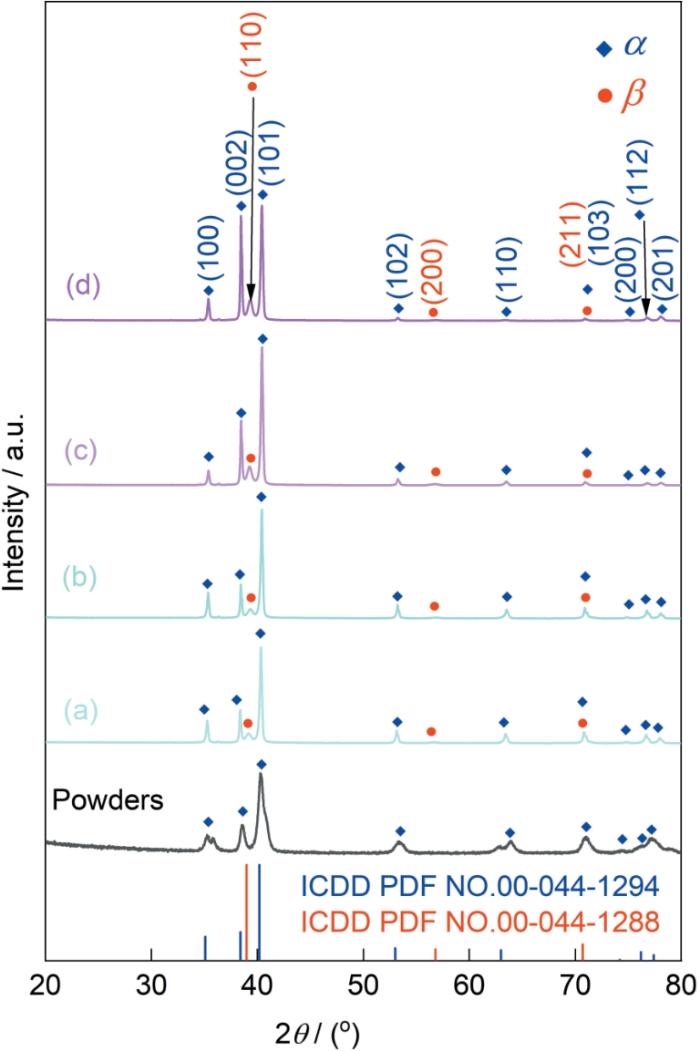
图2
TC11粉末和TC11合金、对照组合金热暴露前后的XRD谱
Fig.2
XRD patterns of TC11 alloys powders, before (a) and after (b) thermal exposure of HIP alloy and before (c) and after (d) thermal exposure of wrought alloy
图3给出了TC11合金的显微组织,其中颜色较亮的是α相,较暗的是β相。从图3a、c可见,热暴露前PM-HIP成形TC11合金和对照组合金的显微组织均由α、β两相组成,但是形态和分布显著不同。PM-HIP成形TC11合金中大量的α、β相具有球形特征(尺度为~50 μm)和明显的分层结构。球形的外层主要由等轴晶粒构成,而内层是层片晶粒。Yang等[23]和张英东等[24]报道,锻造TC11合金的显微组织主要由随机分布的等轴和层片晶粒构成。从图4可见,对照组合金中的层片α厚度并不相同,有~1 μm和~3 μm两种,呈较为明显的双峰分布。而粉末冶金中的层片更为均匀,其厚度约为2 μm (图4a)。热暴露后两种合金中的α、β相的尺寸、形态和分布仍然不同。从图3和图4可见,与对照组中的晶粒尺寸的变化相比,粉末冶金TC11合金热暴露前后的组织稳定性较高,其等轴α等效直径均值和层片α厚度均值分别为~3.7 μm和~2.5 μm。热暴露后锻造TC11合金的显微组织的变化最为显著,层片α厚度的差异减小。热暴露后锻造合金组织中等轴α晶粒的平均尺寸为~4.8 μm,热暴露前尺寸明显偏大的等轴晶粒大多消失[25]。
图3

图3
TC11合金和对照组合金热暴露前后的显微组织
Fig.3
Microstructure of TC11 alloys before and after thermal exposure (a) HIP alloy before thermal exposure, (b) HIP alloy after thermal exposure, (c) wrought alloy before thermal exposure, (d) wrought alloy after thermal exposure
图4

图4
TC11合金热暴露前后的晶粒尺寸
Fig.4
Statistical data of grain size of TC11 alloys before (a) and after (b) thermal exposure
用两种工艺制备的合金显微组织不同,可归因于其成形过程中温度和荷载不同。锻造合金在制备过程中受到较大的应力,成形合金晶粒发生塑性变形或破碎[26]。而PM-HIP成形合金的情况,与此显著不同。PM-HIP成形合金是微米级粉末在压力下烧结而成,可分为4个阶段:包套的屏蔽控制低速致密化、粉末的位移重排控制高速致密化、粉末的塑性变形控制高速致密化、蠕变扩散机制控制低速致密化[27]。在第一阶段显著的变形使粉末之间发生强烈的摩擦、挤压和变形,粉末表面的塑性变形远高于内部,表现为特有的微观变形不均匀性。但是,在合金的成形过程中载荷使相的形核和长大改变,不同变形区的畸变能和界面能的影响不同,从而使相的形貌和尺寸显著不同。Bourgeois等[28]的研究表明,相的析出和长大与畸变能和界面能高度相关。在本文的实验中,在变形量较大区域析出的α晶粒其畸变能的影响较小,α晶粒的形态主要受界面能控制,等轴析出的晶粒界面能最小,因此析出的α相主要呈等轴形态。而对于变形量较小的区域,α晶粒的析出则主要受畸变能控制,因此α晶粒趋于保持共格关系,从而具有针状或棒状形态。热处理后上述形态保持下来,并在热暴露过程中维持稳定。合金锻造时较大的变形量使等轴组织优先析出,但是在热处理(固溶+时效)过程中发生回复和再结晶,变形程度的降低使层片组织得以保留。实验结果表明,热处理产生的双峰分布的α相不能在后续热暴露过程中保持稳定。层片α与β保持较好的Burgers取向关系[29],是低变形组织中的优先析出相。因此,在热暴露过程中发生的主要是层片晶粒的长大,而大尺寸的等轴晶粒在固溶+时效热处理后材料的变形回复使其占比显著降低。
图5

图5
TC11合金热暴露前后的SEM照片
Fig.5
SEM images of TC11 alloys before and after thermal exposure (a) HIP alloy before thermal exposure, (b) HIP alloy after thermal exposure, (c) wrought alloy before thermal exposure, (d) wrought alloy after thermal exposure, (e-h) secondary α phase of TC11 alloys
为了研究TC11合金中晶粒的取向关系,图6给出了两种合金在三个方向上α晶粒的取向分布,图6e~h给出了两种合金极图的主视图。锻造合金具有各向异性,其横向、轧制方向和法线方向的力学性能不同。与对照组锻造合金中晶粒的明显取向特征不同,粉末冶金中的晶粒随机分布[33]。锻造合金的织构强度较高,如图6g中的最大极密度值为4.91,图6h中的为6.82;粉末冶金合金的最大极密度值分别为1.67和1.77。晶粒取向更均匀的合金,其疲劳性能较为优异[34]。层片α须保持共格关系以降低畸变能,而等轴α相与β的共格程度较低,因此粉末冶金合金中较多的等轴晶粒表明其晶粒取向均匀性更高。Guo等[35]对Ti-6Al-4V合金的研究结果表明,等轴α的体积分数提高12%则疲劳强度提高95 MPa。锻造合金在锻造过程中的应力和变形使晶粒取向更为一致[36],而粉末冶金中的晶粒是球形的。因此,PM-HIP成形TC11合金热暴露前后晶粒取向的随机性较高。
图6

图6
TC11合金热暴露前后的EBSD图
Fig.6
EBSD images of TC11 alloys before and after thermal exposure (a) HIP alloy before thermal exposure, (b) HIP alloy after thermal exposure, (c) wrought alloy before thermal exposure, (d) wrought alloy after thermal exposure, (e) pole figure of HIP alloy before thermal exposure, (f) pole figure of HIP alloy after thermal exposure, (g) pole figure of wrought alloy before thermal exposure and (h) pole figure of wrought alloy after thermal exposure
2.2 TC11合金长期热暴露后的力学性能
TC11合金这种典型的两相高温钛合金,可在500 °C长时间服役。图7a给出了TC11合金热暴露前后的室温(RT)和高温(500 ℃)应力-应变曲线。可以看出,PM-HIP成形TC11合金和对照组TC11合金的曲线都有明显的线弹性阶段和硬化阶段,其延伸率(> 10%)较高。随着测试温度的提高,两种实验合金的强度都显著降低,应变为~15%时出现强度的峰值。图7b给出了从应力-应变曲线提取的TC11合金的屈服强度(YS)、抗拉强度(UTS)、延伸率(El),红线和蓝线分别是GB/T 38915-2020规定的锻件的室温抗拉强度、屈服强度和延伸率标准。可以看出,粉末冶金合金的室温性能明显优于锻造合金,表明用粉末冶金制备的合金致密化良好,其屈服强度和延伸率分别为1016 MPa、16%。两种实验合金的高温拉伸性能差异减小,屈服强度为~550 MPa,延伸率均超过20%。值得注意的是,热暴露后粉末冶金合金的高温拉伸强度有所提高(558 MPa→626 MPa),而延伸率没有明显的变化。综合分析结果表明,粉末冶金合金的性能与锻造合金的性能基本上相同。这也表明,粉末冶金合金没有因其致密化不高而影响其性能。PM-HIP成形TC11合金和锻造TC11合金在650 ℃热暴露后,其屈服强度和延展率分别为514 MPa、20%,519 MPa、20%。这表明,这两种合金的拉伸性能基本相同。
图7

图7
TC11合金热暴露前后的力学性能
Fig.7
Mechanical properties of TC11 alloys before and after thermal exposure (a) stress-strain curves, (b) tensile properties
合金的强度σ与晶粒尺寸d的关系为σ = σ0 + kd-1/2,即Hall-Petch公式。其中σ0为基体强度;k为Hall-Petch系数,表征晶界对强度的影响[37]。此公式也适用于钛合金中。Chong等[38]用Hall-Petch公式拟合了Ti-6Al-4V合金中两相的晶粒尺寸与强度的关系。本文用等轴α的等效直径和层片α厚度表示TC11合金的晶粒尺寸[17]。与具有双峰分布的锻造合金相比,晶粒尺寸更小的粉末冶金合金其强度应当更高,得到了室温拉伸性能的验证。但是,两者的高温拉伸性能差距显著减小,而热暴露后几乎相同。其原因可能是,随着温度的提高晶界强度与晶内强度的差距减小。根据Hall-Petch公式,参数k的减小降低了晶粒尺寸的影响。
拉伸实验结果表明,热暴露后TC11合金的拉伸强度明显提高。从图4可见,热暴露后锻造合金的晶粒尺寸增大(层片α厚度均值~1.9 μm→2.3 μm),粉末冶金合金的晶粒尺寸变化较小。这个结果,与屈服强度的提高矛盾。这表明,对于相同的σ0,Hall-Petch公式不能反映强度随着晶粒尺寸的变化。为了分析合金热暴露前后力学性能的变化与晶粒尺寸的关系,观察了合金拉伸断口的形貌(图8a~d)。可以看出,两种合金热暴露前后的断口宏观上均呈杯锥状,且均可见纤维区、放射区和剪切唇。微观断口的形貌表明其为韧性断裂:韧窝的形状不规则,没有明显的几何对称性。同时,两种合金热暴露前后的纳米压痕硬度(图8e)与拉伸性能的特点相同,即其硬度都有所提高。这表明,热暴露使两种成形工艺的TC11合金的强度都提高,但是晶粒尺寸的变化不是合金力学性能改变的关键因素。
图8

图8
合金热暴露前后的拉伸微观断口和纳米压痕硬度
Fig.8
Microscopic fracture surfaces and nanoindentation hardness before and after thermal exposure (a) HIP alloy before thermal exposure, (b) HIP alloy after thermal exposure, (c) wrought alloy before thermal exposure, (d) wrought alloy after thermal exposure, (e) nanoindentation hardness
2.3 TC11合金长期热暴露后的组织
图9
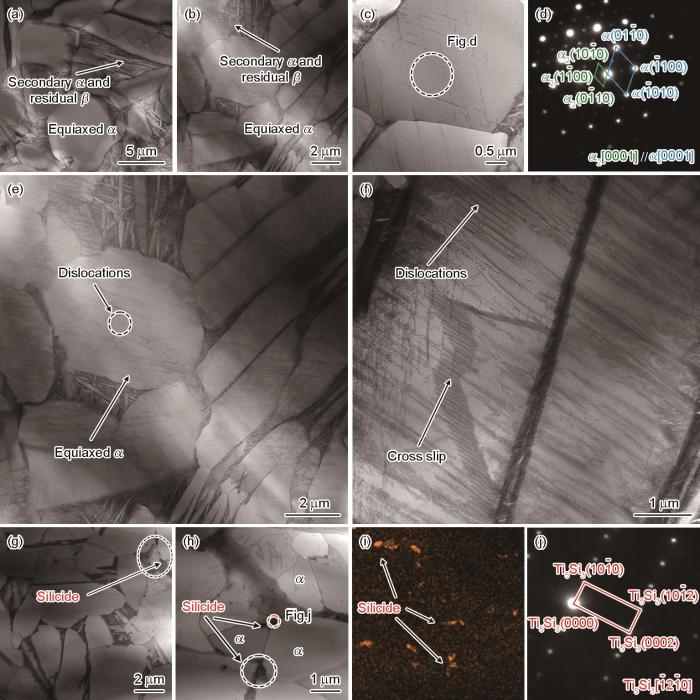
图9
PM-HIP TC11合金热暴露前后的TEM照片
Fig.9
TEM images of PM-HIP TC11 alloy before and after thermal exposure (a) before thermal exposure, (b) after thermal exposure, (c, d) selected area electron diffraction (SAED) patterns after thermal exposure, (e, f) samples after thermal exposure and stretching, (g-j) after 650 oC/400 h thermal exposure
图10

图10
PM-HIP TC11合金热暴露前后的组织演化示意图
Fig.10
Schematic of microstructure evolution in PM-HIP TC11 alloy before and after thermal exposure
图9表明,在500 ℃热暴露后合金显微组织的衍射花样中出现了明显的α2相特征斑点。α2相在α基体中的析出提高了合金的强度,使Hall-Petch关系中的基体强度σ0增大,并降低了晶粒尺寸的影响,即k (Hall-Petch系数)减小。原基于Hall-Petch关系(I)预测的a→b1强度变化不准确,而可能是a→b2,即基于晶粒尺寸与α2的修正参数的Hall-Petch关系(II)。同样的,在更高的温度(650 ℃)热暴露,在晶界析出的大量硅化物使合金的强度显著降低。另一方面,在更高的温度大尺寸α2相的析出使α2的强化效果降低[44]。此时,基体强度的σ0减小,提高了晶粒尺寸的影响,即Hall-Petch系数k增大。因此,Hall-Petch关系可能是III,即合金发生了a→c过程。
3 结论
(1) 采用PM-HIP成形技术可制备TC11合金,其室温和高温强度以及延伸率等拉伸性能与锻造合金的性能相当。
(2) 在500 ℃热暴露400 h后,PM-HIP成形TC11合金的等轴α等效直径和层片α厚度表明其组织稳定性良好。
(3) PM-HIP成形TC11合金在热暴露过程中析出了α2相及硅化物,调整Hall-Petch关系中的参数σ0、k可唯象的表征热暴露过程中析出相引起的强度变化。
参考文献
On temperature and strain rate dependent strain localization behavior in Ti-6.5Al-3.5Mo-1.5Zr-0.3Si alloy
[J].
<p>Deformation behaviors of Tie6.5Al-3.5Mo-1.5Zr-0.3Si alloys with <em>α/β</em> lamellar structure were investigated systematically at different temperatures from room temperature to 950 <sup>o</sup>C and different strain rates. Results reveal that when the deformation temperature is higher than a critical temperature of 600 <sup>o</sup>C, an evident transition of deformation behavior from localized shear banding to <em>α/β </em> lamella kinking, flow softening and temperature/strain rate-dependent peak flow stress occurred in the alloy. The critical conditions for the occurrence of internal cracking and strain localization behavior associated with temperature and strain rate were determined.</p>
Microstructure based cracking behavior and life assessment of titanium alloy under very-high-cycle fatigue with elevated temperatures
[J].
Hot deformation mechanism and microstructure evolution of TC11 titanium alloy in β field
[J].
Microstructure evolution and layer bands of laser melting deposition Ti-6.5Al-3.5Mo-1.5Zr-0.3Si titanium alloy
[J].
Tensile creep behavior of heat-treated TC11 titanium alloy at 450-550 oC
[J].
Quantitative relationship between microstructural parameters and tensile properties of TC11 alloy
[J].
TC11合金显微组织特征参数与拉伸性能的定量关系
[J].
Preparation and ring rolling processing of large size Ti-6Al-4V powder compact
[J].
Effect of hot isostatic pressing procedure on performance of Ti6Al4V: Surface qualities, microstructure and mechanical properties
[J].
Progress in hot isostatic pressing technology of titanium alloy powder
[J].
钛合金粉末热等静压近净成形研究进展
[J].
Simulation and verification of near-net shaping a complex-shaped turbine disc by hot isostatic pressing process
[J].
Mechanical property of powder compact and forming of large thin-wall cylindrical structure of Ti55 alloys
[J].Pre-alloyed powders of T55 have been hot-isostatic-pressed (HIPed) at different HIPing temperatures, and the powder compacts were solution- and aging- treated. Thereafter the powder compacts were carefully examined to establish the relationship between their microstructure and mechanical property. Powder compacts HIPed at 940℃ and 970℃ showed no significant difference on the microstructure and tensile properties. Due to the densification wave effect caused by a non-uniformity of temperature/pressure field during HIPing, the recommended HIPing temperature is 940℃ in this work. The tensile property of powder compact at 600℃ was improved obviously after solution- and aging- treatment. The tensile property of the heat-treated powder compact is close to that of the wrought alloy but better than those of the cast ones. Finite element analysis was used to predict the final dimensions of the small casing component after HIPing, which is well consonant with the experimental data, thus, the FEM analysis is an efficient method for the design and manufacture of powder components. Based on the optimal container design and FEM analysis, a large thin-wall cylindrical structure of Ti55 alloys was manufactured successfully.
Ti55粉末合金的拉伸性能和薄壁筒体结构的成型
[J].
Effect of creep stress on the high-temperature tensile stability of TC11 titanium alloy
[J].
Fatigue strength plateau induced by primary alpha phase size in TC11 alloy
[J].
Microstructure of PM TC11 alloy and its effect on mechanical behavior
[J].
TC11粉末钛合金的微观组织及其形成机理
[J].
The influence of high temperature exposure on fracture behaviors of TC11 titanium alloy
[J].
热暴露对TC11钛合金断裂行为的影响
[J].对TC11钛合金经不同温度和时间热暴露后的拉伸性能进行了考察,对不同热暴露后断裂行为的变化及其原因进行了分析研究。结果表明,热暴露温度不高于550℃,热暴露后的室温拉伸性能与未处理时相差不大,断面由纤维区和剪切唇区组成,无放射区;热暴露温度高于550℃时,热暴露后TC11钛合金的塑性急剧下降,断面由放射区和剪切唇区组成,无纤维区,且放射区收敛于断面上靠近试样表面附近,点源。放射区微观上可见韧窝、准解理及沿相界、晶界分离的混合形貌特征,不同于纤维区的等轴韧窝形貌,且剪切唇区可见解理、准解理脆性断裂特征。热暴露后TC11钛合金这种宏微观断裂行为的变化是由试样表面氧污染层的缺口效应、针状α2(Ti3Al)相的析出以及次生α与β的长大所致。
Microstructure evolution mechanism and mechanical properties of TC11-TC17 dual alloy after annealing treatment
[J].
Influence of hot isostatic pressing temperature on microstructure and mechanical properties of Ti-6.5Al-3.5Mo-1.5Zr-0.3Si alloy
[J].
Microstructural development of Ti-6Al-4V alloy via powder metallurgy and laser powder bed fusion
[J].A detailed study was carried out to gain a better understanding of the microstructural differences between Ti-6Al-4V parts fabricated via the conventional powder metallurgy (PM) and the laser powder bed fusion (L-PBF) 3D printing routes. The parts were compared in terms of the constituent phases in the microstructure and their effects on the micro- and nano-hardness. In L-PBF parts, the microstructure has a single phase of martensitic α′ with hcp crystal structure and acicular laths morphology, transformed from prior parent phase β formed upon solidification of the melt pool. However, for the sintered parts via powder metallurgy, two phases of α and β are noticeable and the microstructure is composed of α grains and α + β Lamellae. The microhardness of L-PBF processed Ti-6Al-4V samples is remarkably higher than that of the PM samples but, surprisingly, the nano-hardness of the bulk martensitic phase α′ (6.3 GPa) is almost the same as α (i.e., 6.2 GPa) in PM samples. This confirms the rapid cooling of the β phase does not have any effect on the hardening of the bulk martensitic hcp α′. The high microhardness of L-PBF parts is due to the fine lath morphology of α′, with a large concentration of low angle boundaries of α′. Furthermore, it is revealed that for the α phase in PM samples, a higher level of vanadium concentration lowers the nano-hardness of the α phase. In addition, as expected, the compacting pressure and sintering temperature during the PM process led to variations in the porosity level as well as the microstructural morphology of the fabricated specimens, which will in turn have a significant effect on the mechanical properties.
Martensite formation and decomposition during traditional and AM processing of two-phase titanium alloys—An overview
[J].Titanium alloys have been considered as unique materials for many years. Even their microstructure and operational properties have been well known and described in details, the new technologies introduced—e.g., 3D printing—have restored the need for further research in this area. It is understood that martensitic transformation is usually applied in heat treatment of hardenable alloys (e.g., Fe alloys), but in the case of titanium alloys, it also occurs during the thermomechanical processing or advanced additive manufacturing. The paper summarizes previous knowledge on martensite formation and decomposition processes in two-phase titanium alloys. It emphasizes their important role in microstructure development during conventional and modern industrial processing.
Microstructure study of a rapid solidification powder metallurgy high temperature titanium alloy
[J].
一种快速凝固粉末冶金高温钛合金微观组织特征研究
[J].
Effects of thermal exposure on cyclic deformation and fracture behavior of Ti600 titanium alloy
[J].
Characterization of hot deformation microstructures of alpha-beta titanium alloy with equiaxed structure
[J].
Effect of thermal mechanical deformation on microstructure and properties of the diffusion bonded TC11 titanium alloy
[J].
Microstructure evolution of α''-phase and α'-phase and microhardness of TC11 titanium alloy
[J].
TC11钛合金中α″相和α′相的组织演变和显微硬度
[J].研究了TC11钛合金中α"相和α'相的显微组织转变和显微硬度。金相显微组织观察和X射线衍射分析的结果表明: 随着固溶温度的提高α"相逐渐向α'相的晶体结构转变,α相、α"相和α'相的显微组织演变规律为:α+α",α+α"+α',α+α',α'。显微硬度测试的结果表明:在935~995℃固溶后显微硬度随着温度的提高先增大后减少,在985℃固溶后显微硬度达到峰值。综合分析显微组织影响合金显微硬度的机理:在935~985℃固溶后α'片层的厚度和间距变化的幅度小,β转变组织长大缓慢,在β转变组织中先后析出α"和α'相,随着固溶温度的提高α'片层的含量随之提高产生了相变强度效果,使其显微硬度提高;在985~995℃固溶后α'片层的厚度和间距明显增大,β转变组织变粗大,α"相消失,α'相的含量降低,相变强化的效果减弱,使β转变组织的显微硬度降低。
Effects of thermal exposure on microstructure and mechanical properties of TC11 titanium alloy
[J].
热暴露对TC11钛合金组织和力学性能的影响
[J].
Effect of multidirectional isothermal forging on microstructure and mechanical properties in Ti-6Al-4V alloy
[J].In the present work, the microstructure and mechanical properties of Ti-6Al-4V alloy during multidirectional isothermal forging (MDIF) were systematically investigated. The evolution of the microstructure and texture of Ti-6Al-4V alloy during MDIF was studied using TEM and electron backscattered diffraction (EBSD). The experiment results showed that the grain size decreased with the increase in cumulative strain, especially in the easy deformation zone. After four deformation cycles, a homogeneous equiaxed grained microstructure with an average grain size of 0.14 μm was achieved. The texture changes of the alloy were studied in detail. After one cycle of MDIF, the texture was mainly composed of (0002) [01 10], and the Euler angles were (8°, 30°, 30°). The density of texture decreased with the increase in loading cycle, but the dispersion of texture increased. After four cycles of MDIF, the non-basal texture (1010) <1102> texture was observed, and the Euler angles were (82°, 33°, 0°). The highest achieved mechanical properties for Ti-6Al-4V alloy in the MDIF condition were a yield strength 900 MPa, ultimate tensile strength of 921 MPa, and an elongation of 12.1% at room temperature. The increase in MDIF cycles improved the hardness of the alloy. The significant improvement in mechanical properties was attributed to the ultrafine-grained microstructure.
Development of powder metallurgy Ti2AlNb alloys
[J].
粉末冶金Ti2AlNb合金研究进展
[J].
Transforming solid-state precipitates via excess vacancies
[J].Many phase transformations associated with solid-state precipitation look structurally simple, yet, inexplicably, take place with great difficulty. A classic case of difficult phase transformations is the nucleation of strengthening precipitates in high-strength lightweight aluminium alloys. Here, using a combination of atomic-scale imaging, simulations and classical nucleation theory calculations, we investigate the nucleation of the strengthening phase θ' onto a template structure in the aluminium-copper alloy system. We show that this transformation can be promoted in samples exhibiting at least one nanoscale dimension, with extremely high nucleation rates for the strengthening phase as well as for an unexpected phase. This template-directed solid-state nucleation pathway is enabled by the large influx of surface vacancies that results from heating a nanoscale solid. Template-directed nucleation is replicated in a bulk alloy as well as under electron irradiation, implying that this difficult transformation can be facilitated under the general condition of sustained excess vacancy concentrations.
Crystal orientation and morphology of α lamellae in wrought titanium alloys: On the role of microstructure evolution in β processing
[J].
Effect of solution and aging treatment on microstructure and impact properties of TC11 titanium alloy
[J].
固溶时效处理对TC11钛合金组织与冲击性能的影响
[J].
Probing nanoscale variant distribution in a heterogenous α/β titanium alloy
[J].
Evolution of secondary α phase during aging treatment in novel near β Ti-6Mo-5V-3Al-2Fe alloy
[J].Evolution of secondary α phase during aging treatment of a novel near β titanium alloy Ti-6Mo-5V-3Al-2Fe(wt.%) was studied by OM, SEM, and TEM. Results indicated that size and distribution of secondary α phase were strongly affected by aging temperature and time. Athermal ω phase formed after super-transus solution treatment followed by water quenching, and promoted nucleation of needle-like intragranular α in subsequent aging process. When aged at 480 °C, fine scaled intragranular α with small inter-particle spacing precipitated within β grains and high ultimate tensile strength above 1500 MPa was achieved. When the aging temperature increased, the size and inter-particle spacing of intragranular α increased and made the strength reduce, but the ductility got improved. When aging temperature reached as high as 600 °C, ω phase disappeared and intragranular α coarsened obviously, resulting in serious decrease of strength. While mutually parallel Widmanstätten α laths formed at the vicinity of β grain boundaries and grew into the internal area of β grains, and significant improvement of ductility was achieved. As the aging time increased from 4 h to 16 h at 600 °C, the intragranular α grew slightly and brought about minor change of mechanical properties.
In situ investigation of the mechanical property anisotropy of TC11 forgings through electron backscatter diffraction
[J].Electron backscatter diffraction and scanning electron microscopy were performed herein to in situ investigate the influence of texture on the anisotropic deformation mechanism of TC11 forged components. The in situ tensile specimen was cut from the TC11 ring forging, and the tensile force–displacement curve was recorded while the slip lines in the specimen surface detected was traced during the in situ tensile test. The tensile results show that the yield and ultimate tensile strengths decreased in the order of transverse-direction (TD) > rolling-direction (RD) > normal-direction (ND) samples. The anisotropy of the tensile strength was related to the differences in the activated slip systems of the ND, TD, and RD samples. The slip lines results show that in the yielding stage, the ND, TD, and RD samples were dominated by Prismatic <a>, Pyramidal <c + a>, and Pyramidal <a> slips, respectively. In order to further analyze the relationship between the slip system and the yield strength, an anisotropy coefficient was determined to evaluate the differences in resistances for different activated slip systems, providing a good explanation of the variations in the tensile strength anisotropy. The ratios of the critical resolved shear stress (CRSS) of the basal, Prismatic <a>, primary Pyramidal <c + a>, and secondary Pyramidal <c + a> slip systems in the α phase were estimated to be 0.93:1:1.18:1.05 based on the type, number, orientation of slip activations, and Schmid factor. Moreover, the Prismatic <a> slips primarily occurred in the axial and radial (ND and RD) samples with [0001] and [1-21-2] textures, whereas the Pyramidal <c + a> slip system was dominant in the TD samples with [112-2] and [101-2] textures. Overall, this research demonstrates that the activation of the α-phase slip depends on the grain orientation, SF, and the CRSS, promoting strong strength anisotropy.
Powder metallurgy TC11 titanium alloy via hot isostatic pressing: preparation, microstructure and high-cycle fatigue property
[J].
粉末冶金TC11钛合金的热等静压制备与高周疲劳性能研究
[J].
Effect of powder size on fatigue properties of Ti-6Al-4V powder compact using hot isostatic pressing
[J].
Texture and microtexture variations in a near-α titanium forged disk of bimodal microstructure
[J].
Hall-Petch relation and boundary strengthening
[J].
Yielding nature and Hall-Petch relationships in Ti-6Al-4V alloy with fully equiaxed and bimodal microstructures
[J].
The influence of precipitation of Alpha2 on properties and microstructure in TIMETAL 6-4
[J].
Precipitation hardening of laser powder bed fusion Ti-6Al-4V
[J].
Effect of thermal exposure on microstructure evolution and mechanical properties of TC25G alloy
[J].The microstructure and room temperature tensile properties of heat-treated TC25G alloy after thermal exposure were investigated. The results show that the α2 phase dispersed in the α phase, and silicide precipitated firstly at the α/β phase boundary and then at the dislocation of the αp phase and on the β phase. When thermal exposure was 0–10 h at 550 °C and 600 °C, the decrease of alloy strength was mainly due to the dominant effect of dislocations recovery. With the rise and extension of thermal exposure temperature and time, the increasing quantity and size of precipitates played an important role in the improvement of alloy strength. When thermal exposure temperature rose to 650 °C, the strength was always lower than that of heat-treated alloy. However, since the decreasing rate of solid solution strengthening was smaller than the increasing rate of dispersion strengthening, alloy still showed an increasing trend in the range of 5–100 h. When thermal exposure time was 100–500 h, the size of the α2 phase increased from the critical value of 3 nm to 6 nm, and the interaction between the moving dislocations and the α2 phase changed from the cutting mechanism to the by-pass mechanism (Orowan mechanism), and thus alloy strength decreased rapidly.
Effects of thermal exposure temperature on room-temperature tensile properties of Ti65 alloy
[J].As a critical material for high-temperature components of aero-engines, the mechanical properties of Ti65 alloy, subjected to high-temperature and long-term thermal exposure, directly affect its service safety. The room-temperature tensile properties of the Ti65 alloy after thermal exposure to temperatures ranging from 450 °C to 650 °C for 100 h were investigated. The results indicate that as the thermal exposure temperature increases, the strength of Ti65 alloy initially increases and then decreases, while ductility exhibits a decreasing trend. The strength of the thermally exposed alloy positively correlates with the size and content of the α2 phase. The ductility of the thermally exposed alloy is comprehensively influenced by the surface oxidation behavior, α2 phase, and silicides. After the prolonged thermal exposure, stress concentration at the crack tips within the oxide layer was enhanced with the increased thickness of the surface TiO2 oxide layer, leading to premature fracture due to reduced alloy ductility. Furthermore, the α2 phase in the matrix promotes the planar slip of dislocations, while silicides at the α/β phase boundaries hinder dislocation motion, causing dislocation pile-ups. Both behaviors facilitate crack nucleation and deteriorate alloy ductility.
Silicide formation in Ti-3Al-8V-6Cr-4Zr-4Mo
[J].


