



气凝胶的孔隙率高、比表面积超大且密度较低,在吸声领域受到了极大的关注[14~16]。与传统吸声材料相比,气凝胶内的三维多孔网络结构能显著延长声波的传播路径,使声能的耗散效率提高[17,18]。制造纤维素气凝胶的原料可再生和可生物降解[19]。为了进一步提高纤维素气凝胶的吸声性能,可添加改性助剂[20]。Liu等[21]将二维片层状材料MXene分散在气凝胶基体中,其与基体的性能差异提高了声波的界面损耗,还使其具有声热转换性能。Pang等[20]利用原子级薄的二维石墨烯片强大的面内刚性来为其制备的吸声材料提供优越的共振性能,使材料在200~6000 Hz宽频段的平均吸声系数提高了约320%。二硫化钼(Molybdenum disulfide, MoS2)是典型的二维过渡金属二硫属化物(Transition metal dichalcogenides, TMDCs),将其分散在于纤维素气凝胶基体中形成大量异质界面,可提高声波的损耗[22~24]。碳纤维(Carbon fiber, CF)的强度较高,在气凝胶内部作为增强相构建刚性支撑网络,可提高因孔隙率较高力学强度较低的纯纤维素气凝胶的使用寿命[25,26]。本文用二硫化钼作为改性助剂和引入碳纤维制备纤维素基复合气凝胶研究其吸声性能。
1 实验方法
1.1 实验用材料
羧甲基纤维素Ⅲ,纯度> 98.0%;短切碳纤维,长度0.5 mm/直径7 μm;二硫化钼,AR (直径< 2 μm);去离子水,实验室自制。
1.2 碳纤维/二硫化钼改性纤维素复合气凝胶的制备
称取2 g羧甲基纤维素(Carboxymethyl cellulose, CMC)溶于98 mL去离子水中,搅拌12 h制得质量分数为2%的羧甲基纤维素溶液,将其超声脱泡1 h后加入一定量的短切碳纤维和二硫化钼,续搅拌5 h得到均匀分散的混合液。将混合液缓慢倒入直径为3 cm的玻璃模具中,并将模具的温度降到-18 ℃保持8 h使混合液完全冻结。继续冷冻干燥48 h,制备出碳纤维/二硫化钼改性的纤维素复合气凝胶(MCA)。将所得的改性纤维素气凝胶命名为CMC/CF-x/MoS2-y (x、y分别为所添加碳纤维、二硫化钼的质量分数)。
1.3 复合气凝胶的表征
将液氮冷冻后的复合气凝胶样品切割成直径为3 cm、高度为2 cm的圆柱体。用电子天平称重后计算出样品的表观密度(ρa)。用3H-2000TD系列全自动真密度分析仪测试出样品的真密度(ρt)。
气凝胶的孔隙率(ρ)为材料中孔隙体积与材料总体积之比
将液氮冷冻后的样品切成长宽约为1 cm的薄片,将其喷金处理后用SEM (JSM-5510LV)观测其微观形貌,用EDS表征复合气凝胶表面元素的分布。
将干燥的气凝胶样品剪切成尺寸小于3 mm的碎块,将其置入STA409PC综合热分析仪中,在干燥氮气气氛下以10 ℃/min的速度从室温加热至800 ℃,记录期间样品的相对质量损失。
用万能实验机(Instron5567)测量样品的压缩应力-应变曲线。所用的样品是直径为3 cm、高为2 cm的圆柱体,沿垂直轴压缩,速率为20 mm/min。
根据国家标准GB/T18696.1-2004 (ISO10534-1996),用驻波比法和SW477型双麦克风阻抗管(管径为30 mm)测试样品的吸声系数,每个样品测三次取其结果的平均值。测试频率范围为1000~5500 Hz。
2 结果和讨论
2.1 复合气凝胶的微观形貌和元素分布
纤维素气凝胶的微观形貌如图1所示。由图1a1~c1可见,在纯CMC气凝胶内有均匀排布的片层状结构和大量的孔隙。这些孔隙使MCA的密度极低和孔隙率较高,是声波在MCA内部传播的主要通道;图1a2~c2给出了添加的CF穿插在羧甲基纤维素片层中形成立体支架,是MCA的支撑。声波在孔隙内传播时,横插的CF使摩擦阻尼提高,促进声能向热能的转换;添加MoS2制备的MCA其微观结构如图1a3~c3所示。可以看出,MoS2的添加没有破坏MCA的片层结构,气凝胶内部的孔隙完整、均匀。未添加MoS2的纤维素气凝胶的CMC片层光滑、平整(图2a);添加的MoS2分布在CMC片层上使其变得粗糙,构成了有助于吸声的异相界面(图2b)。
图1

图1
纤维素气凝胶的SEM照片
Fig.1
SEM images of cellulose aerogels (a1-c1) unmodified cellulose aerogel, (a2-c2) CMC/CF-1, (a3-c3) CMC/CF-1/MoS2-0.75
图2

图2
MoS2改性前后气凝胶孔隙壁的SEM照片
Fig.2
SEM images of aerogel pore walls (a) unmodified with MoS2, (b) modified with MoS2
图3

图3
CMC/CF-1/MoS2-0.75气凝胶的EDS照片
Fig.3
EDS images of CMC/CF-1/MoS2-0.75 cellulose aerogel (a) C, (b) O, (c) S, (d) Mo
2.2 复合气凝胶的密度和孔隙率
图4

图4
CF含量和MoS2含量对改性纤维素气凝胶密度和孔隙率的影响
Fig.4
Effect of CF content (a, b) and MoS2 content (c, d) on the density and porosity of CF modified cellulose aerogels
2.3 复合气凝胶的力学性能
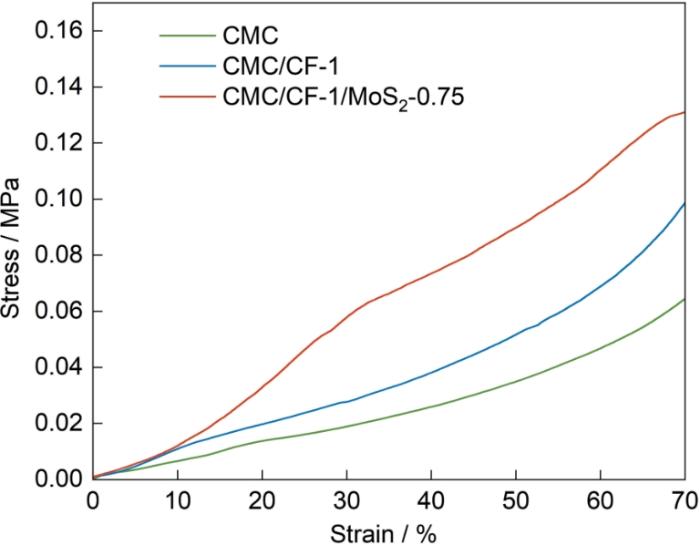
图5给出了未改性和改性纤维素气凝胶的压缩应力-应变曲线。与纯CMC气凝胶相比,应变为70%时CF改性使气凝胶的压缩应力由0.064 MPa提高到0.099 MPa;MoS2改性使压缩应力提高到0.131 MPa。
图5
2.4 复合气凝胶的热稳定性
图6

在整个热失重过程中,纯CMC的纤维素气凝胶失重64.84%,添加CF的复合气凝胶失重52.53%,添加CF/MoS2的复合气凝胶失重最少(36.22%)。其原因是,热稳定性良好的MoS2贴附在CMC片层表面。温度较高时羧甲基纤维素发生热分解,MoS2和产生的焦炭构成的隔温层延缓了质量损失。CF和MoS2的添加显著提高了MCA的热稳定性,扩展了这种纤维素气凝胶的应用范围。
2.5 复合气凝胶的吸声性能
生活中的噪声频率通常低于2000 Hz,亟需吸声性能优异的多孔吸声材料吸收1000~2000 Hz的中频噪声[18]。图7给出了引入CF/MoS2的纤维素复合气凝胶吸声系数的变化。由图7a可见,添加少量的CF使复合气凝胶的吸声系数小幅度提高,对1250 Hz频段的吸声系数从0.56提高到了0.67。其原因是,交错的碳纤维支架使复合气凝胶内部的孔隙变得复杂,声波在孔隙内传播的路径延长,使吸声性能在一定程度上提高,CF添加量为1%时达到峰值[30]。CF的添加量超过1%时,密集的CF堵塞气凝胶内的孔隙,阻碍声波进入气凝胶。同时,CF的添加也提高了多孔骨架的刚性,降低了声波在MCA内传播时骨架共振产生的阻尼损耗而使其吸声性能降低[31,32]。由图7b可见,CF添加量为1%而MoS2含量不同的MCA,其吸声系数(> 0.7)较高,且在1000~2000 Hz 频段内随着MoS2含量的提高随之提高。这种提高在1250 Hz尤为显著,MoS2含量为0.75%样品的吸声系数达到峰值,频率为1250 Hz时吸声系数从0.67提高到0.8。多数样品在2500 Hz出现吸声峰,最高吸声系数可达0.99 (MoS2添加量为0.25%)。同时,2000~5500 Hz频段的吸声系数并未随着气凝胶内结构的变化发生明显的降低(仍> 0.9),表现出优异的宽带降噪性能。MoS2含量为1%的MCA其吸声系数显著降低,因为随着MoS2含量的提高MCA多孔骨架的刚性也随着MoS2贴附于孔隙壁而提高。MoS2含量过高时,刚性提高所致的骨架共振阻尼耗散显著降低,最终使MCA的吸声性能略微降低。
图7
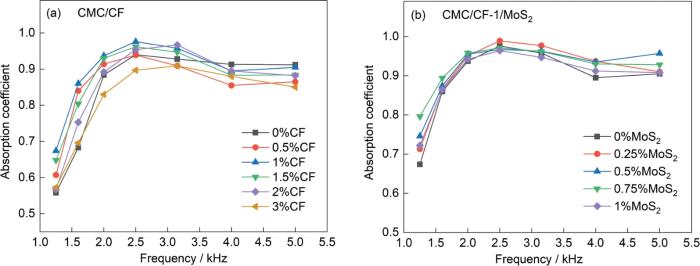
图7
CF含量和MoS2含量对改性纤维素气凝胶吸声系数的影响
Fig.7
Effect of CF content (a) and MoS2 content (b) on Sound Absorption Coefficient of modified cellulose aerogels
MCA具有多孔材料的典型吸声特性,冷冻干燥构建的以片层为主体的微观结构,成了大量空腔和传声通道。声波入射时,空气在孔隙内振动产生黏滞阻尼,声波通过热传导在固-气界面产生声能损耗,实现了对噪声的高效吸收。引入MoS2后,MoS2在羧甲基纤维素片层表面形成异质界面,提高了羧甲基纤维素片层的粗糙度,使声波在片层受到的摩擦阻尼加剧;同时,随着MoS2的添加羧甲基纤维素片层的致密度提高,加强了声波碰到气凝胶孔隙壁时的反射,进一步提高了声能耗散,最终使中频吸声性能提高[33]。
3 结论
(1) 使用CF和MoS₂作为添加剂,制备出改性纤维素复合气凝胶,其组分分布均匀,增强相与基体结合良好,改性气凝胶仍具有低密度(< 0.06 g/cm3)及高孔隙率(> 97.60%)的特点。
(2) CF与MoS₂的引入可显著提升材料力学性能,其于70%应变下的压缩应力为0.131 MPa,较基体增幅达104.7%。
(3) MCA的吸声性能优异,于中高频段的吸声性能得到了有效改善。当MoS2含量为0.75%时,材料在1000~2000 Hz中频区域吸声系数提升幅度最大,1250 Hz频段的吸声系数从0.56提升到了0.8,相较基体增幅达42.9%。
参考文献
A review of adverse effects of road traffic noise on human health
[J].
Noise pollution due to road traffic is a potential threat to human health. Since it is a global hazard, the rapid urbanization and exponential traffic growth have aggravated the problem. Population residing along the busy traffic lanes is continuously exposed to the sound levels which are above the permissible limits. This constant exposure to noise pollution is a cause of concern as it leads to several adverse impacts on human health. Traffic noise causes irritation and annoyance, sleep disturbances, cardiovascular disease, risk of stroke, diabetes, hypertension and loss of hearing. It results in decreased work performance. The present review highlights the serious health hazards of road traffic noise (RTN) which needs to be curbed. Preventive measures of noise pollution can help in combating noise-induced health hazards and increased work performance.
Environmental noise pollution in the united states: developing an effective public health response
[J].Background: Tens of millions of Americans suffer from a range of adverse health outcomes due to noise exposure, including heart disease and hearing loss. Reducing environmental noise pollution is achievable and consistent with national prevention goals, yet there is no national plan to reduce environmental noise pollution.
Long-term exposure to traffic noise and risk of incident cardiovascular diseases: a systematic review and dose-response meta-analysis
[J].While noise pollution from transportation has become an important public health problem, the relationships between different sources of traffic noise and cardiovascular diseases (CVDs) remain inconclusive. A comprehensive meta-analysis was therefore conducted to quantitatively assess the effects of long-term exposure to road traffic, railway, and aircraft noise on CVDs and relevant subtypes. We systematically retrieved PubMed, Embase, and Web of Science for articles published before April 4, 2022. Summary relative risks (RRs) and 95% confidence intervals (CIs) were estimated by the fixed- or random-effects models. In total, 23 articles were included in our meta-analysis. The risk of CVDs increased by 2% (RR 1.020, 95% CI 1.006-1.035) and 1.6% (RR 1.016, 95% CI 1.000-1.032) for every 10 dB increment of road traffic and aircraft noise. For CVD subtypes, the risk increased by 3.4% (1.034, 1.026-1.043) for stroke and 5% (1.050, 1.006-1.096) for heart failure with each 10 dB increment of road traffic noise; the risk of atrial fibrillation increased by 1.1% (1.011, 1.002-1.021) with each 10 dB increment of railway noise; and the risk increased by 1% (1.010, 1.003-1.017) for myocardial infarction, 2.7% (1.027, 1.004-1.050) for atrial fibrillation, and 2.3% (1.023, 1.016-1.030) for heart failure with each 10 dB increment in aircraft noise. Further, effects from road traffic, railway, and aircraft noise all followed positive linear trends with CVDs. Long-term exposure to traffic noise is positively related to the incidence risk of cardiovascular events, especially road traffic noise which significantly increases the risk of CVDs, stroke, and heart failure.© 2023. The New York Academy of Medicine.
Transportation noise pollution and cardiovascular disease
[J].Epidemiological studies have found that transportation noise increases the risk of cardiovascular morbidity and mortality, with high-quality evidence for ischaemic heart disease. According to the WHO, ≥1.6 million healthy life-years are lost annually from traffic-related noise in Western Europe. Traffic noise at night causes fragmentation and shortening of sleep, elevation of stress hormone levels, and increased oxidative stress in the vasculature and the brain. These factors can promote vascular dysfunction, inflammation and hypertension, thereby elevating the risk of cardiovascular disease. In this Review, we focus on the indirect, non-auditory cardiovascular health effects of transportation noise. We provide an updated overview of epidemiological research on the effects of transportation noise on cardiovascular risk factors and disease, discuss the mechanistic insights from the latest clinical and experimental studies, and propose new risk markers to address noise-induced cardiovascular effects in the general population. We also explain, in detail, the potential effects of noise on alterations of gene networks, epigenetic pathways, gut microbiota, circadian rhythm, signal transduction along the neuronal-cardiovascular axis, oxidative stress, inflammation and metabolism. Lastly, we describe current and future noise-mitigation strategies and evaluate the status of the existing evidence on noise as a cardiovascular risk factor.
Noise and mental health: evidence, mechanisms, and consequences
[J].The recognition of noise exposure as a prominent environmental determinant of public health has grown substantially. While recent years have yielded a wealth of evidence linking environmental noise exposure primarily to cardiovascular ailments, our understanding of the detrimental effects of noise on the brain and mental health outcomes remains limited. Despite being a nascent research area, an increasing body of compelling research and conclusive findings confirms that exposure to noise, particularly from sources such as traffic, can potentially impact the central nervous system. These harms of noise increase the susceptibility to mental health conditions such as depression, anxiety, suicide, and behavioral problems in children and adolescents. From a mechanistic perspective, several investigations propose direct adverse phenotypic changes in brain tissue by noise (e.g. neuroinflammation, cerebral oxidative stress), in addition to feedback signaling by remote organ damage, dysregulated immune cells, and impaired circadian rhythms, which may collectively contribute to noise-dependent impairment of mental health. This concise review linking noise exposure to mental health outcomes seeks to fill research gaps by assessing current findings from studies involving both humans and animals.
Military and industrial performance: the critical role of noise controls
[J].
Construction noise management: a systematic review and directions for future research
[J].
Acoustic energy absorption properties of fibrous materials: a review
[J].
Development status-quo of absorbing materials
[J].
吸音材料的发展现状与趋势
[J].
Improving low-frequency sound absorption of micro-perforated panel absorbers by using mechanical impedance plate combined with Helmholtz resonators
[J].
Microstructure-based experimental and numerical investigations on the sound absorption property of open-cell metallic foams manufactured by a template replication technique
[J].
Sound-absorbing porous materials: a review on polyurethane-based foams
[J].
Sound absorption structures: from porous media to acoustic metamaterials
[J].
Closed‐loop recyclable high‐performance polyimine aerogels derived from bio‐based resources
[J].
Strong, lightweight, and shape‐memory bamboo‐derived all‐cellulose aerogels for versatile scaffolds of sustainable multifunctional materials
[J].
Preparation and properties of SiOC aerogel/flexible ceramic fiber composite
[J].SiOC aerogels with different C/Si ratio were prepared by sol-gel method with ethyl orthosilicate (TEOS) and methyl trimethoxysilane (MTMS) as precursor. Then the SiOC aerosol was sprayed on the flexible ceramic fiber insulation blanket by atmospheric spraying, therewith, the SiOC aerogel/flexible ceramic fiber composite material was successfully prepared. The C/Si ratio is an important factor affecting the performance of SiOC aerogel/flexible ceramic fiber composites. As the ratio of C/Si (atomic ratio) increases, the gel time of SiOC sol is prolonged, whilst it is easier to infiltrate into the insulation blanket; the density and thermal conductivity of the composite decrease first and then increase. When the ratio is 0.67 the thermal conductivity of the composite is the lowest, namely, 0.026 W/m·K at room temperature and 0.174 W/m·K at 1000℃ respectively. Compared with unmodified insulation blanket the thermal conductivity is significantly reduced, especially by 47% at high temperature environment. The composite has excellent high temperature resistance and oxidation resistance. At 1200℃ in air the mass loss percentage of the sample is about 1% after pyrolysising for 1 h, whilst about 5% after pyrolysising for 3 h. As the C/Si ratio increases the mass loss of the composite increasees; in addition, the SiOC aerogel composite material also has good hydrophobic properties, flexibility and resilience.
SiOC气凝胶/柔性陶瓷纤维复合材料的制备和性能
[J].选用正硅酸乙酯(TEOS)和甲基三甲氧基硅烷(MTMS)为前驱体,用溶胶-凝胶法制备不同C/Si(原子比,下同)比的SiOC气凝胶,再用大气喷涂法将其喷涂在柔性陶瓷纤维隔热毡中制备出SiOC气凝胶/柔性陶瓷纤维复合材料。C/Si比,是影响SiOC气凝胶/柔性陶瓷纤维复合材料性能的主要因素。随着C/Si比的提高SiOC溶液的凝胶时间延长且更易浸入隔热毡,材料的密度和热导率先降低后提高。C/Si比为0.67的材料热导率最低,其室温热导率为0.026 W/m·K,1000℃时的热导率为0.174 W/m·K。与未改性的隔热毡相比,其热导率显著降低,尤其是在高温下热导率降低47%;同时,这种材料还具有优异的耐高温和抗氧化性能,在1200℃空气中静烧1 h后试样的质量损失只约为1%,静烧3 h后约为5%,随着C/Si比的提高其质量损失随之提高;同时,SiOC气凝胶复合材料还具有良好的疏水性能、柔性和回弹性。
Preparation of lamellar-structured carboxymethyl cellulose aerogels for efficient sound absorption
[J].
Hierarchically maze-like structured nanofiber aerogels for effective low-frequency sound absorption
[J].
Superwetting PVA/cellulose aerogel with asymmetric structure for oil/water separation and solar-driven seawater desalination
[J].
Highly efficient cellular acoustic absorber of graphene ultrathin drums
[J].
Anisotropic cellulose-based phase change aerogels for acoustic-thermal energy conversion and management
[J].
Three-dimensional highly porous MoS2/graphene aerogel for visible-light-driven photocatalytic degradation of tetracycline
[J].
3D ternary nanocomposites of molybdenum disulfide/polyaniline/reduced graphene oxide aerogel for high performance supercapacitors
[J].
Lightweight porous aerogels comprising nanofibrillated cellulose and MXene nanosheets for simultaneous microwave and sound absorption applications
[J].
Carbon fiber surfaces and composite interphases
[J].
Mechanically resistant and sustainable cellulose-based composite aerogels with excellent flame retardant, sound-absorption, and superantiwetting ability for advanced engineering materials
[J].
Conductive MoS2 quantum dot/polyaniline aerogel for enhanced electrocatalytic hydrogen evolution and photoresponse properties
[J].
Structural regulation and performance optimization of MoS2 modified PLA composites
[D].
二硫化钼改性聚乳酸复合材料的结构调控与性能优化
[D].
Recycling of pineapple leaf and cotton waste fibers into heat-insulating and flexible cellulose aerogel composites
[J].
Dual-network PVA fiber-doped cellulose aerogel with labyrinth structure for low and medium frequency acoustic and flame retardant applications
[J].
Influence of frame parameters of viscoelastic foams on sound-absorbing performance
[J].
黏弹性泡沫多孔材料骨架特征参数对材料吸声性能的影响
[J].
Electrospinning nanofilms to improve sound absorption of flexible or rigid porous material
[J].
Proceedings of International Conference on Intelligent Manufacturing and Automation
[M].


