



非金属夹杂物对钢材的疲劳性能有重要的影响,其作用机制主要取决于夹杂物的尺寸、成分、形貌和分布[5,6]。钢材的疲劳裂纹往往在基体内的非金属夹杂物处萌生[7]。钢材中的夹杂物与基体的结合界面,通常是较薄弱的区域。在循环载荷作用下,基体与夹杂物之间因弹性模量等物理性质的不同使形变不协调进而在界面引起应力集中,最终萌生裂纹并导致疲劳失效[8,9]。因此,对夹杂物改性以降低其对疲劳性能的负面影响,已成为一个重要研究方向。目前针对钢材中非金属夹杂物的改性已取得较多成果。Wu等[10]添加适量稀土元素铈改变GCr15钢中夹杂物的类型,生成含铈的氧化物、硫化物和氧硫化物使其接触疲劳性能显著提高。Hao等[11]在50CrV弹簧钢中按1∶2的质量比加入铈和镧,促进球形稀土夹杂物形成而使材料的拉压疲劳性能提高。除了加入稀土元素对钢中的非金属夹杂物改性,还可用MnS软相包裹硬质氧化物夹杂物[12]。近年来研究发现,适量提高S的含量可促进生成由塑性较好的MnS将Al2O3包裹成复合夹杂物[13,14]。与单一Al2O3夹杂物相比,此类复合夹杂物能提高车轮钢的冲击韧性和断裂韧性[15]。郭俊波等[12]的研究进一步表明,在尺寸相近的条件下,含MnS复合夹杂物试样的疲劳寿命比含Al₂O₃夹杂物的试样高。
上述研究用软相包裹硬相的夹杂物改性方法可缓解疲劳开裂,但是其开裂机制及其与高强钢疲劳开裂行为的关系仍不很清楚,尤其是在载荷较高的情况下对其疲劳开裂机制仍然需要深入研究。鉴于此,本文研究一种有由软相MnS包裹硬相Al2O3-MgO的复合夹杂物的高强度贝马复相钢的疲劳开裂并揭示其机制。
1 实验方法
1.1 实验用材料
实验材料是贝氏体-马氏体复相钢。用线切割从钢坯上获取尺寸为5 mm × 6 mm × 6 mm的金相试样,将其依次用400目、800目、1200目、2000目砂纸机械研磨后用金刚石抛光膏抛光,然后用体积分数为4%的硝酸酒精溶液浸蚀。用Olympus BX-53M型光学显微镜(OM)和ZEISS SIGMA 500型场发射扫描电子显微镜(SEM)观察试样的显微组织,并用其配备的能量色散X射线光谱仪(EDS)分析组织中夹杂物的成分。
用ZEISS SIGMA 500型场发射扫描电子显微镜观察试样的拉压疲劳断口,测试能量色散X射线光谱表征拉压疲劳断口处的夹杂物,并使用image-pro-plus软件测量和分析其尺寸。
1.2 拉伸实验
根据国家标准GB/T228.8-2021《金属材料 拉伸试验第1部分:室温试验方法》加工拉伸样品,拉伸样品的尺寸如图1a所示。在Instron 5982型万能试验机上进行试样的单向拉伸,拉伸速率为1.8 mm/min。用标距为25 mm的引伸计监测试样标距段的应变,在应变达到2%时卸除。使用配套测试系统采集应力-应变数据,绘制应力-应变曲线。
图1

图1
试样的尺寸图
Fig.1
Schematic diagrams of specimen dimensions for tensile testing (a), and high-cycle fatigue testing (b)
按照国家标准GB/T 3075-2021进行高周疲劳实验,试样的尺寸如图1b所示。实验在GPS-100型高频疲劳实验机上进行,采用应力幅控制方式,应力比为-1,频率约为120 Hz。用升降法测试B/M复相钢的疲劳强度,循环次数达到107时视为通过。
1.3 有限元模拟
依据高周疲劳试样的尺寸,使用商用有限元软件ABAQUS建立三维有限元模型,在试样的平行段中间靠近表面不同位置预置夹杂物,模拟在疲劳载荷下夹杂物周围基体的应力。在靠近试样表面5 μm处与400 μm处分别预置同尺寸球形夹杂物,其尺寸为60 μm。预置夹杂物后部分模型的有限元网格划分如图2所示。夹杂物周围基体的最小网格尺寸为1 μm,单元总数为67万个,选取单元类型为8节点减缩积分单元C3D8R。模拟时,选取的夹杂物类型为MnS。模拟加载的疲劳应力幅值为680 MPa,应力比为-1。
图2

图2
夹杂物周围网格的划分
Fig.2
Finite element mesh surrounding the inclusion (a) surface inclusion, (b) interior inclusion
2 实验结果
2.1 实验用钢试样的显微组织
图3
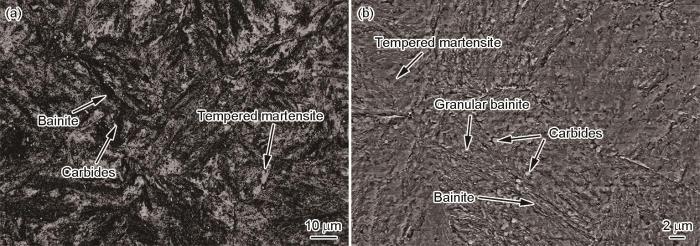
图4

图4
实验钢中的非金属夹杂物和能谱分析结果
Fig.4
Non-metallic inclusions in the experimental steel and corresponding EDS mapping results (a) SEM micrograph, (b) Al, (c) Mg, (d) S, (e) Mn
2.2 实验用钢的力学性能
图5给出了实验用钢的工程应力-应变曲线。三组平行试样的拉伸测试数据的重复性良好:屈服强度分别为1214.15 MPa、1252.58 MPa和1260.66 MPa,抗拉强度分别为1391.8 MPa、1436.35 MPa和1446.78 MPa,断后延伸率均高于10%。这表明,这种贝氏体-马氏体复相钢的屈服强度和抗拉强度较高且塑性良好。但是,其屈服强度与抗拉强度较为接近,平均屈强比约为0.87,表明这种钢在循环载荷下的硬化能力有限。
图5

图5
实验钢的工程应力-应变曲线
Fig.5
Engineering stress-strain curves of the experimental steel
2.3 高周疲劳强度
图6
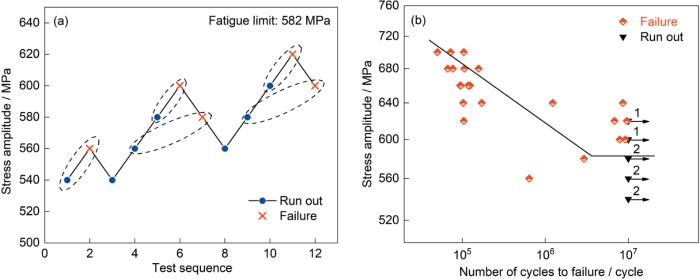
图6
实验钢的疲劳强度和S-N曲线
Fig.6
Staircase method diagram for fatigue strength (a) and S-N curve (b) of the experimental steel
2.4 疲劳断口的形貌
表1 实验钢的疲劳寿命、断口形貌特征和夹杂物特征
Table 1
| Specimen | σa / MPa | Nf | Inclusion location | Shell composition | Core composition | |
|---|---|---|---|---|---|---|
| 1 | 560 | 639427 | 57.28 | Surface | MnS | Al2O3 + MgO |
| 2 | 580 | 2924716 | 80.29 | Interior | MnS | Al2O3 + MgO |
| 3 | 600 | 7877568 | 55.23 | Surface | MnS + MgO | Al2O3 + MgO |
| 4 | 600 | 9204356 | 46.98 | Interior | MnS | Al2O3 + MgO |
| 5 | 620 | 6810867 | 58.52 | Interior | MnS | Al2O3 + MgO |
| 6 | 620 | 9604958 | 42.80 | Interior | MnS | Al2O3 + MgO |
| 7 | 620 | 104205 | 36.50 | Surface | MnS | Al2O3 + MgO |
| 8 | 640 | 102635 | 36.70 | Surface | MnS | Al2O3 + MgO |
| 9 | 640 | 8588689 | 47.29 | Interior | MnS | Al2O3 + MgO |
| 10 | 640 | 1229512 | 71.52 | Interior | MnS | Al2O3 + MgO |
| 11 | 640 | 171627 | 35.46 | Surface | MnS | Al2O3 + MgO |
| 12 | 660 | 95867 | 36.78 | Surface | MnS | Al2O3 + MgO |
| 13 | 660 | 124227 | 32.90 | Surface | MnS | Al2O3 + MgO |
| 14 | 660 | 94503 | 20.46 | Surface | MnS | Al2O3 + MgO |
| 15 | 660 | 117826 | 27.85 | Surface | MnS | Al2O3 + MgO |
| 16 | 680 | 157013 | 28.90 | Surface | MnS | Al2O3 + MgO |
| 17 | 680 | 105946 | 27.38 | Surface | MnS | Al2O3 + MgO |
| 18 | 680 | 66951 | 49.04 | Surface | MnS | Al2O3 + MgO |
| 19 | 680 | 77065 | 31.35 | Surface | MnS | Al2O3 + MgO |
| 20 | 700 | 72432 | 26.40 | Surface | MnS | Al2O3 + MgO |
| 21 | 700 | 104337 | 24.78 | Surface | MnS | Al2O3 + MgO |
| 22 | 700 | 50186 | 28.66 | Surface | MnS | Al2O3 + MgO |
图7

图7
表面夹杂诱导裂纹萌生样品断口的SEM图像(σa = 560 MPa, Nf = 639427)
Fig.7
SEM micrographs of the fracture surface showing surface inclusion-induced crack initiation (σa = 560 MPa, Nf = 639427) (a) macroscopic fracture morphology, (b) morphology of the inclusion at the crack initiation site, (c) EDS analysis result of the inclusion
图8

图8
内部夹杂诱导裂纹萌生样品断口的SEM图像(σa = 580 MPa, Nf = 2924716)
Fig.8
SEM micrographs of the fracture surface showing internal inclusion-induced crack initiation (σa = 580 MPa, Nf = 2924716) (a) macroscopic fracture morphology, (b) morphology of the inclusion at the crack initiation site, (c) EDS analysis result of the inclusion
图8给出了应力幅为580 MPa、疲劳寿命为2924716试样的断口。从图8a可见,疲劳源位于样品内部,断口的宏观形貌为典型的“鱼眼”状。Murakami等[20,21]用光学显微镜观察过这类形貌,将其命名为光学暗区(ODA)。之后用各类方法的一些不同术语表征该形貌,如细颗粒区(FGA)[22,23]、颗粒状光亮表面(GBF)[24,25]、粗糙表面区(RSA)[26]等。图8b表明,在鱼眼区中心仍有大尺寸非金属夹杂物,其与基体之间的界面轮廓清晰。在拉压疲劳载荷作用下,该夹杂物与基体发生界面剥离;进一步观察可见在夹杂物内部出现一条明显的裂纹,表明夹杂物在循环过程中发生了断裂。图8c表明,该夹杂物的成分与图7所示的表面夹杂物相同,其外壳均为MnS、内部含Al2O3和MgO的复合夹杂物。
3 讨论
3.1 对复合夹杂物处的应力场的模拟
表2 夹杂物和钢基体的机械性能参数
Table 2
| Inclusion | E / GPa | ν |
|---|---|---|
| Al2O3 | 390 | 0.25 |
| MnS | 103 | 0.3 |
| MgO | 279.7 | 0.18 |
模拟试样的加载条件设定:疲劳应力幅值为680 MPa,应力比为-1。根据对疲劳断口的观察,与钢基体接触的非金属夹杂物的主要成分是MnS,因此在靠近试样表面5 μm处和400 μm处分别预置尺寸为60 μm的球形MnS夹杂物。沿拉伸方向的等效应力模拟结果,如图9所示。可以看出,在拉压疲劳实验过程中,MnS的弹性模量(约为103 GPa)远低于钢的弹性模量,二者之间显著的差异导致在靠近表面的界面出现较为严重的应力集中,促进了疲劳裂纹的萌生和扩展[27]。还发现,随着与表面距离的增大应力集中系数逐渐减小,夹杂物距离表面较远处(400 μm)等效应力为890.23 MPa,应力集中系数为1.31;而夹杂物靠近表面(5 μm)时,等效应力升高到977.17 MPa,应力集中系数增大到1.43。局部夹杂物与基体界面的应力达到临界值,导致局部破坏[30]。
图9

图9
MnS夹杂物周边的等效应力分布云图
Fig.9
Contours of equivalent stress surrounding MnS inclusions (a) near-surface inclusion, (b) internal inclusion
有限元模拟结果表明,对于该试样钢,靠近样品表面的夹杂物与基体界面是裂纹萌生较为严重的区域,即进行高周疲劳试验时如果有大尺寸非金属夹杂物靠近甚至与表面接触,可能会因基体组织的约束能力较弱而表现出较低的疲劳寿命。大尺寸非金属夹杂物位于试样内部时,应力集中的程度较低。同时,远离表面使基体组织对疲劳裂纹萌生的约束作用增强和裂纹萌生所需循环周次增加,并在断口形成典型的鱼眼形貌。
3.2 夹杂物的位置对实验钢疲劳寿命的影响
在高周疲劳状态下,金属材料的疲劳寿命主要取决于疲劳裂纹萌生的寿命[31]。对断口的观察表明,在拉压疲劳过程中裂纹萌生在非金属夹杂物与基体的界面。这一现象,与疲劳寿命的两极化分布密切相关。统计所有断口中非金属夹杂物的位置和形貌,并在图10中的S-N曲线标出。从图10和表1可见,疲劳寿命高于106周次的长寿命试样,其断裂机制是内部夹杂物诱导裂纹萌生,疲劳源位于试样内部,典型断口的形貌如图8所示;而寿命低于106周次的短寿命试样,其断裂则源于表面或近表面的夹杂物,断口形貌如图7所示。由此可见,夹杂物到试样表面的距离是疲劳寿命两极分化的关键因素。夹杂物接近表面时,该处基体的约束作用减弱,应力集中更显著,裂纹的容易萌生使疲劳寿命显著缩短[32,33]。
图10

图10
夹杂物所处位置的统计结果
Fig.10
Statistical results of inclusion locations. Int-inc: internal inclusion-induced crack initiation, sur-inc: surface inclusion-induced crack initiation
从图10可见,应力幅为600 MPa时存在一个疲劳源位于表面但寿命接近107周次的特殊试样,即3号试样。这一结果与前文“近表面MnS夹杂物因弹性失配导致应力集中、从而显著降低疲劳寿命”的结论不同。对该断口进行单独分析以找到原因。图11给出了该试样的断口形貌和EDS结果。观察发现,该夹杂物位于次表面,其成分仍以Al、S、Mn、Mg等元素为主,但与前述的典型夹杂物不同:该夹杂物的外壳由MnS与MgO构成。与单一MnS外壳相比,含有MgO弹性模量更高的复合外壳可缓解界面处的弹性失配程度,从而减弱了应力集中效应[29]。与单一MnS外壳相比,含有MgO的复合外壳弹性模量较高。施加循环载荷时夹杂物与基体界面处的应力集中效应显著缓解,裂纹萌生所需的循环周次相应增加,从而大幅度提高了试样的疲劳寿命。因此,夹杂物的微观结构也是影响试验钢疲劳寿命分散性的关键因素。
图11

图11
特殊样品断口的SEM图
Fig.11
SEM micrographs of the fracture surface of the special specimen (σa = 600 MPa, Nf = 7877568) (a) non-metallic inclusion at the crack initiation site, (b-g) EDS mapping results of Fe, O, Al, S, Mg, and Mn, respectively
4 结论
(1) 在这种贝马复相钢应力比为-1的拉压高周疲劳实验中,疲劳寿命呈现显著的两极化分布而表现出明显的离散性。
(2) 钢中的疲劳裂纹均起源于复合夹杂物与基体的界面。MnS与钢基体之间显著的弹性失配,尤其是在近表面区域的界面产生严重的应力集中使裂纹优先萌生。
(3) 在较高的应力水平下实验钢的疲劳寿命两极化分布主要受其内部非金属夹杂物位置的影响。基体对位于或接近表面的夹杂物约束较弱,裂纹易于萌生和扩展而导致疲劳寿命较短;基体组织对位于试样内部的夹杂物较强的三维约束延缓了裂纹的萌生和扩展,使疲劳寿命显著延长。
(4) 复合夹杂物外壳的成分和结构对钢的疲劳行为有关键性影响。含有MgO的MnS复合外壳能提高钢的弹性模量缓解界面应力集中,从而延缓裂纹萌生而延长钢的疲劳寿命。
参考文献
An overview of estimations for the high-cycle fatigue strength of conventionally manufactured steels based on other mechanical properties
[J].
Investigations of fatigue damage in a nitriding low-carbon bainitic steel for high-performance crankshaft
[J].
In the automotive environment, the need to increase the performance of materials requires extra engineering efforts. The possibility of developing new materials is strategically important. Indeed, alternative solutions in terms of material choice allow designers to optimise their projects and keep competitive production costs. Traditional quenched and tempered steels are usually used for highly stressed components, and possible alternatives could be important competitive opportunities. One possible substitute is using bainitic steels to exploit their economic advantages while maintaining acceptable mechanical performances. This paper explores the fatigue life behaviour of a new low-carbon bainitic steel for applications requiring case hardening treatment obtained by the nitriding process. A high-cycle fatigue (HCF) strength assessment is conducted through a test campaign to compare treated and untreated material. The improvement in fatigue strength is evaluated as well as the study of fracture surfaces, residual stress, and microhardness profiles to assess in detail the effectiveness of the nitriding process. It is found that the nitriding leads to an improvement in fatigue life but not as much as expected because of the low ductile behaviour of this steel, the high speed of stress application added, and the embrittlement of the nitriding treatment, as confirmed through fracture surface analysis.
Inclusion-matrix debonding and fatigue crack initiation in low alloy steel
[J].
(E) effect of oxide inclusions on fatigue failure
[J].
Initial microzonal corrosion mechanism of inclusions associated with the precipitated (Ti, Nb)N phase of Sb-containing weathering steel
[J].
Influence of large carbides on rotating bending fatigue of GCr4Mo4V steel
[J].Annealed hot rolled high temperature bearing steel GCr4Mo4V manufactured by “VIM+ESR” was heated at 1120 ℃ for 30 min before being oil quenched, and then the specimen was tempered at 530 ℃ for 2 h followed with air cooling for 3 times. The rotating bending fatigue experiment was carried out on the heat treated specimen under stress levels of 960, 1000, 1040 and 1080 MPa, respectively. The <i>S</i>-<i>N</i> curve was obtained via the experimental data. A median fatigue limit of 686 MPa is calculated accordingly. Analysis of the fracture morphology indicates that the rotating bending fracture of GCr4Mo4V bearing steel consists of 3 typical zones, which are near surface crack-initiated site, crack propagation zone and stress tearing zone. The distance between the crack initiated site and specimen surface is about 240 μm, and at the center of the crack-initiated site exists large size carbide, the particle size of which distributes in the range of 16.93-53.94 μm. The crack nucleates at the boundary between large size carbide and the matrix, and gradually propagates towards the center of the specimen; in the end, the specimen is teared into two pieces by the torsion stress. The mathematical analysis shows that, the size of the large carbides <i>D</i> shows a perfect linear relation with the logarithm of fatigue life <i>N</i>, and the mathematical relation is lg(<i>N</i>)=-0<i>.</i>053 77<i>D</i>+7<i>.</i>326 82 according to the fitting results. And it is clear that the extreme refinement of the large carbides is absolutely a significant way for life prolonging of GCr4Mo4V bearing steels.
大颗粒碳化物对GCr4Mo4V钢旋转弯曲疲劳的影响
[J].
Literature review on inclusions in steel
[J].
钢中夹杂物的文献综述
[J].
Effect of rare earth cerium on inclusions and contact fatigue properties in high-carbon chromium bearing steel
[J].
Effect of rare-earth elements on fatigue properties of spring steel
[J].
Improvement of the MnS composite inclusions on the fatigue behaviour of wheel steel
[J].
硫化锰复合夹杂物对车轮钢疲劳性能的改善
[J].
Effect of heat treatment on morphology and distribution of inclusions in wheel steels
[J].
热处理对车轮钢中夹杂物的形态和分布的影响
[J].
Effect of sulfur contents on properties and inclusions in high speed wheel steels
[J].
S含量对高速车轮钢性能和夹杂物的影响
[J].研究了S含量对高速车轮钢性能和夹杂物的影响。借助扫描电镜(SEM)对车轮钢中MnS,Al2O3等夹杂物进行了观察和统计分析,结果表明:随着S质量分数的增加(0.002%~0.014%),车轮钢的强度基本保持同一水平但冲击韧性先增加后降低,在S质量分数为0.011%时韧性最优。其原因在于S含量的增加可以有效地促进塑性较好的MnS对硬性的Al2O3相的包裹,从而改善钢的韧性;但S含量过度增加则导致MnS量过多,反而对韧性不利。
Study of complex ductile inclusions controlling in medium-high carbon steels
[J].Formation of a special kind of complex ductile inclusions (CDI), which were character as oxides covered by sulphides, was investigated in a medium--high carbon steel. It was believed that fatigue and toughness properties of carbon steels were benefited from CDI formation, for oxides were separated from steel matrix. By means of thermodynamic calculation and inclusion microscopy in medium-high carbon steels with different S content and with Ca-treated, CDI in 0.55C steels has been researched. And thermal-stability of the CDI was researched by high temperature quenching. The results show that the frequency of CDI formation increase with S content changes from 0.001% to 0.01%. However, the fraction of covered oxides is no more than 90% without Ca-treated and can be promoted to about 100% in 0.006% S steel after Ca-treated. The reason of improved CDI formation by increasing S content and Ca-treated is that sulphides precipitation temperature could be promoted to higher than solid line of matrix, which is clearly showed by thermodynamic calculation. Furthermore, thermo-stability of CDI is affected heavily by heating history of matrix steel. Sulphide will dissolute from oxide when heat steel casting to an improper high temperature. Fortunately, the dissolution process could be stunted with redundant S content. It shows that thermo-stability of CDI could be received in Ca-treated steels with more than 0.006%S.
中高碳钢中复合延性夹杂物控制研究
[J].
The significant impact of the characteristics of granular structure and granular bainite on the mechanisms contributing to strength-ductility combination
[J].
High/very high cycle fatigue behaviors of medium carbon pearlitic wheel steels and the effects of microstructure and non-metallic inclusions
[J].
Very-high-cycle fatigue behavior of a structural steel with and without induced surface defects
[J].
Mechanism of crack initiation and early growth of high strength steels in very high cycle fatigue regime
[J].
Factors influencing the mechanism of superlong fatigue failure in steels
[J].
Mechanism of fatigue failure in ultralong life regime
[J].
Fine granular area formation by damage-induced shear strain localization in very-high-cycle fatigue
[J].
Fatigue life and mechanistic modeling of interior micro-defect induced cracking in high cycle and very high cycle regimes
[J].
S-N curve characteristics and subsurface crack initiation behaviour in ultra-long life fatigue of a high carbon-chromium bearing steel
[J].The S–N curve obtained from cantilever‐type rotary bending fatigue tests using hour‐glass‐shaped specimens of high carbon‐chromium bearing steel clearly distinguished the fracture modes into two groups each having a different crack origin. One was governed by crystal slip on the specimen surface, which occurred in the region of short fatigue life and a high stress amplitude level. The other was governed by a non‐metallic inclusion at a subsurface level which occurred in the region of long fatigue life and low stress amplitude. The inclusion developed a fish‐eye fracture mode that was distributed over a wide range of stress amplitude not only below the fatigue limit defined as the threshold for fracture due to the surface slip mode but also above the fatigue limit. This remarkable shape of the S–N curve was different from the step‐wise one reported in previous literature and is characterized as a duplex S–N curve composed of two different S–N curves corresponding to the respective fracture modes. From detailed observations of the fracture surface and the fatigue crack origin, the mechanisms for the internal fracture mode and the characteristics of the S–N curve are discussed.
Subsurface crack initiation and propagation mechanism in high-strength steel in a very high cycle fatigue regime
[J].
High-cycle rotating bending fatigue property in very long-life regime of high-strength steels
[J].In order to investigate the fatigue properties of high‐strength steels in the very long‐life regime up to over 109 cycles, cantilever‐type rotating bending fatigue tests were carried out for two kinds of high‐strength steels, SUJ2 and SNCM439, which were machined by grinding and finished by electropolishing after grinding. And also, the residual stress on the specimen surface of the ground specimen was examined by X‐ray diffractometer in order to investigate effects of the residual stress on the fatigue properties. From the investigations, the S–N curves clearly have a tendency to decrease again in the longer‐life range over 107 cycles for both types of specimen and for both steels. From observations of fracture surfaces, it was found that fatigue crack origins could be grouped into two types: (i) ‘surface crack origin type’ in the shorter‐life regime and (ii) ‘internal crack origin type’ in the longer‐life regime.
Fatigue crack growth behavior of railway wheel steel modified by sulfides enveloping oxides inclusions
[J].
Effect of cooling process on microstructure and fracture toughness of as-cast advanced high strength steel
[J].
冷却制度对铸态先进高强度钢组织及断裂韧性的影响
[J].通过设计一套可开模的水冷铜模装置,研究了不同连续冷却工艺对先进高强度钢显微组织和断裂韧性的影响。为研究试验钢的裂纹形成及扩展机理,对试样中不同类型夹杂物在基体中所产生的径向应力进行了计算以及应用了一种新方法来表征试验钢裂纹的扩展行为。结果表明:试验钢在固相线附近进行缓慢冷却有利于形成更多的MnS+Al<sub>2</sub>O<sub>3</sub>复合夹杂物,与单一的Al<sub>2</sub>O<sub>3</sub>夹杂相比,复合夹杂周围的径向应力明显降低。试验钢在临界铁素体转变温度以下缓慢冷却,有助于获得更多的晶内多边形铁素体,晶内多边形铁素体对裂纹扩展有抑制作用,因此试验钢的断裂韧性更高。
First principle calculation of non-metallic inclusions properties in steel
[J].
钢中非金属夹杂物性质第一性原理计算
[J].采用第一性原理研究了钢中非金属夹杂物的晶体结构性能、电子性能和力学性能,从微观角度评价了非金属夹杂物的结构稳定性,揭示了非金属夹杂物对钢材力学性能的影响规律。结果表明,所分析夹杂物中,TiN的结合能绝对值最大、结构最稳定,其次为SiO<sub>2</sub>和Al<sub>2</sub>O<sub>3</sub>;MnS、Cu<sub>2</sub>O、CuO和FeO的结合能绝对值较低,原子间化学键较弱,结构相对不稳定。能带结构分析表明,Al<sub>2</sub>O<sub>3</sub>、CaO、MgO、SiO<sub>2</sub>、AlN、MgAl<sub>2</sub>O<sub>4</sub>、Ca<sub>2</sub>SiO<sub>4</sub>、CaAl<sub>4</sub>O<sub>7</sub>属于绝缘材料,Cu<sub>2</sub>O、CaS、MnS属于半导体材料,FeO、CuO、FeS、TiN属于导体材料。弹性性能计算结果表明,TiN的弹性模量和硬度值最大,分别为517.70 GPa和31.77 GPa,表明TiN夹杂物刚性大,抵抗变形或破坏的能力较强,属脆性夹杂物;Cu<sub>2</sub>O的弹性模量和硬度值最小,分别为25.06 GPa和0.24 GPa,属塑性夹杂物;复合非金属夹杂物CaAl<sub>4</sub>O<sub>7</sub>弹性模量和硬度值分别为124.58 GPa和5.52 GPa,塑性变形能力相对较差,属半塑性夹杂物。G/B(体积模量与剪切模量的比值)和泊松比结果表明,SiO<sub>2</sub>的G/B值偏离0.57最多,泊松比最小,为0.02,夹杂物脆性严重。Cu<sub>2</sub>O的泊松比最大为0.46,结合其弹性模量与硬度值可知,其弹性性能较好。研究结果为钢中非金属夹杂物的合理控制提供了理论依据和数据支撑。
The effect of inclusion size on the local conditions for void nucleation near a crack tip in a mild steel
[J].
A fatigue life prediction approach to surface and interior inclusion induced high cycle and very-high cycle fatigue for bainite/martensite multiphase steel
[J].


