



高熵合金具有多主元特性和优异的性能,在极端环境领域有极大的应用潜力[1~3]。调控合金的元素组成优化其力学性能,已成为研究的焦点,添加合金元素可调控其相结构[4~8]。实验结果表明,添加Ti[9]或Zr[10]等元素产生固溶沉淀硬化可使基体强化和提高耐磨性;而添加Cu[11,12]或Mn[13,14]等元素则能促进面心立方(FCC)相的生成,使材料的延展性提高。但是,传统的实验方法研发周期长和成本较高。采用第一性原理计算可提高研究效率。Gao等[15]系统研究了Ti、Ta元素对NbMoTaTiV合金室温韧性的影响。对比超胞(SC)、特殊准随机结构(SQS)和虚拟晶体近似(VCA)三种建模方法发现,用VCA方法预测弹性性能兼具计算效率和精度优势,是设计多组元合金的有效工具。随着Al含量的提高高熵合金的晶体结构逐渐从单一FCC相转变为FCC+体心立方(BCC)混合相,最终形成单一的BCC相。VCA计算结果表明,合金抵抗体积变形、剪切变形和弹性变形的能力增强,这一变化趋势与实验结果一致[16];随着Sc含量的提高(当Sc < 0.7时),高熵合金保持稳定的BCC相。但是,当Sc > 0.7时高熵合金倾向于向FCC或密排六方(HCP)结构转变。VCA计算表明,高熵合金的韧性和塑性变形性能随着Sc增量显著提高[17];而VCA预测,V元素的引入使剪切模量减小和脆性提高[18]。这些计算结果,验证了VCA方法预测高熵合金性能的可靠性并揭示了不同元素对合金的相结构和力学性能的影响。
当前对高熵合金的研究主要集中在金属元素影响其性能的机制,而对非金属元素(如Si、B)的微观作用机理缺少系统的了解。作为传统合金强化的关键元素,Si和B独特的原子特性(如低密度、原子尺寸效应)有显著的结构调控潜力:Si元素能促进BCC相稳定化、诱导金属硅化物沉淀和晶界钉扎效应实现多尺度强化,为开发应用于极端环境的磁性材料提供了新思路[19~21];B元素具有高扩散系数和较小的原子半径,在相变过程中优先占据晶界/间隙位点,通过细化晶粒和抑制位错滑移使耐磨性和抗压强度显著提高[22,23]。虽然Si和B的强化效应已在一些高熵合金[24~27]中得到验证,当前的研究仍有显著的不足:(1) 对Si/B比例协同调控及其对固溶体稳定性影响的机制缺少系统认知;(2) 对Si/B比例精细调控FeCoNiCu特定基体体系的微观结构-宏观性能(尤其强塑性平衡)关联机制尚未深入研究;(3) Si/B协同作用对合金在高压下(0~100 GPa)的结构稳定性、弹性行为、韧脆性转变、各向异性以及位错的影响机制仍未深入研究。为此,本文以FeCoNiCuSi x B1 - x (x = 0, 0.25, 0.5, 0.75, 1)高熵合金为模型体系,研究Si/B比例的协同调控。通过调控Si/B非金属元素比例揭示Si含量对高熵合金的晶体结构、弹性常数、韧脆性判据、各向异性及位错的影响,进一步阐明FeCoNiCuSi0.5B0.5高熵合金在0~100 GPa压力下高压对晶体结构、弹性常数、韧脆性判据、各向异性及位错的影响。本文旨在突破传统金属元素优化的局限,开发兼具高强度和适度塑性的新型高熵合金体系。
1 计算方法和模型
1.1 虚拟晶体近似(VCA)方法
采用虚拟晶体近似方法[28]模拟FeCoNiCuSi x B1 - x (x = 0, 0.25, 0.5, 0.75, 1)高熵合金体系。VCA的核心思想是将占据同一晶格格位的不同原子(例如合金A x B1 - x 中的A和B)视为一种“虚拟原子”,不考虑其成分紊乱的影响。其赝势可表示为
式中,
该方法在保持原晶胞大小和对称性的同时,模拟随机合金的平均电子结构,因而特别适用于计算主要依赖于平均晶格结构和能带的性质(如弹性常数)[15]。但是,作为一种平均场近似,VCA难以获取不同原子混合导致的局域结构弛豫(如键长变化)、电荷重分布及其引发的晶格畸变和无序环境,严重限制其描述局域原子环境依赖性质的准确性。例如,对于原子半径和电子构型差异显著的元素(如本研究中的B、Si与过渡金属Fe、Co、Ni、Cu),VCA因无法获取由原子尺寸失配引起的强烈晶格畸变预测平均晶格常数和实验值可能产生误差。
图1
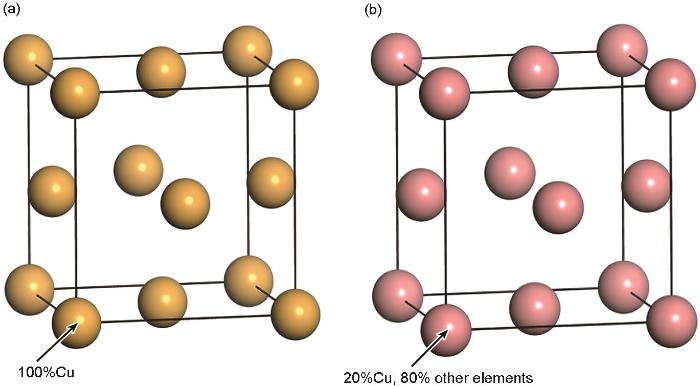
图1
基于VCA方法构建的FeCoNiCuSi x B1 - x 高熵合金结构模型
Fig.1
Structural model of FeCoNiCuSi x B1 - x high entropy alloys was constructed based on the VCA method (a) conventional modeling, (b) virtual crystal approximation method modeling
表1 FeCoNiCuSi x B1 - x 高熵合金成分设计
Table 1
| Alloys | Fe | Co | Ni | Cu | Si | B |
|---|---|---|---|---|---|---|
| x = 0 | 1 | 1 | 1 | 1 | 0 | 1 |
| x = 0.25 | 1 | 1 | 1 | 1 | 0.25 | 0.75 |
| x = 0.5 | 1 | 1 | 1 | 1 | 0.5 | 0.5 |
| x = 0.75 | 1 | 1 | 1 | 1 | 0.75 | 0.25 |
| x = 1 | 1 | 1 | 1 | 1 | 1 | 0 |
1.2 密度泛函理论计算的设置和结构优化
所有计算均基于密度泛函理论(DFT),和使用Materials Studio软件的CASTEP模块[32]。采用广义梯度近似(GGA)的Perdew-Burke-Ernzerhof (PBE)泛函[31,33]描述电子交换-关联能,其计算精度和适用性已在各类材料体系中验证。采用模守恒赝势 (Norm-Conserving Pseudopotential, NCPP)描述离子实与价电子间的相互作用,因其计算精度较高。为了确保计算精度满足能量收敛判据(
图2

图2
FeCoNiCuSi x B1 - x 高熵合金收敛性测试
Fig.2
Convergence test of FeCoNiCuSi x B1 - x high entropy alloys (a) energy cutoff, (b) k-point
使用设定的晶体模型得到的计算参数,对BCC-Fe进行几何优化,得到晶格常数为0.27 nm,与文献值0.287 nm[34]接近。用相同的方法对FCC-Ni进行几何优化,得到晶格常数0.343 nm,与文献值0.352 nm[35]和0.351 nm[36]吻合良好。为了进一步验证参数的可行性,分别建立了FeCoNiCu高熵合金和FeCoNi合金的晶体模型并进行几何优化。优化后FeCoNiCu高熵合金的晶格常数为0.349 nm,与文献值(0.36 nm)[37]相差3.06%;FeCoNi合金的晶格常数为0.356 nm,与文献值(0.357 nm)[38]相差为0.28%。产生上述差值的原因是:(1) 高熵合金多组元效应的复杂性;(2) 计算温度(0 K)与实验温度(300 K)不同;(3) GGA-PBE泛函低估了晶格常数的系统性。优化结果与文献值相差较小,验证了模型构建方法的准确性和计算参数的适用性。
2 结果和讨论
2.1 FeCoNiCuSi x B1 -x 高熵合金的相结构
依据高熵合金多主元体系的相形成准则,综合考虑了原子半径差(
表2 不同Si含量FeCoNiCuSi x B1 - x 高熵合金的相形成判定参数
Table 2
| Alloys | VEC | ||||||
|---|---|---|---|---|---|---|---|
| x = 0 | 14.89 | 13.38 | -8.64 | 2.79 | 6.969 | 8.2 | 1.575 |
| x = 0.25 | 13.05 | 14.32 | -11.38 | 2.23 | 6.321 | 8.25 | 1.571 |
| x = 0.5 | 10.84 | 14.53 | -13.84 | 1.82 | 5.51 | 8.3 | 1.566 |
| x = 0.75 | 7.97 | 14.32 | -16.02 | 1.52 | 4.449 | 8.35 | 1.562 |
| x = 1 | 2.92 | 13.38 | -17.92 | 1.25 | 2.871 | 8.4 | 1.101 |
此外,
2.2 晶体结构
基于参数计算,优化FeCoNiCuSi x B1 - x 高熵合金的晶体结构。图3给出了不同Si含量FeCoNiCuSi x B1 - x 高熵合金的晶格常数和密度。由图3可见,随着Si含量从x = 0提高到x = 1,合金的晶格常数由0.309 nm增大到0.319 nm;密度从11130 kg/m3降至10820 kg/m3。其原因是,Si/B原子半径的不同引发晶格畸变;Si原子的半径显著比B原子的大,Si含量的提高(B含量相应减少)使原子尺寸失配度提高;较大的Si原子占据晶格位点使局部晶格膨胀,原子间键长重组的加剧使晶胞体积增大。虽然x = 1时δ < 6.5%,满足高熵合金形成条件,但Si替代B后引入的原子尺寸差异仍会导致局域晶格畸变,使晶胞体积增大,从而导致合金密度降低。
图3
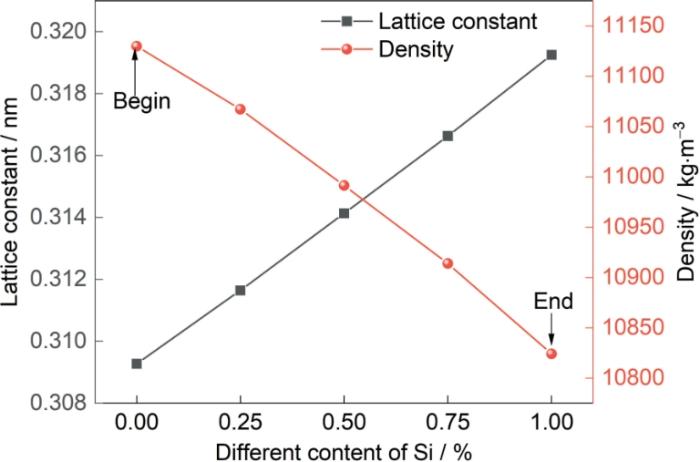
图3
不同Si含量FeCoNiCuSi x B1 - x 高熵合金的晶格常数和密度
Fig.3
Lattice constant and density in FeCoNiCuSi x B1 - x high entropy alloys with varying Si contents
在不考虑动力学因素的情况下,混合元素形成合金相主要由Gibbs自由能
控制。式中
金属材料的热力学稳定性,与取决于生成热(与
式中
图4给出了不同Si含量FeCoNiCuSi x B1 - x 高熵合金的基态能量和生成热。由图4可见,FeCoNiCuSi x B1 - x 高熵合金的基态总能量均为负值,说明高熵合金体系比较稳定,与Si元素的含量没有关系。同时,所有成分的生成热均为负值,表明FeCoNiCuSi x B1 - x 高熵合金在热力学上是稳定的。随着Si含量的提高高熵合金的基态总能量持续降低(绝对值增大),表明Si的加入显著提高了合金体系的稳定性;高熵合金的生成热也持续减小(绝对值增大),表明合金的热力学稳定性随着Si含量得到提高而提高。这表明,Si的加入降低了系统的能量和增强了原子间的结合,使FeCoNiCuSi x B1 - x 高熵合金的稳定性和热力学稳定性提高。
图4
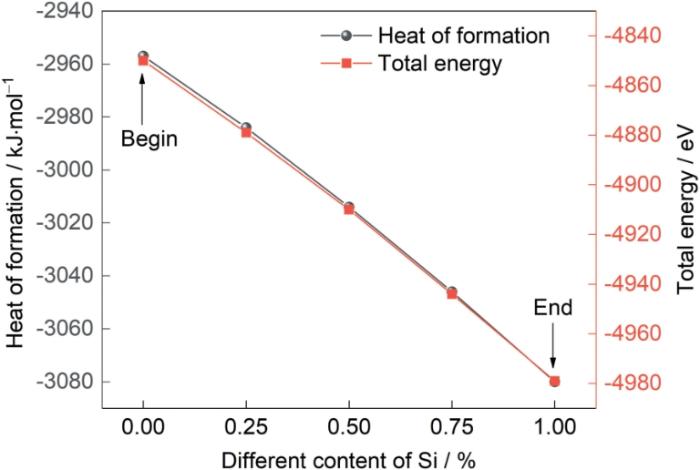
图4
不同Si含量FeCoNiCuSi x B1 - x 高熵合金的基态总能量和生成热
Fig.4
Ground-state total energy and heat of formation of FeCoNiCuSi x B1 - x high entropy alloys with varying Si contents
2.3 FeCoNiCuSi x B1 - x 高熵合金的弹性
式中
表3列出了不同Si含量FeCoNiCuSi x B1 - x 高熵合金的弹性常数及其变化幅度。计算变化幅度,以x = 0时的值为初始值;由表3可知,这些弹性常数的值始终大于0,不随Si元素含量的变化。这表明,FeCoNiCuSi x B1 - x 高熵合金的弹性常数满足力学稳定性要求。但是,随着Si元素的不断增加
表3 不同Si含量FeCoNiCuSi x B1 - x 高熵合金的弹性常数(Cij, GPa)及其变化幅度(%)
Table 3
| Alloys | Variation / % | Variation / % | Variation / % | |||||
|---|---|---|---|---|---|---|---|---|
| x = 0 | 1372.9 | 0 | 688.2 | 0 | 244.6 | 0 | 684.7 | 2749.3 |
| x = 0.25 | 1302.8 | -5.10 | 647.5 | -5.92 | 236.1 | -3.47 | 655.3 | 2597.8 |
| x = 0.5 | 1200 | -12.59 | 589.2 | -14.39 | 229.7 | -6.09 | 610.8 | 2378.4 |
| x = 0.75 | 1074.8 | -21.71 | 555.5 | -19.28 | 197.9 | -19.09 | 519.3 | 2185.8 |
| x = 1 | 927.9 | -32.41 | 542.4 | -21.20 | 134.7 | -44.93 | 385.5 | 2012.7 |
位错应变能,表征晶体的晶格畸变产生的内能增加。在材料的弹性形变过程中产生的位错,其单位长度应变能决定塑性变形抗力和加工难度。位错应变能越高则材料的变形抗力越强,加工能耗越大。FeCoNiCuSi x B1 - x 高熵合金中单个位错单位长度上的应变能为[58]
式中
图5

图5
不同Si含量FeCoNiCuSi x B1 - x 高熵合金的弹性模量和位错应变能
Fig.5
Elastic modulus and dislocation strain energy of FeCoNiCuSi x B1 - x high entropy alloys at different Si contents (a) elastic modulus, (b) strain energy per unit length of a single dislocation
用VRH (Voigt-Reuss-Hill)方法计算了合金的弹性模量。此法中的Voigt近似给出了弹性模量的理论上界(最大值),Reuss近似则给出了理论下界(最小值)。Hill近似取Voigt和Reuss近似值的算术平均,能更准确地反映材料的宏观弹性性能。因此,后续分析用Hill近似计算弹性模量。计算合金弹性常数时,CASTEP软件提供了Voigt、Reuss和Hill三种近似方式。
Reuss近似为
Hill近似为
表4
用VRH近似计算的不同Si含量FeCoNiCuSi x B1 - x 高熵合金的体积模量
Table 4
| Alloys | ||||||
|---|---|---|---|---|---|---|
| x = 0 | 916.4 | 916.4 | 916.4 | 283.7 | 276.1 | 279.9 |
| x = 0.25 | 866 | 866 | 866 | 272.7 | 265.8 | 269.2 |
| x = 0.5 | 792.8 | 792.8 | 792.8 | 260 | 255 | 257.5 |
| x = 0.75 | 728.6 | 728.6 | 728.6 | 222.6 | 218.7 | 220.6 |
| x = 1 | 670.9 | 670.9 | 670.9 | 157.9 | 153.1 | 155.5 |
表5
不同Si含量FeCoNiCuSi x B1 - x 高熵合金的下柯西压强、泊松比
Table 5
| Alloys | B/G | Hardness / GPa | Yield strength / GPa | ||
|---|---|---|---|---|---|
| x = 0 | 443.6 | 0.361 | 3.27 | 12.9 | 4.3 |
| x = 0.25 | 411.4 | 0.359 | 3.22 | 12.81 | 4.27 |
| x = 0.5 | 359.5 | 0.353 | 3.08 | 13.04 | 4.35 |
| x = 0.75 | 357.6 | 0.362 | 3.3 | 10.8 | 3.6 |
| x = 1 | 407.7 | 0.392 | 4.31 | 6.22 | 2.07 |
由表5可见,随着Si含量的提高B/G、泊松比和柯西压强均先减小后增大。但是,FeCoNiCuSi x B1 - x 高熵合金整体表现出韧性特征,表明Si元素的加入未导致合金由韧性向脆性转变。此外,合金的硬度和屈服强度变化与B/G和泊松比呈一定的负相关趋势,即随着Si含量增加,合金塑性倾向增强,而硬度和屈服强度呈下降趋势。Si含量为0~0.5时合金的硬度较高,而Si含量为0.5~1时硬度较低,其变化趋势与屈服强度相同。x = 0.5的合金其韧性最低而硬度最高,而x = 1时合金的韧性最高而硬度最低。
式中
表6
不同Si含量FeCoNiCuSi x B1 - x 高熵合金的各向异性系数(
Table 6
| Alloys | |||
|---|---|---|---|
| x = 0 | 0.138 | 0.014 | 0.714 |
| x = 0.25 | 0.13 | 0.013 | 0.721 |
| x = 0.5 | 0.098 | 0.01 | 0.752 |
| x = 0.75 | 0.089 | 0.009 | 0.762 |
| x = 1 | 0.157 | 0.015 | 0.699 |
由表6可见,x = 1时
图6

图6
不同Si含量FeCoNiCuSi x B1 - x 高熵合金的杨氏模量三维曲面图
Fig.6
Three-dimensional surface plot of Young's modulus for FeCoNiCuSi x B1 - x high entropy alloys with varying Si contents (a) x = 0, (b) x = 0.25, (c) x = 0.5, (d) x = 0.75, (e) x = 1
图7
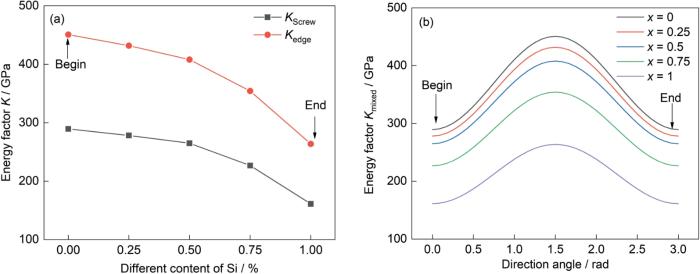
图7
不同Si含量FeCoNiCuSi x B1 - x 高熵合金的能量因子
Fig.7
Energy factor
2.4 FeCoNiCuSi x B1 - x 高熵合金的电子结构
不同Si含量FeCoNiCuSi x B1 - x 高熵合金的总态密度(TDOS),如图8所示。可以看出,FeCoNiCuSi x B1 - x 高熵合金的成键电子主要分布在-15~5 eV区间,所有结构在费米能级(0 eV)上的值均为正,表明合金具有显著的金属特征。随着Si含量的提高费米能级处的总态密度随之提高,图中0 eV处的线表示费米能级线。高熵合金在费米能级线最近的双强峰对应的能量,分别为-1.2413 eV和0.981 eV、-1.2072 eV和0.8507 eV、-1.16 eV和0.654 eV、-1.1749 eV和0.4969 eV、-1.2412 eV和0.2181 eV。上述合金的赝能隙,分别为2.2223 eV、2.0579 eV、1.814 eV、1.6718 eV、1.4593 eV。赝能隙是费米能级附近两个最近强峰之间的能量差,反映合金的共价性。赝能隙越宽,共价性越强[70]。这表明,随着Si含量的提高赝能隙越来越窄,即FeCoNiCuSi x B1 - x 高熵合金的金属性越强,共价性越弱。
图8

图8
不同Si含量FeCoNiCuSi x B1 - x 高熵合金的总态密度
Fig.8
Total density of states of the FeCoNiCuSi x B1 - x high entropy alloys with varying Si contents
共价性降低表明键合方向性阻力减小,使剪切模量的主导性下降,使体积模量和杨氏模量降低,即合金的变形抗力能力减小;金属键主导使柯西压强维持正值,保障材料韧性基底,但是受到硬度竞争机制调控(x = 0.5时残留共价性致硬度峰值而韧性谷值,x = 1时金属性最强实现韧性峰值)。金属性的提高降低位错核心区电子的局域化,显著降低位错应变能(
3 压力对FeCoNiCuSi0.5B0.5 高熵合金晶体结构和力学性能的影响
FeCoNiCuSi x B1 - x (x = 0, 0.25, 0.5, 0.75, 1)高熵合金始终具有韧性材料的特性。分析不同Si含量高熵合金的B/G和泊松比的变化趋势,发现x = 0.5时其延展性较低,而硬度最大。这一特性表明,在常温常压下FeCoNiCuSi0.5B0.5高熵合金具有良好的力学稳定性。
3.1 FeCoNiCuSi0.5B0.5 高熵合金的晶体结构
图9

图9
FeCoNiCuSi0.5B0.5高熵合金在不同压力下的晶格常数和密度
Fig.9
Lattice constant and density of FeCoNiCuSi0.5B0.5 high entropy alloy under different pressures
图10

图10
FeCoNiCuSi0.5B0.5高熵合金在不同压力下的基态总能量和生成热
Fig.10
Ground-state total energy and heat of formation of FeCoNiCuSi0.5B0.5 high entropy alloy under different pressures
3.2 FeCoNiCuSi0.5B0.5 高熵合金的弹性
应用第一性原理计算了在0~100 GPa范围内FeCoNiCuSi0.5B0.5高熵合金的弹性常数和弹性模量。表7列出了FeCoNiCuSi0.5B0.5高熵合金在不同压力下的弹性常数及其变化幅度。
表7 FeCoNiCuSi0.5B0.5高熵合金在不同压力下的弹性常数(Cij, GPa)及其变化幅度(%)
Table 7
| Pressure / GPa | Variation / % | Variation / % | Variation / % | |||||
|---|---|---|---|---|---|---|---|---|
| 0 | 1200 | 0 | 589.2 | 0 | 229.7 | 0 | 610.8 | 2378.4 |
| 20 | 1309.3 | 9.11 | 657.3 | 11.56 | 261.9 | 14.02 | 652 | 2623.9 |
| 40 | 1429.4 | 19.12 | 739.2 | 25.46 | 293.9 | 27.95 | 690.2 | 2907.8 |
| 60 | 1528.9 | 27.41 | 804.8 | 36.59 | 324 | 41.05 | 724.1 | 3138.5 |
| 80 | 1647.1 | 37.26 | 889.5 | 50.97 | 353.4 | 53.85 | 757.6 | 3426.1 |
| 100 | 1742.2 | 45.18 | 952.8 | 61.71 | 381.9 | 66.26 | 789.4 | 3647.8 |
由表7可见,随着压力的变化
图11给出了FeCoNiCuSi0.5B0.5高熵合金在不同压力下的弹性模量和位错应变能。由图11a可见,随着压力的提高合金的体积模量、剪切模量和杨氏模量均增大:x = 0 GPa时模量最小,合金的刚度较低;x = 100 GPa时模量显著增大,刚度大幅提高。这表明,压力得到提高使合金抵抗弹性变形(体积变形、剪切变形)的能力提高。由图11b可见,随压力的提高,单个位错单位长度应变能随之增大,并在x = 100 GPa时达到最大值。根据位错理论,应变能的增大意味着位错运动阻力增大,使位错难以滑移,从而使材料的塑性变形性能降低。总之,压力的提高使弹性模量与位错应变能随之提高,实现了对合金力学性能的调控:刚度显著提高,但是塑性降低。
图11

图11
FeCoNiCuSi0.5B0.5高熵合金在不同压力下的弹性模量和及位错应变能
Fig.11
Elastic modulus and dislocation strain energy of FeCoNiCuSi0.5B0.5 high entropy alloy under different pressures (a) elastic modulus, (b) strain energy per unit length of a single dislocation
表8 FeCoNiCuSi0.5B0.5高熵合金在不同压力下VRH近似计算出的体积模量B和剪切模量G
Table 8
| Pressure / GPa | ||||||
|---|---|---|---|---|---|---|
| 0 | 792.8 | 792.8 | 792.8 | 260 | 255 | 257.5 |
| 20 | 874.6 | 874.6 | 874.6 | 287.6 | 284.3 | 285.9 |
| 40 | 969.3 | 969.3 | 969.3 | 314.4 | 312.4 | 313.4 |
| 60 | 1046.2 | 1046.2 | 1046.2 | 339.2 | 338.2 | 338.7 |
| 80 | 1142.0 | 1142.0 | 1142.0 | 363.6 | 363.1 | 363.4 |
| 100 | 1215.9 | 1215.9 | 1215.9 | 387 | 386.9 | 387 |
表9
FeCoNiCuSi0.5B0.5高熵合金在不同压力下的柯西压强、泊松比
Table 9
| Pressure / GPa | B/G | Hardness / GPa | Yield strength / GPa | ||
|---|---|---|---|---|---|
| 0 | 359.5 | 0.3535 | 3.079 | 13.04 | 4.35 |
| 20 | 395.35 | 0.3526 | 3.059 | 14.15 | 4.72 |
| 40 | 445.32 | 0.3541 | 3.093 | 14.91 | 4.97 |
| 60 | 480.83 | 0.3539 | 3.089 | 15.78 | 5.26 |
| 80 | 536.07 | 0.3562 | 3.143 | 16.26 | 5.42 |
| 100 | 570.91 | 0.3561 | 3.142 | 17 | 5.67 |
由表9还可见,随着压力的提高合金的韧性、硬度和屈服强度都随之提高。其原因是,在高压条件下原子间距的减小使原子间的相互作用力增大,从而使材料的变形抗力和断裂韧性更高。这表明,适当提高压力有利于提高FeCoNiCuSi0.5B0.5高熵合金的综合力学性能。
表10
FeCoNiCuSi0.5B0.5高熵合金在不同压力下的各向异性系数(
Table 10
| Pressure / GPa | |||
|---|---|---|---|
| 0 | 0.098 | 0.0097 | 0.7521 |
| 20 | 0.058 | 0.0057 | 0.8034 |
| 40 | 0.031 | 0.0031 | 0.8514 |
| 60 | 0.015 | 0.0015 | 0.8950 |
| 80 | 0.0058 | 0.00057 | 0.9330 |
| 100 | 0.00131 | 0.00013 | 0.9674 |
图12

图12
FeCoNiCuSi0.5B0.5高熵合金在不同压力下的杨氏模量三维曲面图
Fig.12
Three-dimensional surface plot of Young's modulus for FeCoNiCuSi0.5B0.5 high entropy alloy under different pressures (a) x = 0 GPa, (b) x = 20 GPa, (c) x = 40 GPa, (d) x = 60 GPa, (e) x = 80 GPa, (f) x = 100 GPa
在无压力条件下FeCoNiCuSi0.5B0.5高熵合金的
图13给出了FeCoNiCuSi0.5B0.5高熵合金在不同压力下的能量因子
图13

图13
FeCoNiCuSi0.5B0.5高熵合金在不同压力下的能量因子
Fig.13
Energy factor K of FeCoNiCuSi0.5B0.5 high entropy alloy under different pressures (a) screw dislocation (
3.3 FeCoNiCuSi0.5B0.5 高熵合金的电子结构
为了深入研究这种结构稳定机制,计算了不同压力下FeCoNiCuSi0.5B0.5高熵合金的总态密度。如图14所示,FeCoNiCuSi0.5B0.5高熵合金的成键电子分布在-15~5 eV区间,所有结构在费米能级(0 eV)上的值均为正,说明合金具有显著的金属特征。随着压力的提高费米能级处的总态密度逐渐降低。图中的黑色虚线表示费米能级线。FeCoNiCuSi0.5B0.5高熵合金在费米能级线附近的双强峰对应的能量分别为-0.63 eV和0.654 eV、-0.6467 eV和0.6778 eV、-0.6488 eV和0.7059 eV、-0.6449 eV和0.7096 eV、-0.6639 eV和0.7208 eV、-0.6885 eV和0.7367 eV。这些合金的赝能隙分别为:1.284 eV、1.3245 eV、1.3547 eV、1.3545 eV、1.3847 eV、1.4252 eV。这表明,随着压力的提高赝能隙变宽,表明FeCoNiCuSi0.5B0.5高熵合金共价性越强则金属键越弱。
图14
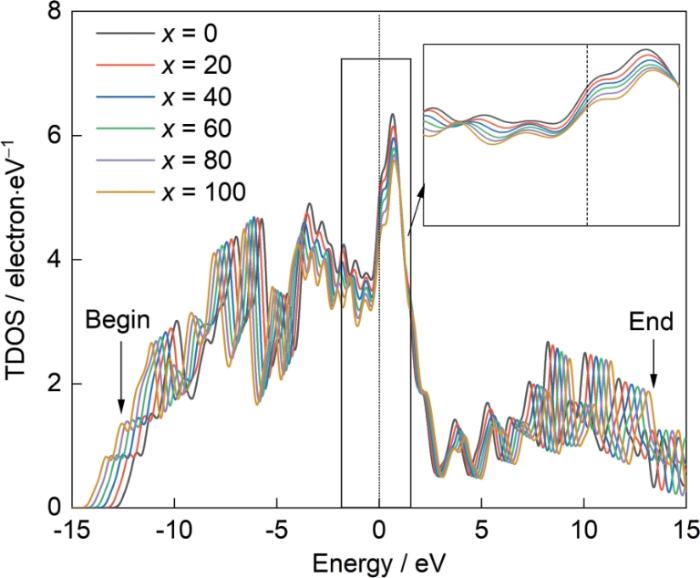
图14
FeCoNiCuSi0.5B0.5高熵合金在不同压力下的总态密度
Fig.14
Total density of states of the FeCoNiCuSi0.5B0.5 high entropy alloy under different pressures
共价性增强显著提高了键合方向性阻力,使剪切模量、体积模量及杨氏模量同步增大,提高了合金的弹性变形抗力;金属键基底维持柯西压强正值保障韧性底线,而共价键主导协同提高硬度和屈服强度,形成"高强韧"特性;电子局域化的提高使位错应变能及形核能垒大幅提高。虽然螺型位错仍具有相对优势,其运动受阻使塑性显著降低;高压同时激活多滑移系(FCC→HCP转变),使各向异性系数(
4 结论
(1) 随着Si含量的提高FeCoNiCuSi x B1 - x 高熵合金的晶格常数显著增大,而密度呈降低的趋势。Si元素的加入对合金力学稳定性的影响较小,但是使弹性模量、体积模量和剪切模量降低。B/G、泊松比和柯西压强则呈先减小后增大的趋势,表明Si含量的提高有利于改善合金的塑韧性,并降低脆性断裂倾向。Si含量的提高还提高了合金的热力学稳定性和体系稳定性,Si含量的提高弱化了键合共价性、降低了位错运动阻力、优化了位错形核行为,在牺牲部分刚度的同时使塑性显著提高。
(2) 随着压力的提高FeCoNiCuSi0.5B0.5高熵合金的晶格常数减小,密度和变形抗力提高。调控压力,使这种合金保持优异的韧性。压力的提高使合金体系的稳定性和热力学稳定性有所降低,但是基态总能量和生成热的变化较小。随着压力的提高,合金的各向异性降低。压力通过压缩原子间距和诱发电子结构重排(共价性增强),同步提高了FeCoNiCuSi0.5B0.5高熵合金的刚度、强度及硬度,位错运动阻力的增大抑制了塑性变形。虽然塑性降低,但是强化的共价键维系了材料的韧性。抑制了位错的不均匀形核,施加高压可能实现高强韧协同变形。
参考文献
Nanostructured high‐entropy alloys with multiple principal elements: novel alloy design concepts and outcomes
[J].
Microstructural development in equiatomic multicomponent alloys
[J].
Ultra-high strength WNbMoTaV high-entropy alloys with fine grain structure fabricated by powder metallurgical process
[J].
Effect of Ti and C additions on the microstructure and mechanical properties of the FeCoCrNiMn high-entropy alloy
[J].
Effect of additional alloying elements on microstructure and properties of AlCoCrFeNi high entropy alloy system: a comprehensive review
[J].
Effect of Al content on properties of CrFeNiAl x Si high entropy alloy
[J].
Al含量对CrFeNiAl x Si系高熵合金性能的影响
[J].
Effect of molybdenum content on microstructure and corrosion resistance of CoCrFeNiMo high entropy alloy
[J].
High entropy alloys have been extensively paid attention in the coating industry due to their excellent mechanical properties and corrosion resistance. CoCrFeNiMox high-entropy alloy coatings were prepared on the surface of Q235 steel by laser cladding with synchronous powder feeding. The microstructure, microhardness and corrosion resistance of the coatings were studied. The corrosion mechanism of the alloys was analyzed and the strengthening mechanism of their corrosion resistance was revealed combined with the first-principle calculation. The results show that CoCrFeNiMo0.1 and CoCrFeNiMo0.2 are composed of the fcc phase. The fcc phase and tetragonal CrMo phase are both observed in the CoCrFeNiMo0.3 high-entropy alloy layer. The microstructure of the alloys is composed of dendrites. Cr and Mo elements are enriched in the interdendritic, and Co and Fe elements are enriched in the dendrites. CoCrFeNiMox high-entropy alloys have excellent comprehensive corrosion resistance in 3.5% (mass fraction) NaCl solution. As the content of Mo increases, the corrosion potential shifts to more positive potentials, the corrosion current density decreases, the length of polarization region increases, the impedance arc radius increases, and the electrode reaction resistance increases. It is found via the first-principle calculation that the higher corrosion resistance of the coating is related to its dense passivation film.
Mo含量对CoCrFeNiMo高熵合金组织及耐蚀性能的影响
[J].
Microstructure and wear resistance of CoCrFeNiTi x high entropy alloy coating
[J].
CoCrFeNiTi x 高熵合金涂层的显微组织和耐磨性能
[J].用激光熔覆工艺在40Cr钢表面制备CoCrFeNiTi <sub>x</sub> (x=0、0.2、0.5、0.8)高熵合金涂层并计算其热力学参数,使用X射线衍射仪(XRD)、扫描电镜(SEM)、能谱仪(EDS)、显微硬度仪、摩擦磨损试验机等手段检测合金的物相组成、组织、元素分布、硬度及耐磨性,研究了Ti元素含量对其显微组织和耐磨性能的影响。结果表明:随着Ti元素含量的提高,合金物相在面心立方(FCC)结构的基础上形成了体心立方(BCC)结构,熔覆层中部的组织由晶界明显、晶粒分布均匀的等轴晶组成,最后形成了柱状树枝晶;随着Ti元素含量的提高,合金横截面的硬度逐渐提高,最高为412.32 HV<sub>0.2</sub>,比基体的硬度提高了1.8倍;涂层的磨损量和摩擦系数均随之降低,Ti含量为0.8时涂层其耐磨性能最优,磨损量最小为6.8 mg,摩擦系数为0.35。涂层的磨损机制,以磨粒磨损、粘着磨损和氧化磨损为主。
Effect of Ti addition on the microstructure and high-temperature oxidation property of AlCoCrFeNi high-entropy alloy
[J].
Effect of Zr content on microstructure and mechanical properties of AlCoCrFeNi high entropy alloy
[J].
Microstructure and mechanical properties of heat treated Al1.25CoCrCuFeNi high entropy alloys
[J].
Effect of copper addition on the AlCoCrFeNi high entropy alloys properties via the electroless plating and powder metallurgy technique
[J].
Effects of Ti and Cu on the microstructure evolution of AlCoCrFeNi high-entropy alloy during heat treatment
[J].
Phase separation and mechanical behavior of AlCoCrFeNi-X (X = Cu, Mn, Ti) high entropy alloys processed via powder metallurgy
[J].
The improvement of room temperature plasticity of refractory high entropy alloy based on different first principles calculation models and experiment verification
[J].
First-principles calculations and experimental studies of phase structure and mechanical stability of Al x CoCrFeNi series high-entropy alloys
[J].
Al x CoCrFeNi系高熵合金物相结构及力学稳定性第一性原理计算和试验研究
[J].
First principal study of TiZrHfNbSc x refractory high entropy alloys with different Sc content
[J].
第一性原理计算Sc含量对TiZrHfNbSc x 难熔高熵合金性能的影响
[J].
Effects of V on microstructure and properties of Al0.4Co0.5V x FeNi high-entropy alloys: first-principles study
[J].
基于第一性原理计算V元素对高熵合金Al0.4Co0.5V x FeNi的组织及性能影响
[J].
Analysis of Si addition on phase formation in AlCoCrCuFeNiSix high entropy alloys
[J].
Phase evolution of CoCrCuFeNiSi x high-entropy alloys prepared by mechanical alloying and spark plasma sintering
[J].
Exploring strengthening mechanism of FeCoNiAl high-entropy alloy by non-metallic silicon addition produced via powder metallurgy
[J].
Effect of B content on microstructure and mechanical properties of FeCrCoNiMn high-entropy alloy
[J].
B含量对FeCrCoNiMn高熵合金组织及力学性能的影响
[J].
Research on mechanical properties and corrosion behavior of (Co34Fe8Cr29Ni8Si7)100- x B x high entropy alloy coating
[J].
Effects of Si additions on microstructures and mechanical properties of VNbTiTaSi x refractory high-entropy alloys
[J].
Enhancement of strength-ductility balance of heavy Ti and Al alloyed FeCoNiCr high-entropy alloys via boron doping
[J].As one of the most effective mechanisms, precipitation-hardening is widely used to strengthen high-entropy alloys. Yet, heavy precipitation-hardened high-entropy alloys usually exhibit serious embrittlement. How to effectively achieve ultra-high strength and maintain reliable ductility remains a challenge. Here, we report a study of doping extremely little boron to meet this target. We found that adding of 30 ppm boron into the heavy Ti and Al alloyed FCC FeCoNiCr high-entropy, (FeCoNiCr)88Ti6Al6 HEA (at.%) which is strengthened mainly by both coarse BCC-based (Ni, Co)2TiAl Heusler and fine L12-type FCC-based (Ni, Co)3TiAl precipitates and shows ultrahigh strength but poor ductility, could significantly change the original microstructure and consequently improve mechanical performance, owing to the well-known effect of boron on reducing the energy of grain boundaries. The boron addition can (1) eliminate microcavities formed at Heusler precipitate-matrix interfaces; (2) suppress the formation and segregation of coarse BCC Heusler precipitates; (3) promote the formation of L12 nanoparticles. This changes of microstructure substantially improve the tensile ductility more than by ~86 % and retain comparable or even better ultimate tensile strength. These findings may provide a simple and costless solution to produce heavy precipitation-strengthened HEAs with ultrahigh strength and prevent accidental brittleness.
Wear and corrosion resistance of laser cladding CoCrFeNiSi x high entropy alloy coating
[J].
激光熔覆CoCrFeNiSi x 高熵合金涂层的耐磨和耐蚀性能
[J].在40Cr表面激光熔覆CoCrFeNiSi <sub>x</sub> (x = 0.2,0.6,1)高熵合金涂层,分析其物相、显微组织、硬度并测试了摩擦磨损和电化学腐蚀性能,研究了Si元素对高熵合金涂层的相结构、组织和性能的影响。结果表明:随着Si元素的增加涂层从单一面心立方结构转变为面心立方和硅化物σ相结构,最后转变为面心立方、体心立方和σ相结构。涂层的显微组织由等轴晶转变为柱状晶,最后成为树枝晶。随着Si含量的提高涂层的显微硬度随之提高,x = 1的涂层其平均硬度最高(498.92HV),约为基体的2.52倍。其主要原因是,Si元素的加入导致晶格畸变,引起的固溶强化和涂层中生成的金属间化合物σ相产生了第二相强化。随着Si含量的提高涂层的磨损量减少和平均摩擦系数显著降低,Si含量为1的涂层摩擦系数约为0.309。在总体上,涂层的主要磨损机制由黏着磨损、分层磨损向磨粒磨损演变,耐磨性能明显提高。在3.5%NaCl溶液中,这种涂层的耐蚀性能随着Si含量的提高而提高,Si含量为1的涂层,其耐蚀性能最好。
Kr ions irradiation damage behavior of AlNbMoZrB refractory high-entropy alloy
[J].As a burnable poison element, boron (B) has been successfully added into the AlNbMoZr based refractory high-entropy alloy (RHEA) via arc melting method, thus a novel high strength nuclear RHEA material with neutron toxic properties was developed. Hence, the alloy was subjected to irradiation of Kr ions of 4 MeV intensity to assess its irradiation damage behavior in terms of its microstructure and mechanical property evolution. The results of room temperature compression testing show that AlNbMoZrB alloy has excellent mechanical property with compression yield strength ~1180 MPa, fracture strength ~1274 MPa, and plasticity ~4.8%. By comparatively examining the phase structure and microstructure evolution of AlNbMoZrB alloy before and after irradiation, it is found that AlNbMoZrB alloy has a typical dendrite structure, in which the dendrite region is a matrix phase with disordered BCC structure, and the interdendrite region is composed of FCC structure Al-Zr phase and α-Zr phase. After irradiation with Kr ions, the α-Zr phase underwent an amorphous transformation. At the same time, high density <100> and 1/2<111> dislocation loops are also generated. The volume density of the dislocation loop is ~4.11×10²² m-3 and the size is between 12 nm and 16 nm after subjected Kr ions irradiation at room temperature. The volume density of the dislocation loop decreased to ~1.63×10²² m-3 and the size increased to 23~27 nm after subjected the same Kr ions irradiation at 300℃.
AlNbMoZrB系难熔高熵合金的Kr离子辐照损伤行为
[J].基于电弧熔炼法将可燃毒物硼(B)元素添加到AlNbMoZr基难熔高熵合金(RHEA)中,制备出一种具有中子毒物特性的高强度新型核用RHEA材料。对其进行强度为4 MeV的Kr离子辐照实验,研究了这种材料的Kr离子辐照损伤行为。室温压缩结果表明,AlNbMoZrB合金具有优异的力学性能,其压缩屈服强度可达1180 MPa,压缩强度约为1274 MPa,塑性约为4.8%。对辐照前后这种合金的相结构和显微组织演化的分析结果表明,AlNbMoZrB合金具有典型的枝晶组织,其中枝晶区为无序BCC结构基体相,枝晶间区由FCC结构的Al-Zr相及α-Zr相组成,经Kr离子辐照后α-Zr相发生非晶化转变,还产生了高密度<100>和1/2<111>型位错环。在室温辐照条件下位错环的体积密度约为4.11×10<sup>22</sup> m<sup>-3</sup>,尺寸为12~16 nm;在300℃辐照条件下位错环的体积密度降低到约1.63×10<sup>22</sup> m<sup>-3</sup>,尺寸增大到23~27 nm。
Predicting alloy vibrational mode properties using lattice dynamics calculations, molecular dynamics simulations, and the virtual crystal approximation
[J].
Application of a new virtual crystal approach for the study of disordered perovskites
[J].
Applicability of a quantum mechanical `virtual crystal approximation' to study Al/Si-disorder
[J].
Iterative minimization techniques for ab initio total-energy calculations: molecular dynamics and conjugate gradients
[J].
First-principles simulation: ideas, illustrations and the CASTEP code
[J].
Generalized gradient approximation made simple
[J].
First-principle studies of AlFe x TiCrZnCu high entropy alloys with the different mole fractions of Fe
[J].
第一性原理计算Fe含量对高熵合金AlFe x TiCrZnCu力学性能的影响
[J].
A determination of the Debye–Waller temperature factor and the X-ray Debye temperature for Ni, Cr, Fe, Mo and W
[J].
Charting the complete elastic properties of inorganic crystalline compounds
[J].The elastic constant tensor of an inorganic compound provides a complete description of the response of the material to external stresses in the elastic limit. It thus provides fundamental insight into the nature of the bonding in the material, and it is known to correlate with many mechanical properties. Despite the importance of the elastic constant tensor, it has been measured for a very small fraction of all known inorganic compounds, a situation that limits the ability of materials scientists to develop new materials with targeted mechanical responses. To address this deficiency, we present here the largest database of calculated elastic properties for inorganic compounds to date. The database currently contains full elastic information for 1,181 inorganic compounds, and this number is growing steadily. The methods used to develop the database are described, as are results of tests that establish the accuracy of the data. In addition, we document the database format and describe the different ways it can be accessed and analyzed in efforts related to materials discovery and design.
Microstructure and mechanical properties of FeNiCoCu system high entropy alloys and their composites
[D].
FeNiCoCu系高熵合金及其复合材料的微观组织与力学性能研究
[D].
Microstructures and corrosion behaviors of FeCoNi and CrFeCoNi equimolar alloys
[J].
Investigation on properties of (Ti/Zr/Hf/Sn/W)NbMoTaV high-entropy alloys using first-principles calculation and analysis method
[J]. J.
(Ti/Zr/Hf/Sn/W)NbMoTaV高熵合金性能第一性原理计算分析方法
[J].
Microstructures and crackling noise of Al x NbTiMoV high entropy alloys
[J].A series of high entropy alloys (HEAs), AlxNbTiMoV, was produced by a vacuum arc-melting method. Their microstructures and compressive mechanical behavior at room temperature were investigated. It has been found that a single solid-solution phase with a body-centered cubic (BCC) crystal structure forms in these alloys. Among these alloys, Al0.5NbTiMoV reaches the highest yield strength (1,625 MPa), which should be attributed to the considerable solid-solution strengthening behavior. Furthermore, serration and crackling noises near the yielding point was observed in the NbTiMoV alloy, which represents the first such reported phenomenon at room temperature in HEAs.
Phase selection, lattice distortions, and mechanical properties in high‐entropy alloys
[J].
Accelerated exploration of multi-principal element alloys with solid solution phases
[J].Recent multi-principal element, high entropy alloy (HEA) development strategies vastly expand the number of candidate alloy systems, but also pose a new challenge—how to rapidly screen thousands of candidate alloy systems for targeted properties. Here we develop a new approach to rapidly assess structural metals by combining calculated phase diagrams with simple rules based on the phases present, their transformation temperatures and useful microstructures. We evaluate over 130,000 alloy systems, identifying promising compositions for more time-intensive experimental studies. We find the surprising result that solid solution alloys become less likely as the number of alloy elements increases. This contradicts the major premise of HEAs—that increased configurational entropy increases the stability of disordered solid solution phases. As the number of elements increases, the configurational entropy rises slowly while the probability of at least one pair of elements favouring formation of intermetallic compounds increases more rapidly, explaining this apparent contradiction.
Effect of valence electron concentration on stability of fcc or bcc phase in high entropy alloys
[J].
First-principles calculations of properties of Ti x NbMoTaW high entropy alloys
[J].
Ti x NbMoTaW系高熵合金性能的第一性原理计算
[J].
Solid-solution phase formation rules for multi-component alloys
[J].
Lattice-distortion-enhanced yield strength in a refractory high-entropy alloy
[J].
Lattice distortion in a strong and ductile refractory high-entropy alloy
[J].
Local lattice distortion in high-entropy alloys
[J].
Relationship between the widths of supercooled liquid regions and bond parameters of Mg-based bulk metallic glasses
[J]. J.
Composition design of high entropy alloys using the valence electron concentration to balance strength and ductility
[J].
Calculated thermal properties of metals
[J].
(FeCoNi)75Cu25- x Si x high entropy alloys prepared by mechanical alloying and spark plasma sintering: microstructure, deformation behavior and dynamic recrystallization kinetics
[J].
Tensile and shear loading of four fcc high-entropy alloys: a first-principles study
[J].
Microstructure and properties of CuCrNi x TiZr high entropy alloys: experiments and first principles calculations
[J].
First-principles calculation of phase stability and elastic properties of Cr x MoNbTiV refractory high-entropy alloys
[J].
Elastic energy of multi-component solid solutions and strain origins of phase stability in high-entropy alloys
[J].
The influence of site preference on the elastic properties of FCC_CoCrFeNi multi-principal element alloy
[J].
First-principles calculation of mechanical properties of Ir-Rh alloy
[J].
Ir-Rh合金力学性能的第一性原理计算
[J].
First-principle calculation on mechanical properties of FeAl x NiCrMn high-entropy alloys
[J].
FeAl x NiCrMn系高熵合金力学性能的第一性原理计算
[J].
Effects of Mn content on mechanical properties of FeCoCrNiMn x (0 ≤ x ≤ 0.3) high-entropy alloys: a first-principles study
[J].
Successful prediction of the elastic properties of multiphase high entropy alloys in the AlTiVCr-Si system through a novel computational approach
[J].
A simplified method for calculating the debye temperature from elastic constants
[J].
First principles calculation of structural stability and mechanical properties of FeAlNiCrMn high entropy alloy
[J].
FeAlNiCrMn高熵合金结构稳定性和力学性能的第一性原理计算
[J].
First-principles calculation of electronic structure and mechanical properties of binary phases in Mg-Zn-Y-La alloy
[J].
Mg-Zn-Y-La合金中二元相的电子结构和力学性质的第一性原理计算
[J].
Microscopic theory of hardness and design of novel superhard crystals
[J].
Heterogeneous anisotro-py index and scaling in two-phase random polycrystals
[J].
Modeling of alloying effect on elastic properties in BCC Nb-Ti-V-Zr solid solution: from unary to quaternary
[J].
Impurity concentration effects on the structures, ductile and electronic properties of Zr-doped gamma-TiAl alloys
[J].
杂质浓度对Zr替位掺杂γ-TiAl合金的结构延性和电子性质的影响
[J].
Prediction of NbTaTiZr-based high-entropy alloys with high strength or ductility: first-principles calculations
[J].
First-principle calculation investigation of NbMoTaW based refractory high entropy alloys
[J].
High pressure synthesis of a hexagonal close-packed phase of the high-entropy alloy CrMnFeCoNi
[J].High-entropy alloys, near-equiatomic solid solutions of five or more elements, represent a new strategy for the design of materials with properties superior to those of conventional alloys. However, their phase space remains constrained, with transition metal high-entropy alloys exhibiting only face- or body-centered cubic structures. Here, we report the high-pressure synthesis of a hexagonal close-packed phase of the prototypical high-entropy alloy CrMnFeCoNi. This martensitic transformation begins at 14 GPa and is attributed to suppression of the local magnetic moments, destabilizing the initial fcc structure. Similar to fcc-to-hcp transformations in Al and the noble gases, the transformation is sluggish, occurring over a range of >40 GPa. However, the behaviour of CrMnFeCoNi is unique in that the hcp phase is retained following decompression to ambient pressure, yielding metastable fcc-hcp mixtures. This demonstrates a means of tuning the structures and properties of high-entropy alloys in a manner not achievable by conventional processing techniques.


