



用于制造汽车的先进高强钢(AHSS)的发展经历了三代。第一代汽车钢的强塑积偏低,难以满足严苛的性能标准。虽然以TWIP钢为代表的第二代先进高强钢的强塑积显著提高,但是其总合金元素含量超过25%,高合金化使其成本大幅度提高。第三代汽车钢的核心目标,是实现高性能和低成本,其中Mn含量为3%~12% (质量分数)的中锰钢具有优异的综合力学性能、较低的成本和良好的加工性能[1,2]。将常规中锰钢在临界区退火热处理,即将其加热到两相区长时间等温退火后冷却至室温,得到铁素体和奥氏体双相超细晶的组织,使其兼具高强度、高塑性和高应变硬化性能[2~4]。在拉伸变形过程中,这种中锰钢中的残余奥氏体在外加应力作用下转变为马氏体。这种应变诱导的马氏体相变使其具有优异的加工硬化性能和均匀的伸长率,即强度和塑性同时提高,产生了相变诱发塑性变形,即TRIP(Transformation Induced Plasticity)效应[5]。这表明,残余奥氏体的稳定性是影响中锰钢力学性能的关键因素。添加强奥氏体稳定化元素Mn可扩大奥氏体相区,在室温下得到更高体积分数的奥氏体组织并提高其机械稳定性,使中锰钢在变形过程中发生充分的TRIP效应[6,7]。但是,含量过高的Mn易产生严重的偏析带和使奥氏体稳定性大幅提高,不利于TRIP效应的发生。
张喜亮等[8]使用原位电子背散射衍射(EBSD)和球差透射电镜(ACTEM)等手段研究了具有新型异质结构的中锰钢的TRIP效应。结果表明,在中锰TRIP钢的拉伸过程中C/Mn含量较低的颗粒状奥氏体先发生相变,而含量较高的块状和片层状奥氏体在较大的应变范围内逐渐发生相变,从而导致高强度与高塑性的良好匹配。Shi等[9]进行室温拉伸测试了中锰钢的力学性能。结果表明,随着Mn含量的提高中锰钢的抗拉强度显著提高,但是延伸率有所降低。上述工作研究了Mn对中锰钢力学性能的影响以及发生形变诱导相变的规律,但是没有揭示Mn影响形变诱导相变的机制,特别是关于Mn对微区力学性能和微观组织的影响以及产生的宏观拉伸性能差异,仍须深入研究。晶体塑性本构模型的优势,在于能在复杂边界条件下高效求解晶体力学问题和模拟材料在晶粒尺度上的变形行为[10~12],为研究中锰钢单轴拉伸产生的不均匀变形机制和微观组织演变提供理论基础。采用基于快速Fourier变换的谱求解器[13~15],可实时计算材料内部状态变量的变化进而在连续变形条件下计算特征变量的演化[16]。本文进行晶体塑性模拟计算研究中锰钢的Mn含量对其变形行为的影响。
1 计算模型和方法
1.1 晶体的塑性模型
其中
引入塑性速度梯度张量
描述
形变诱导相变对塑性变形的额外贡献可引入塑性速度梯度张量
其中
奥氏体(fcc)向新生马氏体(bcc)的转变[20]是先通过Bain应变沿着晶向族
将其转换为Bain关系[100]fcc//[01
发生Bain应变后,奥氏体和新马氏体之间的晶体学取向关系遵循反西山(Inverse Nishiyama-Wassermann)关系[011]fcc//[111]bcc,[01
类比。其中
表1 嵌入晶体塑性模型的等效相变系
Table 1
| β | Tensile direction | Compressive direction | Rotation direction | Rotation angle |
|---|---|---|---|---|
| 1 | [100], [010] | [001] | [100] | +10.26° |
| 2 | [100], [010] | [001] | [100] | -10.26° |
| 3 | [100], [010] | [001] | [010] | +10.26° |
| 4 | [100], [010] | [001] | [010] | -10.26° |
| 5 | [100], [001] | [010] | [100] | +10.26° |
| 6 | [100], [001] | [010] | [100] | -10.26° |
| 7 | [100], [001] | [010] | [001] | +10.26° |
| 8 | [100], [001] | [010] | [001] | -10.26° |
| 9 | [010], [001] | [100] | [010] | +10.26° |
| 10 | [010], [001] | [100] | [010] | -10.26° |
| 11 | [010], [001] | [100] | [001] | +10.26° |
| 12 | [010], [001] | [100] | [001] | -10.26° |
式中
等效分切应力可描述为
其中
式中
1.2 形变诱导相变的晶体塑性模型
表2 fcc晶体结构的层错带系统
Table 2
| Fault-band system | |
|---|---|
| 1 | |
| 2 | |
| 3 | |
| 4 | |
| 5 | |
| 6 | |
| 7 | |
| 8 | |
| 9 | |
| 10 | |
| 11 | |
| 12 |
将fcc滑移系统的剪切量投影到层错带系上,滑移量的投影矩阵如表2所示,则所有投影剪切滑移量的总和为
其中层错带系
两个不同的层错带系
其中
其中
fcc金属中两个Shockley不全位错的平衡分解距离
其中堆垛层错能与奥氏体转变为马氏体的Gibbs自由能差
其中
式中
于是,马氏体体积分数
新生马氏体的体积为
其中
本文中与滑移系
式中
和
其中
计算马氏体相变的平均自由程。其中
1.3 晶体塑性的计算流程
本文的工作,在DAMASK的理论框架[14]下使用基于快速Fourier变换(Fast Fourier Transform, FFT)的谱求解器开展。该方法使用周期性边界条件高效求解晶体塑性力学平衡问题。在此框架下,根据弹性变形Hooke定律
图1
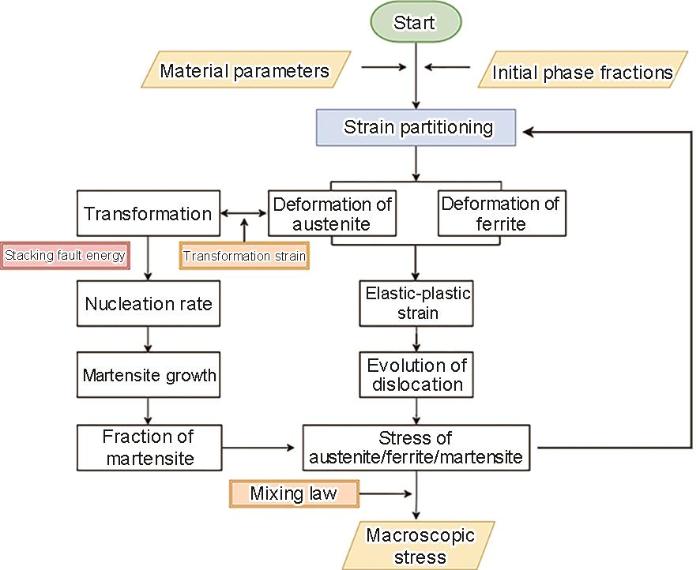
图1
晶体塑性本构模型的计算流程
Fig.1
Schematic representation of crystal plasticity constitutive model
2 计算设置
2.1 实验用材料的制备和显微组织
本工作所用的材料为中锰0.2C-7Mn钢(质量分数,下文称7Mn钢)和0.2C-5Mn钢(下文称5Mn钢)。7Mn钢的化学成分为Fe-6.7Mn-0.19C-0.015Al-0.002P-0.007S,5Mn钢的化学成分为Fe-4.76Mn-0.19C-0.013Al-0.002P-0.007S。用真空感应炉熔炼实验用钢,将铸锭在1200 ℃均匀化2 h后(在1200~1100 ℃)锻造成截面尺寸为70 mm × 70 mm的坯料,然后炉冷至室温。将试样多道次热轧后进行常规奥氏体逆相变热处理:分别将7Mn钢试样加热至660 ℃后保温6 h和将5Mn钢试样加热至665 ℃后保温6 h,随后冷却至室温。在临界区退火过程中碳化物在马氏体板条间析出,同时逆相变奥氏体形核并生长。随着保温时间的延长碳化物逐渐溶解,最终呈现出铁素体和残余奥氏体双相板条组织状态。
用型号为SUPRA 35的场发射扫描电子显微镜(SEM)观察试样的组织形貌(图2),加速电压为20 kV,工作距离为11~12 mm。
图2
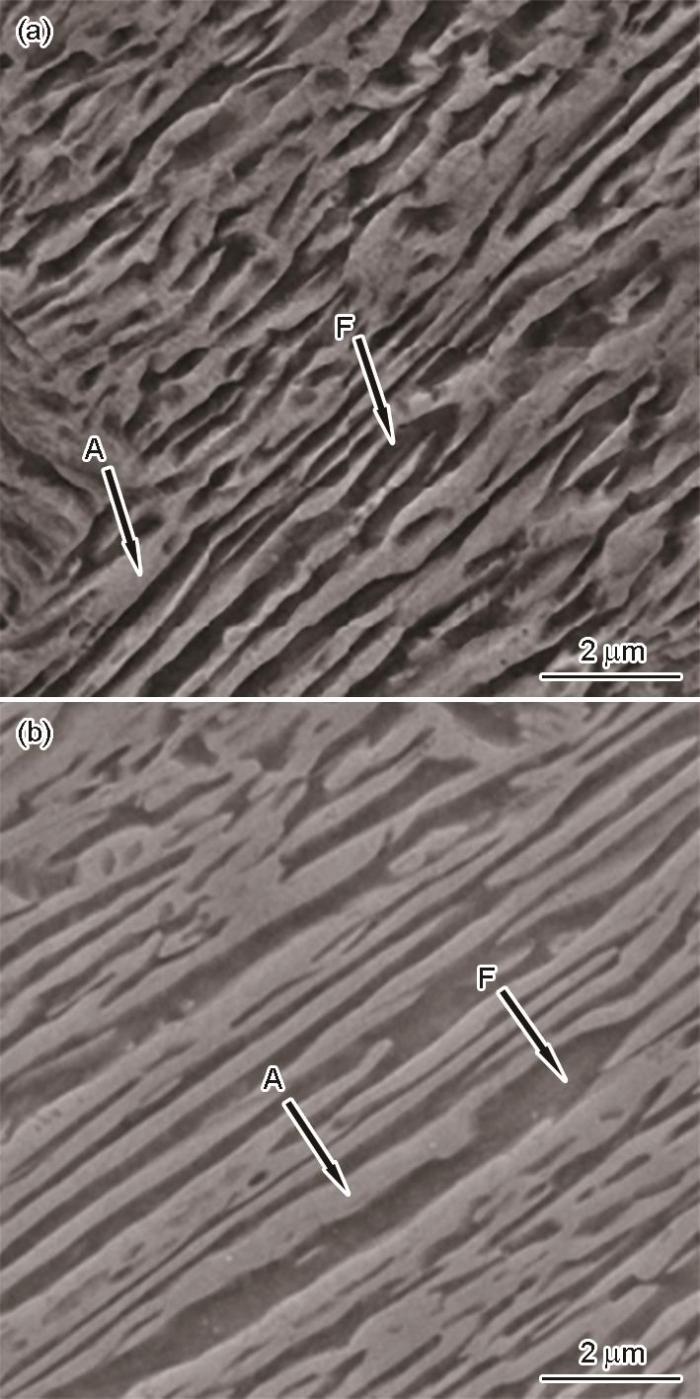
图2
7Mn钢和5Mn钢的显微组织SEM照片
Fig.2
SEM micrographs of deformed microstructure (a) 7Mn steel, (b) 5Mn steel
2.2 7Mn钢和5Mn钢的拉伸性能
图3
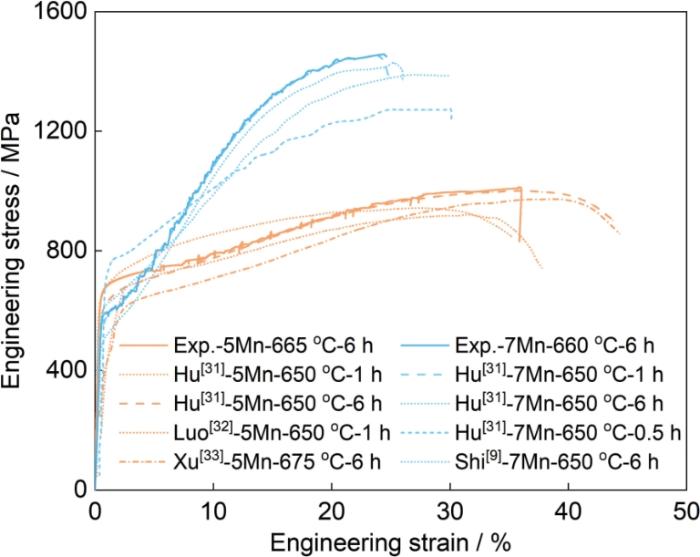
图3
7Mn钢和5Mn钢的拉伸性能
Fig.3
Engineering stress-strain curves of 7Mn steel and 5Mn steel in the experiment and papers
2.3 代表性体积单元模型和参数验证
本工作将SEM图片进行数字图像处理以构建微结构代表性体积单元(RVE)模型。先读入原始的微观组织SEM图片并将其转化为灰度图片,并根据奥氏体、铁素体双相组织的对比度差异得到图像二值化处理结果;随后,针对腐蚀或拍摄等原因导致的图像噪点进行过滤和消除,使两相的基体组织分离。最后,基于晶界与基体的特征差异将晶界提取出来,使基体组织和晶界分离。建立微几何模型后,选用正方形四节点单元对几何模型进行网格划分。
为了使RVE模型具有代表性和计算精度和计算效率,先设置尺寸梯度分别为2 μm × 2 μm、4 μm × 4 μm、6 μm × 6 μm、8 μm × 8 μm、10 μm × 10 μm、12 μm × 12 μm与14 μm × 14 μm的一系列模型,分别计算对应的应力-应变曲线以确定RVE的最优尺寸。如图4a所示,计算结果趋于收敛时得到临界尺寸12 μm ×12 μm。然后针对截面尺寸为12 μm ×1 2 μm的几何模型设置网格数目梯度,分别为150 × 150、175 × 175、200 × 200、225 × 225、250 × 250、275 × 275和300 × 300。采用相同的收敛性方法确定了临界网格数目为275 × 275,对应单元尺寸为0.044 μm × 0.044 μm。
图4
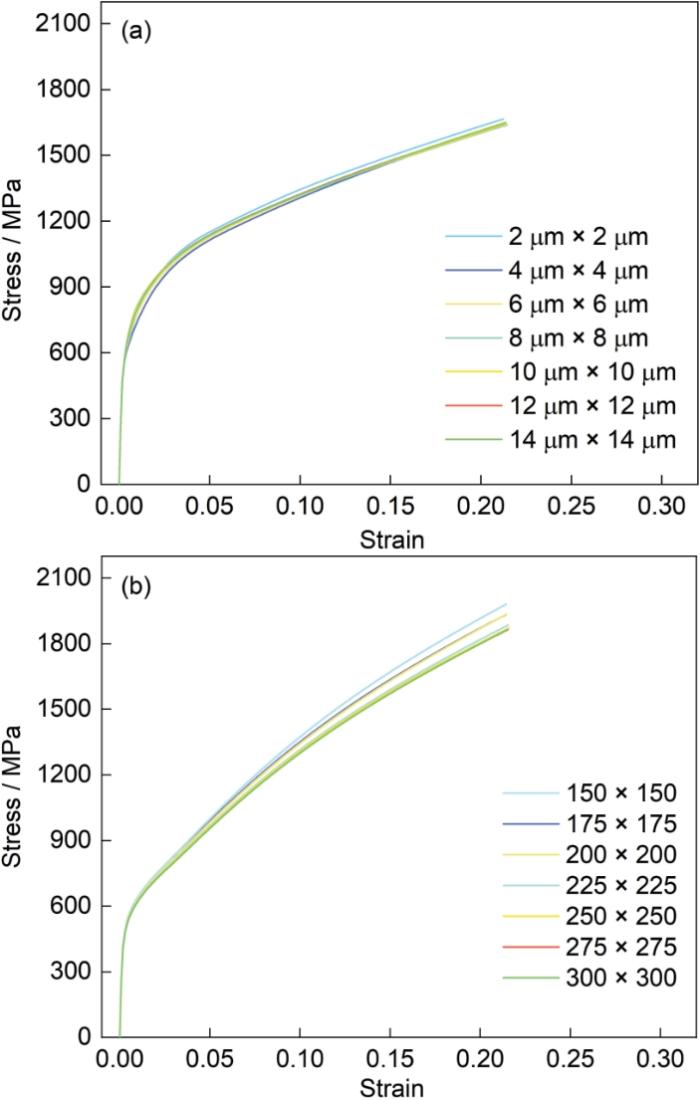
图4
使用不同尺寸和不同网格划分的RVE模型计算出的宏观应力-应变曲线
Fig.4
Macroscopic stress-strain curves of different sizes (a) and meshes (b) of RVE model
在此基础上,基于常规奥氏体工艺处理的两种中锰钢建立了用于晶体塑性计算模拟的RVE模型,如图5所示,图中的红色区域代表铁素体相,蓝色区域为奥氏体相。
图5
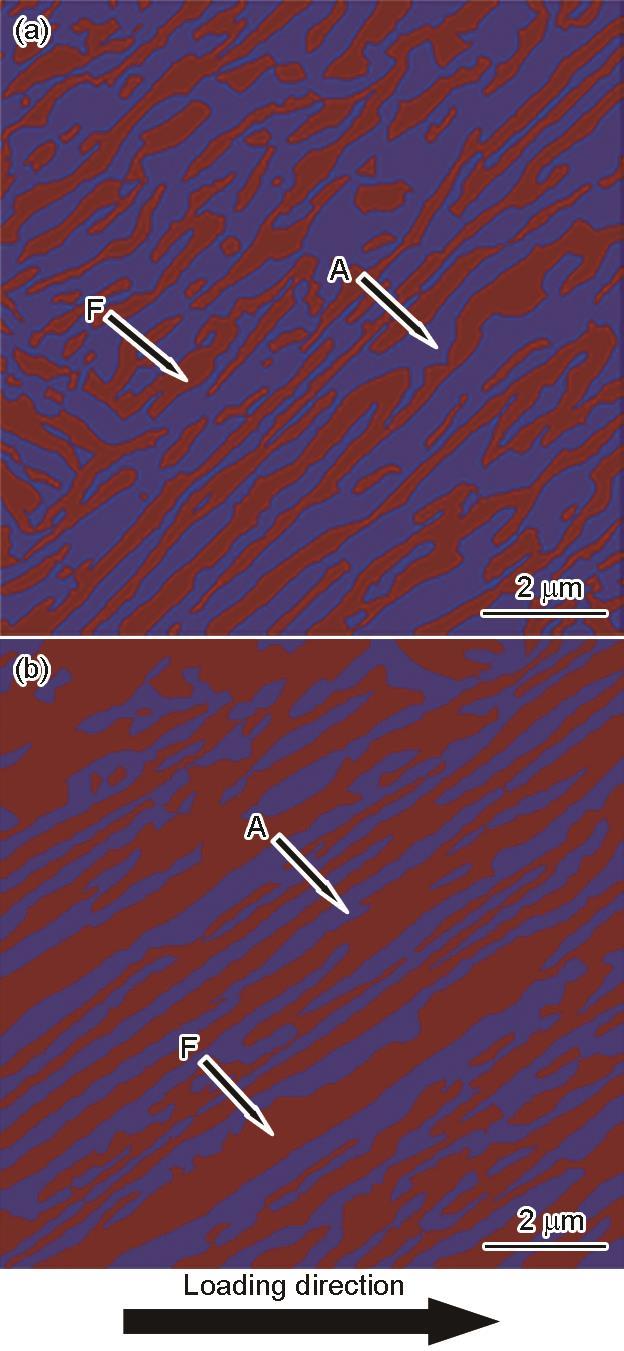
图5
基于7Mn钢和5Mn钢的组织建立的RVE模型
Fig.5
RVE models based on the microstructure of 7Mn steel (a) and 5Mn steel (b)
| Phase | Elastic modulus / GPa |
|---|---|
| Austenite | 175.0 (C11), 115.0 (C12), 135.0 (C44) |
| Ferrite | 232.2 (C11), 136.4 (C12), 117.0 (C44) |
表4 用于晶体塑性计算的7Mn钢中奥氏体和铁素体的本构参数
Table 4
| Deformation mechanism | Parameters | fcc | bcc | Units |
|---|---|---|---|---|
| Slip | Magnitude of Burgers vector for each slip system | m | ||
| Activation energy for glide for each slip system | J | |||
| Adjustment parameter p for slip | 0.5 | 0.4 | ||
| Adjustment parameter q for slip | 1.3 | 1.3 | ||
| Strength due to elements in solid solution | Pa | |||
| Transformation | Magnitude of Burgers vector for each transformation system | - | m | |
| Width of martensite nucleus | - | m | ||
| Adjustment parameter for transformation | 3.0 | - | ||
| Martensite lamellar thickness for each transformation system | - | m | ||
| Stacking fault energy | 10.0 | - | mJ/m² |
3 计算结果和讨论
图6展示了两种中锰钢单轴拉伸得到的和模拟计算出的宏观应力-应变曲线。可以看出,材料的屈服强度和硬化性能的模拟计算结果与实验数据的一致性良好,表明模拟计算所用参数合理,用本模型能可靠地预测中锰钢单轴拉伸的变形行为。
图6
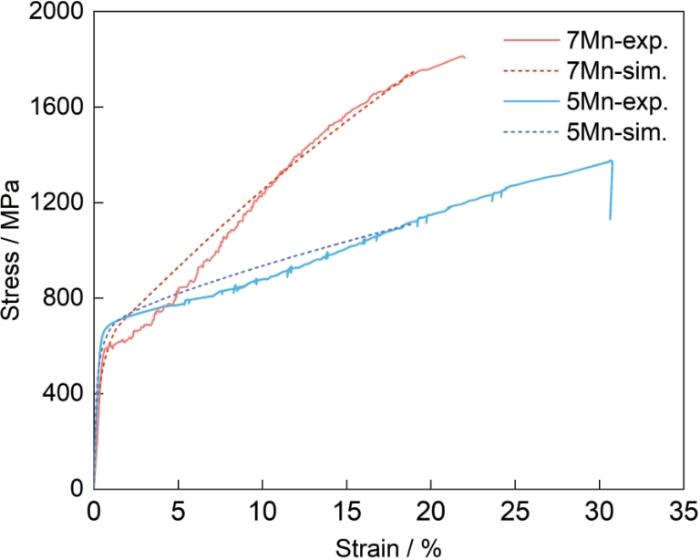
图6
7Mn钢和5Mn钢的实验和计算的应力-应变曲线
Fig.6
Macroscopic stress-strain curves of the experiment and the crystal plasticity simulation for 7Mn steel and 5Mn steel
表5 7Mn钢和5Mn钢中奥氏体和铁素体的Mn含量
Table 5
| Steel | fcc-Mn | bcc-Mn |
|---|---|---|
| 7Mn steel | 8.369 | 2.229 |
| 5Mn steel | 7.519 | 1.943 |
本模型中奥氏体中Mn含量的差异导致层错能的改变,进一步影响了形变诱导马氏体相变行为。同时,数值化表达了这一影响机制。基于Olson和Cohen[25]提出的马氏体剪切形核理论,马氏体形核时在奥氏体中的层错带交叉位置一个全位错解离为两个Shockley不全位错且形成了层错。5Mn钢中奥氏体的层错能较低,7Mn钢的奥氏体层错能较高。层错能的高低,直接影响奥氏体发生形变诱导马氏体相变的难易程度[40]。5Mn钢中的奥氏体层错能更低,使全位错更易解离和形成层错。因此,马氏体形核更加容易。另外,根据晶体塑性模型计算了两种钢中马氏体相变临界应力:7Mn钢中的奥氏体发生马氏体相变的临界应力为786 MPa,显著高于5Mn钢的579 MPa。该临界应力值对应于马氏体的体积分数超过0.2%情况下的等效应力,该计算值与Nimaga等[41]实验测得的中锰钢马氏体相变临界应力范围450~800 MPa高度吻合,表明7Mn钢中的奥氏体更难达到发生相变的条件。
上述计算结果表明,层错能的不同是导致两种中锰钢马氏体相变行为不同的关键因素。为了深入探究层错能变化对奥氏体变形行为的影响,并在遵循单一变量原则的前提下进一步验证晶体塑性模型的可靠性,本文以两种中锰钢形成的奥氏体-铁素体双相板条组织的形貌特征为参考,构建了如图7所示的具有层错能梯度的理想板条状简化模型。文献[42]的结果表明,中锰钢的层错能低于20 mJ/m2时主要塑性变形机制为位错滑移和形变诱导相变;层错能为20~50 mJ/m2时,主要发生孪生诱发塑性(TWIP)效应。据此,三组模型分别选取20 mJ/m2、15 mJ/m2和10 mJ/m2作为参考层错能值[43]。图7给出了这三组板条组织模型在应变逐渐增大(ε = 0.01,ε = 0.02,ε = 0.03)的过程中奥氏体发生形变诱导马氏体相变的演化情况。图7中的黄色区域为铁素体,蓝色区域为奥氏体,红色区域为原始奥氏体在外加应变下转变成的新生马氏体。层错能较高时,即在奥氏体的机械稳定性较高的条件下,马氏体相变的临界应力更高,相变只能发生在先达到临界应力的小部分奥氏体区域。相反,层错能较低时马氏体相变的临界应力更容易达到。因此,在变形过程中大部分奥氏体组织均能满足发生相变的应力条件,马氏体的生长更均匀。
图7
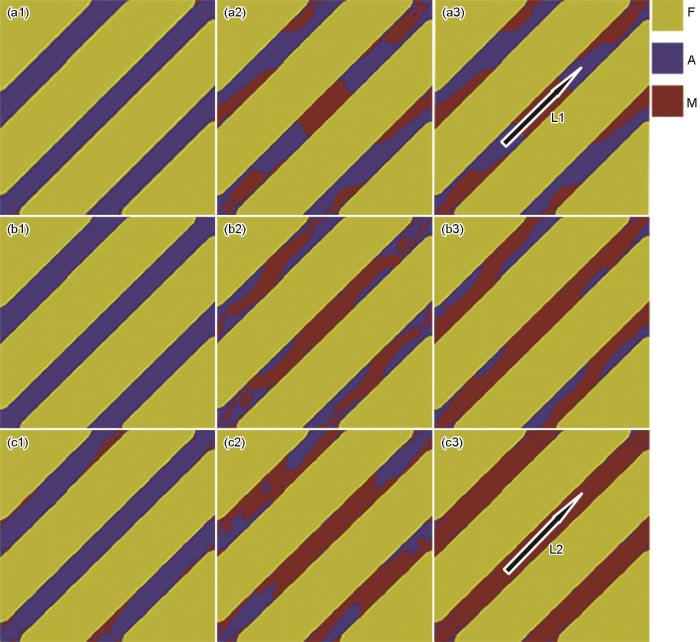
图7
应变ε = 0.01、0.02和0.03时不同层错能模型的形变诱导相变演化云图
Fig.7
Distributions of deformation-induced martensitic transformation of simplified models with stacking fault energy of 20 mJ/m2 (a1-a3), 15 mJ/m2 (b1-b3), and 10 mJ/m2 (c1-c3) at ε = 0.01 (a1-c1), 0.02 (a2-c2), and 0.03 (a3-c3)
图8
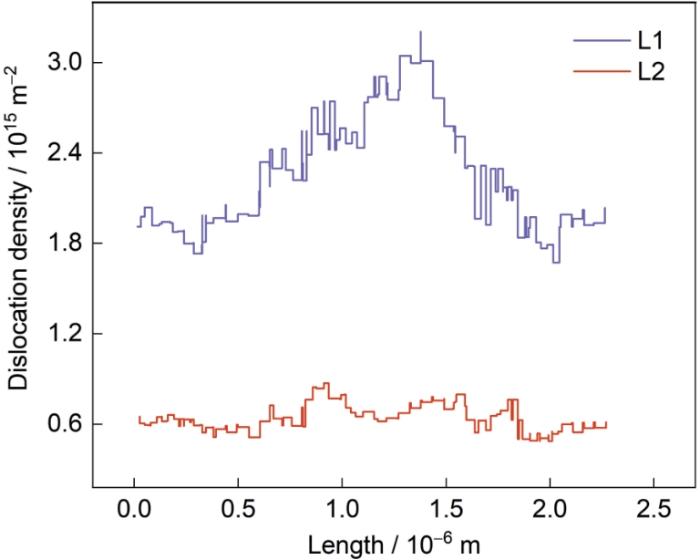
图8
图7中微区L1和L2的位错密度
Fig.8
Dislocation density along path L1 and L2 shown in Fig.7
如图9所示,在整体变形过程中层错能较高的情况下,在应变较大的原始奥氏体区域同时存在奥氏体和马氏体的双相组织。其中奥氏体发生马氏体相变提供部分硬化贡献,新生马氏体与残余奥氏体之间的相界面也对硬化有部分贡献。因此,这些因素共同使组织具有更高的加工硬化性能。相反地,层错能较低时奥氏体更容易发生充分的分布更加均匀的马氏体相变。与只发生部分相变的奥氏体相比,发生充分相变的奥氏体内应力分布更加均匀,使材料具有较高的延伸率。
图9
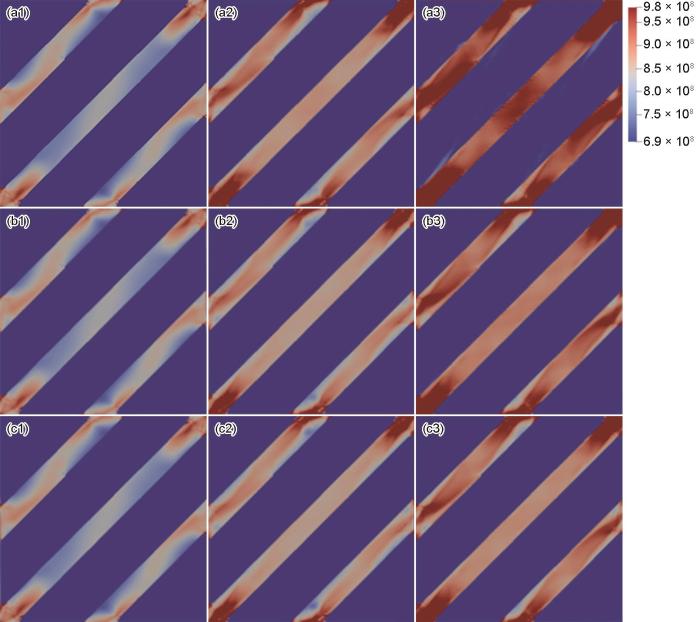
图9
应变ε = 0.01, 0.02, 0.03时不同层错能模型的等效应力云图
Fig.9
Von Mises stress distributions of simplified models with stacking fault energy of 20 mJ/m2 (a1-a3), 15 mJ/m2 (b1-b3), and 10 mJ/m2 (c1-c3) at ε = 0.01 (a1-c1), 0.02 (a2-c2), and 0.03 (a3-c3)
对上述理想简化模型的研究表明,作为关键物理量的层错能对奥氏体的机械稳定性有显著的影响,进而导致不同的形变诱导相变行为,最终使材料的力学性能不同。为了验证该模型在真实复杂组织中的适用性并进一步解释7Mn钢和5Mn钢变形过程中的差异,本文采用基于真实微观组织的RVE模拟晶体的塑性,计算并分析了7Mn钢和5Mn钢两种中锰钢的变形过程,以及奥氏体的相变动力学和加工硬化率。从图10可见,在7Mn钢的变形过程中加工硬化率先提高后降低。值得注意的是,这一波动区间恰好对应7Mn钢发生形变诱导马氏体相变最显著的阶段。相比之下,5Mn钢的奥氏体机械稳定性较低,应变较小时就发生了充分的马氏体相变,使其在变形后期难以产生较大的加工硬化率。
图10
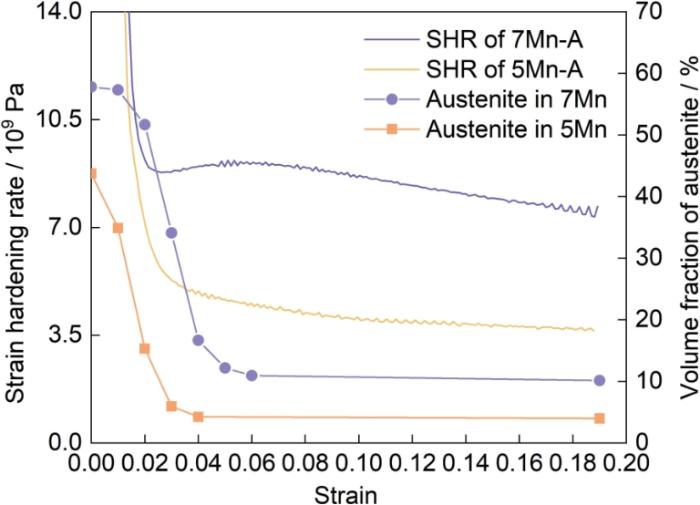
图10
7Mn钢和5Mn钢中奥氏体的加工硬化率和相变动力学
Fig.10
Strain hardening rate of austenite and the kinetics of transformation in 7Mn steel and 5Mn steel
7Mn钢与5Mn钢微区变形行为的差异,如图11所示。可以看出,在变形的初始阶段7Mn钢中的奥氏体相对稳定,未发生显著的形核。而5Mn钢中的奥氏体机械稳定性较低,表现出爆发式形核特征和出现大面积形核区域。随着应变的增大7Mn钢中的马氏体开始在应力集中区域发生弥散形核,而5Mn钢中的马氏体则进入高生长期。随着应变的进一步增大,7Mn钢中的马氏体逐渐生长,而5Mn钢的马氏体相变已接近完成。应变达到0.04时,7Mn钢中的奥氏体完成了主要的相变过程。
图11
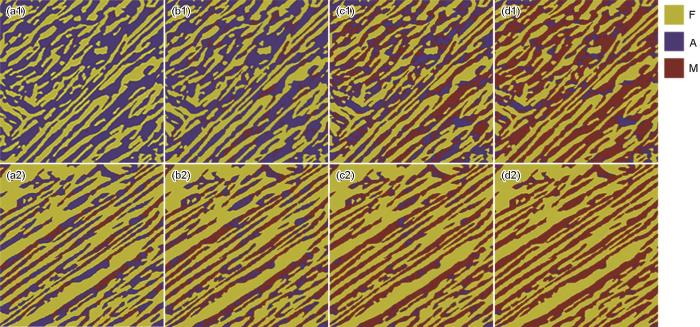
图11
7Mn钢和5Mn钢的形变诱导相变云图
Fig.11
Evolution of deformation-induced martensitic transformation for the crystal plasticity simulation of 7Mn steel (a1-d1) and 5Mn steel (a2-d2) at ε = 0.01 (a1, a2), 0.02 (b1, b2), 0.03 (c1, c2), and 0.04 (d1, d2)
图12
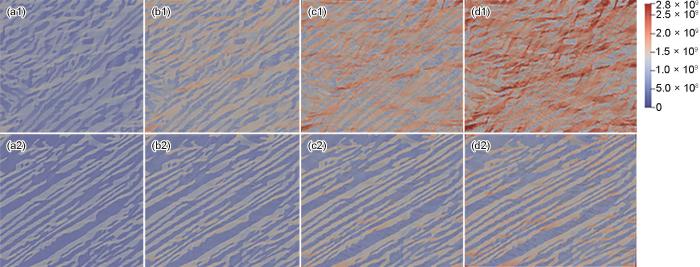
图12
7Mn钢和5Mn钢的等效应力云图
Fig.12
Von Mises stress distributions for the crystal plasticity simulation of 7Mn steel (a1-d1) and 5Mn steel (a2-d2) at ε =0.04 (a1, a2), 0.09 (b1, b2), 0.14 (c1, c2), and 0.19 (d1, d2)
图13
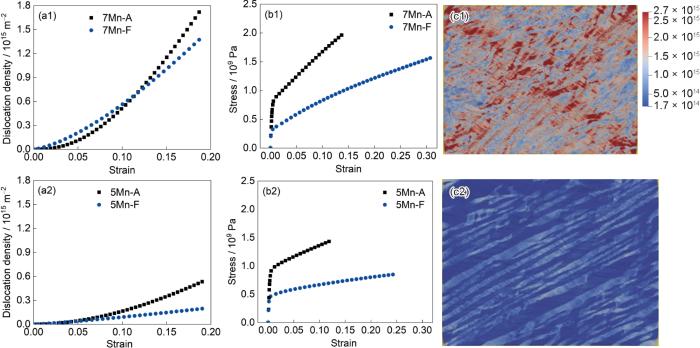
图13
7Mn钢和5Mn钢中单相的位错密度和应力-应变曲线以及位错密度云图
Fig.13
Calculated dislocation density (a1, a2) and stress-strain curves (b1, b2) in fcc and bcc, and dislocation density distributions (c1, c2) of 7Mn steel (a1-c1) and 5Mn steel (a2-c2) at ε = 0.19
为了揭示上述不同力学响应的原因,进一步分析了钢中的位错行为。作为置换型合金元素的Mn置换铁原子后在晶格中产生点缺陷,从而提高了位错形核的概率[44]。7Mn钢较高含量的Mn提高了位错增殖的可能性;在外加应变相同的条件下7Mn钢承载了更高的应力,使其内部的位错增殖速率显著提高。图13a1和a2中的位错密度演化曲线清晰地表明,7Mn钢中奥氏体和铁素体两相的初始位错密度均比5Mn钢的高且位错的平均自由程更短。因此,7Mn钢的应变硬化性能更高。为了更直观地分析应力在两相间的配分,计算并绘制了奥氏体和铁素体的应力-应变曲线,如图13b1和b2所示。可以看出,随着应变的增大7Mn钢中两相间的应力配分差异显著增大且变化更为剧烈。这种非协调的应力分配削弱了两相间变形的协调性,是其延伸率较低的一个重要原因。同时,奥氏体和铁素体具有更强的加工硬化性能,使7Mn钢的抗拉强度更高。相比之下,5Mn钢中两相间的应力配分均匀且缓慢增长,有利于使其具有优异的延伸率。
4 结论
(1) 使用基于晶体塑性框架构建的耦合形变诱导相变的本构模型可模拟中锰钢在单轴拉伸过程中各相的应力-应变响应以及奥氏体发生形变诱导马氏体相变的过程。根据Mn元素配分产生的奥氏体成分差异,可建立奥氏体的机械稳定性与层错能的关系,并建立“中锰钢的Mn元素含量-奥氏体层错能-形变诱导马氏体相变行为-微区力学响应-宏观力学性能”这一机制,揭示Mn含量对中锰钢的变形机制和力学性能的影响。
(2) 层错能的差异对形变诱导马氏体相变行为有显著的影响。7Mn钢中层错能较高的奥氏体机械稳定性更强,将相变推迟到在更高的应变下发生且马氏体的形核更为弥散。而5Mn钢中奥氏体较低的层错能,使其可在较小应变范围内完成相变。两者形变诱导相变行为的不同产生了不同的TRIP效应。
(3) 形变诱导相变行为的差异影响对宏观力学的响应。7Mn钢中的奥氏体在发生相变最剧烈的区间出现加工硬化率的不连续“凸起”,而5Mn钢中马氏体相变的过早发生限制了加工硬化性能的提高。
(4) 新生马氏体与原始奥氏体之间的界面对位错运动的阻碍引起局部区域内位错的显著累积,有助于硬化性能的提高。这提高了奥氏体层错能较高的7Mn钢的加工硬化性能,但是使其变形协调性降低。
参考文献
M3 microstructure control theory and technology of the third-generation automotive steels with high strength and high ductility
[J].
高强度高塑性第三代汽车钢的M3组织调控理论与技术
[J].
高强度、高塑性是汽车钢的重要发展方向,本文综述了高强度高塑性第三代汽车钢的“多相(multiphase)、亚稳(metastable)和多尺度(multiscale)” M<sup>3</sup>组织性能调控理论和技术,以及面临的新挑战。M<sup>3</sup>组织与性能调控理论为高强度高塑性钢提供了理论支持,亚稳奥氏体的相变诱发塑性(TRIP)效应能够提高加工硬化率并推迟颈缩的发生,从而提高了钢的强度与塑性,同时产生了剪切边裂纹敏感性提高,氢致延迟断裂性能下降,循环载荷下亚稳奥氏体的转变行为复杂等新的问题和挑战。当前,含亚稳奥氏体高强度高塑性钢的质量一致性和应用基础研究缺乏,而汽车钢作为量大面广的产品,需要从它的成分设计和组织调控-冲裁切割-成形制造-连接涂装-服役评价等全链条环节中开展组织演变和性能评估,充分考虑产品的技术适用性和成本,进而为组织调控理论和技术的完善提供依据。
Enabling strong and formable advanced high-strength steels through inherited homogeneous microstructure
[J].
The enhancement of ductility in high-strength steels
[J].
An ultrahigh strength and enhanced ductility cold-rolled medium-Mn steel treated by intercritical annealing
[J].
The dual role of TRIP effect on ductility and toughness of a medium Mn steel
[J].
Research on microstructures, mechanical properties and austenite stability in medium Mn-content steels with high strength and ductility
[D].
中锰高强塑性钢组织性能及奥氏体稳定性研究
[D].
Tailoring retained austenite and mechanical property improvement in Al-Si-V containing medium Mn steel via direct intercritical rolling
[J].
Microstructure and mechanical properties of a novel heterogeneous cold-rolled medium Mn steel with high product of strength and ductility
[J].The mechanical properties of a novel heterogeneous cold-rolled medium Mn steel were investigated by means of mechanical testers, in situ EBSD (electron back-scattered diffraction) and SDTEM (spherical differential transmission electron microscope). The results show that the sample annealed at 680°C consists of multiple microstructure of austenites (granular shape, blocky shape, and lath-like shape) and fine ferrite grains. The heterogeneous steel has ultimate tensile strength of 1.27 GPa, total elongation of 54.5% and product of strength and elongation of 69.3 GPa·%. During tensile deformation the granular-shape austenite with a low C/Mn content preferentially transforms into martensite ahead of the blocky-shape and lath-like austenite with high C/Mn content, and the multi-type microstructure of austenite with various stability lead to a continuous TRIP effect in a large strain region, which is responsible for the excellent properties of the heterogeneous medium Mn steel. In addition, austenite grain boundaries or austenite/ferrite interfaces are the preferred nucleation zone of martensite during deformation. The effect of Mn/C content on austenite stability readily overrides those of grain size.
一种新型高强塑积异质冷轧中锰钢的力学性能
[J].使用原位电子背散射衍射(EBSD)和球差透射电镜(ACTEM)等手段,研究了新型异质结构中锰TRIP钢在拉伸过程中微观组织的演变机制和力学性能。结果表明,在680℃退火后的实验钢中生成了多形貌、多尺度的异质奥氏体结构(颗粒状、块状、片层状奥氏体)和铁素体组织,其抗拉强度为1272 MPa,总延伸率为54.5%,强塑积高达69.3 GPa·%。在拉伸过程中C/Mn含量较低的颗粒状奥氏体先发生相变,而C/Mn含量较高的块状和片层状奥氏体在较大的应变范围内逐渐发生相变,从而导致高强度与高塑性的良好匹配。结果还表明,马氏体相变优先在奥氏体晶界/相界附近的区域形核。与晶粒尺寸相比,C/Mn元素对奥氏体稳定性的作用更重要。
Enhanced work-hardening behavior and mechanical properties in ultrafine-grained steels with large-fractioned metastable austenite
[J].
Overview of constitutive laws, kinematics, homogenization and multiscale methods in crystal plasticity finite-element modeling: Theory, experiments, applications
[J].
Experimental investigation of plastic grain interaction
[J].
Grain-scale micromechanics of polycrystal surfaces during plastic straining
[J].
Numerical experiments in revisited brittle fracture
[J].
N-site modeling of a 3D viscoplastic polycrystal using fast Fourier transform
[J].
Improved approximations of Fourier coefficients for computing periodic structures with arbitrary stiffness distribution
[J].
DAMASK-The Düsseldorf Advanced Material Simulation Kit for modeling multi-physics crystal plasticity, thermal, and damage phenomena from the single crystal up to the component scale
[J].
Kinematic description of crystal plasticity in the finite kinematic framework: A micromechanical understanding of F = F e F p
[J].
A discussion of multiplicative decompositions and strain measures
[J].
Kinetics of strain-induced martensitic nucleation
[J].
A molecular dynamics study of the FCC→BCC transformation at fault intersections
[J].
Zur kristallplastizität. III: Über den mechanismus des gleitvorganges
[J].
A constitutive model for FCC single crystals based on dislocation densities and its application to uniaxial compression of aluminium single crystals
[J].
Work hardening in heterogeneous alloys—a microstructural approach based on three internal state variables
[J].
A dislocation density based constitutive law for BCC materials in crystal plasticity FEM
[J].
A mechanism for the strain-induced nucleation of martensitic transformations
[J].
A crystal plasticity model for twinning- and transformation-induced plasticity
[J].
Non-crystallographic shear banding in crystal plasticity FEM simulations: Example of texture evolution in α-brass
[J].
Orientation dependence of shear banding in face-centered-cubic single crystals
[J].
Dislocation density evolution and interactions in crystalline materials
[J].
Kinetics of flow and strain-hardening
[J].
Microstructural mechanisms of metastable austenite control in high strength-ductility medium-Mn steels
[D].
高强塑积中锰钢亚稳奥氏体调控的微观机理研究
[D].
Experimental and numerical analysis on formation of stable austenite during the intercritical annealing of 5Mn steel
[J].
Effects of aluminium on the Microstructure and mechanical properties in 0.2C-5Mn steels under different heat treatment conditions
[J].
Elastic properties of Fe-Mn random alloys studied by ab initio calculations
[J].We have studied the influence of the Mn content on the elastic properties of Fe–Mn random alloys (space group of Fm3¯m) using ab initio calculations. The magnetic effects in Fe–Mn alloys have a strong influence on the elastic properties, even above the Néel temperature. As the Mn content is increased from 5to40at.%, the C44 elastic constant is unaffected, while C11 and C12 decrease. This behavior can be understood based on the magnetovolume effect which softens the lattice. Since the amplitude of local magnetic moments is less sensitive to volume conserving distortions, the softening is not present during shearing.
Mesoscopic analysis of deformation heterogeneity and recrystallization microstructures of a dual-phase steel using a coupled simulation approach
[J].
On the prediction of stacking fault energy on medium Mn steels
[J].
An equivalent von Mises stress and corresponding equivalent plastic strain for elastic-plastic ordinary peridynamics
[J].
Introduction of crystallographic factor into the von Mises equivalent stress calculation
[J].
Austenite stability of ultrafine-grained transformation-induced plasticity steel with Mn partitioning
[J].
Correlations between the calculated stacking fault energy and the plasticity mechanisms in Fe-Mn-C alloys
[J].
Revealing orientation-dependent martensitic transformation in a medium Mn steel by micropillar compression
[J].
Twinning-induced plasticity aided high ductile duplex stainless steel
[J].
Modified embedded-atom method interatomic potentials for pure Mn and the Fe-Mn system
[J].


