



早期工程化应用的变形高温合金主要进行合金化提高其性能,随着制备技术的发展粉末高温合金用于进一步提高发动机的安全性和耐久性[3]。粉末冶金成形工艺,包括热等静压(Hot isostatic pressing, HIP)、热压烧结、热机械变形、注射成型以及增材制造等[4,5]。目前,热等静压近净成形技术是航空航天领域最成熟的粉末冶金工艺。通过HIP成形去除包套后的零件可以直接使用,成品致密度高,孔隙率低,力学性能优异。HIP技术适于制造复杂几何形状的零件,如风扇盘、异型筒等[6]。与传统精密铸造工艺相比,HIP技术能消除宏观成分偏析,优化合金的微观组织,显著提高其性能稳定性。与锻造工艺相比,HIP技术可实现近净成形,显著提高材料的利用率并缩短加工周期。优化工艺参数和提高材料的综合性能,推动了HIP近净成形复杂构件在航空航天等领域的应用。
ЭП741合金(国内牌号为FGH4097)是一种镍基沉淀强化型粉末高温合金,其粉末盘在多种型号的航空发动机中得到了广泛的应用。ЭП741粉末盘的成形方法,包括HIP、HIP+等温锻造以及热挤压+等温锻造三种工艺。本文以ЭП741预合金粉末为原料用HIP技术制备粉末合金,并比较其与粉末变形合金(HIP+等温锻造)显微组织和-196 ℃、室温、650 ℃力学性能,为ЭП741粉末合金在航空航天领域的应用提供参考。
1 实验方法
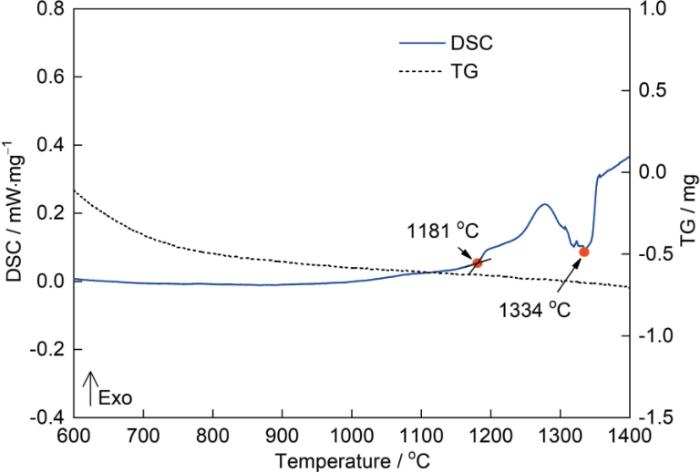
用真空惰性气体雾化法(VIGA)和等离子旋转电极雾化法(PREP)工艺制备ЭП741预合金粉末。使用TCH600氧氮氢分析仪和Agilent 7400等离子体发射光谱仪测定ЭП741预合金粉末与变形合金的化学成分和杂质含量,结果列于表1。用装有Ultim Max N硅漂移型能谱仪(EDS)的TESCAN MIRA3型场发射扫描电镜(SEM)观察预合金粉末的表面形貌,并检测粉末中夹杂物的元素成分。用STA449F3超高温综合热分析仪测量ЭП741粉末的相变点温度,升温速率为5 ℃/min。
表1 ЭП741预合金粉末和粉末变形合金的主要化学成分及杂质含量
Table 1
| Material | H | N | O | W | Mo | Al | Ti | Nb | Hf | Co | Cr | Si | Ni |
|---|---|---|---|---|---|---|---|---|---|---|---|---|---|
| VIGA powder | 0.0002 | 0.012 | 0.0074 | 4.08 | 3.93 | 5.05 | 1.69 | 2.39 | 0.23 | 16.2 | 9.08 | 0.10 | Bal. |
| PREP powder | < 0.0015 | < 0.0020 | 0.0060 | 5.58 | 3.94 | 5.09 | 1.82 | 2.62 | 0.31 | 16.0 | 8.88 | 0.03 | Bal. |
| Deformed PM alloy | < 0.0001 | 0.0005 | 0.0037 | 5.63 | 4.05 | 5.18 | 1.84 | 2.59 | 0.24 | 16.2 | 9.11 | < 0.10 | Bal. |
用HIP近净成形技术制备ЭП741粉末合金:将两种粉末填充在低碳钢包套中,包套空腔的直径为50 mm、长度为140 mm、壁厚为5 mm。将包套中的粉末振实、真空除气、封焊后,在RD200型热等静压炉中进行HIP致密化,HIP制度为1200 ℃/140 MPa/3 h。
粉末变形合金取自涡轮盘毛坯,制备工艺为:HIP成形后将坯料以10~20 ℃/min分阶段加热至1100~1150 ℃,再转移到等温锻造液压机中锻造成型。使用Versa XRM-500型X射线三维成像系统统计ЭП741粉末合金和粉末变形合金中的孔隙缺陷。用TESCAN MIRA4型SEM表征合金的显微形貌,电解腐蚀液为16 g Cr2O3 + 170 mL H3PO4 + 10 mL H2SO4,电压3~5 V,腐蚀时间约5~10 s。使用Image Pro Plus软件统计粉末中的γ相和原始颗粒边界的面积分数。用线切割从粉末合金与变形合金上切取测试力学性能的样品,将其加工成直径为5 mm、标距为25 mm的M10拉伸试样。用SANS-CMT 5205、SUNS UTM5305S等万能实验机测试ЭП741合金在室温、650 ℃和-196 ℃的拉伸性能。用JSM-IT800SHL型SEM对拉伸断口纵截面进行EBSD晶体取向分析,并使用Aztec Crystal软件提取晶体学信息。
2 结果和讨论
2.1 ЭП741预合金粉末的制备
目前,高温合金粉末的制粉工艺主要有VIGA和PREP。VIGA工艺,是放在陶瓷坩埚里的高温合金原料在真空熔炼室内熔化成液流,经高压气流吹碎后高速凝固成球形预合金粉末。PREP工艺不同于传统气雾化技术依靠坩埚熔炼,而是用等离子弧熔化电极棒末端。这种设计在一定程度上避免了陶瓷坩埚材料对粉末的污染[9,10]。图1给出了用VIGA和PREP两种工艺制备的ЭП741粉末的形貌和粒度分布。两种粉末的D50 (D50表示小于该粒径的颗粒占比为50%,大于该粒径的颗粒占比为50%,用来表示粉末的平均粒度)分别为74和71 μm,可见其平均粒度接近。PREP粉末的粒度更集中,其表面光滑,球形度较高,几乎没有卫星球。而VIGA粉末的球形度较低,有卫星球和夹杂。用EDS分析夹杂的主要元素组成(质量分数,%):Si 10.24,Al 4.29,O 43.07,Ni 11.48,Co 4.24,确定其为富集Si、Al和O元素的陶瓷夹杂。VIGA粉末中夹杂物的主要来源是陶瓷坩埚,次要来源包括母合金残留和设备污染等。与VIGA工艺相比,PREP工艺不使用陶瓷坩埚,因此制备出的粉末较为洁净[11]。
图1
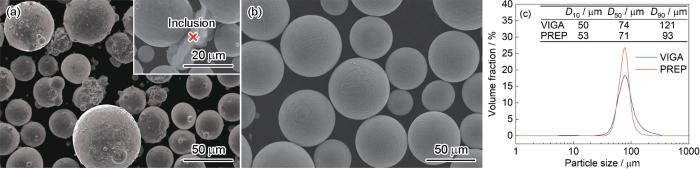
图1
ЭП741预合金粉末形貌的SEM像和粒度分布
Fig.1
SEM images (a, b) and particle size distributions (c) of ЭП741 pre-alloyed powders prepared by VIGA (a) and PREP (b)
图2
为了评估不同制粉工艺对粉末合金力学性能的影响,从而筛选出适用于HIP工艺的粉末制备工艺,测试了用两种工艺制备的ЭП741粉末合金的室温和高温(650 ℃)拉伸性能,结果如图3所示。用PREP粉末制备的ЭП741合金的室温性能良好,抗拉强度为1442 MPa,延伸率为17%。在650 ℃性能略微下降,抗拉强度为1247 MPa,延伸率为12%。用VIGA粉末制备的合金的抗拉强度和延伸率均与PREP粉末制备的合金有较大的差距,力学性能较差。
图3
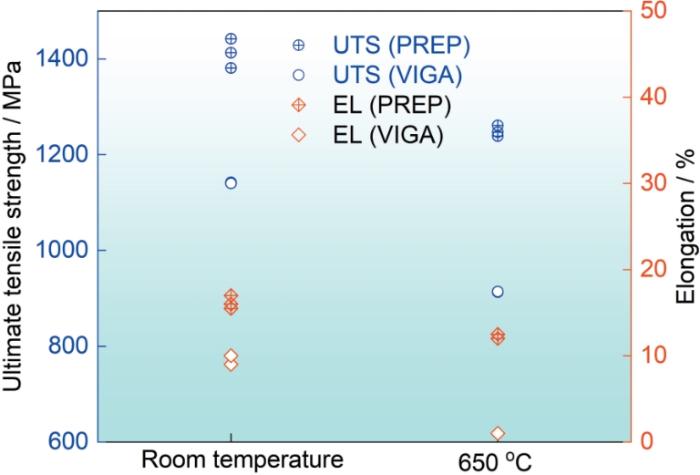
图3
ЭП741粉末合金的室温和650 ℃拉伸力学性能
Fig.3
Tensile properties of PM ЭП741 alloy at room temperature and 650 oC
图4给出了两种合金的断口形貌,可见其断裂模式均为沿晶断裂。用PREP粉末制备的合金断口有脱粘的粉末颗粒,而用VIGA粉末制备的合金在裂纹源和裂纹生长区有夹杂物。EDS能谱分析结果表明,夹杂物中富集Si元素而非Al元素,如图4b所示。这表明,ЭП741合金中的夹杂物不是镍基粉末高温合金中常见的Al2O3,而是SiO2,且在HIP过程中与基体γ相发生反应形成了贫γ′区域[13~15]。在拉伸过程中,夹杂物破坏了组织均匀性,裂纹优先从夹杂处萌生并沿晶界生长,使合金的高温力学性能降低而发生脆断。夹杂物的来源是母合金残留、陶瓷坩埚和设备污染等。因此,选择VIGA工艺制备预合金粉末时除了选择合适的坩锅材料和优化坩锅烘焙工艺外,还须用静电分离工艺等方法去除夹杂[16]。
图4
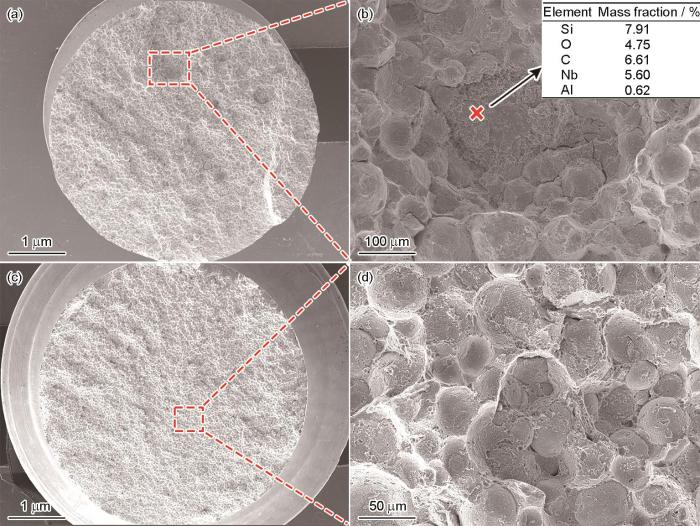
图4
两种制粉工艺的ЭП741合金的650 ℃拉伸断口形貌
Fig.4
Tensile fracture of PM ЭП741 alloy at 650 oC formed by VIGA (a, b) and PREP (c, d)
综上所述,用PREP工艺制备的粉末洁净度高,致密化成形后力学性能更优。本研究在VIGA和PREP两种工艺中优选PREP工艺制备ЭП741预合金粉末,并以ЭП741粉末在1200 ℃/140 MPa/3 h下热等静压成形的粉末合金为研究对象,开展与ЭП741粉末变形合金的对比研究。
2.2 ЭП741合金的显微组织和力学性能
采用不同的热处理制度调控粉末高温合金的显微组织。张莹等[17]根据对ЭП741产品性能的综合要求制定了高温固溶+一级时效和固溶+多级时效两种制度。本文的实验制定了两种热处理制度:制度1:1200 ℃/2 h/AC + 870 ℃/32 h/AC;制度2:1080 ℃/5 h + 850 ℃/12 h→700 ℃/12 h[18]。图5给出了用两种制度热处理的粉末合金和粉末变形合金的组织形貌。3种合金均由基体γ相和强化γ′相组成,电解腐蚀消除了少量γ相使γ′相在SEM下突出显示。用制度1处理的粉末合金显微组织与粉末变形合金最为接近,由晶界上较大的初生γ′相和晶内均匀细密的立方结构次生γ′相组成。而用制度2处理的粉末合金中初生γ′相粗大,组织形貌与粉末变形合金不同。由于采用制度1制备的ЭП741合金的γ′相形状大小更接近粉末变形合金,因此在后续实验中选用制度1制备的合金并与粉末变形合金进行对比研究。
图5
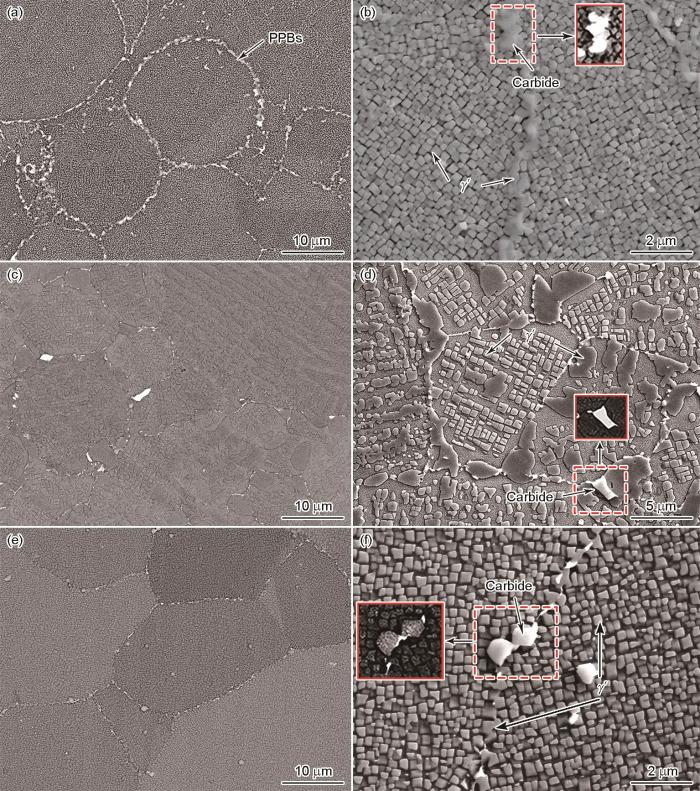
图5
ЭП741粉末合金不同热处理态和粉末变形合金的SEM像
Fig.5
SEM images of ЭП741 alloy after HT1 (a, b), HT2 (c, d) and deformed PM alloy (e, f)
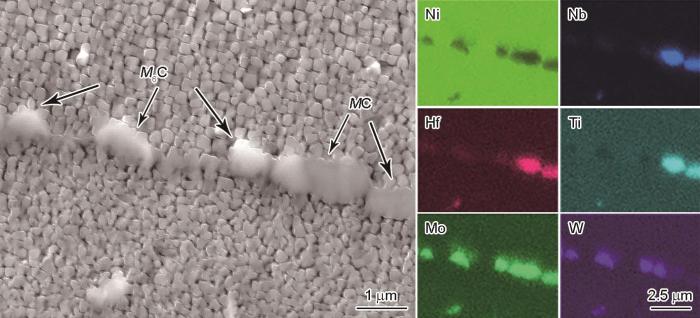
在ЭП741合金晶界上的碳化物,在背散射电子成像(Back-scattered electron, BSE)图像中呈现浅色,如图5b, d, f所示。进行EDS面扫描分析碳化物的化学组成,结果如图6所示。可以看出,ЭП741合金中有两种碳化物,分别是MC型和M6C型碳化物[19]。MC碳化物是Nb、Ti和Hf等元素与碳生成的初级碳化物,热稳定性较高;而M6C碳化物是W、Mo等元素的析出产物。MC碳化物在粉末冶金过程中生成,作为原始颗粒中的强化相分布在晶粒内或晶界附近。M6C碳化物是热处理中的蜕化反应(MC + γ→M6C + γ′)生成的,主要分布在晶界,影响合金的晶界强度。对比粉末合金和粉末变形合金可见,粉末变形合金中碳化物的含量较低,呈块状零散分布在晶界和基体内;而粉末合金中碳化物的含量较高,连续分布在晶界。
图6
热致孔洞是粉末合金的重要缺陷,严重影响粉末合金的力学性能,其形成原因与粉末的质量、HIP和热处理制度等因素有关[20]。本文实验使用的ЭП741粉末合金和变形合金的组织中均未发现明显的孔隙。孔隙的尺寸通常为微米级,用SEM观察、X射线探伤或超声波探伤等方法难以得到其完整信息。将样品加工成直径为2 mm的细棒,用Micro-CT技术可统计粉末合金和粉末变形合金样品中随机位置处的孔隙尺寸(图7)。从图7可见,粉末合金和粉末变形合金中的孔隙都以孔径小于10 μm的微孔隙为主,其数量和大小没有数量级上的差别。实验结果表明,热等静压后ЭП741粉末合金基本上完全致密化,与ЭП741变形合金没有明显的差别,与粉末钛合金需用HIP制坯+热机械变形的联合工艺消除合金孔隙以提高其性能的结论不同[21]。
图7
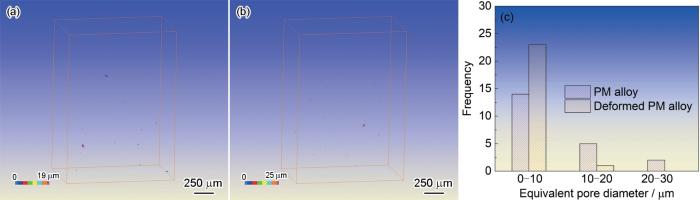
图7
ЭП741合金内部显微孔隙的大小及分布
Fig.7
Micro-CT images of ЭП741 alloy (a) PM alloy, (b) deformed PM alloy, (c) pore size distribution histograms
PPBs是粉末表面的碳化物和氧化物,是粉末高温合金中另一种常见的缺陷,在高温下难以消除,阻碍粉末的结合和塑性变形[12]。关于PPBs的形成机制,有两种观点:一种观点认为在HIP过程中粉末表面的氧化物颗粒成为碳化物的优先形核位置,促进碳化物在粉末颗粒之间的结合界面析出形成PPBs,此即氧化物核心说[22]。另一种观点认为,粉末结合界面元素扩散速率较高和临界形核功较低,使碳化物、γ′相和氧化物易于在结合界面析出形成PPBs,即粉末接触界面低能说[23]。虽然PPBs的形成机理尚有争论,但两种观点都认为PPBs的形成与晶界上析出的连续碳化物网络有关。使用Image Pro Plus软件统计粉末合金和粉末变形合金内γ相和PPBs的面积分数(随机选取10张以上显微组织照片,计算出γ相和PPBs像素数量与总像素数量的比值),结果如图8所示。可以看出,粉末合金和粉末变形合金中γ相的含量分别为34.84%和36.33%,没有显著的差别。粉末合金中PPBs的占比较大,约为7.39%。在粉末变形合金中未观测到PPBs。
图8
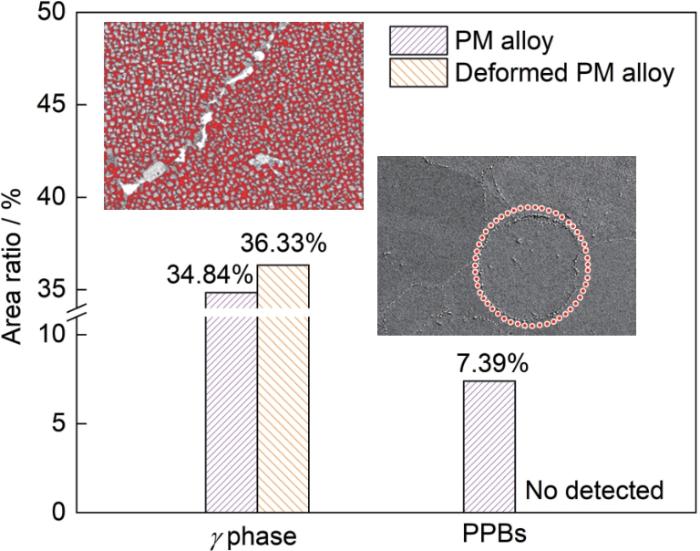
图8
ЭП741合金中γ相和PPBs的面积分数
Fig.8
Area fraction of γ phase and PPBs of ЭП741 alloy
图9给出了ЭП741粉末合金和粉末变形合金在-196 ℃、室温和650 ℃下的拉伸性能。可以看出,两种合金的强度均随着温度的提高而降低,粉末合金在-196 ℃的平均抗拉强度为1461 MPa,略比粉末变形合金的高。粉末变形合金在650 ℃的平均抗拉强度为1355 MPa,显著优于粉末合金。粉末变形合金的延伸率随着温度的提高而提高,而粉末合金的延伸率变化较小。在650 ℃粉末合金的平均延伸率为14.5%,与粉末变形合金的24.0%有明显的不同。粉末变形合金在-196 ℃的延伸率降至11.0%,而粉末合金的低温平均延伸率为13.5%,优于粉末变形合金。
图9
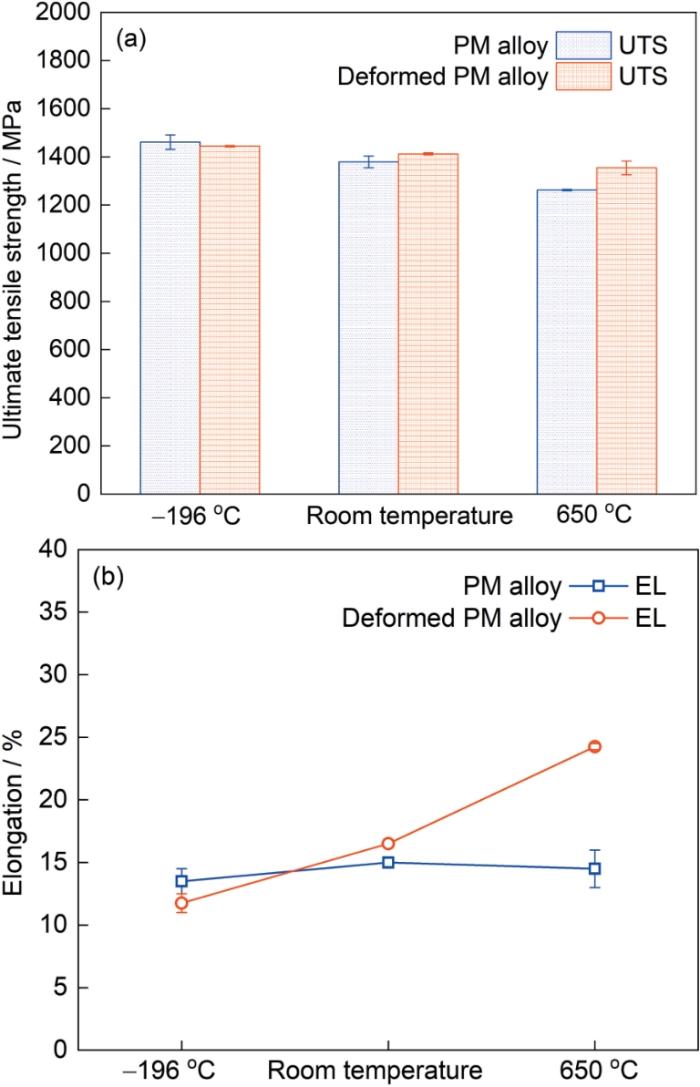
图9
ЭП741合金在不同温度下的拉伸性能
Fig.9
Tensile properties of ЭП741 alloy at different temperatures (a) ultimate tensile strength, (b) elongation
ЭП741粉末合金在不同温度下的断口组织,如图10a, c, e所示,可见明显的粉末脱粘现象。这表明,ЭП741粉末合金的断裂模式为沿晶断裂,裂纹沿PPBs萌生或扩展。在粉末变形合金的断口可观察到大量解理面,如图10b, d, f所示。其原因是,在变形过程中晶界强度显著提高,晶粒间紧密结合和微裂纹难以在晶界上形核,使裂纹几乎都在晶粒内扩展而发生穿晶断裂[24,25]。两种ЭП741合金的断裂模式没有因为温度的变化而改变。在不同温度下粉末合金的拉伸性能均受到PPBs缺陷的负面影响。
图10
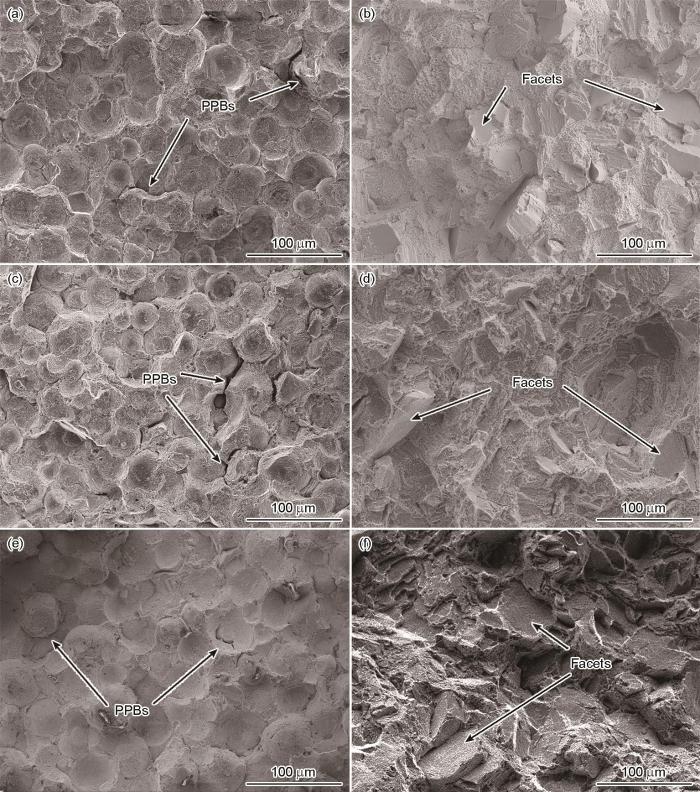
图10
ЭП741粉末合金和粉末变形合金在不同温度下的断口形貌
Fig.10
SEM fractographs of PM ЭП741 alloy and deformed PM alloy at -196 oC (a, b), room temperature (c, d) and 650 oC (e, f)
对比粉末合金和粉末变形合金的显微组织和断口形貌可以发现,两者最大的差异在于粉末合金中有粉末变形合金没有的PPBs缺陷。据此推测,PPBs是粉末合金和粉末变形合金力学性能差异的主要原因。Qiu等[26]研究了室温和高温下PPBs影响镍基粉末高温合金力学性能的机理。结果表明,在拉伸过程中位错不能穿过晶界上析出的碳、氧化物,而是在PPBs上形成应力集中区域,最终诱发晶界滑移和裂纹萌生,使粉末颗粒间脱粘断裂。在本文的实验中,在室温和650 ℃的拉伸性能测试结果与这一结论相符。在高温软化的作用下,不含PPBs的ЭП741粉末变形合金的塑性大幅度提高,延伸率从16.5%提高到24.5%;而ЭП741粉末合金的延伸率在PPBs的影响下不升反降,使抗拉强度和延伸率均与粉末变形合金有较大的不同。在-196 ℃,低温韧脆转变机制使合金的强度显著提高,粉末变形合金的延伸率从16.5%降至11.0%,而粉末合金的延伸率变化很小。这表明,在低温下PPBs对粉末合金力学性能的影响明显减弱。
2.3 PPBs对粉末高温合金低温力学性能的影响
图11a和b给出了用EBSD表征的ЭП741粉末合金和粉末变形合金的低温拉伸断口纵截面形貌。可以看出,在低温下粉末合金试样的断口表面崎岖,在粉末脱粘处有PPBs,而粉末变形合金试样的断口较为平整。其原因是,PPBs使界面间的结合能力下降,裂纹优先从PPBs扩展,裂纹在沿球形形貌的PPBs扩展过程中偏离原来的裂纹扩展路径。在拉伸力作用下裂纹扩展最终回到原方向。这一过程在拉伸过程中反复发生,形成了曲折的裂纹断口。曲折的裂纹扩展路径在一定程度上抵消了PPBs对力学性能的恶化。对此,可根据裂纹尖端的有效驱动力和能量加以解释[27]。裂纹的扩展路径越曲折,则路径越长。在应力相同的情况下,单位长度裂纹尖端的有效驱动力越小,则裂纹扩展速率越低。同时,裂纹扩展的曲折路径每个单位长度增加的表面能都大于相对平整的裂纹扩展单位长度所增加的表面能。值得注意的是,裂纹扩展的曲折对PPBs恶化作用的抵消只在低温环境下生效,因为只有在低温下位错运动受阻,裂纹转向后需要更多的能量才能回到原有的扩展路径上。而在高温下,热激活使位错运动的阻力降低,大量位错在PPBs上产生应力集中和微裂纹,裂纹转向后沿PPBs扩展并回到原有扩展方向上。因此,只有在低温下粉末合金的PPBs使裂纹扩展路径越曲折,裂纹扩展的抗力越强,则裂纹的扩展速率越低。
图11
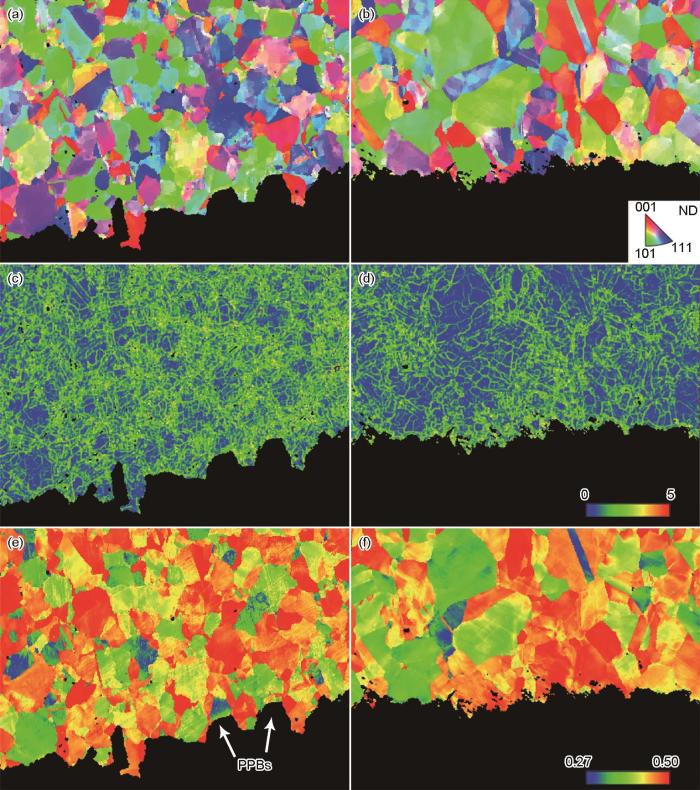
图11
ЭП741粉末合金和粉末变形合金断口纵截面的EBSD图
Fig.11
IPF maps (a, b), KAM maps (c, d), and Schmid factor maps (e, f) of longitudinal sections near the fractures of PM ЭП741 alloy (a, c, e) and deformed PM alloy (b, d, f)
使用Aztec Crystal软件分析EBSD数据,得到了断口截面处取向差角的分布(Kernel average misorientation, KAM),可近似反映几何必须位错的密度。在裂纹扩展过程中,裂纹尖端的应力集中使位错从裂纹尖端沿两个对称分布的滑移面间歇发射,形成塑性变形区[28, 29]。位错发射是缓解裂纹尖端应力集中的关键机制,位错滑移释放应力集中可钝化裂纹尖端而延缓裂纹扩展。如图11c和d所示,粉末合金断口的纵截面可观察到的位错密度更高。这表明,在粉末合金中裂纹的扩展过程中发射了更多的位错,裂纹尖端的塑性变形能力比粉末变形合金强。根据计算出的断口截面组织的施密特因子(Schmid factor, SF)绘制的热分布图,如图11e和f所示。SF表征滑移系在外部应力作用下的分切应力效率。在裂纹的扩展过程中,裂纹尖端的高应力集中激活特定的滑移系使位错沿该滑移系运动。裂纹尖端有多个滑移系发生竞争或产生协同效应,使裂纹路径偏转或分叉。滑移系的SF越高,其分切应力越早达到临界值,则位错优先沿此滑移系发射。由图11e, f可知,变形合金中不同滑移系的组织分布较集中,因此在扩展过程中裂纹不会明显转向。粉末变形合金中裂纹的高速扩展使其塑性变形能力降低。粉末合金中不同滑移系的组织零散分布,使裂纹更容易在不同滑移系的作用下转向。由于PPBs具有球形或半球形形貌,裂纹在特定时刻的转向角度可能接近90°,此时裂纹大幅偏离原有的裂纹扩展方向,更容易被SF较小的“硬取向”晶粒阻碍扩展路径,需要吸收更多的能量才能继续扩展。因此,在-196 ℃裂纹扩展方向的改变使PPBs对合金性能的恶化作用减弱,使粉末合金的平均抗拉强度和延伸率得以小幅度超过变形合金。
为了验证PPBs对力学性能的恶化在低温下减弱这一规律的普适性,对比了同为镍基沉淀强化型粉末高温合金的Inconel 718合金在不同温度下的力学性能变化。Inconel 718合金在-250~700 ℃宽温域内的综合力学性能优异,在航空发动机、液体燃料火箭发动机等领域得到了广泛应用。用HIP技术制备的Inconel 718合金其显微组织如图12所示,可见其主要缺陷是与ЭП741粉末合金相同的PPBs。图13给出了Inconel 718合金在-196 ℃、室温及650 ℃下的拉伸性能。可以看出,粉末冶金Inconel 718合金在650 ℃塑性明显下降,存在中温低塑性,平均延伸率仅为4.7%。其原因是,在大气环境下650 ℃拉伸过程中,沿晶界扩散的氧原子与Cr、Nb等元素反应生成脆性氧化物(如Cr2O3、NbO2)。这些氧化物弱化了晶界结合力,PPBs有利于氧的扩散和脆性氧化物的生成,使合金的延伸率显著降低[30]。在-196 ℃粉末冶金Inconel 718合金的低温平均延伸率与室温相比有所降低,从18.8%下降至13.8%,同样优于Inconel 718变形合金[31]。粉末冶金Inconel 718合金低温延伸率的退化程度远低于高温延伸率,表明PPBs在低温下对力学性能的影响比在高温下弱。
图12
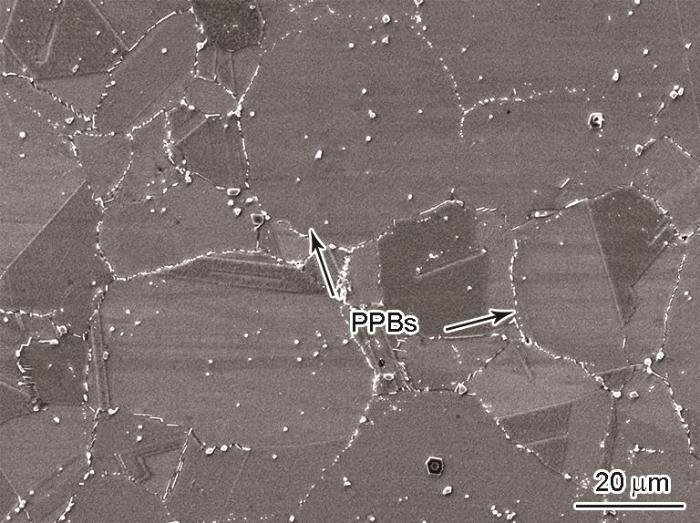
图13
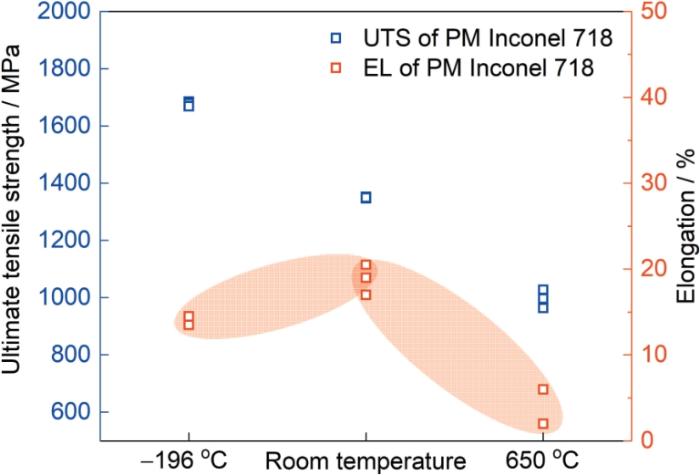
ЭП741合金和Inconel 718合金在-196 ℃、室温和650 ℃下的力学性能表明,镍基粉末高温合金中的PPBs对低温拉伸性能的影响比其对高温拉伸性能的影响更弱。粉末合金与粉末变形合金的低温拉伸断裂过程示意图,如图14所示。可以看出,试样受拉应力时位错在滑移面上移动,在低温下位错运动困难,表现出强度随着温度的降低而提高[32~34]。在裂纹的扩展过程中,裂纹尖端的应力集中不断发射位错形成塑性变形区。位错优先在SF更高的滑移系上开动,使裂纹萌生。粉末变形合金的晶粒较大,且不同取向晶粒的分布较集中,因此裂纹扩展较快,扩展路径较平直,塑性变形能力较差。粉末合金的晶粒较小,不同取向的晶粒分布较为分散,使裂纹更容易受到硬取向晶粒的阻碍。同时,不完整的PPBs使裂纹转向后不能自动回到原来的扩展路径而需要吸收更多的能量。因此,PPBs对低温力学性能的恶化作用减弱。ЭП741粉末合金在低温下的延伸率变化较小,平均抗拉强度和延伸率小幅超过变形合金。
图14
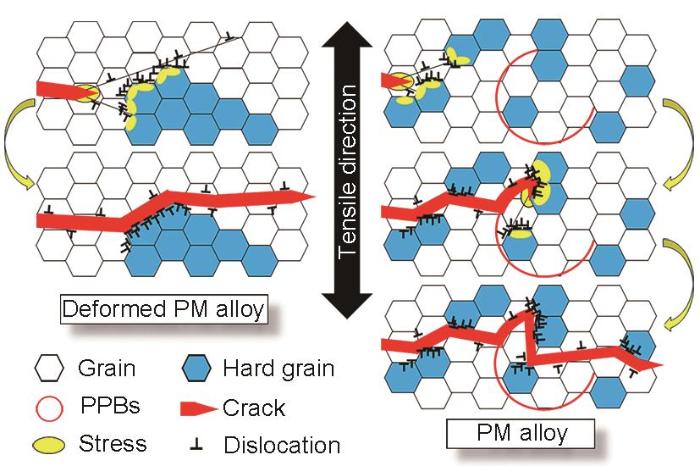
图14
ЭП741粉末合金和粉末变形合金的拉伸断裂过程示意图
Fig.14
Schematic diagram of tensile fracture mode of PM alloy and deformed PM alloy
3 结论
(1) 与VIGA工艺相比,用PREP工艺制备的预合金粉末球形度好,洁净度高,成形后的力学性能更优。
(2) 在1200 ℃热等静压和合适的热处理后,ЭП741粉末合金的组织由晶界上的初生γ′相和晶内的立方结构次生γ′相组成,晶界上的碳化物形成PPBs。
(3) ЭП741粉末合金的室温和650 ℃力学性能低于粉末变形合金。在-196 ℃粉末合金的抗拉强度和延伸率略高于粉末变形合金。不同温度下的断口均为沿晶断裂,裂纹沿PPBs扩展。
(4) PPBs使粉末合金的裂纹扩展方向偏移和使裂纹扩展路径延长。在高温下热激活作用增强,位错的运动阻力降低,裂纹沿PPBs高速扩展,此时PPBs会恶化粉末合金的力学性能。在低温下位错运动受阻,需要更高的应力才能移动,此时裂纹转向会延缓裂纹扩展速率,因此在低温下PPBs对性能的恶化作用减弱。
致谢
本项工作使用的粉末变形合金取自西安欧中材料科技股份有限公司提供的变形环件,在此表示感谢。
参考文献
Development of powder metallurgy superalloy
[J].
粉末高温合金研究进展
[J].
Application and prospect of wrought superalloy in liquid rocket engine
[J].
变形高温合金在液体火箭发动机中的应用进展及展望
[J].
Research progress in powder metallurgy superalloys and manufacturing technologies for aero-engine application
[J].
The research progress in powder metallurgy (PM) superalloys and manufacturing technologies are reviewed. The key control factors of Ar gas atomization (AA) powder manufacturing are introduced, including the aspects of the equipment development, atomization process, particle size, oxygen content, powder morphology and inclusion control. For the turbine disk manufacturing technology, the research progress of dual-property turbine disk, dual-alloy integral turbine wheel technologies and isothermal forging die materials are summarized. In the field of basic research, high-throughput experiment, advanced characterization and creep behavior of PM superalloys were introduced. According to the current major demand for aero-engines and 3D printing, the future of PM superalloys manufacturing technology is prospected.
航空发动机用粉末高温合金及制备技术研究进展
[J].本文概述了我国粉末高温合金及制备技术的研究进展。在粉末制备方面,重点介绍了Ar气雾化制粉技术关键因素,包括设备、雾化过程、粒度控制、O含量控制、粉末形貌控制和夹杂控制等。针对涡轮盘件制备技术,总结了双性能涡轮盘、双合金整体叶盘技术和等温锻造模具用材料的研究进展。此外,还介绍了在粉末高温合金高通量实验和表征以及蠕变行为等方面的研究进展。结合当前航空发动机、3D打印等高端工程用材料重大需求,对我国粉末高温合金制备技术和发展方向进行了展望。
Comparative study on hot workability of powder metallurgy Ti-22Al-24Nb-0.5Mo alloy
[J].Powder metallurgy (PM) Ti2AlNb alloy of Ti-22Al-24Nb-0.5Mo (atomic fraction, %) was prepared from pre-alloyed powder using hot isostatic pressing (HIPing). Compression tests of PM Ti2AlNb alloy, heat treated PM Ti2AlNb alloy and wrought Ti2AlNb alloy with the same chemical composition were conducted on Gleeble-3800 testing machine. The testing temperatures were from 930oC to 1050oC, strain rates varied from 0.001 s-1 to 10 s-1, and engineering strain was about 50% for each compression. The results show that the deformability of PM Ti2AlNb alloy is comparable to that of wrought alloy, and heat treatment has no obvious effect on the hot workability of PM Ti2AlNb alloy. The high temperature flow behavior of Ti2AlNb alloys prepared by different fabrication routes is similar in this work, while processing windows for PM Ti2AlNb alloy is broader than casting alloys especially at low temperature or relative high strain rate. PM Ti2AlNb billets for hot deformation were prepared by a typical powder metallurgy process, and were upset or drawn out to different deformation in two-phase region. Macrostructure of deformed PM Ti2AlNb billets were observed, no macro crack was found in deformed PM Ti2AlNb billets and the deformation was uniform. The results of tensile tests show that the deformed PM Ti2AlNb alloy after heat treatment presents better tensile properties.
粉末Ti-22Al-24Nb-0.5Mo合金热变形能力的对比研究
[J].采用预合金粉末热等静压工艺制备名义成分为Ti-22Al-24Nb-0.5Mo(原子百分数)的粉末Ti<sub>2</sub>AlNb合金, 对粉末合金、经热处理的粉末合金和同种成分的熔铸Ti<sub>2</sub>AlNb合金进行了压缩实验。结果表明, 粉末Ti<sub>2</sub>AlNb合金具有与熔铸变形合金相当的变形能力, 热处理对粉末Ti<sub>2</sub>AlNb合金的变形能力没有明显的影响, 粉末合金在低温和高应变速率下的变形抗力更低, 不易开裂。采用典型粉末成型工艺制备粉末Ti<sub>2</sub>AlNb热变形坯料, 在两相区进行了不同变形量的墩粗和拔长热变形。结果表明, 粉末Ti<sub>2</sub>AlNb坯料变形后没有宏观裂纹, 变形均匀。拉伸实验结果表明, 变形后经热处理的粉末Ti<sub>2</sub>AlNb合金表现出更好的拉伸性能。
Development of modern powder metallurgy materials and technology
[J].
现代粉末冶金材料与技术进展
[J].
Progress in hot isostatic pressing technology of titanium alloy powder
[J].
钛合金粉末热等静压近净成形研究进展
[J].
Russian pд hydrogen-oxygen engine technology
[J].
俄罗斯PД—0120氢氧发动机技术
[J].
HIP activities for turbopump components of Korea space launch vehicle
[J].
Development status of the preparation of nickel-based superalloy spherical powder
[J].
镍基高温合金球形粉末制备发展现状
[J].
A review: high-performance spherical metal powder preparation methods
[J].
高性能球形金属粉末制备技术进展
[J].
Effect of inclusions on microstructure and mechanical properties of powder metallurgy FGH97 alloy
[J].
夹杂物对粉末冶金FGH97合金显微组织与力学性能的影响
[J].
Hot isostatic densification of Inconel 718 powder alloy and elimination of prior particle boundaries
[J].Inconel 718 alloy is widely used in aeronautical fields owing to its excellent mechanical properties and high-temperature resistance. Hot isostatic pressing (HIPing) is a powder metallurgy (PM) processing technology that produces near or net-shape components and solves the problems of macro-segregation and microstructure inhomogeneity. However, the application of PM Inconel 718 alloys has been limited by prior particle boundaries (PPBs), which can negatively impact mechanical properties, such as elongation at elevated temperatures and impact properties. To address this issue, the formation of PPBs can be suppressed during HIPing, or they can be eliminated through subsequent processing. Pre-alloyed powder of Inconel 718 was prepared using the electrode induction melting gas atomization (EIGA) method, and PM Inconel 718 alloys were prepared through the HIPing route. The resulting compacts were subjected to special high-temperature heat treatment, and their mechanical properties were tested. The mechanical properties of PM Inconel 718 test bars were found to be comparable to those of the wrought version of the alloy. However, large and complex components of PM Inconel 718 can contain undesirable PPBs due to mold shielding and insufficient degassing, resulting in poor ductility and impact properties after standard heat treatment. Special high-temperature heat treatment can effectively eliminate the PPBs in the compacts, leading to a substantial improvement in tensile ductility and impact properties. This improvement makes it possible to prepare large and complex components through HIPing with improved mechanical properties.
粉末冶金Inconel 718合金的热等静压成形和原始颗粒边界的消除
[J].采用无坩埚感应熔炼超声气体雾化法(EIGA) +热等静压工艺制备的大尺寸粉末冶金Inconel 718合金坯料中存在大量原始颗粒边界,恶化了材料的力学性能。本工作通过特殊高温热处理对合金坯料进行组织修复,观察了其显微组织、测试了其力学性能。结果表明,试验型包套成形合金的力学性能与锻件相当。采用相同热等静压工艺成形大型复杂结构件,由于屏蔽效应、制备工艺参数未完全优化等原因,粉末冶金结构件中出现大量原始颗粒边界(PPBs),恶化了Inconel 718合金的拉伸塑性和冲击性能。特殊高温热处理可以有效消除合金坯料中的PPBs,增加颗粒间结合强度,改善合金性能。热等静压+特殊高温热处理可以作为粉末冶金Inconel 718大型复杂结构件成形工艺,结构件本体力学性能与锻件相当。
Deformation mechanism and quantitative characterization of Al2O3 inclusions in powder metallurgy superalloys
[J].
Study on fatigue fracture characteristics of powder metallurgy superalloy FGH4113A
[J].
粉末高温合金FGH4113A疲劳断裂特性的研究
[J].
Fatigue crack propagation induced by SiO2 inclusions in P/M superalloys studied by in situ SEM
[J].
Analysis of electro-separation of inclusions in Ni-based superalloy powder
[J].
镍基高温合金粉末中非金属夹杂物电选工艺分析
[J].
Heat treatment processes and microstructure and properties research on P/M superalloy FGH97
[J].
FGH97粉末冶金高温合金热处理工艺和组织性能的研究
[J].
Heat-treatment technology of high-plasticity nickel base alloy
[P].
一种高塑性镍基合金的热处理工艺
[P].
Effect of heat treatment processes on microstructure and properties of a P/M Ni-based superalloy
[J].
热处理工艺对一种镍基P/M高温合金组织性能的影响
[J].
Effect of solution heat treatment on the porosity growth of nickel-based P/M superalloys
[J].Thermal-induced porosity (TIP) is one of the major defects in powder metallurgy (P/M) superalloys, and it seriously affects the performance of P/M superalloys. The effects of solution heat treatment on the growth of the TIP of the nickel-based P/M superalloy FGH97 were investigated. A series of solution heat treatment tests were carried out at holding temperatures ranging from 1150 to 1200 °C, with holding times ranging from 0.5 to 8 h. The results showed that the holding time, temperature, and the initial volume of porosity are the primary factors influencing porosity growth, and the volume fraction of TIPs increases by increasing the temperature or extending the holding time. The porosity growth models were constructed based on the porosity statistics combined with a nonlinear fitting method. To evaluate the accuracy of the proposed models, the correlation coefficient (R) and average absolute relative error (AARE) were calculated between the predicted and experimental values. The unbiased AARE values were 2.06% and 3.99% for the average value of TIP and the worst value of TIP, respectively, which imply that the proposed porosity growth models have greater accuracy and can be used to illustrate TIP behavior in solution heat treatment.
Hot deformation behavior of a hot-isostatically pressed Ti-6Al-4V alloy from recycled powder
[J].In this work, a new use of mixed Ti-6Al-4V powder, consisting of the retained powder after screening for additive manufacturing and the recycled powder after multiple printing, has been exploited. The powder mixture has been hot-isostatically-pressed (HIPed) at 930 °C/120 MPa for 3 h to reach full density. The hot deformation behavior of the as-HIPed powder compacts were investigated through isothermal compression tests, kinetic analyses, and hot processing maps. Finally, the optimized hot working parameters were validated using upsetting tests. The results show that the as-HIPed Ti-6Al-4V alloy has a fine and homogeneous microstructure. The activation energies were calculated to be 359 kJ/mol in the α + β phase regime and 463 kJ/mol in the β phase regime, respectively. The optimal hot working parameters are a deformation temperature above 950 °C and strain rate higher than 0.1 s−1. The hot workability of as-HIPed powder compacts is better than the as-cast billets. The deformed microstructure can be finer than that of as-HIPed state, and the mechanical performance can be further improved by the optimal thermo-mechanical processing treatment.
Prior particle boundary and its effect on tensile properties of PM FGH96 superalloy
[J].
粉末高温合金FGH96中的原始粉末颗粒边界及其对合金拉伸断裂行为的影响
[J].
Formation and microstructure evolution of precipitation on prior particle boundaries in P/M nickel—base superalloys
[J].
镍基粉末高温合金原始颗粒边界形成及组织演化特征
[J].
PPB structure elimination, DRX nucleation mechanisms and grain growth behavior of the 3rd-generation PM superalloy for manufacturing aviation components
[J].
Characteristics of inter-particle rupture on LCF fractograph of P/M nickel-based superalloy
[J].
颗粒间断裂在P/M镍基高温合金低周疲劳断口上的特征
[J].
Microstructural development and tensile behavior of a hot isostatically pressed nickel-based superalloy
[J].
Fatigue crack propaation behavior of high strength titanium alloy
[J].
一种高强钛合金疲劳裂纹扩展行为
[J].
Study of crack-propagation mechanism of Al0.1CoCrFeNi high-entropy alloy by molecular dynamics method
[J].The crack propagation mechanism of Al0.1CoCrFeNi high-entropy alloy (HEA) was investigated with the molecular dynamics method. The pre-crack propagation and stretching processes of single-crystal Al0.1CoCrFeNi HEA and Al0.1CoCrFeNi HEA with grain boundaries were simulated. The effects of strain rates and different crystal structures on the crack propagation of the alloy therein at room temperature were studied. They both exhibited plastic deformation and ductile fracturing, and the crack tip involved dislocations at 45° and 135° under the tensile stress. The dislocations formed in the intrinsic-stacking fault and stacking fault based on hexagonal closely packed structures spread and then accumulated near the grain boundary. At the position where hexagonal closely packed structures were accumulated, the dent was obviously serious at the 1/3 position of the alloy where the fracturing finally occurred. The yield strength for Al0.1CoCrFeNi HEA with grain boundaries was lower than that of the single-crystal Al0.1CoCrFeNi HEA. However, Young’s moduli for Al0.1CoCrFeNi HEA with grain boundaries were higher than those of the single-crystal Al0.1CoCrFeNi HEA. The grain boundaries can be used as the emission source of dislocations, and it is easier to form dislocations in the-single crystal Al0.1CoCrFeNi HEA, but the existence of grain boundaries hinders the slippage of dislocations.
Solid metal induced embrittlement of titanium alloys
[D].
Grain size effect on strain localization, slip-grain boundary interaction and damage in the Alloy 718 Ni-based superalloy at 650 oC
[J].
High-cycle fatigue properties at cryogenic temperatures in INCONEL 718 nickel-based superalloy
[J].
The microstructural control and mechanical properties of CoCrFeNi-M deformed high-entropy alloys
[D].
CoCrFeNi-M系变形高熵合金组织调控与力学性能
[D].
Microstructural evolution of 6061 aluminium alloy subjected to static and dynamic compression at low temperature
[J].In this research, an effect of low temperature on the mechanical properties and microstructure of 6061-T6 aluminium alloy (AA6061-T6) subjected to static and dynamic loading was investigated systematically. The specimens were subjected to compression at the temperature of − 80°C in a range of strain rates from 0.001 to 0.1 1/s under static conditions, and from 1250 to 3400 1/s under dynamic conditions to compare their mechanical responses. The deformation mechanisms were discussed based on EBSD analysis. It was found, that under both testing conditions, dynamic recovery was the dominant mechanism responsible for material deformation.


