



在中锰钢的制备过程中,较高的淬透性使热轧后空冷至室温的组织以马氏体为主。为此,冷轧前须对钢板进行软化退火,以消除内应力、降低硬度和提高冷加工性能。软化退火可在临界区或亚临界区温度范围内进行,在不同相区退火形成的组织不同,进而影响后续的再结晶和相变[30~32]。在各种热机械加工条件下,中锰钢的微观组织演变较为复杂[33~35]。其中退火时的升温速率不仅显著影响奥氏体相变动力学和合金元素的配分[36,37],还影响再结晶与相变之间的交互作用,从而决定最终的组织特征[38~40]。因此,合理设计软化退火工艺,可精细调控在临界区退火过程中冷轧中锰钢的组织转变。揭示不同升温速率下再结晶与相变的内在关联规律,将为基于组织定制的热机械工艺设计提供理论依据。本文在不同相区对Fe-0.15C-5Mn冷轧中锰钢进行软化退火,制备两种具有不同初始组织的冷轧板材,研究软化退火对冷轧中锰钢再结晶和奥氏体相变的影响。对比分析两种试样在亚临界区退火过程中的亚结构演化以阐明不同初始冷轧组织再结晶的差异,进一步将两种试样以不同升温速率连续加热至临界区分析二者的组织演化规律,以揭示软化退火对奥氏体相变的影响及其机制。
1 实验方法
实验用材料为Fe-C-Mn系低合金冷轧中锰钢其主要化学成分(质量分数,%)为:C 0.15, Mn 4.78, Fe余量。使用Thermo-Calc软件(TCFE8数据库)计算出这种实验钢的平衡相变温度,其中Ae1 (铁素体、奥氏体、渗碳体共存的最低温度)为494 ℃,Ae3 (铁素体、奥氏体共存的最高温度)为729 ℃。用真空感应炉熔炼实验钢并浇铸成50 kg钢锭,将其在1200 ℃进行均匀化处理后锻造成厚度为70 mm的锻坯。将锻坯重新加热至1200 ℃并保温2 h,然后7道次热轧成厚度为4 mm的热轧板。为了获得均匀的组织以便于后续加工,对热轧板在850 ℃正火处理1 h。
常规中锰钢板热轧后的组织以马氏体为主,硬度较高,难以直接进行冷轧加工,因此须进行软化退火以提高其可加工性。本文实验中在冷轧前选取两个不同相区进行软化退火,分别为Ae1以下的铁素体和渗碳体相区和Ae1~Ae3之间的奥氏体与铁素体两相区,如图1所示。软化退火在箱式炉中进行,将热轧板分别置于亚临界温度450 ℃保温6 h (记为SA450)和临界区温度690 ℃保温1 h (记为SA690)。经不同工艺处理后,两种试样呈现出不同的相组成和合金元素分布特征。SA690试样在临界区软化退火过程中形成奥氏体和铁素体两相组织,冷却后转变为富Mn马氏体和贫Mn铁素体交替排列的层片状结构(图1b)。而SA450试样在亚临界温度退火后马氏体基体发生回复,最终的组织由回火马氏体基体和渗碳体组成,渗碳体沿马氏体束和板条界处析出(图1d)。对软化退火后的中锰钢板进行酸洗处理,随后进行60%压下量的室温冷轧。在冷轧过程中,SA690试样中的马氏体和铁素体层片均发生压延变形,板条间距显著减小,形成具有高储存能的形变马氏体与铁素体混合组织(图1c)。SA450试样中的马氏体也发生板条片间距不均匀的塑性变形,出现部分变形程度较低、板条间距较大的区域(图1e)。
图1

图1
中锰钢软化退火的工艺示意图、软化退火以及冷轧后的微观组织
Fig.1
Schematic diagrams of softening annealing for MMnS (a), microstructures of the samples after softening annealing (b, d) and cold rolling (c, e) (b, c) SA690 samples, (d, e) SA450 samples (αF—ferrite, αM—martensite, αF(DEF)—deformed ferrite, αM(DEF)—deformed martensite, θ—cementite)
从两种冷轧板上沿冷轧变形的轧制方向切取金相试样,进行奥氏体逆相变退火。为了研究软化退火对再结晶行为的影响,将冷轧试样在亚临界区500 ℃分别进行10 min和3 h的等温退火(图2a)。在此温度区间冷轧中锰钢中只发生回火马氏体再结晶,而不会发生奥氏体相变。为进一步研究软化退火对奥氏体相变的影响,将冷轧试样以连续升温方式分别加热至680、700和720 ℃后立即淬火,以分析不同相变阶段所形成奥氏体的组织特征,工艺路径如图2b所示。为了系统考察软化退火组织对不同加热条件下奥氏体逆相变以及再结晶-相变交互机制的影响,实验中采用了0.1 ℃/s和20 ℃/s两种升温速率。在淬火相变膨胀仪(DIL, LINSEIS L78 RITA/Q)上进行模拟热处理,试样的尺寸为1.2 mm × 4 mm × 10 mm,用K型热电偶实时监测温度。
图2
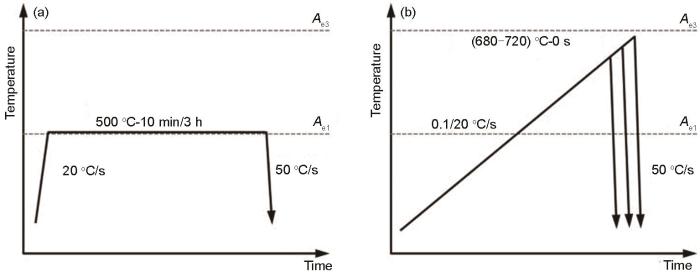
图2
在不同温度软化退火的冷轧中锰钢在亚临界区退火和临界区退火的热处理工艺示意图
Fig.2
Schematic diagrams of subcritical annealing (a) and intercritical annealing (b) for cold-rolled MMnS suffered softening annealing at different temperatures
在热处理后试样的心部区域切取金相试样,将其RD-ND截面(RD为轧向,ND为法向)研磨抛光,使用体积分数2%的硝酸酒精溶液腐蚀,用场发射扫描电子显微镜(SEM, ZEISS SUPRA 35)观察微观组织形貌。使用配备电子背散射衍射系统(EBSD, Oxford Symmetry S2)的扫描电镜(SEM, Thermo Fisher Scientific Apero 2C)表征微观结构,加速电压为20 kV,扫描步长为20~50 nm。将EBSD样品依次进行机械研磨和振动抛光以彻底去除表面应力层。使用Buehler VibroMet2型振动抛光仪振动抛光,使用的SiO2悬浮液粒径为50 nm,抛光时间为10 h。使用AztecCrystal软件处理EBSD数据。
2 实验结果
2.1 在不同温度软化退火的中锰钢在亚临界退火中的组织演化
2.1.1 SA450试样在亚临界区退火过程中组织的转变
为了明确软化退火对冷轧中锰钢再结晶的影响,将两种冷轧试样在尚未发生奥氏体相变的亚临界区保温。图3给出了SA450试样在500 ℃退火过程中微观组织的演化。可以看出,这个试样的初始冷轧组织由回火马氏体基体和渗碳体组成(图3a1)。由平均局部取向差(KAM)的分布可见,这个试样的组织包括片层间距较窄的高应变区域(图3a3红色实线框)和间距较大、变形程度较低的低应变区域(图3a3红色虚线框)。在500 ℃保温10 min形变马氏体基体处于回复初期,原始层片边界发生破坏和重组,在高应变区内出现少量细小的再结晶晶粒;而在低应变区,高密度位错运动演化为低能态的位错网络,并逐渐转变为小角度晶界(LAGB),如图3b3所示。此时,组织中大量的渗碳体钉扎晶界,一定程度上抑制了回火马氏体的再结晶。保温3 h后马氏体的连续再结晶机制发生位错重组和晶界取向差增大,部分亚晶界和LAGB转化为大角度晶界(HAGB),如图3c1所示。因此,在高应变区域观察到由HAGB围成的再结晶铁素体晶粒,其内部位错密度显著降低,但是这些晶粒尚未等轴化,仍呈现沿轧制方向延伸的扁平形貌。而在低应变区,虽然亚晶界和LAGB的比例显著提高却未转变为HAGB(图3c3)。
图3
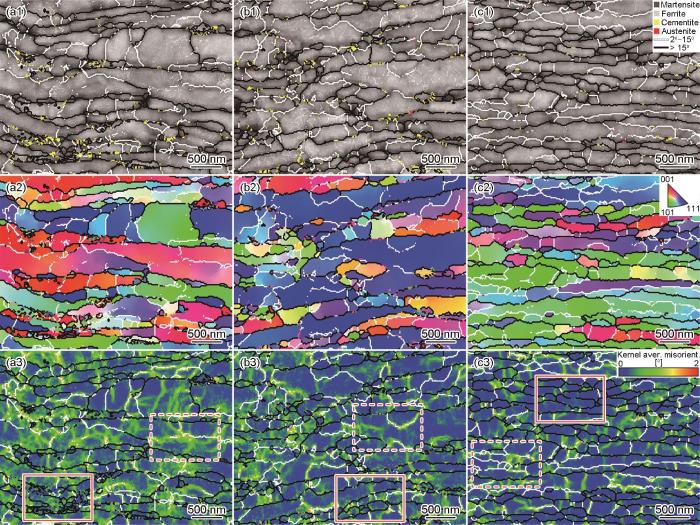
图3
SA450试样的冷轧态、在500 ℃退火保温10 min和3 h微观组织的EBSD结果
Fig.3
EBSD analysis revealing the microstructures of the SA450 sample after cold-rolling (a) and annealing at 500 oC for 10 min (b) and 3 h (c) (a1-c1) band contrast (BC) maps overlapped the GB and phase distribution maps, (a2-c2) IPF maps overlapped the GB maps, (a3-c3) kernel average misorientation (KAM) maps overlapped the GB maps
2.1.2 SA690试样在亚临界区退火过程中组织的转变
SA690试样在500 ℃等温退火过程中微观组织的演化,如图4所示。可以看出,此试样在临界区软化退火和冷轧后,初始组织由交替分布的形变铁素体和形变马氏体组成。如图4a1所示,与形变铁素体相比形变马氏体的衍射质量(BC)值更低,且内部存在渗碳体。冷轧在马氏体区域积累了大量的形变缺陷,包含HAGB、LAGB片段和高密度位错(图4a3红色实线框区域);而铁素体层片内的缺陷密度较低,取向梯度变化较小,只有少量平行于ND方向的LAGB和亚晶界(图4a3红色虚线框区域)。在500 ℃保温10 min后在形变马氏体区域生成了再结晶晶粒,表明已经发生了马氏体再结晶(图4b1)。与SA450试样类似,SA690试样中的形变马氏体也因连续再结晶发生了组织演变:高密度位错重排演化为LAGB并进一步转化为HAGB,从而使马氏体区域的HAGB比例显著提高。相比之下,形变铁素体的初始缺陷密度较低使其晶界演化程度较为有限(图4b3)。延长保温时间到3 h,马氏体再结晶充分发生,原始层片状两相组织转变为均匀分布的再结晶铁素体组织。与SA450试样中仍呈扁平状晶粒的形貌不同,SA690试样中的再结晶晶粒呈现出更为等轴化的形态(图4c)。
图4
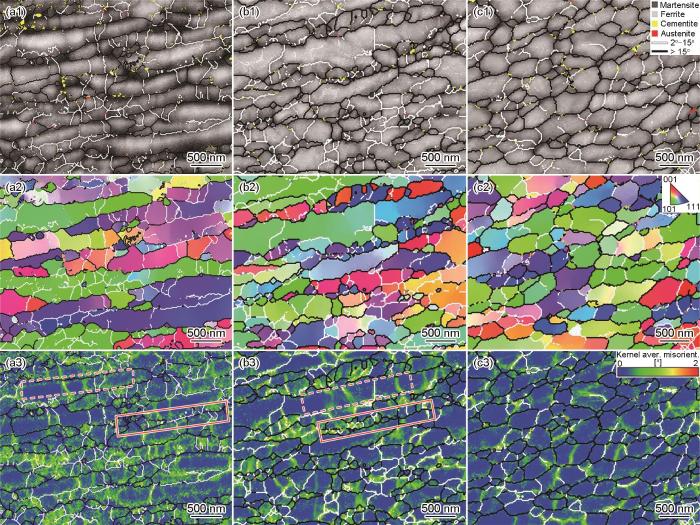
图4
SA690试样的冷轧态、500 ℃退火保温10 min和3 h后微观组织的EBSD结果
Fig.4
EBSD analysis revealing the microstructures of the SA690 sample after cold-rolling (a) and annealing at 500 oC for 10 min (b) and 3 h (c) (a1-c1) BC maps overlapped the GB and phase distribution maps, (a2-c2) IPF maps overlapped the GB maps, (a3-c3) KAM maps overlapped the GB maps
2.2 在不同温度软化的中锰钢在连续升温退火过程中组织的演化
2.2.1 SA450试样在连续升温过程中组织的转变
图5
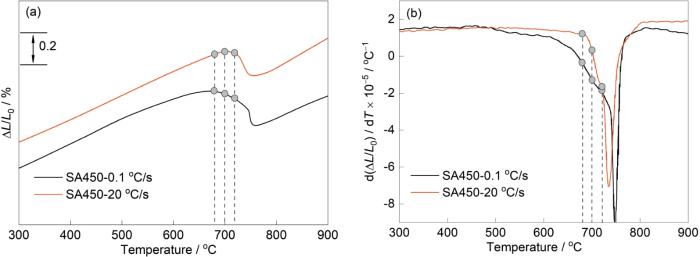
图5
SA450试样以不同速率升温时的膨胀曲线
Fig.5
Dilatation curves of SA450 samples during heating with different heating rates (a) dilatation curves, (b) the first derivatives of dilatation curves (ΔL—change in sample length, L0—initial sample length)
图6给出了SA450试样以不同速率升温到680~720 ℃并立即冷却时的微观组织,各温度点在膨胀曲线中的对应位置在图5中标出。以0.1 ℃/s的速率升温至680 ℃,大部分区域的形变马氏体已完成再结晶,生成了细小的等轴铁素体晶粒。伴随马氏体再结晶,在等轴晶粒的晶界析出的细小颗粒状渗碳体为奥氏体相变提供了形核点。奥氏体晶粒在含渗碳体的三叉晶界形核并长大,伴随着渗碳体的溶解(图6a),在少部分未再结晶区域仍保持着变形后的带状形态。缓慢的升温使渗碳体有充分时间析出、聚集并长大,因此在这些区域中可见尚未完全溶解的粒状渗碳体。升温至700 ℃马氏体再结晶和奥氏体相变进一步发生,形成由等轴铁素体和奥氏体组成的均匀两相组织(图6b)。继续升温至720 ℃,奥氏体体的积分数提高和晶粒尺寸有所增大,但是其稳定性降低并在冷却过程中转变为马氏体(图6c)。升温速率提高至20 ℃/s,再结晶和相变都推迟到更高温度。高速升温至680 ℃试样只发生马氏体回复,再结晶和相变的程度都很低,渗碳体仍大量析出但是颗粒更为细小(图6d)。研究表明,在高速升温过程中较高的奥氏体相变热力学驱动力促使奥氏体集中形核[37, 42]。这表明,在升温至700 ℃的过程中奥氏体在渗碳体处迅速形核并极快长大成粗大的非稳定奥氏体(图6e)。升温至720 ℃奥氏体的体积分数达到80%~90%,只剩少量低变形带未发生转变(图6f)。在高速升温条件下奥氏体相变极快,组织演变以相变为主导而在未相变区域未见再结晶晶粒生成。
图6
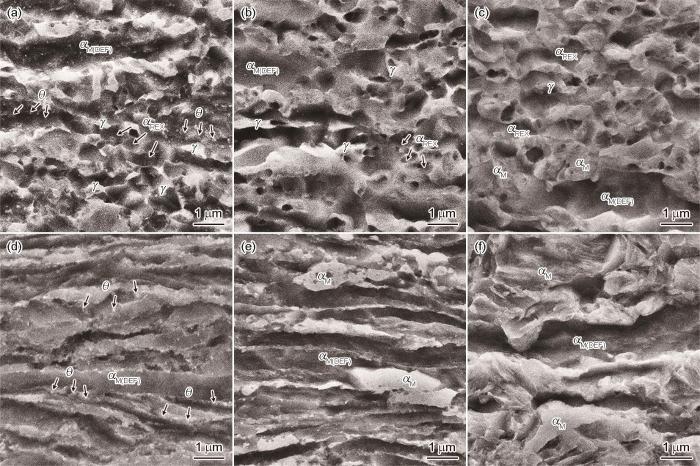
图6
SA450试样以不同速率升温至680 ℃、700 ℃和720 ℃的微观组织
Fig.6
Quenched microstructures of SA450 samples heated to 680 oC (a, d), 700 oC (b, e) and 720 oC (c, f) at different rates (a-c) 0.1 oC/s, (d-f) 20 oC/s (αM(DEF)—deformed martensite, αREX—recrystallized ferrite, θ—cementite, γ—retained austenite, αM—martensite)
2.2.2 SA690试样在连续升温过程中组织的转变
SA690试样在连续升温过程中的膨胀曲线,如图7所示。可以看出,这个试样的膨胀曲线随升温速率的变化规律与SA450试样基本相同,只是偏离线性关系的幅度更为显著。特别是在高速升温条件下SA690试样的一阶导数曲线在相变起始阶段呈现出缓慢下降的特征(图7b),与SA450试样的高速下降明显不同。此外,SA690试样的Ac1明显比SA450试样的低,表明Mn元素的预配分促进了富Mn马氏体区域中奥氏体的形核。但是在相变后期,在贫Mn区域需要更高的热力学驱动力的铁素体向奥氏体的转变,使SA690试样的Ac3反而比SA450试样的高。以上结果表明,临界区软化退火使中锰钢在后续退火过程中发生奥氏体相变的温度区间显著扩大。这一效应,对于实际生产中拓宽热处理工艺窗口有重要的意义。
图7
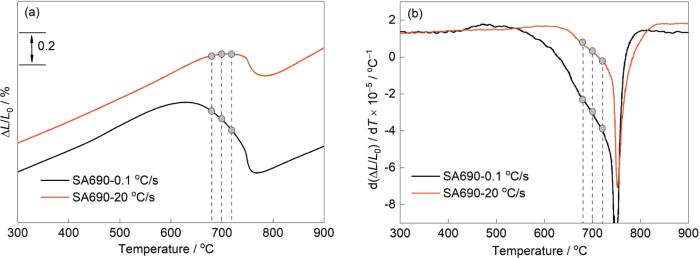
图7
SA690试样以不同速率升温时的膨胀曲线
Fig.7
Dilatation curves of SA690 samples during heating with different heating rates (a) dilatation curves, (b) the first derivatives of dilatation curves
图8给出了SA690试样以不同速率升温至680 ℃~720 ℃立即冷却后的微观组织。以0.1 ℃/s的速率缓慢升温,使再结晶在奥氏体相变前有足够的时间进行。升温至680 ℃组织中已生成了大量的等轴状再结晶晶粒,并伴随着渗碳体颗粒的析出。此时,奥氏体在再结晶铁素体晶粒的三叉晶界形核,形成了由奥氏体和铁素体组成的双相等轴组织(图8a)。随着温度的继续升高奥氏体进一步生长,其体积分数不断提高(图8b~c)。升温速率提高至20 ℃/s虽然显著抑制了SA690试样中马氏体再结晶,但是仍然发生了再结晶。高速升温至680 ℃,在组织中可见大量细小的等轴再结晶晶粒(图8d)。奥氏体能在这些细小的铁素体晶界处形核。与较低的升温速率相比,高速升温使奥氏体的形核位置更多,晶粒数量明显增加且分布更为弥散(图8e)。进一步升温至720 ℃奥氏体长大的程度较低且未出现明显的粗化或合并,其组织仍以细小的两相结构为主,部分区域保留了带状形貌(图8f)。
图8
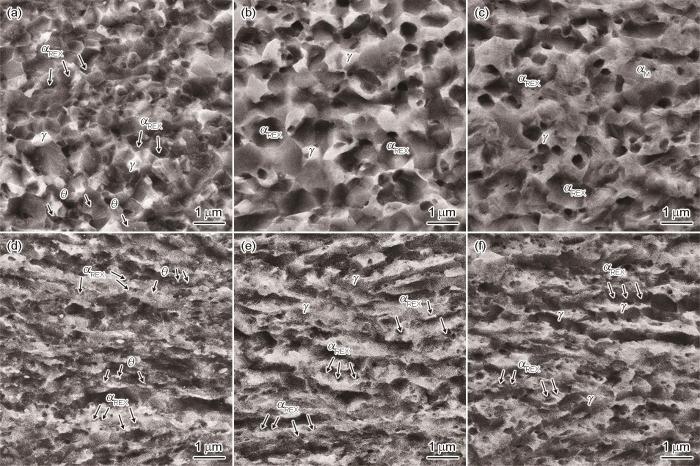
图8
SA690试样以不同速率升温至680 ℃、700 ℃和720 ℃的微观组织
Fig.8
Quenched microstructures of SA690 samples heated to 680 oC (a, d), 700 oC (b, e) and 720 oC (c, f) at different rates (a-c) 0.1 oC/s, (d-f) 20 oC/s
3 讨论
3.1 软化退火对冷轧中锰钢中再结晶的影响
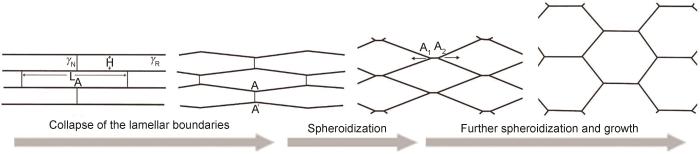
对比两种试样在亚临界区退火过程中的组织演化(图3和图4),可见软化退火对冷轧中锰钢马氏体再结晶的影响。在两种试样中,形变马氏体均通过连续再结晶机制发生再结晶。但是,与SA450试样相比,SA690试样中的马氏体层片间距更小、缺陷密度更高,积累了更大的形变储能。这些因素,共同促进了晶界的重组和再结晶晶粒的生成。因此,在相同的退火时间内,SA690试样中马氏体再结晶更快,更容易生成被HAGB包围的再结晶晶粒。此外,再结晶晶界的迁移,使马氏体区域中的再结晶晶界与相邻铁素体的晶界合并,生成新的再结晶晶粒。因此,SA690试样中马氏体再结晶的充分发生,使原始形变马氏体与铁素体的组织差异基本消失,显著提高了整体组织的均匀性。如图9所示,高度变形的片状组织在连续再结晶过程包括以下阶段[43,44]:层片结构分解、以Y型结点迁移为主导的进一步球化和晶粒生长。其中层片结构的分解起源于结点A处由表面张力驱动的结构失稳,该过程取决于沿RD方向与ND方向的晶粒横纵比(L/H)以及相对边界能量(γR/γN)。与SA450试样相比,SA690试样的马氏体层片内有更多的平行于ND方向且取向差较大的晶界,有利于提高沿ND方向晶界的晶界能γN,从而降低发生再结晶所需的临界L/H值。同时,SA690试样中形变马氏体的变形程度更高,其晶界横纵比更容易达到临界L/H值。因此,SA690试样中的层片结构更易分解使A点与A′点接触,随后新节点A1和A2形成并在晶界张力的作用下拉开。这一过程促进晶粒的球化和长大,最终生成更为等轴化的晶粒。
图9
综上所述,在临界区软化退火后在冷轧中锰钢中形成了具有高缺陷密度和剧烈变形特征的马氏体板条组织,显著促进了后续热处理过程中马氏体层片结构的分解和等轴化转变,从而加速了马氏体再结晶。与在亚临界区软化退火相比,在临界区软化退火减少了大块低应变区域,削弱了这些难再结晶区域对最终组织均匀性的不利影响,显著提高了组织的均匀性。
3.2 软化退火对冷轧中锰钢中奥氏体相变的影响
图9对比了两种试样在低速加热至680 ℃后冷却所得的组织。SA450试样冷轧后形成了片层间距较小的高应变区和变形程度较弱的低应变区,这种组织不均匀性在退火后依然存在(图10a1)。在高应变区,高密度位错演变成低能态的位错网络,随着晶界取向差的增大亚晶界转变为LAGB和HAGB(图10a2)。部分晶粒发生等轴化,奥氏体主要在三叉HAGB处形核。而在低应变区,马氏体再结晶程度较低和KAM值仍然较高,晶界类型以高密度位错网络、亚晶界和LAGB为主。相比之下,SA690试样在升温至680 ℃时已经生成均匀分布的再结晶铁素体和奥氏体等轴晶粒(图10b1)。这表明,在低速升温条件下该试样的再结晶在奥氏体相变前已基本完成。大规模晶界迁移使大量位错湮灭和重排,形成高比例的HAGB (图10b2)。这些HAGB为奥氏体相变提供了形核位置,奥氏体沿晶界迅速形核并长大,最终形成平均直径约1 μm的铁素体和奥氏体等轴两相组织。此外,SA690试样中生成的奥氏体来源于原富Mn马氏体区域。马氏体再结晶形成的晶界为Mn元素的配分提供了扩散通道,从而提高了奥氏体的稳定性,使其在高温退火后仍保留到室温。综上所述,在临界区软化退火的中锰钢不仅微观组织的均匀性显著提高,残余奥氏体的含量也明显提高。
图10
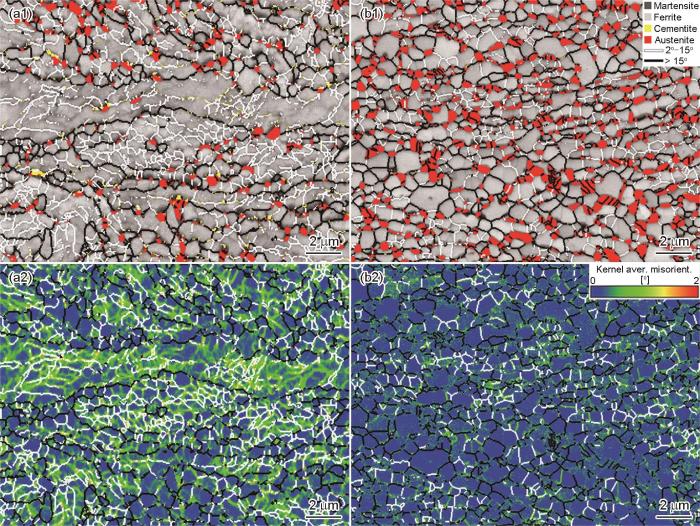
图10
SA450和SA690试样以0.1 ℃/s速率升温至680 ℃时的微观组织
Fig.10
Quenched microstructures of SA450 (a) and SA690 (b) samples heated to 680 oC at 0.1 oC/s (a1, b1) BC images overlapped the GB and phase distribution images, (a2, b2) KAM images overlapped the GB images
两种试样以20 ℃/s的速率升温至680 ℃后冷却,形成的组织如图11所示。可以看出,提高升温速率使再结晶和相变都在更高的温度发生,两种试样中的马氏体再结晶程度较弱表明其处于早期回复阶段。从图11a1可以看出,SA450试样的组织仍具有明显的非均匀分布特征,高应变区中HAGB和LAGB的含量均比低应变区的高。随着马氏体基体的回复渗碳体沿晶界析出,再结晶和相变均未发生,组织仍处于高应变变形状态,其KAM值较高(图11a2)。在升温过程中奥氏体迅速生成,而渗碳体的大量析出促进了奥氏体的形核。因此,SA450试样在高速升温条件下易生成粗大的不稳定奥氏体,并在冷却过程中转变为块状马氏体(图6e~f)。即使在高速升温的条件下,SA690试样相变开始时形变马氏体中仍发生了一定程度的再结晶,形成了相互连接的HAGB和LAGB网络(图11b1)。组织中生成了平均晶粒尺寸约为250 nm的细小铁素体晶粒,其内部的KAM值显著降低,表明形变引入的高密度位错已大量湮灭,进一步证实发生了马氏体再结晶(图11b2)。此外,冷轧在形变铁素体中产生了大量平行于ND方向的亚晶界和LAGB,这些晶界与马氏体再结晶形成的HAGB连接,构成了多类型晶界交织的晶界网络。在临界区软化退火过程中发生的Mn配分促进了马氏体层片内C/Mn原子的富集,从而使后续退火过程中渗碳体优先在马氏体再结晶晶界析出。这些渗碳体,为奥氏体相变提供了有利的形核点[45]。从图11b中还可见,高速升温使再结晶晶粒的等轴化程度较低,沿RD方向的HAGB仍保持平直形态。奥氏体主要在这些HAGB和LAGB的交界形核并沿平直晶界生长,最终成为条带状晶粒。结果表明,在高速升温过程中SA690试样中的奥氏体并未发生大规模的形核,而是持续在新生成的再结晶晶界形核和生长。其原因是,Mn的预配分导致在部分区域生成贫Mn铁素体,促使渗碳体只在富Mn马氏体片层内和相界面析出,而不像SA450试样中在马氏体基体中析出。同时,再结晶的进行显著降低了再结晶晶粒内部的位错密度,再结晶铁素体也抑制了奥氏体的生长。因此,SA690试样保持了平均晶粒尺寸约600 nm的细小等轴双相组织。此外,晶界这种高速扩散通道使奥氏体中的Mn原子进一步富集从而使其稳定性提高,使新生成的奥氏体晶粒保留到室温。
图11
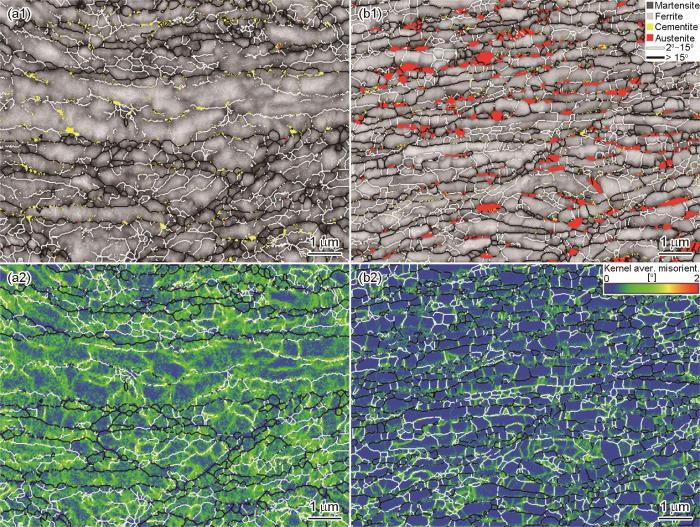
图11
SA450和SA690试样以20 ℃/s速率升温至680 ℃的微观组织
Fig.11
Quenched microstructures of SA450 (a) and SA690 (b) samples heated to 680 oC at 20 oC/s (a1, b1) BC images overlapped the GB and phase distribution images, (a2, b2) KAM images overlapped the GB images
在中锰钢的冷轧过程中,软化退火、冷轧和临界区退火等工艺都对再结晶和相变有显著的影响。已有研究表明,在退火过程中奥氏体的形核位置及其晶界特征,对奥氏体的生长和晶粒形貌有重要的影响[46]。本文对中锰钢冷轧后分别在不同相区进行软化退火,以形变马氏体/铁素体两相层片组织作为初始结构,并在此基础上对两种试样施以不同速率的临界区退火,其微观组织演化和Mn再分配过程如图12所示。首先,在临界区软化退火的中锰钢其马氏体再结晶动力学促进了奥氏体的形核,使其组织的均匀性显著提高。相比之下,SA450试样中的低应变区域难以完全发生再结晶,不利于奥氏体的生成。在相同的退火条件下SA690试样中的奥氏体相变开始时其再结晶程度远高于SA450试样,位错的重排和湮灭更为彻底,晶界迁移更为活跃。这不仅消除了未再结晶区域还为奥氏体形核提供了更多的三叉晶界点,从而使奥氏体分布更加均匀弥散,奥氏体相变动力学使奥氏体的稳定性显著提高。其次,在马氏体再结晶引起的层片结构分解和奥氏体对晶粒粗化的阻碍,使组织显著细化。SA690试样中的初始层片更窄且形变储能较高,在退火过程中更易分解成细小的等轴晶粒。奥氏体在晶界的迅速形核阻碍了晶界迁移,从而抑制了铁素体晶粒的粗化。尤其是高速升温使奥氏体在尚未等轴化晶粒的HAGB和LAGB交界形核,最终形成超细晶双相组织。此外,在临界区软化退火后,中锰钢在后续的退火过程中奥氏体相变对升温速率的敏感性下降。SA450试样在高速升温过程中几乎不发生再结晶,奥氏体形核迅速且难以控制。而预退火已使SA690试样中部分区域生成贫Mn铁素体,马氏体再结晶使低位错密度的铁素体晶粒在相变初期生成,从而抑制了高速升温条件下奥氏体的高速生长和合并。即使提高升温速率奥氏体也只在再结晶晶界形核和生长,其相变模式与低速升温条件下基本相同,因此仍形成了铁素体和奥氏体两相组织,拓宽了退火工艺窗口。综上所述,在临界区软化退火促进了冷轧中锰钢在后续退火过程中的马氏体再结晶,进而影响奥氏体的形核和生长。该工艺有助于实现组织均匀化和晶粒细化,为中锰钢微观组织的定制提供了更宽泛的工艺路径和调控策略。
图12
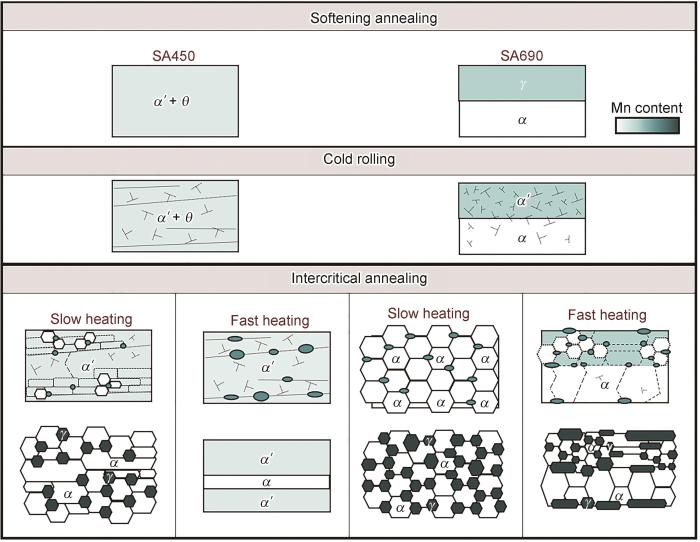
图12
冷轧中锰钢在不同条件下软化退火的组织演化机制
Fig.12
Microstructure evolution mechanism of cold-rolled MMnS after different softening annealing treatments
4 结论
(1) 在不同相区进行软化退火,可在中锰钢中形成回火马氏体/渗碳体和马氏体/铁素体双相组织。在临界区软化退火的中锰钢,冷轧后形成了具有高缺陷密度的双相层片结构。与回火马氏体相比,这种高度变形的马氏体薄片在后续热处理过程中易发生分解和等轴化转变,从而显著促进马氏体的再结晶进程。
(2) 在临界区软化退火可促进冷轧中锰钢中马氏体的再结晶,在奥氏体相变发生前即形成均匀分布的再结晶晶界网络。这种晶界网格结构能促进奥氏体在退火早期发生广泛而弥散形核,而奥氏体晶粒的生成抑制了再结晶铁素体的进一步长大,有利于形成超细晶双相组织,从而实现组织的细化和均匀化调控。
(3) 在临界区软化退火可降低奥氏体相变对升温速率的敏感性,和抑制高速升温过程中奥氏体的集中形核倾向,可扩大奥氏体相变的温度区间,显著拓宽冷轧中锰钢在热处理过程中的工艺窗口。
参考文献
Advanced lightweight materials for automobiles: a review
[J].
Thermomechanical processing of advanced high strength steels
[J].
Processing routes, resulting microstructures, and strain rate dependent deformation behaviour of advanced high strength steels for automotive applications
[J].
The role of transformation-induced plasticity in the development of advanced high strength steels
[J].
Processing, microstructure, mechanical properties, and hydrogen embrittlement of medium-Mn steels: a review
[J].
As a representative of steels available in the market, medium-Mn steel shows vast application prospects in lightweight automobile fields. This review details the research progress of medium-Mn steels, focusing on the following aspects. The roles of common adding elements, rolling technologies, and various heat treatments on the microstructure and mechanical properties of medium-Mn steel are analyzed, thus providing references for designing tailored medium-Mn steel with excellent performance. Considering that hydrogen embrittlement is a challenge faced in the development of high-strength steel, the hydrogen embrittlement behavior of medium-Mn steel is also discussed, particularly emphasizing the influence of microstructure, hydrogen concentration, strain, etc. Furthermore, practical strategies to improve resistance to hydrogen embrittlement are summarized. Finally, this review provides prospects for the development and research prospects of medium-Mn steel.
Austenite tailoring for strength and ductility enhancement in medium Mn steel: a brief review
[J].
Physical metallurgy of medium-Mn advanced high-strength steels
[J].Steels with medium manganese (Mn) content (3∼12 wt-%) have emerged as a new alloy class and received considerable attention during the last decade. The microstructure and mechanical response of such alloys show significant differences from those of established steel grades, especially pertaining to the microstructural variety that can be tuned and the associated micromechanisms activated during deformation. The interplay and tuning opportunities between composition and the many microstructural features allow to trigger almost all known strengthening and strain-hardening mechanisms, enabling excellent strength-ductility synergy, at relatively lean alloy content. Previous investigations have revealed a high degree of microstructure and deformation complexity in such steels, but the underlying mechanisms are not adequately discussed and acknowledged. This encourages us to critically review and discuss these materials, focusing on the progress in fundamental research, with the aim to obtain better understanding and enable further progress in this field. The review addresses the main phase transformation phenomena in these steels and their mechanical behaviour, covering the whole inelastic deformation regime including yielding, strain hardening, plastic instability and damage. Based on these insights, the relationships between processing, microstructure and mechanical properties are critically assessed and rationalized. Open questions and challenges with respect to both, fundamental studies and industrial production are also identified and discussed to guide future research efforts.
A review of the processing, microstructure and property relationships in medium Mn steels
[J].Medium Mn steels are an emerging class of 3rd generation advanced high-strength steels. These steels have received significant attention due to their high strengths, large ductilities and also lower cost compared to their predecessor high Mn Twinning Induced Plasticity (TWIP) steels. Additionally, medium Mn steels have been found to exhibit TWIP and/or Transformation Induced Plasticity (TRIP) effects which can be harnessed to give a high strain hardening rate. Many thermomechanical processing concepts in the literature have been developed, producing multiple microstructure types with differentmechanical properties. The present review therefore aims to summarise the current knowledge of medium Mn steel alloy design especially on the processing, microstructure and property relationships in medium Mn steels. It complements the review of Sun et al. [Physical metallurgy of medium-Mn advanced high-strength steels, Int Mater Rev. 2023.], written independently and in parallel, which focusses more on the phase interfaces and thermodynamics.
Synergistic enhancement mechanism of mechanical properties and hydrogen embrittlement resistance in medium Mn steels by coupling warm/cold rolling and delta ferrite
[J].
Heterostructure mediated high strength and large ductility in novel medium-Mn steels with low Mn content
[J].
Tailoring the metastable reversed austenite from metastable Mn-rich carbides
[J].
A critical review on medium-Mn steels: mechanical properties governed by microstructural morphology
[J].
Effect of tempering temperatures on microstructure and mechanical property of a test low-carbon medium-manganese steel
[J].Hot rolled plates of a low-carbon medium-manganese test steel 4Mn (Fe-4Mn-3.5Ni-2Cu-0.05C-0.018Nb-0.018Ti, in mass fraction) were heated at 860 oC for 1 h and then water quenching, followed by tempering treated at 600, 640, and 670 °C for 2 h respectively. Next, the effect of tempering process on the microstructure and mechanical property of the steel plates was assessed via SEM+EBSD, XRD, TEM, pendulum impact testing machine and hydraulic tensile testing machine. The results indicate that the microstructure of the steels tempered at different temperatures is composed of tempered martensite/ferrite + reversed austenite + fresh martensite. With the increasing tempering temperature, the ultimate tensile strength and work hardening index increase sequentially, while the yield strength and low-temperature impact toughness decreases sequentially. For tempering at 600 and 640 oC, the increase in ultimate tensile strength is primarily due to the transformation-induced plasticity effect formed by a fresh martensite, with the improving work hardening capability of the steel gradually as the temperature rises. For tempering at 670 oC, the content of fresh martensite significantly increases, enhancing the work hardening capacity and further boosting the ultimate tensile strength. However, the steel becomes excessively hard and brittle, leading to premature necking and a reduction in elongation. The decrease in low-temperature impact toughness is due to two factors, on one hand the mechanical stability of reversed austenite decreases, weakening its ability to mitigate stress concentrations through transformation, resulting in a reduction in the energy required for crack initiation; on the other hand, the increase of twins and blocky reversed austenite leads to a shift in the fracture austenite grain boundaries, thereby reducing the crack propagation energy. The precipitation of Nb/TiC in steel can help refine the grain size. In addition, the Cu-rich phase coarsens with the increase of tempering temperature, significantly reducing the yield strength.
高温回火对低碳中锰钢微观组织和力学性能的影响
[J].将低碳中锰钢Fe-4Mn-3.5Ni-2Cu-0.05C-0.018Nb-0.018Ti在860 ℃淬火1 h后水冷,再分别在600、640和670 ℃回火2 h,然后分别用JBN-300C摆锤冲击实验机和WE-300液压拉伸实验机进行冲击实验和拉伸实验。结果表明,在不同温度回火的实验钢,其微观组织均由回火马氏体/铁素体+逆转变奥氏体+新鲜马氏体构成。随着回火温度的提高实验钢的抗拉强度和加工硬化指数随之提高,屈服强度和低温冲击功降低。在600和640 ℃回火的实验钢,其抗拉强度的提高主要依赖相变诱导塑性效应生成的新鲜马氏体,其加工硬化性能随着回火温度的提高而改善。回火温度提高到670 ℃新鲜马氏体的含量显著提高,虽然加工硬化能力和抗拉强度进一步提高,但是实验钢变得硬而脆和颈缩提前,从而使其延伸率降低。低温冲击功降低的原因,一个是逆转变奥氏体机械稳定性降低和相变缓解应力集中的效果减弱,使裂纹形成功降低;另一个是孪晶和块状逆转变奥氏体数量的增多导致断裂模式转变为晶间断裂,裂纹易沿着孪晶界和原奥氏体晶界高速扩展而降低了裂纹扩展功。实验钢中Nb/TiC的析出,有助于晶粒细化。同时,回火温度的提高使富Cu相粗化,使实验钢的屈服强度显著降低。
Effect of aging treatment on microstructure evolution and mechanical properties of Fe-12Mn-8Al-1C-3Cu lightweight steel
[J].By aging treatment of a medium manganese lightweight steel at 550oC, the evolution of its microstructure and mechanical properties was analyzed. The results indicate that aging treatment has a significant impact on precipitates. When the aging time is less than 30 minutes, a large number of intragranular κ'-carbides formed by spinodal decomposition, which distributed dispersedly in the austenite matrix. As the aging time increases, besides the intragranular κ'-carbides, intergranular κ-carbides are also formed at grain boundaries through eutectoid reactions as a layered structure of α ferrite and κ-carbide. Intragranular κ'-carbides greatly increase the strength, but intergranular κ-carbides significantly reduce the ductility of the steel. Compared with long-time aging, the strength of the steel can be significantly increased by short-time aging, while the steel still maintains a high elongation with better overall mechanical properties. Among them, the good performance is achieved for the steel after aging for 30 minutes, namely a tensile strength of 1031 MPa, yield strength of 784 MPa, an elongation of 41.08%, and a product of strength and elongation of 42.35 GPa·%.
时效处理对Fe-12Mn-8Al-1C-3Cu轻质钢的组织演变和力学性能的影响
[J].对中锰轻质钢进行不同时间的时效处理,研究了时效时间对其微观组织演变和力学性能的影响。结果表明,时效处理时间对析出物有显著的影响。时效时间短于30 min时,在奥氏体基体内析出大量调幅分解生成的弥散分布的晶内κ'碳化物。随着时效时间的延长,除了在晶内析出κ'碳化物,在晶间也发生共析反应在晶界处形成κ-碳化物,构成(α-铁素体+晶间κ-碳化物)片层组织。晶内κ'碳化物的生成使钢的强度提高,但是晶间κ-碳化物的析出使其塑性显著降低。与长时时效相比,短时时效使钢的强度显著提高,还使其保持较高的伸长率,使其具有更优异的综合力学性能。时效30 min的钢,其抗拉强度为1031 MPa,屈服强度为784 MPa,伸长率为41.08%,强塑积为42.35 GPa·%。
Summary of differences in microstructure and properties between hot-rolled and cold-rolled annealing processes of medium manganese steel
[J].
中锰钢热轧与冷轧退火工艺下组织与性能差异综述
[J].
Effects of intercritical annealing process on microstructures and tensile properties of cold-rolled 7Mn steel
[J].
Austenite transformation and deformation behavior of a cold-rolled medium-Mn steel under different annealing temperatures
[J].
Interaction between recrystallization and phase transformation during intercritical annealing in a cold-rolled dual-phase steel: a cellular automaton model
[J].
Interaction between ferrite recrystallization and austenite formation in dual-phase steel manufacture
[J].
Intercritical annealing of cold-rolled ferrite-pearlite steel: microstructure evolutions and phase transformation kinetics
[J].
Interactions between ferrite recrystallization and austenite formation in high-strength steels
[J].
Microstructures resulting from the interaction between ferrite recrystallization and austenite formation in dual-phase steels
[J].
Significance of cold rolling reduction on Lüders band formation and mechanical behavior in cold-rolled intercritically annealed medium-Mn steel
[J].
Ultra-fine heterogeneous microstructure enables high strength-ductility in a cold-rolled medium Mn steel
[J].
Improving strength-ductility synergy in medium Mn steel by combining heterogeneous structure and TRIP effect
[J].
Fabrication of bimodal-grained Al-free medium Mn steel by double intercritical annealing and its tensile properties
[J].
Strong interactions between austenite and the matrix of medium-Mn steel during intercritical annealing
[J].The effects of heat treatment on the microstructure evolution was studied in regards to austenite nucleation and grain growth. It was found that the austenite nucleation and matrix recrystallization kinetics of samples annealed at 675 °C for different times were revealed, implying a strong interaction between the ferrite matrix and austenite. The recrystallization of the matrix during annealing provided favorable conditions for austenite nucleation and growth, and the formation of austenite during this process reduced the matrix recrystallization kinetics, thus delaying the recrystallization process of the matrix around the austenite grains. The statistical results for the austenite grain size under different annealing temperatures indicated that the average grain size of the austenite slightly increases with increasing of the annealing temperature, but the austenite with the largest grain size grows faster at the same temperature. This difference is attributed to the strict Kurdjumov Sachs (KS) orientation relationship (OR) between the austenite grains and the matrix, because the growth of austenite with a strict KS OR with the matrix is often inhibited during annealing. In contrast, the austenite maintains a non-strict KS OR with the matrix and can grow preferentially with increasing annealing temperature and time.
Enhancement austenite content in medium-Mn steel by introducing cold-rolled deformation and inhibiting subsequent recrystallization
[J].
By controlling recrystallization degree: a plain medium Mn steel overcoming Lüders deformation and low yield-to-tensile ratio simultaneously
[J].
Effect of heterogeneous microstructure on martensitic transformation behavior and mechanical properties of a cold rolling medium Mn steel
[J].
Effect of Mn pre-partition before cold rolling on austenite reversion and mechanical properties of 3.5Mn steel
[J].
Microstructure and mechanical properties of a novel heterogeneous cold-rolled medium Mn steel with high product of strength and ductility
[J].The mechanical properties of a novel heterogeneous cold-rolled medium Mn steel were investigated by means of mechanical testers, in situ EBSD (electron back-scattered diffraction) and SDTEM (spherical differential transmission electron microscope). The results show that the sample annealed at 680°C consists of multiple microstructure of austenites (granular shape, blocky shape, and lath-like shape) and fine ferrite grains. The heterogeneous steel has ultimate tensile strength of 1.27 GPa, total elongation of 54.5% and product of strength and elongation of 69.3 GPa·%. During tensile deformation the granular-shape austenite with a low C/Mn content preferentially transforms into martensite ahead of the blocky-shape and lath-like austenite with high C/Mn content, and the multi-type microstructure of austenite with various stability lead to a continuous TRIP effect in a large strain region, which is responsible for the excellent properties of the heterogeneous medium Mn steel. In addition, austenite grain boundaries or austenite/ferrite interfaces are the preferred nucleation zone of martensite during deformation. The effect of Mn/C content on austenite stability readily overrides those of grain size.
一种新型高强塑积异质冷轧中锰钢的力学性能
[J].使用原位电子背散射衍射(EBSD)和球差透射电镜(ACTEM)等手段,研究了新型异质结构中锰TRIP钢在拉伸过程中微观组织的演变机制和力学性能。结果表明,在680℃退火后的实验钢中生成了多形貌、多尺度的异质奥氏体结构(颗粒状、块状、片层状奥氏体)和铁素体组织,其抗拉强度为1272 MPa,总延伸率为54.5%,强塑积高达69.3 GPa·%。在拉伸过程中C/Mn含量较低的颗粒状奥氏体先发生相变,而C/Mn含量较高的块状和片层状奥氏体在较大的应变范围内逐渐发生相变,从而导致高强度与高塑性的良好匹配。结果还表明,马氏体相变优先在奥氏体晶界/相界附近的区域形核。与晶粒尺寸相比,C/Mn元素对奥氏体稳定性的作用更重要。
Fundamentals and application of solid-state phase transformations for advanced high strength steels containing metastable retained austenite
[J].
M³ microstructure control theory and technology of the third-generation automotive steels with high strength and high ductility
[J].
高强度高塑性第三代汽车钢的M3组织调控理论与技术
[J].高强度、高塑性是汽车钢的重要发展方向,本文综述了高强度高塑性第三代汽车钢的“多相(multiphase)、亚稳(metastable)和多尺度(multiscale)” M<sup>3</sup>组织性能调控理论和技术,以及面临的新挑战。M<sup>3</sup>组织与性能调控理论为高强度高塑性钢提供了理论支持,亚稳奥氏体的相变诱发塑性(TRIP)效应能够提高加工硬化率并推迟颈缩的发生,从而提高了钢的强度与塑性,同时产生了剪切边裂纹敏感性提高,氢致延迟断裂性能下降,循环载荷下亚稳奥氏体的转变行为复杂等新的问题和挑战。当前,含亚稳奥氏体高强度高塑性钢的质量一致性和应用基础研究缺乏,而汽车钢作为量大面广的产品,需要从它的成分设计和组织调控-冲裁切割-成形制造-连接涂装-服役评价等全链条环节中开展组织演变和性能评估,充分考虑产品的技术适用性和成本,进而为组织调控理论和技术的完善提供依据。
Recrystallization controlling in a cold-rolled medium Mn steel and its effect on mechanical properties
[J].Owing to the excellent combination of specific strength and ductility, medium Mn steels (MMSs) with Mn contents of 3%-12% (mass fraction) are considered the most promising candidates for the third-generation advanced high-strength steel. The combination of excellent strength-ductility is mainly attributed to the active transformation-induced plasticity effect of the metastable retained austenite during deformation. Therefore, producing a considerable amount of retained austenite with reasonable stabilities in the steel by various heat treatment schedules is always important. In this study, granular- and lamellar-structured retained austenites were developed in a cold-rolled 0.15C-5Mn MMS by introducing a technical process of precontrolling ferrite recrystallization in the annealing schedule. The microstructures of the annealed samples were analyzed using SEM, EBSD, and TEM. The results show that duplex microstructures comprising various amounts of recrystallized ferrite and fresh martensite can be obtained in the cold-rolled MMS when controlling the occurrence of recrystallization at different intercritical temperatures by a preannealing process. When this microstructure is used for the final austenite reverted transformation annealing, the resultant ultrafine duplex microstructure with recrystallized ferrite and two types of heterogeneous retained austenite, i.e., lamellar and granular, is produced. The heterogeneous-structured austenite shows more sensitivity to increasing strain, i.e., various mechanical stabilities, which enable an excellent strength-ductility combination and reduced Lüders strain in the cold-rolled medium Mn steel.
冷轧中锰钢的再结晶调控及其对力学性能的影响
[J].为探究铁素体再结晶对冷轧中锰钢微观组织与力学性能的影响规律,以0.15C-5Mn (质量分数,%)冷轧中锰钢为研究对象,采用两步临界区退火的热处理方法,利用SEM、TEM和EBSD等表征手段和力学性能测试方法,研究了铁素体再结晶调控对冷轧中锰钢多样化残余奥氏体形成及其力学性能的影响。结果表明,通过在不同温度预先调控冷轧中锰钢中的铁素体再结晶,可获得由不同比例的等轴状再结晶铁素体和马氏体组成的双相细晶组织。经常规退火处理后,在终态组织中形成了不同体积分数的超细晶再结晶铁素体和呈等轴状/板条状形貌的多样化细晶残余奥氏体,使中锰钢在拉伸变形过程中表现出多样化的TRIP效应,在提升冷轧中锰钢强塑性能的同时,其Lüders变形也获得改善。
Kinetic transitions and Mn partitioning during austenite growth from a mixture of partitioned cementite and ferrite: role of heating rate
[J].Austenite formation from a ferrite-cementite mixture is a crucial step during the processing of advanced high strength steels (AHSS). The ferrite-cementite mixture is usually inhomogeneous in both structure and composition, which makes the mechanism of austenite formation very complex. In this contribution, austenite formation upon continuous heating from a designed spheroidized cementite structure in a model Fe-C-Mn alloy was investigated with an emphasis on the role of heating rate in kinetic transitions and element partitioning during austenite formation. Based on partition/non-partition local equilibrium (PLE/NPLE) assumption, austenite growth was found alternately contribute by PLE, NPLE and PLE controlled interfaces migration during slow-heating, while NPLE mode predominately controlled the austenitization by a synchronous dissolution of ferrite and cementite upon fast-heating. It was both experimentally and theoretically found that there is a long-distance diffusion of Mn within austenite of the slow-heated sample, while a sharp Mn gradient was retained within austenite of the fast-heated sample. Such a strong heterogeneous distribution of Mn within austenite cause a large difference in driving force for ferrite or martensite formation during subsequent cooling process, which could lead to various final microstructures. The current study indicates that fast-heating could lead to unique microstructures which could hardly be obtained via the conventional annealing process.
The effects of the heating rate on the reverse transformation mechanism and the phase stability of reverted austenite in medium Mn steels
[J].
Effect of cold-rolling and heating rate on austenite formation in a low-carbon steel
[J].
The effect of heating rate and soaking time on microstructure of an advanced high strength steel
[J].
Microstructure evolution of medium-manganese Al-alloyed steel manufactured by double-step intercritical annealing: Effects of heating and cooling rates
[J].
Dilatometric study on the recrystallization and austenization behavior of cold-rolled steel with different heating rates
[J].
Comments on "the effects of the heating rate on the reverse transformation mechanism and the phase stability of reverted austenite in medium Mn steels" by J. Han and Y.-K. Lee, Acta Materialia 67 (2014) 354-361
[J].
Toward unraveling the mechanisms responsible for the formation of ultrafine grained microstructure during tempering of cold rolled martensite
[J].
Interactions between recrystallization and austenite reversion during intercritical annealing of a cold-rolled medium Mn steel
[J].
Multi-scale characterization of austenite reversion and martensite recovery in a cold-rolled medium-Mn steel
[J].A medium-Mn steel (Fe-12Mn-3Al-0.05C wt%) was designed using Thermo-Calc (R) simulations to balance the fraction and stacking fault energy of reverted austenite. lntercritical annealing for 0.5, 8 and 48 h was carried out at 585 degrees C to investigate the microstructural evolution. X-ray diffraction (XRD), electron backscatter diffraction (EBSD), 3-dimensional EBSD, energy-dispersive spectroscopy via scanning transmission electron microscopy (STEM-EDS) and atom probe tomography (APT) enable characterization of phase fraction, grain area, grain morphology and alloy partitioning. An increase in annealing time from 0.5 h to 48 h increases the amount of ultrafine-grained (UFG) reverted austenite from 3 to 40 vol %. EBSD and TEM reveal multiple morphologies of UFG austenite (equiaxed, rod-like and plate-like). In addition, most of the remaining microstructure consists of recovered alpha'-martensite that resembles the cold-rolled state, as well as a relatively small fraction of UFG ferrite (i.e., only a small amount of martensite recrystallization occurs). Multi-scale characterization results show that the location within the cold-rolled microstructure has a strong influence on boundary mobility and grain morphology during austenite reversion. Results from APT reveal Mn-decoration of dislocation networks and low-angle lath boundaries in the recovered alpha'-martensite, but an absence of Mn-decoration of defects in the vicinity of austenite grains, thereby promoting recovery. STEM-EDS and APT reveal Mn depletion zones in the ferrite/recovered alpha'-martensite near austenite boundaries, whereas gradients of C and Mn co-partitioning are visible within some of the austenite grains after annealing for 0.5 h. Relatively flat C enriched austenite boundaries are present even after 8 h of annealing and indicate certain boundaries possess low mobility. At later stages the growth of austenite followed the local equilibrium (LE) model such that the driving force between two equilibrium phases moves the mobile interface, as confirmed by DICTRA simulations (a Thermo-Calc (R) diffusion module). The sequence of austenite reversion is: (i) formation of Mn- and C-enriched face-centered-cubic nuclei from decorated dislocations and/or particles; (ii) co-partitioning of Mn and C and (iii) growth of austenite controlled by the LE mode. (C) 2019 Acta Materialia Inc. Published by Elsevier Ltd.


