



铋基半导体材料具有独特的层状结构、适宜的能带位置和良好的光催化活性,其中的碳酸氧铋(Bi2O2CO3)是一种典型的紫外光响应型光催化剂[6~8]。但是,碳酸氧铋的带隙(约3.1 eV)较宽和光生电子-空穴对的高速复合,严重制约了其在太阳能驱动催化中的应用。为了克服这些困难,可设计或合成新型铋基化合物(如铌酸盐[9]、碘酸盐[10])、调控材料的微观形貌与维度(如构建纳米片[11,12]、纳米线结构[13])或构筑异质结复合体系(如BiOBr/Bi2O2CO3[14]、Bi2S3/Bi2O2CO3[15])以促进电荷分离;还可以进行表面修饰尤其是引入贵金属纳米颗粒(如Au、Ag)[16~19]拓展光吸收范围并提高载流子分离效率[20~22]。
1 实验方法
1.1 实验用材料和试剂
实验用试剂:五水硝酸铋(Bi(NO3)3·5H2O)、多聚甲醛((CH2O) n )、尿素(CO(NH2)2)、无水乙醇(CH3CH2OH)、硝酸(HNO3)均为分析纯。实验用水是去离子水。
1.2 纯相Bi2O2CO3 的制备
将0.5 g的CO(NH2)2溶解在40 mL去离子水中,将2.45 g Bi(NO3)3·5H2O加入其中和搅拌0.5 h,然后移入容积为100 mL的聚四氟乙烯反应釜中,在200 ℃的烘箱中保温2 h。将产物用去离子水和无水乙醇各离心充分洗涤(3遍)后得到白色沉淀,将其在60 ℃烘箱中真空干燥12 h得到白色粉末样品,标记为BOC。
1.3 Bi/Bi2O2CO3 的制备
用一锅水热法合成Bi/Bi2O2CO3复合材料。将0.485 g的Bi(NO3)3·5H2O溶解在20 mL稀硝酸溶液(1 mol/L)中,在剧烈搅拌条件下加入0.6 g (0.02 mol)的多聚甲醛和40 mL去离子水,然后将得到的混合物转移到温度为180 ℃容积为100 mL的聚四氟乙烯内衬不锈钢高压釜中,恒温反应10 h后自然冷却至室温。离心收集所得沉淀并依次用去离子水和无水乙醇充分洗涤,然后在60 ℃真空干燥24 h后,得到浅灰色粉末样品。改变前驱体中Bi与C的摩尔比(1∶20、1∶25、1∶30、1∶40、1∶50)分别得到从浅灰色到深灰色不同Bi负载量的粉末样品,分别标记为Bi/BOC-1、Bi/BOC-2、Bi/BOC-3、Bi/BOC-4和Bi/BOC-5。
1.4 催化剂的表征
用X射线粉末衍射仪(XRD 6100)测定预合成样品的XRD谱,Cu靶(Kα,λ = 0.15406 nm)辐射源,工作电流及电压分别为40 mA和4 kV,扫描速度为0.2秒/步,2θ扫描范围20°~70°。用扫描电子显微镜(SEM,SU8000)观察样品的微观形貌,加速电压5~25 kV,样品室的真空度小于3 × 10⁻⁵ Pa,测试前,为了增加样品的导电性,需对样品喷金30 s处理。用Lambda 950型UV-Vis-NIR光谱仪测定固体粉末样品的紫外可见漫反射光谱,用BaSO4作为标准参比,检测范围为200~800 nm。用ASAP 2020型分析仪,在77 K下测试样品的比表面积和孔径分布。分析前,将样品在适当温度下脱气使样品室的真空度小于1.3 × 10⁻³ Pa。根据吸附等温线吸附量(P/P0 = 0~0.35)用多点吸附法计算比表面积,用Barrett-Joyner-Halenda (BJH)法计算孔径分布。用MULTI AUTO LAB M204型电化学工作站测量样品的光电化学性能,使用传统三电极电化学池,包括Pt片对电极、Ag/AgCl参比电极和工作电极。工作电极的制备:将10 mg催化剂均匀分散在0.1 mL N, N-二甲基甲酰胺中,超声分散1 h后取20 μL悬浊液均匀涂在面积约为0.25 cm2的ITO导电玻璃上,在室温下干燥后即得工作电极。电解液为0.2 mol·L-1 Na2SO4,光源为420 nm的氙灯。所加偏压为0.4 mV,每光照40 s后关灯40 s,连续测试400 s。用Titan G2 60-300型透射电镜(TEM)观测材料的内部结构。将样品按一定比例放入乙醇中,超声分散均匀后滴在多孔铜网碳膜表面,干燥后送入真空室进行观察。采用Bruker EMXplus-6/1进行电子自旋共振(ESR)测试。配制1 mg/mL样品,加入溶剂(测羟基自由基用去离子水作溶剂,测超氧自由基用甲醇做溶剂)后超声分散1 min。在30 µL样品中加30 µL DMPO混合均匀,用毛细管吸取适量混合液置于石英管中,放入ESR谐振腔腔内进行羟基自由基、超氧自由基的测试。用K-Alpha型的X射线光电子能谱仪(XPS)测试样品的光电子能谱,激发源为能量为1486.6 eV的Al靶Kα射线,Al靶需单色化处理。对样品扫描射线的范围为400 µm,工作电压12 kV,灯丝电流6 mA。使用结合能284.8 eV的C 1s电子峰校正测试样品的能谱。
使用可见光光催化反应装置测试样品的光催化性能。光源为300 W的氙灯,在光照过程中使用420 nm的截止滤光片滤掉紫外光部分。分别使用初始浓度为20 mg/L的孔雀石绿(MG)和25 mg/L的环丙沙星(CIP)作为模拟污染物。将0.08 g催化剂投入80 mL模拟污染物溶液中形成悬浮液,在避光条件下搅拌0.5 h以达到吸附-脱附平衡。打开灯源后每隔预定时间取样3.0 mL,离心分离后用Cary-50型紫外可见光谱仪测定MG溶液的紫外可见吸收光谱的变化,用配备紫外检测器(275 nm)的高效液相色谱仪(HPLC)测定CIP溶液的浓度。
2 结果和讨论
2.1 样品的物相组成
图1给出了BOC和不同Bi/C摩尔比Bi/Bi2O2CO3样品的XRD谱。BOC样品的所有衍射峰均可归属为正交晶系结构,且与标准卡片JCPDS 01-084-1752匹配,未观测到其它杂质峰,表明其为纯相Bi2O2CO3。在Bi/C比例为1∶20的Bi/BOC-1样品的谱中仍只出现BOC的特征衍射峰,没有出现金属Bi的衍射峰。其原因:一是Bi的含量较低;二是超细Bi纳米颗粒在BOC纳米片表面高度分散,衍射峰严重宽化而被背景信号掩盖。因此,需用灵敏度更高的表征手段确认金属Bi的存在及其分布。在Bi/C比例为1∶25的Bi/BOC-2的谱中,在2θ为27.2°处出现的微弱但可辨识的新衍射峰对应金属Bi的(012)晶面,表明增强的还原性前驱体体系已能诱导微量金属Bi的成核和生长。在进一步增加多聚甲醛用量的Bi/BOC-3和Bi/BOC-4的谱中27.2°、37.9°、39.6°、48.7°和64.5°处出现一系列以红色圆点标记的新衍射峰,与三方晶系金属Bi的标准卡片(JCPDS 01-085-1329)一致。这些衍射峰形尖锐、半高宽减小,说明随着还原剂用量的增加Bi颗粒的结晶度提高和尺寸有所增大。其中Bi/BOC-4的金属Bi衍射峰强度最为显著,表明该配比的BOC表面已被高密度Bi纳米颗粒均匀覆盖,形成了界面接触良好的异质结构。尤其在Bi/C比例增至1∶50的Bi/BOC-5的XRD谱中只观察到金属Bi的一系列特征峰,而Bi2O2CO3的衍射峰完全消失,表明在此高还原性环境中碳酸盐基体完全还原为金属Bi,生成了纯Bi相而非复合材料。上述结果表明,调节前驱体中多聚甲醛的用量即可精确调控Bi/Bi2O2CO3复合材料中金属Bi的负载量和晶相组成。
图1
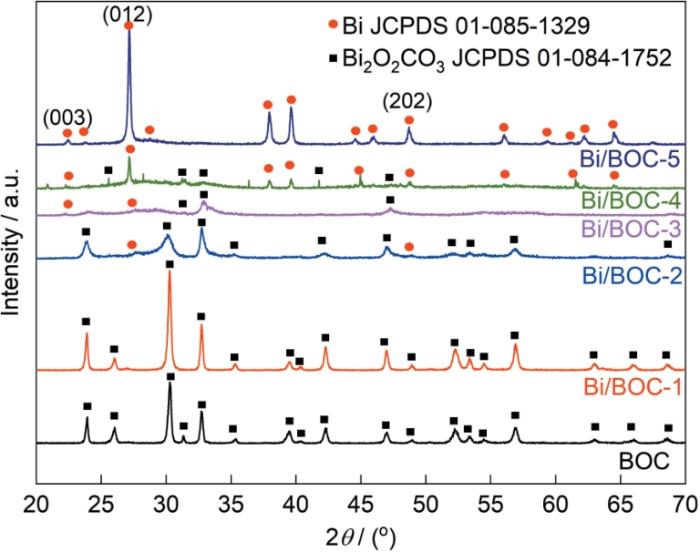
图1
BOC and Bi/Bi2O2CO3样品的XRD谱
Fig.1
XRD patterns of BOC and Bi/Bi2O2CO3 composites
2.2 样品的形貌
如图2所示,BOC和Bi/BOC-1样品具有不规则的片状结构,其中BOC的片层厚度为30~60 nm,而Bi/BOC-1的片层更薄、尺寸更小,厚度为10~20 nm。图3a表明,Bi/BOC-1样品呈现不规则纳米片状结构,放大后可见分散在表面的Bi纳米颗粒(图3b)。在图3c给出的典型HRTEM图像中可见两组清晰的晶格条纹,其中间距为0.27 nm的条纹对应正交晶系Bi2O2CO3的(002)晶面,而间距为0.33 nm的条纹则对应三方晶系Bi的(012)晶面。两套晶格条纹在界面处相连,表明Bi与Bi2O2CO3形成了紧密的异质结界面。选区电子衍射(SAED)花样(图3d)进一步证实了两相共存:内环强点对应基体相Bi2O2CO3的(002)晶面(d ≈ 0.27 nm),外环弱点对应Bi的(110)晶面(d ≈0.23 nm)。由于Bi/BOC-1中金属Bi含量极低,Bi(012)晶面(d ≈ 0.33 nm)的衍射信号极弱且更靠近中心,未在图中单独标出。上述结果和XRD数据都证明已经成功构建了Bi/Bi2O2CO3复合材料。
图2
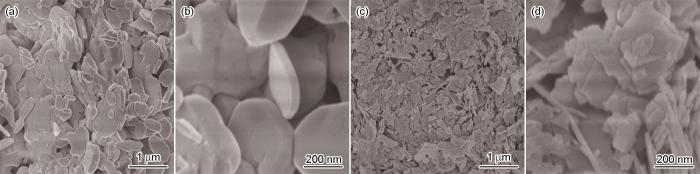
图3
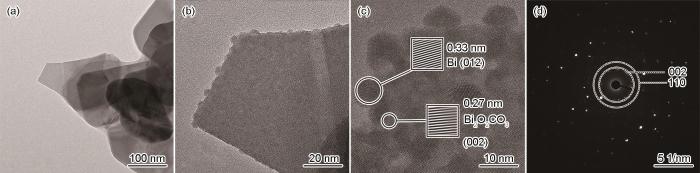
图3
Bi/BOC-1的TEM、HRTEM图和SAED衍射花样
Fig.3
TEM images (a, b), HRTEM image (c), and SAED pattern (d) of Bi/BOC-1
2.3 样品的光吸收性能
用紫外-可见漫反射光谱(UV-Vis DRS)表征样品的光吸收性能,结果如图4所示。纯相BOC的吸收边位于368 nm,对应带隙约为3.37 eV,只响应紫外光。引入金属Bi的复合材料在可见光区(400~800 nm)均出现吸收增强,且随着Bi负载量的增加呈规律性变化:Bi/BOC-1和Bi/BOC-2呈现微弱吸收尾,表明少量Bi纳米颗粒产生初步的SPR效应;Bi/BOC-3和Bi/BOC-4形成宽化吸收肩峰,为局域等离子体共振效应(LSPR)典型特征;Bi/BOC-5因过量Bi形成连续金属相,表现了全谱段强背景吸收。样品的颜色由白色依次变为浅灰、灰、深灰直至黑色,与可见光吸收增强的趋势一致,证实已引入金属Bi和产生了SPR效应。
图4
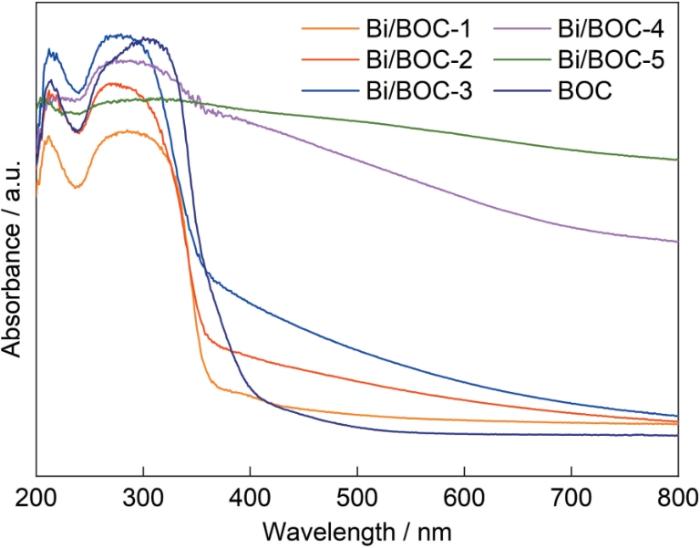
图4
不同样品的紫外可见分光光度谱
Fig.4
UV-Vis diffuse-reflectance spectra of the as-synthesized samples
2.4 化学组成和表面元素电子状态
图5a中的XPS全谱表明,样品中主要有Bi、C和O三种元素。Bi元素来源于制备出的复合材料,而C和O元素来源于仪器本底及表面吸附羟基的较小贡献。在高分辨率Bi 4f XPS谱(图5b)中156.42 eV和161.70 eV处的两个强峰分别归属于Bi 4f7/2和Bi 4f5/2跃迁,表明Bi以Bi3+的形式存在。在154.98 eV和160.37 eV处的两个较弱的峰,归属于金属单质Bi的特征信号。O 1s高分辨谱(图5c)可拟合成三个峰:位于527.63 eV的峰归属于层状Bi2O2CO3中[Bi2O2]2+层内的Bi-O键;528.44 eV和528.76 eV处的峰则分别对应复合材料表面吸附的羟基和碳酸根物种。在C 1s谱(图5d)中位于286.30 eV的峰来源于Bi/Bi2O2CO3中的O=C-O结构单元,而282.28 eV与283.49 eV处的峰则归属于外来碳污染。XPS结果进一步证实,所制备的复合材料表面存在单质Bi。为了确定Bi2O2CO3表面单质Bi的相对含量,对Bi/BOC-1至Bi/BOC-4的XPS高分辨Bi 4f谱进行分峰拟合和半定量分析。结果表明,4个样品中单质Bi的相对含量(原子比)依次为2.01%、3.12%、3.24%和3.78%,即随着多聚甲醛用量的增加呈单调递增趋势。Bi/BOC-5的XRD谱已证实其为纯Bi相,表明碳酸盐基体完全分解,单质Bi的比例接近100%。
图5
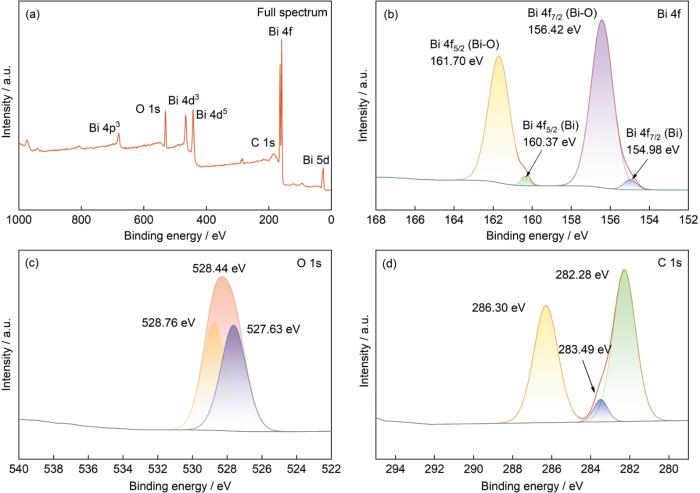
图5
Bi/BOC-1样品的XPS总谱以及Bi 4f、O 1s和C 1s的高分辨谱
Fig. 5
XPS survey spectrum of Bi/BOC-1 (a), and high-resolution spectra of Bi 4f (b), O 1s (c), and C 1s (d)
2.5 样品的光催化性能
以MG和CIP作为模拟污染物,表征了样品的光催化性能。图6给出了在模拟太阳光照射下不同光催化剂对MG和CIP的降解效果。结果表明,Bi/BOC-1对两种污染物的降解效率最高,可见光照射1 h后分别降解约96%的MG和94%的CIP。相比之下,纯相BOC对MG和CIP的降解率仅为46%和64%。Bi/BOC-2的光催化性能与BOC相近,而Bi/BOC-3、Bi/BOC-4和Bi/BOC-5的性能则明显低于BOC。
图6
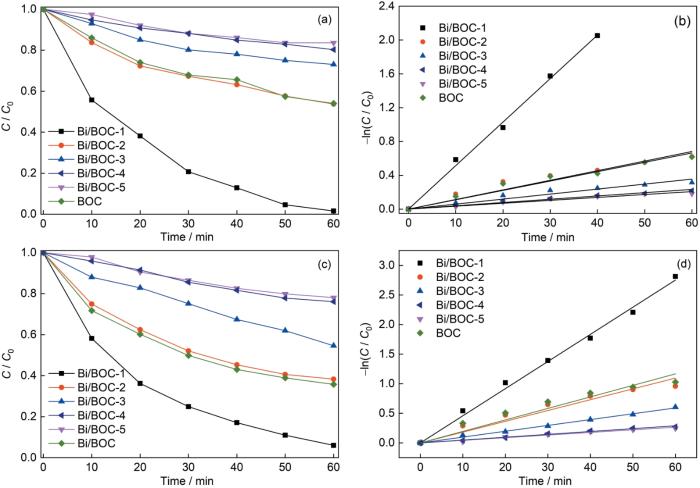
图6
所制备样品对MG和CIP的降解活性和-ln(C/C0)与时间的关系
Fig.6
Activities of as-prepared samples for the degradation of MG (a) and CIP (c), and plots of -ln(C/C0) vs. time (b, d)
根据图6b、d中的数据,降解动力学符合准一级反应模型。以CIP降解为例,BOC、Bi/BOC-1和Bi/BOC-5的表观速率常数(k)分别为0.019、0.046和0.0044 min-1。其中Bi/BOC-1的降解速率约为BOC的2.4倍,表明在BOC纳米片上负载适量的Bi纳米颗粒可显著提高其光催化性能。但是,负载量增加的Bi/BOC-5,其光催化降解速率反而低于BOC的1/4。这表明,过量负载的Bi纳米颗粒在BOC纳米片表面聚集,阻碍了对光的吸收。因此,需精确控制Bi的负载量。
为了表征Bi/BOC-1复合材料的结构稳定性,进行了5次循环降解实验,结果如图7所示。在相同反应条件下,Bi/BOC-1的循环稳定性良好:第1次循环60 min内CIP的降解率达95.6%,第5次循环后仍保持88.4%的降解效率。催化剂的循环寿命实验结果表明,这种复合材料具备良好的结构稳定性和重复使用性能。
图7

图7
Bi/BOC-1对CIP光催化降解的循环图
Fig.7
Cycling runs of photocatalytic degradation of CIP over Bi/BOC-1
表1对比了近5年文献报道的同类Bi基等离子体光催化材料。与传统方法相比,即采用溶剂热法、室温组装或两步法合成并以NaBH4、乙二醇或甲酰胺等为还原剂,采用一步水热法并以廉价的多聚甲醛兼作碳源与还原剂,可见合成流程显著简化。Bi/BOC-1对MG的降解速率常数(0.085 min-1)比文献报道的Bi/Bi2O2CO3体系(0.045 min-1)提高了近90%,表明其具有显著增强的光催化活性。
表1 不同合成策略下Bi/Bi2O2CO3基光催化材料的性能对比
Table 1
| Catalysts | Synthesis method | Reducing agent | Target pollutant | Rate constantk / min⁻¹ | Source |
|---|---|---|---|---|---|
| Bi/BOC-1 | Hydrothermal method | Polyoxymethylene (Bifunctional) | MG | 0.085 | This work |
| Bi/BOC-1 | Hydrothermal method | Polyoxymethylene (Bifunctional) | CIP | 0.046 | This work |
| Bi/Bi2O2CO3 | Solvothermal method | Formamide | RhB | 0.090 | [27] |
| Bi/Bi2O2CO3 | Hydrothermal method | DMF | BPA | 0.028 | [28] |
| Bi/BiOI/Bi2O2CO3 | Room temperature assembly | NaBH₄ | NO(gaseous phase) | - | [29] |
| Bi/Bi2O2CO3 | Hydrothermal method | Thiourea | NO(gaseous phase) | 0.045 | [30] |
| Bi/Bi2O2CO3 | Solvothermal method | Methanol | Hydrogen production | 81.5 μmol/(g·h) | [31] |
| Bi/BiOF/Bi2O2CO3 | Hdydrothermal method | Ethylene glycol | CIP | 0.062 | [32] |
2.6 光电化学性能
为了揭示Bi纳米颗粒对Bi2O2CO3半导体光催化的影响,测试了光生载流子在材料中的转移与分离。图8a给出了在一定偏压下每间隔40 s光照和不光照条件下的电流变化曲线;图8b给出了暗态下三种材料的Nyquist曲线。可以看出,Nyquist曲线是接近半圆的弧线,对应高频范围下电荷转移的特征,弧线半圆的直径对应电子转移的阻力。与纯相BOC相比,Bi/BOC-1样品具有比纯BOC更高的光电流强度和更低的电化学阻抗,表明Bi/Bi2O2CO3复合材料中电子与空穴的分离效率显著提高。金属Bi作为导电组分,降低了材料的界面电荷转移阻力。因此,在相同测试条件下,Bi/BOC-5表现出最低的电化学阻抗与最强的光电流响应。尽管Bi/BOC-5具有最优的载流子分离与传输能力,其在污染物降解实验中却表现出最低的光催化活性。这表明,Bi纳米颗粒的导电性虽然有利于促进光生载流子在半导体材料中的分离与迁移,但是过量的Bi纳米颗粒团聚覆盖了材料表面的活性位点,从而降低了光催化效率。
图8

图8
样品的瞬态光电流响应和Nyquist图
Fig.8
Transient photocurrent response (a) and Nyquist plots (b) of the as-prepared samples
图9给出了固体荧光(PL)光谱。可以看出,在365 nm激发下纯相BOC在~625 nm处出现较强的本征荧光发射峰,归属于光生电子-空穴的带间辐射复合。Bi/BOC-1的荧光强度比BOC显著降低,表明适量的Bi纳米颗粒能抑制载流子复合,与其增强的光电流响应和降低的电化学阻抗结果一致,解释了其光催化活性最优。但是,Bi/BOC-5的荧光强度反而高于纯BOC,呈现出“荧光增强-活性骤降”的反常现象。过量Bi纳米颗粒虽因其高导电性降低了界面电荷转移阻力(表现为最低EIS弧径和最强光电流),但是其在BOC表面严重团聚成为光生载流子的复合中心,导致电子-空穴在金属Bi表面即发生湮灭,不能参与表面的氧化还原反应。这一结果揭示:Bi/Bi2O2CO3复合材料的光催化活性并非单纯取决于载流子分离效率,而是光吸收、电荷分离以及表面活性位点三者协同作用的结果。适度的Bi负载(如Bi/BOC-1),可在拓宽可见光响应的同时通过肖特基结驱动的界面电荷转移促进载流子空间分离。
图9
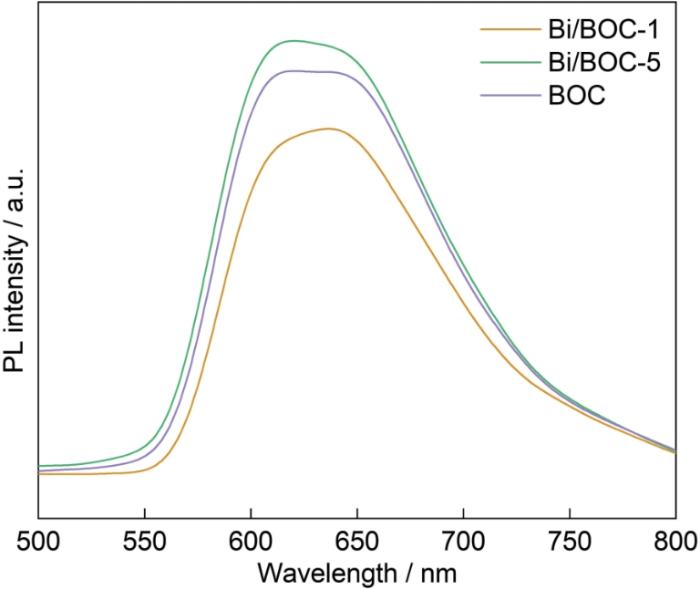
图9
固体荧光(PL)光谱
Fig.9
Solid-state photoluminescence (PL) spectra of the as-synthesized samples
2.7 活性物种的确定
进行Bi/BOC-1的捕获实验以确定光催化过程中的活性物种。在光催化反应体系中分别引入抗坏血酸(AA)、乙二胺四乙酸(EDTA)和甲醇(CH3OH)作为超氧自由基(
图10
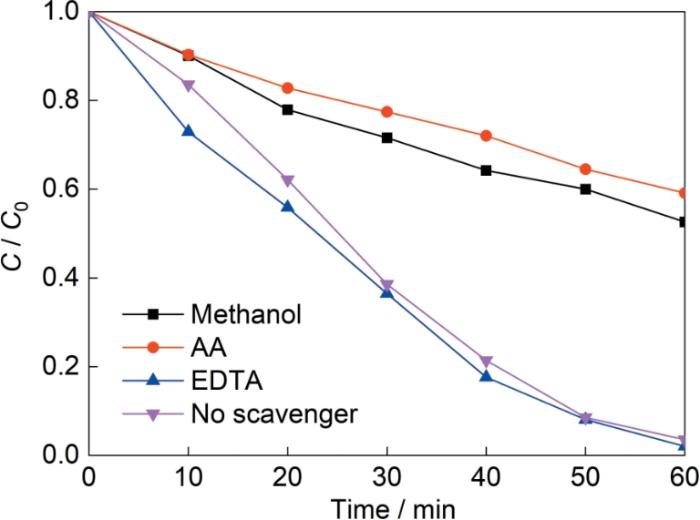
图10
Bi/BOC-1样品在添加不同捕获剂条件下对MG的降解
Fig.10
Degradation of MG by Bi/BOC-1 sample under different capturing agent conditions
为了确认催化体系中存在羟基自由基与超氧自由基,采用DMPO作为捕获剂进行电子顺磁共振(EPR)检测Bi/Bi2O2CO3复合光催化剂。DMPO可与超氧自由基反应生成加合物DMPO-
图11

图11
样品中DMPO-
Fig.11
Electron spin trapping resonance spectra of DMPO-
2.8 复合材料的光催化机理
根据结合自由基捕获实验结果和能带结构分析,提出了Bi/Bi2O2CO3复合光催化剂在紫外-可见光照射下的反应机理,如图12所示。在太阳光辐照下金属Bi的Fermi能级(约-0.17 eV)高于Bi2O2CO3的导带位置(约-0.68 eV)[33],表明Bi表面SPR效应激发的光生电子可注入至Bi2O2CO3的导带。由于O2/
图12
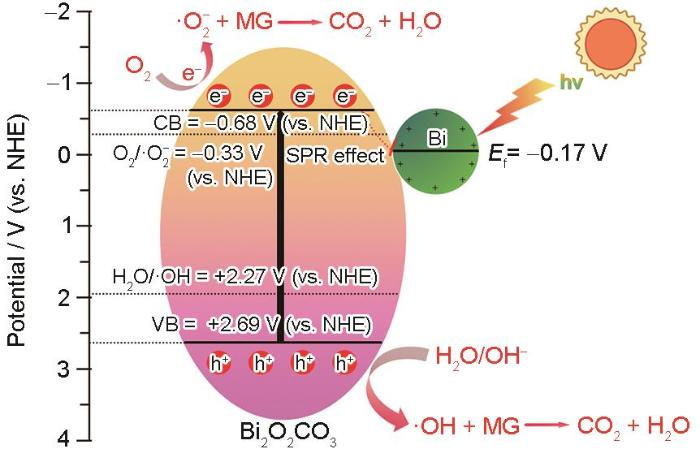
图12
Bi/Bi2O2CO3复合材料在可见光照射下的电子-空穴分离示意图
Fig.12
Schematic diagram of separation of electron-hole pairs over Bi/Bi2O2CO3 composites under visible light
3 结论
(1) 以多聚甲醛作为碳源和还原剂的双功能前驱体,用一步水热法可使Bi3+还原和原位构筑Bi/Bi2O2CO3异质结。
(2) 调控多聚甲醛用量(0.8 g为优化条件),可精确调节单质Bi负载量,制备出的催化剂对环丙沙星和孔雀石绿的光催化活性最优。
(3) 金属Bi的等离子体共振效应与Bi/Bi2O2CO3肖特基异质结的协同作用,可增强可见光吸收和促进光生载流子的分离与传输,使光催化效率显著提高。
参考文献
The advanced progress of single-atom photocatalysts for energy conversion and environmental remediation
[J].
Constructing dual-atom catalysts by replacing N atoms with heteronuclear transition metals as efficient sulfur host materials for lithium-sulfur batteries: a first-principles study
[J].
Progress and challenges in full spectrum photocatalysts: mechanism and photocatalytic applications
[J].
A novel macro-meso-micro intimate heterogeneous structure constructed 3DOM TiO2/rGO/TiN composite for efficiently solar photocatalysis degradation of organic dye pollutants
[J].
Synergistic contact-electro-catalysis and photocatalysis via TiO2@PTFE composites for efficient N2 to NH3 conversion
[J].
Sonochemical synthesis of large two‐dimensional Bi2O2CO3 nanosheets for hydrogen evolution in photocatalytic water splitting
[J].
Oriented charge accumulation mediated by bond reconstruction of interfacial Bi atoms on Bi2O2CO3@bismuth-organic framework heterostructures for simultaneously boosting photocatalytic Cr(VI) reduction and levofloxacin degradation under LED illumination
[J].
Efficient degradation of antibiotic pollutants in water by Ca2+/Ce3+ Co-doped Bi2O2CO3 photocatalysts
[J].
Visible light activation of impurity doped lithium niobate for photocatalysis
[J].
Construction of energy storage heterojunction and enhancement mechanism of dark and full-spectrum energy storage piezoelectric catalysis
[J].
Bi2O2CO3 nanosheet composites with Bi-based metal-organic frameworks for photocatalytic H2O2 production
[J].
Ultrastable and efficient visible-light-driven CO2 reduction triggered by regenerative oxygen-vacancies in Bi2O2CO3 nanosheets
[J].
Transformation of Bi4Cl2S5 into sub-10 nm Bi2O2CO3 nanowires for electrochemical reduction of CO2
[J].
BiOBr/Bi2O2CO3 heterojunction photocatalyst for the degradation of tetracycline
[J].
Preparation and properties of 3D spherical Bi2S3/Bi2O2CO3 photocatalytic materials self-assembled by 2D nanosheets
[J].
Enhanced efficiency of electron-hole separation in Bi2O2CO3 for photocatalysis via acid treatment
[J].
Biosynthesis of plasmonic Ag/Bi2O2CO3 nanocomposites from Acacia hybrid leaf extract with enhanced photocatalytic activity
[J].
Morphology modulation and performance optimization of nanopetal-based Ag-modified Bi2O2CO3 as an inactivating photocatalytic material
[J].
In situ growth of Au nanoparticles on 3D Bi2O2CO3 for surface plasmon enhanced visible light photocatalysis
[J].
Interfacial modulation with aluminum oxide for efficient plasmon-induced water oxidation
[J].
Plasmonic photocatalysis for CO2 conversion to chemicals and fuels
[J].
Tailoring the surface reactivity of plasmonic Au@TiO2 photocatalyst bio-based chitosan fiber towards cleaner of harmful water pollutants under visible-light irradiation
[J].
A plasmonic fiber was rationally designed as an efficient visible-light photocatalyst for the breakdown of organic and inorganic pollutants. The nanostructured Au@TiO2 with tuneable size was fabricated via a photodeposition method and then soaked in chitosan fiber to produce the photoactive plasmonic fiber. Based on the X-ray photoelectron spectroscopy results, some of Ti4+ was reduced in situ to Ti3+ when Au was added, which enhanced the stability and degradation performance. Different water pollutants, including methylene blue, carbofuran, and metronidazole, were completely attacked and degraded by the plasmonic fiber but not the Au@TiO2 photocatalyst. Moreover, the active plasmonic fiber could convert toxic chromium, Cr(VI), to biocompatible Cr(III) (similar to 98.9%) in the presence of citric acid within 21 min. In some cases, the catalytic performance remained almost unchanged, even after being recycled 8 times, with little loss (similar to 4.1%). The plasmonic fiber exhibited enhanced degradation activity, consistent kinetic behavior, catalytic reduction, and stability. This fabric photocatalyst should contribute to possible energy saving and environmental applications. (C) 2019 Elsevier Ltd.
Non-noble metal and nonmetallic plasmonic nanomaterials with located surface plasmon resonance effects: photocatalytic performance and applications
[J].Photocatalysts with located surface plasmon resonance effects (LSPRs) have been studied in recent years due to their superior light harvesting capacity and photocatalytic performance in solving environmental problems and energy shortages. Plasmonic-noble-based photocatalysts are limited in terms of their practical application on account of their high cost, fixed plasma frequency, and low abundance. In order to solve these shortcomings, non-noble metal and nonmetallic plasmonic photocatalysts with LSPRs and advantages such as a lower cost and wider light adsorption range from the UV to NIR region have been developed. This paper reviews the recent development of non-noble metal and nonmetallic plasmonic photocatalysts and advances the research direction of plasmonic photocatalysts to achieve high photocatalytic activity and stability, providing guidance for photocatalysis to solve environmental problems and energy shortages.
Plasmon assisted highly efficient visible light catalytic CO2 reduction over the noble metal decorated Sr-incorporated g-C3N4
[J].The photocatalytic performance of g-C3N4 for CO2 conversion is still inadequate by several shortfalls including the instability, insufficient solar light absorption and rapid charge carrier’s recombination rate. To solve these problems, herein, noble metals (Pt and Au) decorated Sr-incorporated g-C3N4 photocatalysts are fabricated via the simple calcination and photo-deposition methods. The Sr-incorporation remarkably reduced the g-C3N4 band gap from 2.7 to 2.54 eV, as evidenced by the UV–visible absorption spectra and the density functional theory results. The CO2 conversion performance of the catalysts was evaluated under visible light irradiation. The Pt/0.15Sr-CN sample produced 48.55 and 74.54 µmol h−1 g−1 of CH4 and CO, respectively. These amounts are far greater than that produced by the Au/0.15Sr-CN, 0.15Sr-CN, and CN samples. A high quantum efficiency of 2.92% is predicted for the Pt/0.15Sr-CN sample. Further, the stability of the photocatalyst is confirmed via the photocatalytic recyclable test. The improved CO2 conversion performance of the catalyst is accredited to the promoted light absorption and remarkably enhanced charge separation via the Sr-incorporated mid gap states and the localized surface plasmon resonance effect induced by noble metal nanoparticles. This work will provide a new approach for promoting the catalytic efficiency of g-C3N4 for efficient solar fuel production.
Semimetal bismuth-enhanced light absorption, charge transfer and photocatalytic activity
[J].
Dual plasmonic coupling effect in Bi/vacancy-rich Bi2WO6 heterojunction for selective CO2 photoreduction to CH4
[J].
Formamide-assisted one-pot synthesis of a Bi/Bi2O2CO3 heterojunction photocatalyst with enhanced photocatalytic activity
[J].
One-pot hydrothermal preparation of Bi/Bi2O2CO3 with improved photocatalytic activity for bisphenol A degradation
[J].
A Bi/BiOI/(BiO)2CO3 heterostructure for enhanced photocatalytic NO removal under visible light
[J].
Noble metal-like behavior of plasmonic Bi particles as a cocatalyst deposited on (BiO)2CO3 microspheres for efficient visible light photocatalysis
[J].
Plasma enhanced Bi/Bi2O2CO3 heterojunction photocatalyst via a novel in-situ method
[J].
One-pot preparation of Bi/BiOF/Bi2O2CO3 Z-scheme heterojunction with enhanced photocatalysis activity for ciprofloxacin degradation under simulated sunlight
[J].
Defective Bi4MoO9/Bi metal core/shell heterostructure: enhanced visible light photocatalysis and reaction mechanism
[J].
Microwave-hydrothermal preparation and visible-light photoactivity of plasmonic photocatalyst Ag-TiO2 nanocomposite hollow spheres
[J].


