



应用于不同领域的离子交换膜,分为水基类和能量类两大类。水基类离子交换膜主要用于电渗析、扩散透析和膜电容去离子;而能量类离子交换膜则应用于反电渗析、燃料电池和氧化还原液流电池等[1,2]。理想的离子交换膜应具有以下性能:高导电性/低电阻、高离子交换容量(IEC)、高选择透过性、高尺寸稳定性、低膜膨胀和吸水率以及优异的机械性能。市售阴离子交换膜的离子交换容量较低、抗污染性较差和选择透过性低,使膜的使用寿命短、电解效率低以及成本和能耗提高[3]。对离子交换膜进行改性可提高其性能。常用的改性方法,有掺入添加剂、表面改性和调节渗透性[4,5]。例如,在膜中掺入氧化石墨烯(GO)或氮化碳等纳米材料。GO表面富含-COO-和-OH基团,引入的额外电荷在膜内形成新的正负电荷中心,可提高固定电荷密度和增强Donnan排斥,从而使膜的选择透过性提高。同时,额外电荷位点等同于“内置离子交换基团”,无需化学接枝即可使离子交换容量提高15%~40%;在碳材料表面进行磺化或胺化,可精准调控电荷密度[6]。Qiu等[7]将两种功能化离子液体碳纳米管掺入咪唑基聚合物,提高了膜的氢氧化物电导率、碱性稳定性、含水率及机械和热稳定性。导电聚合物这种离子交换材料[8~10]能在控制电极电位的条件下实现离子掺杂或脱杂,从而使其同时具有离子导电性和电子导电性[11]。Kumar等[12]使用三氯化铁作为氧化剂聚合苯胺改性有机-无机杂化离子交换膜,提高了膜的选择透过性、稳定性和致密性;Salmeron-Sanchez等[13]用导电聚合物聚吡咯改性阴离子交换膜(AEM),使其离子交换容量提高还保持了其优异的机械稳定性。提高膜内离子基团的密度可提高其电导率,但是其含水率的提高易引发溶胀,进而降低其化学稳定性和机械韧性。Sun等[14]进行Fe3+辅助耦合的表面改性在基膜表面构建PEI-PPy交联网络,在提高膜的选择透过性的同时保持了优异的机械强度。此外,将导电聚合物与石墨、碳纤维、碳纳米管或石墨烯等碳材料复合,可产生协同导电效应而使聚吡咯的电导率和结构稳定性显著提高[15~18]。
本文中综合考虑膜表面改性的经济性、表面亲水性和高选择透过性提出一种高效制备高选择透过性阴离子交换膜的方法,研究PPy与GO浓度比、电沉积溶液支持电解质浓度以及电流密度对改性膜物化性能的影响。
1 实验方法
1.1 改性膜的制备
实验用化学试剂和材料(均为分析纯)有:型号为IONSEP-AIM的阴离子交换膜(基体为聚乙烯类),GO(对其进行超声处理得到99.98%纳米片),吡咯(99.99%),氯化钠(99.5%),硫酸(99.8%),硝酸(99.8%),六水合三氯化铁(99.7%),氯化钾(99%)和去离子水。
先将阴离子交换膜预处理:将商品AEM裁减使其尺寸为6 cm × 6 cm,然后浸泡入温度为25 ℃的1.0 mol/L NaCl溶液中,垂直旋转搅拌24 h充分实现反离子交换后储存于1.0 mol/L NaCl溶液中(备用)。
阴离子交换膜的改性:将0.1 mol/L吡咯和0.1 mol/L硫酸1∶1混合制得吡咯(Py)溶液,然后将预处理膜样品置于其中在25 ℃磁力搅拌1 h;再分别将0.02 g/L、0.05 g/L、0.1 g/L、0.2 g/L、0.5 g/L的GO分散均匀的电沉积在膜上得到改性膜,记为PPy-GO-M。电沉积GO在单膜双室装置中进行,改性膜将装置分为两个隔室,分别为阳极室和阴极室;阴极室溶液为用于电沉积改性的GO和NaCl混合溶液,阳极室溶液为0.1 mol/L NaCl,阴离子交换膜面向阴极室一侧的膜表面为改性面。采用电沉积法对不同浓度配比的膜进行表面改性,分别制备了吡咯与氧化石墨烯配比为5∶1、2∶1、1∶1、1∶2、1∶5的五种膜,记为M1、M2、M3、M4、M5。
1.2 膜的形貌和性能表征
1.2.1 膜形貌的表征
用ZEISSGeminiSEM 500型扫描电子显微镜(SEM)观察膜表面和断面的形貌,将膜在60 ℃真空干燥箱中烘干24 h至恒重。测试前膜的表面喷金5 min;用能量色散X射线光谱(EDX)和扫描电子显微镜进行膜的元素分析。
用配有全反射组件的Fourier变换显微红外光谱仪(VERTEX70)鉴定AEM中的主要官能团;红外测试条件:扫描次数为16次,分辨率为2 cm-2,光谱范围为4000~450 cm-1。
用型号为ThermoESCALAB250XI的 X射线光电子能谱(XPS)仪检测膜表面元素含量及化学结构;测试条件:真空度8 × 10⁻¹⁰ Pa,激发源采用Al Kα射线,工作电压12.5 kV,灯丝电流16 mA。进行10次的循环信号累加;测试全谱为100.0 eV,步长1.000 eV,停留时间40 ms,以C 1s 284.80 eV结合能为能量标准进行核电校正。
1.2.2 含水率(单位质量干膜的含水质量)和离子交换容量的测试
先用去离子水清洗预处理膜,然后将其在(60 ℃)真空干燥箱中干燥24 h至恒重,准确测量其质量后浸入浓度为1.0 mol/L的NaCl溶液中,24 h后测量膜的湿重,含水率为
式中
式中n为Cl-摩尔数(mmol),
1.2.3 表观迁移数和选择透过性的测试
图1
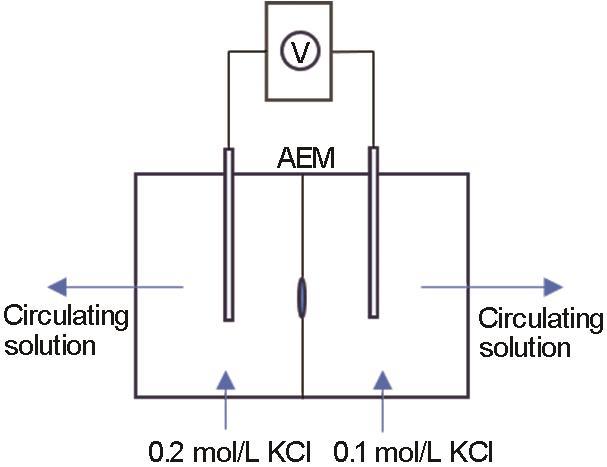
图1
迁移数测试装置示意图
Fig.1
Schematic diagram of the setup for the measurement of transport number
根据迁移数
计算离子选择性
式中t-为阴离子交换膜的表观迁移数;Em为所测膜电位值(mV);E0为理想膜电位值,取15.24 (25 ℃);0.15 mol/L KCl中t = 0.510。
1.2.4 水接触角的测试
使用接触角测量仪(OCA-25)测试薄膜在室温下的静态水接触角:将膜样品用去离子水清洗后放入真空烘箱中干燥24 h,测试用液体为去离子水,平均滴液量为5 μL,在液滴接触膜表面后的5 s内拍摄10幅图像以确定平衡液滴接触角。液滴接触角,为液滴的基线与固液边界切线之间的夹角。
1.2.5 膜面电阻的测试
使用电化学工作站(AUTOLABPGSTAT128N, Switzerland)的四电极设置(图2)测试膜的电化学阻抗,测试面积为1 cm2。在温度为25 ℃的2.0 mol/L NaCl溶液中施加频率为10 kHz~1 mHz的10 mV正弦电势扰动,测试50个频率点,使用NOVA2.1软件拟合。
图2

图2
四电极体系电化学阻抗测试系统
Fig.2
Electrochemical impedance spectroscopy testing system for four electrode system
膜面电阻(Ω)为
式中Rm为膜电阻,R1为测得的膜和溶液的电阻之和,R0为溶液电阻,R为可变电阻。
2 结果和讨论
2.1 PPy与GO的配比对膜性能的影响
图3给出了PPy-GO改性膜的离子交换容量、含水率、选择透过性、接触角和膜面电阻与PPy-GO配比的关系。图3a给出了改性膜的含水率与离子交换容量的关系。可以看出,离子交换容量是决定离子交换膜导电性的主要因素,直接影响膜中亲水性官能团的密度,进而影响膜的吸水率和质子传导性[20]。改性膜的WU和IEC均比原膜有所提高,不同浓度比的改性膜其离子交换容量为2.08~2.45 mmol/g,吸水率为30.18%~36.12%。从图3b可以看出,与原膜相比,随着氧化石墨烯浓度的提高迁移数和选择透过性的变化趋势相似,即先增大后减小再增大,其大小的排序为:M2 > M4 > M5 > M1 > M3。这一结果,可能受膜孔密度和固定电荷密度变化的影响。迁移数最大和选择透过性最高时PPy与GO之比为2∶1,其次为1∶2。其原因是,该质量比的改性膜均匀致密,孔密度和固定电荷密度变化较小,从而增强了共离子的排斥[21]。图3c表明,PPy与GO比为2∶1的改性膜其接触角由原膜的97°降至75.7°;而PPy与GO比为1∶5的改性膜其接触角则从75.7°增大到89.2°。这表明,PPy-GO改性有助于提高AEM表面的亲水性和负电荷密度,尤其是氧化石墨烯浓度为0.02~0.5 g/L时电沉积PPy-GO对膜表面亲水性的提高较为显著。从图3d可以看出,PPy-GO改性膜的膜面电阻与原膜的相近,表明氧化石墨烯层对AEM电阻的影响较小。这表明,PPy-GO改性层很薄,对离子跨膜迁移的影响较小。
图3
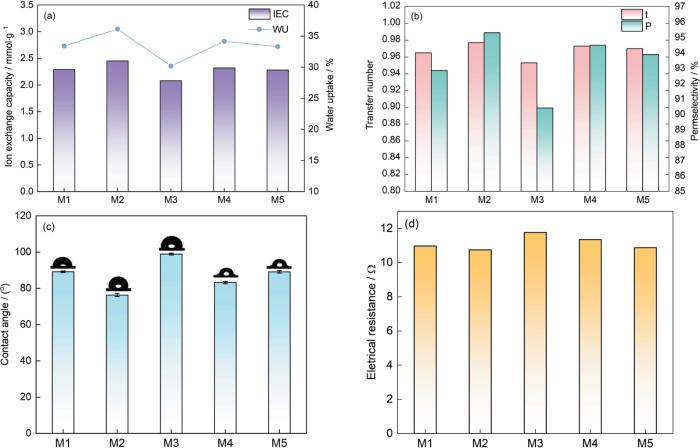
图3
PPy-GO配比对改性膜表面性质的影响
Fig.3
Effect of PPy-GO ratio on the surface properties of modified membranes (a) ion exchange capacity and water uptake, (b) transference number and selectivity, (c) contact angle, (d) surface resistance (Modification conditions: current density 5 mA/cm2, 0.1 mol/L NaCl, deposition time 20 min)
2.2 支持电解质NaCl的浓度对膜性能的影响
电沉积溶液中支持电解质NaCl的浓度对AEM性质的影响,如图4所示。从图4a可以看出,改性膜的含水率略有提高。这表明,改性剂的加入增加了膜中正电荷的数量,从而扩展了导电区域进而提高了膜的含水率。但是,随着NaCl浓度的进一步提高含水率的变化趋于平稳。图4b表明,与原膜相比,随着NaCl浓度的变化,改性膜的选择透过性分别提高了0.59%、0.68%、0.72%、0.65%和0.41%。图4c表明,电沉积溶液中NaCl的浓度较低(0.3 mol/L)时,PPy-GO改性膜的亲水性较强,接触角为77.2°;随着NaCl浓度的提高膜的接触角逐渐增大,表明较高的盐浓度降低了PPy-GO对AEM表面亲水性的影响。较高NaCl的浓度可能影响膜表面亲水性的改善,但是无论NaCl浓度如何变化PPy-GO改性膜的性能始终优于原始膜。此外,在较高浓度NaCl的作用下,膜表面的氯离子可能使氧化石墨烯纳米片产生静电斥力[22,23],使在膜表面的沉积变得困难。这一现象进一步表明,NaCl的浓度应该适当[24]。
图4

图4
氯化钠浓度对改性膜表面性质的影响
Fig.4
Effects of NaCl concentration on the surface properties of modified membranes (a) ion exchange capacity and water uptake, (b) transference number and selectivity, (c) contact angle, (d) surface resistance (Modification conditions: current density 5 mA/cm2, 0.1 g/L GO, deposition time 20 min)
2.3 电流密度对膜性能的影响
图5给出了电流密度对PPy-GO改性阴离子交换膜关键性能的影响。图5a表明,随着电流密度的提高IEC呈“先增后稳”的趋势:电流密度分别为1 mA/cm2、3 mA/cm2、5 mA/cm2、7 mA/cm2和9 mA/cm2时IEC依次为2.39 mmol/g、2.56 mmol/g、2.74 mmol/g、2.16 mmol/g和2.03 mmol/g。在低电流区(小于3 mA/cm2)阳极过电位线性提高,PPy⁺自由基的生成速率随着提高,与GO偶联并锚定于膜表面,可使阳离子位点增多;电流密度高于5 mA/cm2使自由基的浓度过高而引发链终止反应加剧,局部单体的耗尽出现IEC平台甚至小幅下降[5],与实验最大值一致。图5b表明,随着电流密度的提高改性膜的选择透过性随之提高,分别为94.93%、95.21%、97.31%、94.71%和93.06%。电流密度适当提高的PPy-GO层强化了Donnan排斥,提高了离子选择性。过量沉积则产生缺陷,使选择性降低。图5c给出了改性膜的接触角与电流密度的关系。可以看出,随着电流密度的提高接触角依次为99°、90°、86°、80°和83°,GO含氧官能团的暴露使膜表面的亲水性提高;电流密度高于5 mA/cm2时,GO片层的堆叠混乱使有效亲水基团减少,接触角小幅回升。图5d给出了膜的表面电阻与电流密度的关系。可以看出,随着电流密度的提高改性膜的表面电阻比原膜均有所减小,分别为10.22 Ω、8.9 Ω、7.56 Ω、8.1 Ω和8.74 Ω。电流密度为0~5 mA/cm²时,均匀分布的PPy-GO网络提供了连续导电通道;电流密度继续提高使GO无序堆叠和局部沉积层过厚,阻碍离子传输而使膜面电阻止降略升[25]。
图5

图5
电流密度对改性膜表面性质的影响
Fig.5
Effects of current density on the surface properties of modified membranes (a) ion exchange capacity and water uptake, (b) transference number and selectivity, (c) contact angle, (d) surface resistance (Modification conditions: 0.3 mol/L NaCl, 0.1 g/L GO, deposition time 20 min)
综上所述,电流密度为3~5 mA/cm2可使PPy-GO改性AEM的综合性能最优:IEC与选择透过性同步提高,表面电阻降至最低,且亲水性最佳。电流密度超过5 mA/cm2,自由基过量引发链终止和GO无序堆积使膜的性能降低。
在电沉积过程中,带电的氧化石墨烯纳米片在外加电场的驱动下迁移到AEM表面,氧化石墨烯均匀分布在膜表面时,大尺寸的氧化石墨烯纳米片难以穿透AEM而提高了膜的表面性能。但是,过高浓度的氧化石墨烯纳米片可能产生π-π相互作用聚集,在PPy-GO改性膜表面生成不均匀且无序的结构而影响改性效果的提高[26]。以上结果表明,PPy-GO的最佳共沉积条件为:PPy∶GO配比2∶1,支持电解质NaCl的浓度为0.3 mol/L,电流密度为5 mA/cm2,沉积时间为20 min。表1列出了原膜(PM)与改性膜的基础性能的比较。由表1可见,改性膜的WU与IEC同时升高,可能归因于:(i) GO引入的亲水性磺酸/羧基;(ii) PPy固定正电荷(-NH⁺-)渗透吸水;(iii) 更薄且多孔的PPy-GO皮层降低疏水屏障但是不损害机械完整性。
表1 原膜和改性膜的基础性能
Table 1
| Membranetype | Thickness / mm | Water uptake/ % | Ion exchange capacity/ mmol·g-1 | Contact angle/ (°) | Resistance / Ω | Permeability / % |
|---|---|---|---|---|---|---|
| PM | 0.38-0.42 | 29.71 | 1.89 | 123.2 | 11.14 | 92.65 |
| PPy-GO-M | 0.4 | 39.41 | 2.74 | 80.5 | 7.56 | 97.31 |
2.4 改性膜的SEM形貌和EDX
膜的表面形貌是评价其微观结构和性能的重要指标[27]。用SEM观察膜改性前后的表面形貌,图6给出了PPy-GO改性膜的结构变化。用千分尺测量的改性膜厚度没有明显的变化,与膜断面SEM的测试结果一致。如图6a所示,原膜的表面凹凸不平,存在的微孔、空腔和孔隙源于异相离子交换膜由均相离子交换树脂和惰性粘结剂的小颗粒混合而成。但是,这种微观结构有利于活性物质的渗透。PPy-GO改性膜表面聚合反应后,观察到聚集的颗粒和条纹形貌,膜表面更加致密和平整,表明改性物质封堵了膜的孔道[28]。表2列出了原膜和改性膜表面元素的含量。对改性膜的元素组成的EDX分析结果表明(图6b),氮元素的存在表明聚吡咯已成功沉积在膜上;同时,改性膜中氧元素含量的提高进一步证明GO已经掺杂在膜中。膜表面的元素分布特征,可从表面映射图像中清晰观察到。GO纳米片的覆盖,使阴离子交换膜表面的元素均匀分布。
图6

图6
原膜和改性膜表面、断面的SEM照片、碳和氮元素EDX
Fig.6
SEM of the surface and cross-section of the pristine (a) and modified (b) membranes and EDX analysis of carbon and nitrogen elements on the surface and cross-section of the modified membrane (Modification conditions: current density 5 mA/cm2, PPy:GO = 2:1, 0.3 mol/L NaCl, deposition time 20 min)
表2 原膜和改性膜表面元素的含量
Table 2
| Sample | C | O | N |
|---|---|---|---|
| PM | 96.90 | 3.10 | 0.00 |
| PPy-GO-M | 80.20 | 9.20 | 10.50 |
2.5 改性膜的FT-IR谱和XPS谱
图7a给出了阴离子交换膜的红外光谱。可以看出,所有的膜在波长为2900 cm-1 (C-Hst)均出现类聚合物链的吸收峰,改性膜的吸收峰变强。在1450~1550 cm-1范围内的吸收峰可能与PPy的芳香环伸缩振动有关,在1200~1300 cm-1范围内出现了聚吡咯中C-N伸缩振动峰;PPy-GO-M膜在1100 cm-1的吸收峰源于C-O单键的伸缩振动,1731 cm-1和1630 cm-1处的吸收峰对应羧基上的C=O键和未氧化的sp2 C=C键,表明GO成功引入在PPy基体上[29]。值得注意的是,PPy-GO复合层的C=O特征峰下移至1500 cm-1,可能源于GO片层与芳香聚吡咯环之间的相互作用和氢键作用,表明GO羧基的掺杂作用[30,31]。
图7

图7
原膜和改性膜的红外光谱、改性膜的Raman光谱、原膜C 1s光谱和改性膜的C 1s光谱
Fig.7
FT-IR spectrum of the pristine and modified membrane (a), Raman spectrum of PPy and the modified membrane (b), C 1s narrow-spectrum of the pristine membrane (c) and C 1s narrow-spectrum of the modified membrane (d)
图7b给出了PPy、PPy-GO-M的Raman光谱。聚吡咯的Raman光谱中的两个高强度峰分别对应D带和G带。与D带对应的峰指的是与聚吡咯结构中的缺陷或无序相关的峰,G带对应聚吡咯中吡咯环的C=C键的振动。对于PPy-GO-M,与D带和G带对应的峰分别移动到1348和1585 cm-1,意味着PPy和GO物质之间存在π-π相互作用。D带和G带的强度比(ID/IG),表征材料的结构无序或缺陷。从图7b可见ID/IG值下降,表明PPy与GO结合后材料的结构较为有序。XPS谱,可用于分析膜表面不同元素的含量和碳元素的化学价态[32]。如图7c、d所示,与原膜相比,PPy-GO-M的C-N和C=O相对含量有所提高,表明引入氧化石墨烯影响了膜表面化学组成,与EDX分析结果一致;膜的化学组成的改变,表明在改性过程中引入了新基团[33]。
2.6 PPy-GO共沉积的机理
基于对红外光谱的分析结果,提出了可能的聚合机制。实验和理论研究结果表明,在沉积过程中,邻近的环氧基与羟基之间的相互作用导致在石墨烯片上生成了酮基(C=O)。在反应的初期,聚吡咯中的带正电氢原子(H)与环氧化物中的带负电氧原子(O)之间发生静电吸引而生成了新的O-H键,环氧化物中的一个C-O键和吡咯分子中的C-H键断裂生成了GO和Py自由基[34]。如图8所示,吡咯的聚合源于单体氧化引发的一系列氧化、去质子化和交联反应[35]。得到广泛认同的PPy形成机制是[35,36]:氧化剂引发产生两个自由基阳离子,通过偶联反应形成新的自由基,再通过去质子化形成双吡咯二聚体。二聚体再次氧化,并与另一个氧化片段结合。在聚合过程中,氧化、偶联和去质子化的反应随机发生最终生成更长的聚合物链[37]。研究结果表明,部分GO的羟基和环氧基促进了吡咯单体的聚合,具有芳香结构的PPy通过π-π堆积与GO相互吸引。在膜的孔隙中,聚合物可能生成了一定的化学键合或物理缠结,从而使膜的性能提高。
图8

3 结论
(1) 采用共沉积方法和使用GO作为吡咯的化学氧化剂,在一定的电流密度,PPy:GO比和电解质条件下可制备PPy-GO改性的高选择透过性AEM。
(2) 共沉积PPy-GO改性膜表面光滑,亲水性和选择透过性高,膜电阻较低。
参考文献
A hierarchical model for novel schemes of electrodialysis desalination
[J].
A new hierarchical model for the electrodialysis (ED) process is presented. The model has been implemented into gPROMs Modelbuilder (PSE), allowing the development of a distributed-parameters simulation tool that combines the effectiveness of a semi-empirical modelling approach to the flexibility of a layered arrangement of modelling scales. Thanks to its structure, the tool makes possible the simulation of many different and complex layouts, requiring only membrane properties as input parameters (e.g. membrane resistance or salt and water permeability). The model has been validated against original experimental data obtained from a lab scale ED test rig. Simulation results concerning a 4-stage treatment of seawater and dynamic batch operations of brackish water desalination are presented, showing how the model can be effectively used for predictive purposes and for providing useful insights on design and optimisation.
Electrodeposition of cobalt in double-membrane three-compartment electrolytic reactor
[J].
Preparation of dopamine and polyethyleneimine co-deposition modified cation exchange membrane
[J].The cation exchange membrane was prepared by co-deposition of Dopamine (DA) and Polyethyleneimine (PEI) based on mussel bionic binders, and its properties were characterized by infrared spectrometer, scanning electron microscope, and UV visible spectrophotometer. The effect of DA to PEI concentration ratio on the performance of the modified membrane was studied. The results showed that with the increase of PEI concentration, the selective permeability and membrane resistance increased first and then decreased, while the oxidation percentage of the modified membrane decreased first and then increased. When the concentration ratio of DA to PEI was 1:1, the modified membrane had lower oxidation percentage and membrane resistance. Accordingly, the water content and ion exchange capacity were 48.68% and 2.49 mmol/g, respectively, and the selective permeability was up to 97.8%, that is 8.08% superior to the original membrane.
DA-PEI共沉积表面改性阳离子交换膜的制备
[J].
Selectivity of ion exchange membranes: a review
[J].
Porous structure of ion exchange membranes investigated by various techniques
[J].
Mussel-inspired co-deposition of catechol-amine and graphene oxide (GO) modified anion exchange membranes (AEMs) for antifouling
[J].
Preparation of anion exchange membrane with enhanced conductivity and alkaline stability by incorporating ionic liquid modified carbon nanotubes
[J].
Potassium-ion recovery with a polypyrrole membrane electrode in novel redox transistor electrodialysis
[J].
Ion conductivity and permselectivity measurements of polypyrrole membranes at variable states of oxidation
[J].
Recent advances in application of polypyrrole nanomaterial in water pollution control
[J].
Polyaniline modified organic-inorganic hybrid cation-exchange membranes for the separation of monovalent and multivalent ions
[J].
Chemical physics insight of PPy-based modified ion exchange membranes: a fundamental approach
[J].
Monovalent cation exchange membranes prepared by Fe3+-assisted coupled surface modification of PEI-PPy for potassium extraction from simulated brine
[J].
Functionalized graphene-based polyamide thin film nanocomposite membranes for organic solvent nanofiltration
[J].
Fabrication of polyaniline/poly(ethylene oxide)/non-covalently functionalized graphene nanofibers via electrospinning
[J].
Fabrication of graphene sheets/polyaniline nanofibers composite for enhanced supercapacitor properties
[J].
Enhancing electrochemical performance of graphene oxide/polyaniline composite through plasma-assisted chemical cross-linking and surface modification
[J].
Simultaneous measurement and ODE-modeling of ion- and water permeability through ion exchange membranes
[J].
Synthesis of silica immobilized phosphotungstic acid (Si-PWA)-poly(vinyl alcohol) (PVA) composite ion-exchange membrane for direct methanol fuel cell
[J].
Studies on transport properties of surfactant immobilized anion-exchange membrane
[J].
V2O3@C optimized by carbon regulation strategy for ultra long-life aqueous zinc-ion batteries
[J].
Surface composite modification of anion exchange membrane by electrodeposition and self-polymerization for improved antifouling performance
[J].
Modification and properties characterization of heterogeneous anion-exchange membranes by electrodeposition of graphene oxide (GO)
[J].
Aggregation kinetics of graphene oxides in aqueous solutions: experiments, mechanisms, and modeling
[J].Although graphene oxide (GO) has been used in many applications to improve human life quality, its environmental fate and behavior are still largely unknown. In this work, a novel approach that combines experimental measurements and theoretical calculations was used to determine the aggregation kinetics of GO sheets in aqueous solutions under different chemistry conditions (e.g., cation valence and pH). Experimental data showed that both cation valence and pH showed significant effect on the aggregation of GO sheets. The measured critical coagulation concentrations were in good agreement with the predictions of the extended Schulze-Hardy rule. Ca(2+) and Mg(2+) were more effective than Na(+) in aggregating the GO sheets, which could be attributed to the cross-linking between GO sheets by the divalent cations through "bridging" the functional groups at the edges of the GO sheets. When solution pH increases, deprotonation of carboxylic groups was found to play a key role in increasing GO sheet stability and surface charge development. These results suggested that edge-to-edge and face-to-face interactions were the dominant modes of GO aggregation in the presence of divalent metal ions and H(+), respectively. A modified attachment efficiency (α) model was developed on the basis of the Maxwell approach with considerations of both primary and secondary minima. The model predictions matched the experimental measurements of the aggregation kinetics of GO sheets in aqueous solutions under all of the tested experimental conditions well.
Graphene oxides in water: correlating morphology and surface chemistry with aggregation behavior
[J].
Enhanced fumion nanocomposite membranes embedded with graphene oxide as a promising anion exchange membrane for fuel cell application
[J].
Surface modification of inter-polymer cation exchange membrane by controlled loading of polyaniline/metal particles for improved electrodialytic performance during mono-/bi-valent ions separation
[J].
Enhanced anticorrosion performance of PPY-graphene oxide/PPY-camphorsulfonic acid composite coating for 304SS bipolar plates in proton exchange membrane fuel cell
[J].The enhanced corrosion resistance with sustained conductivity are the prerequisites of stainless steel bipolar plates for practical application in proton exchange membrane fuel cell. Herein, we prepare a conductive polypyrrole-graphene oxide/polypyrrole-camphorsulfonic acid bilayer composite coating (PPY-GO/PPY-CSA) on 304 stainless steel bipolar plate by electrodeposition method. The electrochemical tests are conducted in the simulated bipolar plates working environment, the potentiostatic polarization results imply that the PPY-GO/PPY-CSA composite coating offers stable corrosion resistance with low potentiostatic corrosion current density in comparison with the PPY-GO coating. The corresponding electrochemical impedance spectroscopy measurements reveal that the PPY-GO/PPY-CSA composite coating exhibits satisfactory conductivity and displays sustained anodic protection effect with superior anticorrosion performance during the 696 h of immersion. The excellent corrosion protection ability of the PPY-GO/PPY-CSA composite coating owing to its good adhesion strength, compact structure, satisfactory conductivity as well as the synergetic interaction between the two layers of the coating. (C) 2019 The Korean Society of Industrial and Engineering Chemistry. Published by Elsevier B.V.
Graphene oxide/polypyrrole nanocomposites: one-step electrochemical doping, coating and synergistic effect for energy storage
[J].
Pulse electrochemical incorporation of graphene oxide into polypyrrole films for supercapacitor electrode materials
[J].
Fabrication of PVDF cation exchange membrane for electrodialysis: influence and mechanism of crystallinity and leakage of co-ions
[J].
Polyaniline encapsulated sulphonated graphene oxide based cation exchange membrane for electrodialytic separation of mono- and bi-valent ions
[J].
The azanes: a class of material incorporating Nano/micro self-assembled hollow spheres obtained by aqueous oxidative polymerization of aniline
[J].
Mechanism and kinetics of the electrochemical formation of polypyrrole under forced convection conditions
[J].
Mechanisms of the chemical and electrochemical polymerizations of pyrrole compared by product spectrometry and conductivity loss effected by pyridine inhibition or by over-oxidation
[J].


