



重水堆的过剩反应性小、长瞬发中子寿期、大容积常温低压热阱和不停堆换料,还可使用天然铀作为核燃料,燃料利用率较高,是世界三大商用堆型之一,受到各国的持续关注。重水堆堆芯的结构与压水堆不同,其主热传输系统(Primary heat transfer system)在堆芯区的压力边界,由一组水平布置的Zr-2.5Nb合金无缝管(压力管)组成。压力管内部紧贴燃料组件,高温高压的冷却剂在压力管内流动,使燃料组件冷却。
Zr合金材质压力管是重水堆内的核心部件,其与燃料组件间的摩擦、磨损影响重水堆可靠性[16]。自二十世纪70年代加拿大AECL公司为满足重水堆设计需要开展了大量压力管与燃料组件的磨损实验[17],积累了实验数据[18,19]。重水堆燃料组件的构成,包括燃料(棒束)包壳、支撑垫板和端板等。燃料包壳管外侧的支撑垫板与压力管内壁直接接触,燃料包壳间也彼此隔开,大大降低了燃料包壳的磨损程度。因此,由于重水堆燃料组件的特殊结构,重水堆的磨损问题主要是压力管的磨损[20],而压力管的磨损是支撑垫板所致[21]。因此,亟需研究压力管与承重垫片的微动磨损行为,以及高温高压水中压力管的磨损机制和材料退化方式。Attia等研究了温度对Zr-2.5Nb压力管的微动磨损行为的影响,提出随着温度的升高Zr合金的磨损系数先增大后减小,可归因于在不同温度下产生的第三体层(Third-body layer)性能差异[22]。Kumar等研究了氢化物对Zr-2.5Nb压力管微动磨损行为的影响。氢化物的生成使摩擦系数和磨损程度降低,可归因于氢化物降低了Zr合金的耐腐蚀性,使第三体层较快形成[23]。上述关于Zr-2.5Nb压力管微动磨损行为的研究,是在室温空气或高温空气中开展的,采用的接触形式是球-板接触,缺少对高温高压水中Zr-2.5Nb管内壁与垫片间微动磨损行为的研究。与在室温空气或高温空气相比,高温高压水中Zr合金的腐蚀加快[24,25],促进第三体层的形成;同时,Zr合金的硬度降低、塑性增强[26],使磨损机制和损伤形式发生变化。而且球-板接触可视为点接触,其接触区应力较为集中。但是,Zr-2.5Nb管-垫片接触为线接触,接触区应力较为分散。接触形式的不同是影响微动磨损的主要因素之一[27]。因此,亟须研究高温高压水中Zr-2.5Nb压力管与垫片间微动磨损行为。本文模拟重水堆一回路水中研究两种典型振动工况下Zr-2.5Nb压力管和承重垫片间微动磨损行为,分析Zr-2.5Nb压力管内壁的磨损体积/深度,计算磨损系数,观察磨损区的表面/截面形貌和理清压力管的磨损机制和损伤形式。
1 实验方法
实验用材料:带有预氧化膜的重水堆压力管,名义成分为Zr-2.5Nb-0.1O。对磨材料:重水堆燃料组件用带支撑垫板的Zr-4燃料包壳。实验用支撑垫板材质的主要成分(质量分数):1.35%Sn,0.23%Fe,0.12%O,0.08%Cr,Zr余量。如图1所示,用线切割制备压力管和垫片试样,压力管的长度为32.0 mm,宽度为12.0 mm,厚度为4.3 mm;装配完成后,压力管和垫片的接触区,是长度为30.0 mm、宽度为3 mm的矩形。
图1

图1
压力管和垫片试样的实物图
Fig.1
Installation picture of pressure tube sample and bearing pad sample
在室温下用超纯水配制重水堆典型一回路溶液,LiOH的浓度为1.2 mg/kg,室温pH = 10.2,将溶液置入水化学回路。高压釜内温度设置为310 ℃,压力为15.5 MPa,溶解氧DO < 5 μg/kg,溶解氢DH = 0.8 mg/kg,通过水化学回路实时监测和控制。
根据重水堆运行经验,选择了两种典型的重水堆燃料棒束振动工况:其一,法向力10 N、振幅±50 μm,频率30 Hz,运行时间50 h;其二,法向力40 N、振幅±150 μm,频率25 Hz,运行时间67 min。在微动实验过程中,数据采集系统实时采集储存摩擦力-位移(Ft-D)曲线。实验后取出试样,用超纯水和无水乙醇清洗后风干。为了保证数据的准确性,每组实验至少重复3次,取其结果的平均值。
用白光干涉仪(Zygo Newview 9000)观察压力管磨损区的3D形貌,根据体积和深度计算磨损系数;用场发射扫描电子显微镜(SEM, FEI XL 30)观察压力管磨损区表面和截面形貌,以分析磨损机制和损伤形式。
2 实验结果
根据Ft-D曲线判断微动状态[28,29]:Ft-D曲线为闭合直线,表明微动为粘着状态;Ft-D曲线为半张开的梭形,表明微动属于混合粘-滑状态;Ft-D曲线为张开的平行四边形,表明微动为完全滑移状态。在微动过程中Ft-D曲线的变化如图2所示。随着微动周次的增加两种典型工况下的Ft-D曲线均保持平行四边形,表明在整个微动过程中微动始终为完全滑移状态,Zr-2.5Nb压力管和垫片的接触界面发生相对运动。而且,可将Ft-D曲线的两个峰值绝对值之和的平均值视为摩擦力。如图2a,b所示,在10 N工况下平均摩擦力约为3.8 N,平均摩擦系数约为0.38;如图2c,d所示,在更为严苛的40 N工况下,平均摩擦力约为11.7 N,平均摩擦系数约为0.29。
图2
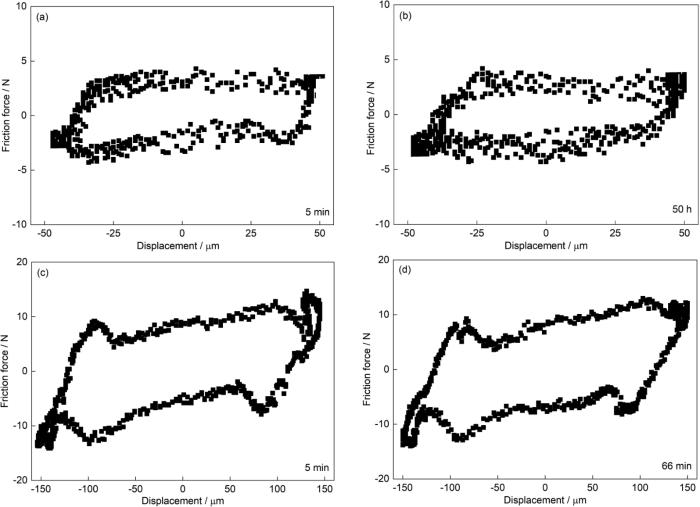
图2
两种工况下Ft-D曲线随微动周次的变化
Fig.2
Variations of Ft-D curves with fretting cycles under two conditions (a, b) 10 N, (c, d) 40 N
图3给出了两种典型工况下Zr-2.5Nb压力管内壁磨损区的3D形貌。可以看出,磨损区较为均匀,表明压力管与垫片接触良好,实验结果具有代表性。根据3D形貌可清晰辨别Zr-2.5Nb压力管内壁磨损区和磨损区边缘的磨屑堆积,表明在这两种工况下材料的损失极为严重,可归因于相对滑动有利于磨屑的产生和排出。
图3
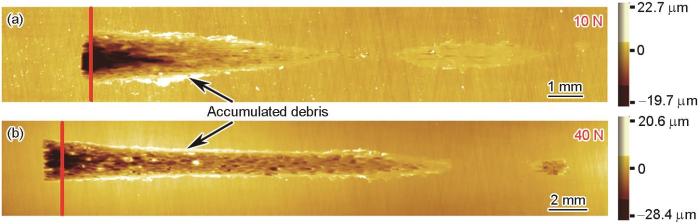
图3
两种工况下Zr-2.5Nb压力管内壁磨损区3D形貌
Fig.3
3D morphologies of worn areas on Zr-2.5Nb pressure tube under two conditions (a) 10 N, (b) 40 N
图4
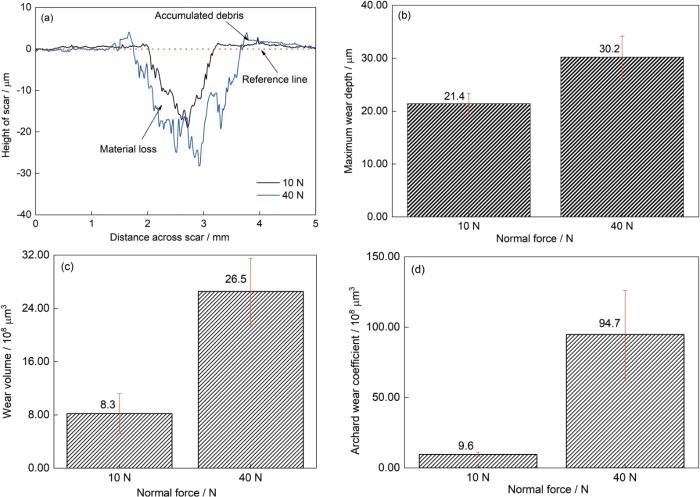
图4
两种工况下Zr-2.5Nb压力管内壁的磨损区轮廓
Fig.4
Cross-sectional profile (a), the maximum wear depth (b), wear volume (c) and Archard wear coefficient (d) of worn area on Zr-2.5Nb pressure tube under two conditions
图5

图5
两种工况下Zr-2.5Nb压力管内壁磨损区SEM表面形貌
Fig.5
Surface morphologies of worn areas on Zr-2.5Nb pressure tubes under two conditions (a, b) 10 N, (c, d) 40 N
图6

图6
在10 N下Zr-2.5Nb压力管内壁磨损区截面SEM形貌
Fig.6
Cross-sectional morphologies of worn area on Zr-2.5Nb pressure tube under 10 N (a) overall image, (b) magnified image of region A, (c, d) magnified images of local regions
图7
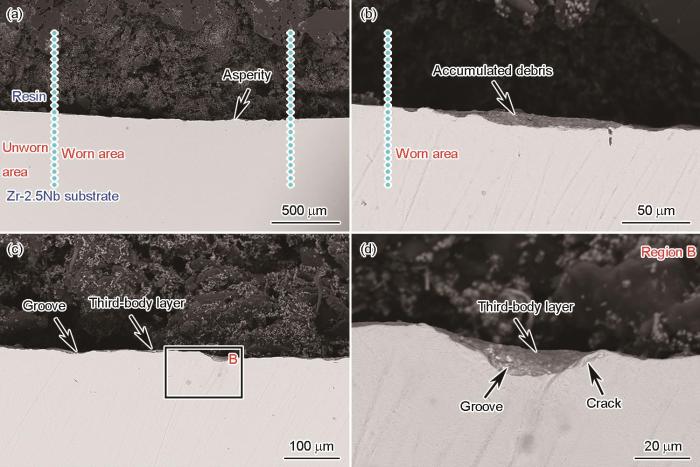
图7
在40 N下Zr-2.5Nb压力管内壁磨损区截面SEM形貌
Fig.7
Cross-sectional morphologies of worn area on Zr-2.5Nb pressure tube under 40 N (a) overall image, (b) edge image of worn area, (c) magnified image of local region, (d) magnified image of region B
3 讨论
重水堆中Zr-2.5Nb压力管在完全滑移状态下的主要磨损机制是磨粒磨损。在压力管内壁和承重垫片表面有大量的微凸体,二者接触区的微凸体间紧密接触。这表明,在微动过程中施加的法向力和切向力由微凸体承受。因此,循环载荷使微凸体发生疲劳开裂。如图6c所示,磨粒磨损起源于微凸体开裂产生的磨粒。裂纹的扩展深度取决于法向力和切向力;法向力或振幅较大时,微凸体的尺寸范围增大且受载荷影响的区域较深,使微凸体两侧裂纹的相对位置变宽,且裂纹扩展的深度增大。同时,高温高压水的腐蚀使裂纹扩展加快,微凸体两侧的裂纹扩展并在底部相遇,形成可在接触区内运动的磨粒。
4 结论
(1) 模拟重水堆一回路水中两种典型工况下压力管和垫片的微动状态均为完全滑移区,严苛工况下压力管的磨损程度极为严重,因为磨粒尺寸的增大加剧了磨粒磨损。磨损程度与摩擦力有关,与摩擦系数无关。
(2) 压力管的主磨损机制为磨粒磨损,亚机制为微耕;微耕起源于微凸体开裂产生的大块磨粒,磨粒与基体为两体接触;随着磨粒的移动,在基体表面形成犁沟,并伴随着磨粒的碎化。
参考文献
Effect of temperature on fretting wear behaviors of Zr-4 zirconium alloy under different operating conditions
[J].
温度对不同运行工况下Zr-4锆合金微动磨损行为的影响
[J].
采用高温微动磨损试验机对Zr-4合金管进行切向微动磨损试验,通过改变法向载荷研究了试验温度(25,100,200,325℃)对不同运行工况(完全滑移区和部分滑移区)下微动磨损行为的影响。结果表明:在相同试验温度下完全滑移区的摩擦因数高于部分滑移区,不同运行工况下200,325℃时的摩擦因数更早达到稳定状态。在完全滑移区,合金的磨损机制包括磨粒磨损、氧化磨损和剥层,温度的升高对合金微动磨损程度的影响较大,325℃时的微动磨损程度最大;而在部分滑移区,磨损机制包括剥层、黏着磨损和氧化磨损,试验温度的升高对微动磨损程度的影响很小。在相同试验温度下,部分滑移区的微动磨损量远低于完全滑移区;试验温度的升高对完全滑移区微动磨损量的影响较明显,而对部分滑移区的影响不大。
Investigating grid-to-rod fretting wear of nuclear fuel claddings using a unique autoclave fretting rig
[J].
Fretting wear mechanisms of Zircaloy-4 and Inconel 600 contact in air
[J].
Influence of contact shape and supporting condition on tube fretting wear
[J].
Effect of spring shapes on the variation of loading conditions and the wear behaviour of the nuclear fuel rod during fretting wear tests
[J].
Effect of normal force on fretting wear behavior of zirconium alloy tube in simulated primary water of PWR
[J].
The transformation of fretting corrosion mechanism of zirconium alloy tube mating with 304 stainless steel in high temperature high pressure water
[J].
Effect of coolant pH on the fretting corrosion behavior of zirconium alloy
[J].
Wear behavior of zirconium-4 alloy after different irradiation damage level
[J].
Fretting wear behaviors of Zr-4 alloy under different ions irradiation conditions
[J].
Establishment of fretting maps of Zr alloy cladding tube mated with Zr alloy dimple in simulated primary water of pressurized water reactor
[J].
Fretting wear behaviour of Zr alloy cladding tube under partial slip regime with different duration in simulated primary water of PWR
[J].
Fretting wear behavior of Zr alloy cladding tube mated with Zr alloy dimple under mixed fretting regime in simulated primary water of PWR
[J].The fretting wear behavior of Zr alloy cladding tube under mixed fretting regime in a high-temperature pressurized water was investigated. The main wear mechanism is adhesive wear, with characters of small-scale delamination at the center of worn area and serious delamination on the worn edge. A long crack throughout the worn area and other cracks propagated towards the substrate are observed. The cross-sectional microstructure of worn area can be divided into a thick third-body layer, thin inner oxide layer and thick tribologically transformed structure layer, and their formation mechanisms are analyzed in detail. Finally, the mixed fretting regime process and the microstructural evolution during fretting wear are discussed.
Evolution of fretting wear behavior of zirconium alloy cladding tube under gross slip regime in simulated primary water of pressurized water reactor
[J].The evolution of fretting wear behavior of zirconium alloy cladding tubes mated with dimples under the gross slip regime (GSR) was investigated. The findings revealed that the primary wear mechanisms under GSR were delamination, surface fatigue wear and abrasive wear, and the fretting damage rate mainly depends on delamination. The cross-sectional microstructure of the worn area could be divided into the third-body layer, tribologically transformed structure layer, and general deformation layer, with their formation mechanisms analyzed. Furthermore, the mechanism of wear-induced grain refinement was identified as dynamic recrystallization (DRX), including both continuous DRX and discontinuous DRX. Additionally, the processes of fretting wear and DRX were discussed.
Effects of displacement amplitude and normal force on fretting wear behavior of zirconium alloy tube in simulated primary water of PWR
[J].
Fretting-wear of zirconium alloys
[A].
Fretting wear of Zr-alloy pressure tubes under the combined effects of in-plane and out-of-plane flow-induced vibrations
[J].
Fretting-wear of zirconium alloys
[J].
Effect of temperature on tribo-oxide formation and the fretting wear and friction behavior of zirconium and nickel-based alloys
[J].
Tribological and corrosion behavior of hydrided zirconium alloy
[J].
The correlation between tetragonal phase and the undulated metal/oxide interface in the oxide films of zirconium alloys
[J].
Mechanism of the α-Zr to hexagonal-ZrO transformation and its impact on the corrosion performance of nuclear Zr alloys
[J].
In-situ investigation of the fatigue crack initiation and propagation behavior of Zircaloy-4 with different hydrogen contents at RT and 300 oC
[J].
Fretting wear of laterally supported tube
[J].
Study of fretting wear behavior of 690TT heat exchanger tube under three fretting regimes in high temperature pressurized water
[J].
Contact and rubbing of flat surfaces
[J].The interpretation of certain phenomena occuring at nominally flat surfaces in stationary or sliding contact is dependent on the assumed distribution of the real area of contact between the surfaces. Since there is little direct evidence on which to base an estimate of this distribution, the approach used is to set up a simple model and compare the deduced theory (e.g., the deduced dependence of the experimental observables on the load) with the experimental evidence. The main conclusions are as follows. (a) The electrical contact resistance depends on the model used to represent the surfaces; the most realistic model is one in which increasing the load increases both the number and size of the contact areas. (b) In general, mechanical wear should also depend on the model. However, in wear experiments showing the simplest behavior, the wear rate is proportional to the load, and these results can be explained by assuming removal of lumps at contact areas formed by plastic deformation; moreover, this particular deduction is independent of the assumed model. This suggests that a basic assumption of previous theories, that increasing the load increases the number of contacts without affecting their average size, is redundant.


