



超声切割止血刀通过换能器将电能转换成55.5 kHz的超声波,利用其机械效应、空化效应和热效应实现组织的切割和止血,使用这种刀手术时雾气少、视野好、可精准切割,是新一代Ⅲ类微创外科手术器械[1]。
钛合金的化学成分、相组成以及织构是影响其弹性模量的主要因素。钛合金中α相的弹性模量较高(110~120 GPa),β相的弹性模量较低(70~80 GPa)[7]。提高Al、O等α相稳定元素的含量可提高α相的弹性模量;提高Mo、V、Nb、W等β相稳定元素的含量使β相的稳定性升高和弹性模量降低[8~11]。α相的各向异性对其弹性模量的影响较大,与c轴平行方向的弹性模量为145 GPa,与c轴垂直方向的弹性模量为100 GPa[7]。Ti2448合金中的β相沿<100>方向的弹性模量为27.1 GPa,沿<110>方向的弹性模量为56.3 GPa,沿<111>方向的弹性模量为88.1 GPa[12]。Ti-6Al-4V合金由α和β相组成,α相和β相的弹性性能共同决定其弹性模量[13]。在不同温度进行热处理,可调整α相和β相的体积分数、β相中β稳定元素的含量以及α相的织构强度,从而调整Ti-6Al-4V合金的弹性模量[14~17]。目前,关于固溶和时效处理对Ti-6Al-4V合金显微组织和拉伸性能的影响研究较多[18~20],但是,精确调控其弹性模量的机制尚不清楚,尤其是退火温度对α/β相协同作用的影响机理缺少深入研究。鉴于此,本文在不同温度对Ti-6Al-4V合金退火,研究退火温度对其组织和弹性模量的影响并揭示其机制。
1 实验方法
实验用合金的成分(质量分数,%)为:Al 6.36、V 4.17、Fe 0.19、O 0.12、C 0.016、N 0.0058、H < 0.001、Ti余量,按此成分将海绵钛、铝钒中间合金和铝豆混合后压成电极,用真空自耗电弧熔炼三次得到Ti-6Al-4V合金铸锭。将铸锭进行单相区开坯锻造、两相区锻造、轧制和拉拔等工序制成直径为5.8 mm的丝材。
用金相法测得合金的相变温度Tβ 为978 ℃。使用KSL-1200X-5L箱式马弗炉将合金丝材退火,退火温度分别为560、590、620、650、680、710、740、770、800、830、860、890、920、950、980和1010 ℃。以10 ℃/min的速率将马弗炉温升至指定温度后将样品放入,保温2 h后取出空冷。用于分析组织的试样取自丝材的纵截面,依次用150#、800#、2000#和3000#砂纸将其表面打磨,再用平均粒径为50 nm的SiO2悬浊液(抛光液)在麂皮抛光布上机械抛光成镜面,使用HF∶HNO3∶H2O体积比为1∶3∶10的腐蚀液进行腐蚀。用日本理学的Ultima Ⅳ X射线衍射仪(X-ray Diffraction,XRD) 分析试样的相组成;用TESCAN MIRA3 AMU扫描电镜(Scanning Electron Microscope, SEM)观察其显微组织;用Oxford-C Nano电子背散射衍射仪(Electron Backscatter Diffraction, EBSD)表征其显微组织和织构。用RFDA HTVP1750-C设备并用脉冲激励法测量其弹性模量。用M6标准拉伸试样在Zwick/Roell Z150万能实验机上进行室温拉伸,拉伸速度为1 mm/min,试样的尺寸如图1所示。
图1

2 结果和讨论
图2

图2
原始材料样品的SEM图、IPF面分布图和极图
Fig.2
SEM image (a), IPF plane distribution diagram (b), and pole figure (c) of the original material sample
图3给出了在不同温度退火试样的XRD谱。可以看出,所有样品的谱中均出现明显的α相衍射峰和微弱的β相衍射峰,表明这些试样均由α相和β相组成。原始样品中α相的(0002)峰最强,对应的衍射角为38.14°。随着退火温度的提高,α相的(0002)峰向右移动,退火温度为920 ℃时衍射角增大到38.48°。其原因是,随着退火温度的提高,Ti-6Al-4V合金中α相稳定元素和β相稳定元素重新分配,α相稳定元素聚集在α相中,Al元素在α相中的溶解度也随之提高,半径更小的α相稳定元素Al固溶进入α相置换Ti原子,使α相的晶格常数变小,从而使衍射角增大,即衍射峰右移。
图3

图3
在不同退火温度样品的XRD谱
Fig.3
XRD patterns of samples at different annealing temperatures
图4给出了在不同温度退火试样的SEM图像。由图4a、b可见,在560和650 ℃退火材料的加工流线依然存在,α相晶粒的平均尺寸为1.88 μm,晶粒沿着拉拔方向呈扁平的椭球状;而β相的形状从长条状向近球形过渡,表明材料发生了回复;在740 ℃退火后加工流线完全消失,β相的尺寸增大到0.93 μm,其微观形貌呈等轴状(图4c);在830 ℃退火后,材料中β相内出现板条状平均宽度为24 nm的次生α相(αs)。残余的β相和次生α相构成的β转变组织(βT),显著长大,平均尺寸为2.21 μm (图4d中的箭头标出),合金由初生α相(αp)、残余β相和次生α相组成。在920 ℃退火材料中的初生α相平均晶粒尺寸达到5.08 μm,β相的平均尺寸大于5.65 μm。同时,β转变组织中的板条α相数量增多,宽度增大(图4e);在1010 ℃退火后材料中已无初生α相,只有交错排列的板条状α相和残余β相,其中α相的宽度明显增大,平均宽度为2.76 μm,残余β相的平均宽度只有32 nm (图4f)。
图4

图4
在不同温度退火热处理试样的SEM图
Fig.4
SEM results of the samples subjected to annealing heat treatment at 560 oC (a), 650 oC (b), 740 oC (c), 830 oC (d), 920 oC (e) and 1010 oC (f)
随着退火温度的提高,β相的体积分数随之提高,材料的组织逐渐由变形组织转变为等轴组织;退火温度达到830 ℃时开始析出板条状的次生α相,材料的组织转变为双态组织;退火温度提高到β单相区时初生α相完全消失,其组织变为网篮组织。
SEM中β相(或β转变组织)体积分数的统计结果,在图5中给出。在560~978 ℃退火时,随着退火温度的提高β相(或β转变组织)的体积分数逐渐增大;退火温度高于相变点进入单相区后,材料只由β转变组织组成,初生α相完全消失。原始材料拉拔后保留了较多的亚稳β相,低温退火使部分β相转为α相,因此在560~830 ℃退火试样中的α相体积分数比原始材料的高;在560~830 ℃退火时,随着退火温度的提高α相的体积分数缓慢降低,β相的体积分数缓慢提高;在830~1010 ℃退火时,随着退火温度的提高β相的体积分数较快提高。在低温下β相稳定元素富集在体积分数较低的β相中,随着退火温度的提高β相的体积分数随之提高,β相中的β稳定元素含量降低。在冷却过程中,根据β相的稳定性高温β相依次转变为稳定β相、亚稳β相和次生α相。因此,在560~830 ℃退火时,β相处于稳定状态;退火温度为830 ℃时,β相处于亚稳状态;在830~1010 ℃退火时β相的稳定性较低,在冷却过程中析出次生α相[21]。
图5
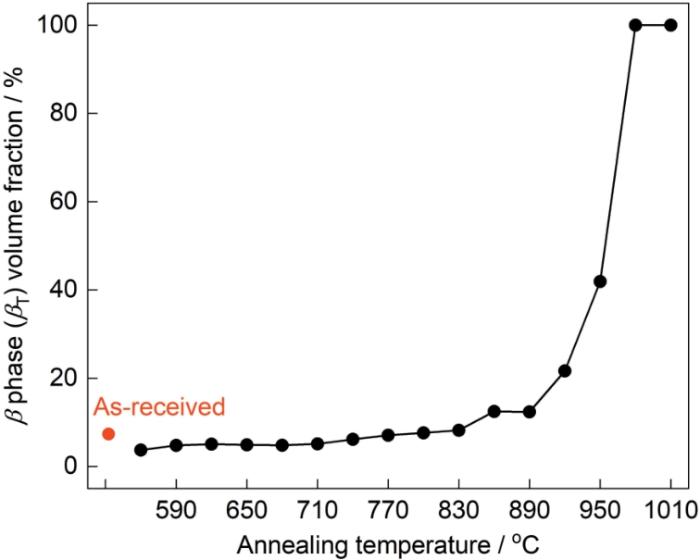
图5
材料中β相(βT)的体积分数随退火温度的变化
Fig.5
Graph of the volume fraction of the β phase (βT) in the material varying with the annealing temperature
图6

图6
在不同温度退火热处理试样的IPF面分布图
Fig.6
IPF plane distribution diagrams of the samples subjected to annealing heat treatment at 650 oC (a), 740 oC (b), 830 oC (c) and 920 oC (d)
图7给出了合金中晶粒的取向分布(Grain orientation spread, GOS)。可以看出,退火温度为650 ℃时晶粒取向角差值为0°~2°的晶粒可分为两种形态:其一是回复导致取向角变小的较大晶粒,其二是再结晶生成的新的较小无畸变晶粒;退火温度为740和830 ℃时,取向角差值为0°~2°的晶粒占比超过90%。与低温退火相比,晶粒明显长大。
图7

图7
在不同温度退火热处理试样的GOS图
Fig.7
GOS diagrams of the samples subjected to annealing heat treatment at 650 oC (a), 740 oC (b), 830 oC (c) and 920 oC (d)
统计在不同温度退火试样中晶粒的取向角:将取向角为0°~2°变形量较小的晶粒视为再结晶晶粒,取向角为2°~7°的晶粒视为回复晶粒,取向角大于7°的晶粒视为变形晶粒[22]。三种晶粒的占比统计结果,在图8中给出。在退火前的原始试样中有大量位错。退火温度为560~740 ℃时,随着退火温度的提高合金中的位错减少,释放了残余应力,组织中的变形晶粒和回复晶粒随之减少,再结晶晶粒的数量不断增加;退火温度为740 ℃时再结晶晶粒的含量超过90%,表明发生了完全再结晶。退火温度为740~830 ℃时,析出次生α相前回复晶粒与再结晶晶粒的比例保持在1∶9;退火温度为830~950 ℃时析出的次生α相与母相存在Burgers位向关系,但不同变体集束间较大的位向差使再结晶晶粒的比例略有降低。
图8

图8
退火温度对变形晶粒、回复晶粒和再结晶晶粒体积分数的影响
Fig.8
Influence of annealing temperature on the volume fractions of deformed grains, recovered grains and recrystallized grains
图9给出了在不同温度退火试样的极图。可以看出,在650 ℃退火的试样其{10
图9

图9
在不同温度退火处理试样的极图
Fig.9
Pole figures of the samples subjected to annealing heat treatment at 650 oC (a), 740 oC (b), 830 oC (c) and 920 oC (d)
合金试样的弹性模量与退火温度的关系,如图10所示。退火前原始合金的弹性模量为104.30 GPa,退火使弹性模量提高。可以看出,在560~830 ℃退火,随着退火温度的提高弹性模量从106.14 GPa减小到104.55 GPa (降低了1.59 GPa,降幅为1.50%,平均降低速率为0.0059 GPa/℃);在高于830 ℃的温度退火,弹性模量随着退火温度的提高而增大,在950 ℃退火后弹性模量达到最高值109.97 GPa (提高了5.42 GPa,增幅为5.18%,平均提高速率为0.06 GPa/℃)。在560~830 ℃退火的合金由初生α相和β相组成,随着退火温度的提高α相的体积分数降低而β相的体积分数提高,因α相的弹性模量比β相的高,因此合金的弹性模量降低。在830 ℃退火后β相处于弹性模量值最低的亚稳临界状态,使合金的弹性模量最低。在830~950 ℃退火,随着退火温度的提高初生α相的体积分数降低,但是β转变组织中析出的次生α相的体积分数提高,使合金的弹性模量提高;另一方面,退火织构的出现使织构强度提高,也使其弹性模量提高[7,23]。
图10

图10
材料的弹性模量随退火温度的变化
Fig.10
Elastic modulus of the material varying with the annealing temperature
图11给出了这种合金的拉伸性能与退火温度的关系。退火前原始试样的屈服强度为983 MPa,在560和590 ℃退火后其屈服强度分别提高到1029和1034 MPa;在590~830 ℃退火,随着退火温度的提高屈服强度从1034 MPa降低到809 MPa;在830~920 ℃退火,合金的强度随着退火温度的提高从809 MPa提高到868 MPa。
图11

图11
材料的屈服强度和抗拉强度、断后延伸率和断面收缩率随退火温度的变化图
Fig.11
Variation of the material's yield strength and tensile strength (a), elongation after fracture and reduction of area (b) with annealing temperature
在低于590 ℃的温度对合金退火相当于时效处理,其屈服强度和抗拉强度都提高;在590~830 ℃退火,随着退火温度的提高变形组织发生回复和再结晶,合金中β相的体积分数提高而稳定性降低,使β相的强度下降并伴随着初生α相和β相晶粒的长大,使其强度显著降低;在830 ℃退火,β相恰处于临界亚稳状态导致其强度最低。在830~920 ℃退火,β转变组织由稳定的β相和次生α相组成,α/β界面增多的强化作用使合金试样的强度提高[25]。在560~920 ℃退火,合金处于双相区,β转变组织的体积分数从3.71%提高到21.63%,体积分数高于78%的初生α相使延伸率约为20%,其塑性不变;在单相区退火合金的组织由交错排列的稳定β相和次生α相组成,变形协调能力的降低使其塑性急剧下降。
3 结论
(1) 在560~830 ℃退火,随着退火温度的提高Ti-6Al-4V合金中β相的体积分数由3.71%提高到8.19%,初生α相的体积分数由96.29%降低到91.81%;在830 ℃退火后从β相中析出了次生α相;在830~950 ℃退火,随着退火温度的提高β转变组织的体积分数由8.19%提高到41.91%;在高于Ti-6Al-4V合金相变点的980和1010 ℃退火初生α相完全消失,高温β相转变为稳定β相和次生α相。
(2) 在560~830 ℃退火Ti-6Al-4V合金的弹性模量由106.17 GPa降低到104.57 GPa;在830~950 ℃退火弹性模量由104.57 GPa提高到110.00 GPa。
(3) 在560和590 ℃退火Ti-6Al-4V合金的屈服强度为1029和1034 MPa;在590~830 ℃退火,随着退火温度的提高屈服强度由1034 MPa降低到809 MPa;在830~920 ℃退火,随着退火温度的提高屈服强度由809 MPa提高到868 MPa。在560~920 ℃退火,Ti-6Al-4V合金的塑性不变。
参考文献
Effects of different tissue loads on high power ultrasonic surgery scalpel
[J].
The objective of this study is to investigate the influence of various tissue loads on the working characteristic of the ultrasonic scalpel, including working frequency, input admittance and reflection factor. Ex vivo animal experiments are carried out and relevant discussions of experimental results are provided. Admittance measurement results show that different tissue loads have different effects on a scalpel's working ability. Soft tissue makes the working frequency decrease and bone tissue makes it increase. Radius of admittance circles and reflection factor are also different. Equivalent circuit model is found and with a least-square parameter identification method, input admittance of ultrasonic scalpel with different tissue loads is solved. Results show that admittance circle radius is determined by the value of R1. Changes in L1 and C1 contribute to the shift of working frequency. This study will help decrease the sensitivity of ultrasonic scalpel to loads and greatly increase surgery efficiency.
Mechanical properties and in vitro biocompatibility evaluation of TiN/TiO2 coated Ti6Al4V alloy
[J].
Fabrication, structure and mechanical and ultrasonic properties of medical Ti6Al4V alloys part Ⅰ: microstructure and mechanical properties of Ti6Al4V alloys suitable for ultrasonic scalpel
[J].Ti6Al4V alloy has been considered as a key component used in ultrasonic scalpels. In this series of papers, the fabrication, structure, and mechanical and ultrasonic properties of medical Ti6Al4V alloys suitable for ultrasonic scalpel are studied systemically. These alloys with low elastic modulus and present a typical bimodal microstructure with relatively high β phase content (~40%) and lamellar α thickness of ≤ 0.9 µm. In the first paper, the relationship between the microstructure and mechanical properties of hot-rolled Ti6Al4V alloys treated by heating treatment is discussed. In the second paper, the dependence of the ultrasonic properties on the microstructure of the heat-treated Ti6Al4V alloys is reported. With increasing solid solution temperature, the content and size of the primary α phase decrease. In contrast, the content and size of the lamellar α phase increase. Additionally, the β phase content first increases and then decreases. The microstructure of Ti6Al4V alloys could be slightly changed by aging treatment. When the solid solution treatment temperature increases to 980 °C from 960 °C, the average size of the lamellar α phase in the alloys increases by 1.1 µm. This results in a decrease in the average yield strength (93 MPa). The elastic modulus of alloys is mainly controlled by the β phase content. The microstructure of alloys by solution-treatment at 960 °C shows the highest β phase content and lowest average elastic modulus of 99.69 GPa, resulting in the minimum resonant frequency (55.06 kHz) and the highest average amplitude (21.48 µm) of the alloys at the length of 41.25 mm.
Investigation to resonant frequency control of high power ultrasonic transducer based on the beating model
[J].
Physics of ultrasonic surgery using tissue fragmentation: part Ⅰ
[J].The ultrasonic surgical aspirator employs a vibrating metal tip to fragment tissue and then aspirates the debris through the hollow center of the tip. The mechanism of interaction has been stated to be poorly understood, most likely related to cavitation, possibly in concert with other mechanical actions. In Part I (of two parts), the role of stroke, suction, frequency, tissue type and tip area are examined with regard to tissue fragmentation rate. A tissue quantifier which can be used to relate the performance of the ultrasonic aspirator and a selected tissue is described. Suction is shown to make a significant contribution to the interaction. Thermal and tip load experiments are used to estimate the acoustic pressures and powers at the tip. In Part II, photographic and acoustic data from experiments in water and on a range of fresh pig tissues are used to further investigate the fragmentation effect.
Fabrication, structure, and mechanical and ultrasonic properties of medical Ti6Al4V alloys part Ⅱ: relationship between microstructure and mechanical properties and ultrasonic properties of ultrasonic scalpel
[J].In this study, the ultrasonic resonance parameters of Ti6Al4V alloys under different heat treatments are measured by an impedance analyzer. The amplitude of the specimens is measured experimentally by means of optical microscope and image analysis software. These results show that the ultrasonic properties of Ti6Al4V alloys are closely related to β phase content and elastic modulus of the alloys. The highest volume fraction of the β phase appears in the specimen treated by solid solution treatment at 960 °C is 40.2%. These alloys present the lowest average elastic modulus (~99.69 GPa) and the minimum resonant frequency (55.06 kHz) and the highest average amplitude (21.48 µm) when the testing sample length is 41.25 mm. These findings can be used to guide the design of medical Ti6Al4V alloys for ultrasonic scalpels.
Recent advances and prospects in β-type titanium alloys for dental implants applications
[J].
Microstructural characterization and mechanical behaviors of Ti-xNb alloys (x = 34-44.at%) fabricated by spark plasma sintering: the role of sintering temperature and Nb content
[J].
Mapping of elastic stiffness in an α+β titanium alloy using atomic force acoustic microscopy
[J].
Effect of Fe- and Cu-content on microstructure and mechanical properties of TC10 Ti-alloy bars
[J].The influence of Fe- and Cu-content on the microstructure and mechanical properties of TC10 alloy bars was investigated by means of scanning electron microscopy, EDS analysis of transmission electron microscopy, and mechanical testing machine. The results indicate that for the as rolled and annealed TC10 Ti-alloys, with the increasing Fe- and Cu-content, their yield strength and tensile strength increase, while the changes in elongation and cross-sectional shrinkage at break are not significant. For the solid solution aged TC10 alloy, Ti is evenly distributed in both βt and αp phases, Al is less distributed at grain boundaries, while V, Fe, and Cu elements are more abundant at the grain boundaries in βt phase. For TC10 alloys with the same Fe- and Cu-content, with the increasing solid solution temperature, their yield strength and tensile strength increase, while the elongation and cross-sectional shrinkage decrease. For TC10 alloys subjected to solid solution treatment at the same temperature, with the increase of Fe and Cu content, their yield strength and tensile strength increase, while the elongation and cross-sectional shrinkage at break decrease. The higher the solid solution temperature, the more significant the influence of alloying elements Fe and Cu on the strength and plasticity of the alloy. Being subjected to solid solution treatment at 900 oC, the alloy with 0.65% Fe and 0.65% Cu can achieve superior comprehensive mechanical properties, with yield strength, tensile strength, elongation, and cross-sectional shrinkage at break of 1392 ± 3 MPa, 1435.5 ± 0.5 MPa, (8 ± 1)% and (21.5 ± 1.5)%, respectively.
Fe和Cu的含量对TC10钛合金棒材力学性能的影响
[J].
Elastic properties of Ti-24Nb-4Zr-8Sn single crystals with bcc crystal structure
[J].
Effect of heat treatment on the microstructural and mechanical properties of Ti6Al4V-equine bone nanocomposites
[J].
Anisotropy of Young′s modulus and tensile properties in cold rolled α′ martensite Ti-V-Sn alloys
[J].
Tunable the mechanical properties of β-Ti1- x M x binary alloys by transition metal M (M = Fe, Mo, Nb, Ni) substitutional doping: a first-principles study
[J].
Impact of 4d transition metals doping on the properties of TiVNbMo-based HEAs
[J].
Optimisation of process parameters to address fundamental challenges during selective laser melting of Ti-6Al-4V: a review
[J].
Influence of processing on microstructure and mechanical properties of (α+β) titanium alloys
[J].
Phase transformations during cooling in α+β titanium alloys
[J].
The influence of β phase stability on deformation mode and compressive mechanical properties of Ti-10V-3Fe-3Al alloy
[J].
Current issues in recrystallization: a review
[J].
Microstructure and textural evolution during cold rolling and annealing of commercially pure titanium sheet
[J].
Recent developments in plastic deformation behavior of titanium and its alloys during the rolling process: a review
[J].Titanium (Ti) and its alloys are used in various applications, including aircraft frames, ship parts, heat exchangers, and evaporator tubes, because of their extraordinary properties, such as high specific strength, excellent corrosion resistance at high temperatures, good castability, and weldability. Plastic deformation plays a crucial role in securing the appropriate microstructure and strength of Ti and alloys in these applications. The rolling process, one of the most useful methods for plastic deformation, causes efficient deformation inside the materials, resulting in grain refinement, dislocation slip, and twinning. Recent studies on the rolling behaviors of Ti and its alloys have explored their crystallographic and mechanical properties. These investigations primarily analyzed the microstructural changes and their influence on the mechanical properties under different temperatures and rolling methods. This study elucidates a complex relationship between the processing conditions and the resulting properties. Therefore, this paper presents a comprehensive review of the state-of-the-art Ti rolling. Various key aspects for verifying the microstructure of Ti and its alloys are discussed, including electron backscatter diffraction analysis, Schmidt factor, and misorientation distribution.
Effect of heat treatment on mechanical properties of a novel Ti-6Al-2Mo-2V-3Nb-2Fe-1Zr alloy
[J].Herein, the effect of heat treatments (solution, solution+single aging and solution+double aging) on the microstructure and mechanical properties of a novel Ti-based alloy Ti-6Al-2Mo-2V-3Nb-2Fe-1Zr was investigated through microstructure characterization and tensile testing. The microstructure observations indicate that the alloy prior to heat treatment possesses a bimodal microstructure consisted of primary αp phase, secondary αs phase, and β phase, and the volume fraction of the primary αp phase and secondary αs phase is 22% and 21%, respectively. After solution treated in the dual phase zone, a portion of the original αp and αs phases was replaced by β phase and the alloy microstructure is comprised of metastable β phase, equiaxed primary αp phase, and coarse lamellar secondary αs phase. After single aging, a large number of evenly distributed needle-like nano secondary αs phases are precipitated within the β phase; After double aging, the volume fraction of α phase increases significantly, while the grain size of primary αp phase and secondary αs phase increases with the increasing aging time. Quasi-static tensile test results reveal that alloys subjected to solution treatment in the dual phase zone exhibit significant enhancements in elongation compared to the as hot-rolled ones, but yielding at lower stress levels. Single aging results in significant increase of strength, thereby presenting an improved strength-ductility balance of the alloy. In comparison with the hot rolling process, the double aging process is unfavored to the ductility, moreover, with the increasing aging time, the strength decreases and elongation increases gradually. Finally, the variation in the work hardening rate of the alloy subjected to different heat treatments may be explained by work hardening rate-strain curves. Based on the experimental data, the modified Hall-Petch constitutive model is fitted, whilst the results predicted by this constitutive model have high coincidence with the experimental data.
热处理对新型Ti-6Al-2Mo-2V-3Nb-2Fe-1Zr合金力学性能的影响
[J].研究了固溶、固溶+单级时效和固溶+双级时效三种热处理制度对Ti-6Al-2Mo-2V-3Nb-2Fe-1Zr合金的微观组织和力学性能的影响。结果表明,这种合金热处理前的组织为双态组织,由初生α<sub>p</sub>相、次生α<sub>s</sub>相和β相组成,其中初生α<sub>p</sub>相的体积分数为22%,次生α<sub>s</sub>相的体积分数为21%;在双相区固溶后,合金原来的热轧态α<sub>p</sub>和α<sub>s</sub>相部分转变为β相,其组织由亚稳β相、等轴状初生α<sub>p</sub>相和粗大片状的次生α<sub>s</sub>相组成;单级时效后,β相中析出了大量均匀分布的纳米细针状次生α<sub>s</sub>相;双级时效后α相的体积分数显著提高,随着时效时间的增加初生α相和次生α相的晶粒尺寸逐渐增大。准静态拉伸实验结果表明,与热轧态试样相比双相区固溶态试样的延伸率显著提高,但是屈服强度明显降低;单级时效后试样的强度显著提高,强度-塑性平衡更佳;与热轧态试样相比,双级时效后试样的延伸率有所降低,随着时效时间的增加合金的强度降低而延伸率提高。用加工硬化率曲线解释了不同热处理的钛合金应变硬化率的变化趋势,并基于实验结果拟合了修正的Hall-Petch模型,与实验结果吻合较好。


