



316L奥氏体不锈钢具有优异的加工性能、高温抗力和耐腐蚀性能,广泛应用于石油化工、海洋防腐、航空航天和核电等领域[1,2]。核电的能量密度高和低碳排放,是一种理想的绿色能源。随着核电技术的发展和应用范围的扩大,对可用于制造反应堆压力容器内构件和冷却系统管道的316L不锈钢的需求持续增长。但是,原始状态的316L不锈钢屈服强度较低(仅约为300 MPa),在高温、高辐照剂量和存在复杂腐蚀介质的条件下长期服役,如此低的强度可能使其过早失效而引发安全事故[3,4]。为了提高316L不锈钢的力学性能,可将其轧制以调控晶粒尺寸和组织形态[5,6]。目前,仍用传统的拉伸性能评估材料的性能。但是,切取试样会破坏材料的结构。因此,应该建立非破坏性评价材料力学性能的方法。
近年来,尝试用硬度间接评估强度,其理论基础是金属材料的硬度与其屈服强度的经验关系[7],例如Tabor公式σy ≈ HV/3。对于316L不锈钢,轧制使其硬度和强度同步提高,标定轧制工艺参数与硬度和强度三者的定量关系即可评估其在役部件的力学性能。与布氏硬度、洛氏硬度以及纳米硬度的测试相比,维氏硬度的测试精度较高和适用范围更广,尤其适用于高精度、微小样品的硬度测试。特别是,用现代便携式维氏硬度检测装置可原位检测关键服役部件的硬度。结合这一技术建立硬度与强度之间的定量关系,可评估在役材料的性能还能及时评估加工成本较高、尺寸较小的贵金属材料[7~10]。Tabor[7]提出,钢材以及其他合金的抗拉强度与维氏硬度的比值与其应变硬化系数之间有一定的关系。Lai和Lim[11]发现,铝合金、管道钢、低碳钢以及Assab 760钢的强度变化时,强度系数与应变硬化系数都与硬度呈线性关系。这一结果,可用于预测材料的抗拉强度和屈服强度。Zhang等[12]研究不同组织的铜合金、锆基、钴基金属玻璃(BMG)以及Al₂O₃合金时,发现压痕行为及剪切变形性能显著影响其硬度与强度的比值。Umemoto等[13]致力于建立单一相结构钢材的硬度与拉伸性能之间的关系,并提出了多种硬度与屈服强度、拉伸强度之间的比例系数。Tian等[14]也研究了高熵合金的硬度与强度之间的关系,并根据不同的晶体结构提出了定量的根据硬度预测强度的模型。
1 实验方法
实验用316L不锈钢的化学成分(质量分数,%)为:P 0.04、C 0.03、Si 0.40、Mn 1.12、Cr 16.1、Ni 10.2、Mo 2.04、S 0.002、Fe余量。将直径为55 mm的棒材分别进行固溶处理(Solution treatment)、40%冷轧(Cold rolling)、90%温轧(Warm rolling)、以及90%冷轧(Cold rolling),将这4种试样分别记为ST、40CR、90WR、90CR。使用维氏硬度测量仪(LM247AT)测量这4种试样的维氏硬度,在测量过程中使压头下压方向与样品平面垂直(如图1所示),实验力为4.905 N,保载时间15 s,不同硬度点的间隔为500 μm,每组样品测试100个硬度点取其硬度的平均值。在Instron 5982万能实验机上进行室温拉伸实验,拉伸速率为5 × 10⁻⁴ s-1,拉伸载荷加载方向与轧制方向相同。用电火花线切割机加工狗骨形拉伸试样,其尺寸如图2所示,图中标注了试样的轧制方向(Rolling direction, RD)、横向(Transverse direction, TD)以及法向(Normal direction, ND),平行段尺寸为12 mm × 3 mm × 4 mm,总长为60 mm,每种工艺各测试至少3个试样取其结果的平均值[16]。
图1

图1
316L不锈钢的维氏硬度及压痕尺寸测量方法示意图
Fig.1
Schematic diagram of vickers hardness and indentation size measurement method for 316L stainless steel
图2

图2
316L不锈钢拉伸试样的尺寸
Fig.2
Configuration of 316L stainless steel tensile specimen
拉伸实验结束后,在试样夹持段切取尺寸约为5 mm × 4 mm × 5 mm的方块,依次用400#、800#、1200#、1500#、2000#砂纸将其表面精细打磨后用2.5 μm金刚石抛光膏进行机械抛光使表面光滑,再用王水(HCl∶HNO3 = 3∶1)腐蚀其表面用于观察微观组织。用X射线衍射仪(X-Ray diffraction, XRD)测试变形后材料的物相组成,扫描范围为40°~100°,扫描速率为5 (°)/min。使用Zeiss Sigma 500扫描电子显微镜(SEM)观察试样轧制平面、横截面以及法平面的组织,并用电子背散射衍射(Electron backscattered diffraction, EBSD)技术测定晶粒取向、织构并统计晶粒尺寸。用FEI Tecnai F20型透射电子显微镜(Transmission electron microscope, TEM)观察变形过程中试样内位错的分布和晶粒形态。用激光共聚焦显微镜(Laser scanning confocal microscope, LSCM)观察压痕形貌并统计反映金属塑性变形性能的压痕深度(ΔD)和金属堆积高度(ΔH)。
2 实验结果
2.1 显微组织和物相
从图3a可见ST试样内部形成了均匀的单相奥氏体组织,其中有大量等轴晶及孪晶;从图3b可见,40CR试样内有密度较高的位错,晶粒逐渐沿轧制方向(RD)被拉长且有整齐的剪切带和变形孪晶。90WR试样(图3c)和90CR试样(图3d)中的晶粒细小形成了纤维状组织且部分夹杂物分布在其上。剪切带和变形孪晶的生成是面心立方金属在位错滑移受到抑制的情况下的协调变形方式。同时,剪切带的协同变形作用使变形孪晶以束状的形式嵌套在剪切带中形成了特殊的眼状纳米孪晶束(Eye-shaped NT bundles)结构(图3c、d)[17~21]。随着变形量的增加平均晶粒尺寸由8.8 μm依次减小到0.99 μm (图3e~h)。
图3

图3
固溶和轧制后316L不锈钢的形貌和晶粒尺寸统计
Fig.3
Microstructure morphology and grain size statistical chart of 316L stainless steel after solution treatment and rolling (a, e) ST, (b, f) 40CR, (c, g) 90WR, (d, h) 90CR
从图4给出的XRD谱可以看出,ST试样中的衍射峰均为奥氏体峰,分别为FCC的(111)、(200)、(220)、(311)、(222)。这表明,固溶处理的316L不锈钢其原始态微观组织均为奥氏体组织。在经不同轧制的试样中出现3个不同的衍射峰分别为BCC的(110)、(200)、(211),表明应变诱发了不同程度的马氏体相变。40CR试样和90WR试样的谱中马氏体的衍射峰不明显,90CR试样的谱中奥氏体的衍射峰明显削弱。从40CR到90CR试样其马氏体的衍射峰强度依次提高,表明其马氏体含量的提高。
图4

图4
将316L不锈钢进行4种工艺处理后的XRD谱
Fig.4
XRD patterns of 316L stainless steel after being treated by four processes
电子背散射衍射的表征结果如图5所示,可见ST试样中晶粒随机取向。在反极图(图5a)中晶粒取向颜色在样品表面较为分散,没有明显的织构特征。40CR试样(图5b)中的晶粒平均尺寸明显减小但是奥氏体晶粒形态未完全破坏并生成许多变形孪晶,冷轧使晶界更加清晰和紧密而形成了以奥氏体为主掺杂了许多剪切带和变形孪晶的轻度异质层状结构[22]。90WR试样(图5c)中的晶粒沿轧制方向拉成长条状形成了明显的织构,大部分晶粒取向在轧制过程中发生了变化[23]。同时,温轧使样品中的部分晶体结构发生了一定程度的回复而使位错密度降低和部分应力释放,使其综合力学性能部分恢复。冷轧后的90CR试样(图5d),极高的变形程度使其内部产生较大的应力,在反极图中出现了许多未被解析的黑色部分。但是,仍能观察到细小的变形晶粒以及冷轧引起的显著织构特征[5]。
图5

图5
4种316L不锈钢试样轧制面的晶粒形态和取向示意图
Fig.5
Schematic diagrams of grain morphology and orientation on the rolling surface of four 316L stainless steel samples (a) ST, (b) 40CR, (c) 90WR, (d) 90CR
图6给出了4种试样中几何必要位错(Geometrically necessary dislocations, GND)的分布和密度。从ST试样到90CR试样,GND密度依次提高。固溶处理消除了ST试样中的晶体缺陷,位错周围自由移动空间的增大和相互作用的减少,维持了位错的低密度状态。40CR试样中的位错密度显著提高,位错集中分布在晶界附近且分布不均匀,较大晶粒内的位错密度较低,小晶粒处的位错密度较高。冷轧施加的外力使晶体发生塑性变形,使滑移系产生大量位错,并聚集在原子排列不规则的晶界。将90WR试样在高温下变形,虽然其内部原子的活性使部分位错能攀移和交滑移以缓解位错塞积,但是变形产生的位错远超回复过程的位错消除量,使位错密度仍大幅度提高。90CR试样的变形温度较低,位错运动以滑移为主,较细的晶粒和大量晶界使位错的运动空间极为有限,使大量位错塞积在一起。
图6

图6
4种316L不锈钢试样轧制面的GND分布和密度示意图
Fig.6
Schematic of GND distribution and density on the rolling surface of four 316L stainless steel samples (a) ST, (b) 40CR, (c) 90WR, (d) 90CR
图7

图7
90CR和90WR试样的组织形态和眼状纳米孪晶束结构
Fig.7
Microstructure morphology and eye-shaped nanotwin bundles of 90CR and 90WR samples (a) 90CR, (b) magnified regional view of specimen 90CR, (c) 90WR, (d) magnified regional view of specimen 90WR
2.2 维氏硬度和压痕的微观形貌
不同工艺的处理使316L不锈钢的平均维氏硬度发生了显著变化。图8a给出了4种试样的硬度。可以看出,从ST试样到90CR试样,其平均维氏硬度随着晶粒尺寸的减小增幅达119.9% (表1)。硬度的变化,反映了材料抵抗弹性变形、塑性变形或破坏的能力。随着晶粒尺寸的减小相同面积的材料中晶界数量显著增加,变形过程中晶界对位错运动的阻碍逐渐增强,在宏观上表现出更高的硬度。如图8c~f所示,4种试样的硬度数据均符合正态分布特征,其平均值位于分布峰值,标准差决定了曲线的宽窄程度,而方差和标准差则反映了数据的离散性。这种离散性,体现了材料显微组织的均匀程度。如图8b所示,从ST试样到90CR试样硬度方差呈现出先增大后减小的变化规律。ST试样的方差值最小即硬度的波动最低,表明其组织均匀性最优;40CR试样的方差最大,表明其组织均匀性较差。虽然标准差呈现先升后降的趋势,但是所有试样的标准差均在较低水平,且中位数与平均值的偏差不超过5%。这表明,4组试样的整体组织均匀性都较为良好。
图8

图8
4种试样的硬度变化示意图、硬度的参数变化示意图和分布直方图
Fig.8
Schematic diagram of the change in hardness (a), hardness parameters (b) and the histogram of the hardness distribution (c-f) for four samples
表1 4种试样的力学性能参数[16]和压痕尺寸
Table 1
| Material | σy / MPa | σb / MPa | HV | ΔD / μm | ΔH / μm | K | n |
|---|---|---|---|---|---|---|---|
| 90CR | 1225 ± 8 | 1363 ± 13 | 431 | 6.61 | 1.03 | 3098 | 0.20 |
| 90WR | 1010 ± 22 | 1170 ± 21 | 379 | 7.04 | 1.15 | 1710 | 0.09 |
| 40CR | 793 ± 23 | 904 ± 8 | 310 | 7.73 | 1.43 | 1087 | 0.06 |
| ST | 285 ± 3 | 667 ± 11 | 196 | 10.49 | 1.55 | 895 | 0.22 |
图9

图9
4种试样的硬度压痕形貌和截面测量示意图
Fig.9
Vickers hardness indentation morphology and cross-sectional measurement schematics for four samples (a) ST, (b) 40CR, (c) 90WR, (d) 90CR
2.3 拉伸性能
式中
图10

图10
4种试样的应变硬化率曲线和真应力-应变曲线
Fig.10
Strain hardening rate curves (a) and true stress-strain curves (b) of four samples
3 讨论
3.1 不同工艺处理的316L不锈钢组织演化和性能强化机制
固溶处理使316L不锈钢在前序加工过程中受损的奥氏体晶格恢复,出现了部分孪晶、位错密度显著降低和消除内应力,晶体结构趋于均匀稳定。但是,ST试样的晶粒尺寸较大。根据Hall-Petch[26,27]关系,这种较大的晶粒尺寸限制了其强度的进一步提高,并且晶粒内空间充足的位错运动使其加工硬化能力较弱(图3a);剪切力作用使40CR试样内产生了大量位错、变形孪晶及剪切带,其相互协调使材料的塑性变形得以进行。如图6b所示,轧制过程中破碎的晶粒周围的位错密度较高,而在较大晶粒中位错主要分布在晶界。90WR试样内发生部分回复,使其韧性与同等变形量的冷轧相比有所恢复。90CR试样剧烈的变形使其内部出现大量应力集中点,在变形过程中剪切带的相互作用降低了局部应力集中导致材料断裂的可能,从而维持了塑性变形[21,28,29]。在90CR和90WR试样中,剪切带的相互作用产生了大量眼状纳米孪晶束(图7c,d)。这种眼状纳米孪晶束是一种使不锈钢的强度和延展性提高的微观结构[29,30]。同时,XRD结果显示,超过马氏体相变点的应力集中会诱发马氏体相变,使剪切带中生成细小的马氏体晶粒,从而使材料进一步强化[18,31~35]。这一演化过程如图11所示,是316L不锈钢经不同工艺处理后硬度、强度显著提高的原因[36,37]。
图11

图11
316L不锈钢在固溶和轧制处理过程中的组织演化机理
Fig.11
Microstructural evolution mechanism in 316L stainless steel during solution treatment and rolling processes
3.2 压痕形貌的形成原理
从图12可见,经不同工艺处理的4种试样其强度系数K随着硬度的提高而增大,而应变硬化指数n则随着硬度的提高先减小后增大,压痕深度和堆积高度则随着硬度的提高而降低。Zhang等[12]的研究表明:测试硬度的压头压入使材料发生加工硬化。测试后的硬度压痕形态分为下沉型、堆积型和裂纹型。不同形态对应不同的硬度-强度关系,其中具有堆积型压痕形态的硬度与强度之间存在线性关系。图9所示的4种试样的压痕形貌及截面测量示意图表明,这4种试样的压痕形态均为典型堆积形态。分析压痕形貌的形成原理,有助于理解材料硬度与强度之间的关系。压头与金属表面接触使接触区域迅速发生局部变形并引起材料硬化。硬化后的区域挤压周围金属,使塑性变形在更广泛的范围内扩展。但是,不同工艺处理使材料内的位错运动空间受限,从而限制了塑性变形的范围。从ST试样到90CR试样,其强度系数和应变硬化指数分别揭示了材料的硬化极限和材料的硬化速率。ST试样的硬化速率最高但是其强度系数较低,而90CR试样的硬化速率较高和强度系数最高。这4种试样靠近压痕处的材料其加工硬化能力不同,进而形成了不同的堆积型压痕形貌。
图12

图12
4种试样的硬度与强度系数、应变硬化指数、压痕深度和堆积高度的关系
Fig.12
Relationships between the hardness of the four specimens and the strength coefficient (a), the strain hardening exponent (b), the indentation depth (c), the accumulation height (d)
3.3 硬度与强度之间的定量关系
式中HV为维氏硬度(MPa);m为比例系数(约为2.6~3.7)[12],σb为材料的抗拉强度(MPa)。材料的处理工艺及其内部组织不同,因此m的数值可能在小范围内波动。许多学者的研究指出[34,39~42],金属材料的硬度与屈服强度或抗拉强度之间一般存在3倍关系(表2),不同试样的硬屈比(维氏硬度与屈服强度的比值)和硬强比(维氏硬度和抗拉强度的比值)反应硬度与屈服强度和抗拉强度3倍关系的偏差程度。实验结果表明,ST试样的硬度与屈服强度之间的关系严重偏离了3倍关系,误差为55.49%。随着材料强度的提高,3倍关系的误差随之减小。从40CR试样到90CR试样其误差分别为21.69%、15.03%和12.99%,逐渐靠近3倍关系(图13a)。对比图12a和b,在误差减小的同时强度系数上升而应变硬化指数先下降后逐渐上升。这一现象说明,材料的加工硬化能力影响材料硬度与屈服强度之间的3倍关系。不同试样的屈强差不同,测试硬度的压头与材料表面接触使材料发生短暂的弹性变形后便开始塑性变形直至保载时间结束。在此过程中,应变硬化速率的不同使不同的试样硬化到不同的状态。而不同的强度系数则使材料的硬化极限不同,硬化速率和强度系数更高试样的硬度更接近材料的本征特性,因此随着硬度的提高硬度与屈服强度之间的3倍关系逐渐接近。从低强度试样到高强度试样,不同的应变硬化能力只对应了材料在某一状态下硬度与屈服强度的3倍关系。也正是硬化能力的差异使硬度与屈服强度关系中的比例系数发生波动。从图13b可以看出,大多试样的硬度与抗拉强度之间的3倍关系符合较好,但是40CR试样硬度与抗拉强度的3倍关系的偏差最大。在硬度测试中40CR试样的硬度波动最大,其方差为162.5HV (图8d),其原因可能是40%冷轧后组织中出现了随机分布且分散的剪切带和变形孪晶,形成了如图5b所示的轻度异质层状结构[22]。这种结构,使硬度出现较大的波动。从图6b也可以看出,一些晶粒细小区域的位错密度显著高于其他区域,在硬度测试过程中较软的奥氏体组织先发生塑性变形和位错源先开动,但是位错的运动受到周围剪切带和变形孪晶的限制而发生塞积,组织结构之间的非均匀协调塑性变形共同反映材料抵抗破坏的能力。大量的硬度测试结果表明,40CR试样的硬度波动性较大,与抗拉强度的3倍关系偏差也最明显。而ST、90WR和90CR试样的硬度与抗拉强度之间的3倍关系较为准确,误差均小于10% (图13b)。
表2 4种试样的硬屈比和硬强比
Table 2
| Sample | Hardness / MPa | 3σy / MPa | 3σb / MPa | σy, error / % | σb, error / % |
|---|---|---|---|---|---|
| 90CR | 4223.8 | 3675 | 4089 | 12.99 | 3.19 |
| 90WR | 3174.2 | 3156 | 3510 | 15.03 | 5.50 |
| 40CR | 3038.0 | 2379 | 2712 | 21.69 | 10.73 |
| ST | 1920.8 | 855 | 2001 | 55.49 | -4.18 |
图13

图13
4种试样的硬度与屈服强度以及抗拉强度之间的关系示意图
Fig.13
Schematic diagrams of the relationships between the hardness of the four specimens and the yield strength (a) as well as the tensile strength (b)
为了验证上述硬度与强度间的3倍关系,分析了文献[43]中抗拉强度为492~1274 MPa的Cu-Be合金数据(表3)。可以看出,随着这种合金强度的提高其强度系数呈现持续增大的趋势,而应变硬化指数先减小后增大再减小。从图14可见,随着Cu-Be合金强度的提高其硬度与屈服强度之间3倍关系的误差逐渐减小。同时,硬度与抗拉强度之间2.7倍的线性关系且误差小于10%。从图14b也可见,抗拉强度最低的Cu-Be合金试样其硬度与强度2.7倍关系的误差较大。其原因是,这个试样的应变硬化指数较高和强度系数较低。虽然较高的应变硬化指数使试样在变形过程中硬化较快,但是较低的强度系数限制了硬化的极限。因此,这个试样的硬度难以与抗拉强度保持良好的3倍关系。对Cu-Be合金的分析表明,不同材料的强度系数和应变硬化指数对硬度与强度之间的比例关系有显著的影响。
表3 Cu-Be合金拉伸性能和硬屈比、硬强比参数
Table 3
| Sample | Hardness / MPa | 3σy / MPa | 2.7σb / MPa | σy, error / % | σb, error / % | K | n |
|---|---|---|---|---|---|---|---|
| 3622.9 | 3405.0 | 3439.8 | 6.02 | 5.05 | 2019 | 0.12 | |
| Cu-Be alloy | 2660.1 | 2484.4 | 2827.4 | 6.60 | -6.29 | 2005 | 0.18 |
| 1791.0 | 1268.4 | 1808.7 | 29.18 | -0.99 | 879 | 0.14 | |
| 981.7 | 540.9 | 1328.6 | 44.91 | -35.34 | 389 | 0.16 |
图14
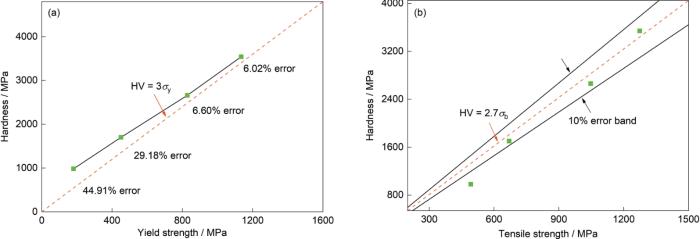
图14
Cu-Be合金的硬度与屈服强度以及抗拉强度之间的关系示意图
Fig.14
Schematic diagrams of the relationships between the hardness of Cu-Be alloy and the yield strength (a) as well as the tensile strength (b)
4 结论
(1) 固溶处理可恢复316L不锈钢的奥氏体晶格并消除内应力,但是大晶粒抑制了强度的提高。冷/温轧过程中的位错、孪晶和剪切带协调变形促进了塑性变形,剪切带的交互作用形成了眼状纳米孪晶束,与马氏体相变一起使材料的强度和硬度显著提高。
(2) 不同工艺处理使材料强度提高的同时塑性变形及变形扩展性能降低。4种试样的压痕形态均为堆积型,强度提高引起的强度系数和应变硬化指数的增加使压痕深度与压痕周围金属堆积高度减小。
(3) 随着强度的提高材料的强度系数和应变硬化速率随之提高,316L不锈钢的硬度与屈服强度之间3倍关系的误差逐渐减小,而与抗拉强度之间的3倍关系良好。这种比例关系受到材料加工硬化能力的调控,硬化能力适中的材料其强度系数限制了硬化的极限,而应变硬化指数则调控材料达到硬化极限的速率。随着强度系数和应变硬化指数的提高硬度与屈服强度的3倍关系逐渐准确,而与抗拉强度的比例关系较好。
参考文献
Failure investigation of an AISI 316L pipe of the flare system in an off-shore oil platform
[J].
Interaction of CsOH with structural steel 316L and simulated products of the steel-cladding reaction under assumed conditions relevant for the accident at the Fukushima Dai-Ichi Unit 2 and 3
[J].
Excellent cryogenic tensile properties of ultra-fine grained 316L stainless steel after electropulsing treatment in liquid nitrogen
[J].
The effect of electropulsing treatment (EPT) in liquid nitrogen (LN) on the microstructure and mechanical properties of cold-rolled 316L austenitic stainless steel was assessed, aiming at tensile properties of the EPT-LN treated cold-rolled 316L steel at room and cryogenic temperature, and the relevant deformation mechanisms. It is found that the LN-EPT could induce recrystallization of the cold-rolled 316L stainless steel. The recrystallization ratio is dependent upon the EPT energy input, and after being treated by EPT-7.5LN with discharge voltage of 7.5 kV, the 316 steel presents a fully recrystallized microstructure. The EPT-LN treated steels exhibit significantly higher strength-ductility synergy when they were deformed at 77 K rather than at 293 K. The TEM observation result of the deformed steel revealed that the main mechanisms related with the tensile deformation of 316 steel at 293 K were mainly of dislocation slip and deformation twinning, however, there exist a large amount of deformation-induced martensite transition for that at 77 K. The martensite transitions and their subsequent deformation result in a significant increase in the strain hardening capability, thereby enhancing the strength-ductility synergy. Further analysis shows that the deformation mechanism transition is mainly caused by the significant reduction of stacking fault energy of the steel at low temperatures.
液氮电脉冲处理超细晶316L不锈钢的低温拉伸性能
[J].在液氮环境用电脉冲(EPT)工艺优化冷轧316L奥氏体不锈钢的微观组织和力学性能,研究了电脉冲处理后样品的室温和低温拉伸性能及其变形机制。结果表明:液氮电脉冲处理后的冷轧316L不锈钢可得到再结晶组织。输入电脉冲的能量不同,其再结晶比例也不同, EPT-7.5LN样品可产生完全再结晶组织。在不同温度下电脉冲处理样品的拉伸实验结果表明,在77 K的拉伸强度-塑性匹配远比在293 K时的高。透射电镜的表征结果表明,样品在293 K的拉伸变形机制以位错和变形孪晶为主,在77 K的拉伸变形时则发生了大量形变诱导马氏体相变。正是大量的马氏体相变及其随后的位错滑移变形使材料的加工硬化能力显著提高,从而使其塑性增强。进一步分析表明,产生变形机制差异的主要原因是,在低温下这种材料的层错能显著降低。
Localized corrosion resistance of three commonly-used stainless steels
[J].Three kinds of austenitic steels 1Cr18Ni9Ti, 304 and 316L all contain different minor elements. The localized corrosion behavior of them was comparatively investigated, including intergranular corrosion, pitting corrosion and stress corrosion. Results show that the addition of Ti and the low C content are beneficial to the enhancement of intergranular corrosion resistance of the steel. Among others, the solution treated 304 steel has the best pitting corrosion resistance owing to the highest content of Cr and N, while 316L steel has the best stress corrosion resistance in 42% boiling MgCl2 because of its high Ni content.
三种常用不锈钢的耐局部腐蚀性能
[J].研究了微量元素含量不同的1Cr18Ni9Ti、304、316L三种奥氏体不锈钢的耐局部腐蚀性能,包括晶间腐蚀、点蚀和应力腐蚀。结果表明,Ti元素的添加和较低的含C量都能改善抗晶间腐蚀性能;Cr和N含量最高的固溶态304不锈钢最耐点蚀;Ni含量最高的固溶态316L在42%沸腾氯化镁溶液中抗应力腐蚀性能最优。
Tensile properties of a nanocrystalline 316L austenitic stainless steel
[J].
Some strengthening methods for austenitic stainless steels
[J].
Analysis of hardness-tensile strength relationships for electroformed nanocrystalline materials
[J].
A new approach to plasticity and its application to blunt two dimensional indenters
[J].The classical slip line field solution for a two-dimensional punch is found to give a constraint factor (2.57) which is too small when the specimen beneath the punch is extensive. A new approach based on elasticity provides a constraint factor of 2.75. The new method of analysis also enables residual stresses to be estimated and indicates that plastic flow occurs not only when the specimen is loaded, but also when it is unloaded. Several details concerning the performance of hardness indenters are explained by the new theory for the first time.
The determination of yield strength from hardness measurements
[J].
On the prediction of tensile properties from hardness tests
[J].
General relationship between strength and hardness
[J].
Relationship between hardness and tensile properties in various single structured steels
[J].
Correlating strength and hardness of high‐entropy alloys
[J].
The relationship between hardness and yield stress in irradiated austenitic and ferritic steels
[J].
The effect of tailored deformation on fatigue strength of austenitic 316L stainless steel
[J].
Formation mechanism of the eye-shaped nano-twin bundles in cold rolled 316L stainless steel
[J].
Formation of nano-grains dominated by twin-twin intersection for a RASP-processed 316L stainless steel
[J].
Microstructural evolution and nanostructure formation in copper during dynamic plastic deformation at cryogenic temperatures
[J].
Design for strength-ductility synergy of 316L stainless steel with heterogeneous lamella structure through medium cold rolling and annealing
[J].
Critical microstructures and defects in heterostructured materials and their effects on mechanical properties
[J].
Heterogeneous lamella structure unites ultrafine-grain strength with coarse-grain ductility
[J].Grain refinement can make conventional metals several times stronger, but this comes at dramatic loss of ductility. Here we report a heterogeneous lamella structure in Ti produced by asymmetric rolling and partial recrystallization that can produce an unprecedented property combination: as strong as ultrafine-grained metal and at the same time as ductile as conventional coarse-grained metal. It also has higher strain hardening than coarse-grained Ti, which was hitherto believed impossible. The heterogeneous lamella structure is characterized with soft micrograined lamellae embedded in hard ultrafine-grained lamella matrix. The unusual high strength is obtained with the assistance of high back stress developed from heterogeneous yielding, whereas the high ductility is attributed to back-stress hardening and dislocation hardening. The process discovered here is amenable to large-scale industrial production at low cost, and might be applicable to other metal systems.
Cold rolling behaviour and textural evolution in AISI 316L austenitic stainless steel
[J].
Superior strength and ductility of 316L stainless steel induced by micro/nano/ultrafine-grains multiphase complex structures
[J].
Hall-Petch behaviour of 316L austenitic stainless steel at room temperature
[J].
On the Hall-Petch relationship and substructural evolution in type 316L stainless steel
[J].
Evolution and microstructure of shear bands in nanostructured Fe
[J].Shear band development in consolidated nanocrystalline and ultrafine-grained Fe has been monitored as a function of overall strain from the onset of plastic deformation. The deformation mechanisms of the grains inside the shear bands, the origin of the inhomogeneous deformation, and the propensity for shear localization in nanostructures are explained based on microstructural information acquired using transmission electron microscopy.
Structural evolutions of metallic materials processed by severe plastic deformation
[J].
Formation of nanosized martensite particles in stainless steels
[J].
Formation of shear bands and strain-induced martensite during plastic deformation of metastable austenitic stainless steels
[J].
A mechanism for the strain-induced nucleation of martensitic transformations
[J].
Effect of strain-induced martensite on the formation of nanocrystalline 316L stainless steel after cold rolling and annealing
[J].
Superior strength and ductility of 316L stainless steel with heterogeneous lamella structure
[J].
Processes of deformation-induced martensite transformation and microstructure refinement of 316L stainless steel during surface mechanical rolling treatment
[J].
316L不锈钢在表面机械滚压处理时的形变诱导马氏体相变和组织细化过程
[J].采用表面机械滚压处理(SMRT)在316L不锈钢表面制备出梯度纳米结构(GNS)表层, 研究了SMRT对GNS表层中的相组成和微观组织演变的影响机制。结果表明: 经SMRT后316L不锈钢表层的奥氏体相发生形变诱导马氏体相变, 且马氏体含量随着SMRT压下量的增大而增多; 微观组织的细化过程先后经历了高密度位错生成和交互作用、形变孪生、形变诱导马氏体相变和马氏体晶粒细化过程, 最终在最表层形成以马氏体相为主、晶粒尺寸~55 nm的纳米晶组织。
Heterogeneous nanostructure developed in heavily cold-rolled stainless steels and the specific mechanical properties
[J].
Age-hardening mechanisms of heterogeneous-nanostructured SUS316LN stainless steel fabricated by heavy cold rolling
[J].
Grain refinement mechanisms and strength-hardness correlation of ultra-fine grained grade 91 steel processed by equal channel angular extrusion
[J].
Correlation of yield strength and tensile strength with hardness for steels
[J].
Tailoring the microstructure and mechanical properties of AISI 316L austenitic stainless steel via cold rolling and reversion annealing
[J].
Cryorolling impacts on microstructure and mechanical properties of AISI 316 LN austenitic stainless steel
[J].
Relation between strength and hardness of high-entropy alloys
[J].


