



镍基单晶高温合金的高温抗氧化性优异和综合力学性能良好,是制造先进航空发动机和燃气轮机涡轮叶片的首选材料[1~7]。制备单晶叶片的定向凝固,是关键工序之一[8~11]。温度梯度是定向凝固的重要参数。在传统的定向凝固工艺(High rate solidification,HRS)中热量发生热辐射散失,凝固后期的温度梯度和冷却速率不断降低,产生严重的组织粗化和凝固偏析。液态金属冷却工艺(Liquid metal cooling,LMC)的主要传热方式是热传导,可显著提高固液界面前沿的温度梯度和细化单晶叶片的组织[12~17]、降低偏析、减小缩孔的尺寸和数量以及减少冶金缺陷,从而提高其力学性能[18~21]。
虽然LMC-Sn工艺的温度梯度比传统的HRS和LMC-Al工艺的温度梯度高,但是LMC-Sn工艺中微量的冷却介质Sn可能进入铸件而将其污染[22]。随着LMC-Sn工艺应用的推广,Sn污染越来越受到关注。但是研究表明,在Sn含量为0.104% (质量分数,下同) 和不含Sn的SC16单晶合金中γ′析出相的形状、尺寸和体积分数没有显著的差异[23]。研究发现,即使SC16和PWA 1483两种单晶合金中Sn的含量高达0.415%,其蠕变强度和低周疲劳强度也没有受到显著的影响[23]。Dreshfield等[24]研究掺杂Sn的Inconel 718合金时也发现,在含Sn合金中并未产生新的析出相或不良显微组织。合金中Sn的含量为0.08%或更低,对合金的室温、425 ℃和650 ℃的拉伸性能几乎没有影响;在650 ℃施加469 MPa、579 MPa、793 MPa的应力条件下,含量低于0.08%的Sn对合金的持久寿命几乎没有影响;但是Sn质量分数高到1%时,793 MPa下的寿命大幅降低。在早期的研究中也有类似的结果[25]。因此,对高温合金中微量Sn的影响仍然存在争议,相关机理并不清楚。同时,高温合金的性能取决于组织,而目前国内外对Sn元素在高温合金中的存在形式和演化缺少系统的研究。鉴于此,本文以Sn为LMC定向凝固工艺的冷却介质制备不同Sn含量的DD26单晶高温合金试棒,系统研究其对DD26镍基单晶高温合金的组织和性能的影响。
1 实验方法
采用LMC-Sn定向凝固工艺制备DD26单晶试棒,熔炼母合金时分别不加或加入质量分数为0.01%、0.05%、0.10%的Sn (下文简称0%Sn合金、0.01%Sn合金、0.05%Sn合金、0.10%Sn合金。四种合金中Sn含量的实测结果分别为< 0.0001%、0.013%、0.052%、0.11%)。
选取DD26单晶晶体取向偏离[001]方向15°以内的单晶试棒,用真空热处理炉对其进行标准热处理,热处理制度为1260 ℃ ± 10 ℃/2 h,空冷+ 1080 ℃ ± 10 ℃/2 h,空冷+ 870 ℃/24 h,空冷[26]。使用差示扫描量热仪(DSC)对不同Sn含量的单晶合金进行差热分析,结合金相法测定合金的相变点和固、液相线温度。测试DSC时从室温升温到1000 ℃,升温速率为40 ℃/min,再从1000 ℃升温到1450 ℃,升温速率为10 ℃/min,降温时从1450 ℃降到1000 ℃,降温速率为10 ℃/min,再从1000 ℃降到室温,降温速率为40 ℃/min。
用Zeiss Axiovert 200MAT型光学显微镜、TESCANCLARA 2023扫描电子显微镜和电子探针观察合金铸态和完全热处理态的显微组织;使用Image-J和Image-Pro Plus软件计算γ′强化相的平均尺寸和体积分数、一次枝晶间距和γ/γ′共晶组织的含量。对铸态和热处理态样品,至少统计3个视场的数据取其结果的平均值。
分别测量合金的室温拉伸性能和975 ℃/255 MPa高温持久性能,测量室温拉伸性能的样品尺寸为M10 mm× Φ5 mm,每种Sn含量的样品2根;测量975 ℃/255 MPa高温持久性能的样品尺寸为M14 mm × Φ5 mm,每种Sn含量的样品3根。用差热分析法表征不同Sn含量铸态合金的相变温度。
2 结果和讨论
2.1 Sn含量对合金相变温度的影响
图1
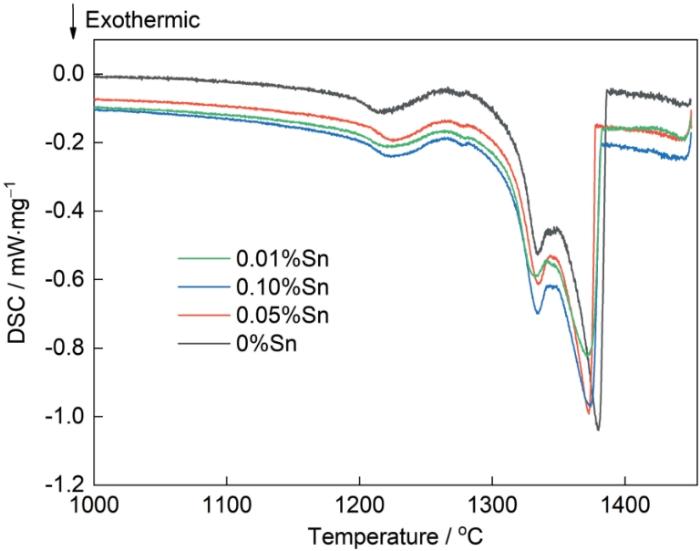
图1
不同Sn含量合金的差热分析曲线
Fig.1
DTA curves of Sn-containing alloys during cooling process
表1 在降温过程中Sn含量对合金相变温度的影响
Table 1
| Alloy | γ/γ′ precipitation/ oC | Carbides / oC | Liquidus / oC |
|---|---|---|---|
| 0%Sn alloy | 1219 | 1334 | 1393 |
| 0.01%Sn alloy | 1221 | 1333 | 1391 |
| 0.05%Sn alloy | 1225 | 1335 | 1385 |
| 0.10%Sn alloy | 1224 | 1334 | 1390 |
2.2 Sn对DD26合金铸态组织的影响
2.2.1 DD26合金的显微组织
图2

图2
不同Sn含量铸态合金的枝晶组织
Fig.2
Dendritic microstructures of as-cast alloys with different Sn contents (a) 0%Sn alloy, (b) 0.01%Sn alloy, (c) 0.05%Sn alloy, (d) 0.10%Sn alloy
图3
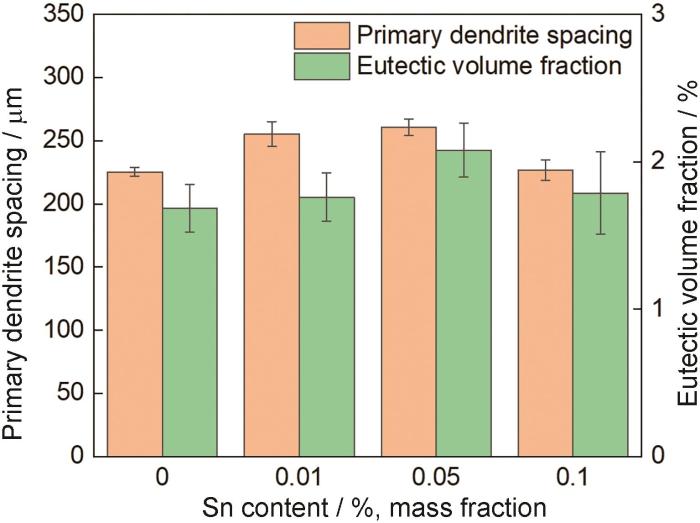
图3
不同Sn含量铸态合金中的一次枝晶间距和共晶的体积分数
Fig.3
Primary dendrite arm spacing and eutectic volume fraction in as-cast alloys with varying Sn contents
图4
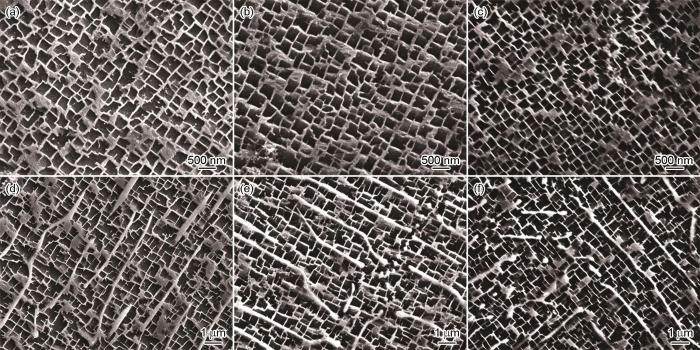
图4
不同Sn含量铸态合金中的枝晶干、枝晶间γ′相的形貌
Fig.4
Morphology of γ′ phase in dendrite core and interdendritic regions of as-cast alloys with different Sn contents (a) 0.01%Sn dendrite core, (b) 0.05%Sn dendrite core, (c) 0.10%Sn dendrite core, (d) 0.01%Sn interdendritic region, (e) 0.05%Sn interdendritic region, (f) 0.10%Sn interdendritic region
图5
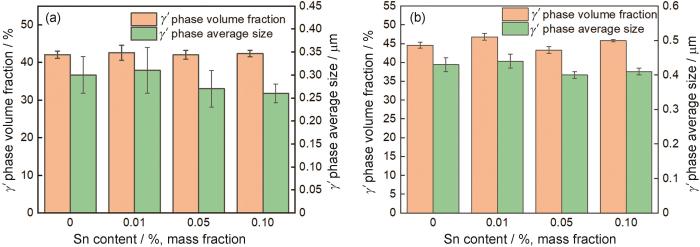
图5
不同Sn含量铸态合金中的枝晶干和枝晶间γ′相的体积分数和平均尺寸
Fig.5
Volume fraction and average size of γ′ phase in dendrite core (a) and interdendritic regions (b) of as-cast alloys with varying Sn contents
2.2.2 Sn元素在DD26合金中的分布
图6

图6
0.10%Sn铸态合金中元素的分布
Fig.6
Element distribution mapping of 0.10%Sn as-cast alloy
图7

图7
图6中(a)区域放大后的元素分布
Fig.7
Element distribution mapping of the magnified region (a) in Fig.6
进一步定量分析了图7中所示区域的元素分布。图8给出的放大图表明,1区域为γ/γ′共晶,2区域为碳化物,3区域为硼化物,4区域为Sn元素富集区,各区域的元素占比列于表2。在Sn富集区,Sn元素的原子分数为3.68%,Ni元素的原子分数为64.06%。如果只考虑Ni和Sn两种元素,在0.1%Sn合金的Sn富集区中Ni-Sn成分约为Ni94.6Sn5.4 (原子分数,%)。根据图9中的Ni-Sn二元相图[27],Ni元素的原子分数为94.57%时,在从液相降温到约600 ℃的凝固过程中并不会与Ni元素生成化合物,继续降温时进入了相图中的两相区,但是因为凝固速率较高难以生成析出相。这表明,铸态合金中Sn元素与Ni基体元素没有生成化合物,只是偏析在枝晶间的γ/γ′共晶组织周围。
图8
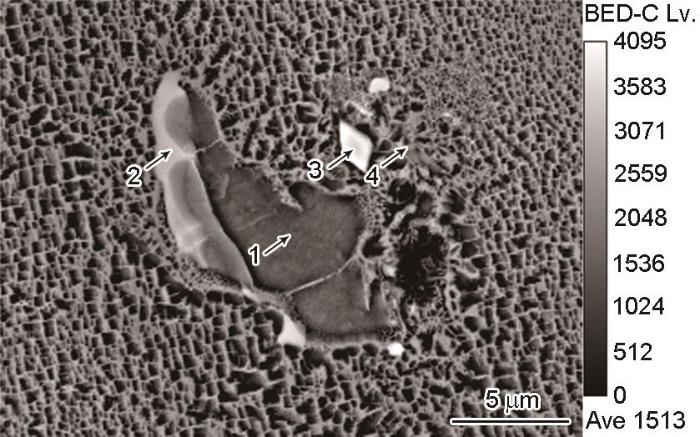
表2 各区域中元素的占比
Table 2
| Region | Ni | Sn | Ti | Al | C | B | Cr | Co | Nb | W | Mo | Hf |
|---|---|---|---|---|---|---|---|---|---|---|---|---|
| 1 | 61.24 | 0.34 | 2.46 | 14.25 | 8.90 | - | 3.57 | 7.01 | 0.84 | 1.40 | - | - |
| 2 | 52.29 | - | 1.97 | 8.82 | 16.88 | - | 6.11 | 8.14 | 1.82 | 3.06 | 0.68 | 0.24 |
| 3 | 10.06 | 0.40 | 0.55 | 0.93 | 7.93 | 45.18 | 15.35 | 2.86 | 1.06 | 6.61 | 9.07 | - |
| 4 | 64.06 | 3.68 | 1.68 | 6.82 | 7.37 | - | 5.12 | 7.90 | - | 1.30 | - | 2.06 |
图9

2.3 固溶态DD26合金中Sn元素的分布
图10给出了0.10%Sn合金固溶热处理后的电子探针结果。可以看出,固溶热处理后,原来铸态合金Sn元素在共晶周围的偏析消失,Sn元素在合金中的分布较为均匀。
图10

图10
0.10%Sn合金固溶热处理后元素的分布
Fig.10
Element distribution mapping of 0.10%Sn alloy after solution heat treatment
计算了0.10%Sn合金在固溶热处理(1260 ℃)过程中Sn元素的扩散行为。采用一维扩散模型,基于Fick第二定律的高斯解定性计算了合金元素扩散距离的均方根(Root mean square displacement,
根据Fick第二定律,扩散过程可用
描述。其中C为Sn元素的浓度(mol/m³);t为时间(s);D为扩散系数(m2/s);x为扩散距离(m)。
对于初始时刻t = 0时的浓度分布C(x,0),假设Sn元素在枝晶间局部区域的初始浓度较高,而在其他区域的浓度较低。经过时间t后,浓度分布趋于均匀。
用高斯法求解Fick第二定律,即
式中的浓度分布与标准高斯概率密度函数
的数学形式相同。比较指数项系数可得
解得扩散过程的方差表达式为
均方根位移(Root mean square displacement,
其中
扩散系数遵循Arrhenius定律[28]
其中D0为前置因子(m2/s),Q为扩散活化能(J/mol),R为气体常数(8.314 J/(mol·K)),T为绝对温度(K)。
固溶热处理温度为1260 ℃,即
在1260 ℃阶段(
可计算固溶温度下的扩散系数3.555 × 10⁻¹³ m2/s。计算结果表明,扩散距离为
2.4 Sn对DD26合金性能的影响
图11给出了不同Sn含量DD26合金的室温拉伸性能。可以看出,不同Sn含量DD26单晶合金的抗拉强度分别为(1050.0 ± 70.0) MPa,(959.0 ± 27.0) MPa,(1114.5 ± 19.5) MPa,(1013.5 ± 96.5) MPa,延伸率分别为(13.0 ± 2.0)%,(12.0 ± 1.0)%,(11.25 ± 0.3)%,(11.5 ± 3.5)%。这表明,即使合金的Sn含量高达0.10%,对其室温拉伸性能也没有显著的影响。不同Sn含量合金的975 ℃/255 MPa高温持久性能,如图12所示。可以看出,不同Sn含量合金的高温持久寿命分别为(53.1 ± 0.3) h,(58.7 ± 3.0) h,(56.7 ± 4.3) h,(53.0 ± 2.0) h。这表明,合金的持久寿命相差不大,即高达0.10%的Sn含量对合金的高温持久性能也没有显著的影响。其原因是,拉伸和持久性能主要取决于析出相,而添加Sn对铸态单晶合金的一次枝晶间距、γ/γ′共晶含量、γ′相的平均尺寸和体积分数都没有显著的影响。虽然0.10%Sn铸态合金中Sn偏析在枝晶间共晶组织周围,但是热处理已经将其消除。这表明,即使合金中Sn元素的含量高达0.10%,对服役前合金的组织几乎没有影响。这表明,在合金中添加Sn对其室温拉伸性能、975 ℃/255 MPa高温持久性能的影响不大。
图11
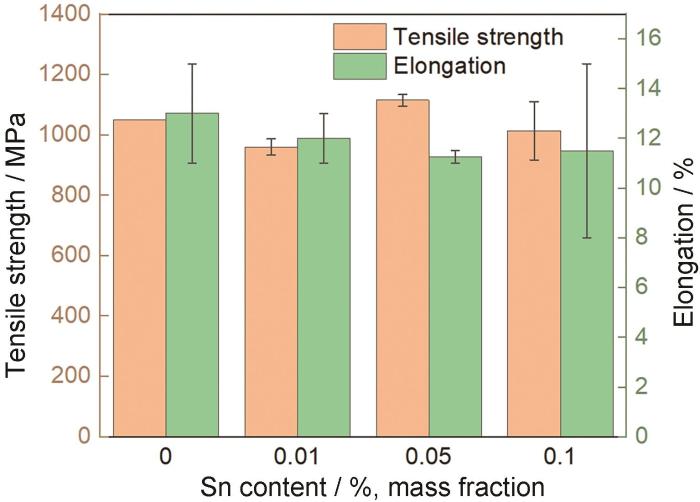
图11
不同Sn含量合金的室温拉伸性能
Fig.11
Room temperature tensile properties of alloys with different Sn contents
图12
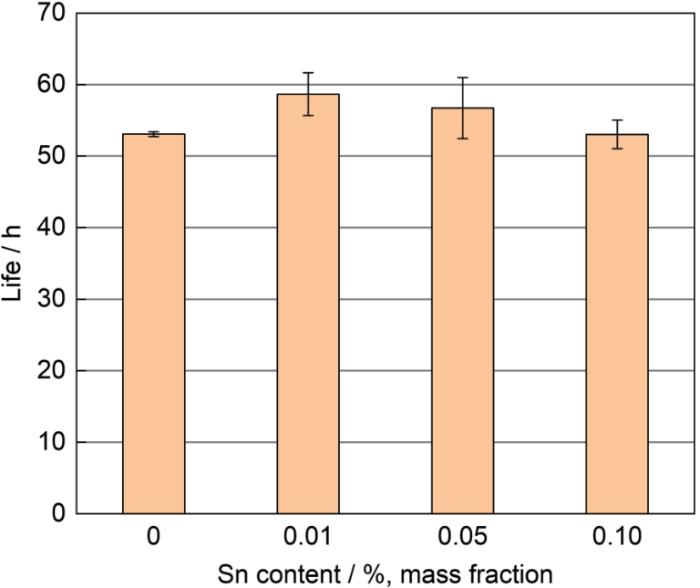
图12
不同Sn含量合金的975 ℃/255 MPa持久性能
Fig.12
Creep properties of alloys with different Sn contents at 975 oC/255 MPa
3 结论
(1) 含量为0.01%、0.05%、0.10%的Sn元素对铸态DD26单晶高温合金的熔化温度、碳化物析出峰值温度和γ/γ′共晶析出峰值温度的影响不大。Sn含量对铸态单晶合金中的一次枝晶间距、γ/γ′共晶含量、γ′相的平均尺寸和体积分数没有显著的影响。
(2) 在铸态0.10%Sn合金中Sn元素在共晶外围富集,没有生成含Sn化合物。热处理后合金中Sn元素的富集消失,Sn元素均匀地分布在合金中。
(3) 含量高达0.10%的Sn元素,对DD26单晶合金的室温拉伸性能和975 ℃/255 MPa高温持久性能没有影响。
参考文献
Effect of thermal exposure on subsurface microstructure evolution of nickel-based single crystal superalloy DD5 after milling
[J].
Effect of Ti content on creep properties of Ni-base single crystal superalloys
[J].
Advances in intelligent design of single crystal superalloys and protective coatings
[J].
单晶合金与防护涂层智能设计进展
[J].随着航空发动机涡轮前温度的不断提升,研发新一代航空发动机涡轮叶片用单晶高温合金及其热防护涂层迫在眉睫。为了满足航空发动机复杂的服役环境对高温结构材料综合性能提出的严苛要求,在材料集成计算工程与材料信息学的推动下,近年来国内外逐步开展了单晶高温合金与热防护涂层的智能设计研究,以提高研发效率、降低研发成本。本文重点综述多尺度计算模拟与机器学习方法在推动新型单晶高温合金与热防护涂层设计上的最新研究进展,确证了多尺度计算模拟为揭示单晶高温合金强韧化机理与热防护涂层抗氧化、阻扩散机制所提供的有效理论支撑,展现机器学习在构建高温结构材料“成分-组织-性能”内禀关系上的可靠性与巨大潜力,为新一代高承温单晶高温合金与热防护涂层提供了智能高效的快速研发新路径。
Ultra-high frequency vibration fatigue of DD6 single crystal superalloy simulating thin-walled specimens
[J].
DD6单晶高温合金模拟薄壁试样超高频振动疲劳
[J].以具有空心气冷结构涡轮叶片用第二代镍基单晶高温合金DD6为研究对象,研究试样厚度对其超高周疲劳性能的影响。基于有限元方法结合实测设计了工作段厚度为0.5 mm的超高频振动疲劳薄壁试样,实测一弯共振频率达到1425 Hz左右,采用电磁振动台开展超高周疲劳实验,获取最高至10<sup>9</sup>周次的疲劳S-N曲线,并开展与标准旋转弯曲疲劳、标准振动疲劳实验数据的对比分析。结果表明:DD6单晶高温合金的疲劳强度在10<sup>7</sup>~10<sup>9</sup>周次范围内下降约25%,薄壁试样高周疲劳强度和同材料标准旋弯疲劳强度基本一致,略低于标准振动疲劳强度;薄壁试样的裂纹在危险截面的表面萌生,呈线源特征,疲劳扩展区存在两个扩展平面,呈现类解理特征。
Effect of thermal processes on creep properties of a nickel-based single crystal superalloy
[J].The effect of heating history, such as those related with standard heat treatment, hot isostatic pressing (HIP), coating and brazing thermal processes, on the microstructure and creep properties (at 760 oC/790 MPa and 980 oC/248 MPa) of a first generation nickel-based single crystal superalloy DD413 was investigated. The results show that the microstructure and creep behavior of nickel-based single crystal superalloy DD413 are significantly affected by different thermal processes. Compared with the standard heat treatment, HIP reduces the size of γʹ and γ channel, but increases the volume fraction of γʹ phase. Meanwhile, micro-pores in the alloy are effectively eliminated by HIP, which improves the creep life. The coating thermal process preparation can coarsen the γʹ and γ channel, reduce the volume fraction of γʹ phase, and delay the rafting kinetics of γʹ phase at high temperature, therewith, reduce the creep property of the alloy. The brazing thermal process not only causes the coarsening of γ′ phase but also destroys the cubic degree of γ′ phase, leading to significant reduction in creep property of the alloy.
热工艺对一种镍基单晶高温合金蠕变性能的影响
[J].对第一代单晶高温合金DD413进行标准热处理、热等静压、涂层热以及钎焊热工艺处理,然后在760 ℃/790 MPa和980 ℃/248 MPa条件下测试其蠕变性能,研究了不同热工艺对合金蠕变性能的影响。结果表明:不同的热工艺都显著影响DD413合金的微观组织和蠕变性能。热等静压后这种合金中的γʹ相和基体通道的尺寸减小,γʹ相的体积分数有所提高并且消除了合金中的显微孔洞,使合金的蠕变性能大幅度提高。涂层热工艺使合金中的γʹ相和基体通道粗化,γʹ相的体积分数和其在高温低应力下的形筏速度降低,不利于合金的中高温蠕变性能。钎焊热工艺不仅使合金中的γ′相粗化还破坏了γ′相立方度,因此合金的蠕变性能显著降低。
Stress rupture deformation mechanism of two "replacement of Re by W" type low-cost second-generation nickel based single crystal superalloys at elevated temperatures
[J].The microstructure and deformation mechanism of two "replacement of Re by W" type low-cost second-generation nickel based single crystal superalloys after fracture at 982℃/248 MPa and 1070℃/137 MPa were investigated by SEM and TEM. The results show that the stress rupture properties of two alloys both reached the level of the second-generation single crystal superalloys; After fracture γ′ phases connected and combined to form "N-type" rafted structure, and the degree of γ′ phases distortion increased with the distance from the fracture. Under the same conditions, the raft degree of γ′ phases in 8.5W+1.0Re alloy was lower than that in 8.0W+1.5Re alloy; At 1070℃/137 MPa, the interfacial dislocation networks of the two alloys became denser; However, the dislocation networks of 8.0W+1.5Re alloy were denser than that of 8.5W+1.0Re alloy, a<010> superdislocations shearing into the γ′ phases were observed after fracture in 8.5W+1.0Re alloy under both conditions; The unstable fracture of the two alloys was mainly ascribed to a/2<110> dislocations in γ matrix shearing into the rafted γ′ phases, which intensify the deformation of rafted γ′ phases, and results in initiation and propagation of microcracks at the γ/γ′ interface, eventually leading to the fracture of the alloy; The interfacial dislocation networks and a<010> superdislocations could both improve the creep resistance of the two alloys.
两种“W替Re”型低成本第二代镍基单晶高温合金的高温持久变形机制
[J].用扫描电镜(SEM)和透射电镜(TEM)观察两种“W替Re”型低成本第二代镍基单晶高温合金分别在982℃/248 MPa和1070℃/137 MPa条件下持久变形断裂后的微观组织,研究了其变形的机制。结果表明,两种合金的持久性能均达到第二代单晶高温合金的水平;持久变形断裂后γ'相连接并合并成“N型筏”结构,随着与距离断口位置的接近γ'相的扭曲变形程度加剧。在相同条件下8.5W+1.0Re合金γ'相的筏形化程度比8.0W+1.5Re合金低;与982℃/248 MPa条件相比,在1070℃/137 MPa下两种合金持久变形断裂后的界面位错网更加致密。在相同条件下,8.0W+1.5Re合金比8.5W+1.0Re合金的位错网更致密,8.5W+1.0Re合金在两条件下持久变形断裂后都能观察到剪切进γ'相的a<010>超位错;两种合金失稳断裂的主要原因是,γ基体中的a/2<110>位错剪切进入γ'相使筏形γ'相变形加剧,裂纹在γ/γ'界面处萌生和扩展,最终使合金断裂;γ/γ'两相界面上的位错网和a<010>超位错可在一定程度上提高合金的持久变形抗力。
Microstructural stability and stress rupture property of a 6Re/3Ru containing nickel-based single crystal superalloy
[J].The microstructural evolution during long-term aging at 1000℃ and 1130℃ and the stress rupture property at 1100℃/140 MPa of a fourth-generation nickel-based single crystal superalloy with 6Re/3Ru were investigated. The microstructure and dislocation configuration of the alloy were observed by field emission scanning electron microscopy (FE-SEM) and transmission electron microscopy (TEM) in terms of its microstructural stability and stress rupture property. The results showed that the alloy displayed excellent microstructural stability. During long-term aging at 1000℃, γ′ phase grew up gradually, but γ′ phase still remained high cubic degree, however, the TCP phases did not precipitate after aging for 1000 h. After aging at 1130℃ for 500 h, the γ′ phase connected each other and became rafting ed. The TCP phase started to precipitate after long-term aging at 1130℃ for 200 h, however, the content of TCP phase was only 0.04% after aging for 1000 h in the alloy. After aging at 1130℃ for 500 h, dislocation networks formed at γ/γ′ interfaces which became more regular and denser with the increase of aging time. The stress rupture life of the alloy at 1100℃/140 MPa was 676.5 h, which reached the level of the fourth-generation nickel-based single crystal superalloy. The γ′ phase underwent N-type rafting, the needle-like TCP phase (μ phase) precipitated, and dislocation pile-up was found near TCP phase after fracture. During stress rupture test, the formation of γ/γ′ interfacial dislocation networks and a<010> super-dislocations in the alloy was beneficial to the stress rupture property.
一种6Re/3Ru镍基单晶高温合金微观组织的稳定性和高温持久性能
[J].用场发射扫描电镜(FE-SEM)和透射电镜(TEM)观察一种第四代镍基单晶高温合金长期时效和持久断裂后的微观组织和位错组态,研究了这种合金在1000℃和1130℃长期时效过程中的组织演化和在1100℃/140 MPa条件下的持久性能。结果表明:这种合金具有较好的组织稳定性,在1000℃长期时效过程中γ'相逐渐长大,但是在1000 h后仍有较好的立方度且没有TCP相析出。在1130℃长期时效500 h后γ'相发生连接和筏化;时效200 h后开始析出TCP相,时效1000 h后合金中TCP相的面积分数只有0.04%。在1130℃长期时效500 h后,γ/γ'界面形成位错网并随着时效时间的延长变得更加规则致密。这种合金在1100℃/140 MPa条件下的持久寿命为676.5 h,达到第四代镍基单晶高温合金水平。持久断裂后γ'相发生N型筏化,合金中析出针状TCP相(μ相)并在TCP相附近出现位错塞积。在持久试验过程中,合金中生成的γ/γ'界面位错网和a<010>超位错有利于提高其持久性能。
Recent progress in research and development of nickel-based single crystal superalloys
[J].
镍基单晶高温合金的研发进展
[J].
Effect of pouring temperature on microstructure and durability of DD419 single crystal superalloy
[J].
浇注温度对DD419单晶高温合金组织及持久性能的影响
[J].
Manufacturing of large size nickel-based single crystal turbine guide vanes by grain continuator technology
[J].
利用引晶技术制备大尺寸镍基单晶涡轮导向叶片
[J].
Solidification behaviours of a single-crystal Ni-base superalloy under lateral constraints
[J].
单晶Ni基高温合金侧向约束条件下的凝固行为
[J].
The effect of liquid metal cooling on thermal gradients in directional solidification of superalloys: thermal analysis
[J].
Development of dendritic structure in the liquid-metal-cooled, directional-solidification process
[J].
Directional crystallization of high-temperature alloys with elevated temperature gradient
[J].
Special features of the structure of single-crystal refractory nickel alloy under directed crystallization
[J].
Directional solidification under high thermal gradient and its application in superalloys processing
[J].<p>Industrial gas turbines (IGTs) are the key equipment to achieving energy strategy, such as energy conservation and clean power generation. When the large and complex IGT blades are fabricated by the conventional Bridgman directional solidification process, the thermal gradients at the solidification front are low and unstable, resulting in some disadvantages: the coarse dendrite structure with severe dendritic segregation, the increased occurrence of casting defects and the poor performance of mechanical properties. These disadvantages provide a good opportunity for rapid development of the directional solidification with high thermal gradient (HG), such as the liquid metal cooling (LMC). In the present work, the physical basis of HG process, the microstructure, mechanical properties, solution heat treatment, and casting defects of the superalloys processed by HG process, have been reviewed. The HG process increases the thermal gradient and the cooling rate, thus permitting microstructural improvements including a more homogeneous fine-dendrite structure with lower elemental segregation and shrinkage porosity, and refinement of carbide, <i>γ′</i> phase and eutectic, reducing the volume fraction of eutectic and shrinkage porosity. During the solution heat treatment, the HG process increases the incipient melting temperature and reduces the residual segregation as well as the content of solution pore. The HG process could effectively inhibit the formation of freckle chains, increase the critical withdrawal rate of the stray grain formation, and decrease the degree of the misorientation of the <001> grain orientation from the casting axis. Moreover, the HG process could improve the mechanical properties including the stress rupture life, low-cycle fatigue (LCF), high-cycle fatigue properties and short-term strength, but the improvement might be reduced at higher temperature or under the oxidation condition.</p>
高梯度定向凝固技术及其在高温合金制备中的应用
[J].
Microporosity reduction by liquid cooling process of a single crystal nickel based superalloy
[J].Microporosity in a single crystal nickel-based superalloy DD33 solidified by high rate solidification (HRS) and liquid metal cooling (LMC) process was investigated by the X-ray tomography (XRT). It is found that the pressure drop was reduced because of the larger volume fraction of eutectic in the alloy solidified by LMC, which results in less solidification-pore (S-pore) formation. Homogenization-pore (H-pore) forms in interdendritic regions during solution heat treatment, which results in the increase of volume fraction of porosities during heat treatment. However, lower level of H-pore in the LMC samples can be attributed to the finer dendrite arm spacing and the lower segregation.
HRS和LMC工艺对第三代镍基单晶高温合金DD33中显微孔洞的影响
[J].采用高分辨透射X射线三维成像技术研究了传统高速凝固法(HRS)和液态金属冷却法(LMC)两种工艺制备的镍基单晶高温合金DD33中显微孔洞的三维尺寸信息, 结果表明: 与HRS相比, LMC工艺降低一次枝晶间距, 增加共晶体积分数, 使最后凝固阶段枝晶间的空隙尺寸变大, 压降降低, 最终降低了铸态孔的尺寸及体积分数。固溶处理后用两种工艺制备的合金中显微孔洞的体积分数都有所增加, 但是用LMC工艺制备的合金中较细的枝晶和较低的偏析程度, 使合金中固溶孔的体积分数显著低于用HRS工艺制备的合金。
Low-cycle fatigue properties of nickel-based superalloys processed by high-gradient directional solidification
[J].
Improvement of creep rupture strength of a liquid metal cooling directionally solidified nickel-base superalloy by carbides
[J].
Directional solidification assisted by liquid metal cooling
[J].

An overview of the development and current status of the directional solidification process assisted by liquid metal cooling (LMC) has been presented in this paper. The driving force of the rapid development of the LMC process has been analyzed by considering the demands of (1) newer technologies that can provide higher thermal gradients for alleviated segregation in advanced alloy systems, and (2) better production yield of the large directionally solidified superalloy components. The brief history of the industrialization of the LMC process has been reviewed, followed by the discussion on the LMC parameters including selection of the cooling media, using of the dynamic baffle, and the influence of withdrawal rates and so on. The microstructure and mechanical properties of the traditional superalloys processed by LMC, as well as the new alloys particularly developed for LMC process were then described. Finally, future aspects concerning the LMC process have been summarized.
Directional solidification of large superalloy castings with radiation and liquid-metal cooling: a comparative assessment
[J].
Reaction of Ni-based superalloy with liquid Sn during liquid-metal-cooled directional solidification
[J].
Improved quality and economics of investment castings by liquid metal cooling media-the selection of cooling media
[A].
Effects of tin on microstructure and mechanical behavior of Inconel 718
[C].
Effects of trace elements on creep properties of nickel-base alloys
[J].
Composition-dependent phase substitution in directionally solidified Sn-22at.%Ni peritectic alloy
[J].
Application of the modified electrostatic model to the impurity diffusion in nickel
[J].


