



镁合金的密度低、比强度高,有望应用在轨道交通和电子通讯等领域[1,2]。但是,镁合金较差的室温可加工性使其应用受到限制[3~5]。对镁合金进行差速挤压或轧制,可提高其可加工性能。对镁合金差速挤压或轧制时生成的高密度析出物[6]和动态再结晶晶粒,产生析出强化和细晶强化[7,8]。Yang等[9]报道了一种Mg-8.0Gd-4.0Y-1.0Mn-0.4Sc合金差速挤压后抗拉强度为425 MPa,源于基体的强织构、动态再结晶(DRXed)晶粒细化和细颗粒的致密分布。Yu等[10]制备出一种抗拉强度为424 MPa的Mg-11.5Gd-4.5Y-(1Nd/1.5Zn)-0.3Zr合金,差速挤压比的提高促进了DRX的发生,提高了Mg5RE相的体积分数而使DRXed晶粒细化。
对无稀土高强度变形镁合金的研究表明,Mg-Zn-Ca[11~13]、Mg-Sn-Ca[14~16]、Mg-Al-Ca[17~19]等合金是下一代高强度低成本变形镁合金的理想选择。其中差速挤压态Mg-Al-Ca合金的强度超高。Li等[20]报道了一种差速挤压态Mg-5Al-3Ca-0.3Mn合金,其超高强度(为451 MPa)主要源于Mg2Ca纳米相密集均匀分散、晶粒细化和强基底织构。Zhang等[21]报道了一种新型Mg-Sn-Ca-Mn变形合金,其屈服强度(450 MPa)的提高与大量的纳米颗粒和超细DRXed晶粒有关,且出现的易动态再结晶的孪晶弱化了织构。但是,这些高强度合金中过高含量的Ca元素导致大量共晶化合物的生成,使其塑性较差(3%~5%)。Yang等[22]通过改变模具挤压通道可使两侧坯料的流动速度不同,速度差产生的剧烈剪切变形使AZ31板材的延伸率达到22.8%。其原因是,差速挤压使晶粒细化和织构弱化。Wang等[23]研究了AZ31差速挤压后的杯突值(IE)的变化,发现差速挤压后的板材其平均IE提高了15%,裂缝长度小于常规差速挤压,是晶粒细化所致。但是,在变形过程中显微组织的差异对其力学性能也有较大的影响。Zhang等[24]发现Mg-1.5Mn-0.3Ce大型锻件的力学各向异性和显微组织非均质性。从边缘到中心的晶粒尺寸、位错密度和织构强度呈梯度变化,表明其微观组织不均匀。同时,锻造态ME20试样在锻造方向和延长方向上的屈服强度差异较大(约为200 MPa),主要与强织构主导孪晶/滑移模式激活有关。但是迄今为止,差速挤压材料的力学性能与显微组织非均质性的关系鲜有报道。鉴于此,本文对Mg-6Al-3Ca-1Zn-0.3Mn合金进行差速挤压,研究其力学性能与微观组织的关系及其机制。
1 实验方法
制备实验用铸态合金Mg-6Al-3Ca-1Zn-0.3Mn的原料有:高纯(高于99.99%)金属Mg、Al、Zn、Mg-25%Ca中间合金和Mg-10%Mn中间合金,制备工艺是重力铸造:将金属依次放入坩埚中在750 ℃熔化后进行充分搅拌,静置适当时间后将坩埚缓慢放入盐水中冷却得到铸锭。对铸锭的成分检测表明,合金的真实成分为Mg-6.03Al-3.04Ca-1.01Zn-0.31Mn。
将铸锭切割成直径为80 mm高度为40 mm的圆柱,进行均匀化处理:分别在400 ℃保温16 h、在500 ℃保温48 h后,放入温度为70 ℃的热水中冷却。
极限差速挤压前,先将铸锭和差速挤压模具在电阻炉中预热20 min。挤压的温度为340 ℃,挤压速率为0.4 mm/s,挤压比为22∶1。最终将圆柱铸锭挤压成厚度为5 mm、宽度为56 mm的板材。差速挤压的模具和差速挤压板材的三向示意图,如图1所示。
图1

从差速挤压板头中尾部各截取截面积为70 mm × 14 mm的狗骨形拉伸试样,拉伸实验的加载轴平行于挤压方向。对不同部位的试样至少做3次测试,取其结果的平均值。差速挤压后的板材表面如图2所示,可见表面没有缺陷。将挤压后的板材沿挤压方向划分为5个区域,分别为头部,头中部,中部,中尾部和尾部。用Smart Lab型X射线衍射仪(X-ray diffraction, XRD)测试板材5个区域的XRD谱,用Axio Observer Z1型光学显微镜(Optical microscope, OM)、Apreo型扫描电镜(Scanning electron microscope, SEM),配有电子背散射衍射 (Electron backscattered diffraction,EBSD)探头的Verios 5 UC型SEM和JEM-2100Plus型透射电镜(Transmission electron microscope, TEM)对其表征。从横向方向-挤压方向(TD-ED)和法向方向-横向方向(ND-TD)分析合金的变形机理。对用于EBSD分析的试样,先进行冶金研磨和抛光,然后在-30 ℃的10%高氯酸酒精溶液中进行120 s的电抛光。使用Aztec Crystal软件分析实验数据,分别用白线和黑线表示EBSD图中的小角度晶界(LAGBs, 2°~15°)和大角度晶界(HAGBs, 15°~100°),未识别的区域为Al2Ca相和Al8Mn5相。
图2

图2
差速挤压板材的表面照片
Fig.2
Photographs of the surfaces of the differential extrusion plates (a) starting, (b) starting-middle, (c) middle, (d) middle-end, (e) end
2 结果和讨论
2.1 差速挤压板材的微观组织
图3

图3
差速挤压板材从头至尾5部分的OM显微组织
Fig.3
OM of five portions of the extruded plates from starting to end (a) starting, (b) starting-middle, (c) middle, (d) middle-end, (e) end
为了分析差速挤压时合金中第二相的演变,图4给出了板材从头到尾部的SEM显微组织照片,图5中第二相对应的EDS结果列于表1。由图4可见,在差速挤压板材中分布着不同尺寸和间距的第二相颗粒,在板材头中部的第二相是网状和粗大的块状颗粒(图4a、b)。能谱(面扫)和EDS结果表明,A点的网状相是富集了Al和Ca元素的Al2Ca相(图5a)。B点粗大的块状第二相,是富集Al和Mn元素的Al8Mn5相(图5a)。在板材的中尾部第二相沿挤压方向呈条带状分布,间距减小。Al2Ca相破碎成小球状(图4c、d)。在板材的尾部,第二相均匀分布(图4e)。面扫和EDS结果表明,C点的球状第二相是Al2Ca相,D点的Al8Mn5相形状和尺寸没有变化(图5b)。对板材的5个位置的XRD分析结果表明,合金中只有Al2Ca相和Al8Mn5相(图6)。
图4

图4
差速挤压板材从头至尾5部分的SEM显微组织
Fig.4
SEM of five portions of the extruded plates from starting to end (a) starting, (b) starting-middle, (c) middle, (d) middle-end, (e) end
图5
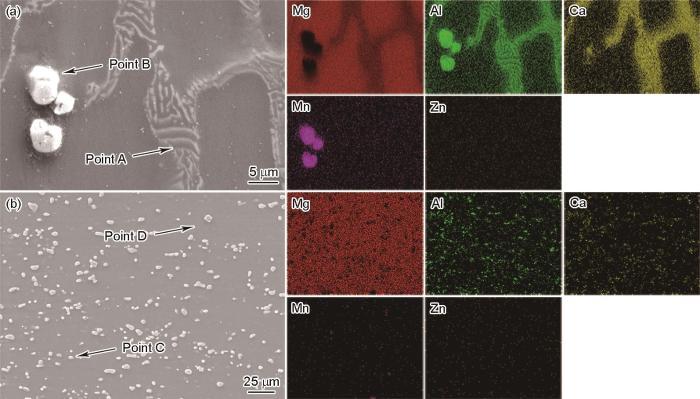
图5
差速挤压板材的EDS分析
Fig.5
EDS analysis results of the extruded plates (a) the starting of the extruded plates, (b) the end of the extruded plates
表1 合金中第二相的EDS结果
Table 1
| Point | Mg | Al | Ca | Mn | Zn |
|---|---|---|---|---|---|
| A | 33.05 | 46.01 | 19.29 | 0.09 | 1.56 |
| B | 13.94 | 52.25 | 0.54 | 33.14 | 0.13 |
| C | 51.89 | 34.33 | 12.72 | 0.07 | 0.99 |
| D | 24.02 | 45.58 | 0.80 | 29.45 | 0.15 |
图6

2.2 对差速挤压过程的有限元模拟
对差速挤压过程进行了Deform-3D有限元模拟,如图7所示。图7a、b给出了温度场分析。可以看出,由坯料到模具出口温度逐渐升高(图7a)。其原因是,随着差速挤压的进行模具口收缩,材料变形使内应力和内能增大而产生了大量热量。在模具出口的温度场不对称,挤压成型后作用力减弱,板材散热使温度逐渐下降(图7b)。在差速挤压的开始阶段坯料运动不稳定,板材的头部离开模具后大量散热,而还处在型腔和模具内的坯料温度较高而产生了温度差。温度差影响合金的再结晶和动态回复,从而使组织不均匀。图7c、d给出了应力场分布。可以看出,对坯料差速挤压时挤压筒内的坯料受到的应力甚至比模具型腔内的坯料还高(图7c)。这表明,在挤压筒内的坯料虽然没有移动,但是也受到力而产生变形。这种变形使坯料内的应力增大而产生大量孪晶,从而促进了挤压后期板材的再结晶。结合图7c可见,板材经过模具出口后不再受到挤压力,等效应力逐渐下降(图7d)。这表明,导致金属板材不同位置组织不同的原因,一是差速挤压前期坯料移动不稳定,通过模具口的板材头部温度迅速下降,而在型腔和模具内部的坯料温度较高,温度差影响合金的变形,使再结晶不彻底而留下大量未再结晶晶粒。在挤压后期坯料运动稳定,板材前后的温度都比较高,促进了合金的完全动态再结晶;二是差速挤压前期坯料未受到较大的应力,直接参与变形使再结晶形核较少。而挤压筒内部坯料受到较大的应力,内部产生的大量孪晶是孪晶诱导再结晶机制,使差速挤压后期的板材具有等轴晶组织。
图7

图7
差速挤压板材的Deform有限元模拟
Fig.7
Deform finite element simulation of extruded plates (a, b) temperature field, (c, d) stress field
采用Deform中元胞自动机模型模拟了差速挤压板材的微观组织,在后处理模块选择同一位置的点进行分析,设置二维元胞空间为150 × 150个的正方形网格,选用绝对长度为1 μm × 1 μm的正方形元胞,位错初始密度为0.01 μm-2。模拟时以动态再结晶的晶界弓出形核机制为依据,忽略其他形核方式;假设在原始晶粒和动态再结晶晶粒的晶界形核,所用动态再结晶数学模型是Mg-Al系合金[25]。初始晶粒为100 μm (图8a)。通过点追踪微观组织的演化,将Deform-3D模拟步数设置为30步差速挤压已完成,结果如图8所示。图8a~e分别对应步数为1、6、12、18、24、30时的微观组织形貌。可以看出,接近等轴状态的大晶粒为基体组织,随着差速挤压的进行在原始基体组织的晶界出现小晶核,在部分晶界生成动态再结晶晶粒(图8b),之后这些小晶核长大,不断吞噬基体组织,动态再结晶在Step 30基本完成(图8e),原始基体组织被细化。在微观上,随着差速挤压的进行基体组织的再结晶程度不断提高,到达临界位错密度时发生动态再结晶,在基体组织的晶界生成小晶核,之后这些小晶核在位错密度差的驱动下长大,直到变形完成[26]。
图8

图8
板材不同步数模拟的微观组织形貌
Fig.8
Microstructure morphology simulated by different steps of plates (a) step 1, (b) step 6, (c) step 12, (d) step 18, (e) step 24, (f) step 30
2.3 差速挤压板材的织构和极图演变
对差速挤压后板材的TD-ED方向进行了EBSD分析,结果如图9所示。可以看出,在挤压板材的头部和头中部的晶粒呈现双峰组织,与上述模拟组织相对应(图8b、c),由粗大的未再结晶晶粒和细小的动态再结晶晶粒组成(图9a、b)。在未再结晶晶粒内存在颜色梯度变化,大量的小角度晶界分布在未再结晶晶粒中。从KAM图也可见,在未再结晶晶粒和晶界的位错密度较高(图9f、g)。在变形晶粒内有大量的位错引起的小角度晶界,这些小角度晶界将原始变形晶粒分成许多亚结构。在差速挤压过程中应力的作用下晶格结构偏转使小角度晶界转变为大角度晶界,生成动态再结晶晶粒。这是典型的连续动态再结晶特征[27, 28]。在差速挤压板材的中部、中尾部和尾部的晶粒主要由细小的动态再结晶晶粒和部分的等轴晶粒组成(图9c~e),与模拟结果相符(图8f)。可以看出,小角度晶界减少而大角度晶界增多。从KAM图可见,在晶界附近的位错密度降低,再结晶晶粒为锯齿状。这表明,在热挤压板材中至尾的后程阶段,大量位错被激活并向晶界移动而使晶界局部突出,使原始晶界呈现锯齿状。然后,在其他滑移体系的作用下在突出处与原始晶界之间形成小角度晶界。最后,在位错的驱动下,由小角度晶界和大角度晶界组成的亚结构发生一定程度的旋转,小角度晶界转变为大角度晶界生成新的动态再结晶晶粒。由此可以证明,这些晶粒的形态特征与不连续动态再结晶特征一致[29, 30]。同时,晶粒细化使晶界面积增大和位错密度降低,阻碍变形过程中的位错运动而使强度提高[31]。
图9

图9
差速挤压板材TD-ED方向上的头中尾部IPF和KAM图
Fig.9
IPF (a-e) and KAM (f-j) maps of five portions of the extruded plates in TD-ED direction from starting to end (a, f) starting, (b, g) starting-middle, (c, h) middle, (d, i) middle-end, (e, j) end
图10

图10
差速挤压板材TD-ED方向上的头中尾部的DRX体积分数和DRX晶粒尺寸分布
Fig.10
DRXed grain (a-e) and recrystallized grain size distribution (f-j) maps of five portions of the extruded plates in TD-ED direction from starting to end (a, f) starting, (b, g) starting-middle, (c, h) middle, (d, i) middle-end, (e, j) end
图11给出了挤压板材TD-ED平面上由头部至尾部的极图和反极图。可以看出,在板材前端头部和头中部具有典型的强基底织构,最大基底强度为34.92 (图11a),是粗大的未再结晶晶粒所致。板材后端中部至尾部再结晶分数的提高,使极图的织构减弱,最小为7.52 (图11d)。这表明,再结晶晶粒使织构弱化。织构强度越低则晶粒取向越分散,可提供更多的滑移系,有利于协调塑性变形。根据反极图,板材从头部至尾部,织构从弱
图11

图11
差速挤压板材TD-ED方向上的头中尾部极图和反极图
Fig.11
Polar maps and inverse pole maps of five portions of the extruded plates in TD-ED direction from starting to end (a) starting, (b) starting-middle, (c) middle, (d) middle-end, (e) end
图12

图12
差速挤压板材ND-TD方向上的头中尾部IPF和KAM图
Fig.12
IPF (a-e) and KAM (f-j) maps of five portions of the extruded plates in ND-TD direction from starting to end (a, f) starting, (b, g) starting-middle, (c, h) middle, (d, i) middle-end, (e, j) end
图13

图13
差速挤压板材ND-TD方向上的头中尾部再结晶分数和晶粒尺寸
Fig.13
DRXed grain (a-e) and recrystallized grain size distribution (f-j) maps of five portions of the extruded plates in ND-TD direction from starting to end (a, f) starting, (b, g) starting-middle, (c, h) middle, (d, i) middle-end, (e, j) end
2.4 差速挤压板材中的残余位错
图14

图14
差速挤压板材头中部未再结晶晶粒中的残余位错
Fig.14
Residual dislocations of unrecrystallized grains in the starting-middle of the extruded plate (a) dislocation analysis of extruded plate grains, (b) TEM image taken under g = (0001) condition, (c) TBDF image taken under g =
图15

图15
差速挤压板材中尾部再结晶晶粒中的残余位错
Fig.15
Residual dislocations of recrystallized grains in the middle-end of the extruded plate (a) HAADF-STEM image of recrystallized grains of the middle-end, (b) HAADF-STEM image of recrystallized grains of the end
2.5 差速挤压板材的力学性能
图16

图16
差速挤压板材头中尾部的拉伸应力-应变曲线
Fig.16
Engineering stress-strain tensile curves of extruded plate from starting to end
表2 差速挤压板材头中尾部的力学性能
Table 2
| Portion | YS / MPa | UTS / MPa | Elongation / % |
|---|---|---|---|
| Starting | 287 | 328 | 2.1 |
| Middle | 257 | 303 | 4.4 |
| End | 176 | 279 | 16.6 |
未再结晶晶粒中有大量的位错,这些位错的相互缠绕和阻塞使合金强化。因此,位错强化(σd)可近似表示为[38]
式中M为Taylor因子,G为剪切模量(Mg为17 GPa), b 为Burgers矢量(Mg为0.32),α为常数(0.2),ρ为位错密度(m-2)。根据Caceres的工作[39],以锥体滑移为主的Mg多晶其M值可估计为2.1~2.5。本文研究的板材基底滑移的施密特因子(Schmid factor, SF)较低,因此取M值为2.5。板材前中端的位错密度为5.088 × 10¹⁴ m-2。由
板材尾部的高伸长率,主要源于其组织的均匀细化和基体织构的弱化。从图9e可见,板材尾部的晶粒取向分布更随机,从而使其织构强度降低。同时,均匀的微观组织使变形更容易,避免了应力集中的产生。正如Jiang等[40]的结果,预锻Mg-1.58Zn-0.52Gd (质量分数,%)合金在350和400 ℃差速挤压后,起断后伸长率分别提高到了~27.9%和~34.8%。在差速挤压过程中产生的大量细小动态再结晶晶粒以及基面织构的弱化,是导致合金断后延伸率提高的重要原因。细小均匀的晶粒不仅阻碍位错在晶界附近的运动使材料形变抗力提高,还能削弱位错在晶界附近产生的局部应力集中引发的局部失稳断裂。这是晶粒细化既能提高材料的强度又能提高其塑性的原因。
3 结论
(1) 在Mg-Al-Ca-Zn-Mn合金板材的差速挤压过程中,温度和内应力是影响其组织的关键因素。在差速挤压初期能量不足使变形不充分和板材组织不均匀。在差速挤压后期坯料稳定,板材中后部比前端的微观组织更均匀。差速挤压使板材的再结晶体积分数提高,板材头部的再结晶晶粒细小,板材尾部再结晶的晶粒长大。
(2) 这种板材的前端为双峰组织,未再结晶晶粒内的位错密度较高和小角度晶界较多,再结晶机制为连续动态再结晶机制。未再结晶区的位错强化和细小动态再结晶的细晶强化是差速挤压板材头部屈服强度较高的主要原因。
(3) 板材尾部大量位错的激活和晶界局部突出,使原始晶界呈现锯齿状,在晶界生成新动态再结晶晶粒最终产生等轴晶组织。尾部晶粒的均匀细化是延伸率较高的主要原因。
参考文献
Magnesium: properties-applications-potential
[J].
Recent research and developments on wrought magnesium alloys
[J].
Effect of various Ca content on microstructure and fracture toughness of extruded Mg-2Zn alloys
[J].
Effect of high Mn content on development of ultra-fine grain extruded magnesium alloy
[J].
Current issues in magnesium sheet alloys: where do we go from here?
[J].
What is going on in magnesium alloys?
[J].
High strength Mg-9Al serial alloy processed by slow extrusion
[J].
High strength SiCp/AZ91 composite assisted by dynamic precipitated Mg17Al12 phase
[J].
Effect of extrusion ratio and temperature on microstructures and tensile properties of extruded Mg-Gd-Y-Mn-Sc alloy
[J].
Effects of extrusion ratio and temperature on the mechanical properties and microstructure of as-extruded Mg-Gd-Y-(Nd/Zn)-Zr alloys
[J].
Towards the development of heat-treatable high-strength wrought Mg alloys
[J].
Processing and microstructure-property relations of high-strength low-alloy (HSLA) Mg-Zn-Ca alloys
[J].
The microstructure, texture and mechanical properties of extruded Mg-5.3Zn-0.2Ca-0.5Ce (wt%) alloy
[J].
A new high-strength extruded Mg-8Al-4Sn-2Zn alloy
[J].
Development of low-alloyed and rare-earth-free magnesium alloys having ultra-high strength
[J].
Enhancing mechanical properties of Mg-Sn alloys by combining addition of Ca and Zn
[J].
High-strength extruded Mg-Al-Ca-Mn alloy
[J].
Effect of Ca/Al ratio on microstructure and mechanical properties of Mg-Al-Ca-Mn alloys
[J].
Effects of different cooling rates during two casting processes on the microstructures and mechanical properties of extruded Mg-Al-Ca-Mn alloy
[J].
Ultrahigh strength Mg-Al-Ca-Mn extrusion alloys with various aluminum contents
[J].
A new rare-earth-free Mg-Sn-Ca-Mn wrought alloy with ultra-high strength and good ductility
[J].
Tailoring texture and refining grain of magnesium alloy by differential speed extrusion process
[J].
Ameliorating the mechanical properties of magnesium alloy: role of texture
[J].
Mechanical anisotropy and microstructural heterogeneity of a free-forged ME20 alloy with a large cross section
[J].
Numerical simulation of asymmetric forging extrusion of AZ31 magnesium alloy
[D].
AZ31镁合金非对称锻造挤压的数值模拟
[D].
Study on dynamic recrystallization behavior of rare earth magnesium alloy during hot deformation and cellular automata simulation
[D].
稀土镁合金热变形动态再结晶行为研究及元胞自动机模拟
[D].
Strain rate dependence of dynamic recrystallization and texture evolution in hot compressed Mg-Gd-Er-Zr alloy
[J].
Effect of thermo-mechanical processing parameters on the dynamic restoration mechanism in an Mg-4Y-2Nd-1Sm-0.5Zr alloy during hot compression
[J].
Effects of dynamic recrystallization mechanisms on texture evolution in Mg-Gd-Y-Zr-Ag alloy during hot compression
[J].
Hot compression behavior and microstructure evolution of Mg-Gd-Y-Zn-Zr alloy
[J].
Investigation on microstructures and properties of rapidly solidified Mg-6wt.% Zn-5wt.% Ca-3wt.% Ce alloy
[J].
Connections between the basal I1 “growth” fault and 〈c+a〉 dislocations
[J].
Influence of precipitation on yield elongation in Mg-Zn alloys
[J].
Microstructure, texture and mechanical properties evolution of extruded fine-grained Mg-Y sheets during annealing
[J].
Precipitation strengthening and reversed yield stress asymmetry in Mg alloys containing rare-earth elements: a quantitative study
[J].
Influence of grain size and texture on Hall-Petch relationship for a magnesium alloy
[J].
Effect of grain size on prismatic slip in Mg-3Al-1Zn alloy
[J].
A high-strength low-rare-earth-alloyed magnesium alloy via traditional hot-extrusion
[J].
Strain hardening behaviour and the Taylor factor of pure magnesium
[J].


