



在众多锌基合金体系中,Zn-Li合金是最具临床转化潜力的体系之一。Li同样是人体必需的微量元素,无细胞毒性,且其原子半径与Zn原子差异较大,合金化后可通过固溶强化与析出强化实现力学性能的显著提升,同时,Li的加入可调控合金的降解行为,避免局部点蚀与沿晶腐蚀的发生[12,13]。现有研究表明,Zn-Li合金的抗拉强度可达250~610 MPa,延伸率可达15%~55%,甚至超过80%,远超高分子可降解材料,完全满足血管支架的力学性能要求[14~17]。心血管支架编织需采用直径小于0.2 mm的超细丝材,该类丝材需经多道次冷拉拔制备,累计变形量通常超过70%。对于密排六方(HCP)结构的锌合金而言,室温下仅基面{0001}<
热处理是一项广泛应用于金属材料加工制备过程中的工艺,通过适当的热处理能改善材料的力学性能,去除内应力及使微观组织均匀化等。近年来,国内外学者围绕锌合金热处理开展了大量研究,形成了诸多有价值的成果。Zhang等[18]通过将元素Ce加入Zn-Al合金中使晶粒细化,并在380 ℃下热处理1 h,使晶粒形成亚微米共析结构,最终该合金呈现出室温超塑性。Sun等[19]通过380 ℃下长期固溶处理45 h,将Zn-0.8Mn合金中MnZn13相的体积分数从15.6%降低到接近零,显著提高了合金耐腐蚀性。同时,在某些锌合金体系中,研究者发现了与传统认知相悖的“退火硬化”现象,为锌合金丝材的热处理提供了新的思路。Wątroba等[20]对冷轧Zn-3Ag-0.5Mg合金板材进行短时退火处理,发现随退火温度升高,合金强度不仅未下降反而得到恢复,这归因于温度升高促进AgZn3沉淀相溶解,增强了固溶强化效应,弥补了再结晶软化导致的强度损失。乔艳艳等[21]在Zn-Cu-Ti合金中也观察到类似现象,相同退火时间下,升高温度可同时促进晶粒长大和第二相溶解,使合金硬度和抗拉强度提高。Mostaed等[22]对拉拔软化的Zn-4.0Ag-0.6Mn合金进行不同时间退火研究,发现随退火时间从1 min延长至20 min,变形诱导的AgZn3沉淀相不断减少,不仅恢复了合金力学性能,还减轻了大尺度变形下的应变软化现象。
但现有关于Zn-Li合金热处理的研究多聚焦于铸态、挤压态块体材料,针对直径小于0.2 mm的Zn-Li合金超细丝材的热处理研究仍缺乏系统研究。基于此,本研究以直径0.14 mm的Zn-0.45Li合金超细丝材为研究对象,将其在70~150 ℃下进行热处理,系统研究热处理对丝材微观组织、力学性能与电化学腐蚀行为的影响,明确热处理下丝材的组织演变规律、性能调控机制,为医用Zn-Li合金支架超细丝材的热处理工艺优化与临床转化提供系统的实验依据与理论支撑。
1 实验方法
1.1 材料制备
本研究中的挤压态Zn-0.45Li合金采用真空感应炉在氩气保护气氛下对纯锌(99.99%)和纯锂(99.99%)金属进行熔炼,具体的工艺如下:将原料置于感应炉中加热至550~600 ℃直至完全熔化,将混合物在该温度下保持10~30 min,然后搅拌以去除炉渣。随后将混合物倒入直径为60 mm的钢模中,铸造温度为500~550 ℃。铸棒冷却凝固至室温后,剥皮并减小直径至50 mm。在热挤压之前,将铸锭在马弗炉中加热至280 ℃,将挤出模具加热至240~260 ℃,并在该温度下保持2.5~3 h。随后以沥青为润滑剂,采用挤压比为20∶1的正向挤压成型,最终获得直径为11.2 mm的Zn-0.45Li合金挤压棒材。
然后采用旋锻加工的方式将Zn-0.45Li合金棒材的直径减小至2 mm,旋锻加工的进给速度为1 cm/s,遵循单道次变形量为10%的原则。在拉拔加工前将旋锻得到的丝材在150 ℃下保温30 min。然后采用0.08 m/s的拉拔速度,在室温下对合金进行多道次拉拔,并在拉拔过程中在丝材表面涂抹润滑油以减少模壁与丝材之间的摩擦,保证丝材表面的光滑度。当达到足够大的累积变形程度(约80%左右)后进行退火处理,退火后再重复上述拉拔过程,最终制得直径为0.14 mm的拉拔态丝材。使用真空干燥箱对拉拔态丝材进行热处理,热处理前将真空干燥箱升温至设定温度,并维持温度稳定,随后将丝材试样平放于专用试样架中,置入干燥箱腔体,然后对腔体进行抽真空并保持真空环境,保温一段时间。保温结束后,立即取出试样,并于室温下空冷。热处理的温度为70 ℃、120 ℃、150 ℃,其中70 ℃和120 ℃的保温时间为30 min、1 h、2 h、4 h;150 ℃由于温度较高,所以保温时间较短,为5 min、15 min、30 min、60 min。
1.2 微观结构表征
使用#600、#1000、#1500和#2000的SiC砂纸对样品进行打磨,然后用2.5 μm和1 μm粒度的金刚石抛光剂进行机械抛光。使用CrO3 + Na2SO4 + HNO3溶液对样品进行腐蚀,采用扫描电子显微镜(SEM,Zeiss Sigma 300)对样品进行微观组织结构观察。EBSD样品经过相同的机械研磨和抛光,然后使用Fischione 1061离子平面抛光仪对样品进行抛光,离子抛光电压为2 kV,抛光时间为2 h。EBSD测试时样品表面与测试机器基准面呈70°角,测试电压为20 kV,扫描步长根据晶粒尺寸确定,一般为最小晶粒尺寸的1/5,使用AZtecCrystal重建所得EBSD数据。
1.3 力学性能测试及断口分析
使用电子万能试验机(MTS E42, USA)进行拉伸试验,拉伸试样直接从丝材上剪取,标距为50 mm。测试前对样品进行打磨,然后在无水乙醇中超声清洗10 min,避免表面粗糙度对力学性能测试的干扰。在室温条件下,以1 mm/min的拉伸速率(对应应变速率为3 × 10-4 s-1)对样品进行拉伸测试,每组样品至少包含三个平行样。拉伸断口形貌通过SEM进行观察。
1.4 电化学测试
采用Palmsens电化学工作站进行材料电化学性能测试,测试系统采用标准的三电极电化学体系:试样为工作电极,铂电极为对电极,饱和甘汞电极(SCE)为参比电极,溶液为模拟体液(SBF)。SBF的成分为8.035 g/L NaCl,0.355 g/L NaHCO3,0.225 g/L KCl,0.231 g/L K2HPO4·3H2O,0.311 g/L MgCl2·6H2O,39 mL/L HCl (1 mol/L),0.292 g/L CaCl2,0.072 g/L Na2SO4,以及6.118 g/L Tris,pH值为7.40。电化学测试样品首先用导电胶将样品固定在铜导线上,然后用热熔胶密封,仅留样品工作表面。进行动电位极化曲线(PDP)测试前,将样品放入测试体系中稳定30 min,PDP测试在开路电位(OCP)±0.5 V范围内,以0.005 V/s的扫描速度进行。每个样品重复三次,用MultiTrace 4.5软件分别对数据进行分析和拟合。
2 实验结果
图1为Zn-0.45Li合金的XRD图谱,结果表明此合金由Zn相和LiZn4第二相组成。可以看到,Zn相的(101)晶面衍射强度明显强于其他晶面衍射峰,表明合金基体沿{101}晶面形成了择优取向。同时各衍射峰峰形尖锐,半高宽极小,表明合金具有高结晶度,晶粒尺寸较大且结构完整。
图1
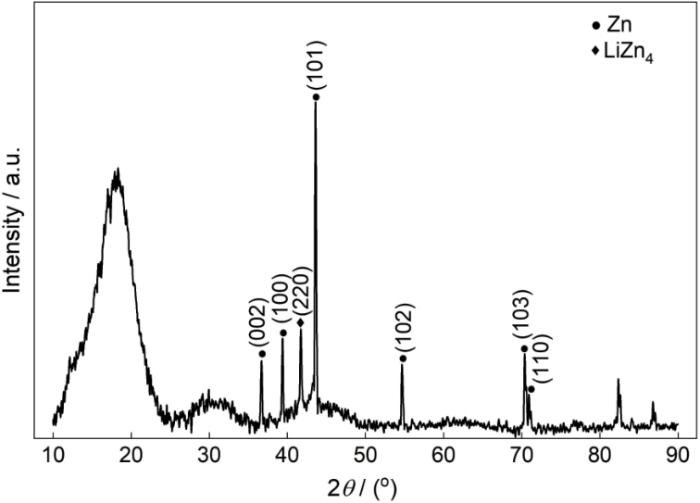
图2为拉拔态Zn-0.45Li合金丝材的SEM图片,可以看到其微观组织呈现出典型的冷变形组织特征,晶粒沿拉拔方向被显著拉长,形成纤维状形貌,无明显的等轴晶存在。在腐蚀环境中,LiZn4相的耐蚀性较差,使其在显微组织中表现为明显的凹陷形貌,从而在显微观察时更易被识别,如高倍SEM图片中的深蓝色箭头所示(图2b)。相比之下,Zn基体由于其较高的耐蚀性,在显微组织中表现为相对明亮的区域。文献研究表明,由于Li的电离能较低,因此在电子束的轰击下容易被电离并扩散,从而导致在EDS分析中难以探测[23]。因此在实际的检测中Li元素难以通过常规的EDS分析进行直接检测[23]。在本研究中,基于微观形貌和腐蚀行为对Zn-0.45Li合金的物相组成进行了表征,并结合XRD结果验证了LiZn4相的存在。同时从图2a中可以看到,Zn相和LiZn4相呈层状交替分布。
图2
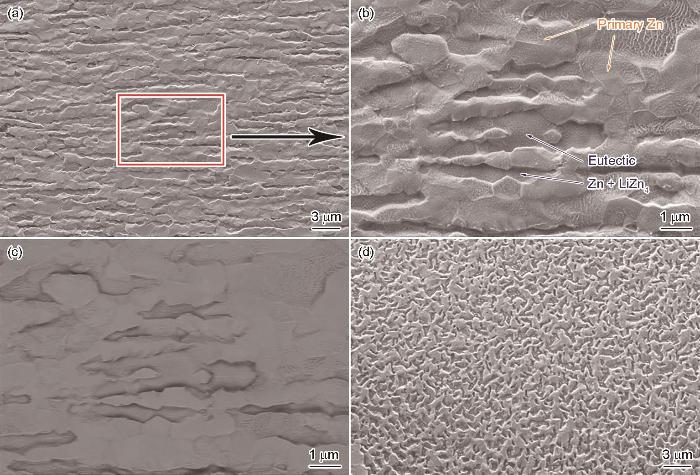
图2
拉拔态Zn-0.45Li合金丝材的SEM及BSE图片
Fig.2
SEM and BSE images of as-drawn Zn-0.45Li alloy wires (a-c) longitudinal sections, (d) cross-section
图3
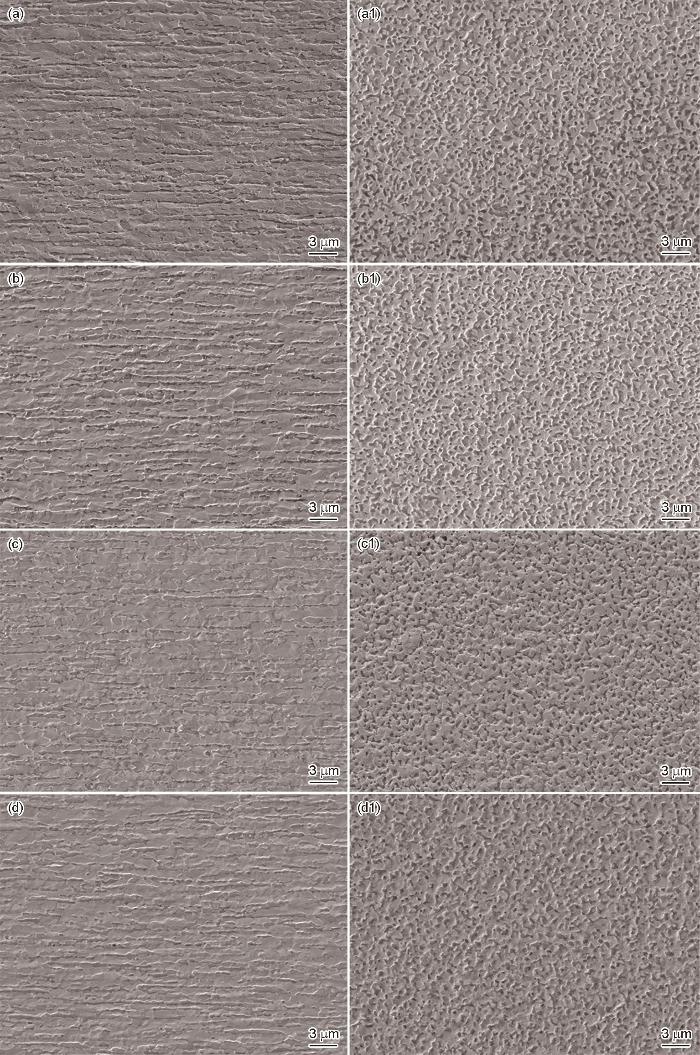
图3
70 ℃热处理后Zn-0.45Li合金丝材的纵截面和横截面SEM图片
Fig.3
SEM images of Zn-0.45Li alloy wire after heat treatment at 70 oC (a-d) longitudinal sections, (a1-d1) cross sections, (a, a1) held for 30 min, (b, b1) held for 1 h, (c, c1) held for 2 h, (d, d1) held for 4 h
图4
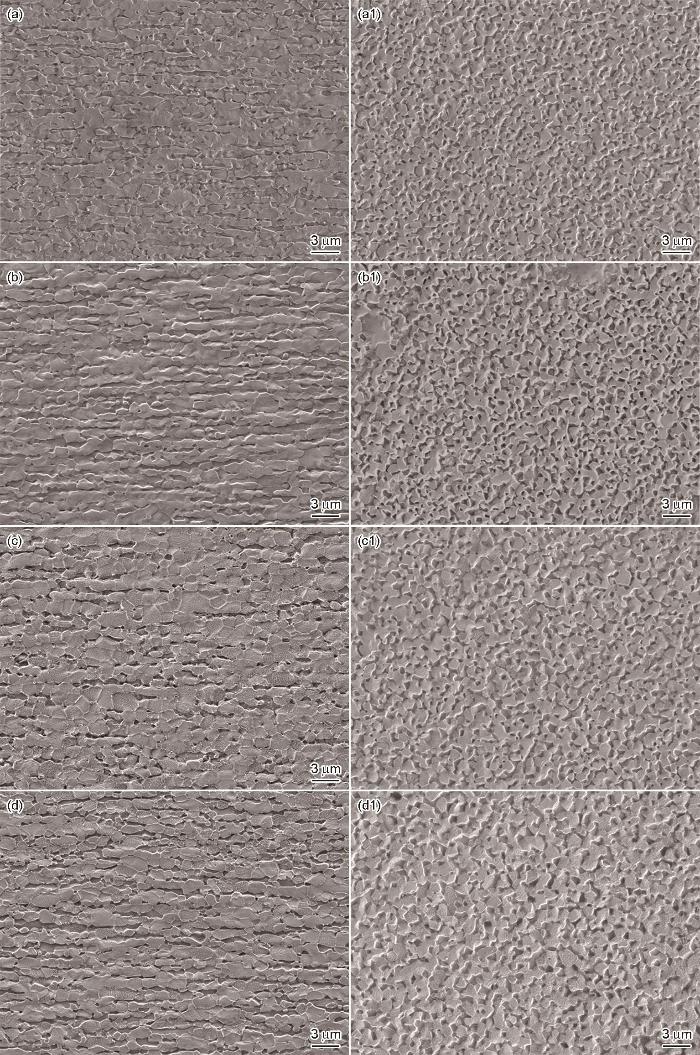
图4
120 ℃热处理后Zn-0.45Li合金丝材的纵截面和横截面SEM图片
Fig.4
SEM images of Zn-0.45Li alloy wire after heat treatment at 120 oC (a-d) longitudinal sections, (a1-d1) cross sections, (a, a1) held for 30 min, (b, b1) held for 1 h, (c, c1) held for 2 h, (d, d1) held for 4 h
图5为Zn-0.45Li合金丝材150 ℃热处理后的SEM图片,150 ℃热处理后微观组织的演变规律与120 ℃规律相同,但由于温度升高后原子扩散速率显著提升,组织演变的速率加快。当保温时间较短时(保温5 min和15 min时)丝材发生部分再结晶,当保温时间增加到30 min时,丝材发生完全再结晶,当保温时间继续增加到1 h时,丝材发生晶粒长大,平均晶粒尺寸显著增加。
图5
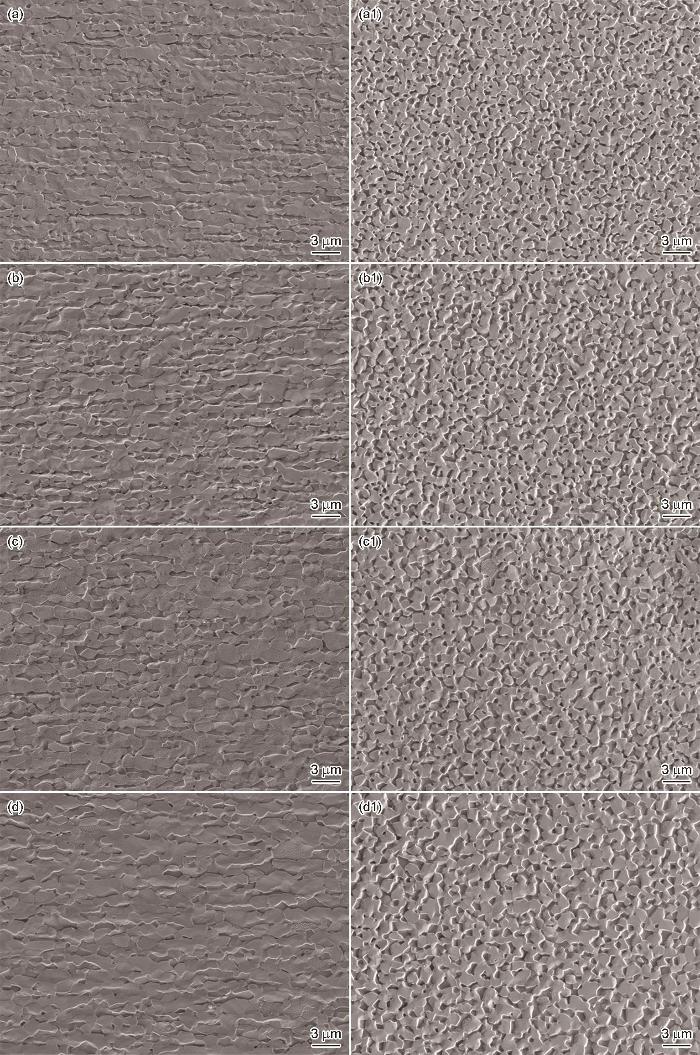
图5
150 ℃热处理后Zn-0.45Li合金丝材的纵截面和横截面SEM图片
Fig.5
SEM images of Zn-0.45Li alloy wire after heat treatment at 150 oC (a-d) longitudinal sections, (a1-d1) cross sections, (a, a1) held for 5 min, (b, b1) held for 15 min, (c, c1) held for 30 min, (d, d1) held for 1 h
采用Image J对第二相进行统计,不同热处理工艺前后Zn-0.45Li合金LiZn4相的平均尺寸和面积分数结果列于表1。可以看到,70 ℃热处理后LiZn4相的大小和面积分数与拉拔态相比无显著变化,表明在该温度下原子的扩散能力有限。当热处理温度升高至120 ℃和150 ℃时,随着保温时间的延长,LiZn4相逐渐粗化,其平均直径明显增大,由拉拔态的0.46 μm增大至0.66 μm左右。与此同时,LiZn4相的面积分数也随保温时间的延长而逐渐增加,由拉拔态的12.61%增加至30%以上,表明LiZn4相的数量增多。
表1 热处理前后Zn-0.45Li合金LiZn4相的平均尺寸和面积分数
Table 1
| Heat treatment | Average size / μm | Area fraction / % |
|---|---|---|
| As-drawn | 0.46 ± 0.01 | 12.61 |
| 70 oC 30 min | 0.47 ± 0.01 | 12.66 |
| 70 oC 1 h | 0.47 ± 0.03 | 12.55 |
| 70 oC 2 h | 0.46 ± 0.02 | 12.91 |
| 70 oC 4 h | 0.47 ± 0.03 | 12.64 |
| 120 oC 30 min | 0.57 ± 0.01 | 21.10 |
| 120 oC 1 h | 0.57 ± 0.03 | 27.88 |
| 120 oC 2 h | 0.63 ± 0.02 | 28.59 |
| 120 oC 4 h | 0.65 ± 0.01 | 31.45 |
| 150 oC 5 min | 0.53 ± 0.02 | 21.54 |
| 150 oC 15 min | 0.56 ± 0.03 | 22.20 |
| 150 oC 30 min | 0.66 ± 0.01 | 24.22 |
| 150 oC 1 h | 0.67 ± 0.01 | 36.93 |
图6为经不同热处理工艺处理前后的Zn-0.45Li合金丝材的应力应变曲线。可以看到,拉拔态Zn-0.45Li合金的抗拉强度为420.5 MPa,延伸率为248.5%,与拉拔态相比,所有热处理工艺下的Zn-0.45Li合金丝材抗拉强度均有不同程度的提升,延伸率均呈下降趋势。
图6
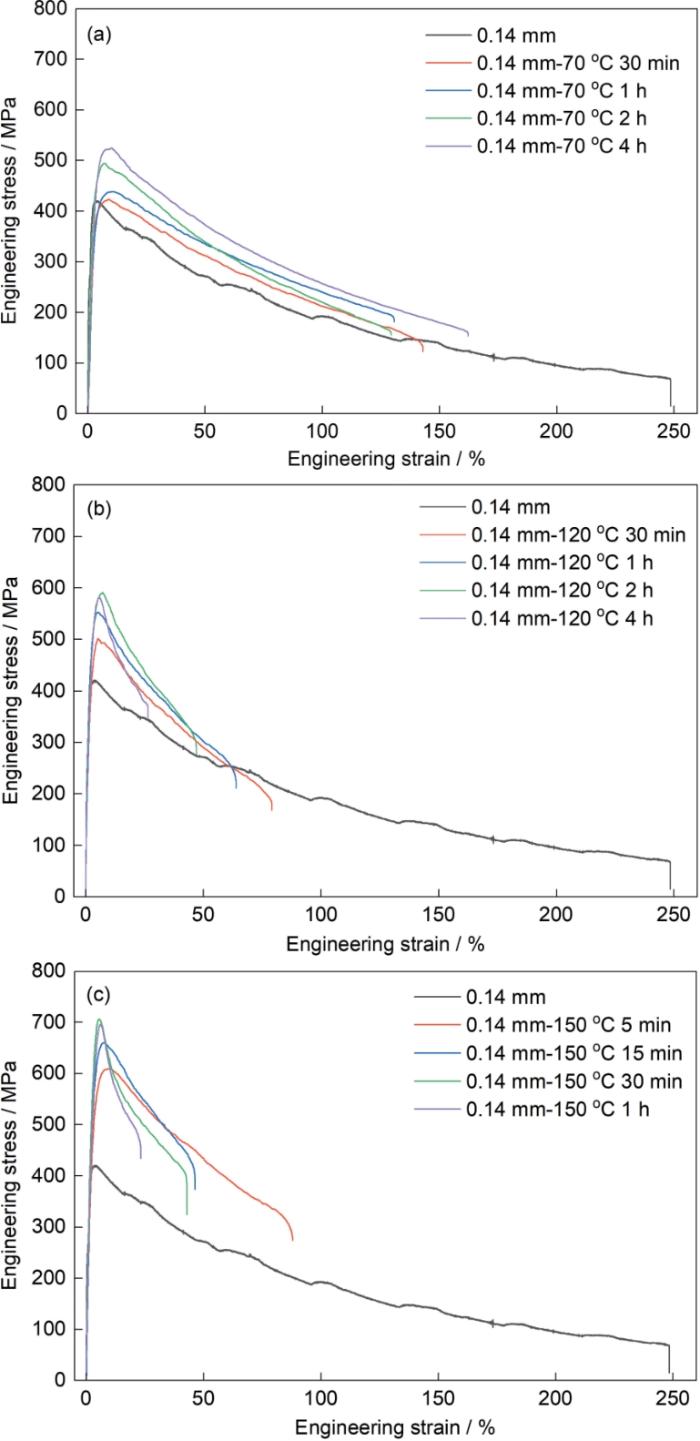
图6
不同热处理工艺前后Zn-0.45Li合金丝材的应力应变曲线
Fig.6
Stress-strain curves of Zn-0.45Li alloy wires before and after different heat treatment processes (a) 70 oC, (b) 120 oC, (c) 150 oC
70 ℃低温热处理时,随着保温时间从30 min延长至2 h,丝材的抗拉强度逐渐升高,由保温30 min的422.7 MPa升高至493.6 MPa;延伸率逐渐下降,由142.9%下降至129.3%。当保温时间进一步延长至4 h时,丝材的抗拉强度继续升高至524.2 MPa,延伸率有所回升,升高至162.2%。
120 ℃热处理时,随着保温时间从30 min延长至2 h,随着保温时间的延长,丝材的延伸率逐渐降低,由79.2%下降至47.0%;抗拉强度逐渐升高,由501.8 MPa升高至590.9 MPa。当保温时间进一步延长至4 h时,丝材的延伸率继续降低至26.6%,同时抗拉强度略有下降,为580.5 MPa。与拉拔态丝材相比,120 ℃保温2 h时的抗拉强度提升了约70 MPa。
150 ℃热处理时,与120 ℃热处理时相似,随着保温时间的延长,丝材的延伸率逐渐减小,由87.9%减小至23.3%;抗拉强度先升高后略有下降,在保温30 min时达到峰值706.9 MPa,且峰值强度较拉拔态提升了约90 MPa。整体来看,热处理温度越高,丝材的抗拉强度提升幅度越大,断后延伸率的降低幅度也越大。与120 ℃保温2 h相比,150 ℃保温30 min后合金的延伸率变化不大,保持在38.5%,但抗拉强度提高了116 MPa,实现了高强度和良好塑性的兼顾。心血管支架要求同时具备高强度和高延展性,支架设计时应优先选用抗拉强度≥ 300 MPa,延伸率> 15%~18%的材料,理想延伸率应达30%以上[24]。150 ℃保温30 min工艺下丝材的强度和延展性能够满足支架设计的要求,为力学性能最优工艺。
为进一步探究热处理过程中微观组织演变对Zn-0.45Li合金丝材力学性能的影响机制,基于前面微观组织和力学性能测试的结果,由于在150 ℃热处理时,合金发生了完整的组织演变过程且该温度热处理后合金的强度提升更为显著,因此本研究选取150 ℃保温不同时间的样品进行EBSD分析。
图7为150 ℃热处理前后Zn-0.45Li合金丝材的EBSD反极图(IPF)、极图和晶粒尺寸分布图。从图7a~d中可以看到,随着保温时间的增加,晶粒由拉长的纤维状形貌转变为等轴晶,且结合图5a~d中的组织图,可以初步判断在Zn晶界处聚集的小颗粒为LiZn4相。随着保温时间的增加,LiZn4相的数量逐渐增多,且由分散的分布逐渐聚集形成条带状,同时LiZn4相的尺寸也随保温时间的增加略有增大。可以观察到,细小的LiZn4晶粒为红色,表明析出相晶粒的c轴,即[0001]几乎与ND平行。而Zn晶粒表现出偏向于[
图7
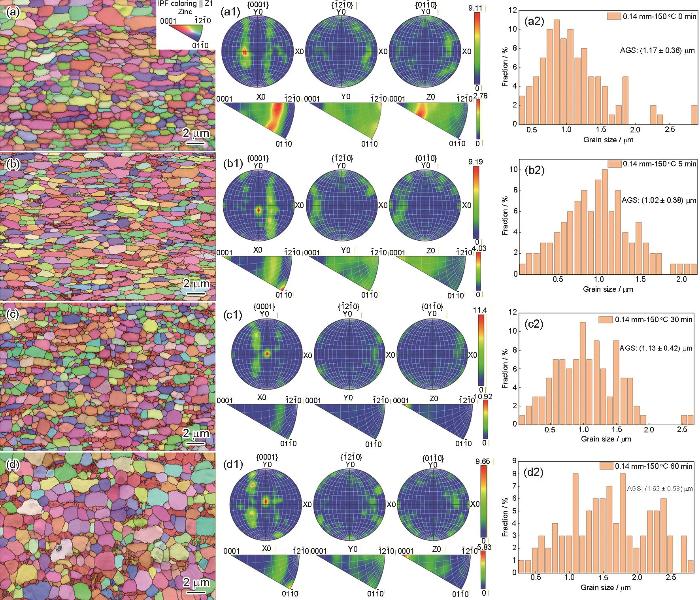
图7
150 ℃热处理前后Zn-0.45Li合金丝材的EBSD取向图、极图、反极图以及晶粒尺寸分布
Fig.7
EBSD orientation maps, pole figures, inverse pole figures, and grain size distribution maps of Zn-0.45Li alloy wires before and after heat treatment at 150 oC (a-a2) as-drawn, (b-b2) held for 5 min, (c-c2) held for 30 min, (d-d2) held for 1 h
图8显示了150 ℃热处理前后Zn-0.45Li合金的再结晶晶粒的分布情况,其中蓝色表示完全再结晶晶粒,黄色表示亚结构,红色表示变形晶粒。可以看到,拉拔态样品中存在亚结构和变形晶粒,在热处理初期,合金主要发生回复,变形晶粒转变为亚结构,而再结晶晶粒比例变化不大。随着保温时间的延长,部分亚结构转变为再结晶晶粒,新形成的再结晶晶粒通过大角度晶界迁移逐渐消耗周围的变形基体,再结晶晶粒比例逐步提高。当保温时间进一步延长至1 h,亚结构比例进一步减少,再结晶晶粒比例进一步增加,小晶粒通过晶界迁移被大晶粒吞并,平均晶粒尺寸明显增大。
图8
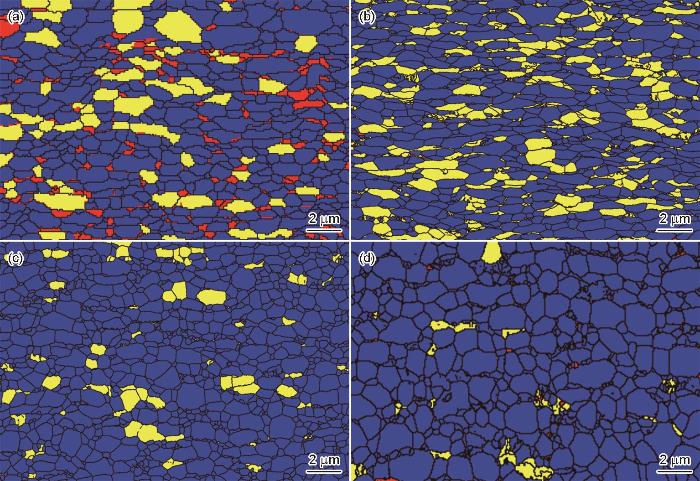
图8
150 ℃热处理前后Zn-0.45Li合金丝材的再结晶晶粒分布图
Fig.8
Distribution of recrystallized grains in Zn-0.45Li alloy wires before and after heat treatment at 150 oC (a) as-drawn, (b) held for 5 min, (c) held for 30 min, (d) held for 1 h
图9
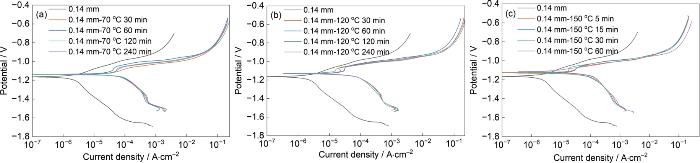
图9
不同热处理工艺前后Zn-0.45Li合金丝材在SBF溶液中的极化曲线
Fig.9
Polarization curves of Zn-0.45Li alloy wires in SBF solution before and after different heat treatment processes (a) 70 oC, (b) 120 oC, (c) 150 oC
表2 不同热处理工艺前后Zn-0.45Li合金丝材在SBF溶液中的极化曲线拟合参数
Table 2
| Heat treatment | Corrosion potential / V | Corrosion current density / A·cm-2 |
|---|---|---|
| 0.14 mm | -1.165 | 1.78 × 10⁻⁶ |
| 0.14 mm-70 oC 30 min | -1.139 | 1.41 × 10⁻⁴ |
| 0.14 mm-70 oC 1 h | -1.135 | 1.47 × 10⁻⁴ |
| 0.14 mm-70 oC 2 h | -1.137 | 1.47 × 10⁻⁴ |
| 0.14 mm-70 oC 4 h | -1.138 | 1.48 × 10⁻⁴ |
| 0.14 mm-120 oC 30 min | -1.133 | 1.65 × 10⁻⁴ |
| 0.14 mm-120 oC 1 h | -1.136 | 1.63 × 10⁻⁴ |
| 0.14 mm-120 oC 2 h | -1.127 | 1.65 × 10⁻⁴ |
| 0.14 mm-120 oC 4 h | -1.132 | 1.67 × 10⁻⁴ |
| 0.14 mm-150 oC 5 min | -1.124 | 1.71 × 10⁻⁴ |
| 0.14 mm-150 oC 15 min | -1.128 | 1.70 × 10⁻⁴ |
| 0.14 mm-150 oC 30 min | -1.126 | 1.67 × 10⁻⁴ |
| 0.14 mm-150 oC 1 h | -1.112 | 1.72 × 10⁻⁴ |
相同热处理温度下,不同保温时间的丝材的腐蚀电流密度相差较小,表明保温时间对丝材的耐蚀性影响较小;随着热处理温度的升高,丝材的腐蚀电流密度逐渐增大。冷拉拔态丝材的自腐蚀电流密度约为1.78 × 10⁻⁶ A/cm2,70 ℃热处理4 h时增至1.48 × 10⁻⁴ A/cm2,120 ℃热处理4 h时增至1.67 × 10⁻⁴ A/cm2,150 ℃热处理1 h时增至1.72 × 10⁻⁴ A/cm2,表明随着热处理温度的升高,丝材的耐蚀性逐渐下降。
3 分析讨论
3.1 热处理对Zn-0.45Li合金丝材微观组织的影响
Zn-0.45Li合金丝材在热处理过程中,依次发生了静态回复、再结晶与晶粒长大三个过程,这一组织演变过程符合可降解锌合金热处理的普遍规律。由于70 ℃温度较低,无法为再结晶形核提供足够的原子扩散驱动力,因此在该温度热处理时合金仅发生位错的重排与回复,晶粒仍保持纤维状,尺寸无明显长大。当热处理温度升高至120 ℃和150 ℃时,原子的扩散速率提高,合金依次经历了部分再结晶、完全再结晶和晶粒长大三个过程,其核心驱动力来自拉拔变形过程中引入的晶格畸变能。同时,在拉拔变形过程中形成的细小的弥散的LiZn4相,通过粒子激发形核(PSN)机制显著提高了再结晶的形核率,加速了完全再结晶的过程[25]。
由于150 ℃下原子扩散速率更快,再结晶形核与长大的速率显著提高,因此在150 ℃热处理时合金仅需30 min即可完成完全再结晶。
3.2 热处理对Zn-0.45Li合金丝材力学性能的影响
70 ℃热处理时,合金以回复为主,未发生明显的再结晶。随着保温时间的延长,回复过程持续发生,合金内部残余应力逐步消除,同时晶粒缓慢长大,从而使丝材抗拉强度逐渐升高,延伸率逐渐下降。随着保温时间进一步延长,充分的回复过程有效消除了合金中的晶格缺陷,使得塑性得以回升。
120 ℃热处理时,由于温度升高为再结晶提供了充足驱动力,再结晶与晶粒长大过程同步进行。随着保温时间的延长,合金晶粒持续长大,从而使丝材的抗拉强度逐渐升高,延伸率逐渐下降。而保温时间过长则引发晶粒过度粗化,粗大的晶粒导致变形的不均匀性增加,从而导致应力集中,使塑性进一步下降;同时由于再结晶使晶粒内部位错密度显著降低,从而使合金强度略有下降。
150 ℃热处理时对丝材力学性能的影响机制与120 ℃相似,但由于热处理温度更高,再结晶与晶粒长大显著加快。随保温时间延长,丝材延伸率持续减小,且降幅远大于70 ℃与120 ℃的样品,这是由于高温下晶粒快速粗化对塑性的大幅削弱;抗拉强度同样先升后降,峰值提前至保温30 min,且高于120 ℃热处理的峰值强度。这表明在该低熔点锌锂合金中,温度越高,达到最优强化效果的热处理时间越短,过度长时保温会引发晶粒异常粗化,致使强度回落。
3.3 热处理对Zn-0.45Li合金丝材耐蚀性的影响
在Zn-Li中,Li在Zn基体中的室温固溶度极低,冷拉拔过程中强烈的塑性变形会引入大量位错、晶格畸变等晶体缺陷,使Li在Zn基体中形成过饱和固溶体,热处理过程为过饱和固溶体的分解提供了驱动力,随着热处理温度的升高,合金中原子的扩散能力增强,过饱和固溶于Zn基体中的Li原子会持续析出,与Zn原子结合形成LiZn4第二相粒子[17],且热处理温度越高,第二相的析出量越多、体积分数越大。
LiZn4相与Zn基体会组成微电偶腐蚀对[29],随着热处理温度升高,LiZn4相的数量与体积分数持续增加,从而微电偶腐蚀对数量显著增多,因此合金的腐蚀电流密度升高,腐蚀速率加快,耐蚀性能下降。
4 结论
(1) 在Zn-0.45Li合金超细丝材中发现显著的退火硬化现象,150 ℃保温30 min工艺下,丝材的抗拉强度达到峰值706.9 MPa,较拉拔态提高约90 MPa,同时延伸率保持在38.5%,实现了高强度与良好塑性的兼顾。
(2) 70 ℃热处理时,丝材仅发生静态回复,晶粒始终保持拉长的纤维状变形形貌,未发生再结晶;120 ℃、150 ℃热处理时,随着保温时间的延长,丝材经历了部分再结晶、完全再结晶和晶粒长大三个过程,晶粒尺寸随保温时间延长逐渐增大,LiZn4相的数量随热处理温度升高与保温时间延长逐渐增多。
(3) 70 ℃热处理时,强度随保温时间延长持续升高,延伸率先降后升;120 ℃、150 ℃热处理时,强度呈先升后降趋势,分别在保温120 min、30 min时达到峰值;热处理温度越高,强度提升幅度越大,延伸率的降低幅度越大。锌合金在晶粒尺寸较小时变形机制以晶界滑移为主,热处理后晶粒长大,晶界减少,晶界滑移变得困难,变形协调性下降,这是丝材热处理后强度提高塑性下降的主要原因。
(4) 热处理后丝材的腐蚀电流密度增大,降解速率升高,腐蚀速率随热处理温度升高而显著增大,相同温度下保温时间对丝材腐蚀行为的影响较弱。热处理后LiZn4相增多,LiZn4相与Zn基体之间的微电偶腐蚀效应,是热处理后丝材降解速率升高的主要原因。
参考文献
Current status and future direction of biodegradable metallic and polymeric vascular scaffolds for next-generation stents
[J].
Because of the increasing incidence of coronary artery disease, the importance of cardiovascular stents has continuously increased as a treatment of this disease. Biodegradable scaffolds fabricated from polymers and metals have emerged as promising materials for vascular stents because of their biodegradability. Although such stent framework materials have shown good clinical efficacy, it is difficult to decide whether polymers or metals are better vascular scaffolds because their properties are different. Therefore, there are still obstacles in the development of biodegradable vascular scaffolds in terms of improving clinical efficacy. This review analyzes the pros and cons of current stent materials with respect to five key factors for next-generation stent and discusses methods of improvement. Furthermore, we discuss biodegradable electronic stents with electrical conductivity, which has been considered unimportant until now, and highlight electrical conductivity as a key factor in the development of next-generation stents.Copyright © 2017 Acta Materialia Inc. Published by Elsevier Ltd. All rights reserved.
Evolution of metallic cardiovascular stent materials: a comparative study among stainless steel, magnesium and zinc
[J].
Optimizing structural design on biodegradable magnesium alloy vascular stent for reducing strut thickness and raising radial strength
[J].
Biodegradable stents for coronary artery disease treatment: recent advances and future perspectives
[J].
Computational analysis of the radial mechanical performance of PLLA coronary artery stents
[J].Stents have been an effective tool to restore and maintain the patency of narrowed blood vessels, but they must have sufficient radial strength. Biodegradable stent materials have substantially lower mechanical properties than permanent stents. The stent geometry and material properties must be considered simultaneously when assessing stent performance. Material tests were performed to determine the mechanical characteristics of high-molecular-weight poly-l-lactic acid (PLLA). The results were used to calibrate an anisotropic elastic-plastic material model. Three distinct geometries were analysed with a range of material stiffness values in a finite element analysis to investigate their comparative effect on the radial strength, recoil, and radial stiffness. The performance of the different geometries varies substantially, with one particular geometry, with the highest material stiffness of 9 GPa, exceeding the desired radial strength of 300 mmHg.Copyright © 2014 IPEM. Published by Elsevier Ltd. All rights reserved.
Recent progress on coatings of biomedical magnesium alloy
[J].
Recent research and progress of biodegradable zinc alloys and composites for biomedical applications: biomechanical and biocorrosion perspectives
[J].Biodegradable metals (BMs) gradually degrade by releasing corrosion products once exposed to the physiological environment in the body. Complete dissolution of biodegradable implants assists tissue healing, with no implant residues in the surrounding tissues. In recent years, three classes of BMs have been extensively investigated, including magnesium (Mg)-based, iron (Fe)-based, and zinc (Zn)-based BMs. Among these three BMs, Mg-based materials have undergone the most clinical trials. However, Mg-based BMs generally exhibit faster degradation rates, which may not match the healing periods for bone tissue, whereas Fe-based BMs exhibit slower and less complete degradation. Zn-based BMs are now considered a new class of BMs due to their intermediate degradation rates, which fall between those of Mg-based BMs and Fe-based BMs, thus requiring extensive research to validate their suitability for biomedical applications. In the present study, recent research and development on Zn-based BMs are reviewed in conjunction with discussion of their advantages and limitations in relation to existing BMs. The underlying roles of alloy composition, microstructure, and processing technique on the mechanical and corrosion properties of Zn-based BMs are also discussed.© 2020 [The Author/The Authors].
Trace elements in human physiology and pathology: zinc and metallothioneins
[J].Zinc is one of the most abundant nutritionally essential elements in the human body. It is found in all body tissues with 85% of the whole body zinc in muscle and bone, 11% in the skin and the liver and the remaining in all the other tissues. In multicellular organisms, virtually all zinc is intracellular, 30-40% is located in the nucleus, 50% in the cytoplasm, organelles and specialized vesicles (for digestive enzymes or hormone storage) and the remainder in the cell membrane. Zinc intake ranges from 107 to 231 micromol/d depending on the source, and human zinc requirement is estimated at 15 mg/d. Zinc has been shown to be essential to the structure and function of a large number of macromolecules and for over 300 enzymic reactions. It has both catalytic and structural roles in enzymes, while in zinc finger motifs, it provides a scaffold that organizes protein sub-domains for the interaction with either DNA or other proteins. It is critical for the function of a number of metalloproteins, inducing members of oxido-reductase, hydrolase ligase, lyase family and has co-activating functions with copper in superoxide dismutase or phospholipase C. The zinc ion (Zn(++)) does not participate in redox reactions, which makes it a stable ion in a biological medium whose potential is in constant flux. Zinc ions are hydrophilic and do not cross cell membranes by passive diffusion. In general, transport has been described as having both saturable and non-saturable components, depending on the Zn(II) concentrations involved. Zinc ions exist primarily in the form of complexes with proteins and nucleic acids and participate in all aspects of intermediary metabolism, transmission and regulation of the expression of genetic information, storage, synthesis and action of peptide hormones and structural maintenance of chromatin and biomembranes.
Biodegradable Zn-Cu-Mn alloy with suitable mechanical performance and in vitro degradation behavior as a promising candidate for vascular stents
[J].
Zinc exhibits ideal physiological corrosion behavior for bioabsorbable stents
[J].
Insight into role and mechanism of Li on the key aspects of biodegradable Zn-Li alloys: microstructure evolution, mechanical properties, corrosion behavior and cytotoxicity
[J].
Structural characteristics and in vitro biodegradation of a novel Zn-Li alloy prepared by induction melting and hot rolling
[J].
Ultrahigh strength and uniform corrosion in Zn-Li alloys through ultrahigh pressure supersaturated solid solution treatment for biodegradable orthopedic applications
[J].\n Zn‐Li alloys are considered promising candidate materials for biodegradable orthopedic implant applications due to their high mechanical performance and good biocompatibility. However, the presence of a large number of second‐phase particles in this class of Zn alloys can lead to severe localized degradation due to micro‐galvanic corrosion, which is detrimental to the mechanical integrity of the alloys during tissue healing in the human body. In this study, we report ultrahigh strength, uniform corrosion, good cytocompatibility, and effective antibacterial ability in Zn‐\n x\n Li (\n x\n = 0.3, 0.5, 0.7; wt%) alloys achieved through supersaturated solid solution treatment (SSST) at 375 °C under ultrahigh pressure of 3 GPa. A high concentration of β‐LiZn\n 4\n phases coexisted with the ‐Zn matrix in the as‐cast Zn‐\n x\n Li alloys, whereas almost all the Li dissolved into the ‐Zn matrix of SSST counterparts. The yield strength was 437 MPa for SSST Zn‐0.3Li, 592 MPa for SSST Zn‐0.5Li, and 686 MPa for SSST Zn‐0.7Li. The SSST Zn‐Li alloys showed uniform degradation with remarkably reduced degradation rates compared to their as‐cast counterparts. The 25% concentration extracts of the Zn‐\n x\n Li alloys demonstrated no cytotoxicity toward MC3T3‐E1 cells, and the alloys exhibited effective antibacterial ability against methicillin‐resistant staphylococcus aureus.\n
High-performance hot-warm rolled Zn-0.8Li alloy with nano-sized metastable precipitates and sub-micron grains for biodegradable stents
[J].Fabricated through a newly developed hot-warm rolling process, Zn-0.8Li (wt%) alloy has ideal strength and ductility far beyond the mechanical benchmark of materials for biodegradable stents. Precipitation of needle-like Zn in primary β-LiZn4 phase is observed in Zn-Li alloy for the first time. Orientation relationship between them can be described as [1-213]β//[2-1-10]Zn, (10-10)β about 4.5° from (0002)Zn. Zn grains with an average size of 640 nm exhibit strong basal texture, detected by transmission electron back-scatter diffraction. Li distribution is determined by three-dimensional atom probe, which reveals the formation of nano-sized metastable α-Li2Zn3 precipitates with a number density of 7.16 × 10²² m-3. The fine lamellar Zn + β-LiZn4 structure, sub-micron grains and the nano-sized precipitates contribute to the superior mechanical properties.
Tribocorrosion mechanism of biodegradable high-strength Zn-0.5Li alloy and pure Zn with bovine serum albumin adsorption
[J].
Effect of hot rolling temperature on microstructures, mechanical properties and corrosion resistance of bio-potential Zn-0.8Li alloy
[J].
Effects of combined use of inoculation and modification heat treatment on microstructure, damping and mechanical properties of Zn-Al eutectoid alloy
[J].
Adjusting comprehensive properties of biodegradable Zn-Mn alloy through solution heat-treatment
[J].
Fine-tuning of mechanical properties in a Zn-Ag-Mg alloy via cold plastic deformation process and post-deformation annealing
[J].In recent years, Zn-based materials have been extensively investigated as potential candidates for biodegradable implant applications. The introduction of alloying elements providing solid-solution strengthening and second phase strengthening seems crucial to provide a suitable platform for the thermo-mechanical strengthening of Zn alloys. In this study, a systematic investigation of the microstructure, crystallographic texture, phase composition, and mechanical properties of a Zn-3Ag-0.5Mg (wt%) alloy processed through combined hot extrusion (HE) and cold rolling (CR), followed by short-time heat treatment (CR + HT) at 200 °C was conducted. Besides, the influence of different annealing temperatures on the microstructure and mechanical properties was studied. An adequate combination of processing conditions during CR and HT successfully addressed brittleness obtained in the high-strength HE Zn-3Ag-0.5Mg alloy. By controlling the microstructure, the most promising results were obtained in the sample subjected to 50% CR reduction and 5-min annealing, which were: ultimate tensile strength of 432 MPa, yield strength of 385 MPa, total elongation to failure of 34%, and Vickers microhardness of 125 HV0.3. The obtained properties clearly exceed the mechanical benchmarks for biodegradable implant materials. Based on the conducted investigation, brittle multi-phase Zn alloys' mechanical performance can be substantially enhanced to provide sufficient plasticity by grain refinement through cold deformation process, followed by short-time annealing to restore proper strength.© 2021 The Authors.
Effects of heat treatment on microstructure and mechanical properties of deformed Zn-Cu-Ti alloy
[J].
热处理对变形Zn-Cu-Ti合金组织和性能的影响
[J].
Towards revealing key factors in mechanical instability of bioabsorbable Zn-based alloys for intended vascular stenting
[J].Zn-based alloys are recognized as promising bioabsorbable materials for cardiovascular stents, due to their biocompatibility and favorable degradability as compared to Mg. However, both low strength and intrinsic mechanical instability arising from a strong strain rate sensitivity and strain softening behavior make development of Zn alloys challenging for stent applications. In this study, we developed binary Zn-4.0Ag and ternary Zn-4.0Ag-xMn (where x = 0.2-0.6wt%) alloys. An experimental methodology was designed by cold working followed by a thermal treatment on extruded alloys, through which the effects of the grain size and precipitates could be thoroughly investigated. Microstructural observations revealed a significant grain refinement during wire drawing, leading to an ultrafine-grained (UFG) structure with a size of 700 nm and 200 nm for the Zn-4.0Ag and Zn-4.0Ag-0.6Mn, respectively. Mn showed a powerful grain refining effect, as it promoted the dynamic recrystallization. Furthermore, cold working resulted in dynamic precipitation of AgZn particles, distributing throughout the Zn matrix. Such precipitates triggered mechanical degradation through an activation of Zn/AgZn boundary sliding, reducing the tensile strength by 74% and 57% for Zn-4.0Ag and Zn-4.0Ag-0.6Mn, respectively. The observed precipitation softening caused a strong strain rate sensitivity in cold drawn alloys. Short-time annealing significantly mitigated the mechanical instability by reducing the AgZn fraction. The ternary alloy wire showed superior microstructural stability relative to its Mn-free counterpart due to the pinning effect of Mn-rich particles on the grain boundaries. Eventually, a shift of the corrosion regime from localized to more uniform was observed after the heat treatment, mainly due to the dissolution of AgZn precipitates. STATEMENT OF SIGNIFICANCE: Owing to its promising biodegradability, zinc has been recognized as a potential biodegradable material for stenting applications. However, Zn's poor strength alongside intrinsic mechanical instability have propelled researchers to search for Zn alloys with improved mechanical properties. Although extensive researches have been conducted to satisfy the mentioned concerns, no Zn-based alloys with stabilized mechanical properties have yet been reported. In this work, the mechanical properties and stability of the Zn-Ag-based alloys were systematically evaluated as a function of microstructural features. We found that the microstructure design in Zn alloys can be used to find an effective strategy to not only improve the strength and suppress the mechanical instability but also to minimize any damage by augmenting the corrosion uniformity.Copyright © 2020. Published by Elsevier Ltd.
A review of existing and emerging methods for lithium detection and characterization in Li-Ion and Li-Metal batteries
[J].
Biodegradable metals for cardiovascular stents: from clinical concerns to recent Zn-Alloys
[J].
Particle effects on recrystallization in magnesium-manganese alloys: Particle-stimulated nucleation
[J].
Effects of extrusion temperature on microstructure, mechanical properties and in vitro degradation behavior of biodegradable Zn-3Cu-0.5Fe alloy
[J].
Transition of dominant deformation mode in bulk polycrystalline pure Mg by ultra-grain refinement down to sub-micrometer
[J].
Effect of rotary forging on the tissue evolution, mechanical properties, degradation properties, and cytocompatibility of medical degradable Zn-0.45Mn alloys
[J].


