



H13钢在航空工业等领域得到了广泛的应用[1~3],其工作环境(如高温和高压)较为恶劣[4~6]。为了延长H13钢的使用寿命和降低成本,须提高其硬度和耐磨性[7~11]。钢的耐磨性与其硬度有密切的关系。Jiang等[12]的研究结果表明,随着马氏体钢硬度的提高其耐磨性随之提高,但是影响耐磨性的还有微观组织等因素。孙荣民等[13]的研究表明,中锰马氏体高强度钢的硬度越高,耐磨性越好。Jagota和Sharma[14]的研究结果表明,随着H13钢硬度的提高其平均摩擦系数和磨损量减小、耐磨性提高。López等[15]的研究结果表明,H13钢硬度的提高有助于提高其耐磨性。Kwon等[16]的研究结果表明,H13钢硬度的提高使其耐磨性提高和平均摩擦系数降低。钢的微观组织对其耐磨性也有重要的影响,钢中二次碳化物的含量、形状和分布等都影响钢的耐磨性。蒋金哲等[17]研究表明,高碳合金马氏体钢在回火过程中析出二次碳化物,降低了磨粒对其表面的切削深度还减轻了磨损表面微观断裂。李国程等[18]研究了Cr20高铬铸铁的磨损性能,发现基体中析出量较多的二次碳化物(硬质相)对其保护作用增强,使耐磨性能提高。Sudhakar等[19]研究表明,合金元素Cr、Mo的添加有助于高铬白口铸铁中二次碳化物的生成,有利于提高其硬度和耐磨性。还有学者发现,碳化物的弥散分布可提高基体硬度、阻碍位错运动和减少粘着磨损,有利于使钢的耐磨性提高[20,21]。王正山等[22]和章昊等[23]的研究表明,在较低的温度淬火,钢中碳化物的析出较慢,其颗粒大小适中且分布均匀,有助于提高其耐磨性。李忠波等[24]研究表明,与析出的片状碳化物相比,钢中析出的短棒状碳化物不易割裂基体,可提高其耐磨性。麻梦梅和雷大俊[11]研究表明,二次回火使H13钢析出更多细小弥散的强化相,使其耐磨性提高。本文将高碳含量H13钢在不同温度固溶,研究钢中的未溶碳化物和二次碳化物分布及其对H13钢耐磨性的影响。
1 实验方法
实验用高碳含量H13钢(简称H13钢)的化学成分为:Fe-0.55C-0.9Si-0.4Mn-4.9Cr-1.3Mo-1.0V(质量分数,%)。在H13钢的基础上,按照合金的成分进行配料,采用25 kg真空冶炼炉进行真空冶炼,使用直径为Φ80 mm的钢锭模浇铸成钢锭,去除冒口及缩孔后锻造成直径为Φ25 mm的棒材,经球化退火,作为本实验用钢,退火后钢的组织主要由球状珠光体组成,如图1所示。
图1

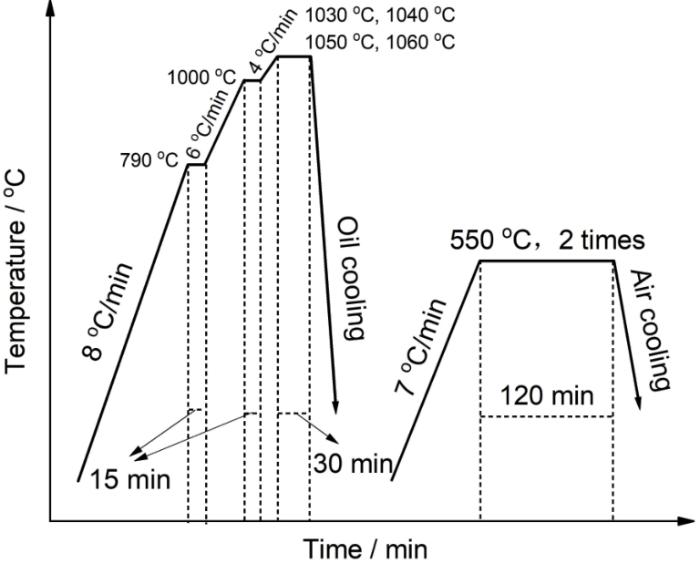
将H13钢线切割成尺寸为10 mm × 10 mm × 15 mm的实验用试样。先将试样升温至790 ℃保温(预热)15 min,然后升温至1000 ℃并保温15 min (二次预热)。然后将试样的温度分别升至固溶温度1030、1040、1050和1060 ℃,保温30 min后油淬。将淬火后的试样进行2次回火处理,回火制度为550 ℃ × 2 h,最后空冷至室温。完整的热处理曲线在图2中给出。
图2
用240#~2000#砂纸将试样预磨,然后将其抛光。用4%的硝酸酒精将试样腐蚀后,用OLYMPUS BX53M光学金相显微镜和SEM3100扫描电子显微镜(SEM)观察淬火和回火试样的显微组织,以及回火后试样的摩擦磨损形貌。为了定量分析H13钢中的碳化物,使用Image J软件标定和统计3张有代表性微观组织中的碳化物,计算碳化物颗粒的含量和尺寸的平均值,其中碳化物颗粒的含量表示为标记范围内碳化物的面积与总面积的比值;将碳化物的总面积除以碳化物的数量得到平均面积,再将各碳化物颗粒视为圆形计算平均直径,即得碳化物的平均尺寸。用THVS-1MDT维氏硬度计测量H13钢试样的维氏硬度,载荷为10 N,加载时间为15 s。用往复摩擦磨损实验机MMF-10测试在不同温度固溶并淬回火后试样的耐磨性,摩擦载荷为1000 N,频率为1 Hz,滑动距离为6 mm,实验时间为1 h。将摩擦磨损前后的试样超声清洗并吹干,用(精度为0.0001 g的)电子天平测量质量并计算磨损量。
2 实验结果
2.1 H13钢的微观组织
图3
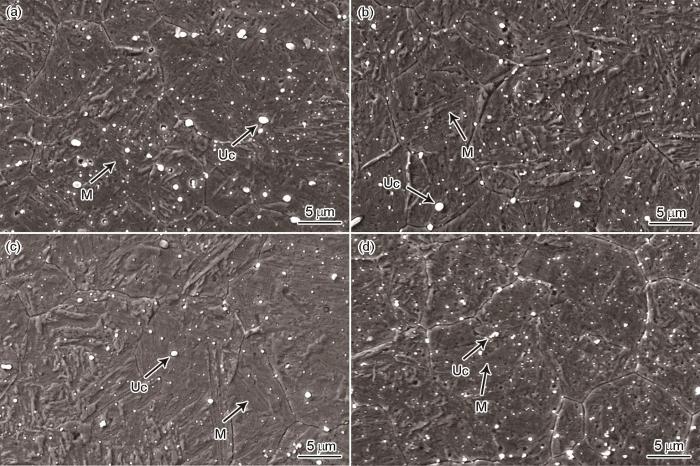
图3
在不同温度固溶淬火后H13钢的微观组织
Fig.3
Microstructure of H13 steel after solution treatments at different temperatures and quenching (a) 1030 oC, (b) 1040 oC, (c) 1050 oC, (d) 1060 oC
图4
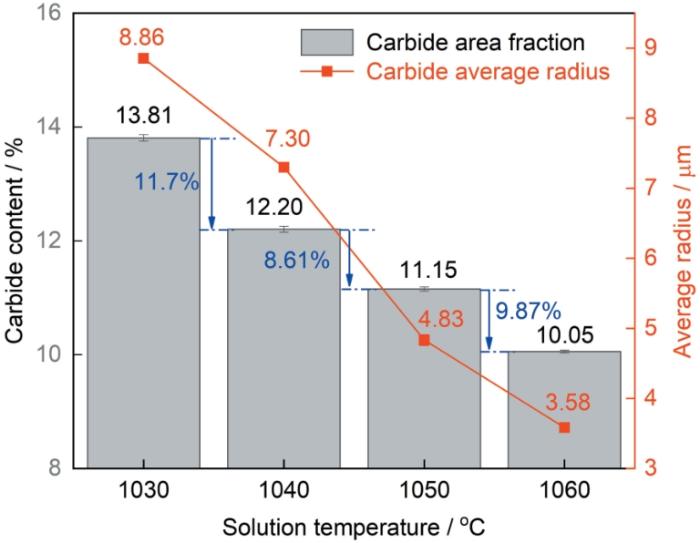
图4
在不同温度固溶淬火后H13钢中未溶碳化物颗粒的含量和尺寸
Fig.4
Conent and size of undissolved carbides in H13 steel after solution at different temperatures and quenching
图5给出了在不同温度固溶后淬火并回火后H13钢的微观组织。可以看出,回火后H13钢中主要有颗粒状(Gc)和细丝状(Fc)碳化物,是淬火后的未溶碳化物和回火时析出的二次碳化物的总和。统计了回火后H13钢中的碳化物数量,结果在图6a中给出。在1030、1040、1050和1060 ℃固溶回火后,H13钢中碳化物的含量分别为17.27%、20.78%、18.32%和17.87%,其变化趋势是先提高后降低,在1040 ℃固溶回火后达到最大值20.78%。将回火后碳化物的总含量减去淬火后未溶碳化物的含量,可得回火析出的二次碳化物含量。计算结果表明,在1030、1040、1050和1060 ℃固溶回火后,析出的二次碳化物的含量分别为3.46%、8.58%、7.17%和7.82% (图6b)。可以看出,固溶温度从1030 ℃提高到1040 ℃,二次碳化物的含量显著提高,提高的幅度达到147.98%。在此固溶条件下二次碳化物的含量最高,达到8.58%。
图5

图5
在不同温度固溶淬火回火后H13钢的微观组织
Fig.5
Microstructure of H13 steel after solution at different temperatures, quenching and tempering (a) 1030 oC, (b) 1040 oC, (c) 1050 oC, (d) 1060 oC
图6
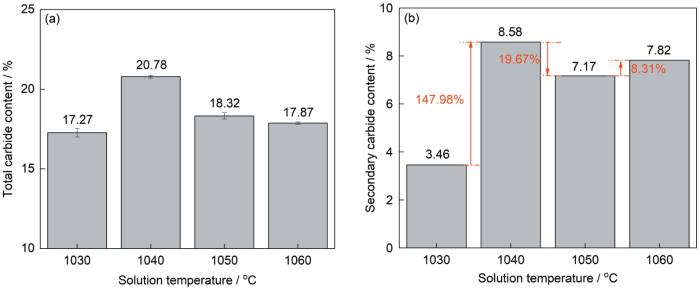
图6
在不同温度固溶淬火回火后H13钢中的碳化物和二次碳化物的含量
Fig.6
Content of total carbides (a) and secondary carbides (b) in H13 steel after solution at different temperatures, quenching and tempering
2.2 H13钢在不同温度固溶淬火并回火后的硬度
图7给出了H13钢在不同温度固溶淬火并回火后的硬度。在1030、1040、1050和1060 ℃固溶淬火后,H13钢的硬度分别为732.2、761.0、778.7和769.0HV1。这表明,随着固溶温度的提高,钢的硬度先提高然后降低。在1050 ℃固溶淬火后H13钢的硬度最高(达到778.7HV1),而在1030℃固溶淬火后硬度最低(为732.2HV1)。
图7
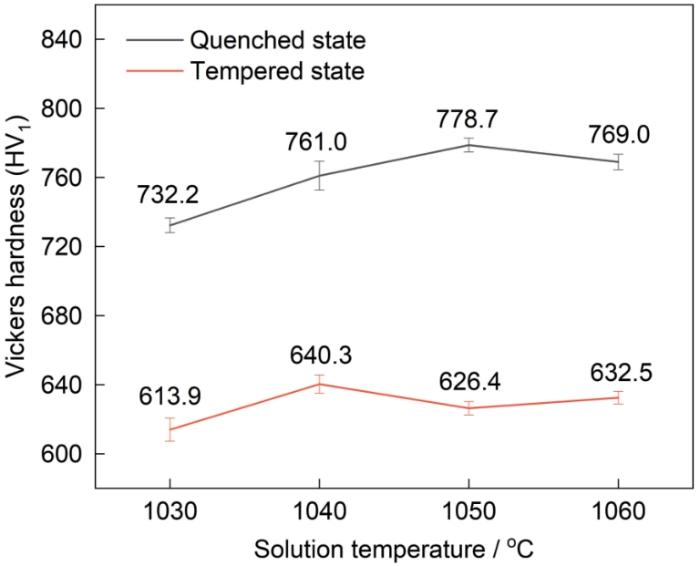
图7
在不同温度固溶淬火回火后H13钢的硬度
Fig.7
Hardness of H13 steel after solution at different temperatures, quenching and tempering
与淬火态相比,回火后H13钢的硬度降低。在1030、1040、1050和1060 ℃固溶淬火后回火,钢的硬度分别为613.9、640.3、626.4和632.5HV1。在1040 ℃固溶回火淬火后,H13钢的硬度最高(为640.3HV1)。
2.3 H13钢的摩擦磨损性能
图8

图8
在不同温度固溶淬火回火后H13钢的摩擦系数和磨损量
Fig.8
Friction coefficient (a) and wear amount (b) of H13 steel after solution at different temperatures, quenching and tempering
图9给出了在不同温度固溶淬火并回火的H13钢试样磨痕的三维形貌。可以看出,在1030、1040、1050和1060 ℃固溶的H13钢,磨痕宽度分别为1.85、1.82、1.83和1.84 mm,磨痕深度分别为80.21、76.33、85.65和77.71 μm。在1040 ℃固溶的试样,磨痕的宽度和深度最小。在1030 ℃固溶的试样磨痕的宽度最大,而在1050 ℃固溶的试样磨痕深度最大。
图9
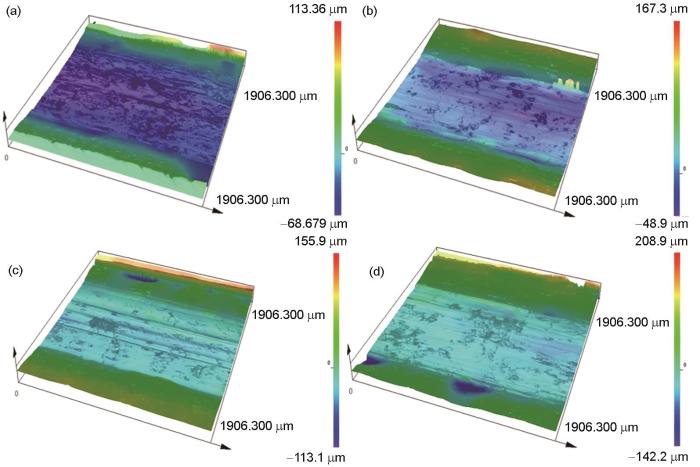
图9
在不同温度固溶的回火态H13钢试样表面的摩擦磨损三维图
Fig.9
Three-dimensional friction and wear morphologies of the tempered H13 steel with different solution temperatures (a) 1030 oC, (b) 1040 oC, (c) 1050 oC, (d) 1060 oC
图10给出了在不同温度固溶淬火并回火后H13钢的摩擦磨损形貌。可以看出,磨损表面的大部分区域不平整,只有一小部分是光滑的。光滑表面与粗糙面的边缘是不规则的锯齿形,是试样表面被摩擦副撕裂破坏所致,磨损表面出现了明显的剥落坑,具有典型的粘着磨损特征。在1050 ℃固溶,剥落坑的尺寸最大,数量最多。在1030和1060 ℃固溶,剥落坑的数量和尺寸比在1050 ℃固溶时有所减少,剥落现象也较轻。在1040 ℃固溶,摩擦磨损面的光滑程度最高,只有很少且尺寸很小的剥落坑。在剥落坑附近有一些白色颗粒,是摩擦时产生的磨屑,也是磨粒磨损的特征。
图10
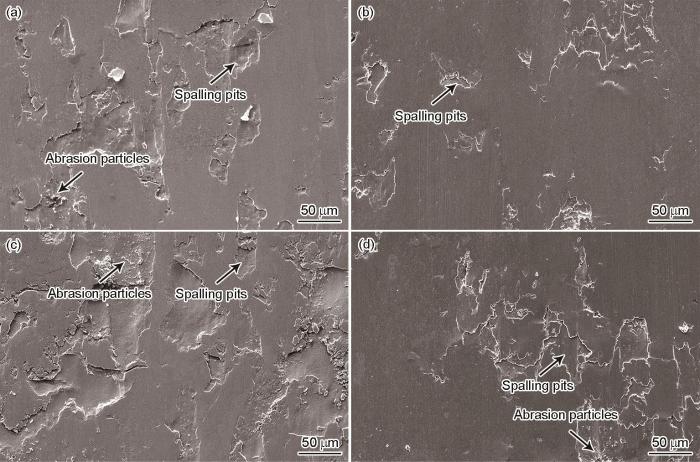
图10
在不同温度固溶回火态H13钢的摩擦磨损形貌
Fig.10
Wear morphologies of the tempered H13 steel with solution treatments at different temperatures (a) 1030 oC, (b) 1040 oC, (c) 1050 oC, (d) 1060 oC
3 讨论
3.1 固溶温度对微观组织的影响
图11

图11
在不同温度固溶淬火回火后H13钢中碳化物微观组织的示意图
Fig.11
Schematic diagram of the carbide microstructure of H13 steel after solution at different temperatures, quenching and tempering (a) 1030 oC, (b) 1040 oC, (c) 1050 oC, (d) 1060 oC
在1040 ℃固溶后更多的碳化物溶解进入奥氏体,淬火后的组织中未溶碳化物颗粒的数量降低和尺寸明显减小(图4)。与在1030 ℃固溶相比,在1040 ℃固溶后H13 钢中未溶碳化物含量降低了11.7%。这使奥氏体中的碳和其它合金元素的含量提高,并导致淬火后马氏体中的碳含量提高,有利于后续回火过程中二次碳化物的析出。因此,回火后钢中二次碳化物的含量明显提高。同时,固溶温度的提高使Cr、Mo、V等合金元素的扩散增强,使更多的合金元素进入基体并均匀分布,有利于合金元素与碳结合生成细小且弥散的二次碳化物。在1040 ℃固溶后钢中二次碳化物分布的示意图,在图11b中给出。可以看出,在1050 ℃固溶回火后,H13钢中二次碳化物数量减少(图6b),其示意图如图11c所示。一方面,固溶温度的提高使溶入基体的合金元素增加、奥氏体的稳定性提高、奥氏体转变为马氏体的开始温度(Ms)降低[25]和残余奥氏体的含量提高。与铁素体相比残余奥氏体能容纳更多的碳元素,使回火时析出的二次碳化物数量减少;另一方面,随着固溶温度的提高奥氏体晶粒长大,晶界的面积减小。
与在1050 ℃固溶相比,固溶温度为1060 ℃时二次碳化物的数量略有增加(图6b)。其原因是,在更高的温度固溶合金元素和碳的扩散速度提高,使大量碳化物溶解进入基体。淬火后基体处于高度过饱和状态,虽然残余奥氏体比铁素体能溶解更多的碳元素,但是在1060 ℃固溶后淬火碳元素在马氏体中过饱和。在淬火过程中马氏体中的碳元素向残余奥氏体中扩散,使残余奥氏体中的碳元素也达到过饱和状态。在马氏体和奥氏体中过饱和的碳和合金元素在回火过程中以碳化物的形式析出,使二次碳化物的含量再次提高(图11d),但是其数量仍比在1040 ℃固溶后回火态H13钢中二次碳化物的数量少。这表明,在较高温度固溶时残余奥氏体的含量对二次碳化物数量的影响较大。
3.2 固溶温度对H13钢力学性能的影响
随着固溶温度的提高,H13钢的淬火硬度先提高后降低并在1050 ℃固溶后达到最高值(图7)。其原因是,固溶温度的提高使未溶碳化物溶解到奥氏体中使马氏体中的碳和其它合金元素的含量提高,过饱和的碳原子以间隙原子的方式溶解于马氏体中,对马氏体强烈的固溶强化使基体的硬度提高。同时,钢中除了未溶碳化物还有一定数量的二次碳化物,二者的合理配比使钢的硬度最高。固溶温度提高到1060 ℃,使溶解进入奥氏体中的合金元素含量提高和淬火后马氏体基体的硬度提高。但是,碳化物的溶解使剩余碳化物的数量减少,碳化物的第二相强化作用减弱。因此,在1060 ℃固溶后钢的硬度比1050 ℃固溶的硬度降低。同时,固溶温度的提高使残余奥氏体的含量随之提高和硬度降低。这是在1060 ℃固溶淬火后硬度降低的重要原因。
固溶温度决定了钢基体组织中碳元素和合金元素的含量,也影响钢中二次碳化物的析出和残余奥氏体的数量,最终影响H13钢的耐磨性能(图8)。在1040 ℃固溶后回火试样的磨损最少和耐磨性能最优,与钢的回火组织密切相关。其原因是,在1040 ℃固溶后H13钢中析出的颗粒状和细丝状二次碳化物含量最高(图6b,图11b),使钢的硬度和稳定性较高,在摩擦中降低磨损。同时,细小分布均匀的二次碳化物也阻碍磨损表面的塑性变形和裂纹扩展,从而提高材料的耐磨性。其次,在1040 ℃固溶后,虽然部分碳化物溶解进入基体但是未溶碳化物的含量仍然较高,其对基体的弥散强化提高了钢的耐磨性。与在1050和1060 ℃固溶相比,较多的未溶碳化物颗粒抑制了晶粒的长大,有利于提高钢的强韧性和耐磨性。同时,与在较高温度固溶相比,钢中的残余奥氏体含量较低。钢中的(软相)残余奥氏体,在摩擦磨损中容易产生裂纹。这表明,较少的残余奥氏体也是H13钢在1040 ℃固溶后耐磨性较好的一个原因。随着固溶温度提高到1050 ℃,H13钢的磨损最多、耐磨性最差,与未溶碳化物和析出的二次碳化物含量的降低以及残余奥氏体的含量提高有关。
4 结论
(1) 高碳H13钢在1030、1040、1050和1060 ℃固溶后淬火,其组织中未溶碳化物的含量降低。随着固溶温度的提高,回火态H13钢中二次碳化物的析出数量先显著增加、后减少、再略有增加,在1040 ℃固溶后的回火态H13钢中碳化物的总量和二次碳化物的数量最多。
(2) 随着固溶温度的提高H13钢淬火后的硬度先提高后降低且在1050 ℃固溶后达到峰值,与淬火组织中碳化物的溶解量、未溶碳化物含量以及残余奥氏体相关。随着固溶温度的提高回火硬度先提高后降低再提高,与二次碳化物析出量的变化相同,在1040 ℃固溶后回火硬度最高。
(3) 在1040 ℃固溶后H13钢耐磨性能最高,钢中析出的二次碳化物最多,阻碍了磨损表面塑性变形与裂纹扩展;较多的未溶碳化物和较少的残余奥氏体,都有利于提高其耐磨性能。在1050 ℃固溶后的H13钢,其耐磨性能最低。
参考文献
Thermal stability of a novel H13 die steel
[J].
新型H13基体钢的热稳定性
[J].
通过改变原H13钢的合金成分,设计了3种新型H13基体钢,采用扫描电镜、显微硬度计和力学性能测试等研究了实验钢的组织和性能,并对其热稳定性进行了研究。结果表明:新型H13基体钢组织中析出的碳化物较原H13钢更为均匀细小,热稳定性有了大幅度的提高;对原H13钢的成分进行合理调整后,Si含量提高到了1.5%,Cr含量降低并提高Mo含量,使得新型H13基体钢的回火组织更加稳定,有利于提高其热稳定性。
Effects of temperature rise on deformation behavior and microstructure of H13 steel during high temperature compression process
[J].
H13钢高温压缩过程中温升对其变形行为及组织的影响
[J].根据热锻工艺温度- 时间特征,利用Gleeble- 3800热模拟试验机对H13钢进行高温压缩试验,在变形温度为800~1100℃,变形速率为01~10s-1条件下获得真应力- 真应变曲线。试验结果表明:压缩过程中,外力做功会导致样品温度升高,温升幅度随变形速率的增加而增大,在较低温度下变形时温升更为显著,这部分温升有利于促进动态再结晶的软化过程。由此导致900℃以下变形的试样在更小应变下就可发生再结晶,其峰值应力不会随变形速率升高而增大,甚至略微降低,呈现出较好塑性。相同变形温度下,变形后的晶粒尺寸随温升幅度的增加而增大。
Recent progress on primary carbides in AISI H13 hot work mold steel
[J].
H13热作模具钢中液析碳化物的研究进展
[J].
The study of the chemical composition and improvement and development for the H13 hot work die & mold steel
[J].
H13热作模具钢的化学成分及其改进和发展的研究
[J].
Effect of annealing process on spheroidized microstructure and mechanical properties of H13 steel
[J]
退火条件对H13钢球化组织与力学性能的影响
[J].
Heat treatment process for H13 hot-working die steel
[J].
H13热作模具钢的热处理工艺研究
[J].
The application of H13 steel
[J].
H13钢的应用现状
[J].
Research progress on wear resistance of surface reinforcement layer of H13 hot work die steel
[J].
H13热作模具钢表面强化层耐磨性能研究进展
[J].
Effects of heat treatment on mechanical properties of H13 steel
[J].
Effect of the quenching and tempering temperatures on the microstructure and mechanical properties of H13 steel
[J].
Heat treatment process and research status of H13 steel
[J].
H13钢热处理工艺及研究现状
[J].
Study on the microstructure and mechanical properties of martensitic wear-resistant steel
[J].In order to improve the overall performance of edge plates such as bulldozer blades, composition and heat treatment processes were optimized on the martensitic wear-resistant steel grade 400 HB. Steel billets were first obtained through smelting in a state of hot rolling, followed by quenching and tempering to obtained wear-resistant steel (HB400). Then, HB400 was subjected to metallographic observation, electron backscatter diffraction (EBSD) testing, and transmission electron microscope (TEM) characterization and property testing. The results showed that HB400 exhibited microstructural refinement, characterized by narrower martensite laths and finer grains. The EBSD results indicated a uniform microstructure with a low content of the residual austenite (0.5%), indicating good hardenability. TEM observation of the martensite matrix revealed the presence of substructures, i.e., numerous dislocations in martensite laths. The average Rockwell hardness (HRC) of HB400 was 46.3, and the average Brinell hardness (HB) was 402. A mechanical properties test demonstrated comprehensive properties, which showed that the ultimate tensile strength and yield strength of HB400 were 1495 MPa and 1345 MPa, respectively, with a relative elongation of 12%. Friction and wear experiments showed that the friction coefficient and wear rate in reciprocating mode decreased by 16.1% and 45.4%, respectively, while in rotating mode, they decreased by 27.6% and 2.1%, respectively, as the load increased from 100N to 300N. According to the wear morphology, the main wear mechanisms were identified as adhesive wear, abrasive wear, and oxidative wear. The lubricating effect of the oxide layer generated by wear was identified as the primary reason for the reduction in the friction coefficient. The relationship between microstructures and properties was discussed based on grain refinement strengthening and dislocation strengthening.
Wear resistant of new type medium manganese high strength martensite steel
[J].
新型中锰马氏体高强度钢的耐磨性能
[J].利用销盘式磨料磨损试验和三体冲击磨料磨损试验研究碳质量分数分别为0.12%和0.19%新型中锰马氏体高强度钢的磨损行为,并与Hardox450钢和21C钢进行耐磨性能对比。用磨损失重量表征耐磨性能,利用LOM、SEM和XRD等设备研究材料磨料磨损机制。结果表明,新型中锰钢耐磨性能与Hardox450钢及21C钢相当。在销盘式磨料磨损试验和三体冲击磨料磨损试验中,马氏体高强钢的耐磨性能与材料的硬度呈线性关系,硬度越高,材料耐磨性越好。由于锰的添加,新型中锰钢的优点不仅在于具有锰的固溶强化特性提高耐磨性能,还在于该钢的淬透性几乎与该钢的冷却速度无关,因而该钢具有大规模工业生产的潜力。
Impact of austenitizing temperature on the strength behavior and scratch resistance of AISI H13 steel
[J].
Influence of heat and cryogenic treatments on the abrasive wear behavior of H13 tool steel
[J].
Tempering behavior and mechanical properties of tempered AISI H13 steel
[J].Microstructural evolutions of AISI H13 steel during tempering were quantitatively investigated by scanning electron microscopy (SEM), x-ray diffractometer (XRD), impact test machine, rockwell hardness tester, ball-on-disk tester in order to describe the main mechanism of softening. Under the condition that the tempering time is 2 h, the hardness increases slightly as the tempering temperature increases, but decreases rapidly when the tempering temperature exceeds 500 °C, while the impact energy increases in proportion to the tempering temperature. Friction tests were conducted in dry condition with a load of 30 N, and the friction coefficient and wear rate according to tempering conditions were measured to prove the correlation with hardness and microstructure. In addition, primary tempering from 300 °C to 700 °C was performed at various times to establish a kinetic model to predict hardness under specific tempering conditions.
Regulation of secondary carbide characteristics and its effect on wear resistance of high carbon high alloy martensitic steel
[J].
二次碳化物特征调控及其对高碳高合金马氏体钢耐磨性的影响
[J].
Effects of heat treatment on microstructure and wear resistance of Cr20 high chromium cast iron used for straw extruder screw
[J].
热处理工艺对秸秆膨化机螺杆用Cr20高铬铸铁组织及耐磨性影响
[J].
Effect of alloying elements on the microstructure and mechanical properties of high chromium white cast iron and Ni-Hard iron
[J].
Influence of quenching process on microstructure and wear resistance of GCr4Mo4V steel
[J].Annealed GCr4Mo4V steel prepared by the process of “VIM+ESR” was oil quenched at 1090, 1120 and 1150 ℃ for 30, 60 and 120 min respectively, and then tempered three times continuously. The dry wear test was carried out on UMT TriboLab wear tester, and the evolution of its microstructure, surface hardness, wear scratch morphology and wear rate were analyzed, and the influence of quenching process on the microstructure and dry wear characteristics of the GCr4Mo4V steel were investigated. The results show that the quenching temperature of 1150 ℃ is the critical temperature for the rapid growth of grains. The increase of quenching temperature promotes the dissolution of large particle carbides. The prolongation of holding time is more conducive to the dispersion distribution of carbides after tempering. The quenching temperature has a greater effect on the refinement of large particle carbides than the holding time. The refinement and dispersion of grain structure and carbides have a positive effect on the improvement of wear resistance of the GCr4Mo4V steel.
淬火工艺对GCr4Mo4V钢组织及耐磨性的影响
[J].
Influence of microstructure and carbide evolution of low-carbon martensitic stainless steel on tool performance
[J].
低碳马氏体不锈钢显微组织和碳化物演变对刀具使用性能的影响
[J].
Effect of forging and heat treatment process on the structure and wear resistance of wear-resistant steel
[J].
锻造及热处理工艺对耐磨钢组织及耐磨性能的影响
[J].
Correlation of wear resistance with carbides for Cr12MoV steel
[J].
Cr12MoV钢的耐磨性与其碳化物相关性研究
[J].
Effect of carbide precipitation on properties of low alloy wear resistant steel
[J].
碳化物的析出对低合金耐磨钢性能的影响
[J].


