



高速电加热兼具高效性和可控性,受到了极大的关注。研究表明,高速电加热显著影响材料的回复、再结晶和位错运动,还能细化其显微组织[10~12]。因此,高速电加热已经成为一种优化材料组织和性能的有效手段[13~15]。高速电加热的原理是,电流通过材料产生热效应和非热效应[16,17]:一方面,焦耳热在极短的时间内使材料的局部温度提高,加速原子扩散和促进微裂纹愈合,并在一定条件下引发组织软化使其塑性提高;另一方面,定向迁移的电子在与位错、间隙原子、孔洞及晶界等缺陷相互作用时产生“电子风”,可降低位错运动的激活能和促进位错滑移以及缺陷的迁移和再分布,从而加速回复、再结晶、晶粒长大以及固态相变。与常规热处理相比,高速电加热能实现高效、定域的组织调控,还能协同利用热效应和非热效应在短时间内调控组织,优化材料的性能[18,19]。
1 实验方法
实验用材料是直径为5 mm、长度为2000 mm的TC4棒材。为了避免温度高于800 ℃使材料过度软化和保温时间过长引起表面严重氧化,实验中将电加热温度限定在650、700、750和780 ℃,保温时间设定为10、30、60、120和180 s。每个温度对应5种不同的保温时间。每组实验均加不同密度的电流将棒材加热到设定的温度,每组试样的拉伸变形量都为2%。
用线切割切取直径和厚度均为5 mm的圆柱金相试样,将其依次用150#、800#、2000#、3000#砂纸打磨后进行机械抛光,抛光液是粒度为50 nm的SiO2悬浊液。然后用Kroll试剂(1%~3%(体积分数)HF,2%~6%(体积分数)HNO3水溶液)将样品腐蚀。分别用蔡司AXIOVERT 200MAT型金相显微镜(OM)和TESCAN MIRA3型场发射扫描电子显微镜(SEM)观察样品的显微组织。使用图像分析软件Image-Pro Plus统计样品中的相尺寸和体积分数。用电子背散射衍射(EBSD)测试试样的反极图(IPF)和相分布。
2 实验结果
2.1 原始态TC4合金的显微组织
图1

图1
初始态TC4钛合金试样的微观组织
Fig.1
Microstructure of TC4 titanium alloy in the initial state (a) SEM image, (b) IPF diagram, (c) phase distribution map, (d) GOS map
2.2 高速电加热对TC4合金显微组织的影响
图2

图2
TC4合金在不同电流加热条件下的SEM照片
Fig.2
SEM images of TC4 alloy under different current heating conditions (a1) 650 ℃ + 10 s, (a2) 650 ℃ + 30 s, (a3) 650 ℃ + 60 s, (a4) 650 ℃ + 120 s, (a5) 650 ℃ + 180 s, (b1) 700 ℃ + 10 s, (b2) 700 ℃ + 30 s, (b3) 700 ℃ + 60 s, (b4) 700 ℃ + 120 s, (b5) 700 ℃ + 180 s, (c1) 750 ℃ + 10 s, (c2) 750 ℃ + 30 s, (c3) 750 ℃ + 60 s, (c4) 750 ℃ + 120 s, (c5) 750 ℃ + 180 s, (d1) 780 ℃ + 10 s, (d2) 780 ℃ + 30 s, (d3) 780 ℃ + 60 s, (d4) 780 ℃ + 120 s, (d5) 780 ℃ + 180 s
图3
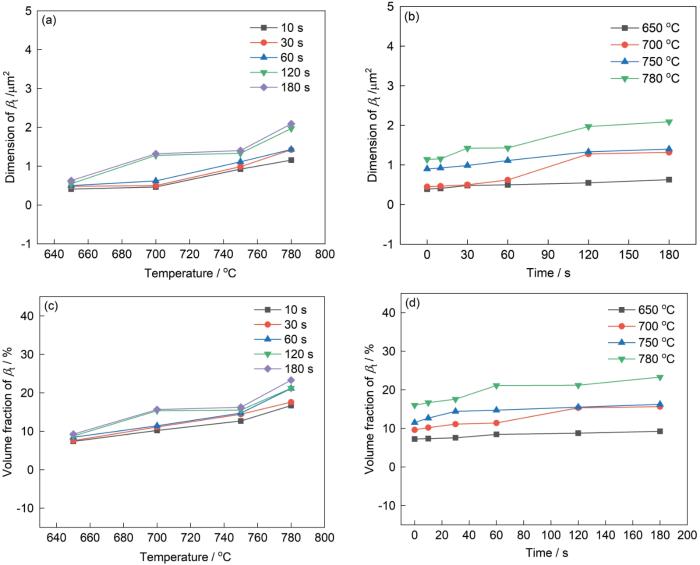
图3
电加热参数对TC4合金显微组织的影响
Fig.3
Effect of electric heating parameters on the microstructure of TC4 alloy (a) β phase transformation structure size changes with temperature, (b) β phase transformation structure size changes with holding time, (c) the volume fraction of β phase transformation structure changed with temperature, (d) the volume fraction of β phase transformation structure changed with holding time
2.3 在电加热过程中TC4合金晶粒尺寸的变化
图4给出了TC4合金样品的初始态组织和电加热后EBSD的IPF图。可以看出,这种合金电加热保温后发生了动态再结晶,其晶粒为等轴状晶粒。不同条件电加热的样品其平均晶粒尺寸也发生了明显变化。其原因是,高速电加热提供的热源使合金试样的温度在极短的时间内提高,增大了金属材料中原子的动能而发生再结晶。
图4
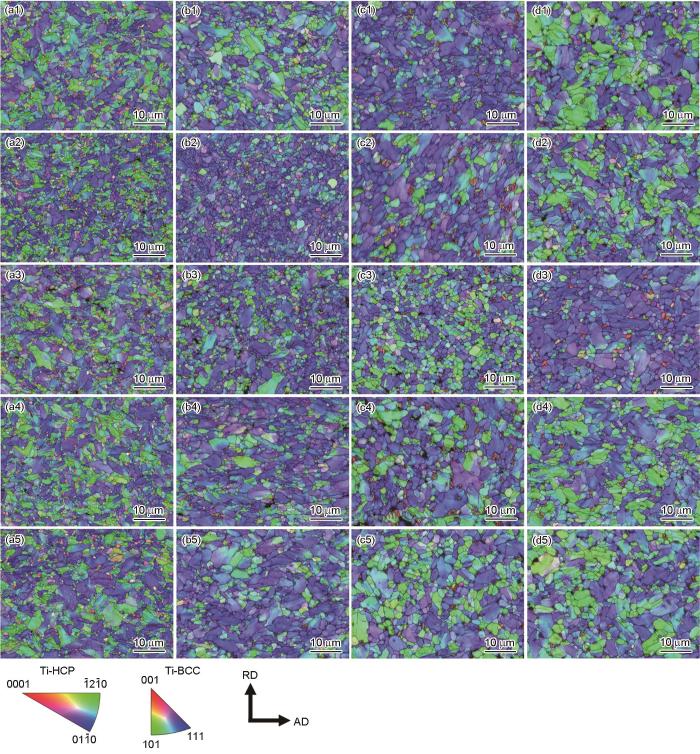
图4
TC4合金在不同电流加热条件下的电子背散射图片
Fig.4
EBSD diagram of TC4 under different current heating conditions (a1) 650 ℃ + 10 s, (a2) 650 ℃ + 30 s, (a3) 650 ℃ + 60 s, (a4) 650 ℃ + 120 s, (a5) 650 ℃ + 180 s, (b1) 700 ℃ + 10 s, (b2) 700 ℃ + 30 s, (b3) 700 ℃ + 60 s, (b4) 700 ℃ + 120 s, (b5) 700 ℃ + 180 s, (c1) 750 ℃ + 10 s, (c2) 750 ℃ + 30 s, (c3) 750 ℃ + 60 s, (c4) 750 ℃ + 120 s, (c5) 750 ℃ + 180 s, (d1) 780 ℃ + 10 s, (d2) 780 ℃ + 30 s, (d3) 780 ℃ + 60 s, (d4) 780 ℃ + 120 s, (d5) 780 ℃ + 180 s
图5a,b给出了晶粒尺寸随着电加热温度和保温时间的变化。可以看出,在短时电加热和长时保温条件下温度对晶粒演化的影响不同,以及在不同温度下保温时间对晶粒尺寸的影响。由图5a可见,保温时间为10、30和60 s时试样的平均晶粒尺寸随着温度的升高先减小后增大。以保温10 s为例,初始态试样电加热到650 ℃发生再结晶,平均晶粒尺寸由初始态的12.82 μm2减小到10.2 μm2。温度升高到700 ℃原子的活动能力增大而使新晶核生成。这表明,在一定程度上,温度越高则再结晶晶粒形核的数量越多,在700 ℃晶粒尺寸细化到8.56 μm2。随着温度升高到750和780 ℃,晶粒尺寸增大到9.17和12.29 μm2。高温有助于再结晶晶粒的形核和晶粒长大,使再结晶晶粒的尺寸增大。保温时间为120和180 s,加热到650 ℃时发生再结晶,晶粒尺寸比初始态有所减小,分别为7.5和11.79 μm2。随着温度升高到700、750和780 ℃,再结晶晶粒进一步长大。
图5
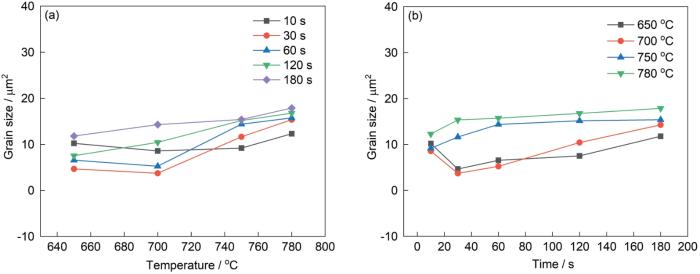
图5
电加热参数对晶粒尺寸的影响
Fig.5
Influence of electric heating parameters on grain size (a) grain size varies with temperature, (b) grain size changes with holding time
图5b给出了在不同温度下保温时间对晶粒尺寸的影响。可以看出,温度为650和700 ℃,随着保温时间的延长晶粒尺寸呈“先减小后增大”的趋势。例如,在650 ℃保温10 s再结晶的晶粒尺寸由12.82 μm2减小到10.2 μm2。保温时间增加到30 s形核的质点更多,使晶粒尺寸进一步减小到4.66 μm2。但是,保温时间延长到60、120和180 s,晶粒尺寸分别增大到6.55、7.52和11.79 μm2。其原因是,在再结晶过程中足够的保温时间使晶粒有充分的时间长大。加热温度为750和780 ℃保温10 s,晶粒尺寸由初始态的12.82 μm2减小到9.17 μm2和12.29 μm2。延长保温时间至30、60、120和180 s则新生成的晶粒有足够的时间长大,使晶粒尺寸随保温时间的延长呈现增大的趋势。综合图5a,b的结果,温度和保温时间的协同作用显著影响TC4合金晶粒的演化。
3 讨论
3.1 高速电加热影响钛合金组织演化的机制
在电加热过程中TC4合金中的α相到β相的转变不仅受热效应影响,还受到非热效应的影响。基于上述电加热的特点以及钛合金中β稳定元素的迁移规律[16~19],图6给出了电加热影响β相形核和长大机制的示意图。在形核阶段,电加热电流通过材料时产生焦耳热效应和使电子在材料内散射,使晶格中的空位和位错等缺陷迁移而产生“电子风”效应。这些缺陷迁移并塞积在晶界或亚晶界,使这些区域的自由能明显提高而提高了β相的形核几率。电加热电流密度的提高强化了“电子风”效应,使形核率提高和形核数增多。同时,β相的生长速率与其稳定元素V的扩散速率呈正相关。随着α相转变为β相,新生成的β相与原始β相的化学成分不同,尤其是V浓度对其影响更大。原始β相晶粒内的V浓度较高,使V元素从这些高浓度区域向α/β相界面处的新生β相扩散,这一过程持续推动相变的进行。根据文献[16,17],电加热不仅提高局部温度从而加速扩散过程,产生的“电子风”等非热效应也影响缺陷的迁移和再分布。与传统热处理依赖热扩散、在较低升温速率与长时间保温下均匀形核-长大过程不同,电加热增强了β稳定元素在β相区和邻近α相区间的迁移和加剧了位错/空位向晶界与亚晶界的聚集,从而提高了β相的形核率和生长速率并降低了α→β转变温度。这些热-非热耦合作用使高速电加热在更短的时间内显著改变相变动力学及其最终的显微组织,更有利于抑制晶粒粗化和促进细化组织的形成。
图6
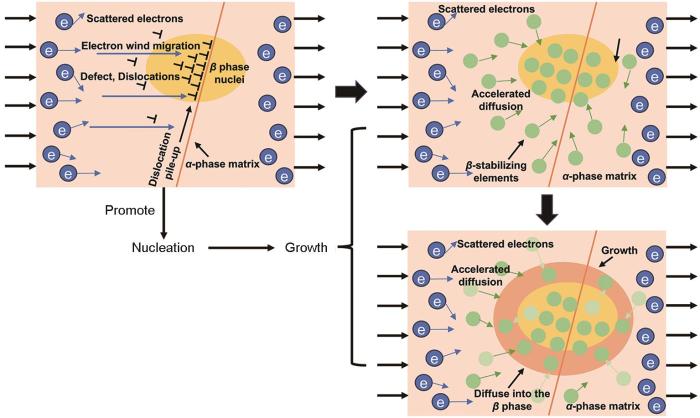
图6
电加热影响钛合金α→β相变的机理示意图
Fig.6
Schematic diagram of the effect of current on α→β phase transition of titanium alloy
3.2 高速电加热对钛合金晶粒尺寸影响机制分析
高速电加热对晶粒尺寸的影响,与材料的动态再结晶密切相关。TC4合金的再结晶温度一般为750 ℃,但是采用电加热在650 ℃就出现再结晶。这表明,与传统热处理依靠长时间的热扩散完成再结晶不同,高速电加热在较短时间内产生的焦耳热效应与非热效应的协同作用,在极短的时间内降低了材料的再结晶温度,从而促进再结晶的发生。同时,传统热处理的长时间保温易使晶粒长大,而高速电加热的加热时间极短,可抑制晶粒长大。由此可见,两种工艺的组织演化动力学和最终形成的显微组织显著不同。
根据经典形核理论,材料的再结晶形核率(在单位时间单位体积内形成的临界晶核数目)为
式中N0为与材料特性和形核过程有关的前因子(也称为频率因子),包含了原子振动频率和晶核形成的其他动力学因素;QN为临界晶核形核所需的激活能,与材料的形核机制和晶核长大过程中涉及的能量变化有关;R为气体常数,约为8.314 J/(mol·K);T为绝对温度(K)。
晶粒长大速率是再结晶的重要参数,决定了最终晶粒尺寸。形核后晶粒的长大速率为
式中G0为与材料特性和晶粒长大机制有关的前因子,包含了晶粒界面迁移的速率常数和晶粒间的相互作用;QG为晶粒长大所需的激活能,与晶粒界面的迁移能和晶粒内部的缺陷密度有关。电加热的热效应和非热效应都影响晶粒的形核和长大,但是两者的机制不同。电加热的电流在材料中产生的焦耳热影响晶粒的形核和长大。随着温度的升高原子的动能增大使迁移速率提高而有利于新晶核的形成。在再结晶过程中,电加热给原子提供足够的激活能促进晶粒的形核和长大。但是,温度的升高或保温时间的延长加剧原子的迁移扩散,使已经形成的晶粒边界不稳定,从而促进晶粒的合并和长大。
4 结论
(1) 高速电加热和保温,使合金中β相的尺寸和体积分数明显变化。高速电加热使原始态β相由细长、不规则状转变为等轴状的β相,加热温度升至700 ℃及以上时β相内部出现了细长针状组织次生α相。随着电加热温度的升高和保温时间的延长,β转变组织的尺寸增大和体积分数提高。与电加热温度对β转变组织尺寸和体积分数的影响相比,保温时间的影响较小。
(2) 电加热的热效应和非热效应协同促进α相向β相的转变。电加热温度的升高使合金中原子的动能增大、振动幅度增大和移动性增强,促进α相向β相的转变。在电加热过程中产生的“电子风”效应加速了合金中的空位和位错等微观缺陷向晶界和亚晶界区域迁移,提高了β相的数量和形核率。“电子风”效应还能促进β稳定元素的扩散而使β相的生长速率提高。
(3) 高速电加热和保温使TC4合金的平均晶粒尺寸明显变化。在短时保温与长时保温条件下高速电加热温度对晶粒尺寸的影响规律不同,保温时间的影响规律也不同。保温时间较短/温度相对较低时,平均晶粒尺寸随温度的升高/保温时间的延长先减小后增大;保温时间较长/温度相对较高时,平均晶粒尺寸随着温度的升高/保温时间的延长而增大。
(4) 在高速电加热过程中,热效应和非热效应共同影响晶粒的形核与长大。热效应提高了原子的动能和迁移速率,促进晶核的形成和晶粒长大,但是过高的温度或过长的保温时间使晶粒边界不稳定,促进晶粒的合并和长大。非热效应则促进位错和缺陷的移动、降低再结晶所需的能量,使周围原子的活动性提高,加速界面反应和降低能量壁垒,有助于再结晶晶粒形核和长大。
参考文献
Effect of heat treatment on mechanical properties of a novel Ti-6Al-2Mo-2V-3Nb-2Fe-1Zr alloy
[J].
Herein, the effect of heat treatments (solution, solution+single aging and solution+double aging) on the microstructure and mechanical properties of a novel Ti-based alloy Ti-6Al-2Mo-2V-3Nb-2Fe-1Zr was investigated through microstructure characterization and tensile testing. The microstructure observations indicate that the alloy prior to heat treatment possesses a bimodal microstructure consisted of primary αp phase, secondary αs phase, and β phase, and the volume fraction of the primary αp phase and secondary αs phase is 22% and 21%, respectively. After solution treated in the dual phase zone, a portion of the original αp and αs phases was replaced by β phase and the alloy microstructure is comprised of metastable β phase, equiaxed primary αp phase, and coarse lamellar secondary αs phase. After single aging, a large number of evenly distributed needle-like nano secondary αs phases are precipitated within the β phase; After double aging, the volume fraction of α phase increases significantly, while the grain size of primary αp phase and secondary αs phase increases with the increasing aging time. Quasi-static tensile test results reveal that alloys subjected to solution treatment in the dual phase zone exhibit significant enhancements in elongation compared to the as hot-rolled ones, but yielding at lower stress levels. Single aging results in significant increase of strength, thereby presenting an improved strength-ductility balance of the alloy. In comparison with the hot rolling process, the double aging process is unfavored to the ductility, moreover, with the increasing aging time, the strength decreases and elongation increases gradually. Finally, the variation in the work hardening rate of the alloy subjected to different heat treatments may be explained by work hardening rate-strain curves. Based on the experimental data, the modified Hall-Petch constitutive model is fitted, whilst the results predicted by this constitutive model have high coincidence with the experimental data.
热处理对新型Ti-6Al-2Mo-2V-3Nb-2Fe-1Zr合金力学性能的影响
[J].研究了固溶、固溶+单级时效和固溶+双级时效三种热处理制度对Ti-6Al-2Mo-2V-3Nb-2Fe-1Zr合金的微观组织和力学性能的影响。结果表明,这种合金热处理前的组织为双态组织,由初生α<sub>p</sub>相、次生α<sub>s</sub>相和β相组成,其中初生α<sub>p</sub>相的体积分数为22%,次生α<sub>s</sub>相的体积分数为21%;在双相区固溶后,合金原来的热轧态α<sub>p</sub>和α<sub>s</sub>相部分转变为β相,其组织由亚稳β相、等轴状初生α<sub>p</sub>相和粗大片状的次生α<sub>s</sub>相组成;单级时效后,β相中析出了大量均匀分布的纳米细针状次生α<sub>s</sub>相;双级时效后α相的体积分数显著提高,随着时效时间的增加初生α相和次生α相的晶粒尺寸逐渐增大。准静态拉伸实验结果表明,与热轧态试样相比双相区固溶态试样的延伸率显著提高,但是屈服强度明显降低;单级时效后试样的强度显著提高,强度-塑性平衡更佳;与热轧态试样相比,双级时效后试样的延伸率有所降低,随着时效时间的增加合金的强度降低而延伸率提高。用加工硬化率曲线解释了不同热处理的钛合金应变硬化率的变化趋势,并基于实验结果拟合了修正的Hall-Petch模型,与实验结果吻合较好。
Effect of Fe- and Cu-content on microstructure and mechanical properties of TC10 Ti-alloy bars
[J].The influence of Fe- and Cu-content on the microstructure and mechanical properties of TC10 alloy bars was investigated by means of scanning electron microscopy, EDS analysis of transmission electron microscopy, and mechanical testing machine. The results indicate that for the as rolled and annealed TC10 Ti-alloys, with the increasing Fe- and Cu-content, their yield strength and tensile strength increase, while the changes in elongation and cross-sectional shrinkage at break are not significant. For the solid solution aged TC10 alloy, Ti is evenly distributed in both βt and αp phases, Al is less distributed at grain boundaries, while V, Fe, and Cu elements are more abundant at the grain boundaries in βt phase. For TC10 alloys with the same Fe- and Cu-content, with the increasing solid solution temperature, their yield strength and tensile strength increase, while the elongation and cross-sectional shrinkage decrease. For TC10 alloys subjected to solid solution treatment at the same temperature, with the increase of Fe and Cu content, their yield strength and tensile strength increase, while the elongation and cross-sectional shrinkage at break decrease. The higher the solid solution temperature, the more significant the influence of alloying elements Fe and Cu on the strength and plasticity of the alloy. Being subjected to solid solution treatment at 900 oC, the alloy with 0.65% Fe and 0.65% Cu can achieve superior comprehensive mechanical properties, with yield strength, tensile strength, elongation, and cross-sectional shrinkage at break of 1392 ± 3 MPa, 1435.5 ± 0.5 MPa, (8 ± 1)% and (21.5 ± 1.5)%, respectively.
Fe和Cu的含量对TC10钛合金棒材力学性能的影响
[J].
Research and development of titanium profiles
[J].
钛型材的研制与开发
[J].
Research on processing technology of TC4 bar and profile
[D].
TC4棒材和型材生产加工工艺研究
[D].
Research on straightening process technology of TC4 alloy wire
[D].
钛合金线材矫形技术研究
[D].
Forming technique and application of titanium alloy
[J].
钛合金成形技术与应用
[J].
Rapid heating of titanium alloy
[J].
钛合金的快速加热
[J].
Research on control system of straightening and on-line electrical heating for titanium and titanium alloy profiles
[D].
钛及钛合金型材矫直在线电加热控制系统应用研究
[D].
Rapid strengthening without loss of ductility via electropulsing treatment in Ti-6Al-4V alloy
[J].
High temperature deformation behavior of the TC6 titanium alloy under the uniform DC electric field
[J].
Retracted: Effect of high-energy electropulsing on the phase transition and mechanical properties of two-phase titanium alloy strips
[J].
Effects of electropulsing on the microstructure and microhardness of a selective laser melted Ti6Al4V alloy
[J].
Anisotropic electroplastic effects on the mechanical properties of a nano-lamellar austenitic stainless steel
[J].
Electropulsing-induced phase transformation behavior in metal materials
[J].
脉冲电流作用下金属材料的相变行为
[J].
Visualizing the electron wind force in the elastic regime
[J].With continued scaling toward higher component densities, integrated circuits (ICs) contain ever greater lengths of nanowire that are vulnerable to failure via electromigration. Previously, plastic electromigration driven by the "electron wind" has been observed, but not the elastic response to the wind force itself. Here we describe mapping, via electron energy-loss spectroscopy, the density of a lithographically defined aluminum nanowire with sufficient precision to determine both its temperature and its internal pressure. An electrical current density of 10 A/cm produces Joule heating, tension upwind, and compression downwind. Surprisingly, the pressure returns to its ambient value well inside the wire, where the current density is still high. This spatial discrepancy points to physics that are not captured by a classical "wind force" model and to new opportunities for optimizing electromigration-resistant IC design.
Revealing the pulse-induced electroplasticity by decoupling electron wind force
[J].Micro/nano electromechanical systems and nanodevices often suffer from degradation under electrical pulse. However, the origin of pulse-induced degradation remains an open question. Herein, we investigate the defect dynamics in Au nanocrystals under pulse conditions. By decoupling the electron wind force via a properly-designed in situ TEM electropulsing experiment, we reveal a non-directional migration of Σ3{112} incoherent twin boundary upon electropulsing, in contrast to the expected directional migration under electron wind force. Quantitative analyses demonstrate that such exceptional incoherent twin boundary migration is governed by the electron-dislocation interaction that enhances the atom vibration at dislocation cores, rather than driven by the electron wind force in classic model. Our observations provide valuable insights into the origin of electroplasticity in metallic materials at the atomic level, which are of scientific and technological significances to understanding the electromigration and resultant electrical damage/failure in micro/nano-electronic devices.© 2022. The Author(s).
Effect of electric current on recrystallization kinetics in interstitial free steel and AZ31 magnesium alloy
[J].
Effects of electric pulse heat treatment on microstructures and dynamic deformation behaviors of Ti6441 alloys
[J].
The effect of additional plastification of irradiated metal with current pickup
[J].
Characterization of flow stress for commercially pure titanium subjected to electrically assisted deformation
[J].
Effect of high density electropulsing treatment on formability of TC4 titanium alloy sheet
[J].


