



机械润滑油的质量影响设备的运行效率和使用寿命。商品润滑油,是润滑油基础油(简称基础油)与添加剂调合而成。商品润滑油中基础油的含量高达85%~99%,其性质对润滑油的性能有决定性影响。基础油中的蜡由高熔点长链正构烷烃组成,这类组分的倾点高和低温流动性能较低。通过正构烷烃的加氢异构化反应可将直链烷烃转化为支链烷烃,能解决以上性能还能制备出具有优异低温流动性和高附加值的润滑油[1]。因此,开发具有良好选择性的正构烷烃异构化催化剂至关重要。
ZSM‑22分子筛是一种具有TON拓扑结构的微孔分子筛,由五元环、六元环和十元环组成,只有一维的十元环(0.45 nm × 0.55 nm)开口孔道[2]。由于ZSM‑22分子筛具有独特的孔道结构和适量的酸性,在正构烷烃异构化反应中其催化性能很高,在石油化工领域得到了广泛的应用[3]。但是,ZSM-22分子筛的微孔孔道较长,不利于长链烷烃分子的传质与扩散,加剧了裂化反应而降低了异构体产物选择性。另一方面,根据正构烷烃异构化的“锁匙”机理与孔口催化机理[4,5],碳正离子中间体质子化发生在ZSM-22孔口酸性位点上,因此要求高活性催化剂有更多暴露的孔口。在微孔分子筛晶体中引入中孔或大孔结构制备多级孔分子筛,可克服固有扩散限制和增加酸性位点,解决微孔尺寸过小产生的传质问题。脱硅法,是制备多级孔ZSM-22分子筛的常用方法。Li等[6]使用NaOH溶液处理商业化ZSM-22,适当浓度的NaOH处理可在ZSM-22中引入了孔径分布为5~50 nm介孔结构。但是使用普通碱处理法脱硅时,大尺寸分子筛晶体难以产生丰富的介孔,碱溶液也使分子筛的结晶度降低和质量损失。溶解再结晶法(Dissolution–Recrystallization)是另一种构筑多级孔ZSM-22分子筛的常用方法,包括两个主要步骤:第一是溶解,用碱处理等方式选择性移除分子筛中的硅,形成介孔或大孔结构。第二是再结晶,使用表面活性剂和水热处理将溶解的物质重新组装成中孔相,实现重结晶。根据溶出度和再结晶水平的不同,可制备不同类型的多级孔分子筛[7]。Wang等[8]改良了溶解再结晶法,将部分脱模板剂与添加CTAB介孔剂相结合制备出多级孔ZSM-22分子筛。此法使介孔分布范围更加可控,生成的介孔其孔径分布集中在3~4 nm。Liu等[9]使用碱溶液部分溶解ZSM-22分子筛,在CTAB的作用下重结晶。碱处理和重结晶同时进行制备的样品,在其外表面形成了均匀的MCM-41介孔,得到多级孔ZSM-22/MCM-41分子筛。与常规碱处理法相比,溶解再结晶法能控制生成的介孔孔径的分布范围,减少了碱处理对晶体结构的破坏。此法还能减少对微孔的堵塞,从而引入均匀的介孔。但是,此法的后处理程序复杂,工艺周期长,成本较高,难以应用在实际生产中。以上两种手段都涉及碱处理,使分子筛的结晶度降低、表面非晶化、降低孔隙率和扩散性能。同时,碱处理还在分子筛表面或孔道上产生一些非骨架结构或脱落的碎片,堵塞孔口和覆盖活性位点,进而降低扩散效率、增大传质阻力和减少活性位点,使正构烷烃异构的性能降低[10]。虽然后处理法在多级孔分子筛的制备中取得了一定进展,但是其工艺复杂、成本较高、易破坏分子筛晶体结构以及难以精确控制孔道。因此,开发一种高效、可控的合成方法是当前研究的热点。近年来,原位合成法因工艺简单、环境友好以及能够精确调控分子筛晶体结构和孔道,成为制备多级孔分子筛的重要方法。原位合成法不仅避免了后处理过程中可能引入结构缺陷,还能在合成过程中精准调控分子筛晶体尺寸、形貌和孔道结构,从而提高催化剂的稳定性和反应性能[11~13]。本文用原位合成法,以十四烷基膦酸(TDPA)作为介孔模板剂,调整TDPA添加量合成具有介孔结构的ZSM-22分子筛并制备成加氢异构催化剂,研究其对正十二烷加氢异构性能的影响。
1 实验方法
1.1 实验用材料
去离子水,自制;碱性硅溶胶(30%),工业品;十八水合硫酸铝,分析纯;氢氧化钾,分析纯;正十二烷,分析纯;TDPA,分析纯;六水合六氯铂酸(Pt = 37.5%);1,6-己二胺(DAH),分析纯。
1.2 催化剂的制备
1.2.1 分子筛的合成
常规ZSM-22分子筛的合成:用动态水热合成法,将SiO2∶0.01Al2O3∶0.14KOH∶0.4 DAH∶47 H2O(摩尔比)在烧瓶中混合搅拌4 h制备出初始凝胶。将初始凝胶在室温下陈化2 h后转移到容积为100 mL的聚四氟乙烯内胆,然后将其置入压力溶弹中,在温度为160 ℃的旋转烘箱晶化60 h。将晶化后的产品过滤、洗涤然后在120 ℃干燥12 h,得到固体粉末。将固体粉末置于温度为550 ℃的马弗炉中煅烧20 h以脱除模板剂,得到ZSM-22分子筛。用1 mol/L NH4Cl溶液(液固体积比为20∶1)将分子筛在80 ℃进行铵交换3 h,将产物离心分离后得到样品。将样品在120 ℃干燥12 h得到固体粉末。将固体粉末置于温度为550 ℃的马弗炉中煅烧6 h,得到ZSM-22分子筛,记为Z22-0。
多级孔ZSM-22分子筛的合成:用动态水热合成法合成多级孔ZSM-22分子筛:将SiO2∶0.01Al2O3∶0.14KOH∶0.4 DAH∶47 H2O∶0.0068~0.0272 TDPA(摩尔比)在烧瓶中混合搅拌4 h制备出初始凝胶,将其在室温下陈化2 h后转移到100 mL聚四氟乙烯内胆,然后将其置于压力溶弹中,在温度为160 ℃的旋转烘箱中晶化60 h。将晶化后的产物过滤、洗涤并在120 ℃干燥12 h得到固体粉末。将固体粉末置于温度为550 ℃的马弗炉中煅烧20 h脱除模板剂,得到ZSM-22分子筛。将ZSM-22分子筛用1 mol/L NH4Cl溶液(液固体积比为20∶1)在80 ℃进行铵交换3 h,然后进行离心分离得到样品。将样品在120 ℃干燥12 h得到固体粉末。将固体粉末置于温度为550 ℃的马弗炉中煅烧6 h,得到最终产品。根据TDPA的添加量分别将所得产品记为Z22-0.0068、Z22-0.0119、Z22-0.0170、Z22-0.0221、Z22-0.0272。
分子筛5L放大合成实验:将SiO2∶0.01Al2O3∶0.14KOH∶0.4 DAH:47 H2O∶0~0.0272 TDPA(摩尔比)在烧瓶中混合搅拌4 h制备出初始凝胶,将其在室温下陈化2 h后转移至温度为160 ℃的5L高压晶化釜晶化60 h。将晶化后得到的产品过滤和洗涤,然后将其在120 ℃干燥12 h得到固体粉末。将固体粉末置于温度为550 ℃的马弗炉中煅烧20 h脱除模板剂,得到ZSM-22分子筛。将ZSM-22分子筛用浓度为1 mol/L的 NH4Cl溶液(液固体积比为20∶1)在80 ℃铵交换3 h,将产物离心分离后得到的样品在120 ℃干燥12 h得到固体粉末。将固体粉末置于550 ℃马弗炉中煅烧6 h得到最终产品。根据TDPA的添加量分别将所得产品记为Z22-0-5L、Z22-0.0068-5L、Z22-0.0170-5L、Z22-0.0272-5L。
1.2.2 Pt负载催化剂的制备
将5L规模合成的分子筛加入一定比例的氧化铝制备出载体,并以六水合六氯铂酸为Pt金属前体,使用过量浸渍的方法负载质量分数为0.5%的Pt。将得到的产物在120 ℃干燥10 h后在450 ℃下焙烧8 h,得到双功能催化剂。根据TDPA添加量将双功能催化剂分别记为Pt/Z22-0-5L、Pt/Z22-0.0068-5L、Pt/Z22-0.0170-5L、Pt/Z22-0.0272-5L。
1.3 分子筛的表征
用Bruker D2PHASER台式X射线粉末衍射仪(XRD)分析样品的物相。用Rigaku ZSX Primus IV X射线荧光光谱仪(XRF)分析样品的元素含量。用Micromeritics ASAP 2460全自动比表面和孔径分析仪分析样品的孔结构。采用Micromeritics AutoChemⅡ2920型化学吸附仪进行氨程序升温脱附(NH3-TPD)用来测定样品的总酸量,中强酸量和弱酸量及中强酸位点与弱酸位点对应的温度。用Thermo Scientific NICOLETiS20傅里叶红外光谱仪进行吡啶红外(Py-IR)分析分子筛酸中心的类型。用核磁共振测定骨架元素。用500 MHz/AVANCE III固体NMR光谱仪测定样品的27Al MAS NMR光谱。用JEOLJSM-7610FPLUS扫描电子显微镜(SEM)观察样品的形貌。用JEM 2100PLUS透射电子显微镜(TEM)观察样品精细结构。
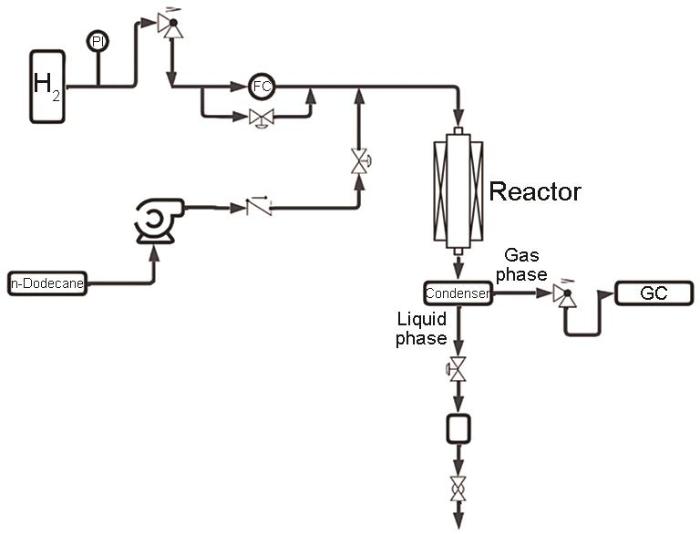
以正十二烷为反应原料,用固定床催化剂评价装置(图1)测试双功能催化剂的性能。将10 mL催化剂装填在反应管的中部,在上下两端填满直径为3 mm的陶瓷球并在底部填充石英棉。反应开始前,将双功能催化剂在流量为100 mL/min温度为400 ℃的氢气氛下还原4 h。还原结束后温度降至反应温度370 ℃。反应条件:压力为10 MPa,氢油比为500(V/V),体积空速(LHSV)为0.7 h-1,反应温度为320~370 ℃。用配备有DB-1HT色谱柱和氢火焰离子检测器(FID)分析产物的Agilent 8890气相色谱。
图1
2 结果和讨论
2.1 TDPA添加量对分子筛结构的影响
2.1.1 ZSM-22分子筛的相对结晶度和TDPA添加量的影响
图2给出了TDPA添加量不同的ZSM-22分子筛的XRD谱与对应的相对结晶度和ZSM-22标准卡片。XRD谱表明,所有产物均具有典型的TON结构,产物为纯相ZSM-22。以Z22-0结晶度为100%,根据产物在7.9°~26.6°的衍射峰面积计算相对结晶度。结果表明,添加适量的TDPA有助于分子筛结晶。其原因是,介孔模板剂TDPA通过其两亲性分子结构形成了有序胶束微环境。这些胶束为分子筛成核提供了有序界面,还通过局部富集硅/铝前驱体和优化传质促进了均匀成核和定向生长;同时,其动态柔性界面可适配晶体生长应力,减少缺陷和提高了结晶度[14]。但是,添加过多的TDPA使分子筛的相对结晶度降低。因为TDPA浓度超过临界胶束浓度影响体系的pH值,使胶束的形态从球状向棒状转变;过量的TDPA还使前驱体过度分散而降低局部浓度,胶束间的空间位阻也干扰骨架有序组装并降低前驱体的稳定性,最终降低成核速率并阻碍晶体的有序生长[15]。
图2
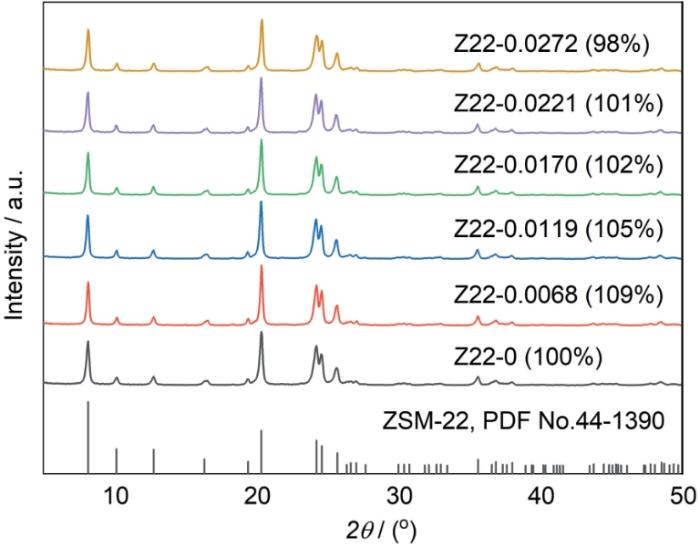
图2
不同TDPA添加量ZSM-22分子筛的XRD谱和相对结晶度
Fig.2
XRD patterns and relative crystallinity of ZSM-22 zeolite with different TDPA additive amounts
2.1.2 合成产物的孔结构
表1 不同TDPA添加量合成产物的BET分析结果
Table 1
| Samples | SBET / m2·g-1 | Smicro / m2·g-1 | Sext / m2·g-1 | Vtotal / cm3·g-1 | Vmicro / cm3·g-1 | Vmeso / cm3·g-1 |
|---|---|---|---|---|---|---|
| Z22-0 | 265 | 232 | 33 | 0.180 | 0.089 | 0.091 |
| Z22-0.0068 | 287 | 245 | 42 | 0.270 | 0.093 | 0.158 |
| Z22-0.0119 | 289 | 244 | 45 | 0.263 | 0.093 | 0.170 |
| Z22-0.0170 | 288 | 242 | 46 | 0.247 | 0.092 | 0.177 |
| Z22-0.0221 | 281 | 240 | 41 | 0.230 | 0.091 | 0.154 |
| Z22-0.0272 | 237 | 198 | 39 | 0.230 | 0.076 | 0.139 |
| Z22-0-5L | 237 | 206 | 31 | 0.16 | 0.081 | 0.079 |
| Z22-0.0068-5L | 265 | 229 | 36 | 0.27 | 0.087 | 0.183 |
| Z22-0.0170-5L | 270 | 235 | 35 | 0.30 | 0.089 | 0.212 |
| Z22-0.0272-5L | 184 | 151 | 33 | 0.26 | 0.058 | 0.203 |
图3
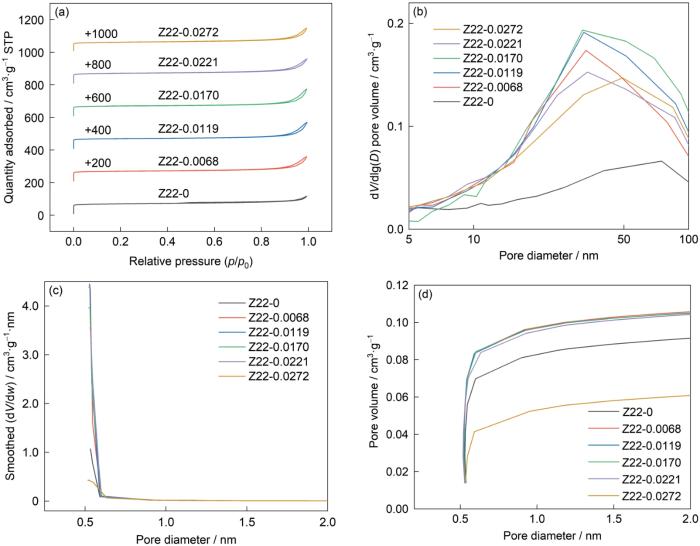
图3
合成产物的孔结构
Fig.3
Texture properties of synthetic products (a) N2 adsorption-desorption isotherm curves of products synthesized with different TDPA addition, (b) BJH aperture distribution, (c) H-K micropore size distribution, (d) H-K cumulative pore size distribution
图3b中的BJH孔径分布曲线和表1中的结构性质表明,添加适量的TDPA有利于多级孔结构的形成。添加范围为nTDPA/SiO2 = 0.0068~0.0170时,随着TDPA添加量的增加产物中的介孔和大孔的体积随之增加,尺寸为10~100 nm的孔径分布峰强度逐渐增强,孔的直径集中在32~34 nm;微孔的体积与总比表面积相差不大。但是,随着TDPA添加量进一步增加,在nTDPA/SiO2 = 0.0170~0.0272范围内产品中的介孔和大孔的体积逐渐减小,尤其是Z22-0.0221与Z22-0.0272样品的各项指标差异明显:介孔和大孔的直径分布从32~34 nm变为32~约50 nm;图3c中的H-K微孔孔径分布和图3d中的H-K累计孔径分布结果表明,随着TDPA添加量的增加微孔的体积呈先增大(nTDPA/SiO2 = 0.0068~0.0170)后减小(nTDPA/SiO2 = 0.0170~0.0272)的趋势。与微孔分子筛相比,Z22-0.0068样品的微孔体积与比表面积显著提高。其原因是,在分子筛合成过程中添加适量的表面活性剂能促进微孔结构的形成,因为其对晶体生长的精细调控。将TDPA/SiO2比控制在适当范围使表面活性剂分子吸附在晶核表面,可抑制晶粒的过度生长而生成更小尺寸的纳米晶体[16]。这些纳米晶体的有序组装,构建了丰富的介孔网络[17]。这种多级孔结构的协同构建引入了介孔系统并保留了原有的微孔通道,使微孔体积和比表面积同时提高。
5L放大实验的结果表明,随着TDPA添加量的增加样品的比表面积和孔结构的变化趋势与小规模实验结果相同。微孔体积、总比表面积和总孔体积均呈现出先增加后减少的趋势,且介孔体积与外比表面积在添加量为nTDPA/SiO2 = 0.0170时达到最大值,但是比表面积和孔体积比小规模实验有所降低,尤其是TDPA的添加量较高时差别更显著。在5L放大合成过程中分子筛的比表面积和孔体积减小,其原因是放大效应使晶体生长动力学和结构缺陷发生变化[18]。放大后,搅拌效率降低和热传递不均匀使成核速率下降和晶体倾向于生长而非成核而生成尺寸更大的晶粒。同时,铝的过量掺入增大了骨架应力而使部分孔道在煅烧或后处理过程中塌陷,减小了孔体积[19,20]。同时,反应条件的波动(如局部pH变化)可能生成非晶态硅铝酸盐覆盖在分子筛表面或堵塞孔道,从而减小了比表面积和降低了孔隙率。这些因素的协同作用,表现为晶体尺寸的增大、孔道结构缺陷以及表面覆盖物的增多,从而使比表面积和孔体积显著降低。
2.1.3 分子筛的形貌和粒径分布
图4
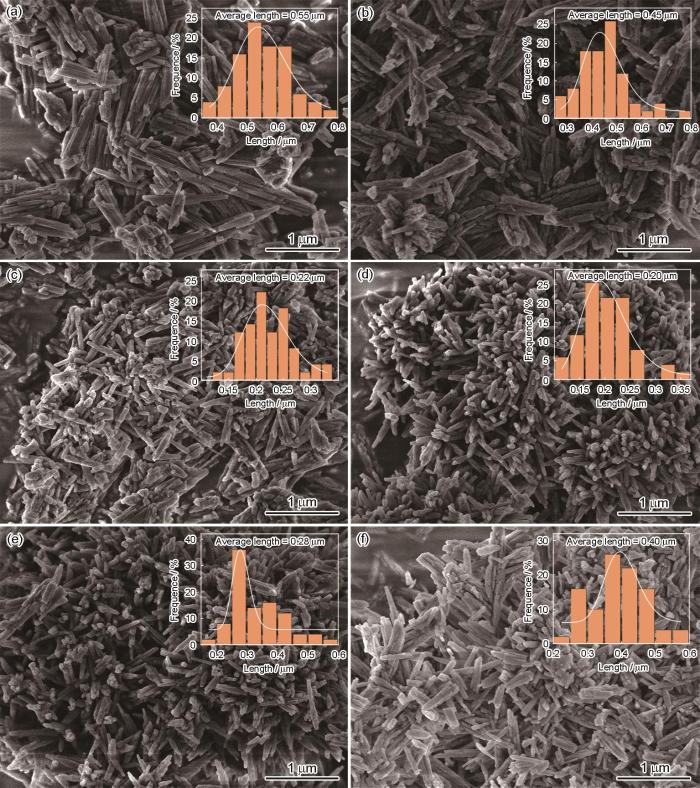
图4
不同TDPA添加量合成产物的SEM照片和频数分布
Fig.4
SEM images of the synthesized products with different TDPA addition amounts and its grain length frequency distribution (a) Z22-0, (b) Z22-0.0068, (c) Z22-0.0119, (d) Z22-0.0170, (e) Z22-0.0221, (f) Z22-0.0272
图5

这表明,TDPA添加量的变化可调控分子筛的生长机制和孔道结构:TDPA的添加量在较小(nTDPA/SiO2 = 0.0068~0.0170)时,TDPA分子作为介孔模板剂通过其两亲性结构在合成体系中形成有序胶束,增大了有机-无机界面的面积。表面活性剂分子优先吸附在晶体侧晶面,借助静电和空间位阻的作用抑制轴向生长,使晶体的长度缩短而形成特定的表面纳米结构[23]。这一过程也改变了晶体的组装模式,使其从高度有序的平行阵列转变为簇状聚集体。在此浓度区间内,TDPA限制了分子筛晶体沿特定方向的过度生长,形成了尺寸均匀的短晶粒结构并构建了孔径分布集中的多级孔体系[24,25]。这种结构特征显著提高了分子筛的扩散性能,缩短了反应物和产物的传输路径,从而提高了传质效率[26,27]。
但是,继续提高TDPA的添加量(nTDPA/SiO2 = 0.0170~0.0272),过量的TDPA分子改变了分子筛前驱体的组装行为,形成了更大尺寸的胶束结构并显著增大了介孔和大孔直径。表面活性剂在晶体界面的吸附构型发生重构,胶束形态从球状转变为棒状或层状,在晶体表面形成新的介孔通道网络[28]。在这一阶段,过量的TDPA干扰晶体的正常生长,破坏了生长的有序性。TDPA的用量进一步增加,则TDPA形成双层吸附结构,内层使侧晶面稳定而外层构建轴向生长通道,溶解-再沉积机制使溶质优先在晶体端面沉积,使晶体重新伸长并形成三维互穿网络结构,表面形貌恢复光滑状态[14,29]。这种晶体尺寸先缩短后伸长的动态变化,表明不同浓度的TDPA分子对分子筛晶体各晶面生长动力学的选择性调控。
2.2 TDPA的添加量对分子筛酸性的影响
2.2.1 NMR表征和XRF表征
根据27Al MAS NMR研究了分子筛骨架中Al元素的配位,结果如图6a所示。可以看出,在所有样品约54.8的化学位移(δ)处出现了明显的单一共振峰,表明存在四面体配位的Al物种。同时,在0的化学位移附近没有检测到对应于骨架外Al物种[30]的明显峰信号,说明ZSM-22晶体骨架内氧化铝为四配位,TDPA的引入没有显著影响Al的化学环境。根据29Si MAS NMR研究了分子筛骨架中Si元素的配位,结果如图6b所示。可以看出,在六个样品的谱中都出现了两个特征共振峰:位于-112处的主峰归属于Si(0Al)配位环境,即硅原子通过四个Si-O-Si键与相邻硅原子连接;而位于-105处的次峰则对应Si(1Al)配位环境,对应Si-O-Al键[31,32]。值得注意的是,所有样品的谱中-112处的峰强度都显著高于-105处的峰,表明样品中Si(0Al)位点的数量明显多于Si(1Al)位点。这种以Si(0Al)为主导的配位环境特征,进一步证实了所合成分子筛的骨架完整性和热稳定性较高[33]。
图6
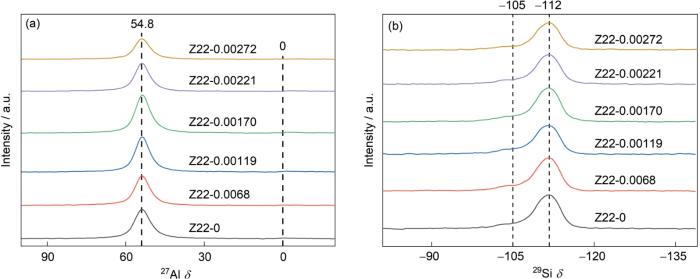
图6
不同TDPA添加量合成产物的NMR谱
Fig.6
NMR spectra of the synthesized products with different TDPA addition amounts (a) 27Al NMR spectra, (b) 29Si NMR spectra
结合表2中的XRF结果,可见TDPA的添加量对分子筛SiO2/Al2O3比的影响。随着TDPA添加量的增加SiO2/Al2O3比呈现先下降后上升的趋势,27Al信号峰的强度呈先提高后降低的趋势。随着TDPA添加量从0增加到0.0170,SiO2/Al2O3比从63.34下降到58.37,27Al信号峰强度增强,表明骨架中Al元素的含量提高。但是,TDPA的添加量继续增加到0.0272,则SiO2/Al2O3比显著提高到86.72和27Al信号峰的强度降低,表明骨架中Al元素的含量降低。
表2 不同TDPA添加量合成产物的硅铝比和NH3-TPD分析结果
Table 2
| Samples | SiO2/Al2O3 (XRF) | Weak acid | Strong acid | Total NH3 uptake / μmol·g-1 | ||
|---|---|---|---|---|---|---|
| Temperature / oC | NH3 uptake / μmol·g-1 | Temperature / oC | NH3 uptake / μmol·g-1 | |||
| Z22-0 | 63.34 | 225 | 275 | 435 | 206 | 481 |
| Z22-0.0068 | 60.63 | 227 | 310 | 447 | 247 | 557 |
| Z22-0.0119 | 58.77 | 230 | 309 | 448 | 249 | 558 |
| Z22-0.0170 | 58.37 | 231 | 317 | 452 | 258 | 575 |
| Z22-0.0221 | 61.32 | 229 | 302 | 451 | 248 | 550 |
| Z22-0.0272 | 86.72 | 218 | 195 | 431 | 145 | 340 |
| Z22-0-5L | 61.63 | 221 | 279 | 443 | 258 | 537 |
| Z22-0.0068-5L | 58.72 | 224 | 290 | 448 | 268 | 558 |
| Z22-0.0170-5L | 54.08 | 227 | 312 | 452 | 303 | 615 |
| Z22-0.0272-5L | 75.26 | 223 | 258 | 439 | 243 | 501 |
2.2.2 分子筛的酸量
图7a和表2给出了分子筛的酸量,分别给出了不同TDPA添加量的产物的氨程序升温脱附(NH3-TPD)曲线和强弱酸量。每条曲线都由130~330 ℃的低温峰和350~500 ℃的高温峰组成,分别对应NH3在弱酸位和中强酸位上的脱附[34]。XRF和NH3-TPD的结果表明,TDPA添加量对分子筛的酸性位数量和强度有显著的影响。适量的TDPA添加(nTDPA/SiO2 = 0.0068~0.0170)能提高骨架中Al元素的含量,从而提高分子筛的总酸量。其原因是,TDPA的加入减小了分子筛的晶粒长度和增加了暴露的酸性位点。但是,添加过多的TDPA(nTDPA/SiO2 = 0.0170~0.0272)使骨架中Al元素的含量降低,进而降低分子筛的总酸量。这种现象,可能与TDPA对分子筛微孔结构的破坏有关[35]。同时,NH3-TPD温度中心的变化进一步佐证了这一结论。添加适量的TDPA使弱酸位和中强酸位的温度中心都上升,表明酸性位的稳定性提高。而添加过多的TDPA则使温度中心下降,表明酸性位的稳定性降低。
图7
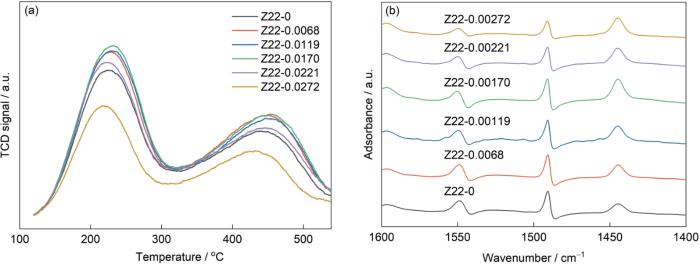
图7
不同TDPA添加量合成产物的酸性
Fig.7
Acidity characterization of products synthesized with different TDPA addition (a) NH3-TPD, (b) Py-IR spectra at 200 oC
2.2.3 TDPA对分子筛酸量的影响
图7b和表3给出了TDPA对合成产物不同类型酸量的影响。所有产物的Py-IR光谱都在1550 cm-1,1490 cm-1,1445 cm-1附近三处有峰,分别属于Brønsted酸性位、Brønsted+Lewis酸性位和Lewis酸性位[36]。在温度为200 ℃测得的是产物的总酸量[37]。如图7b和表3所示,产物的总Brønsted酸量随着TDPA的添加呈现先增加后减少的趋势。这与NH3-TPD测试得到的结果一致。Brønsted酸位由骨架Al原子附近的桥联羟基提供,因此Brønsted酸量呈现这种趋势的原因,可能是分子筛样品的SiO2/Al2O3值相近时TDPA的加入改变了Al原子在不同T位的分布,从而减少了Brønsted酸位的形成[38~40]。值得注意的是,Py-IR和NH3-TPD的表征结果在酸性位分布上不一致,表现为NH3-TPD测得的酸量显著高于Py-IR测得的酸量。这一差异,主要源于探针分子尺寸效应及其对分子筛孔道的可及性不同。ZSM-22分子筛的B酸位点主要分布在孔口与孔道内部[41~43]。但是,吡啶分子的动态直径(0.55~0.60 nm)明显大于ZSM-22分子筛10-MR通道的孔径(0.45 nm × 0.55 nm),使吡啶分子无法进入分子筛孔道内部,因此Py-IR检测到的只是位于10-MR孔口处的B酸位点。相比之下,直径仅为0.37 nm的NH3分子能自由进入分子筛孔道,因此可探测到更多位于孔道内部酸性更强的位点[44,45]。
表3 不同TDPA添加量合成产物的Py-IR分析结果
Table 3
| Samples | Brønsted acidity / μmol·g-1 | Lewis acidity / μmol·g-1 | Total acidity / μmol·g-1 |
|---|---|---|---|
| Z22-0 | 43.93 | 33.24 | 77.17 |
| Z22-0.0068 | 45.36 | 36.64 | 82.00 |
| Z22-0.0119 | 48.41 | 40.33 | 88.74 |
| Z22-0.0170 | 52.89 | 48.36 | 101.25 |
| Z22-0.0221 | 36.30 | 42.15 | 78.45 |
| Z22-0.0272 | 19.70 | 44.79 | 64.49 |
综合XRF、NMR、NH3-TPD和Py-IR的表征结果,可以得出以下结论:添加适量的TDPA(nTDPA/SiO2 = 0.0068~0.0170)能提高分子筛中Al原子的掺入量,从而提高总酸量和Brønsted酸量。添加适量的TDPA不仅减少了分子筛晶粒长度,增加了酸性位点的暴露,还增强了酸性位的稳定性,表现为NH3-TPD曲线中弱酸位和中强酸位的温度中心上升。但是,过度添加TDPA(nTDPA/SiO2 = 0.0170~0.0272)使Al原子掺入量减少,分子筛的总酸量和Brønsted酸量显著下降,导致酸性位的稳定性降低,表现为NH3-TPD曲线中温度中心下降。这表明,TDPA的过量引入可能破坏分子筛骨架中铝原子的分布,减少Brønsted酸位的形成。5L放大实验XRF和NH3-TPD结果表明其酸性变化规律与小试一致,但是SiO2/Al2O3更小,NH3-TPD酸性位数量更多。在5L搅拌釜放大实验中,硅铝比的降低主要源于Al元素的优先掺入和分布不均。搅拌釜放大后混合效率下降,使铝源容易在局部区域富集而形成高铝微区。这种不均匀分布使Al更容易进入分子筛骨架,而硅源因扩散受限未能充分参与反应。同时,放大过程中的温度分布不均使高温区域Al的水解速率提高,进一步促进了Al的掺入[46,47]。虽然较低的硅铝比通常使比表面积和孔体积的减小,但是骨架Al的引入形成更多质子酸位点(≡Si-O(H)-Al≡)[48,49],活性位点的增加可显著提高酸性性能。值得注意的是,这种传质受限导致的硅铝比降低往往伴随着Al分布不均和非骨架Al的形成,可能影响催化剂的稳定性。
2.3 分子筛催化剂的性能
用100 mL相同方案合成的分子筛进行分子筛的5L放大合成,所得分子筛的物化性质变化规律与小试的结果基本一致,以此制备载体和测试催化剂的性能。
图8
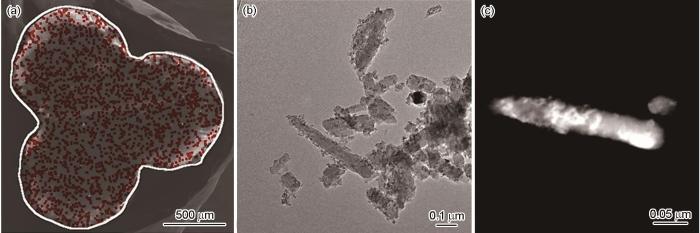
图8
Pt/Z22-0.0170-5L的电镜照片
Fig.8
Comprehensive electron microscopy analysis results of Pt/Z22-0.0170-5L (a) SEM-EDS surface scanning mapping, (b) TEM image, (c) STEM image
图9
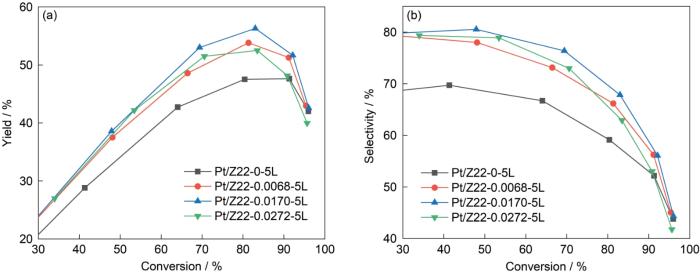
图9
正十二烷加氢异构化的评价结果
Fig.9
Evaluation results of n-dodecane hydroisomerization (a) iso-hexadecane yield, (b) iso-hexadecane selectivity
添加适量的TDPA表面活性剂可显著优化Pt/ZSM-22催化剂的性能。TEM和STEM表征结果表明,添加适量的TDPA使Pt纳米颗粒在分子筛载体表面在微观尺度上均匀分散,EDS面扫描分析结果也表明其在宏观范围内亦呈现高度均匀的覆盖分布[51]。分子筛的结构表明,添加适量的TDPA能调控分子筛的晶粒尺寸,使其缩短并形成多级孔结构。这种结构特性有助于油品分子在分子筛内的扩散和反应,从而提高反应效率和抗中毒能力[52]。这种优化的结构特性不仅提供了丰富的可接触活性位点,还能促进反应物分子的扩散和产物脱附。同时,添加适量的TDPA还改善了催化剂的酸性特征,使酸性位点的分布更加合理。结构表征与催化性能的关联分析表明,Pt物种均匀分散、形成多级孔结构以及优化酸性特征,共同提高了催化剂在加氢异构化反应中的活性、选择性和稳定性[53,54]。但是,添加过量的TDPA可能使晶粒尺寸过大,甚至破坏原有的孔结构,从而限制烷烃分子的扩散和降低反应效率。
3 结论
(1) 使用十四烷基膦酸(TDPA)为介孔模板剂可制备多级孔ZSM-22分子筛。TDPA的引入可构筑多级孔结构。nTDPA/SiO2 = 0.0170适当的分子筛理化特性最优:其平均晶粒尺寸减小,比表面积、总孔体积和总酸量增大,且Brønsted酸位在酸中心分布中占据主导地位,有利于加氢异构化反应。
(2) 优化后的分子筛在正十二烷加氢异构化反应中的催化活性优异。添加适量的TDPA优化分子筛的孔结构和酸性分布,可显著提高催化剂的反应效率和选择性。
参考文献
Effect of metal-acid balance and textual modifications on hydroisomerization catalysts for n-alkanes with different chain length: a mini-review
[J].
Synthesis of ZSM-22 with enhanced acidity using alcoholamine as a structure-directing agent to promote the hydroisomerization of n-heptane
[J].
Effect of Zn modification on hydroisomerization performance of the Fischer-Tropsch heavy diesel over Ni/ZSM-22 catalyst
[J].
Zn改性对Ni/ZSM-22催化剂费托重柴油异构降凝性能的影响
[J].
采用离子交换、成型、负载方法对ZSM-22分子筛进行改性,得到不同Zn负载量的ZSM-22分子筛载体,通过X射线衍射、N2物理吸附?脱附及吡啶吸附红外等表征其物化性质。以改性ZSM-22分子筛为酸性组分、Ni为金属组分制备Ni基加氢异构催化剂,以费托重柴油为原料对其异构降凝性能进行评价。结果表明,离子交换对分子筛结构影响较小,且Zn在分子筛表面呈高度分散状。分子筛负载Zn可降低Br?nsted (B)酸与Lewis (L)酸的酸量比值(B/L),且随Zn负载量增加,B/L值降低,异构烃收率提高,有效抑制裂解反应,提高柴油收率。负载Zn可明显降低重型柴油冷滤点,随Zn负载量逐渐提高,冷滤点上升。在金属加氢性能相同时,减少B酸含量有利于提升催化剂上金属位与酸性位的匹配及重型柴油异构性能。以所制Zn负载量为0.42wt%的Ni基分子筛催化剂在柴油的冷滤点达到国六车用柴油标准-10#柴油要求(冷滤点?5℃)时,柴油收率仍高达90.65%。
Evidences for pore mouth and key-lock catalysis in hydroisomerization of long n-alkanes over 10-ring tubular pore bifunctional zeolites
[J].
Monomethyl-branching of long n-alkanes in the range from decane to tetracosane on Pt/H-ZSM-22 bifunctional catalyst
[J].
Synthesis, characterization and n-hexane hydroisomerization performances of Pt supported on alkali treated ZSM-22 and ZSM-48
[J].
State of the art and perspectives of hierarchical zeolites: practical overview of synthesis methods and use in catalysis
[J].
n-Dodecane hydroisomerization over hierarchical ZSM-22 prepared by a dual-protected alkali treatment
[J].
Toward rational design of narrowly-distributed mesopore on ZSM-22 zeolite for enhanced Pt dispersion and n-alkane isomerization performance
[J].
Mesoporous ZSM-22 zeolite obtained by desilication: peculiarities associated with crystal morphology and aluminium distribution
[J].
Control of location and distribution of heteroatoms substituted isomorphously in framework of zeolites and zeotype materials
[J].Well-controlled incorporation of heteroatoms in frameworks of zeolites and zeotype materials has been achieved by a variety of new synthetic approaches, generating outstanding catalysts compared to uncontrolled materials.
ZSM-22 synthesized using structure-directing agents of different alkyl chain lengths for controlled n-hexadecane hydroisomerizations
[J].
Ultra-low silica zeolite TON: facile synthesis and efficient catalysis in n-dodecane hydroisomerization
[J].
Synthesis of mesoporous X zeolite using an anionic surfactant as templating agent for thermo-catalytic deoxygenation
[J].
The synthesis of hierarchical ZSM-22 zeolite with only the PHMB template for hydroisomerization of n-hexadecane
[J].
Conversion of methanol to propylene over Nano-sized ZSM-5 zeolite aggregates synthesized by a modified seed-induced method with CTAB
[J].
Synthesis of hierarchical ZSM-5 aggregates by an alkali-treated seeds method with cetyltrimethylammonium bromide for the methanol to gasoline reaction
[J].
Synthesis and crystal growth mechanism of ZSM-22 zeolite nanosheets
[J].
Strategies to control zeolite particle morphology
[J].Aluminosilicate zeolites with controllable morphology have attracted considerable attention due to their potential applications in catalysis, adsorption, and separation technologies, as well as the biomedical field. However, the rational design and preparation of zeolites with the required morphology have not been achieved because the zeolite crystallization mechanism has not been fully understood, and therefore, the nucleation and crystal growth processes cannot be oriented. This paper reviews the progresses achieved in zeolite morphology control. The chemical compositions of the synthesis gel, including template (or the structure-directing agent) and framework heteroatoms, silica and alumina sources, alkali metal cations and mineralization ions, crystallization conditions, and synthesis methods have a considerable impact on the crystal morphology. The oriented assembly of zeolite crystals into special morphologies, such as hierarchical porous structures, zeolite membranes, hollow zeolite spheres, and core@shell-structured zeolites, can be realized by using soft and/or hard template methods and adjusting the synthesis and crystallization conditions. In addition, zeolite crystallization and crystal assembly mechanisms are investigated for providing an overall insight into the regulation of zeolite crystal morphology.
In situ imaging of two-dimensional surface growth reveals the prevalence and role of defects in zeolite crystallization
[J].Zeolite crystallization predominantly occurs by nonclassical pathways involving the attachment of complex (alumino)silicate precursors to crystal surfaces, yet recurrent images of fully crystalline materials with layered surfaces are evidence of classical growth by molecule attachment. Here we use in situ atomic force microscopy to monitor three distinct mechanisms of two-dimensional (2D) growth of zeolite A where we show that layer nucleation from surface defects is the most common pathway. Direct observation of defects was made possible by the identification of conditions promoting layered growth, which correlates to the use of sodium as an inorganic structure-directing agent, whereas its replacement with an organic results in a nonclassical mode of growth that obscures 2D layers and markedly slows the rate of crystallization. In situ measurements of layered growth reveal that undissolved silica nanoparticles in the synthesis medium can incorporate into advancing steps on crystal surfaces to generate defects (i.e., amorphous silica occlusions) that largely go undetected in literature. Nanoparticle occlusion in natural and synthetic crystals is a topic of wide-ranging interest owing to its relevance in fields spanning from biomineralization to the rational design of functional nanocomposites. In this study, we provide unprecedented insight into zeolite surface growth by molecule addition through time-resolved microscopy that directly captures the occlusion of silica nanoparticles and highlights the prevalent role of defects in zeolite crystallization.
Integrating experiments and simulations to reveal anisotropic growth mechanisms and interfaces of a one-dimensional zeolite
[J].
Hierarchical SAPO-11 preparation in the presence of glucose
[J].
Synthesis of short, needle-shaped crystals of TON-type zeolite by addition of inhibitors of crystal growth along the [001] direction
[J].
Regulation of crystal growth process of NaP zeolite via the coupling effects of electrostatic interaction and steric hindrance
[J].
A hierarchical MFI zeolite with a two-dimensional square mesostructure
[J].
Generating TON zeolites with reduced [0 0 1] length through combined mechanochemical bead-milling and porogen-directed recrystallization with enhanced catalytic property in hydroisomerization
[J].
Improvement in the catalytic properties of ZSM-5 zeolite nanoparticles via mechanochemical and chemical modifications
[J].
Hierarchical zeolite microspheres with flat sheets, wave sheets or agglomerates induced by gemini surfactant counterion
[J].
Capping with multivalent surfactants for zeolite nanocrystal synthesis
[J].
Quantitative high-resolution 27Al NMR: tetrahedral non-framework aluminium in hydrothermally treated zeolites
[J].
Studies on the synthesis of titanium silicalite, TS-1
[J].
The bulk material dissolution method with small amines for the synthesis of large crystals of the siliceous zeolites ZSM-22 and ZSM-48
[J].
Hydroisomerization activity and selectivity of n-dodecane over modified Pt/ZSM-22 catalysts
[J].
Fabricating ZSM-23 with reduced aspect ratio through ball-milling and recrystallization: Synthesis, structure and catalytic performance in N-heptane hydroisomerization
[J].
Zeolite catalysts with tunable hierarchy factor by pore-growth moderators
[J].
An infrared study of pyridine adsorbed on acidic solids. Characterization of surface acidity
[J].
Synthesis of ZSM-22/SAPO-11 composite molecular sieve-based catalysts with small crystallites and superior n-alkane hydroisomerization performance
[J].
Thermal stability and siting of aluminum in isostructural ZSM-22 and Theta-1 zeolites
[J].
Acidic properties of SSZ-33 and SSZ-35 novel zeolites: a complex infrared and MAS NMR study
[J].
On the location of Lewis acidic aluminum in zeolite mordenite and the role of framework-associated aluminum in mediating the switch between Brønsted and Lewis acidity
[J].Lewis acidic aluminum in zeolites, particularly acidity that is inherent to the framework, is an indeterminate concept. A fraction of framework aluminum changes geometry to octahedral coordination in the proton form of zeolite mordenite. Such octahedrally coordinated aluminum is the precursor of a Lewis acid site and its formation is accompanied by a loss in Brønsted acidity. Herein, we show that such Lewis acid sites have a preferred location in the pore structure of mordenite. A greater proportion of these Lewis acid sites resides in the side-pockets than in the main channel. By reverting the octahedrally coordinated aluminum back to a tetrahedral geometry, the corresponding Brønsted acid sites are restored with a concomitant loss in the ability to form Lewis acid sites. Thereby, reversible octahedral-tetrahedral aluminum coordination provides a means to indirectly switch between Lewis and Brønsted acidity. This phenomenon is unique to Lewis acidity that is inherent to the framework, thereby distinguishing it from Lewis acidity originating from extra-framework species. Furthermore, the transformation of framework aluminum into octahedral coordination is decoupled from the generation of distorted tetrahedrally coordinated aluminum, where the latter gives rise to the IR band at 3660 cm in the OH stretching region.This journal is © The Royal Society of Chemistry.
Hydrocracking of isoheptadecanes on Pt/H-ZSM-22: an example of pore mouth catalysis
[J].
Design and synthesis of Pt catalyst supported on ZSM-22 nanocrystals with increased accessible 10-MR pore mouths and acidic sites for long-chain n-alkane hydroisomerization
[J].
Micropore blocked core-shell ZSM-22 designed via epitaxial growth with enhanced shape selectivity and high n-dodecane hydroisomerization performance
[J].
Quantification of enhanced acid site accessibility in hierarchical zeolites-the accessibility index
[J].
Synthesis and characterization of the Fe-substituted ZSM-22 zeolite catalyst with high n-dodecane isomerization performance
[J].
Control of the Al distribution in the framework of ZSM-5 zeolite and its evaluation by solid-state NMR technique and catalytic properties
[J].
Quantitative production of butenes from biomass-derived γ-valerolactone catalysed by hetero-atomic MFI zeolite
[J].
New trends in tailoring active sites in zeolite-based catalysts
[J].This review addresses the recent developments and trends in tailoring the nature and local properties of active sites in zeolite-based catalysts, with a special focus on novel extra-large pore, layered (2D), nanocrystalline, and hierarchical (mesoporous) zeolites with enhanced pore accessibility. In the first part of the review, we discuss the latest achievements in the bottom-up (direct synthesis) and top-down (post-synthesis) approaches for isomorphous substitution in zeolites enabling control over the type (Brønsted, Lewis, or both), amount, strength, and location of acid sites. The benefits in catalysis provided by such zeolites with tuned acidity and improved accessibility are shown for different acid-catalyzed reactions involving bulky molecules, as in the synthesis of fine chemicals and biomass transformations. The incorporation of metal species of different sizes (increasing from single atoms to clusters and to nanoparticles) in zeolites allows expanding the set of reactions catalyzed by these materials. The main preparation strategies for designing metal-zeolite catalysts, especially those offering control over the size of the metal species, and their catalytic behaviour in industrially relevant and emerging sustainable catalytic processes are dealt with in the second part of the review. Particular attention is paid to the stabilization of size-controlled small metal clusters and nanoparticles through their encapsulation in the voids of zeolite frameworks as well as to the dynamic behaviour of the metal species under reactive environments with important implications in catalysis. The need for using advanced operando spectroscopic and imaging tools to unveil the precise nature and functioning of the active sites in working zeolites is emphasized. The information gathered in this review is expected to provide guidance for developing more efficient zeolite-based catalysts for existing and new applications.
Lewis acidity inherent to the framework of zeolite mordenite
[J].Despite being used extensively as heterogeneous catalysts and supports at the academic and industrial levels alike, the nature of aluminum-based Lewis acidity in zeolites is not completely understood. In this study, we discovered a correlation between Lewis acidity and aluminum structure in the framework of zeolite mordenite. The amount of octahedrally coordinated aluminum in these samples present under wet conditions correlates to the number of Lewis acid sites as detected by Fourier-transform infrared spectroscopy of adsorbed probe molecules in the fully dehydrated state. We illustrate that these aluminum species, which are better considered as framework-associated and not extra-framework aluminum, have Lewis acidic properties when treated under vacuum at high temperature. This observation constitutes important progress in understanding the structure of Lewis acid sites. The Lewis acid sites are framework aluminum species which undergo a change in coordination, from tetrahedral to octahedral, depending on the charge-balancing cation and degree of hydration. These Lewis acid sites exist in the case of charge balancing by protons.
From powder to extrudate zeolite-based bifunctional hydroisomerization catalysts: On preserving zeolite integrity and optimizing Pt location
[J].
Investigation of cooperative effects between Pt/zeolite hydroisomerization catalysts through kinetic simulations
[J].
Hierarchical zeolites with amine-functionalized mesoporous domains for carbon dioxide capture
[J].To prepare materials with high CO2 adsorption, a series of hierarchical LTA zeolites possessing various mesopore spaces that are decorated with alkylamines was designed and synthesized. The highest CO2 uptake capacity was achieved when (3-aminopropyl)trimethoxysilane (APTMS) was grafted onto the hierarchical LTA zeolite having the largest mesopores. Owing to the contributions of both alkylamine groups grafted onto the mesopore surfaces and active sites in the LTA zeolites, the amount of CO2 that can be taken up on these materials is much higher than for conventional aminosilicas such SBA-15 and MCM-41. Furthermore, the adsorbent shows good CO2 uptake capacity and recyclability in dynamic flow conditions. © 2016 WILEY-VCH Verlag GmbH & Co. KGaA, Weinheim.
The effect of the nanoscale intimacy of platinum and acid centres on the hydroisomerization of short-chain alkanes
[J].


