



电流凝固技术因无污染和操作简便,受到了极大的关注[6~14]。国内外学者用电流控制金属和合金的凝固过程,如低熔点金属纯Al及其合金以及Pb-Sn等合金,较高熔点的金属如铸铁及高温合金等,取得了一定的效果[15~24]。结果表明,电流不但使晶粒细化和减小枝晶间距,还能提高定向凝固过程中的界面稳定性和控制其晶体取向[25~32]。Cr-Nb系TiAl基合金具有良好的塑性和强度,是较为成熟的TiAl基合金。控制TiAl基合金的片层取向以及片层取向的比例,可提高其室温塑性。本文施加脉冲电流进行高熔点、高活性的亚包晶Ti-45.5Al-4Cr-2.5Nb基合金的定向凝固,研究脉冲电流对其凝固组织和力学性能的影响并探讨组织演变的机理。
1 实验方法
使用水冷铜坩埚和真空感应熔炼炉(ISM)熔炼实验用材料Ti-45.5Al-4Cr-2.5Nb(原子分数,%),用线切割从TiAl合金铸锭切取直径为19 mm长度为130 mm的圆柱形料棒,料棒与底托通过燕尾连接。将Y2O3粉末与钇溶胶混合制备的涂料刷涂于料棒底端,再将陶瓷管缓慢套在料棒外,从顶端倒入Y2O3粉末填充陶瓷管与料棒之间的空隙,在料棒顶端同样刷涂涂料,将直径为2 mm的Nb丝一端与YS9000DH型输出电源正极连接,另一端系在料棒上端裸露区域,同时将另一端与电源负极连接,插入Ga-In液中。实验原理,如图1所示。定向凝固实验:用真空泵将炉内气压抽至5 Pa以下,然后充入Ar气至300 Pa,重复该过程3次,最后充Ar气使炉内气压保持在300 Pa。打开高频电源加热料棒至设定温度,保温5 min后打开脉冲电流开关,使凝固过程中脉冲电流持续通过熔化的TiAl合金料棒,启动抽拉系统。抽拉至预设长度时,关闭高频电源加热系统和脉冲电流电源。
图1
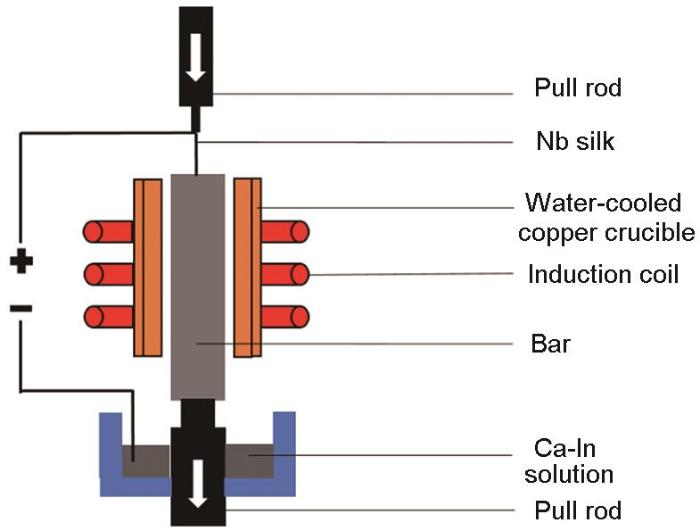
图1
在连续凝固过程中加载脉冲电流的示意图
Fig.1
Schematic diagram of loading pulse current in continuous solidification process
将从定向凝固试棒上线切割的试样打磨,采用Philips X'pert X射线衍射仪(XRD)分析其物相组成,扫描角度为0°~120°。将金相试样打磨、抛光和化学腐蚀后,用TG-3金相显微镜(OM)和S-4700扫描电子显微镜(SEM)观察其微观组织,腐蚀剂的组成为10% HNO3+10% HF+80% H2O;用Instron 5569万能材料试验机测试试样的室温拉伸性能。
2 实验结果
2.1 脉冲电流对定向凝固温度场的影响
从图1可以看出,在实验过程中试棒接触陶瓷管引起侧向散热。图2给出了脉冲电流作用下试棒的温度场分布。可以看出,温度最高处都分布在感应线圈缠绕处的中间部分,施加脉冲方波电流,频率为200 Hz,占空比为0.5,电流密度为0 mA/mm2、17.6 mA/mm2、35.3 mA/mm2和52.9 mA/mm2时,对应最高温度为1711.4℃、1730.1℃、1753.1℃和1774.3℃,脉冲电流作用下最高温度与不加电流最大相差63℃。图3给出了试棒的径向温度分布,具体数值列于表1。可以看出,在不同脉冲电流作用下试棒表层的温度与径向温度最高点之间的温度不同。脉冲电流密度为0 mA/mm2时,熔体最外层与径向温度最高处的温度差为46.5℃。随着电流密度增加到17.6 mA/mm2、35.3 mA/mm2和52.9 mA/mm2时,其温度差分别为31.4℃、25.3℃和17.9℃。随着电流密度的增大熔体最外层与径向温度最高处的温度差逐渐减小,即径向温度差减小,侧向温度梯度减小,侧向散热减小。
图2
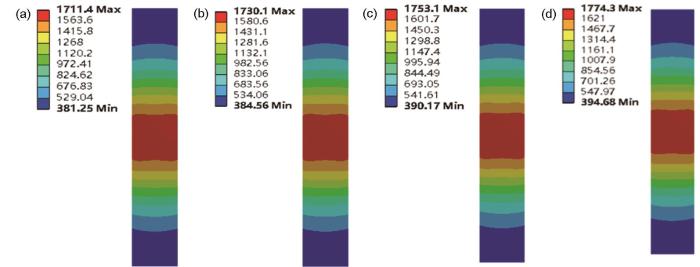
图2
在不同脉冲电流作用下TiAl基合金凝固过程中温度场的分布
Fig.2
Temperature field distribution of TiAl based alloy during solidification under different pulse current (a) 0 mA/mm2; (b) 17.6 mA/mm2; (c) 35.3 mA/mm2; (d) 52.9 mA/mm2
表1 在不同脉冲电流作用下熔体的径向温度差
Table 1
Current density /mA·mm-2 | Radial temperature difference of melt/℃ |
|---|---|
| 0 | 46.5 |
| 17.6 | 31.4 |
| 35.3 | 25.3 |
| 52.9 | 17.9 |
图3
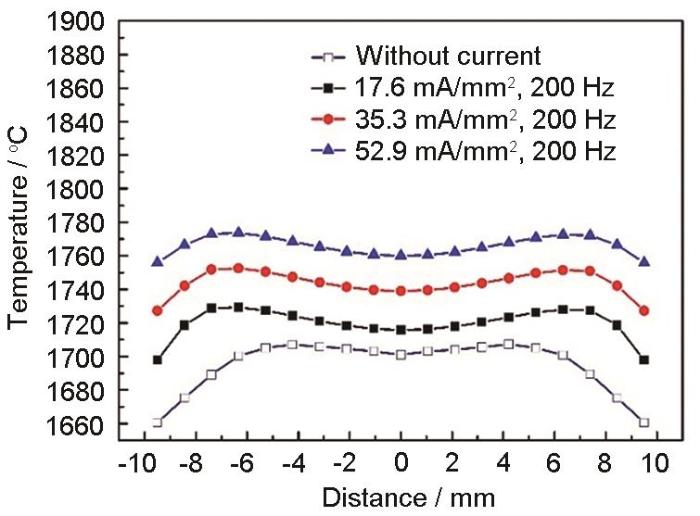
图3
在不同脉冲电流作用下TiAl基合金的径向温度分布
Fig.3
Radial temperature distribution of TiAl based alloy under different pulse current
2.2 脉冲电流作用下TiAl基合金的宏观凝固组织
图4给出了在不同脉冲电流作用下Ti-45.5Al-4Cr-2.5Nb合金试样的宏观组织。可以看出,在脉冲电流作用下的定向凝固过程分为三个区域:初始凝固区、稳定生长区和最终凝固区。初始凝固区可分为两部分:下部分为未熔化区,具有初始的等轴晶组织;上部分为熔化竞争区,偏离角较小,具有粗大的柱状晶组织;进入稳定生长区后,侧向散热使晶粒生长发生了一定的偏离;最后为最终凝固区,下拉至预设长度后缓慢降低加热功率并关闭电源,以侧向为主的散热使柱状晶向侧向生长并最终凝固。
图4
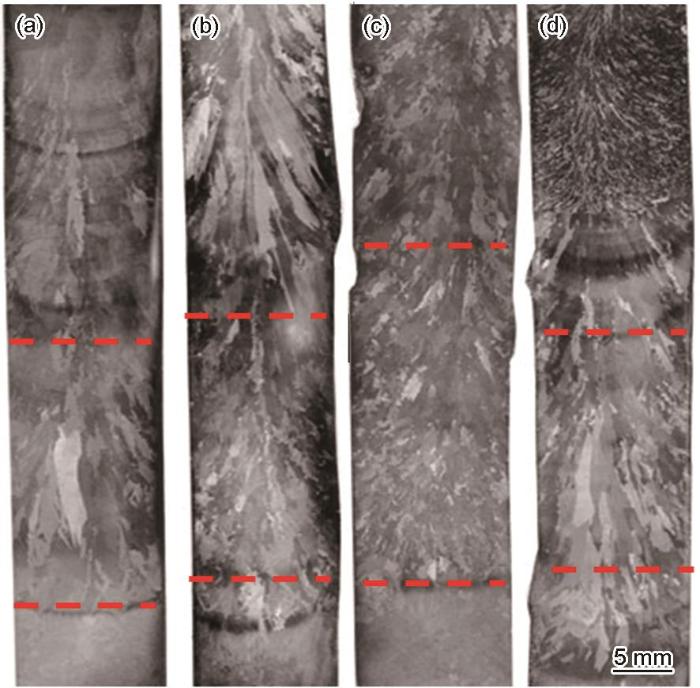
图4
在不同脉冲电流作用下Ti-45.5Al-4Cr-2.5Nb合金试样的宏观凝固组织
Fig.4
Longitudinal section macrostructures of 45.5Al-4Cr-2.5Nb alloy with different pulse current (a) 0 mA/mm2; (b) 17.6 mA/mm2; (c) 35.3 mA/mm2; (d) 52.9 mA/mm2
图4a给出了电流密度为0 mA/ mm2的定向凝固试样。可以看出,试样总体上具有定向凝固组织特征,但是出现了很多细小的晶粒。由于侧向散热较为严重,晶体生长偏离角度较大。施加频率为200 Hz、电流密度为17.6 mA/mm2的脉冲电流后稳定生长区晶粒生长偏离角度明显下降(图4b),且随着脉冲电流密度的增大(图4c),晶粒生长偏离角度减小,柱状晶生长的稳定性和连续性提高。当电流密度增大到52.9 mA/mm2时,在过渡区域生成的晶粒数目增多且较为细小,进入稳定生长区后生成具有定向趋势的定向凝固组织,晶粒生长偏离角进一步减小。即随着电流密度的增大和作用时间的延长,焦耳热效应与集肤效应越明显,使试棒表层温度提高侧向散热减少,从而使柱状晶的偏离角减小。图5给出了不同脉冲电流作用下晶粒平均偏离角所示,具体数值列于表2。脉冲电流频率保持200 Hz,晶粒平均偏离角由电流密度为0 mA/mm2时的30.2°减小到电流密度为52.9 mA/mm2时的17°,与上述模拟结果一致。即随着电流密度的增大径向温度差减小、侧向温度梯度减小和侧向散热减小,使枝晶偏离角减小。
图5
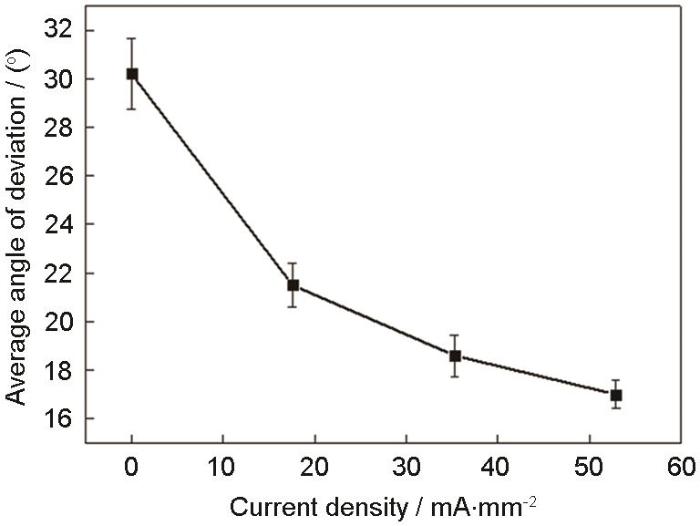
图5
在不同脉冲电流作用下试样晶粒的平均偏离角
Fig.5
Average deviation angle of grains with different pulse current
表2 在不同脉冲电流作用下试样晶粒的平均偏离角
Table 2
| Current density/mA·mm-2 | Average deviation angle of grains / (°) |
|---|---|
| 0 | 30.2 |
| 17.6 | 21.5 |
| 35.3 | 18.6 |
| 52.9 | 17.0 |
2.3 在脉冲电流作用下定向凝固TiAl基合金的相组成
图6
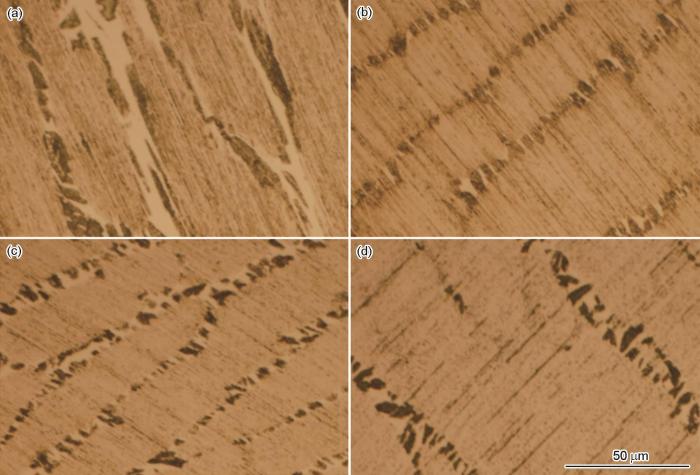
图6
在不同脉冲电流作用下定向凝固TiAl合金的OM像
Fig.6
OM images of directional solidified TiAl with different pulse current (a) 0 mA/mm2; (b) 17.6 mA/mm2; (c) 35.3 mA/mm2; (d) 52.9 mA/mm2
为了研究脉冲电流对Ti-Al基合金的影响,图7给出了脉冲电流密度不同的定向凝固试样的XRD谱。可以看出,与不加脉冲电流相比,脉冲电流密度不同的定向凝固Ti-Al基合金主要由γ-TiAl相、B2相及α2-Ti3Al相组成。衍射谱中的衍射峰及其强度表明,Ti-45.5Al-4Cr-2.5Nb合金中γ-TiAl相的含量较高。
图7
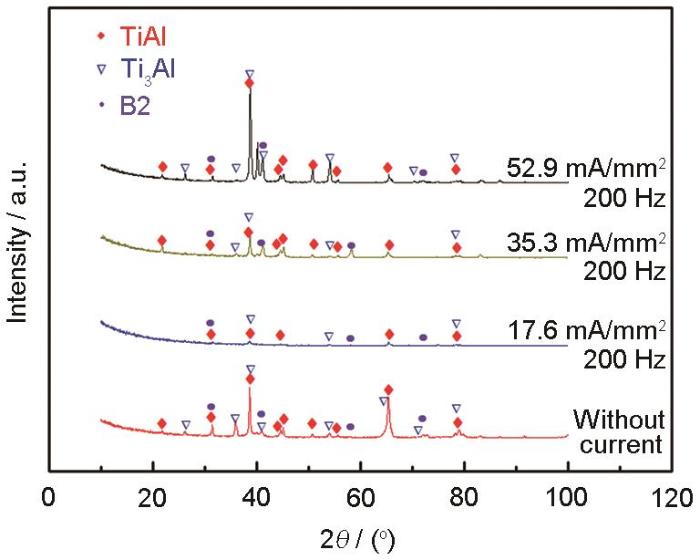
图7
在不同脉冲电流密度下定向凝固TiAl合金的XRD谱
Fig.7
XRD spectra of directional solidification region of TiAl alloys at different current intensities
2.4 脉冲电流对晶粒尺寸的影响
为了考察脉冲电流对晶粒尺寸的影响,切取脉冲密度不同的试样稳定生长区的横截面,其晶粒平均径向尺寸的统计结果列于表3。
表3 在不同脉冲电流作用下试样晶粒的平均径向尺寸
Table 3
| Current density/mA·mm-2 | Average grain width/μm |
|---|---|
| 0 | 850.67 |
| 17.6 | 728.16 |
| 35.3 | 685.93 |
| 52.9 | 776.32 |
可以看出,随着脉冲电流密度的增大晶粒的平均径向尺寸逐渐减小,电流密度为35.3 mA/mm2的晶粒其平均径向尺寸最小为685.93 μm,脉冲电流密度提高到52.9 mA/mm2的晶粒其平均径向尺寸反而增大到776.32 μm。其原因是,脉冲电流降低了形核功和糊状区的温度梯度。脉冲电流引起的形核功为 [33]
式中ΔW为电流所引起的形核功变化,J为电流密度,r为熔体半径,d为洛伦兹力到晶核中心距离,A为常数,
式中G为温度梯度,ΔT为轴向温度增量,Δd为轴向距离增量。脉冲电流的焦耳热效应和洛伦兹力使定向凝固过程中的柱状晶枝晶发生重熔、断裂和晶粒游离,使柱状晶的晶粒细化。但是,随着电流密度的增大熔池长度变长,使糊状区的长度增大,即式中的Δd增大使温度梯度G减小。因此,电流密度增大至一定数值使温度梯度的减小,从而使晶粒的平均径向尺寸增大。
2.5 脉冲电流对片层取向的影响
图8
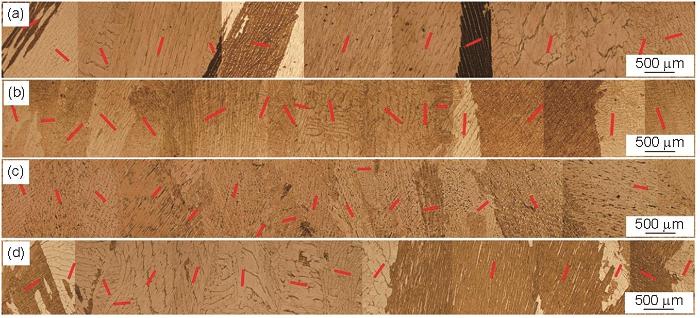
图8
在不同脉冲电流作用下TiAl基合金是片层取向
Fig.8
Effect of different pulse current on lamellar orientation of TiAl based alloy (a) 0 mA/mm2; (b) 17.6 mA/mm2; (c) 35.3 mA/mm2; (d) 52.9 mA/mm2
图9
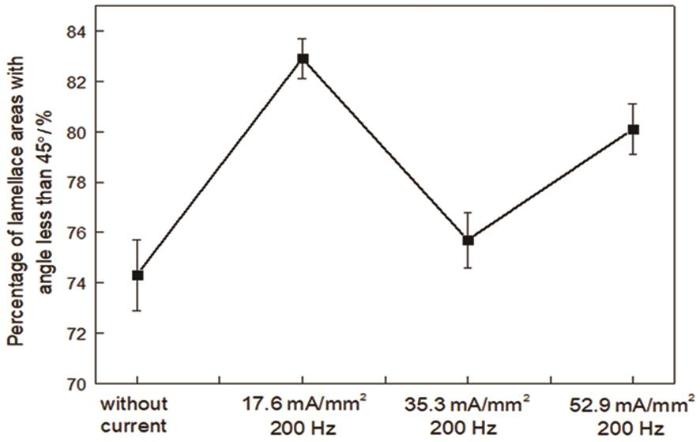
图9
在不同脉冲电流作用下TiAl基合金的片层角度小于45°的片层区域占比
Fig.9
Proportion of lamellar area with lamellar angle less than 45° with different pulse current
2.6 脉冲电流对微观组织的影响
图10
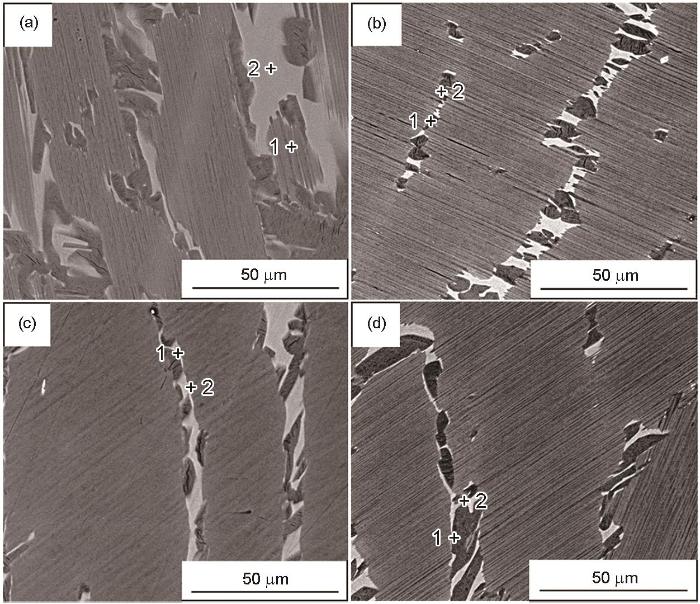
图10
在不同脉冲电流作用下定向凝固TiAl合金的SEM照片
Fig.10
SEM images of directionally solidified TiAl at current intensities (a) 0 mA/mm2; (b) 17.6 mA/mm2; (c) 35.3 mA/mm2; (d) 52.9 mA/mm2
表4 在不同脉冲电流作用下TiAl基合金的能谱分析结果
Table 4
| Sample | Analysis location | Ti | Al | Cr | Nb |
|---|---|---|---|---|---|
| 0 mA/mm2 | 1 | 45.87 | 48.88 | 2.58 | 2.67 |
| 2 | 51.80 | 35.07 | 10.2 | 2.93 | |
| 17.6 mA/mm2 | 1 | 48.37 | 46.16 | 2.71 | 2.76 |
| 2 | 49.69 | 37.16 | 10.27 | 2.88 | |
| 35.3 mA/mm2 | 1 | 47.49 | 46.74 | 2.82 | 2.95 |
| 2 | 51.54 | 35.85 | 9.51 | 3.10 | |
| 52.9 mA/mm2 | 1 | 46.21 | 47.71 | 2.92 | 3.16 |
| 2 | 52.26 | 35.25 | 9.47 | 3.02 |
EDS统计结果表明,带状组织中黑色相Al元素的含量高,而灰白色相Al元素含量较低,Cr元素含量高。综合XRD衍射图谱和原材料的二元TiAl合金当量成分,虽然在XRD衍射谱中有α2相的衍射峰,但是在EDS中很难分辨。其原因是,α2相含量较低或其分布介于γ与B2相间,衍射峰不明显而难以分辨。带状组织中的黑色组织为富Al 的γ-TiAl相,灰白色组织为B2相。EDS结果表明,带状的黑色相Al含量较高,为γ-TiAl相。根据TiAl合金相图及其凝固的特点可以推断,长条状组织之间主要是B2相与γ相相互交叠的片层组织。
多数TiAl基合金的片层都为γ/α2片层,但是Ti-45.5Al-4Cr-2.5Nb却是γ/B2片层,是此成分TiAl合金的凝固路径与固态相变过程造成的。即Ti-45.5Al-4Cr-2.5Nb为富Cr相TiAl合金,由Ti-Al-Cr合金相图[36]。由此可以推断,其平衡凝固过程为L→β+L→β→α+β→α→α+γ→α+γ+B2→α2+γ+B2,即随着熔体温度的降低首在液相中析出初生β相,随后剩余液相转变为单相β,随着温度的进一步降低β相析出α相,随着温度的继续降低γ相从α相中析出。γ相Al的含量较高和Cr含量较低,使其周围的Al含量低、Cr含量高,恰恰对应EDS结果B2相的特征。随着γ相的析出和长大,Al含量的降低Cr含量的提高还促进α相直接转变为B2相,最终形成了γ相与B2相的片层组织。
2.7 脉冲电流作用下TiAl基合金的力学性能的影响
图11
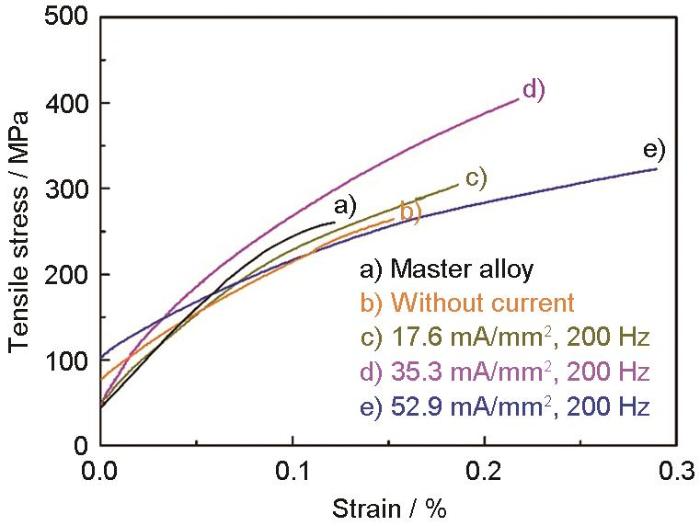
图11
在不同脉冲电流作用下TiAl基合金的室温拉伸曲线
Fig.11
Tensile curves of TiAl based alloy with different pulse current
表5 在不同脉冲电流作用下TiAl基合金的拉伸性能
Table 5
| Sample | Tensile strength/MPa | Elongation/% |
|---|---|---|
| Master alloy | 260.6 | 0.122 |
| 0 mA/mm2 | 264.3 | 0.153 |
| 17.6 mA/mm2 | 304.7 | 0.186 |
| 35.3 mA/mm2 | 404.1 | 0.217 |
| 52.9 mA/mm2 | 322.7 | 0.289 |
这种定向凝固合金的抗拉强度,主要受晶粒平均径向尺寸、晶粒尺寸以及片层宽度的影响。随着电流密度的增大晶粒平均径向尺寸先减小,当电流密度增大至52.9 mA/mm2时晶粒平均径向尺寸受电流热效应和集肤效应的影响,温度梯度降低使晶粒的平均径向尺寸增大,因此其抗拉强度小幅降低。延伸率主要受片层取向与轴向夹角的影响,夹角越小其综合力学性能越好,随着电流密度的增大其夹角逐渐减小,延伸率提高,即受力方向与片层取向的夹角越小其延伸率越高。
3 结论
(1) 施加脉冲电流进行连续凝固制备定向凝固Ti-45.5Al-4Cr-2.5Nb合金并进行模拟仿真,脉冲电流使凝固和相变路径改变,凝固组织主要有带状组织中黑色富Al的γ-TiAl相,灰白色B2相以及其间的γ/B2片层组织。
(2) 脉冲电流的焦耳热效应和电磁搅拌使枝晶重熔或破碎而提高形核率,减小了枝晶的平均宽度,增至一定值的脉冲电流密度引起熔池长度增大和温度梯度减小,使晶粒的平均径向尺寸增大;脉冲电流的集肤效应使熔体的表层电流偏聚,焦耳热效应使侧向散热减小,从而使枝晶的平均偏离角减小。
(3) 脉冲电流的频率不变时细小的晶粒、密集的片层区域有利于提高试样的抗拉强度,因此随着脉冲电流密度的增大晶粒平均尺寸先减小后增大,合金试样抗拉强度先提高后降低。
(4) 施加脉冲电流制备的定向凝固TiAl基合金其延伸率主要受片层取向与轴向夹角的影响,夹角越小其综合力学性能越高。
参考文献
Gamma titanium aluminide alloys-an assessment within the competition of aerospace structural materials
[J].
Recent progress in the development of gamma titanium aluminide alloys
[J].
Review of alloy and process development of TiAl alloys
[J].
Ordered intermetallic alloys, part III: gamma titanium aluminides
[J].
Recent development and prospect of electromagnetic processing of materials
[J].
Solidification behavior and crystal growth mechanism of aluminum under electric pulse
[J].
An innovative method for the microstructural modification of TiAl alloy solidified via direct electric current application
[J].Ti-48Al-2Cr-2Nb alloy solidified with the application of direct electric current has a refined and homogeneous microstructure without segregation. We observed an initial decrease followed by a subsequent increase in grain size and lamellar spacing, with the increase in current density. Similar trend can also be obtained by varying the amount of α2-phase (Ti3Al). Using a directional solidification processing method, the columnar crystal microstructure transforms into an equiaxed crystal microstructure at a current density of 32-64?mA/mm2. High dislocation density is also introduced with a minimum cross-sectional grain size of 460?μm at a current density of 64?mA/mm2. The application of electric current alters the free energy of the critical nucleus and temperature via joule heating, causing a transformation from a columnar grain microstructure into an equiaxed grain microstructure. The increase in current density leads to a rise of the nucleation rate, and a resulting undercooling combined with temperature gradient contribute to growth of the primary phase, which finally results in grain coarsening at a critical current density of 96?mA/mm2. The climb and cross-slip of dislocation and the migration of grain boundary ultimately create variable lamellae spacing of TiAl alloy.
Columnar to equiaxed transition during solidification of small ingot by using electric current pulse
[J].
Influence of an electric or magnetic field on the liquid-solid transformation in materials and on the microstructure of the solid
[J].
Macrostructures and shape memory effect of cast- state electropulse modified Cu-Al-Ni alloys
[J].
电脉冲孕育细化CuAlNi合金的宏观组织与铸态形状记忆效应
[J].
Effect of high density pulse electric current on the solidification structure of low temperature melt of A356 aluminium alloy
[J].
高密度脉冲电流对A356铝合金低温熔体凝固组织的影响
[J].

研究了高密度脉冲电流对A356铝合金低温熔体凝固组织的影响.实验中对680和630℃的低温熔体施加脉冲电流处理,对比试验和凝固曲线测试结果表明.低温熔体中施加脉冲电流有利于增大凝固过冷度.提高冷却速率.缩短凝固时间.细化凝固组织.同时.经脉冲电流处理后.随熔体的保温时间延长.凝固组织逐渐粗化.分析认为.低温熔体结构比凝固过程本身更能影响最终凝固组织.
Modification of solidification structures by pulse electric discharging
[J].
Refining mechanism of the electric current pulse on the solidification structure of pure aluminum
[J].
Migration behavior of solidification nuclei in pure Al melt under effect of electric current pulse
[J].
Colony (grain) size reduction in eutectic Pb-Sn castings by electroplusing
[J].
Modification of solidification structures by pulse electric discharging
[J].
Effect of electric potentials on solidification of near eutectic Pb-Sb-Sn alloy
[J].
Effects of electric current pulse on stability of solid/liquid interface of Al-4.5% Cu alloy during directional solidification
[J].
The relevance of melt convection to grain refinement in Al-Si alloys solidified under the impact of electric currents
[J].
Effect of electric current on the solidification of cast iron
[J].
Effect of DC field on mechanical property of a Ni-based single crystal superalloy
[J].
The tensile properties at room temperature and stress-rupture properties at high temperature of a kind of Ni-based single crystal superalloy grown under a DC field were measured. The results show that the yield strength at room temperature is increased and the stress-rupture life and ductility at 980 ℃ and 221 MPa are improved, whereas the ultimate tensile strength at room temperature varies unnotedly and the ductility at room temperature is reduced. SEM observation and EMPA analysis showed that the prime dendrite arm spacing (PDAS), size of γ’ particles, alloying element segregation, eutectic and the sub-grain boundaries are reduced with the increase of the current. It is considered that the improvement of yield strength and stress-rupture properties arise from the refining of γ’particles and the change of γ/γ’misfits caused by reduction of microsegregation of alloying elements. Furthermore, the enhancement of the stress-rupture properties is also related to the reductions in the PDAS, eutectic and sub-grain boundaries under the action of the electric field.
直流电流对一种镍基单晶高温合金力学性能的影响
[J].
Effect of electric current pulses on solidification of immiscible alloys
[J].
Fabrication of lamellar porous alumina with axisymmetric structure by directional solidification with applied electric and magnetic fields
[J]. J.
Effect of the simultaneous application of a high static magnetic field and a low alternating current on grain structure and grain boundary of pure aluminum, J
Influence of direct electric current on solidification process of Al-Si alloy
[J].
Temperature distribution in bottomless electromagnetic cold crucible applied to directional solidification
[J].
Optimization of electromagnetic energy in cold crucible used for directional solidification of TiAl alloy
[J].
Design and control of microstructure and texture by thermomechanical processing of a multi-phase TiAl alloy
[J].
Intermetallics prepared by directional solidification electromagnetic cold crucible technique
[J].
电流强度对冷坩埚定向凝固Ni3Al金属间化合物微观组织的影响
[J].
Influence of nitrogen on the microstructure and solidification behavior of high Nb containing TiAl alloys
[J].
Effect of electric current pulse on tensile strength and elongation of casting ZA27 alloy
[J].
Room temperature tensile deformation of polysynthecally twinned (PST) crystals of TiAl
[J].
Microstructure and properties of Ti-(43-48)Al-2Cr-2Nb alloy prepared by directional solidification
[J].The effect of Al content on the microstructure and mechanical properties of directionally solidified Ti-(43-48)Al-2Cr-2Nb alloy prepared by cold crucible was investigated. The results show that the directional solidification structure is mainly composed of α2-phase and γ-phase. With the increase of Al content, the α2-phase decreases and the γ-phase content increases, while the direction of microstructural lamellae changed from parallel lamellae and 45° lamellae to vertical lamellae; For the alloy with 48%Al (atomic fraction), the orientation of lamellae is perpendicular to the direction of stress, its compressive strength is high, but plasticity is low; For the alloy with 45%Al (atomic fraction), the orientation of lamellae is parallel to the direction of stress, while maintaining high strength, the room temperature elongation is also high, in other word, the comprehensive properties are good.
定向凝固Ti-(43-48)Al-2Cr-2Nb合金的显微组织和性能
[J].研究了Al含量对冷坩埚定向凝固Ti-(43-48)Al-2Cr-2Nb合金的显微组织和力学性能的影响。结果表明,Ti-(43-48)Al-2Cr-2Nb合金的定向凝固组织主要由α<sub>2</sub>相和γ相组成,随着Al含量的提高α<sub>2</sub>相逐渐减少而γ相含量提高,且其显微组织片层由以平行片层和45°片层为主的混合片层向垂直混合片层转变;Al含量(48%,原子分数)较高的Ti-(43-48)Al-2Cr-2Nb合金其片层取向与应力方向垂直,具有较高的抗压强度和较低的塑性;Al含量(45%,原子分数)适中的合金其片层取向与应力方向平行,具有较高的强度、室温延伸率和综合性能。
Thermodynamic re-modelling of theternary Al-Cr-Ti system with refined Al-Cr description
[J].


